 Скачать презентацию Sustainability in Business —An Update By William R
85450813ccb404c283808284413ffe50.ppt
- Количество слайдов: 55



Sustainability in Business --An Update By William R. Blackburn ORCHSE Strategies Corporate Environmental Forum Park Hyatt Hotel Washington, DC August 1, 2016 illiam lackburn onsulting, Ltd. © 2016 William Blackburn Consulting, Ltd. © 2010 William Blackburn Consulting, Ltd. WRB@WBlackburn. Consulting. com www. WBlackburn. Consulting. com

The Green Hollow Center illiam lackburn onsulting, Ltd. © 2016 William Blackburn Consulting, Ltd. © 2010 William Blackburn Consulting, Ltd. WRB@WBlackburn. Consulting. com www. WBlackburn. Consulting. com
Our Discussion Today 1. Practical Meaning & Scope of Sustainability/ Social Responsibility (emerging consensus from GRI, ISO, Conf Bd. Study, various standards, etc. ) 2. Materiality and Prioritizing Issues for Action (GRI, SASB, IIRC, SEC) 3. Lessons on Sustainable Products & Services 4. Implementation; Integration of Sustainability into Business Operations & Supply Chains (The Sustainability Handbook) illiam lackburn onsulting, Ltd. © 2016 William Blackburn Consulting, Ltd. © 2010 William Blackburn Consulting, Ltd. WRB@WBlackburn. Consulting. com www. WBlackburn. Consulting. com
What is sustainability? (and how do you determine that? ) illiam lackburn onsulting, Ltd. © 2012 William Blackburn Consulting, Ltd. © 2016 William Blackburn Consulting, Ltd. © 2010 William Blackburn Consulting, Ltd. WRB@WBlackburn. Consulting. com www. WBlackburn. Consulting. com
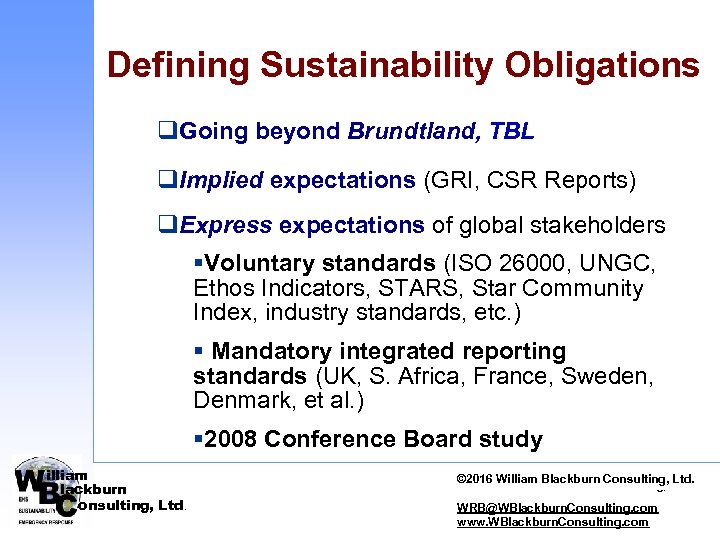
Defining Sustainability Obligations q. Going beyond Brundtland, TBL q. Implied expectations (GRI, CSR Reports) q. Express expectations of global stakeholders §Voluntary standards (ISO 26000, UNGC, Ethos Indicators, STARS, Star Community Index, industry standards, etc. ) § Mandatory integrated reporting standards (UK, S. Africa, France, Sweden, Denmark, et al. ) § 2008 Conference Board study illiam lackburn onsulting, Ltd. © 2016 William Blackburn Consulting, Ltd. © 2010 William Blackburn Consulting, Ltd. © 2012 William Blackburn Consulting, Ltd. WRB@WBlackburn. Consulting. com www. WBlackburn. Consulting. com
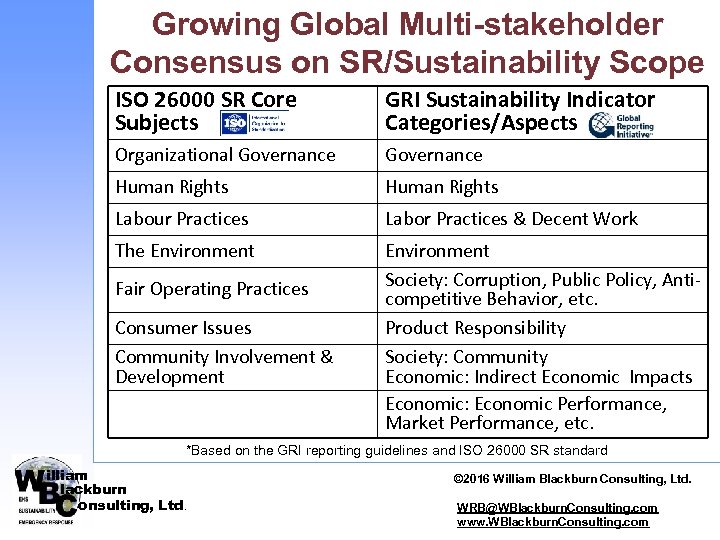
Growing Global Multi-stakeholder Consensus on SR/Sustainability Scope ISO 26000 SR Core Subjects GRI Sustainability Indicator Categories/Aspects Organizational Governance Human Rights Labour Practices Labor Practices & Decent Work The Environment Society: Corruption, Public Policy, Anticompetitive Behavior, etc. Product Responsibility Society: Community Economic: Indirect Economic Impacts Economic: Economic Performance, Market Performance, etc. Fair Operating Practices Consumer Issues Community Involvement & Development *Based on the GRI reporting guidelines and ISO 26000 SR standard illiam lackburn onsulting, Ltd. © 2016 William Blackburn Consulting, Ltd. © 2010 William Blackburn Consulting, Ltd. WRB@WBlackburn. Consulting. com www. WBlackburn. Consulting. com
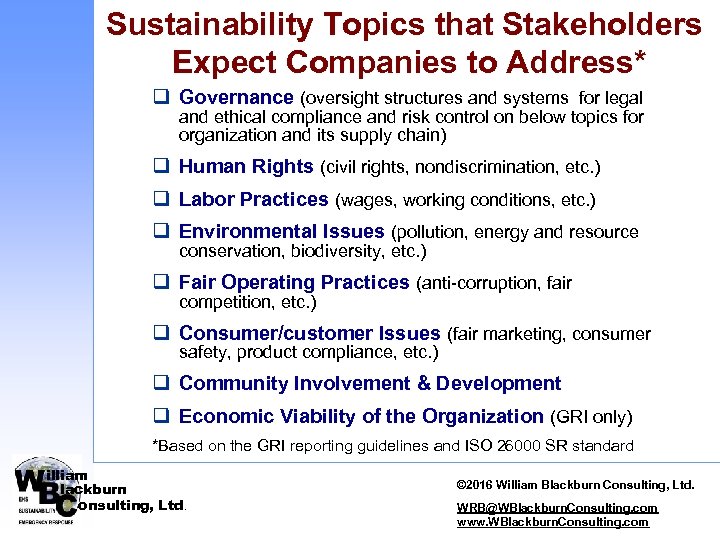
Sustainability Topics that Stakeholders Expect Companies to Address* q Governance (oversight structures and systems for legal and ethical compliance and risk control on below topics for organization and its supply chain) q Human Rights (civil rights, nondiscrimination, etc. ) q Labor Practices (wages, working conditions, etc. ) q Environmental Issues (pollution, energy and resource conservation, biodiversity, etc. ) q Fair Operating Practices (anti-corruption, fair competition, etc. ) q Consumer/customer Issues (fair marketing, consumer safety, product compliance, etc. ) q Community Involvement & Development q Economic Viability of the Organization (GRI only) *Based on the GRI reporting guidelines and ISO 26000 SR standard illiam lackburn onsulting, Ltd. © 2012 William Blackburn Consulting, Ltd. © 2014 William Blackburn Consulting, Ltd. © 2010 William Blackburn Consulting, Ltd. © 2016 William Blackburn Consulting, Ltd. WRB@WBlackburn. Consulting. com www. WBlackburn. Consulting. com
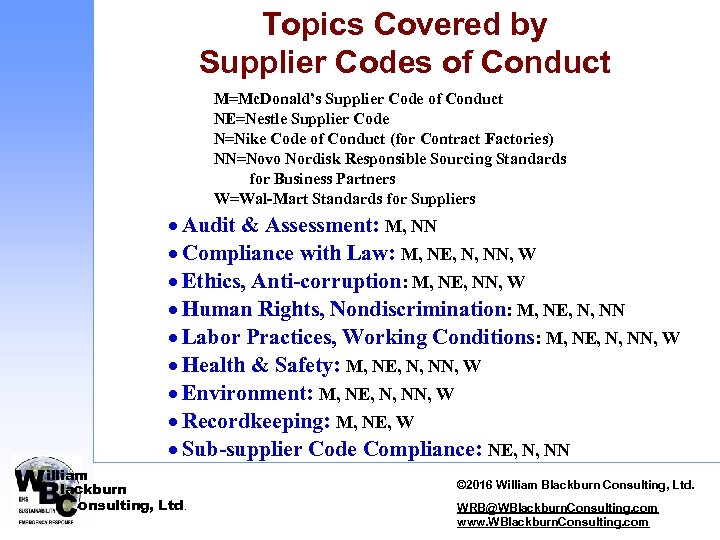
Topics Covered by Supplier Codes of Conduct M=Mc. Donald’s Supplier Code of Conduct NE=Nestle Supplier Code N=Nike Code of Conduct (for Contract Factories) NN=Novo Nordisk Responsible Sourcing Standards for Business Partners W=Wal-Mart Standards for Suppliers Audit & Assessment: M, NN Compliance with Law: M, NE, N, NN, W Ethics, Anti-corruption: M, NE, NN, W Human Rights, Nondiscrimination: M, NE, N, NN Labor Practices, Working Conditions: M, NE, N, NN, W Health & Safety: M, NE, N, NN, W Environment: M, NE, N, NN, W Recordkeeping: M, NE, W Sub-supplier Code Compliance: NE, N, NN illiam lackburn onsulting, Ltd. © 2012 William Blackburn Consulting, Ltd. © 2014 William Blackburn Consulting, Ltd. © 2010 William Blackburn Consulting, Ltd. © 2016 William Blackburn Consulting, Ltd. WRB@WBlackburn. Consulting. com www. WBlackburn. Consulting. com
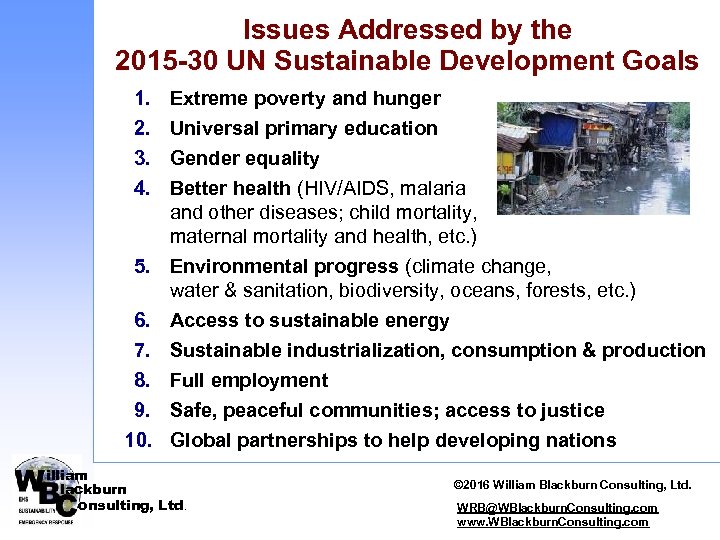
Issues Addressed by the 2015 -30 UN Sustainable Development Goals 1. 2. 3. 4. 5. 6. 7. 8. 9. 10. Extreme poverty and hunger Universal primary education Gender equality Better health (HIV/AIDS, malaria and other diseases; child mortality, maternal mortality and health, etc. ) Environmental progress (climate change, water & sanitation, biodiversity, oceans, forests, etc. ) Access to sustainable energy Sustainable industrialization, consumption & production Full employment Safe, peaceful communities; access to justice Global partnerships to help developing nations illiam lackburn onsulting, Ltd. © 2010 William Blackburn Consulting, Ltd. © 2016 William Blackburn Consulting, Ltd. WRB@WBlackburn. Consulting. com www. WBlackburn. Consulting. com
Commitment to Values & Integration are Keys to Sustainability Leadership q “Companies…are now increasingly integrating sustainability into how they manage every aspect of the business…” --2014 Study by National Association of Environmental Management (NAEM) q A long term commitment to sustainability values integrated deeply within the organization, along with ambitious targets and polices, are the primary reasons a company is considered a sustainability leader. --2014 Globe. Scan/Sustain. Ability survey of over 800 experts in 87 countries illiam lackburn onsulting, Ltd. © 2016 © 2014 William Blackburn Consulting, Ltd. © 2010 William Blackburn Consulting, Ltd. WRB@WBlackburn. Consulting. com www. WBlackburn. Consulting. com
General Definition of Sustainability “The 2 Rs” Values-driven management based on--- R R q Respect: for people and other living things q Resources: the wise use of economic and natural resources —for the purpose of sustaining and promoting the long-term well-being of the organization and society (including the environment). illiam lackburn onsulting, Ltd. © 2015 William Blackburn Consulting, Ltd. © 2010 William Blackburn Consulting, Ltd. WRB@WBlackburn. Consulting. com www. WBlackburn. Consulting. com
Sustainable Products & Services q Improve the efficient use of natural and economic resources along the product life cycle q Provide greater respect and accommodation for the needs of people and other living things along the product life cycle illiam lackburn onsulting, Ltd. © 2016 William Blackburn Consulting, Ltd. © 2010 William Blackburn Consulting, Ltd. WRB@WBlackburn. Consulting. com www. WBlackburn. Consulting. com
The Conference Board Sustainability Benchmarking Studies (See www. WBlackburn. Consulting. com) illiam lackburn onsulting, Ltd. © 2016 William Blackburn Consulting, Ltd. © 2010 William Blackburn Consulting, Ltd. WRB@WBlackburn. Consulting. com www. WBlackburn. Consulting. com
Conference Board Study: A Corporate Commitment to Sustainability (A Sample Sustainability Policy) It is within the best interests of our company and society as a whole that our company move along the path to sustainability. To that end, we will strive to achieve the following vision of performance: 1. Economic success: the wise use of financial resources a. Company Economic Prosperity Our business will be positioned to survive and prosper economically. b. Community Economic Prosperity We will help our community survive and prosper economically.
2. Social responsibility: respect for people a. Respect for Employees We will treat our employees in a respectful, fair, non-exploitative way, especially with regard to compensation and benefits; promotion; training; open, constructive dialogue with management; involvement in decisionmaking; working conditions that are safe, healthy and non-coercive; rights of association, collective bargaining and privacy; employmenttermination practices; and work-life balance. b. Diversity, Fair Hiring Practices We will promote diversity and use employment practices that are fair, responsible, non-discriminatory, and non-exploitative for our employees, board members, and suppliers. c. Responsible Governance We will manage our risks properly, use our economic power responsibly and operate our business in a way that is ethical and legal. d. Respect for Stakeholders We will be transparent, respectful and fair to local populations, investors, suppliers and other stakeholders outside our organization who may be affected by our operations. We will work collaboratively with our communities, governments and supply chain to enhance the well-being of others. e. Fair Dealing With Customers We will be honest and fair with our customers, competing fairly for their business, anticipating their needs, respecting their privacy, and providing them safe and effective products and services under the conditions we promise.
3. Environmental responsibility: respect for life; the wise management and use of natural resources a. Resource Conservation We will conserve our use of natural resources to the extent practicable. b. Waste Prevention and Management We will reduce to the extent practicable the volume and degree of hazard of the wastes we generate from our operations, and handle them in a safe, legal and responsible way to minimize their environmental effects. c. Environmental Risk Control and Restoration We will minimize the risk of spills and other potentially harmful environmental incidents, restore the environment where damaged by us, and enhance it to better support biodiversity. d. Supply Chain Impacts We will work with others in our supply chain to help ensure environmental impacts and risks associated with our products and services are reduced and properly controlled. e. Collaboration With Communities We will collaborate with our communities to protect and improve the environment.
Examples of Economic Topics Brand strength Liabilities Community donations Capital expenditures Market share Local purchasing Cash flow Sales Taxes Credit rating Profits Tax subsidies Dividends Retained earnings Debt and interest R&D investment Income Return on investment
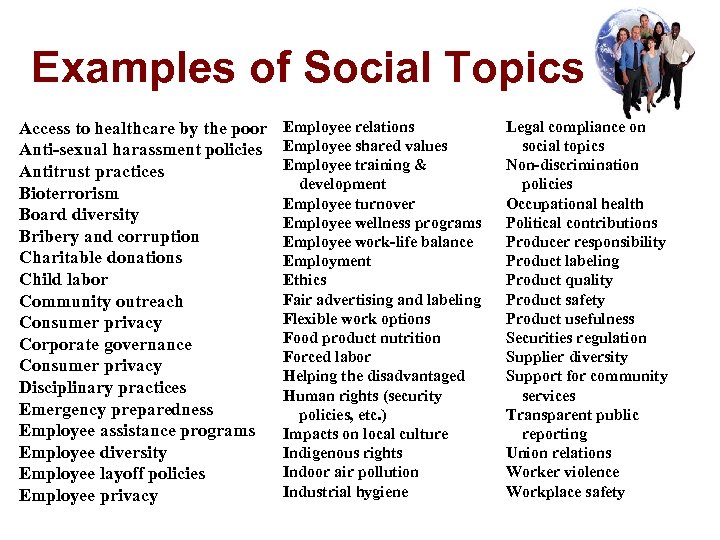
Examples of Social Topics Access to healthcare by the poor Anti-sexual harassment policies Antitrust practices Bioterrorism Board diversity Bribery and corruption Charitable donations Child labor Community outreach Consumer privacy Corporate governance Consumer privacy Disciplinary practices Emergency preparedness Employee assistance programs Employee diversity Employee layoff policies Employee privacy Employee relations Employee shared values Employee training & development Employee turnover Employee wellness programs Employee work-life balance Employment Ethics Fair advertising and labeling Flexible work options Food product nutrition Forced labor Helping the disadvantaged Human rights (security policies, etc. ) Impacts on local culture Indigenous rights Indoor air pollution Industrial hygiene Legal compliance on social topics Non-discrimination policies Occupational health Political contributions Producer responsibility Product labeling Product quality Product safety Product usefulness Securities regulation Supplier diversity Support for community services Transparent public reporting Union relations Worker violence Workplace safety
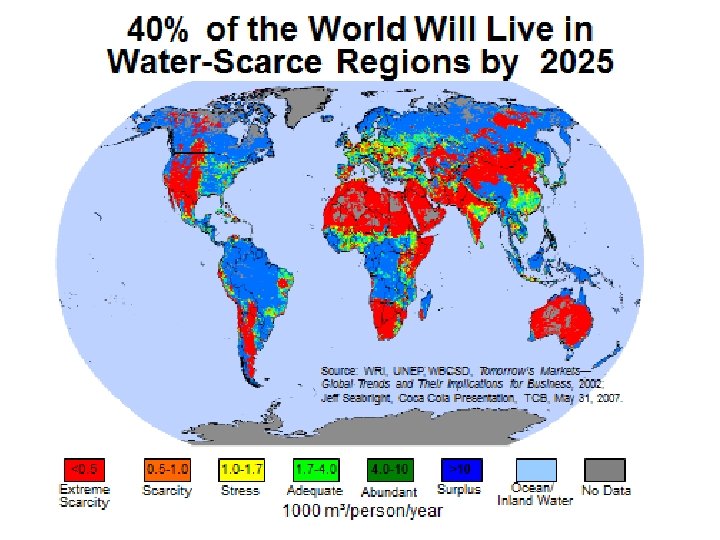
Examples of Environmental Topics Air pollution Animal rights Biodiversity Chemical spills Compliance with environmental laws & permits Customer disposal of products Endangered species Energy conservation Environmentally sensitive design Greenhouse gases Natural habitat restoration Natural resource usage Ozone-depleting substances Packaging reduction Pollution prevention Precautionary Principle Product energy use Product take-back Recycling Renewable energy & materials Soil contamination Soil erosion/depletion Spill prevention Waste disposal Water conservation Water pollution Wetlands protection Wildlife conservation
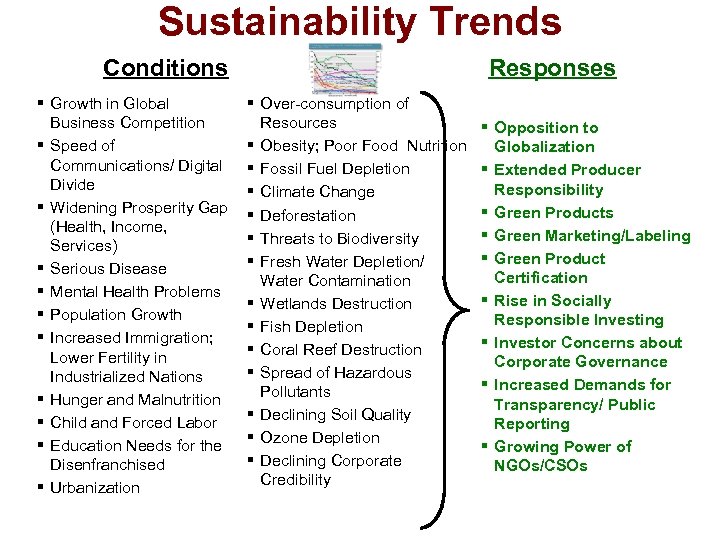
Sustainability Trends Conditions § Growth in Global Business Competition § Speed of Communications/ Digital Divide § Widening Prosperity Gap (Health, Income, Services) § Serious Disease § Mental Health Problems § Population Growth § Increased Immigration; Lower Fertility in Industrialized Nations § Hunger and Malnutrition § Child and Forced Labor § Education Needs for the Disenfranchised § Urbanization Responses § Over-consumption of Resources § Obesity; Poor Food Nutrition § Fossil Fuel Depletion § Climate Change § Deforestation § Threats to Biodiversity § Fresh Water Depletion/ Water Contamination § Wetlands Destruction § Fish Depletion § Coral Reef Destruction § Spread of Hazardous Pollutants § Declining Soil Quality § Ozone Depletion § Declining Corporate Credibility § Opposition to Globalization § Extended Producer Responsibility § Green Products § Green Marketing/Labeling § Green Product Certification § Rise in Socially Responsible Investing § Investor Concerns about Corporate Governance § Increased Demands for Transparency/ Public Reporting § Growing Power of NGOs/CSOs
Some Observations About Sustainability § Sustainability is not about one thing. § The business case for sustainability is really the business case for a process that looks at sustainability trends and issues and prioritizes among the opportunities and threats to an organization to select those for action that contribute the most value. illiam lackburn onsulting, Ltd. © 2015 William Blackburn Consulting, Ltd. © 2010 William Blackburn Consulting, Ltd. WRB@WBlackburn. Consulting. com www. WBlackburn. Consulting. com
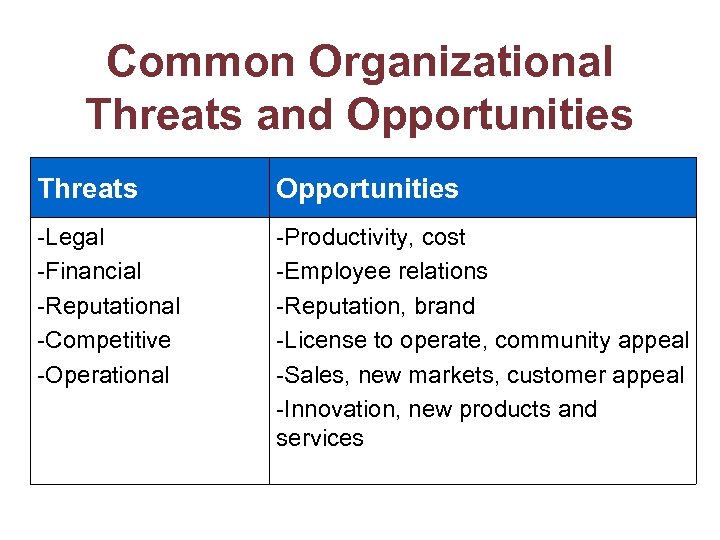
Common Organizational Threats and Opportunities Threats Opportunities -Legal -Financial -Reputational -Competitive -Operational -Productivity, cost -Employee relations -Reputation, brand -License to operate, community appeal -Sales, new markets, customer appeal -Innovation, new products and services
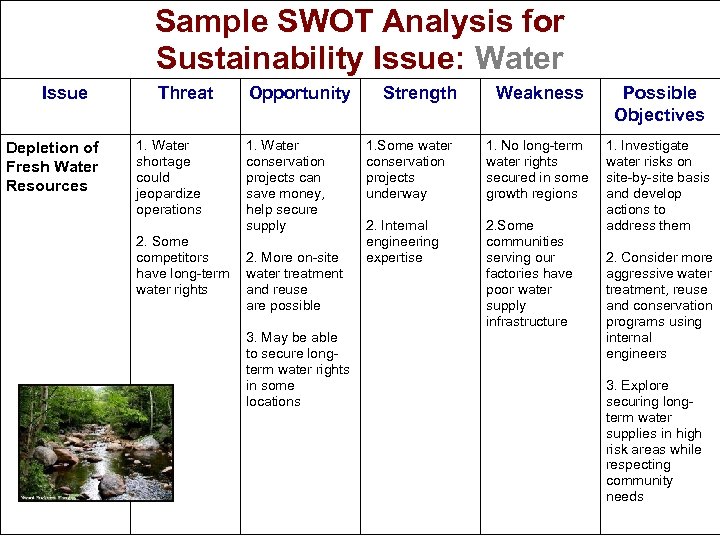
Sample SWOT Analysis for Sustainability Issue: Water Issue Depletion of Fresh Water Resources Threat 1. Water shortage could jeopardize operations 2. Some competitors have long-term water rights Opportunity 1. Water conservation projects can save money, help secure supply 2. More on-site water treatment and reuse are possible 3. May be able to secure longterm water rights in some locations Strength Weakness Possible Objectives 1. Some water conservation projects underway 1. No long-term water rights secured in some growth regions 2. Internal engineering expertise 2. Some communities serving our factories have poor water supply infrastructure 1. Investigate water risks on site-by-site basis and develop actions to address them 2. Consider more aggressive water treatment, reuse and conservation programs using internal engineers 3. Explore securing longterm water supplies in high risk areas while respecting community needs
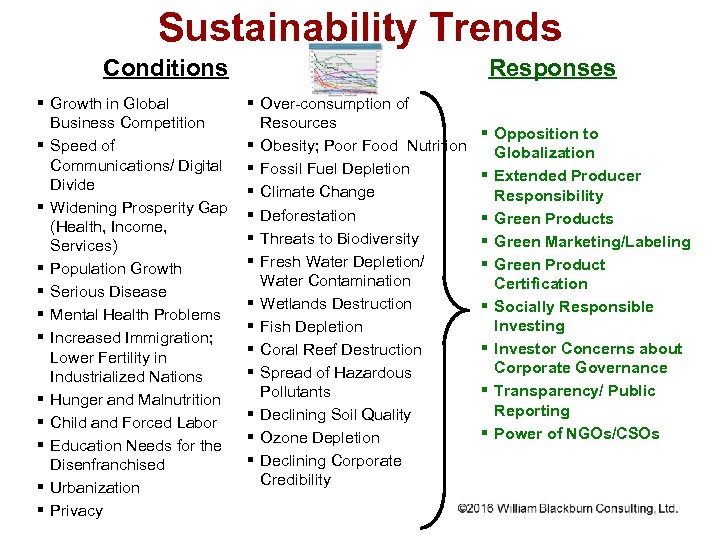
Sustainability Trends Conditions § Growth in Global Business Competition § Speed of Communications/ Digital Divide § Widening Prosperity Gap (Health, Income, Services) § Population Growth § Serious Disease § Mental Health Problems § Increased Immigration; Lower Fertility in Industrialized Nations § Hunger and Malnutrition § Child and Forced Labor § Education Needs for the Disenfranchised § Urbanization § Privacy Responses § Over-consumption of Resources § Obesity; Poor Food Nutrition § Fossil Fuel Depletion § Climate Change § Deforestation § Threats to Biodiversity § Fresh Water Depletion/ Water Contamination § Wetlands Destruction § Fish Depletion § Coral Reef Destruction § Spread of Hazardous Pollutants § Declining Soil Quality § Ozone Depletion § Declining Corporate Credibility § Opposition to Globalization § Extended Producer Responsibility § Green Products § Green Marketing/Labeling § Green Product Certification § Socially Responsible Investing § Investor Concerns about Corporate Governance § Transparency/ Public Reporting § Power of NGOs/CSOs
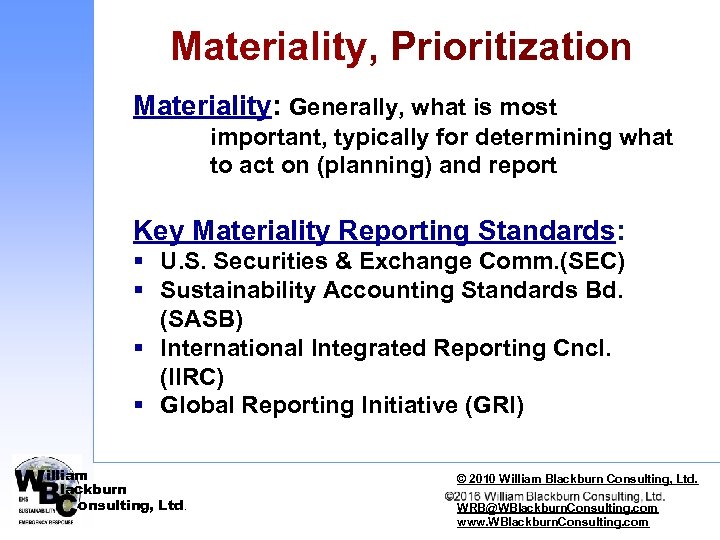
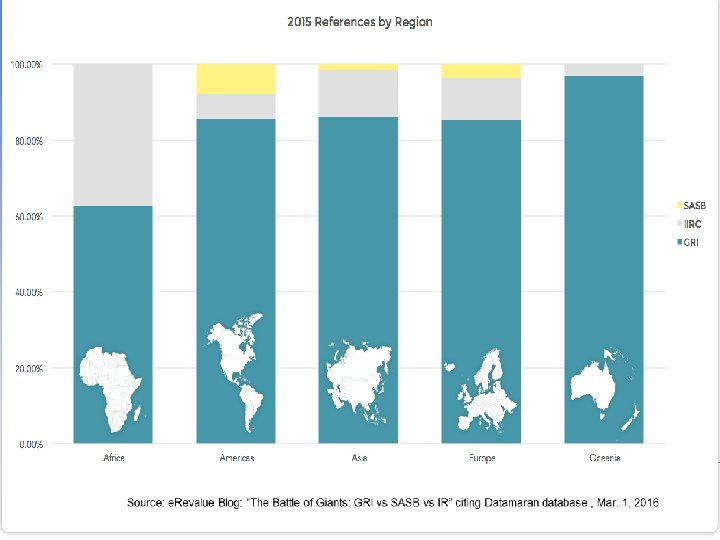
Materiality, Prioritization Materiality: Generally, what is most important, typically for determining what to act on (planning) and report Key Materiality Reporting Standards: § U. S. Securities & Exchange Comm. (SEC) § Sustainability Accounting Standards Bd. (SASB) § International Integrated Reporting Cncl. (IIRC) § Global Reporting Initiative (GRI) illiam lackburn onsulting, Ltd. © 2010 William Blackburn Consulting, Ltd. WRB@WBlackburn. Consulting. com www. WBlackburn. Consulting. com
illiam lackburn onsulting, Ltd. © 2010 William Blackburn Consulting, Ltd. WRB@WBlackburn. Consulting. com www. WBlackburn. Consulting. com
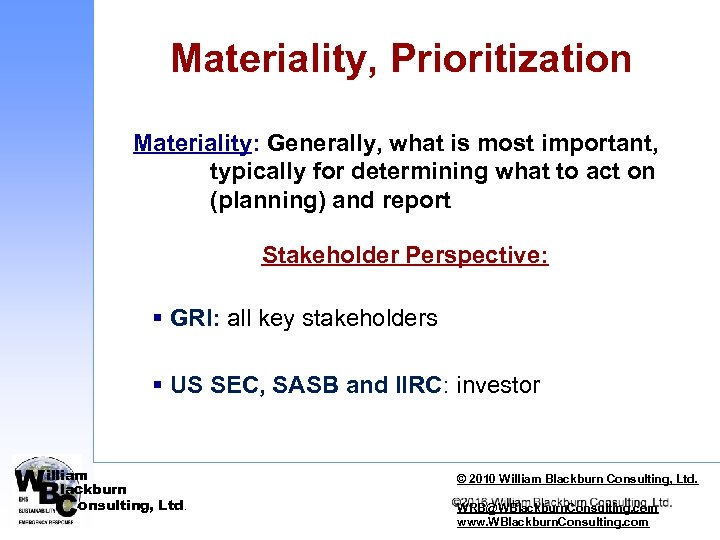
Materiality, Prioritization Materiality: Generally, what is most important, typically for determining what to act on (planning) and report Stakeholder Perspective: § GRI: all key stakeholders § US SEC, SASB and IIRC: investor illiam lackburn onsulting, Ltd. © 2010 William Blackburn Consulting, Ltd. WRB@WBlackburn. Consulting. com www. WBlackburn. Consulting. com
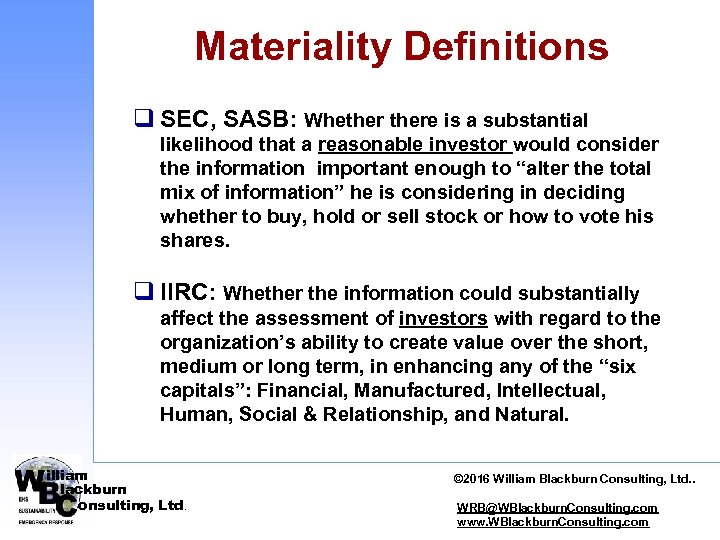
Materiality Definitions q SEC, SASB: Whethere is a substantial likelihood that a reasonable investor would consider the information important enough to “alter the total mix of information” he is considering in deciding whether to buy, hold or sell stock or how to vote his shares. q IIRC: Whether the information could substantially affect the assessment of investors with regard to the organization’s ability to create value over the short, medium or long term, in enhancing any of the “six capitals”: Financial, Manufactured, Intellectual, Human, Social & Relationship, and Natural. illiam lackburn onsulting, Ltd. © 2016 William Blackburn Consulting, Ltd. . © 2010 William Blackburn Consulting, Ltd. WRB@WBlackburn. Consulting. com www. WBlackburn. Consulting. com
Materiality Definitions q GRI: Whether the “aspect” would– § Reflect the organization’s significant economic, environmental and social impacts, or § Substantively influence the assessment and decisions of stakeholders (investors, employees, customers, communities, government, et al. ) about the organization illiam lackburn onsulting, Ltd. © 2016 William Blackburn Consulting, Ltd. . © 2010 William Blackburn Consulting, Ltd. WRB@WBlackburn. Consulting. com www. WBlackburn. Consulting. com
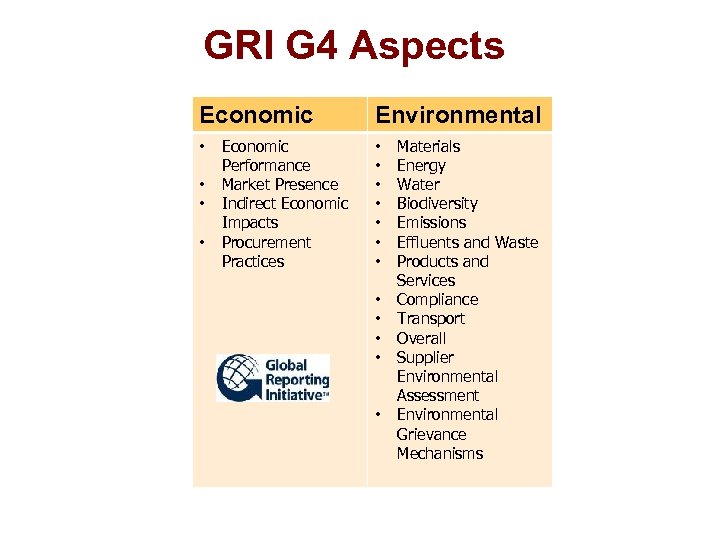
GRI G 4 Aspects Economic • • Economic Performance Market Presence Indirect Economic Impacts Procurement Practices Environmental • • • Materials Energy Water Biodiversity Emissions Effluents and Waste Products and Services Compliance Transport Overall Supplier Environmental Assessment Environmental Grievance Mechanisms
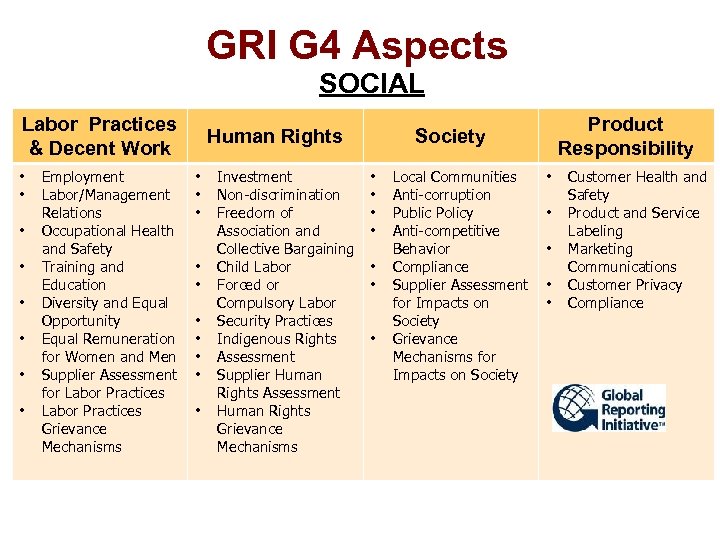
GRI G 4 Aspects SOCIAL Labor Practices & Decent Work • • Employment Labor/Management Relations Occupational Health and Safety Training and Education Diversity and Equal Opportunity Equal Remuneration for Women and Men Supplier Assessment for Labor Practices Grievance Mechanisms Human Rights • • • Investment Non-discrimination Freedom of Association and Collective Bargaining Child Labor Forced or Compulsory Labor Security Practices Indigenous Rights Assessment Supplier Human Rights Assessment Human Rights Grievance Mechanisms Product Responsibility Society • • Local Communities Anti-corruption Public Policy Anti-competitive Behavior Compliance Supplier Assessment for Impacts on Society Grievance Mechanisms for Impacts on Society • • • Customer Health and Safety Product and Service Labeling Marketing Communications Customer Privacy Compliance
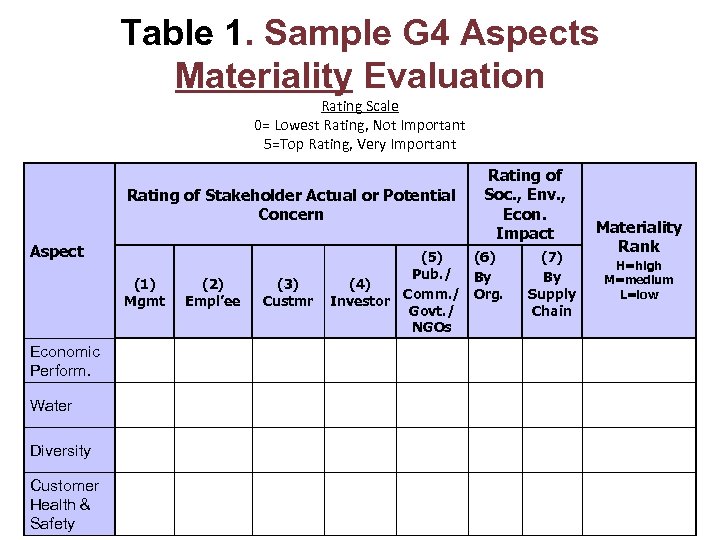
Table 1. Sample G 4 Aspects Materiality Evaluation Rating Scale 0= Lowest Rating, Not Important 5=Top Rating, Very Important Rating of Stakeholder Actual or Potential Concern Aspect (1) Mgmt Economic Perform. Water Diversity Customer Health & Safety (2) Empl’ee (3) Custmr Rating of Soc. , Env. , Econ. Impact (6) (5) Pub. / By (4) Investor Comm. / Org. Govt. / NGOs (7) By Supply Chain Materiality Rank H=high M=medium L=low
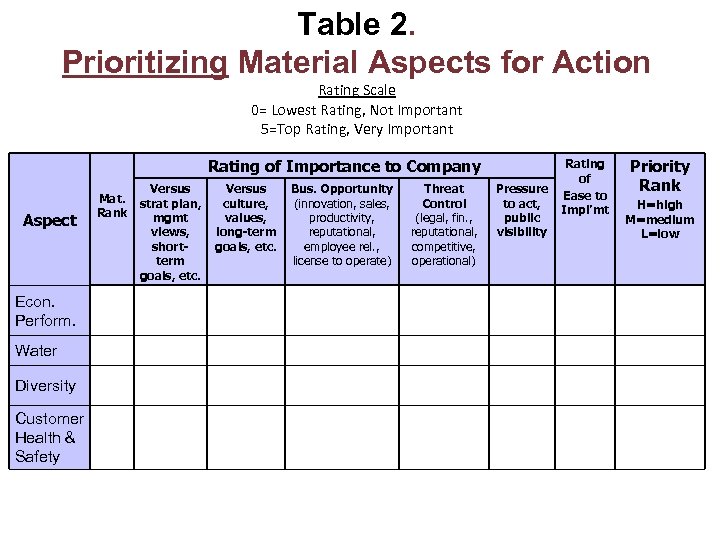
Table 2. Prioritizing Material Aspects for Action Rating Scale 0= Lowest Rating, Not Important 5=Top Rating, Very Important Rating of Importance to Company Aspect Econ. Perform. Water Diversity Customer Health & Safety Mat. Rank Versus strat plan, mgmt views, shortterm goals, etc. Versus culture, values, long-term goals, etc. Bus. Opportunity (innovation, sales, productivity, reputational, employee rel. , license to operate) Threat Control (legal, fin. , reputational, competitive, operational) Pressure to act, public visibility Rating of Ease to Impl’mt Priority Rank H=high M=medium L=low
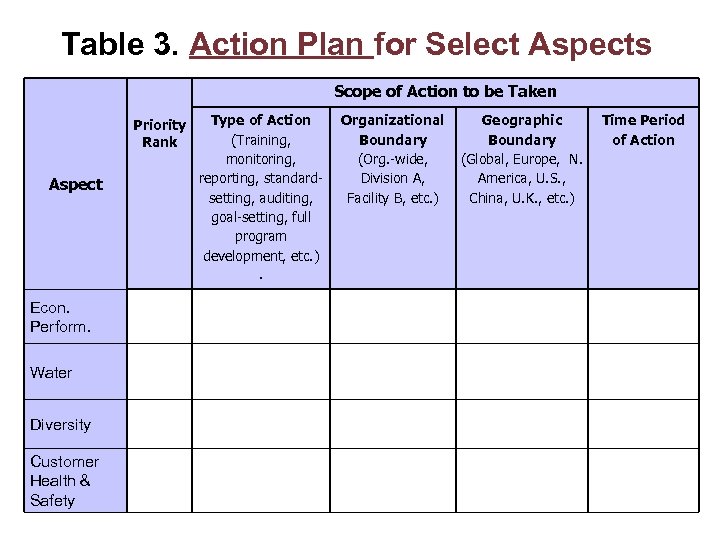
Table 3. Action Plan for Select Aspects Scope of Action to be Taken Priority Rank Aspect Type of Action (Training, monitoring, reporting, standardsetting, auditing, goal-setting, full program development, etc. ). Econ. Perform. Water Diversity Customer Health & Safety Organizational Boundary (Org. -wide, Division A, Facility B, etc. ) Geographic Boundary (Global, Europe, N. America, U. S. , China, U. K. , etc. ) Time Period of Action
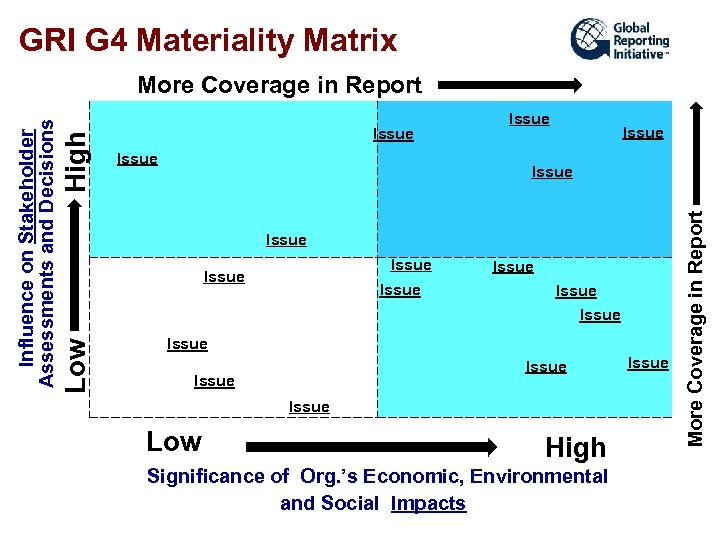
GRI G 4 Materiality Matrix Issue Issue Issue Issue Low High Significance of Org. ’s Economic, Environmental and Social Impacts Issue More Coverage in Report High Issue Low Influence on Stakeholder Assessments and Decisions More Coverage in Report
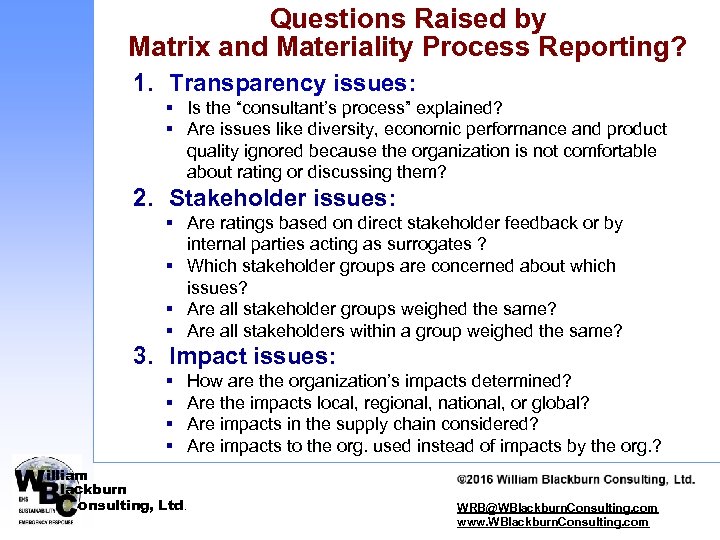
Questions Raised by Matrix and Materiality Process Reporting? 1. Transparency issues: § Is the “consultant’s process” explained? § Are issues like diversity, economic performance and product quality ignored because the organization is not comfortable about rating or discussing them? 2. Stakeholder issues: § Are ratings based on direct stakeholder feedback or by internal parties acting as surrogates ? § Which stakeholder groups are concerned about which issues? § Are all stakeholder groups weighed the same? § Are all stakeholders within a group weighed the same? 3. Impact issues: § § How are the organization’s impacts determined? Are the impacts local, regional, national, or global? Are impacts in the supply chain considered? Are impacts to the org. used instead of impacts by the org. ? illiam lackburn onsulting, Ltd. © 2010 William Blackburn Consulting, Ltd. WRB@WBlackburn. Consulting. com www. WBlackburn. Consulting. com
Observations about Materiality Process & Reporting q Reporting, prompted by GRI G 4 (2013), often leaves gaps, questions about process q Process is rapidly evolving among and within companies q Few companies do this the same way q Some meld materiality and prioritization processes illiam lackburn onsulting, Ltd. © 2010 William Blackburn Consulting, Ltd. WRB@WBlackburn. Consulting. com www. WBlackburn. Consulting. com
Information Sources for Materiality Evaluation § Direct stakeholder feedback, surveys, focus groups, direct discussions § Stakeholder advisory panel § Organization’s own boards, committees § Benchmarking studies § Company plans, policies, codes, goals, key indicators § Industry-specific standards (GRI sector supplm’t, etc. ) § Socially responsible investor (DJSI, et al. ) surveys, resolutions, analyst reports § Emerging legislation § Logs of complaints and claims § Google search of company illiam lackburn onsulting, Ltd. © 2010 William Blackburn Consulting, Ltd. WRB@WBlackburn. Consulting. com www. WBlackburn. Consulting. com
What does it take to produce a successful sustainable product? Under what circumstances can you charge more? illiam lackburn onsulting, Ltd. © 2016 William Blackburn Consulting, Ltd. © 2010 William Blackburn Consulting, Ltd. WRB@WBlackburn. Consulting. com www. WBlackburn. Consulting. com
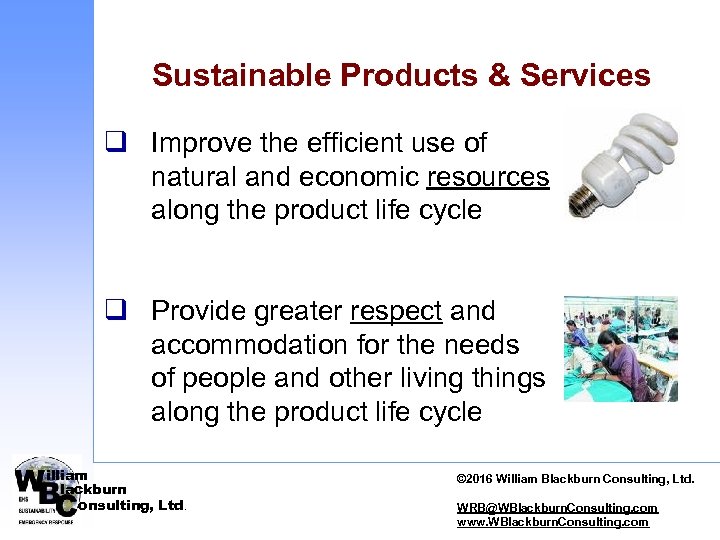
Sustainable Products & Services q Improve the efficient use of natural and economic resources along the product life cycle q Provide greater respect and accommodation for the needs of people and other living things along the product life cycle illiam lackburn onsulting, Ltd. © 2016 William Blackburn Consulting, Ltd. © 2010 William Blackburn Consulting, Ltd. WRB@WBlackburn. Consulting. com www. WBlackburn. Consulting. com
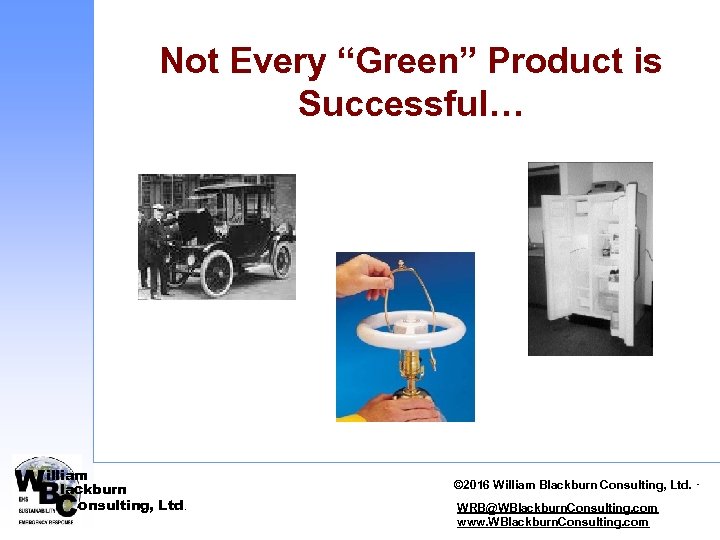
Not Every “Green” Product is Successful… illiam lackburn onsulting, Ltd. © 2010 William Blackburn Consulting, Ltd. © 2016 William Blackburn Consulting, Ltd. WRB@WBlackburn. Consulting. com www. WBlackburn. Consulting. com
7 Lessons on Sustainable Products & Services 1. Customers will pay more for added safety of food and hygiene- and health-related products, and for a more natural living environment; some will pay more for lower life-cycle costs. 2. Products and services for the poor must break barriers on cost/pricing either through low volume per unit, use sharing, or low-cost operations. 3. Government mandate can create markets for green products and services. illiam lackburn onsulting, Ltd. © 2010 William Blackburn Consulting, Ltd. © 2016 William Blackburn Consulting, Ltd. WRB@WBlackburn. Consulting. com www. WBlackburn. Consulting. com
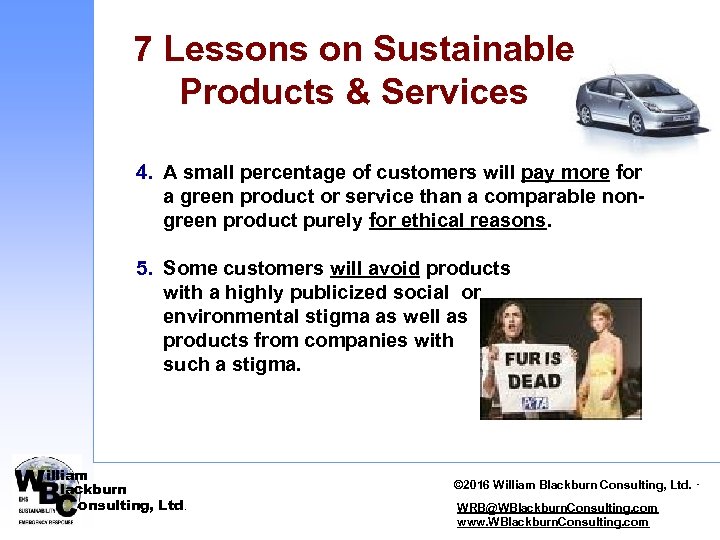
7 Lessons on Sustainable Products & Services 4. A small percentage of customers will pay more for a green product or service than a comparable nongreen product purely for ethical reasons. 5. Some customers will avoid products with a highly publicized social or environmental stigma as well as products from companies with such a stigma. illiam lackburn onsulting, Ltd. © 2010 William Blackburn Consulting, Ltd. © 2016 William Blackburn Consulting, Ltd. WRB@WBlackburn. Consulting. com www. WBlackburn. Consulting. com
7 Lessons on Sustainable Products & Services 6. Some commercial customers will pay more for green products if they can gain a clear reputational advantage with their own customers or other important stakeholders. 7. With those exceptions, a product’s social and environmental advantages and cause-based marketing are differentiating factors, not primary factors, to most consumers. illiam lackburn onsulting, Ltd. © 2010 William Blackburn Consulting, Ltd. © 2016 William Blackburn Consulting, Ltd. WRB@WBlackburn. Consulting. com www. WBlackburn. Consulting. com
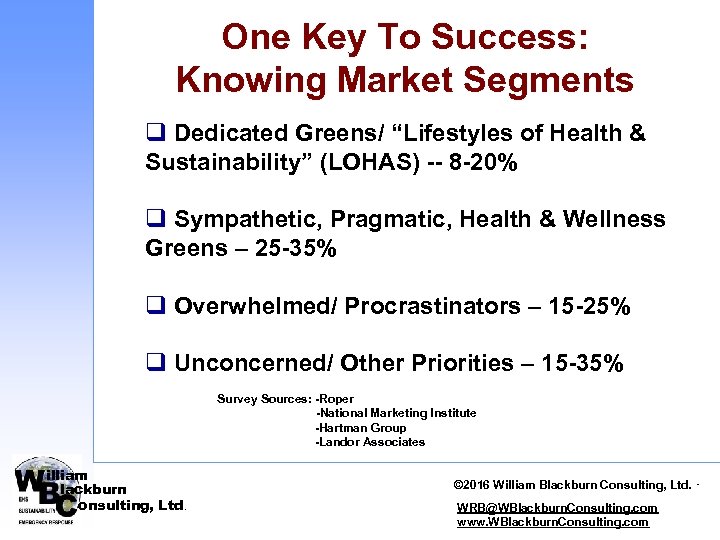
One Key To Success: Knowing Market Segments q Dedicated Greens/ “Lifestyles of Health & Sustainability” (LOHAS) -- 8 -20% q Sympathetic, Pragmatic, Health & Wellness Greens – 25 -35% q Overwhelmed/ Procrastinators – 15 -25% q Unconcerned/ Other Priorities – 15 -35% Survey Sources: -Roper -National Marketing Institute -Hartman Group -Landor Associates illiam lackburn onsulting, Ltd. © 2010 William Blackburn Consulting, Ltd. © 2016 William Blackburn Consulting, Ltd. WRB@WBlackburn. Consulting. com www. WBlackburn. Consulting. com
Implementation/ Integration How do you implement a sustainability program in an organization? illiam lackburn onsulting, Ltd. © 2015 William Blackburn Consulting, Ltd. © 2010 William Blackburn Consulting, Ltd. WRB@WBlackburn. Consulting. com www. WBlackburn. Consulting. com
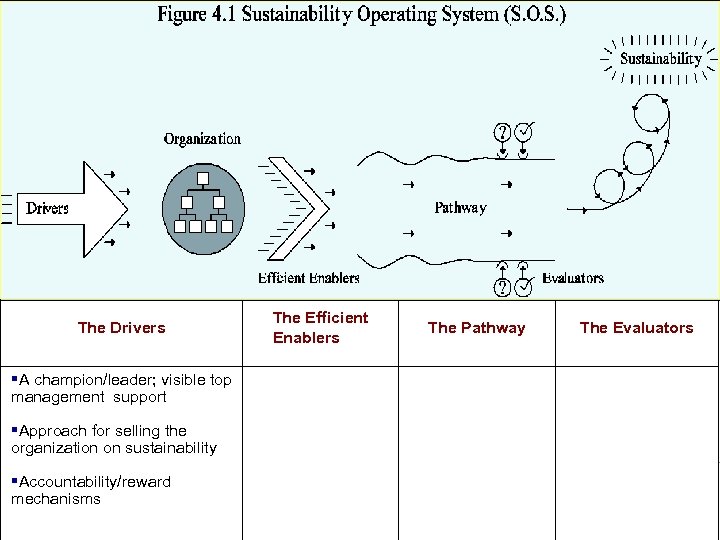
The Drivers The Efficient Enablers The Pathway The Evaluators §A champion/leader; visible top management support §Approach for selling the organization on sustainability illiam §Accountability/reward lackburn mechanisms onsulting, Ltd. © 2010 William Blackburn Consulting, Ltd. WRB@WBlackburn. Consulting. com www. WBlackburn. Consulting. com
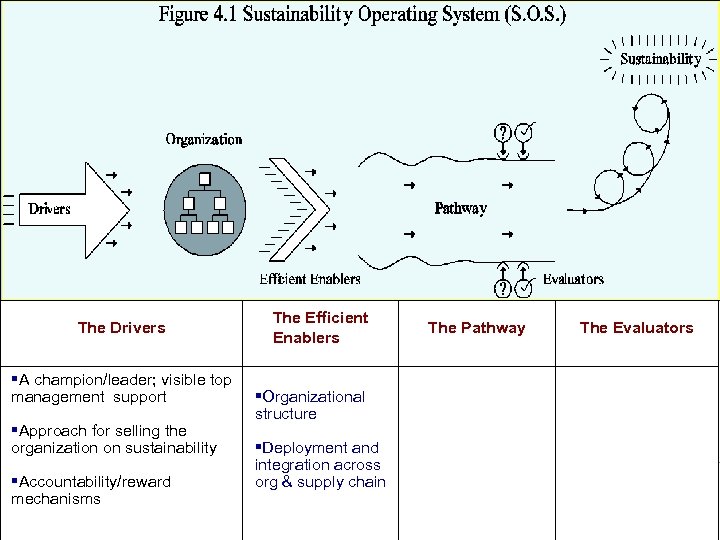
The Drivers §A champion/leader; visible top management support §Approach for selling the organization on sustainability illiam §Accountability/reward lackburn mechanisms onsulting, Ltd. The Efficient Enablers The Pathway The Evaluators §Organizational structure §Deployment and integration across org & supply chain © 2010 William Blackburn Consulting, Ltd. WRB@WBlackburn. Consulting. com www. WBlackburn. Consulting. com
Typical Organizational Structure q Champion/leader: spokesperson; key promoter, coordinator, and organizer; chair of key coordinating team q CEO: companywide and external advocate q Executive sponsor: advocate among upper management, coach for leader and teams q Multi-department, multi-functional coordinating team(s): § Planning, promotion, education § Rollout and feedback § Public reporting q Board oversight committee: high level oversight of SOS performance and effectiveness illiam lackburn onsulting, Ltd. © 2010 William Blackburn Consulting, Ltd. WRB@WBlackburn. Consulting. com www. WBlackburn. Consulting. com
Why the increased focus on sustainability in supply chains? q Public perception of big company responsibility for supply chain q NGO focus and reach, global e-communications WH Y? q Consumer sensitivity to ethical behavior of producers q Extent of financial, environmental and social impact (risk) q Product labeling on environmental/social impacts q Legal compliance (e. g. , EU Ro. HS, WEEE, Packaging Directive, REACH; MSDS, CFC rules) q Supply chain efficiency ($); lean and green q Sustainability as a company strategy; search for sustainable products illiam lackburn onsulting, Ltd. © 2016 William Blackburn Consulting, Ltd. © 2010 William Blackburn Consulting, Ltd. WRB@WBlackburn. Consulting. com www. WBlackburn. Consulting. com
Topics Covered by Supplier Codes of Conduct M=Mc. Donald’s Supplier Code of Conduct NE=Nestle Supplier Code N=Nike Code of Conduct (for Contract Factories) NN=Novo Nordisk Responsible Sourcing Standards for Business Partners W=Wal-Mart Standards for Suppliers Audit & Assessment: M, NN Compliance with Law: M, NE, N, NN, W Ethics, Anti-corruption: M, NE, NN, W Human Rights, Nondiscrimination: M, NE, N, NN Labor Practices, Working Conditions: M, NE, N, NN, W Health & Safety: M, NE, N, NN, W Environment: M, NE, N, NN, W Recordkeeping: M, NE, W Sub-supplier Code Compliance: NE, N, NN illiam lackburn onsulting, Ltd. © 2012 William Blackburn Consulting, Ltd. © 2014 William Blackburn Consulting, Ltd. © 2010 William Blackburn Consulting, Ltd. © 2016 William Blackburn Consulting, Ltd. WRB@WBlackburn. Consulting. com www. WBlackburn. Consulting. com
Supplier Program Collaboration q The Sustainability Consortium: Measuring and communicating sustainability impacts of consumer goods (Wal-Mart, J&J, P&G, Dell, General Mills, NGOs, academics, et al. ) q Ethical Trading Initiative (companies, unions, NGOs) q AIM Progress (consumer goods sector, esp. N. Am, EU) q Apparel, Mills & Sundries Working Group q Beyond Monitoring Working Group (misc. industries) q Business Social Compliance Initiative (retail, brand, importing, trading sectors) q Electronic Industry Citizenship Coalition q Global e-Sustainability Initiative (IT and communications sectors) q Global Social Compliance Programme (esp. , retail, clothing, food sectors) illiam lackburn onsulting, Ltd. © 2012 William Blackburn Consulting, Ltd. © 2016 William Blackburn Consulting, Ltd. © 2010 WRB@WBlackburn. Consulting. com www. WBlackburn. Consulting. com
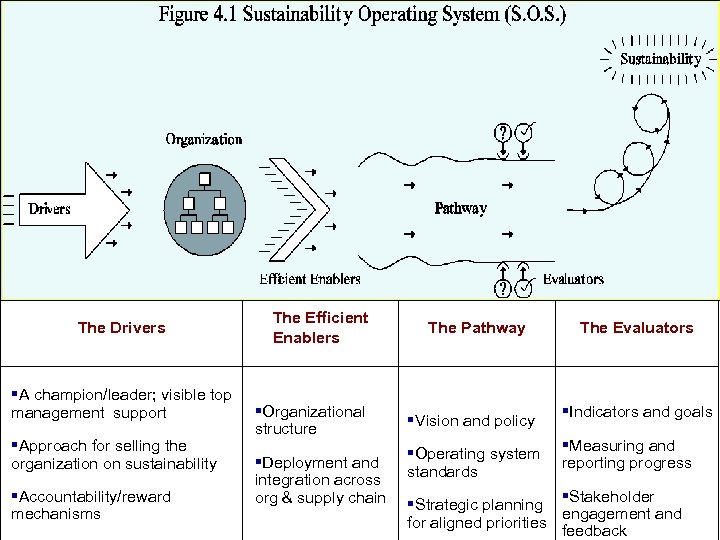
The Drivers §A champion/leader; visible top management support §Approach for selling the organization on sustainability §Accountability/reward mechanisms The Efficient Enablers §Organizational structure §Deployment and integration across org & supply chain The Pathway §Vision and policy §Operating system standards The Evaluators §Indicators and goals §Measuring and reporting progress §Stakeholder §Strategic planning engagement and for aligned priorities feedback
The Sustainability Handbook— The Complete Management Guide to Achieving Social, Economic and Environmental Responsibility illiam lackburn onsulting, Ltd. © 2016 William Blackburn Consulting, Ltd. © 2010 William Blackburn Consulting, Ltd. WRB@WBlackburn. Consulting. com www. WBlackburn. Consulting. com
Скачать презентацию Sustainability in Business —An Update By William R
85450813ccb404c283808284413ffe50.ppt