 Скачать презентацию Sustainability in Action ENGR 10 Introduction to Engineering
9a7bd87b405630555efde98cf3e9fa0a.ppt
- Количество слайдов: 32



Sustainability in Action ENGR 10 Introduction to Engineering http: //www. plu. edu/sustainability/Resources/home. php
Quick Review Sustainability – A Definition o "sustainable development is development that meets the needs of the present without compromising the ability of future generations to meet their own needs. " (Our Common Future, Brundtland Commission of the United Nations, 1987)
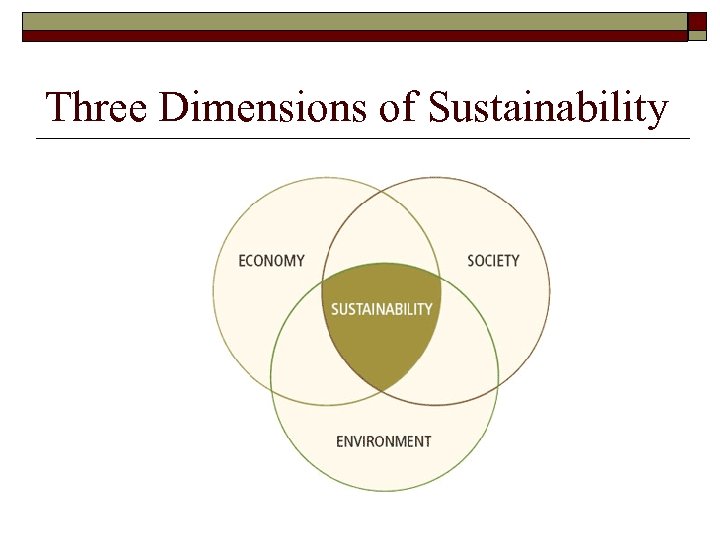
Three Dimensions of Sustainability
Sustainability in our own actions Water Footprint Carbon Footprint
A Measure of Water Sustainability o Water footprint Water required to sustain a population o Virtual Water Volume of water required to produce a commodity or service
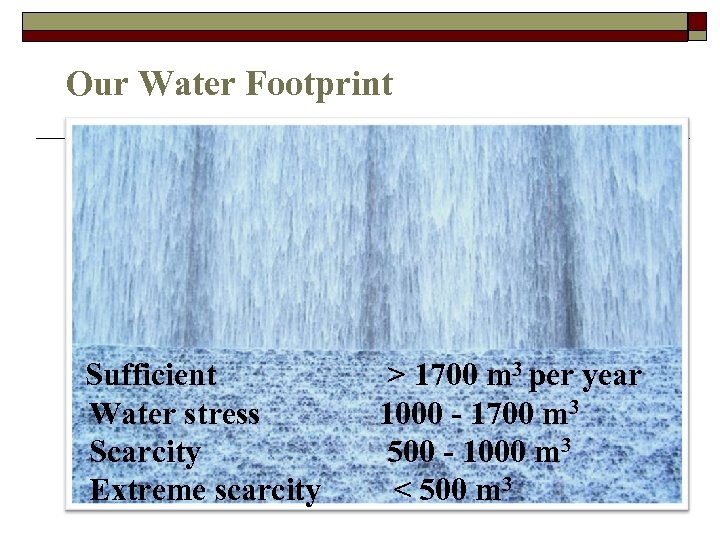
Our Water Footprint Sufficient > 1700 m 3 per year Water stress 1000 - 1700 m 3 Scarcity 500 - 1000 m 3 Extreme scarcity < 500 m 3
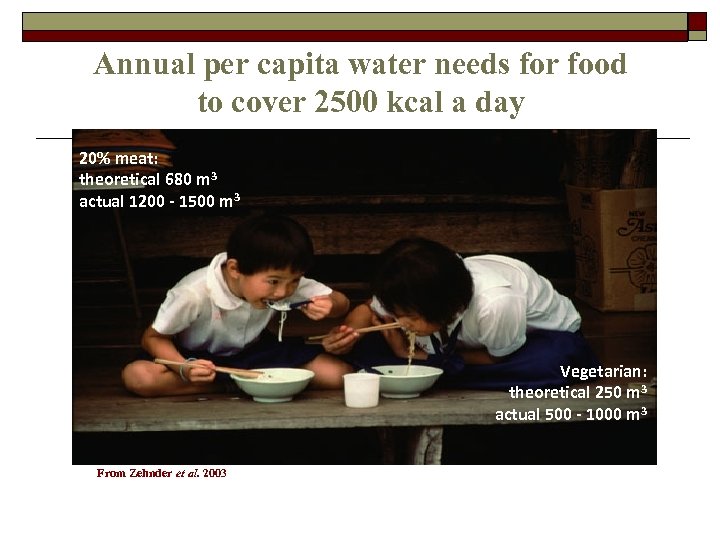
Annual per capita water needs for food to cover 2500 kcal a day 20% meat: theoretical 680 m 3 actual 1200 - 1500 m 3 Vegetarian: theoretical 250 m 3 actual 500 - 1000 m 3 From Zehnder et al. 2003
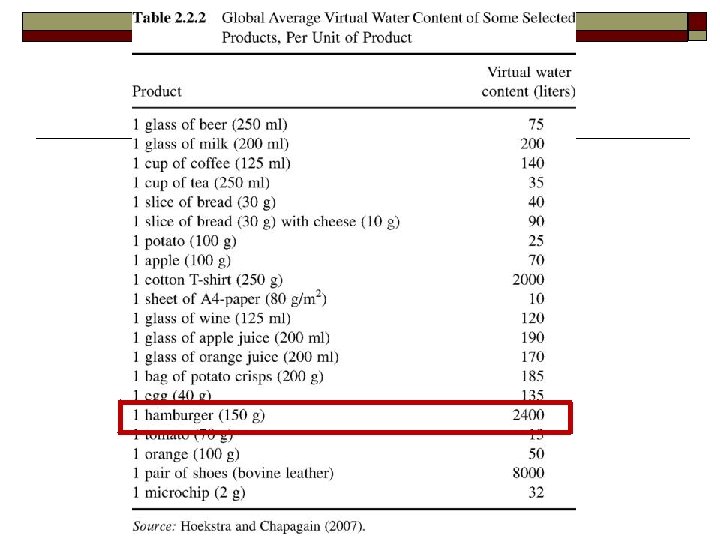
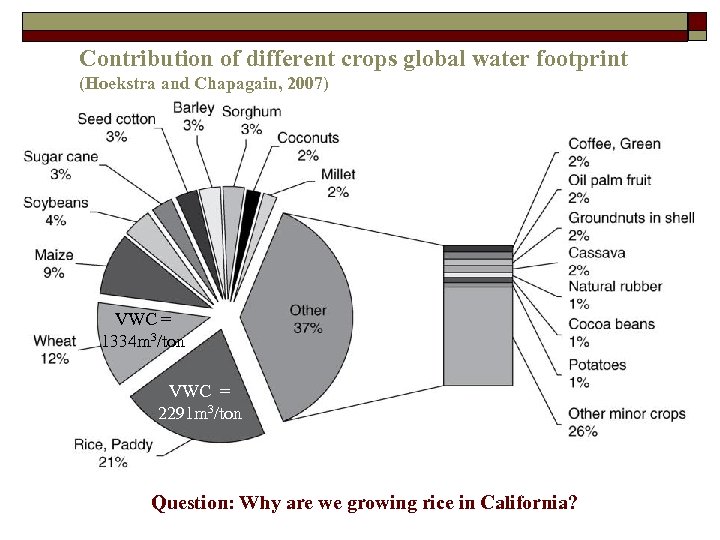
Contribution of different crops global water footprint (Hoekstra and Chapagain, 2007) VWC = 1334 m 3/ton VWC = 2291 m 3/ton Question: Why are we growing rice in California?
Carbon Footprint o o Measurement of all greenhouse gases caused by person, organization, event, or product Units - tons (or kg) of CO 2 equivalent
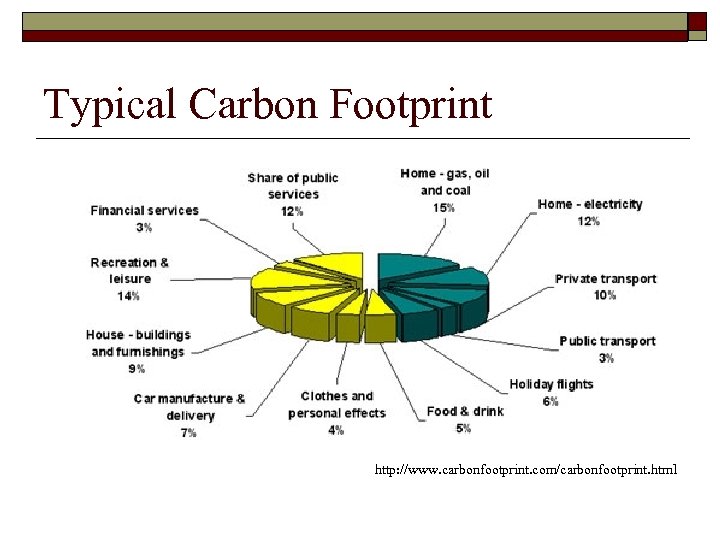
Typical Carbon Footprint http: //www. carbonfootprint. com/carbonfootprint. html
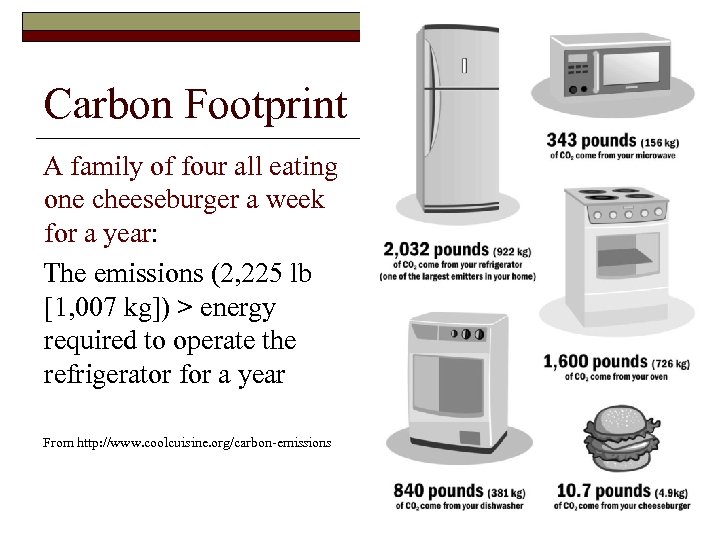
Carbon Footprint A family of four all eating one cheeseburger a week for a year: The emissions (2, 225 lb [1, 007 kg]) > energy required to operate the refrigerator for a year From http: //www. coolcuisine. org/carbon-emissions
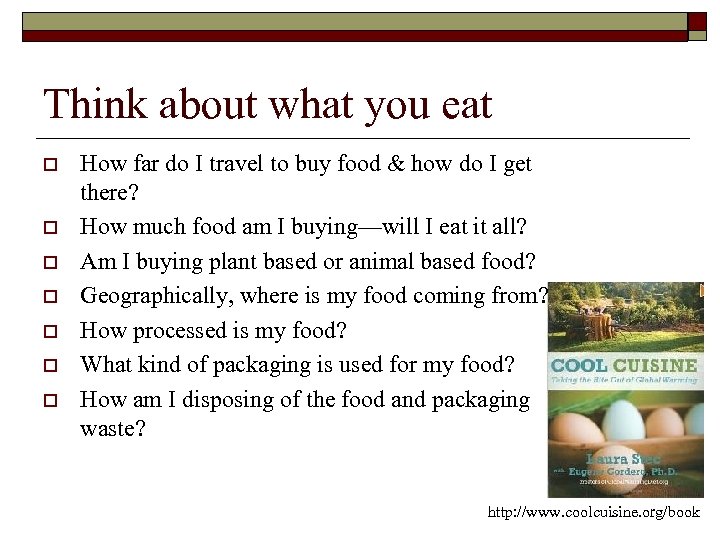
Think about what you eat o o o o How far do I travel to buy food & how do I get there? How much food am I buying—will I eat it all? Am I buying plant based or animal based food? Geographically, where is my food coming from? How processed is my food? What kind of packaging is used for my food? How am I disposing of the food and packaging waste? http: //www. coolcuisine. org/book
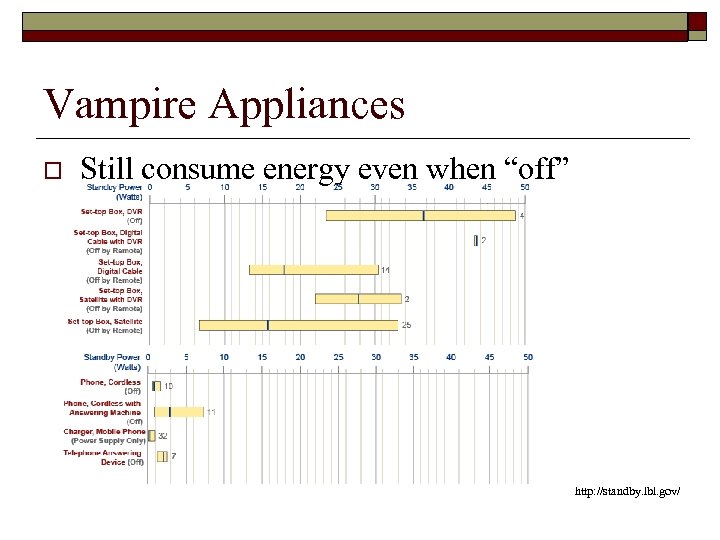
Vampire Appliances o Still consume energy even when “off” http: //standby. lbl. gov/
Other easy personal actions o Waste n n n o Buy products with less packaging Don’t buy bottled water – bring your own Use less toxic cleaning materials (library uses vinegar) Energy n n Turn your computer off when not in use Unplug the charger or appliance (Only 5% of the power drawn by a cell phone charger is used to charge the phone. The other 95% is wasted when it is left plugged into the wall. ) n n Take public transit Purchase sustainable energy
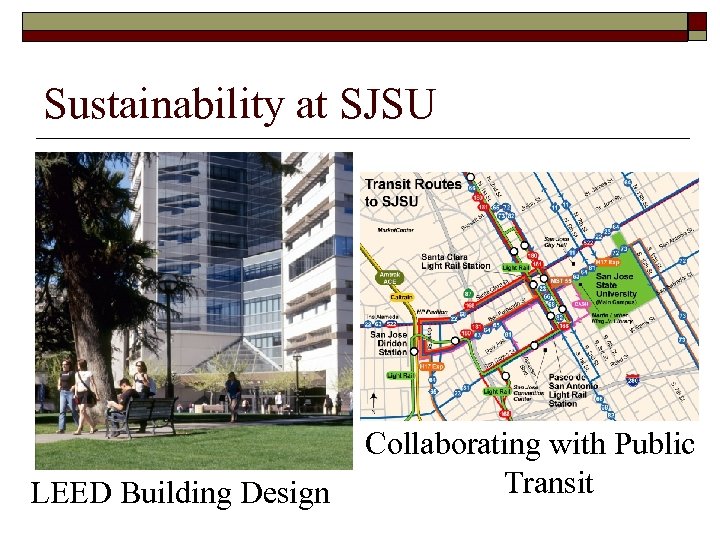
Sustainability at SJSU LEED Building Design Collaborating with Public Transit
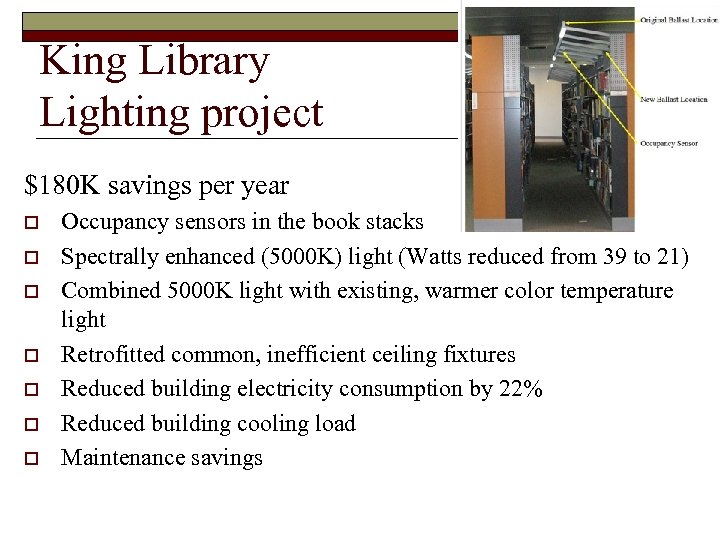
King Library Lighting project $180 K savings per year o o o o Occupancy sensors in the book stacks Spectrally enhanced (5000 K) light (Watts reduced from 39 to 21) Combined 5000 K light with existing, warmer color temperature light Retrofitted common, inefficient ceiling fixtures Reduced building electricity consumption by 22% Reduced building cooling load Maintenance savings
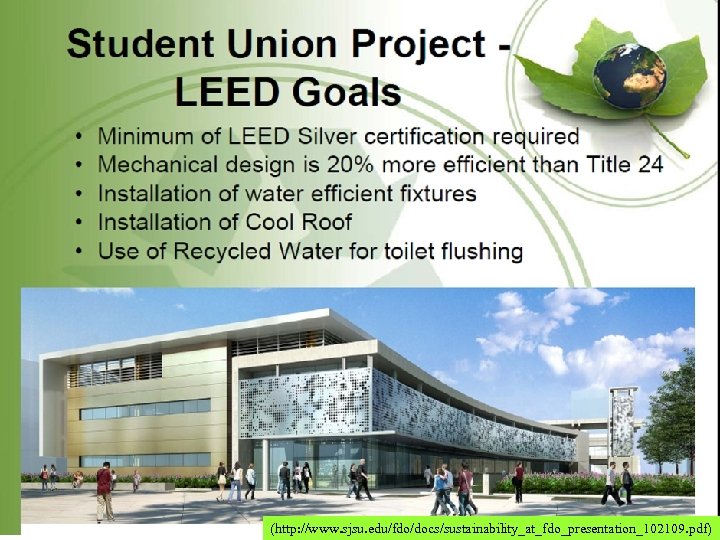
(http: //www. sjsu. edu/fdo/docs/sustainability_at_fdo_presentation_102109. pdf)
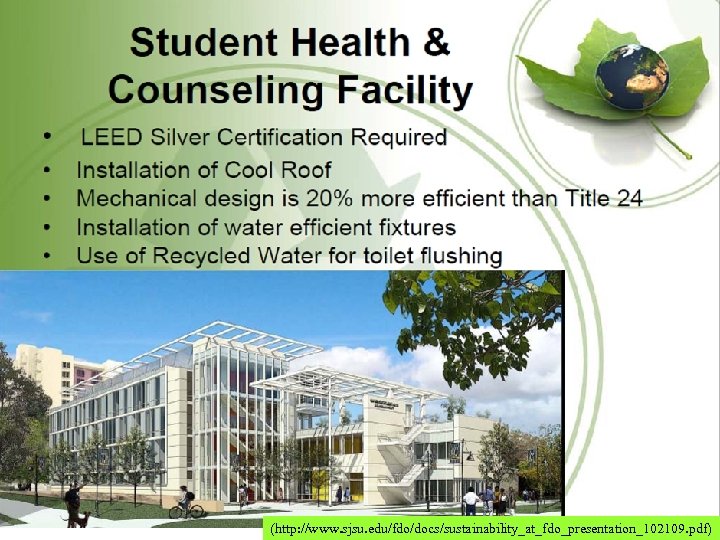
(http: //www. sjsu. edu/fdo/docs/sustainability_at_fdo_presentation_102109. pdf)
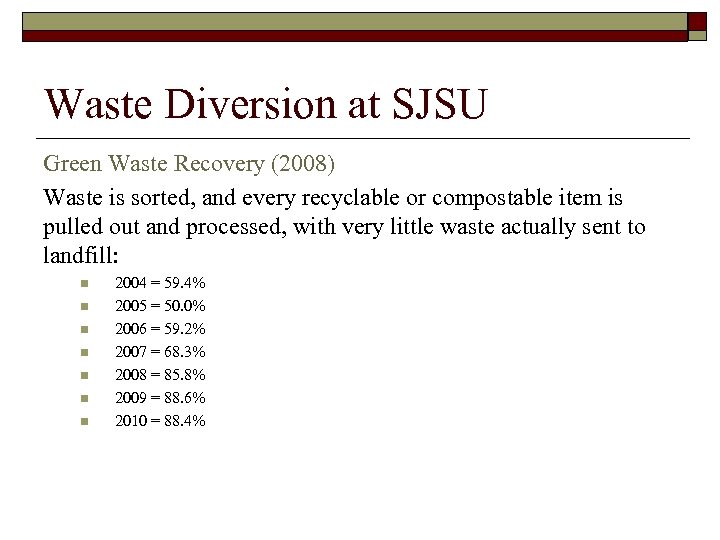
Waste Diversion at SJSU Green Waste Recovery (2008) Waste is sorted, and every recyclable or compostable item is pulled out and processed, with very little waste actually sent to landfill: n n n n 2004 = 59. 4% 2005 = 50. 0% 2006 = 59. 2% 2007 = 68. 3% 2008 = 85. 8% 2009 = 88. 6% 2010 = 88. 4%
Actions on Campus - Examples o Spartan Shops n n o o o 100% of used cooking oil recycled to create biodiesel for vehicles like school buses and trucks Compostable/biodegradable cups, lids, and straws Tableware composed of 100% post-industrial recycled fiber products Use locally grown produce when available AS Computer Service Center in Student Union Computer Lab has e-waste drop off site Converting landscaping to low water plants Recycled water for toilets and landscaping
Some Sustainable Design Principles o o o o Low-impact materials: non-toxic, sustainably produced or recycled materials which require little energy to process Energy efficiency: use manufacturing processes and produce products which require less energy Quality and durability: longer-lasting and better-functioning products Design for reuse and recycling Use Design Impact Measures for total carbon footprint and life-cycle assessment to measure impact Use Sustainable Design Standards and project design guides (example LEED) Service substitution: shift the mode of consumption from personal ownership of products to provision of services which provide similar functions Renewability: materials should come from nearby (local or regional), sustainably managed renewable sources that can be composted when their usefulness has been exhausted.
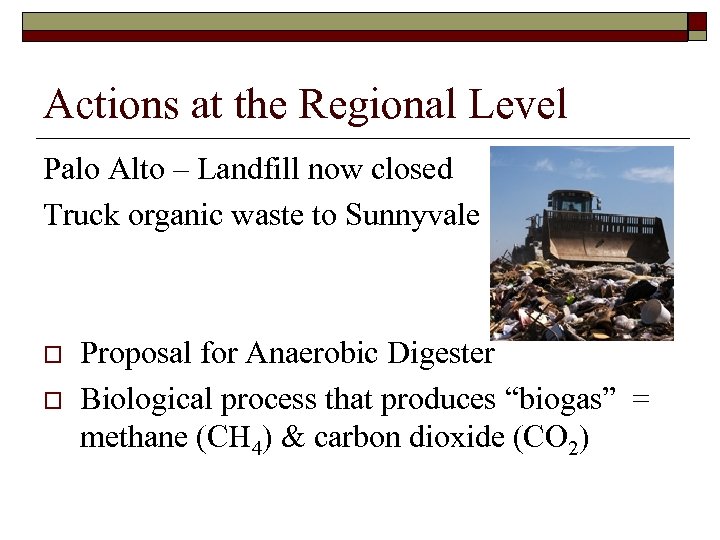
Actions at the Regional Level Palo Alto – Landfill now closed Truck organic waste to Sunnyvale o o Proposal for Anaerobic Digester Biological process that produces “biogas” = methane (CH 4) & carbon dioxide (CO 2)
Benefits o o o Produce $1. 4 million/year energy Revenue from compost sales - $200, 000/year Save $1 million/year incinerating sewage sludge Save $1 million/year for fees to dispose of organic waste Reduced CO 2 emissions (closing incinerator)
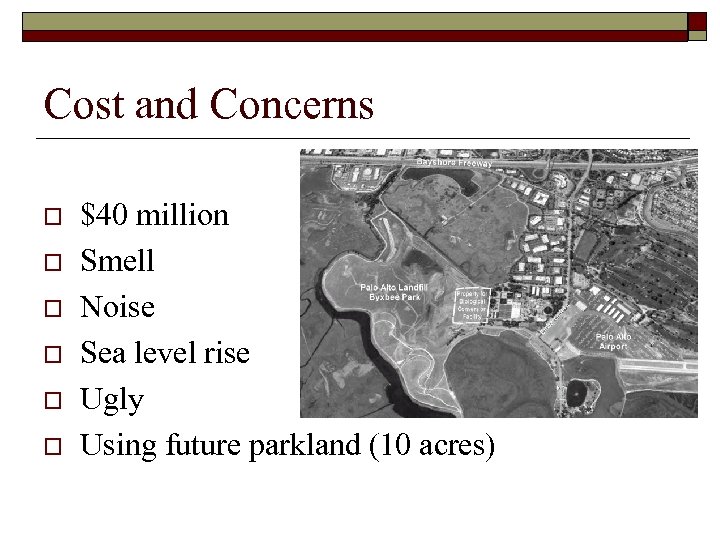
Cost and Concerns o o o $40 million Smell Noise Sea level rise Ugly Using future parkland (10 acres)
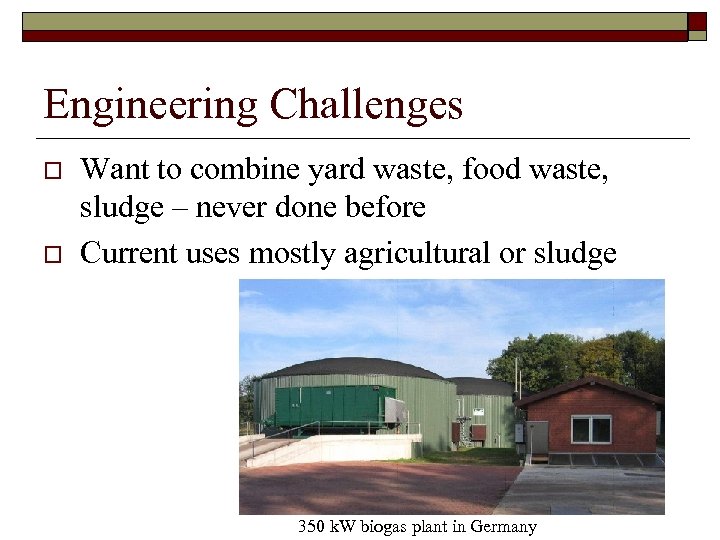
Engineering Challenges o o Want to combine yard waste, food waste, sludge – never done before Current uses mostly agricultural or sludge 350 k. W biogas plant in Germany
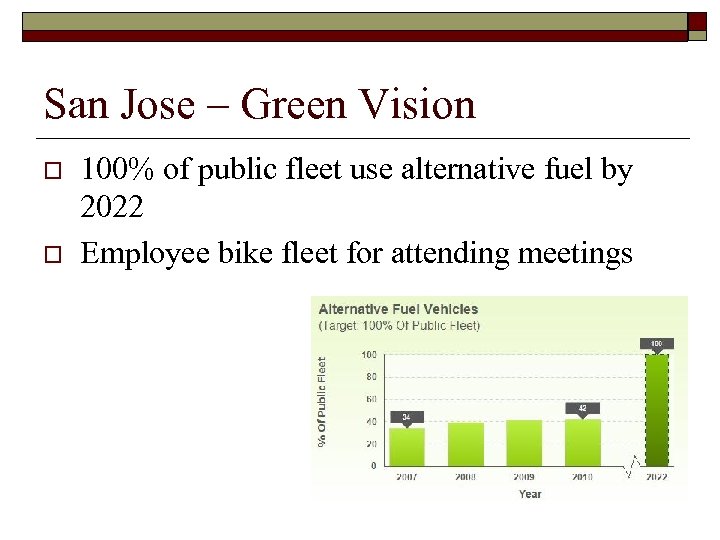
San Jose – Green Vision o o 100% of public fleet use alternative fuel by 2022 Employee bike fleet for attending meetings
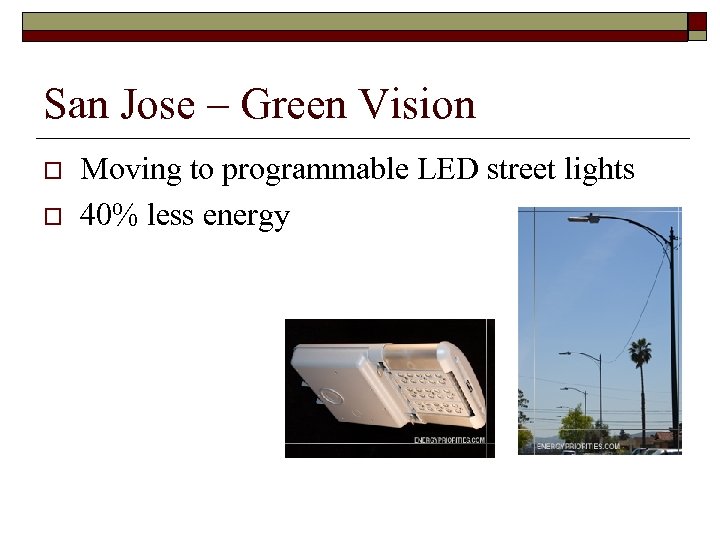
San Jose – Green Vision o o Moving to programmable LED street lights 40% less energy
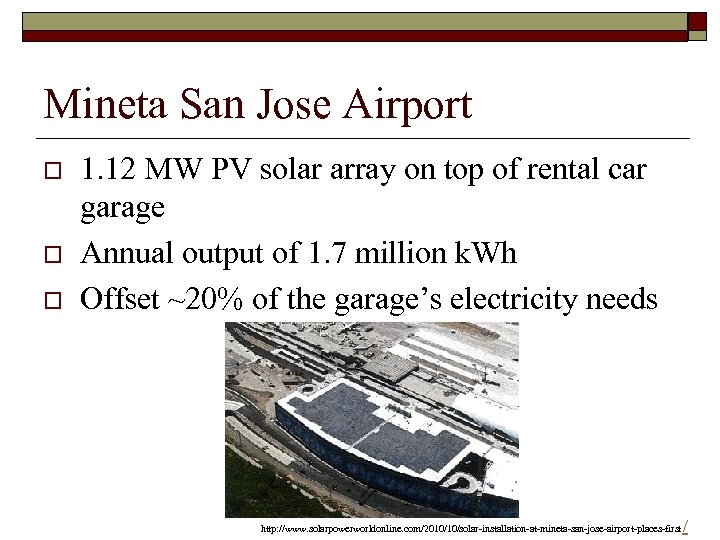
Mineta San Jose Airport o o o 1. 12 MW PV solar array on top of rental car garage Annual output of 1. 7 million k. Wh Offset ~20% of the garage’s electricity needs http: //www. solarpowerworldonline. com/2010/10/solar-installation-at-mineta-san-jose-airport-places-first /
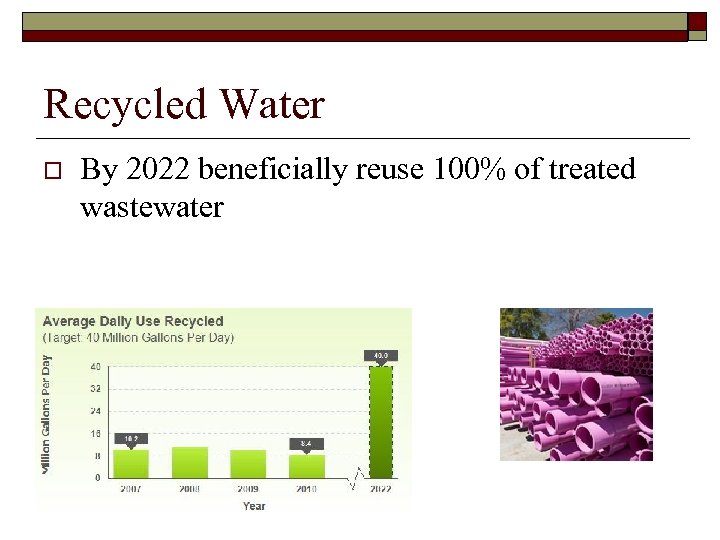
Recycled Water o By 2022 beneficially reuse 100% of treated wastewater
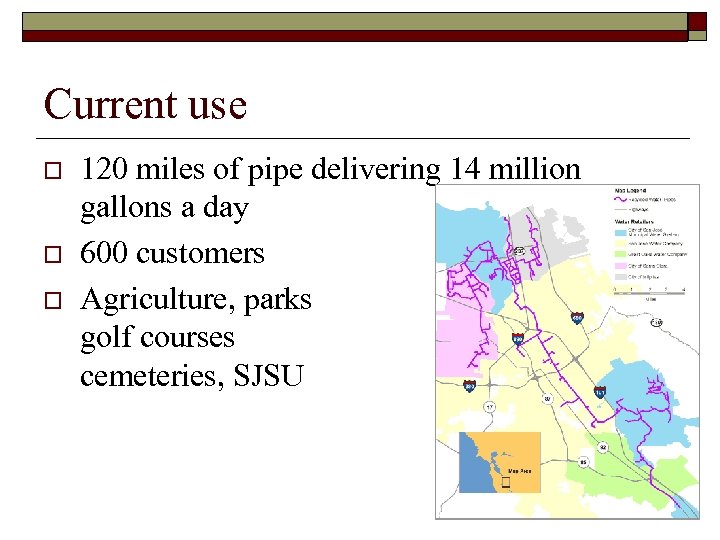
Current use o o o 120 miles of pipe delivering 14 million gallons a day 600 customers Agriculture, parks golf courses cemeteries, SJSU
The Opportunities are Endless o o If you are interested in sustainability read everything you can Projects are going on around you everywhere
Скачать презентацию Sustainability in Action ENGR 10 Introduction to Engineering
9a7bd87b405630555efde98cf3e9fa0a.ppt