 Скачать презентацию Sustainability Freshman Inquiry Oct 14 2009 Jeff Fletcher
240fb650e06c24fc896bf4e8de7907e1.ppt
- Количество слайдов: 14



Sustainability Freshman Inquiry Oct. 14, 2009 Jeff Fletcher
Logistics I • Assignments – HW 3 Typical Meal (Due today. ) – HW 0 • Attend an out of class, non LLC event (e. g. , lecture, workshop, protest, film opening) and write a 1 -2 page reflection summarizing main points/issues in presentation and connecting them to course themes. The event MUST BE approved by me beforehand. – Read for next Monday • Omnivore 8 and 9 • Food and Agriculture Organization (FAO) of the United Nations, 2007. Reconciling livestock and environment.
Logistics II • Fieldtrip Week of Oct. 26 1 -3 Tryon Farms • Prior learning survey data--are averages enough? • Upcoming Events (Good for HW 0): – Why Our Health Matters, Andrew Weil, • Thursday, October 15 th, 2009 7 PM, Arlene Schnitzer Concert Hall (tickets available at PSU box office? ) – The Moral and Political Challenges of Climate Change, Dale Jamieson • October 16, 2009 6: 30 p. m. Smith Memorial Student Union, Room 238 (free)
Important Themes: Omnivore’s Dilemma • • National Eating Disorder Natures way vs. Industrial/Corporate way Omnivore's Dilemma Domestication by Humans; or Domestication of Humans We are corn Dramatic Increase in Corn Yields Corn anatomy and sex Changes to Farm Subsidies (1973)
Industrial Fertilizer • Modern miracle or modern scourge? • Ammonium Nitrate Fertilizer – Leftovers from munitions WWI – Fritz Haber (Haber-Bosch process) – Nobel prize 1920 – More than half of all fertilizer goes to corn – N 2 in air (80%) is inert • The explanation for 2/3 of human population—implications of changes?
Earth Relatively Closed System to Matter • We don’t get any more atoms here on earth – We keep reusing the Hydrogen, Nitrogen, Oxygen, and Carbon atoms we have – Nature’s Recycling • Structure of these systems varies – N critical to proteins in living organisms and abundant in atmosphere, but mostly unavailable • Depends on symbiotic relationship in plants with bacteria that “fix” nitrogen – O part of H 20, C 02, Carbohydrates (systems interconnected) • • Bodies burn carbohydrates -- Cn(H 20)n (e. g. glucose C 6 H 12 O 6 + 6 O 2 <=> 6 CO 2 + 6 H 20 + Energy) Plants can do this backwards with sun for Energy! Similar to burning hydrocarbons (only C + H, i. e. methane=natural gas) CH 4 + 202 = CO 2 + 2 H 20 + energy – C lots of it, but relatively little of it is cycling in atmosphere • Most of the carbon is stored in geologic deposits - carbonate rocks, petroleum, and coal - formed from the burial and compaction of dead organic matter on sea bottoms. The carbon in these deposits is normally released by rock weathering. • Extraction and burning of fossil fuels alters this system
Changes to Farm Subsidies (1973) • Typical Market for Farm Goods – Demand, prices good, grow more, surplus, prices drop, so plant even more, even more surplus, even lower prices • What type of process is this? – Tragedy of the Commons when individuals are not coordinated – Also example of a positive feedback • Changing role of farm subsidies and regulation – Pre 1973: help farmers keep prices high enough to plant next year – 1973 Change: help keep prices low by paying farmers directly to keep growing (even if prices too low to be profitable) • 1920 25% lived on farms – Each could feed itself + 12 – Now each farmer feeds 127
Systems: Feedback • Positive vs. Negative Feedbacks – Examples: • Negative Feedback: Thermostat • Positive Feedback: Microphone too close to speakers • Humans not good at predicting effect of positive feedback • Exponential Growth Examples: – Paper folding 50 times • With partner, roughly how thick is it? – E. Coli growth
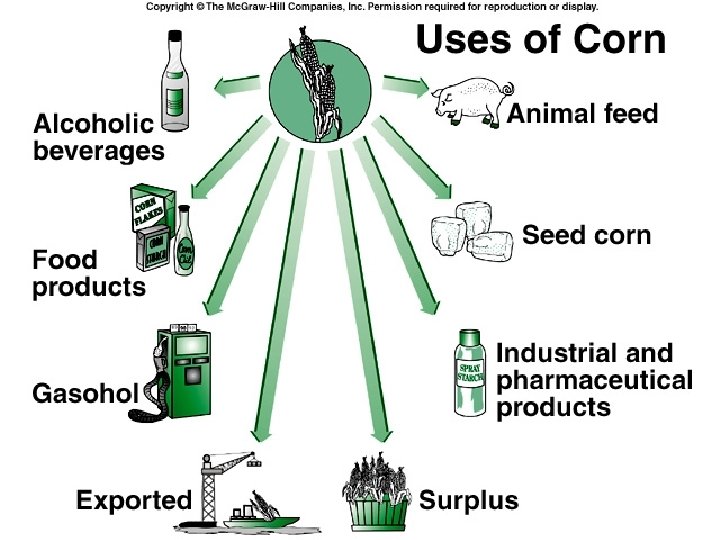
Corn and Corporations • Cargill and ADM buy 1/3 of corn in America • 3/5 of grown corn goes to feed animals in factory farms • “Industrial thinking over logic of evolution” • 4 companies butcher 4/5 cows in America • Mentor session today—look at interview with some agribusiness executives • Follow-up on Biotech's Plan to Sustain Agriculture
Diseases From Food • Besides diseases of overconsumption and bad diets • Most common foodborne infections (from CDC) – Bacteria: Campylobacter, Salmonella, and E. coli O 157: H 7 – Viruses: Norwalk and Norwalk-like viruses. – Occasionally foodborne, infections by Shigella, hepatitis A, and the parasites Giardia lamblia, Cryptosporidia, tapeworms. • Foodborne toxins – pesticides, herbicides – Natural toxins: • Bacteria grow on food: Staphylococcus aureus, Clostridium botulinum. Harmful even after cooking and bacteria have been killed • Other: poisonous mushrooms; poisonous reef fish • Fungi that grow on foods, e. g. peanuts
Biological Reproduction Differences • Basic Transcription and Translation of DNA into Protein • Bacteria (can make its own proteins) – Most scientists consider this LIFE: a living organism • Viruses (cannot make its own proteins) – Some scientist consider this LIFE, many don’t • Multi-cell parasites – Giardia – Tapeworms
New Form of Disease Causing Agent • Protein Structure (e. g. Hemoglobin) • Prions (proteinaceous infectious particles) • Stanley Prusiner first coined the word and first proposed that these infectious proteins were the cause of the disease scrapie in sheep and more importantly Creutzfeldt-Jakob disease in humans. • Prusiner also proposed that the way that this protein multiplied was not though genetic information like DNA or RNA, but rather through the conformation change of normal proteins into rogue proteins. • Affects nerve cells in mammals – Cannot Kill – Not neutralized by digestion, cooking, even normal autoclaving – Kills nerve cells, but slow process
Consequences of Cheap Corn Policies? • In groups construct a causal diagram – Include as many details as you have time for • • Both positive and negative effects Both positive and negative feedbacks Capture as many of the intermediary steps as possible Example: Cows eating corn – What are upstream causes? • Farmers get paid more they grow, more corn on market drives down price, cattle raisers go for cheapest calories. • More subtle: USDA grades corn fed beef higher – What are down stream consequences? • Cows get sick (bloat, acidosis), need antibiotics, increased resistance, increased human disease, need for more expensive antibiotics • More subtle: acid environment causes E. coli and other bacteria to evolve to be acid resistant, so if humans eat these bacteria are not killed, leads to more human infections
Скачать презентацию Sustainability Freshman Inquiry Oct 14 2009 Jeff Fletcher
240fb650e06c24fc896bf4e8de7907e1.ppt