


 Скачать презентацию SUSPENSION DESIGN FOR ADVANCED LIGO Update on GEO
bfb2952c8dd078dc81092e169cc065f7.ppt
- Количество слайдов: 9
 SUSPENSION DESIGN FOR ADVANCED LIGO: Update on GEO Activities Norna A Robertson University of Glasgow for the GEO 600 suspension team LSC Meeting, Hanford 15 th August Sus/Isol Working Group Session LIGO-G 010292 -00 -Z
 Current and Future Work - Mechanical Design Issues n Prototype quadruple pendulum update: covered in earlier talk (Tuesday 14 th August, N Robertson, R Mittleman). n Bonding to heavy glass ( loaded with Pb. O or Bi 2 O 3 , densities from 3. 8 to 7. 2 g/cc): preliminary experiments suggest bonding of such glass to silica can be done; however the temperature range that the bond can be heated through is restricted due to different expansion coefficients. Work continues. n Test of suspending up to 40 kg (metal) in cradle supported by fibres (welding and welding plus bonding), follow up to 10 kg test, to be started in next few months
 Current and Future Work - Thermal Noise Issues n Bonding of GEO optics, and installation of monolithic suspensions in the GEO detector: covered in GEO suspension update talk later in this session (S Rowan) n Coating losses: covered in detector char. session earlier today (S Rowan, G Harry) n Characterisation of bonds and bonding: § § thickness of sodium silicate bonds measured with atomic force microscope – typically ~80 nm (see next slide) work on characterisation of mechanical loss of bond material underway further investigation of silica/sapphire bonding underway (w/Stanford, Caltech) further evaluation of design of silica ears(w/Caltech)
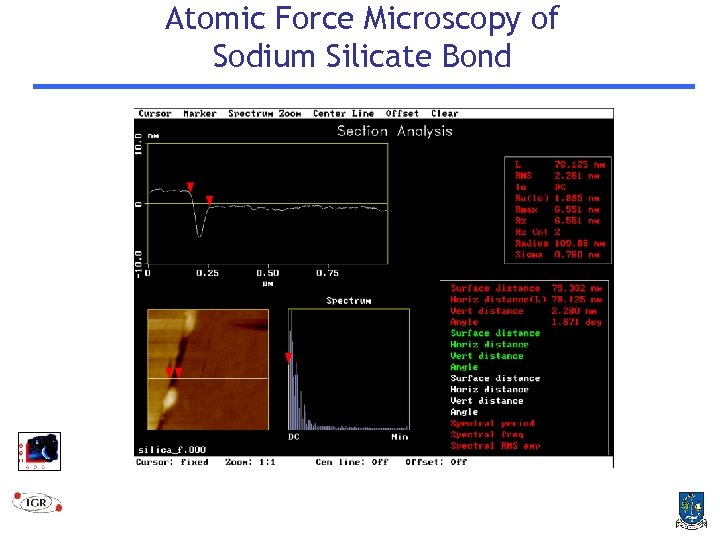 Atomic Force Microscopy of Sodium Silicate Bond
 Current and Future Work - Thermal Noise Issues contd. n Ribbon development work n n n Pulling technique Strength tests, basic and after welding Quality factor tests - see following viewgraphs
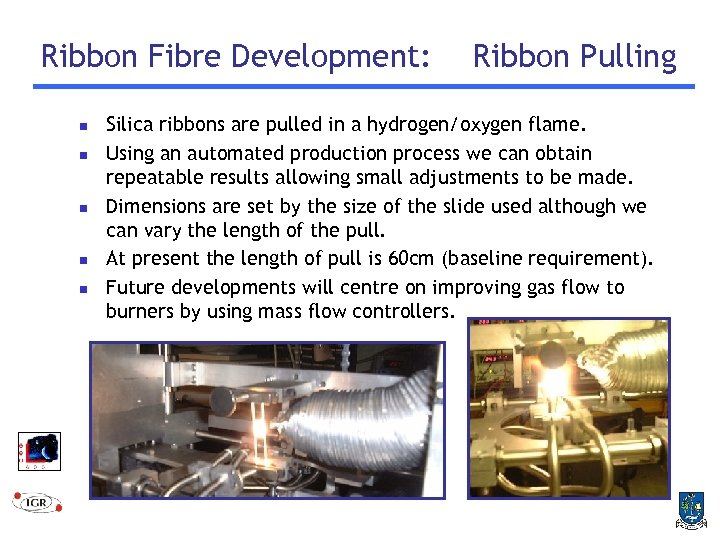 Ribbon Fibre Development: n n n Ribbon Pulling Silica ribbons are pulled in a hydrogen/oxygen flame. Using an automated production process we can obtain repeatable results allowing small adjustments to be made. Dimensions are set by the size of the slide used although we can vary the length of the pull. At present the length of pull is 60 cm (baseline requirement). Future developments will centre on improving gas flow to burners by using mass flow controllers.
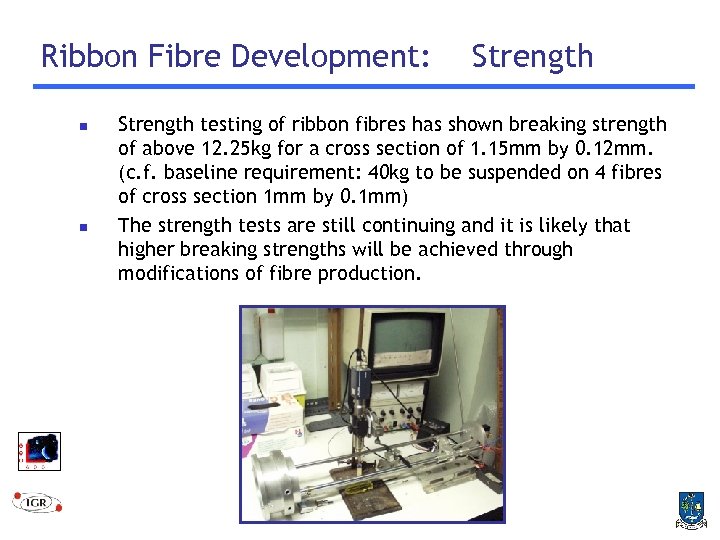 Ribbon Fibre Development: n n Strength testing of ribbon fibres has shown breaking strength of above 12. 25 kg for a cross section of 1. 15 mm by 0. 12 mm. (c. f. baseline requirement: 40 kg to be suspended on 4 fibres of cross section 1 mm by 0. 1 mm) The strength tests are still continuing and it is likely that higher breaking strengths will be achieved through modifications of fibre production.
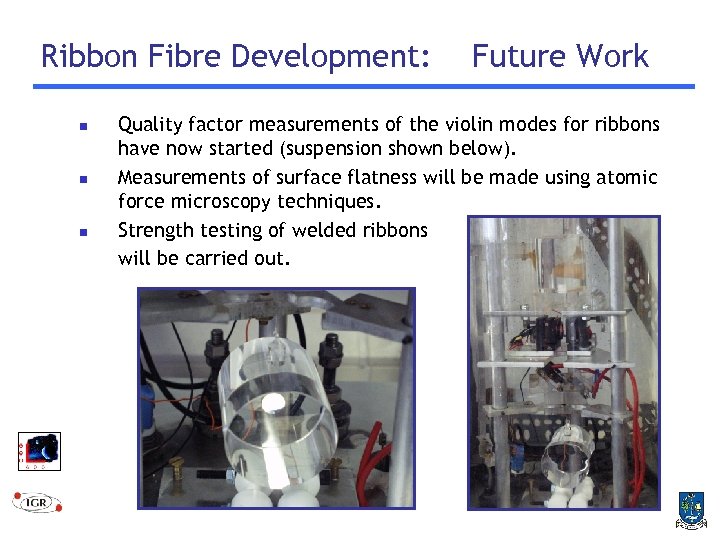 Ribbon Fibre Development: n n n Future Work Quality factor measurements of the violin modes for ribbons have now started (suspension shown below). Measurements of surface flatness will be made using atomic force microscopy techniques. Strength testing of welded ribbons will be carried out.
 Open Issue for Debate n 10 Hz vs 13 Hz cut-off Advantage: small improvement in sensitivity to NBI and stochastic background, increased chance of detection of BH-BH intermediate mass mergers However Thorne argues a 12 -13 Hz wall would be unlikely to have significant impact on merger detections. Areas Requiring Research/Development for 10 Hz a) require heavy penultimate mass to reduce highest vertical resonant frequency to below 10 Hz – leading to issues of n choice of material (heavy glass, composite mass) n bonding issues n handling issues n increased overall weight for isolation system b) harder to achieve overall isolation target