


 Скачать презентацию Susan K Laird MSN RN Clinical Director Content Lead
c00f8612332ea0d420518de1c616cd11.ppt
- Количество слайдов: 30
 Susan K. Laird, MSN, RN Clinical Director/Content Lead CDC-INFO Presentation to AIRS CONFERENCE Reno, Nevada, June 1, 2009
 Objectives • The purpose of this workshop is to… – Share CDC-INFO background, successes and challenges, and lessons learned. – Identify CDC and CDC-INFO resources that are available for use every day and in emergency response.
 Agenda • Welcome and Introductions • What is CDC-INFO? • Background and Scope • Role in Emergency Response • Impact – Internal and External • Questions/Discussion
 What Is CDC-INFO?
 CDC-INFO Vision To be a trusted source that partners, providers, and the public come to for accurate, timely and consistent information.
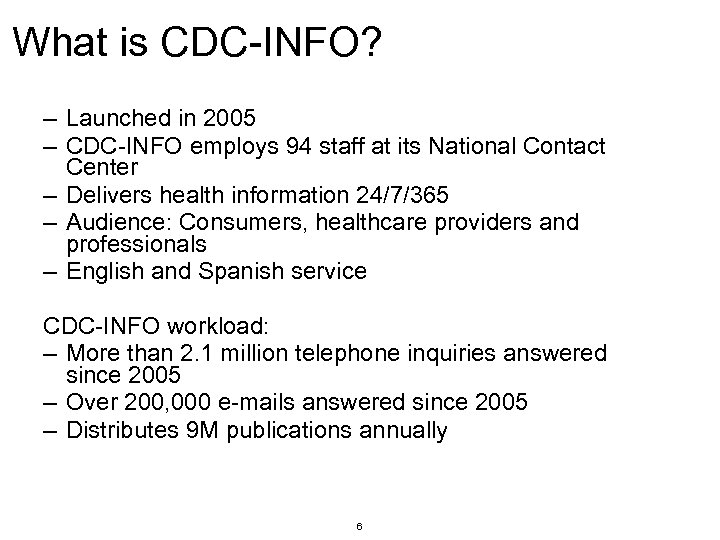 What is CDC-INFO? – Launched in 2005 – CDC-INFO employs 94 staff at its National Contact Center – Delivers health information 24/7/365 – Audience: Consumers, healthcare providers and professionals – English and Spanish service CDC-INFO workload: – More than 2. 1 million telephone inquiries answered since 2005 – Over 200, 000 e-mails answered since 2005 – Distributes 9 M publications annually 6
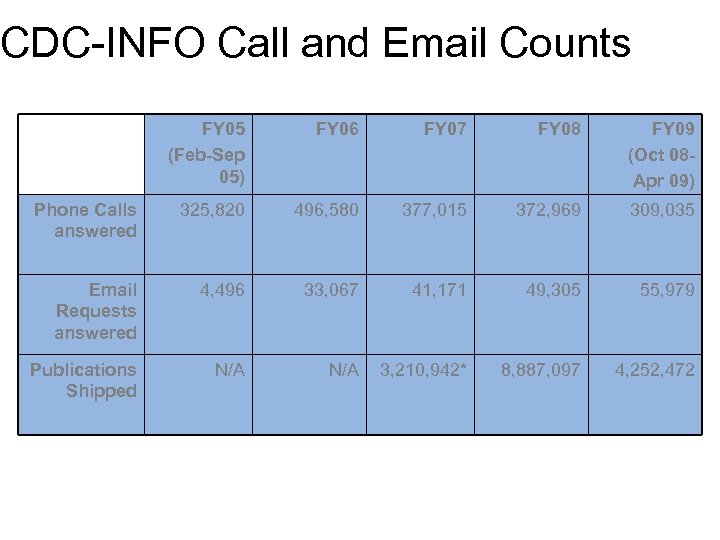 CDC-INFO Call and Email Counts FY 05 (Feb-Sep 05) FY 06 FY 07 FY 08 FY 09 (Oct 08 Apr 09) Phone Calls answered 325, 820 496, 580 377, 015 372, 969 309, 035 Email Requests answered 4, 496 33, 067 41, 171 49, 305 55, 979 Publications Shipped N/A 3, 210, 942* 8, 887, 097 4, 252, 472
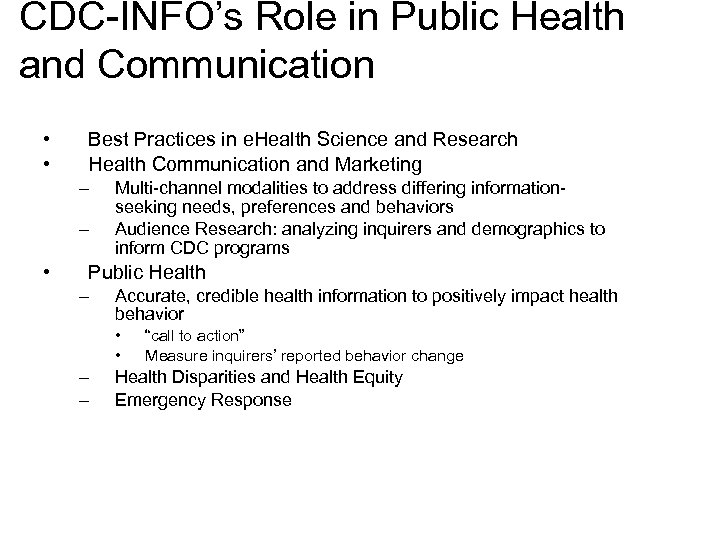 CDC-INFO’s Role in Public Health and Communication • • Best Practices in e. Health Science and Research Health Communication and Marketing – – • Multi-channel modalities to address differing informationseeking needs, preferences and behaviors Audience Research: analyzing inquirers and demographics to inform CDC programs Public Health – Accurate, credible health information to positively impact health behavior • • – – “call to action” Measure inquirers’ reported behavior change Health Disparities and Health Equity Emergency Response
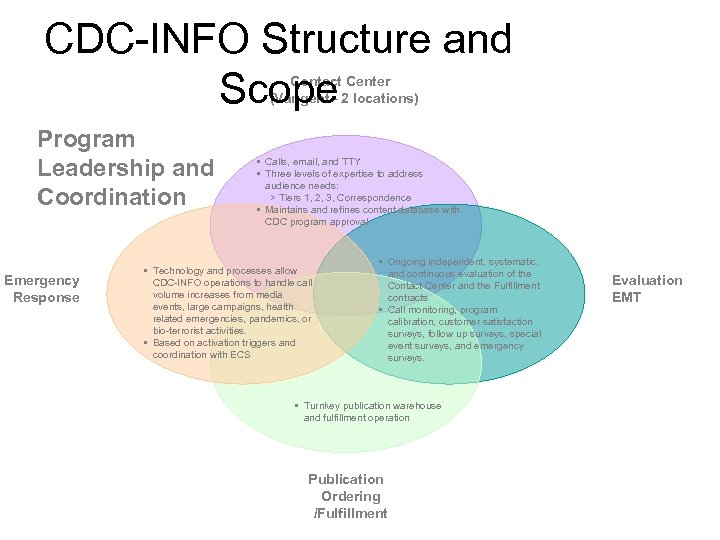 CDC-INFO Structure and Scope Contact Center (Vangent– 2 locations) Program Leadership and Coordination Emergency Response • Calls, email, and TTY • Three levels of expertise to address audience needs: > Tiers 1, 2, 3, Correspondence • Maintains and refines content database with CDC program approval • Technology and processes allow CDC-INFO operations to handle call volume increases from media events, large campaigns, health related emergencies, pandemics, or bio-terrorist activities. • Based on activation triggers and coordination with ECS • Ongoing independent, systematic, and continuous evaluation of the Contact Center and the Fulfillment contracts • Call monitoring, program calibration, customer satisfaction surveys, follow up surveys, special event surveys, and emergency surveys. • Turnkey publication warehouse and fulfillment operation Publication Ordering /Fulfillment Evaluation EMT
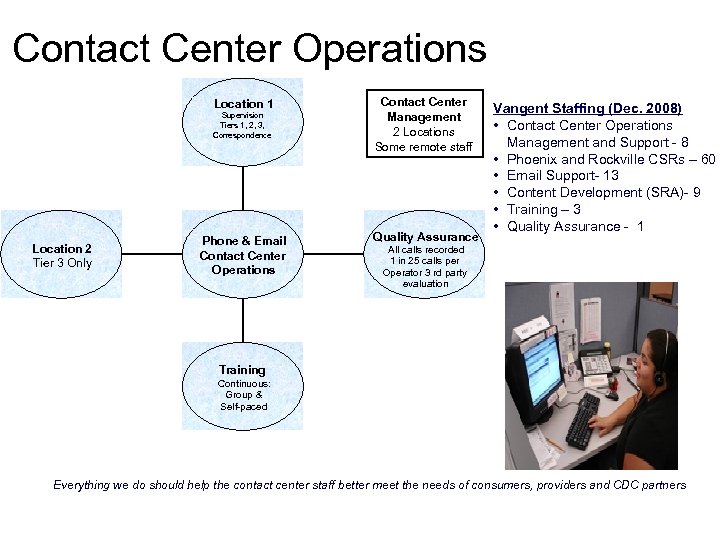 Contact Center Operations Location 1 Phoenix, AZ Supervision Tiers 1, 2, 3, Tiers 1, 2, 3 Correspondence Location 2 Rockville Tier 3 Only Phone & Email Contact Center Operations Contact Center Management 2 Locations Some remote staff Quality Assurance Vangent Staffing (Dec. 2008) • Contact Center Operations Management and Support - 8 • Phoenix and Rockville CSRs – 60 • Email Support- 13 • Content Development (SRA)- 9 • Training – 3 • Quality Assurance - 1 All calls recorded 1 in 25 calls per Operator 3 rd party evaluation Training Continuous: Group & Self-paced Everything we do should help the contact center staff better meet the needs of consumers, providers and CDC partners
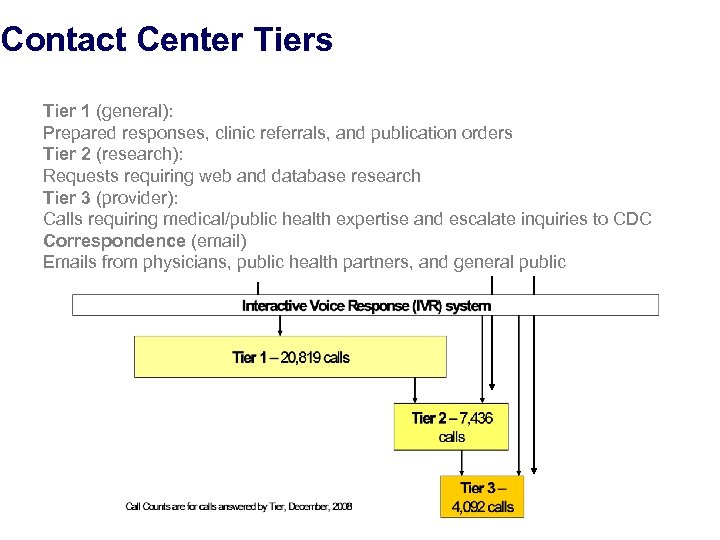 Contact Center Tiers Tier 1 (general): Prepared responses, clinic referrals, and publication orders Tier 2 (research): Requests requiring web and database research Tier 3 (provider): Calls requiring medical/public health expertise and escalate inquiries to CDC Correspondence (email) Emails from physicians, public health partners, and general public
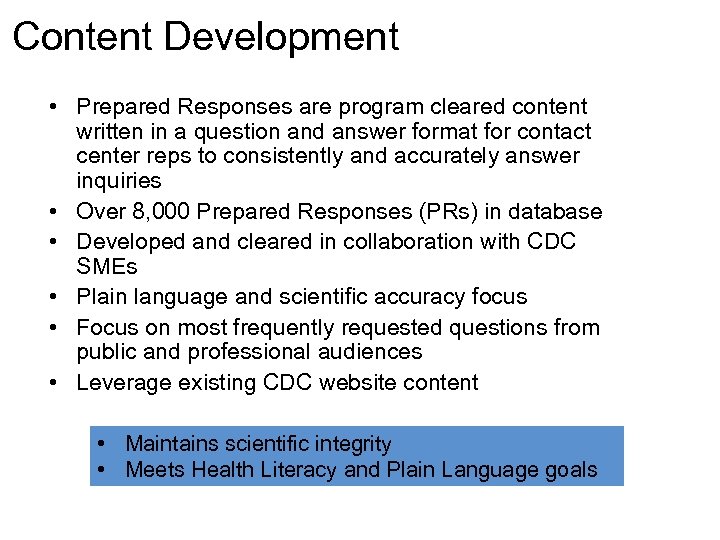 Content Development • Prepared Responses are program cleared content written in a question and answer format for contact center reps to consistently and accurately answer inquiries • Over 8, 000 Prepared Responses (PRs) in database • Developed and cleared in collaboration with CDC SMEs • Plain language and scientific accuracy focus • Focus on most frequently requested questions from public and professional audiences • Leverage existing CDC website content • Maintains scientific integrity • Meets Health Literacy and Plain Language goals
 Content Development What the public wants to know… • • • What is it? What are the signs/symptoms? (What does it look like/feel like? ) How will it hurt me – will I die? How sick, etc. How can I catch it/prevent myself (and my family, loved ones, etc. ) from catching it? If I get it what should I do? Do I stay home and drink fluids? See a doctor? Go to the ER? Call 911?
 Content Development • What does CDC-INFO need to know to best represent CDC Programs? – What types of questions can we anticipate from healthcare providers/hospitals? – What types of questions can we anticipate from state and local health departments?
 Content Development • What do you consider to be sentinel topics? – Best to develop individual Prepared Responses for all potential sentinel topics • What constitutes an “event? ” – Do you have pre-defined “talking points” for events? • Do you have “tipping points” defined? – Is there a specific number of inquiries that could indicate an event of some kind? – When and how do you decide to ramp up?
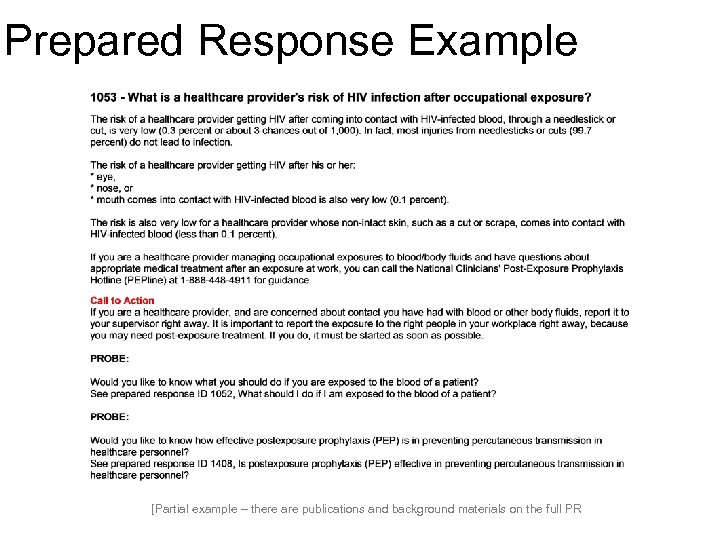 Prepared Response Example [Partial example – there are publications and background materials on the full PR
 Evaluation – Impact and Process Evaluation • Quality Assurance • Customer Satisfaction – Audience Research • User profiles • Health disparities and health equity – Methodology • Approved OMB package for evaluation surveys, including emergency response • CSR monitoring (audio and video) • Scorecards for phone and email • IVR post-call survey • Email survey • Call-back survey • Mystery shopper and calibration/call review – Results • Overall CDC-INFO customer satisfaction consistently meets or exceeds industry standard (75%) • 50% of survey respondents indicate a behavior change was made because of CDC-INFO health information they received
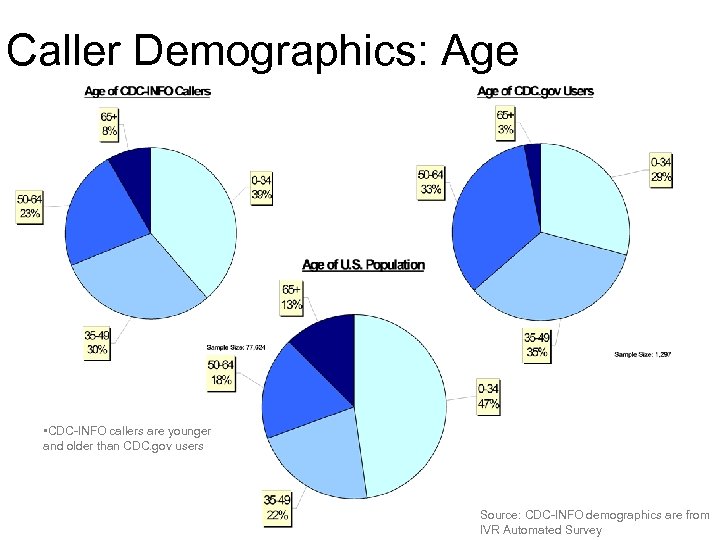 Caller Demographics: Age • CDC-INFO callers are younger and older than CDC. gov users Source: CDC-INFO demographics are from IVR Automated Survey
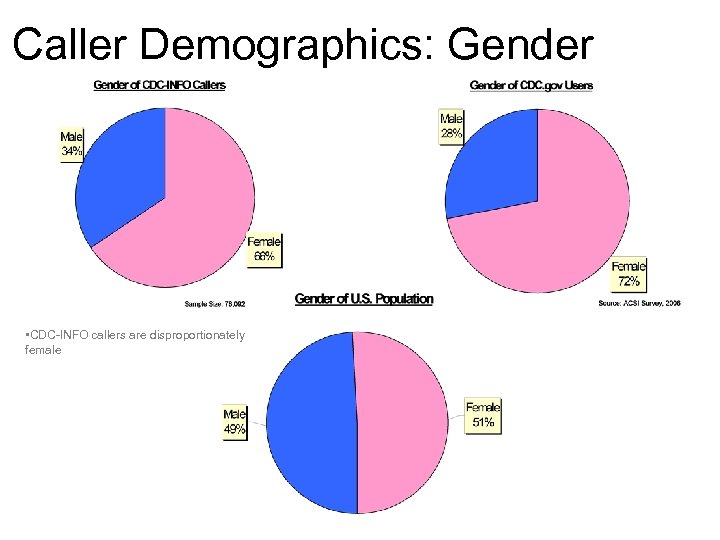 Caller Demographics: Gender • CDC-INFO callers are disproportionately female
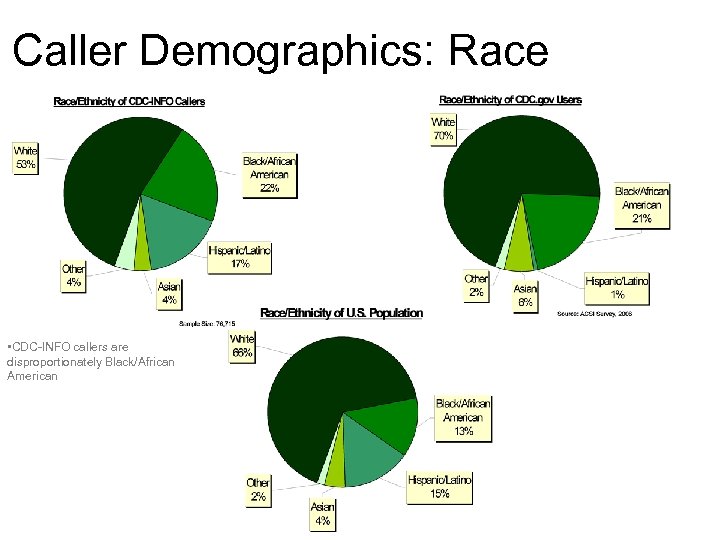 Caller Demographics: Race • CDC-INFO callers are disproportionately Black/African American
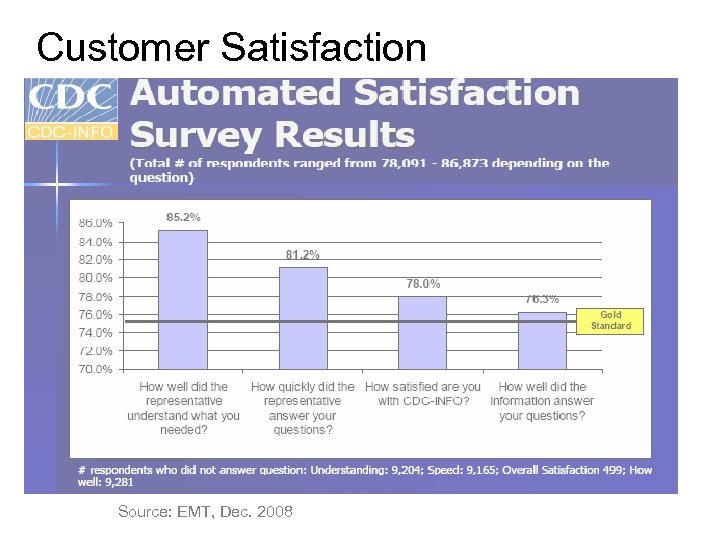 Customer Satisfaction Source: EMT, Dec. 2008
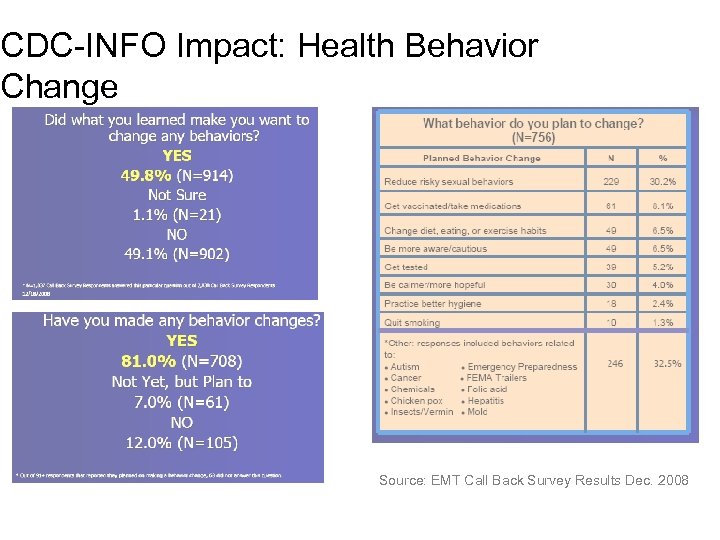 CDC-INFO Impact: Health Behavior Change Source: EMT Call Back Survey Results Dec. 2008
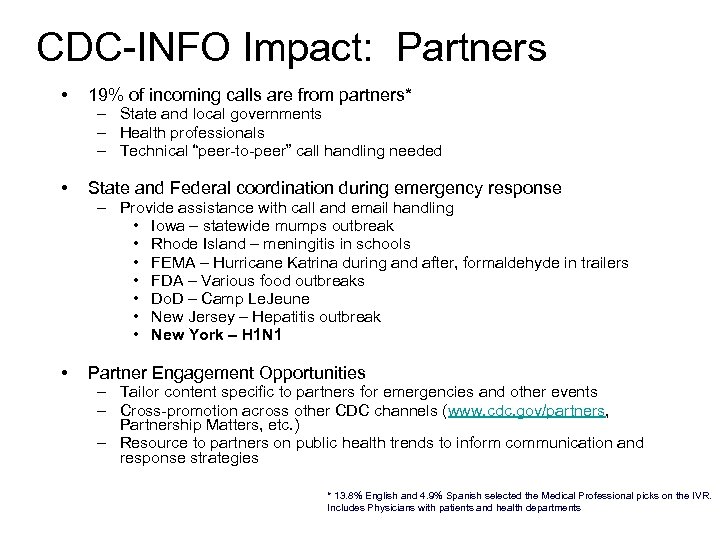 CDC-INFO Impact: Partners • 19% of incoming calls are from partners* • State and Federal coordination during emergency response • Partner Engagement Opportunities – State and local governments – Health professionals – Technical “peer-to-peer” call handling needed – Provide assistance with call and email handling • Iowa – statewide mumps outbreak • Rhode Island – meningitis in schools • FEMA – Hurricane Katrina during and after, formaldehyde in trailers • FDA – Various food outbreaks • Do. D – Camp Le. Jeune • New Jersey – Hepatitis outbreak • New York – H 1 N 1 – Tailor content specific to partners for emergencies and other events – Cross-promotion across other CDC channels (www. cdc. gov/partners, Partnership Matters, etc. ) – Resource to partners on public health trends to inform communication and response strategies * 13. 8% English and 4. 9% Spanish selected the Medical Professional picks on the IVR. Includes Physicians with patients and health departments
 CDC-INFO’S ROLE IN EMERGENCY RESPONSE
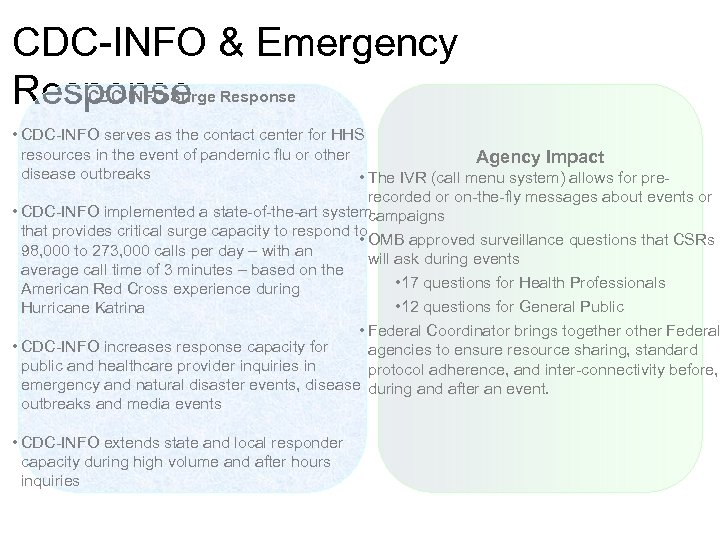 CDC-INFO & Emergency Response CDC-INFO Surge Response • CDC-INFO serves as the contact center for HHS resources in the event of pandemic flu or other Agency Impact disease outbreaks • The IVR (call menu system) allows for prerecorded or on-the-fly messages about events or • CDC-INFO implemented a state-of-the-art system campaigns that provides critical surge capacity to respond to • OMB approved surveillance questions that CSRs 98, 000 to 273, 000 calls per day – with an will ask during events average call time of 3 minutes – based on the • 17 questions for Health Professionals American Red Cross experience during • 12 questions for General Public Hurricane Katrina • Federal Coordinator brings together other Federal • CDC-INFO increases response capacity for agencies to ensure resource sharing, standard public and healthcare provider inquiries in protocol adherence, and inter-connectivity before, emergency and natural disaster events, disease during and after an event. outbreaks and media events • CDC-INFO extends state and local responder capacity during high volume and after hours inquiries
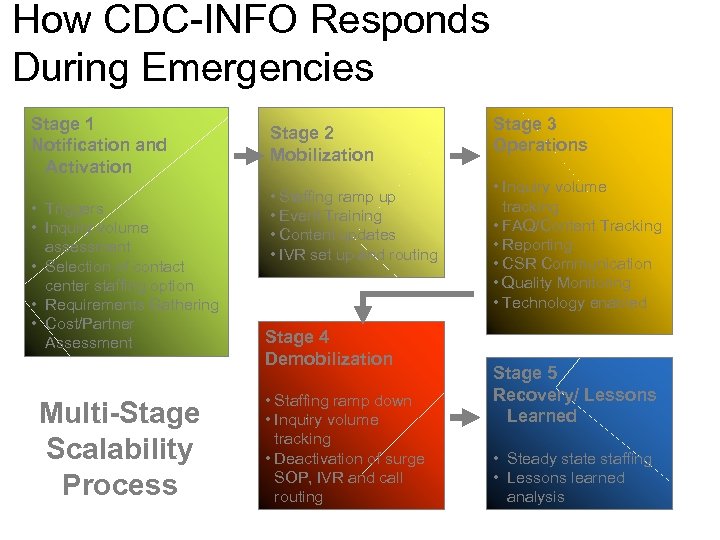 How CDC-INFO Responds During Emergencies Stage 1 Notification and Activation • Triggers • Inquiry volume assessment • Selection of contact center staffing option • Requirements Gathering • Cost/Partner Assessment Multi-Stage Scalability Process Stage 2 Mobilization • Staffing ramp up • Event Training • Content updates • IVR set up and routing Stage 4 Demobilization • Staffing ramp down • Inquiry volume tracking • Deactivation of surge SOP, IVR and call routing Stage 3 Operations • Inquiry volume tracking • FAQ/Content Tracking • Reporting • CSR Communication • Quality Monitoring • Technology enabled Stage 5 Recovery/ Lessons Learned • Steady state staffing • Lessons learned analysis
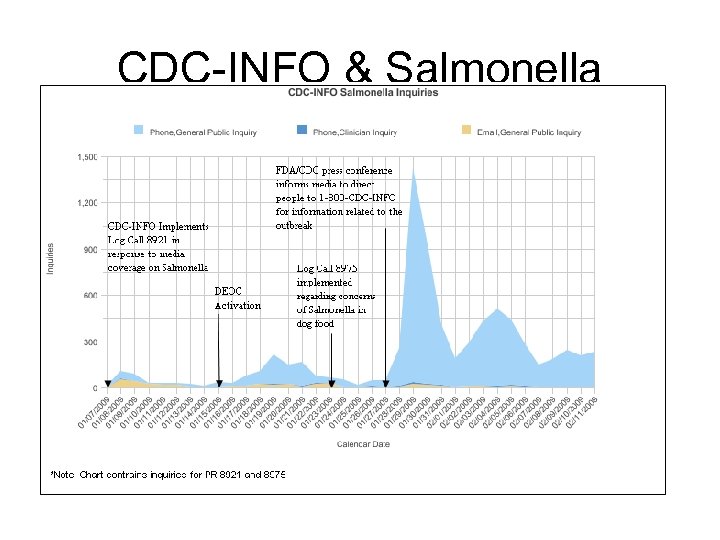 CDC-INFO & Salmonella
 CDC-INFO & H 1 N 1
 Timeline • • MMWR Dispatch Vol. 58 / April 21, 2009 • Swine Influenza A (H 1 N 1) Infection in Two Children — Southern California, March–April 2009 • On April 17, 2009, CDC determined that two cases of febrile respiratory illness occurring in children who resided in adjacent counties in southern California were caused by infection with a swine influenza A (H 1 N 1) virus. The viruses from the two cases are closely related genetically, resistant to amantadine and rimantadine, and contain a unique combination of gene segments that previously has not been reported among swine or human influenza viruses in the United States or elsewhere. Neither child had contact with pigs; the source of the infection is unknown. Investigations to identify the source of infection and to determine whether additional persons have been ill from infection with similar swine influenza viruses are ongoing.
 Timeline – 4/21/2009 • 4: 17 PM - Influenza Coordination Unit sends “heads up” to CDC-INFO Leadership • 4: 18 PM – Content Team asked to develop Log Call. Contact Center management team notified of potential surge • 5: 30 PM – Log Call process initiated at CDCINFO Contact Center