


 Скачать презентацию Surviving the Silicon Pipeline 2006 11 27
b75a64a1dea3f306bb79e0b32304d395.ppt
- Количество слайдов: 26
 Surviving the Silicon Pipeline 2006. 11. 27
 Silicon Cycle
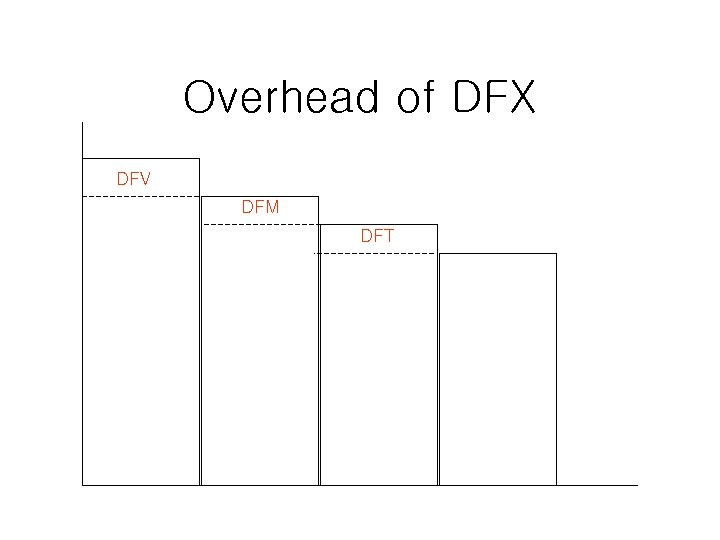
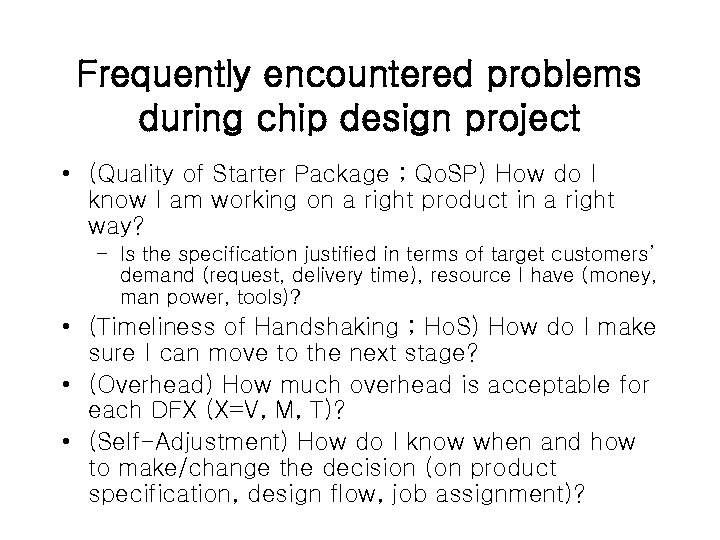 Frequently encountered problems during chip design project • (Quality of Starter Package ; Qo. SP) How do I know I am working on a right product in a right way? – Is the specification justified in terms of target customers’ demand (request, delivery time), resource I have (money, man power, tools)? • (Timeliness of Handshaking ; Ho. S) How do I make sure I can move to the next stage? • (Overhead) How much overhead is acceptable for each DFX (X=V, M, T)? • (Self-Adjustment) How do I know when and how to make/change the decision (on product specification, design flow, job assignment)?
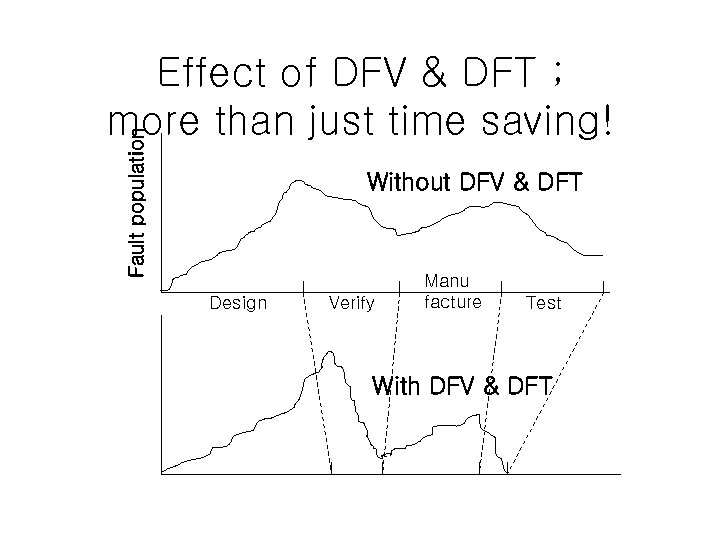
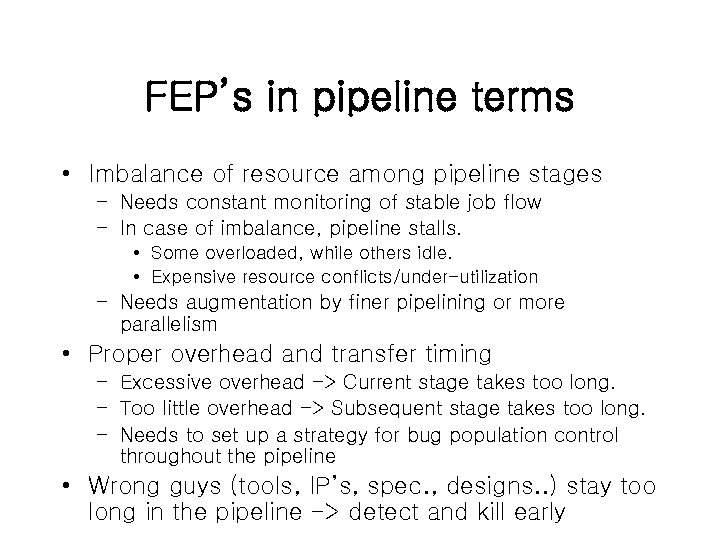 FEP’s in pipeline terms • Imbalance of resource among pipeline stages – Needs constant monitoring of stable job flow – In case of imbalance, pipeline stalls. • Some overloaded, while others idle. • Expensive resource conflicts/under-utilization – Needs augmentation by finer pipelining or more parallelism • Proper overhead and transfer timing – Excessive overhead -> Current stage takes too long. – Too little overhead -> Subsequent stage takes too long. – Needs to set up a strategy for bug population control throughout the pipeline • Wrong guys (tools, IP’s, spec. , designs. . ) stay too long in the pipeline -> detect and kill early
 What is Specification? • Most basically, it is Requirement. • Requirement in terms of – Functionality – Performance (speed) – Power consumption – Cost (NRE, manufacturing) – And … Delivery time
 Essential Components of Specification 1. Requirement ; – Specification must clarify what are wanted. 2. Implementation Readiness ; – Specification must be implementable. If so, how easy? 3. Scenario for getting it through ; – Strategies for • • • Confirming its completeness Finding/correcting design errors Maximizing yield through manufacturing
 Platform-Based Design • Combining two levels (1+2) ; – considering both ‘What are wanted? ’ and ‘Are they implementable? ’ • Middle-out, or dual negotiation approach ; A compromise between Top-Down and Bottom-Up – Target hit probability is nearly doubled. – Limited to a given range of applications – Traversal time, or design time is reduced by ½ compared either to TD or BU
 Specification coverage expands • Depending on the scope of your interest – Barely working design (of a product) – A profitable product (DFM, DFY) – Series of products (derivatives) – Company (company image, investor relations, early market entry…)
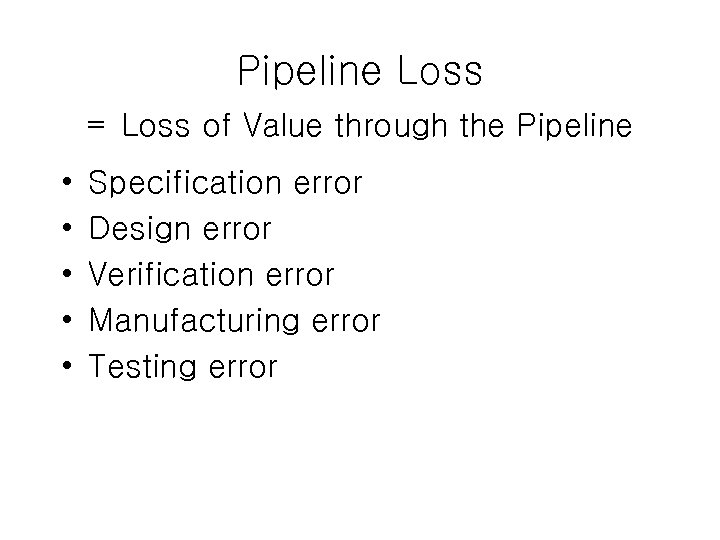 Pipeline Loss = Loss of Value through the Pipeline • • • Specification error Design error Verification error Manufacturing error Testing error
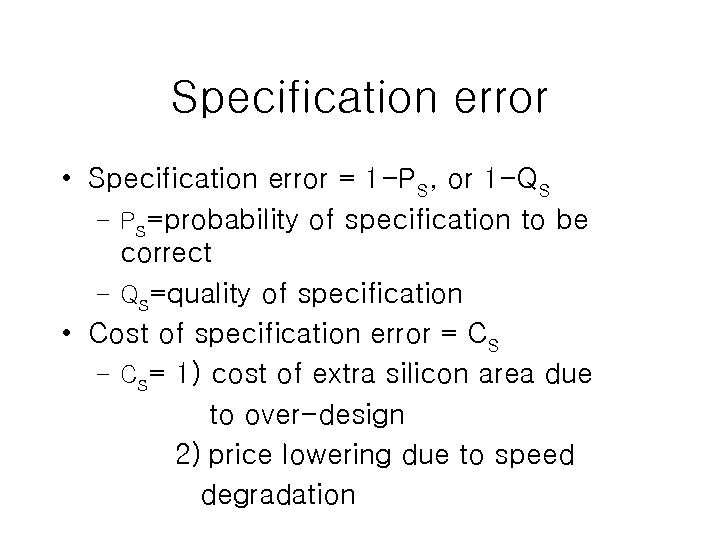 Specification error • Specification error = 1 -Ps, or 1 -Qs – Ps=probability of specification to be correct – Qs=quality of specification • Cost of specification error = Cs – Cs= 1) cost of extra silicon area due to over-design 2) price lowering due to speed degradation
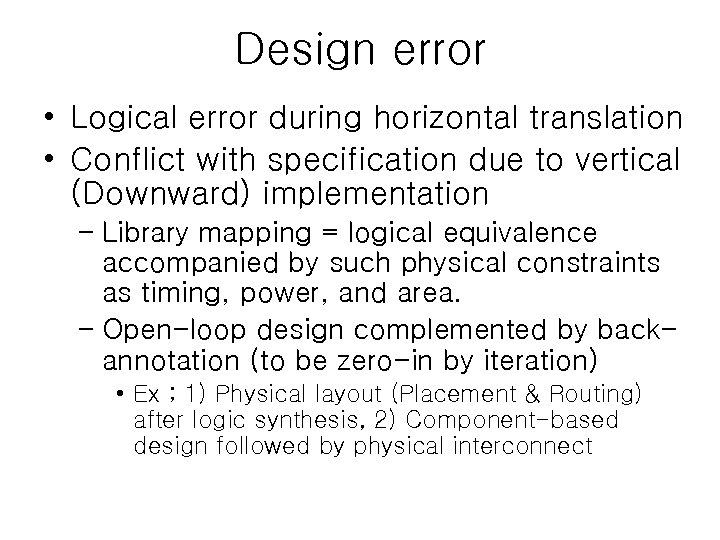 Design error • Logical error during horizontal translation • Conflict with specification due to vertical (Downward) implementation – Library mapping = logical equivalence accompanied by such physical constraints as timing, power, and area. – Open-loop design complemented by backannotation (to be zero-in by iteration) • Ex ; 1) Physical layout (Placement & Routing) after logic synthesis, 2) Component-based design followed by physical interconnect
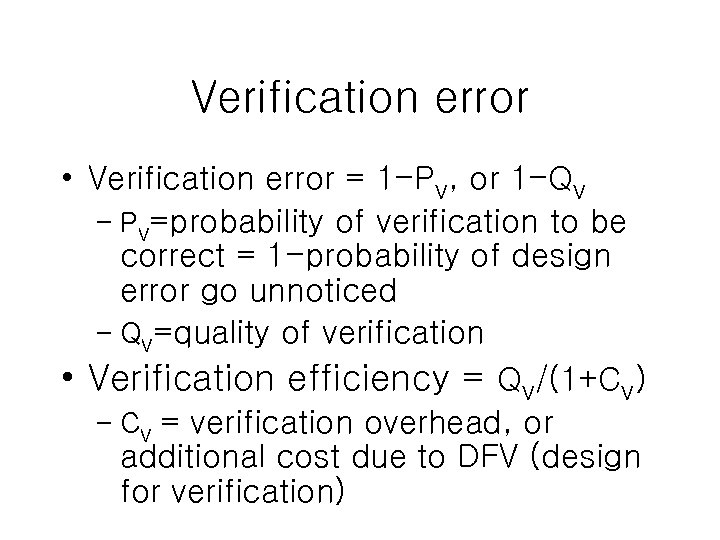 Verification error • Verification error = 1 -Pv, or 1 -Qv – Pv=probability of verification to be correct = 1 -probability of design error go unnoticed – Qv=quality of verification • Verification efficiency = Qv/(1+Cv) – Cv = verification overhead, or additional cost due to DFV (design for verification)
 Pitfalls in Specification • Over-specification/over-design ; miss market window. • Too-long term, too conservative design project ; components obsolete at launch time. ex) military design • Too many external IP’s with insufficient 2 nd sources or little room for royalty negotiation
 Give and Takes of each DFX • DFV (Design for Verification) ; Design time for design time, code size for number of iterations, intra computing effort for inter communication hassle • DFT (Design for Testing) ; Area for reputation, good chips rejected is a physical loss, while bad chips with latent bugs is a strategic loss (X-factor) • DFM (Design for Manufacturability) ; More NRE cost (tool cost, extra preprocessing step) for less unit cost • DFY (Design for Yield) ; more parametric extraction and simulation time for higher yield
 Area, delivery time, reputation, cost, speed, power
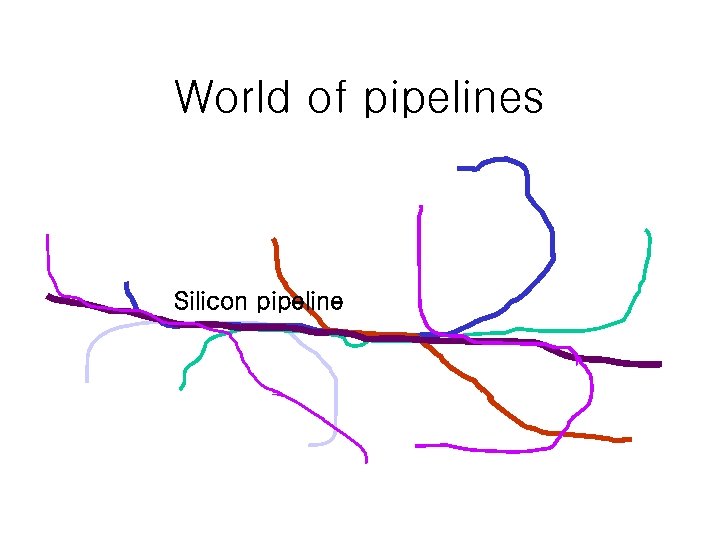 World of pipelines Silicon pipeline
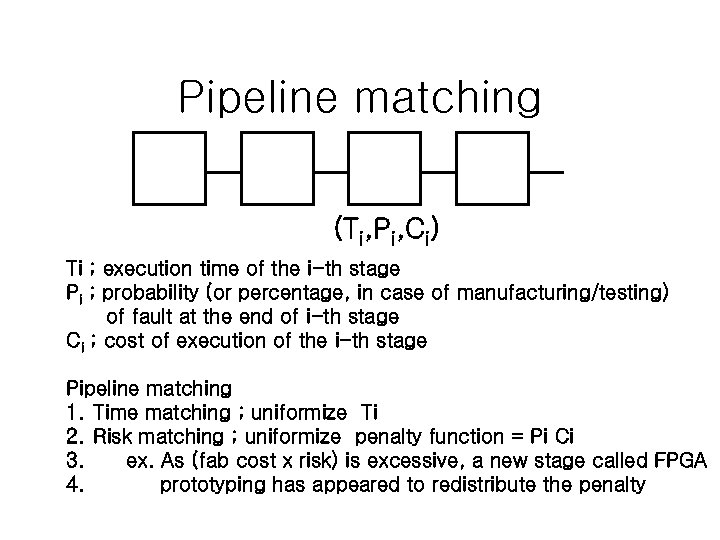 Pipeline matching (Ti, Pi, Ci) Ti ; execution time of the i-th stage Pi ; probability (or percentage, in case of manufacturing/testing) of fault at the end of i-th stage Ci ; cost of execution of the i-th stage Pipeline matching 1. Time matching ; uniformize Ti 2. Risk matching ; uniformize penalty function = Pi Ci 3. ex. As (fab cost x risk) is excessive, a new stage called FPGA 4. prototyping has appeared to redistribute the penalty
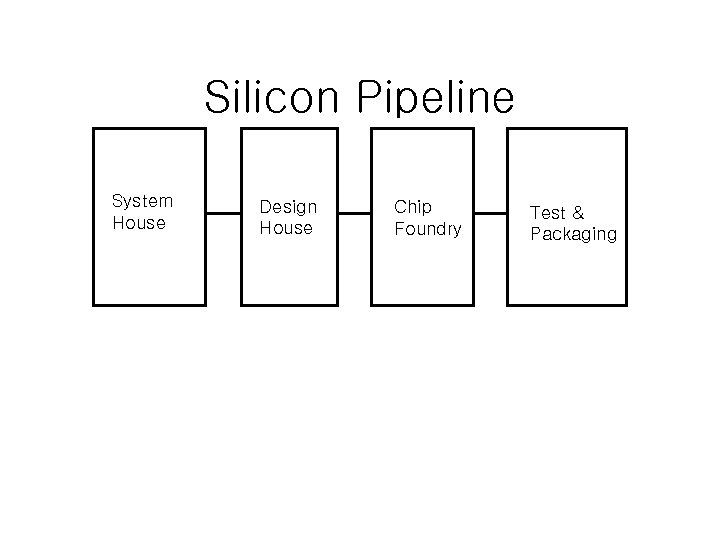 Silicon Pipeline System House Design House Chip Foundry Test & Packaging
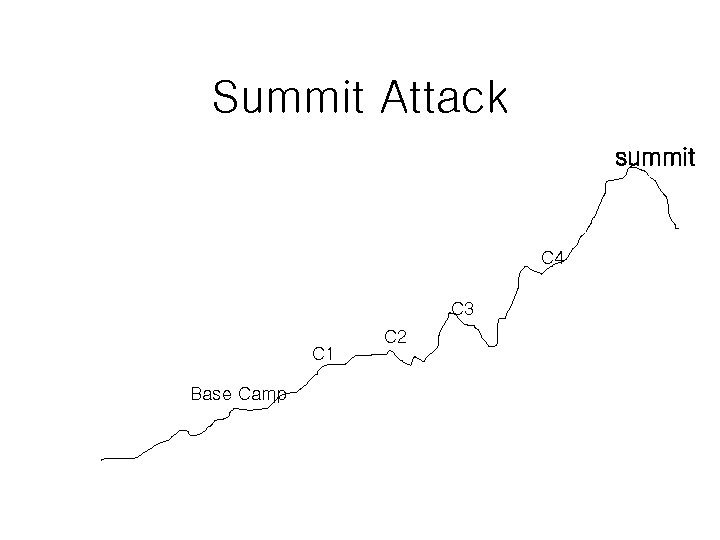 Summit Attack summit C 4 C 3 C 1 Base Camp C 2
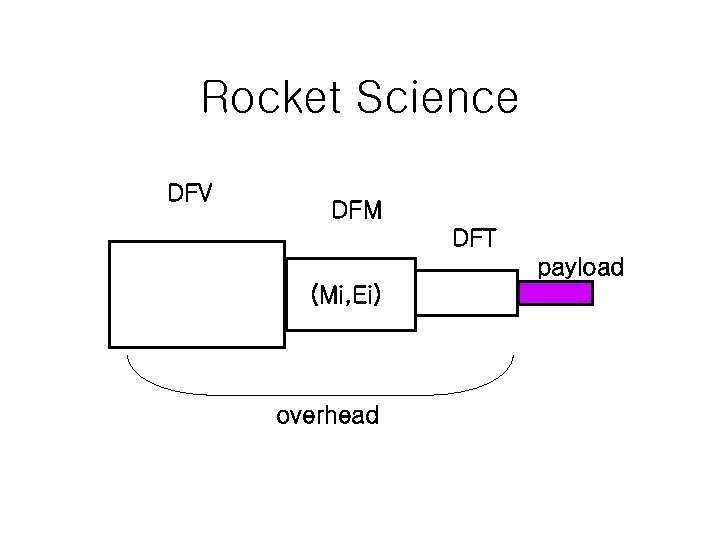 Rocket Science DFV DFM DFT payload (Mi, Ei) overhead
 Overhead of DFX DFV DFM DFT
 Fault population Effect of DFV & DFT ; more than just time saving! Without DFV & DFT Design Verify Manu facture Test With DFV & DFT
 Cost penalty of False pass/reject Stage i-1 pass reject Right pass False pass(FP) Right reject False reject(FR) Cost Penalty = FP x alpha + FR
 Cost penalty of False pass/reject Stage i-1 pass reject Right pass False pass(FP) Right reject False reject(FR) Cost Penalty = FP x alpha + FR
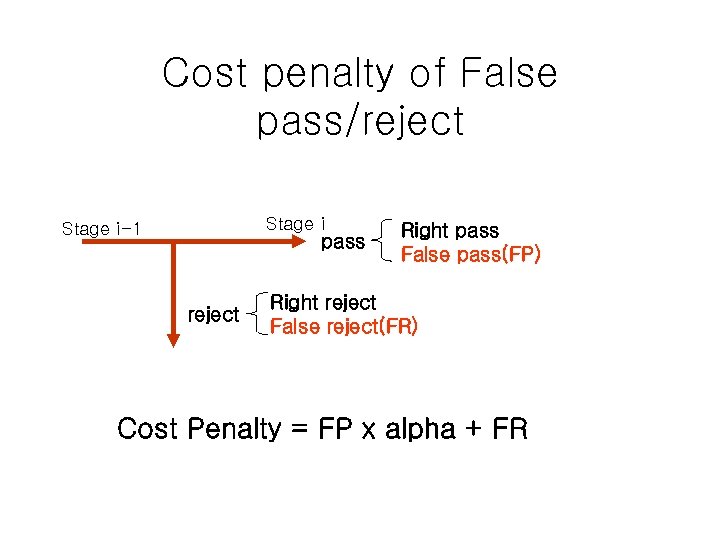
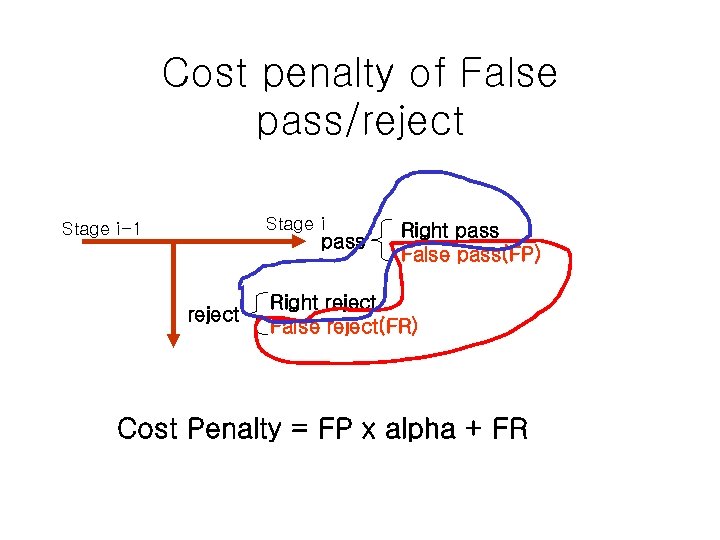
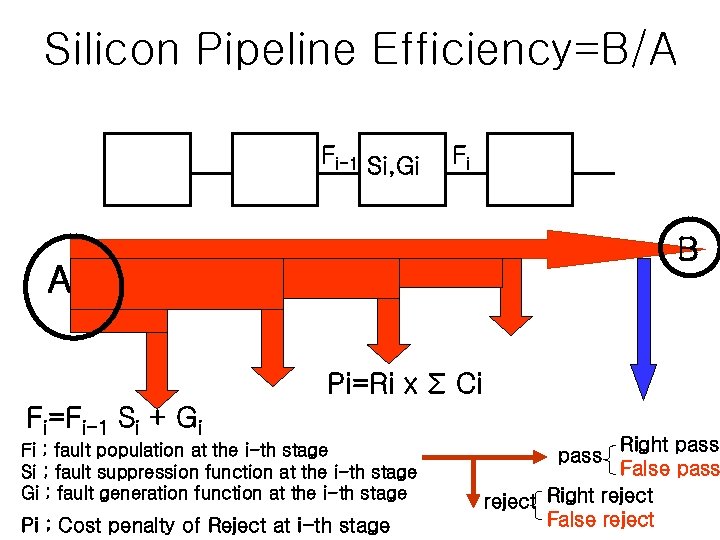 Silicon Pipeline Efficiency=B/A Fi-1 Si, Gi Fi B A Pi=Ri x Σ Ci Fi=Fi-1 Si + Gi Fi ; fault population at the i-th stage Si ; fault suppression function at the i-th stage Gi ; fault generation function at the i-th stage Pi ; Cost penalty of Reject at i-th stage Right pass False pass reject Right reject False reject pass
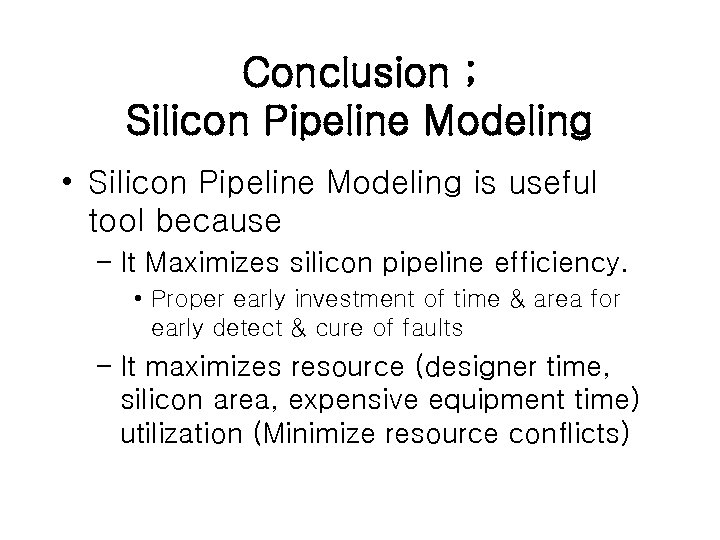 Conclusion ; Silicon Pipeline Modeling • Silicon Pipeline Modeling is useful tool because – It Maximizes silicon pipeline efficiency. • Proper early investment of time & area for early detect & cure of faults – It maximizes resource (designer time, silicon area, expensive equipment time) utilization (Minimize resource conflicts)