 Скачать презентацию Survey of the German Educational System by Eugen
685cecc1b4bd46616eb1402f5a30132a.ppt
- Количество слайдов: 32



"Survey of the German Educational System" by Eugen Weber, Marianum School, Fulda, Germany ewebmar@web. de 29 th March 2014 Hochschule Fulda, Germany
The German Educational System • • education in the federal republic general conditions at German schools performance at school the structure of the system: from kindergarden to university • international assessment of the system • the Sixth Form (years 11 to 13 / 10 to 12) • vocational training / university • Which way to go?
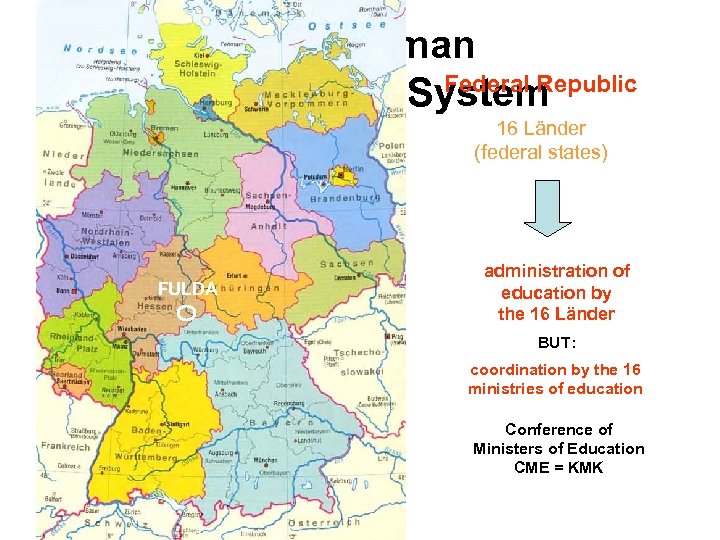
The German Federal Republic Educational System 16 Länder (federal states) FULDA administration of education by the 16 Länder BUT: coordination by the 16 ministries of education Conference of Ministers of Education CME = KMK
General conditions at German schools • free transportion to and from school (until Year 10) • free provision of school books • equal funding of schools (school type / number of students) • financial contribution by parents expected ("Elternspende" – "donation") but voluntary • equal pay for teachers depending on school type (though promotion - functions) • private schools (80% state funding, state syllabus with slight variations, rest church / private institutions, parents; exams chaired by state authority)
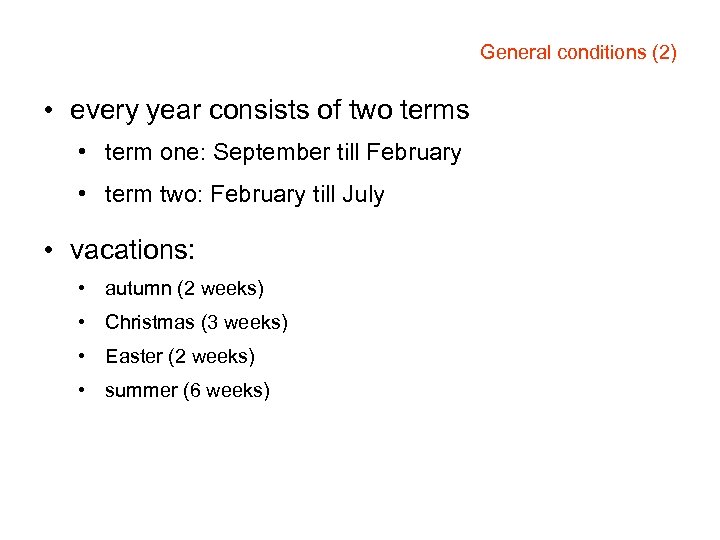
General conditions (2) • every year consists of two terms • term one: September till February • term two: February till July • vacations: • autumn (2 weeks) • Christmas (3 weeks) • Easter (2 weeks) • summer (6 weeks)
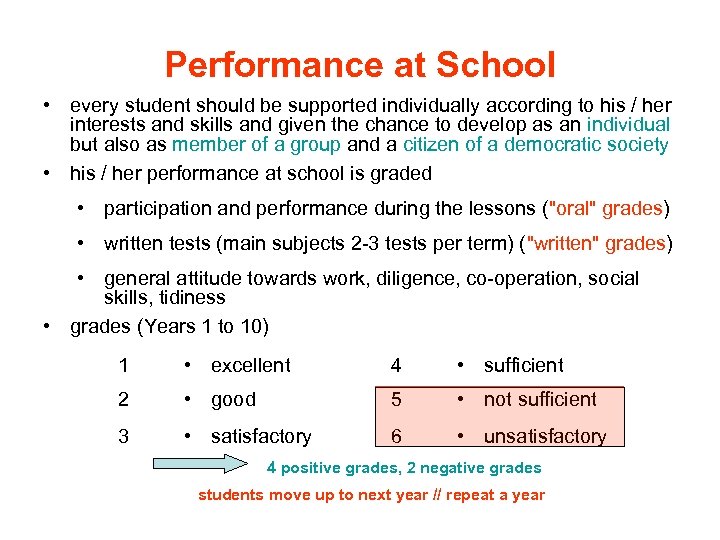
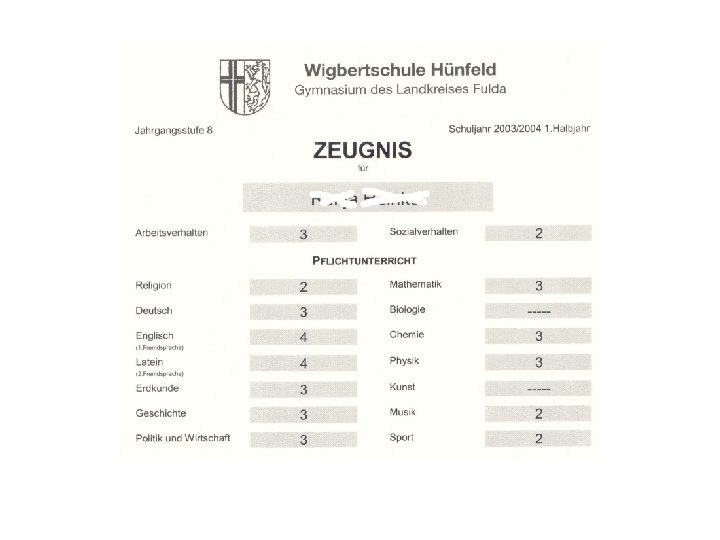
Performance at School • every student should be supported individually according to his / her interests and skills and given the chance to develop as an individual but also as member of a group and a citizen of a democratic society • his / her performance at school is graded • participation and performance during the lessons ("oral" grades) • written tests (main subjects 2 -3 tests per term) ("written" grades) • general attitude towards work, diligence, co-operation, social skills, tidiness • grades (Years 1 to 10) 1 • excellent 4 • sufficient 2 • good 5 • not sufficient 3 • satisfactory 6 • unsatisfactory 4 positive grades, 2 negative grades students move up to next year // repeat a year
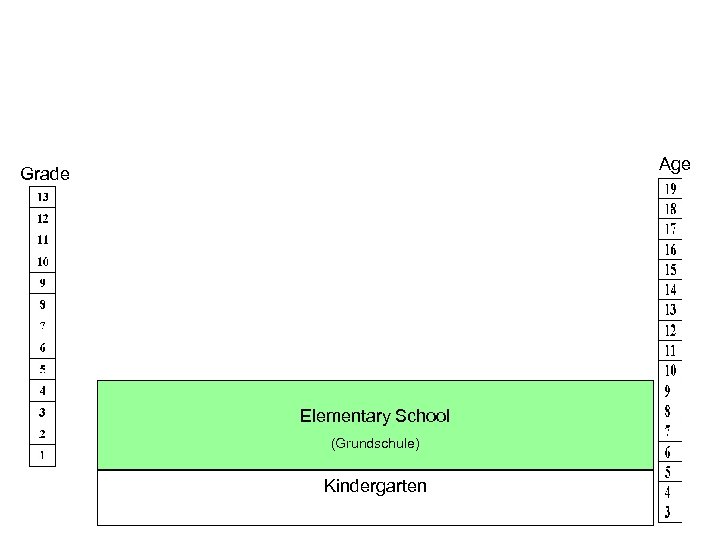
Age Grade Elementary School (Grundschule) Kindergarten
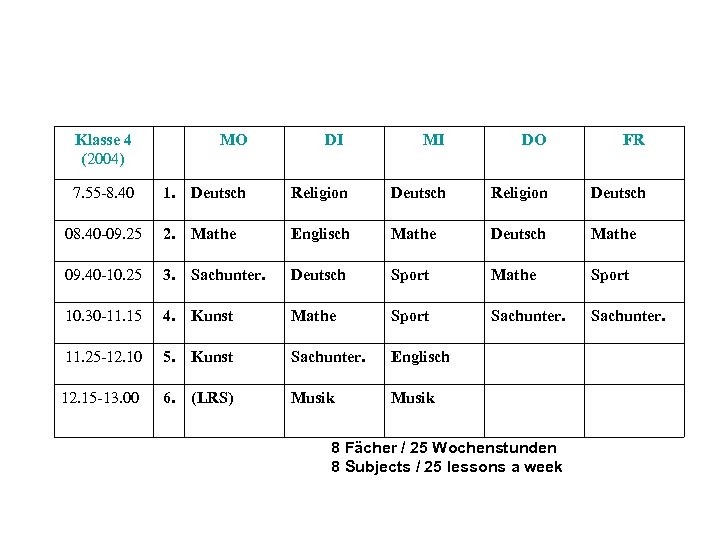
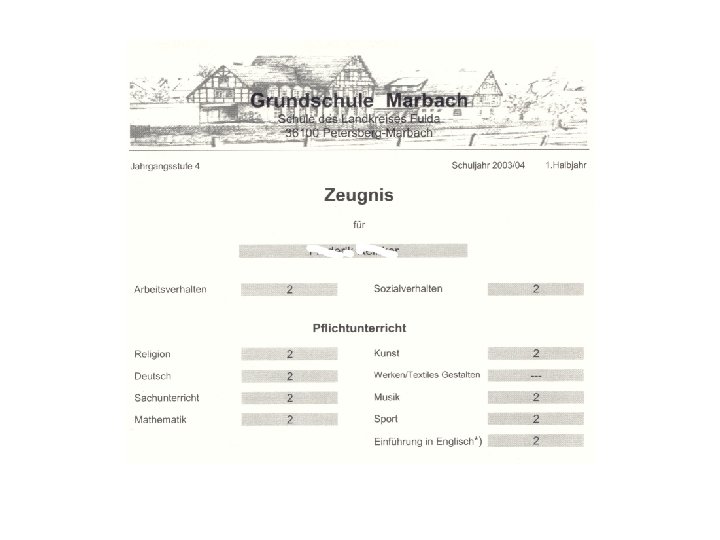
Klasse 4 (2004) MO DI MI DO FR 7. 55 -8. 40 1. Deutsch Religion Deutsch 08. 40 -09. 25 2. Mathe Englisch Mathe Deutsch Mathe 09. 40 -10. 25 3. Sachunter. Deutsch Sport Mathe Sport 10. 30 -11. 15 4. Kunst Mathe Sport Sachunter. 11. 25 -12. 10 5. Kunst Sachunter. Englisch 12. 15 -13. 00 6. (LRS) Musik 8 Fächer / 25 Wochenstunden 8 Subjects / 25 lessons a week
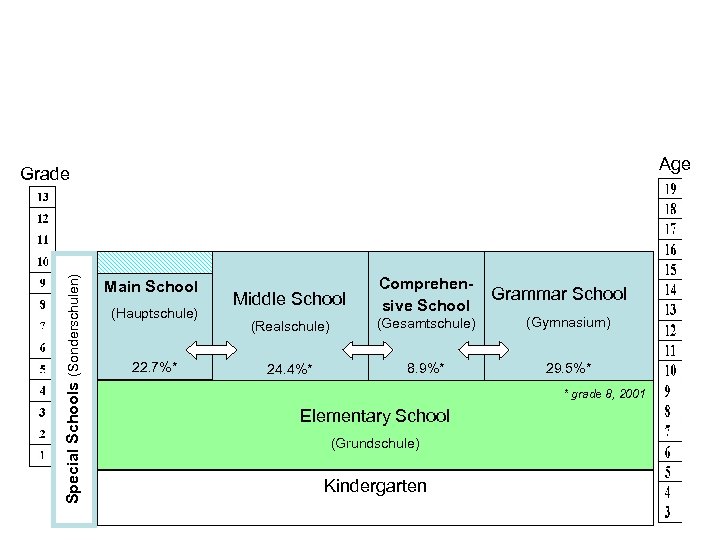
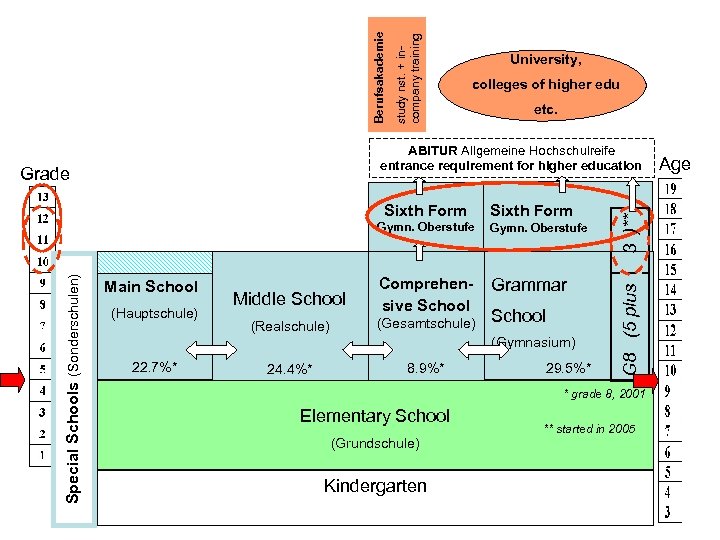
Age Special Schools (Sonderschulen) Grade Main School (Hauptschule) 22. 7%* Middle School Comprehensive School (Realschule) (Gesamtschule) (Gymnasium) 24. 4%* 8. 9%* 29. 5%* Grammar School * grade 8, 2001 Elementary School (Grundschule) Kindergarten
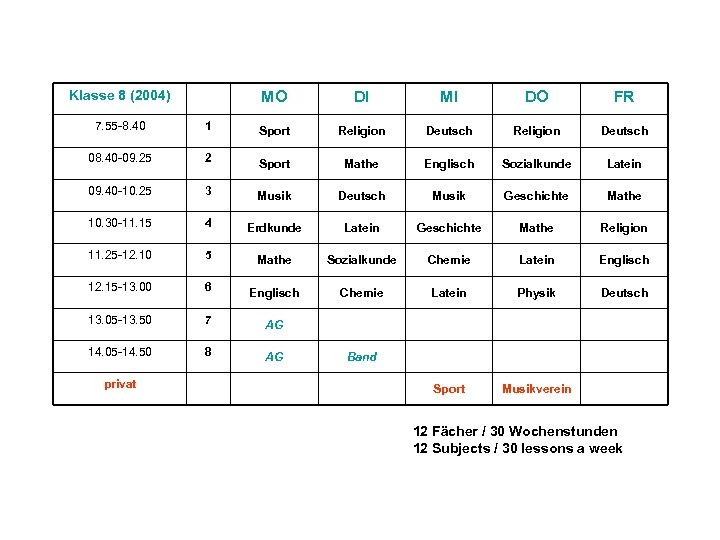
Klasse 8 (2004) MO DI MI DO FR 7. 55 -8. 40 1 Sport Religion Deutsch 08. 40 -09. 25 2 Sport Mathe Englisch Sozialkunde Latein 09. 40 -10. 25 3 Musik Deutsch Musik Geschichte Mathe 10. 30 -11. 15 4 Erdkunde Latein Geschichte Mathe Religion 11. 25 -12. 10 5 Mathe Sozialkunde Chemie Latein Englisch 12. 15 -13. 00 6 Englisch Chemie Latein Physik Deutsch 13. 05 -13. 50 7 AG 14. 05 -14. 50 8 AG Sport Musikverein privat Band 12 Fächer / 30 Wochenstunden 12 Subjects / 30 lessons a week
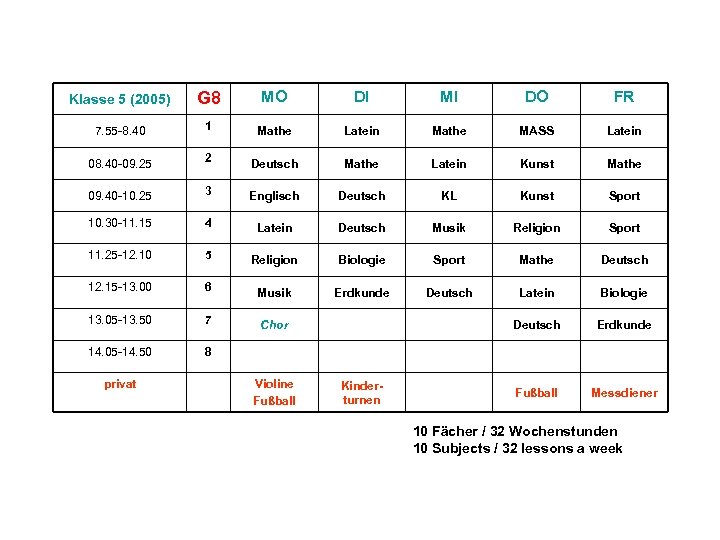
Klasse 5 (2005) G 8 MO DI MI DO FR 7. 55 -8. 40 1 Mathe Latein Mathe MASS Latein 08. 40 -09. 25 2 Deutsch Mathe Latein Kunst Mathe 09. 40 -10. 25 3 Englisch Deutsch KL Kunst Sport 10. 30 -11. 15 4 Latein Deutsch Musik Religion Sport 11. 25 -12. 10 5 Religion Biologie Sport Mathe Deutsch 12. 15 -13. 00 6 Musik Erdkunde Deutsch Latein Biologie 13. 05 -13. 50 7 Chor Deutsch Erdkunde 14. 05 -14. 50 8 Fußball Messdiener privat Violine Fußball Kinderturnen 10 Fächer / 32 Wochenstunden 10 Subjects / 32 lessons a week
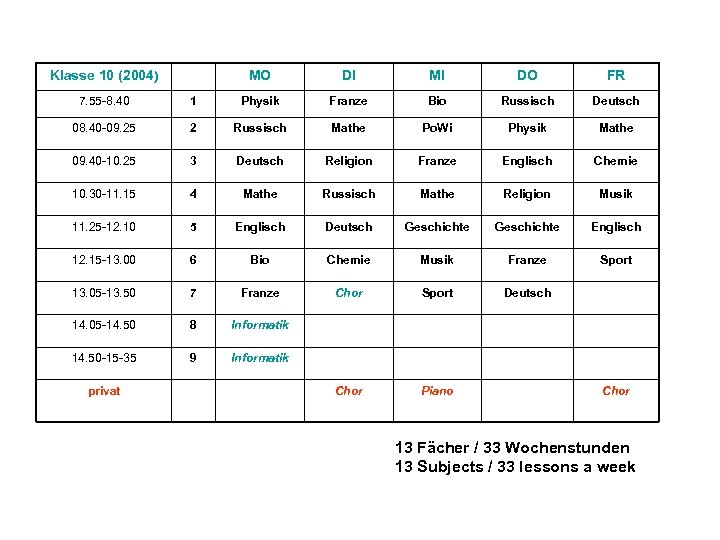
Klasse 10 (2004) MO DI MI DO FR 7. 55 -8. 40 1 Physik Franze Bio Russisch Deutsch 08. 40 -09. 25 2 Russisch Mathe Po. Wi Physik Mathe 09. 40 -10. 25 3 Deutsch Religion Franze Englisch Chemie 10. 30 -11. 15 4 Mathe Russisch Mathe Religion Musik 11. 25 -12. 10 5 Englisch Deutsch Geschichte Englisch 12. 15 -13. 00 6 Bio Chemie Musik Franze Sport 13. 05 -13. 50 7 Franze Chor Sport Deutsch 14. 05 -14. 50 8 Informatik 14. 50 -15 -35 9 Informatik Chor Piano privat Chor 13 Fächer / 33 Wochenstunden 13 Subjects / 33 lessons a week
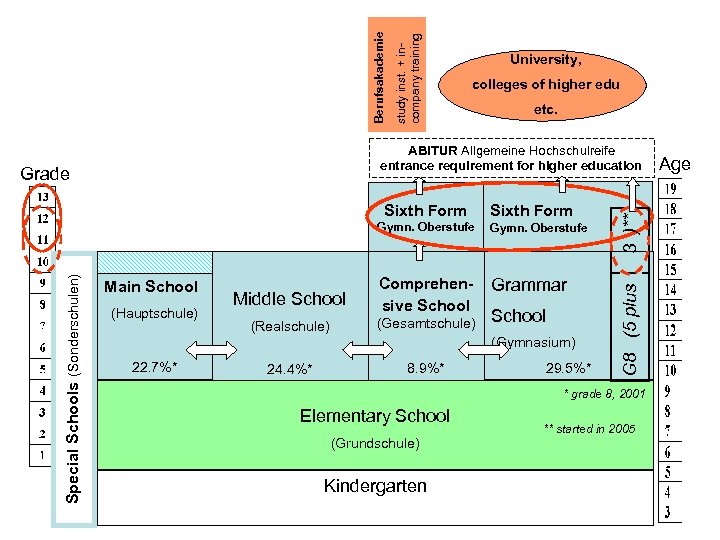
study inst. + incompany training Berufsakademie University, colleges of higher edu etc. Sixth Form Special Schools (Sonderschulen) Gymn. Oberstufe Main School (Hauptschule) Gymn. Oberstufe Middle School Comprehensive School Grammar (Realschule) (Gesamtschule) School (Gymnasium) 22. 7%* 24. 4%* 8. 9%* 29. 5%* G 8 (5 plus Grade 3 )** ABITUR Allgemeine Hochschulreife entrance requirement for higher education * grade 8, 2001 Elementary School (Grundschule) Kindergarten ** started in 2005 Age
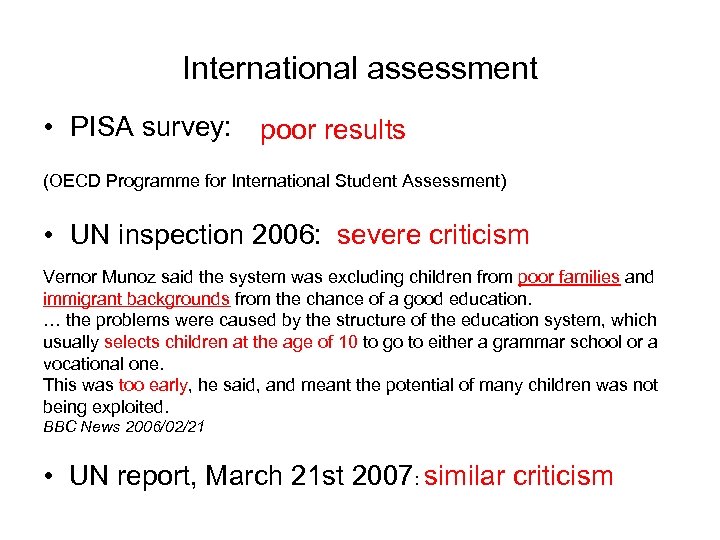
International assessment • PISA survey: poor results (OECD Programme for International Student Assessment) • UN inspection 2006: severe criticism Vernor Munoz said the system was excluding children from poor families and immigrant backgrounds from the chance of a good education. … the problems were caused by the structure of the education system, which usually selects children at the age of 10 to go to either a grammar school or a vocational one. This was too early, he said, and meant the potential of many children was not being exploited. BBC News 2006/02/21 • UN report, March 21 st 2007: similar criticism
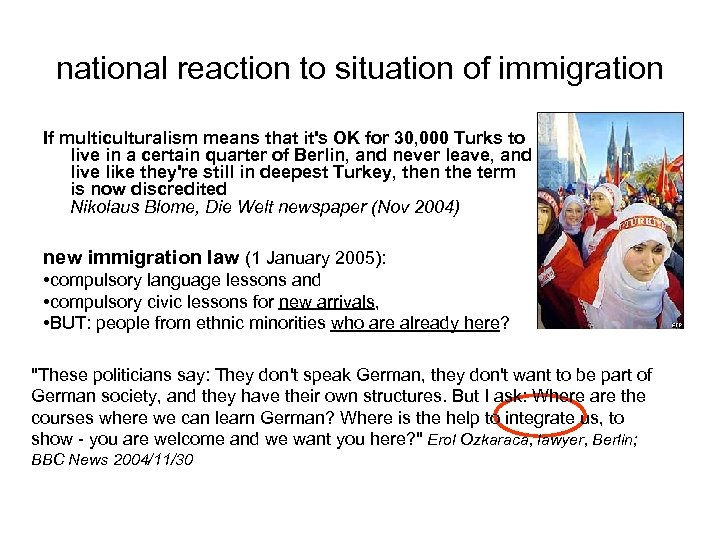
national reaction to situation of immigration If multiculturalism means that it's OK for 30, 000 Turks to live in a certain quarter of Berlin, and never leave, and live like they're still in deepest Turkey, then the term is now discredited Nikolaus Blome, Die Welt newspaper (Nov 2004) new immigration law (1 January 2005): • compulsory language lessons and • compulsory civic lessons for new arrivals, • BUT: people from ethnic minorities who are already here? "These politicians say: They don't speak German, they don't want to be part of German society, and they have their own structures. But I ask: Where are the courses where we can learn German? Where is the help to integrate us, to show - you are welcome and we want you here? " Erol Ozkaraca, lawyer, Berlin; BBC News 2004/11/30

German education system fails immigrant children March 22, 2007 GENEVA -- Germany's education system fails migrant and refugee children through its policies of academic selection, which compound existing social and economic discrimination, a UN human rights report said Wednesday. Secondary education in Germany varies between each "Land" (federal state) but it broadly divides pupils between vocational training ("Hauptschule"), intermediate level ("Realschule"), or academic school aiming for higher education ("Gymnasium"). "It is clear that this early classification militates against the less-advantaged children and teenagers, " said the report by the UN's Special Rapporteur on the right to education, Vernor Munoz. […] Poor children of immigrant origin are over-represented at the "Hauptschule" level and under-represented at the "Gymnasium, " the UN report noted. "The system would appear to have a negative effect, since the disadvantaged end up being doubly disadvantaged, " it said. […]

. t. . b o c e nt o ue in . . . d
study nst. + incompany training Berufsakademie University, colleges of higher edu etc. Sixth Form Special Schools (Sonderschulen) Gymn. Oberstufe Main School (Hauptschule) Gymn. Oberstufe Middle School Comprehensive School Grammar (Realschule) (Gesamtschule) School (Gymnasium) 22. 7%* 24. 4%* 8. 9%* 29. 5%* G 8 (5 plus Grade 3 )** ABITUR Allgemeine Hochschulreife entrance requirement for higher education * grade 8, 2001 Elementary School (Grundschule) Kindergarten ** started in 2005 Age
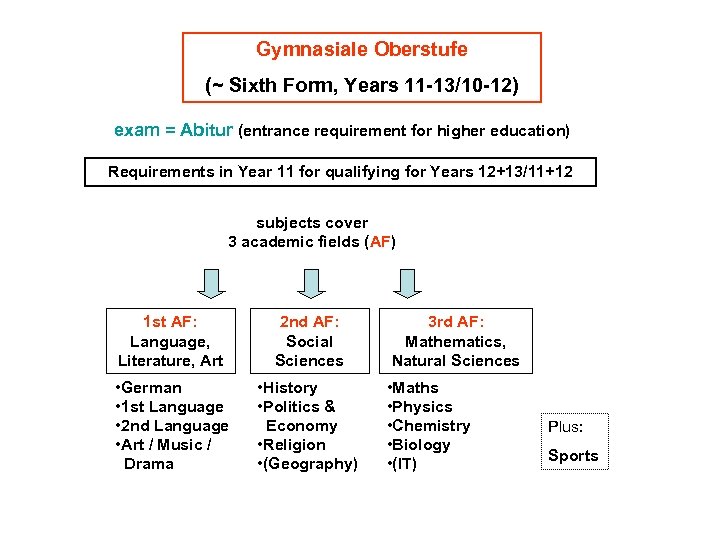
Gymnasiale Oberstufe (~ Sixth Form, Years 11 -13/10 -12) exam = Abitur (entrance requirement for higher education) Requirements in Year 11 for qualifying for Years 12+13/11+12 subjects cover 3 academic fields (AF) 1 st AF: Language, Literature, Art 2 nd AF: Social Sciences • German • 1 st Language • 2 nd Language • Art / Music / Drama • History • Politics & Economy • Religion • (Geography) 3 rd AF: Mathematics, Natural Sciences • Maths • Physics • Chemistry • Biology • (IT) Plus: Sports
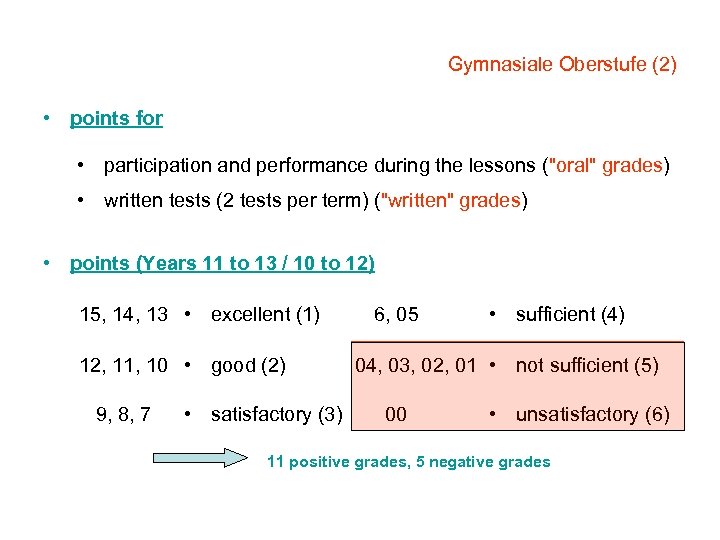
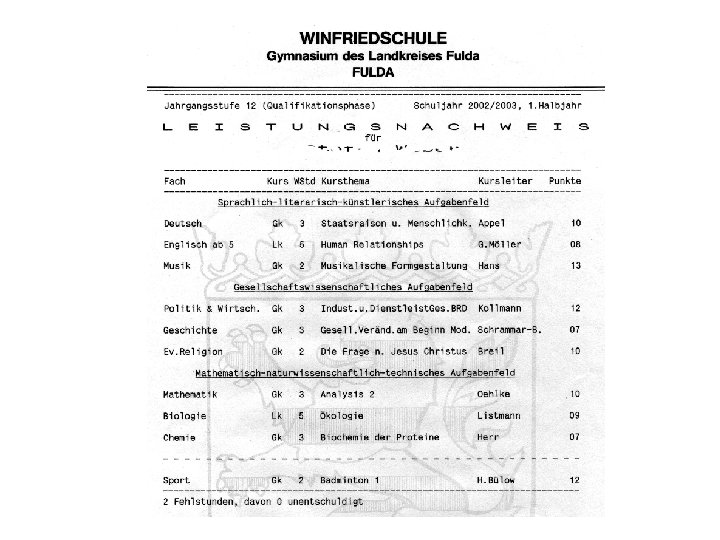
Gymnasiale Oberstufe (2) • points for • participation and performance during the lessons ("oral" grades) • written tests (2 tests per term) ("written" grades) • points (Years 11 to 13 / 10 to 12) 15, 14, 13 • excellent (1) 12, 11, 10 • good (2) 9, 8, 7 • satisfactory (3) 6, 05 • sufficient (4) 04, 03, 02, 01 • not sufficient (5) 00 • unsatisfactory (6) 11 positive grades, 5 negative grades
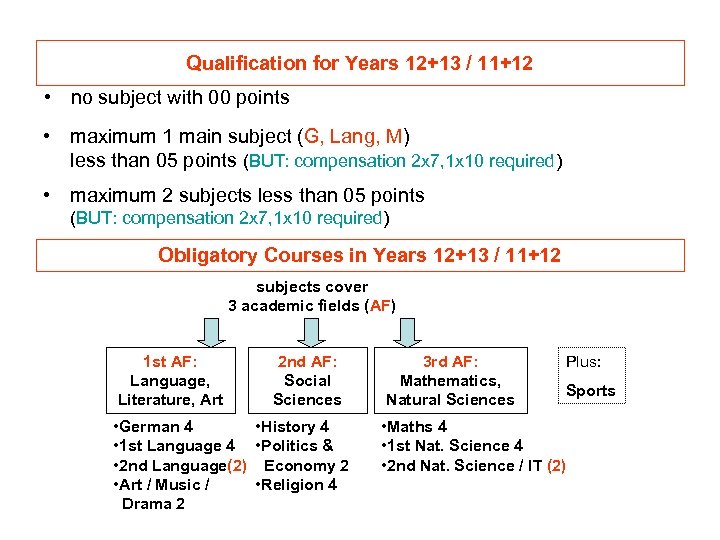
Qualification for Years 12+13 / 11+12 • no subject with 00 points • maximum 1 main subject (G, Lang, M) less than 05 points (BUT: compensation 2 x 7, 1 x 10 required) • maximum 2 subjects less than 05 points (BUT: compensation 2 x 7, 1 x 10 required) Obligatory Courses in Years 12+13 / 11+12 subjects cover 3 academic fields (AF) 1 st AF: Language, Literature, Art 2 nd AF: Social Sciences • German 4 • History 4 • 1 st Language 4 • Politics & • 2 nd Language(2) Economy 2 • Art / Music / • Religion 4 Drama 2 3 rd AF: Mathematics, Natural Sciences Plus: Sports • Maths 4 • 1 st Nat. Science 4 • 2 nd Nat. Science / IT (2)
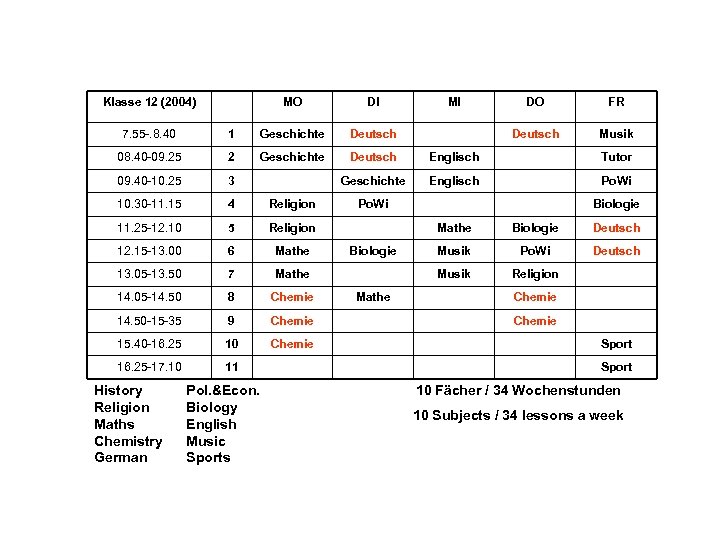
Klasse 12 (2004) MO DI MI DO FR Deutsch Musik 7. 55 -. 8. 40 1 Geschichte Deutsch 08. 40 -09. 25 2 Geschichte Deutsch Englisch Tutor 09. 40 -10. 25 3 Geschichte Englisch Po. Wi 10. 30 -11. 15 4 Religion 11. 25 -12. 10 5 Religion 12. 15 -13. 00 6 Mathe 13. 05 -13. 50 7 Mathe 14. 05 -14. 50 8 Chemie 14. 50 -15 -35 9 Chemie 15. 40 -16. 25 10 Chemie 16. 25 -17. 10 11 History Religion Maths Chemistry German Pol. &Econ. Biology English Music Sports Po. Wi Biologie Mathe Deutsch Musik Po. Wi Deutsch Musik Biologie Religion Chemie Sport 10 Fächer / 34 Wochenstunden 10 Subjects / 34 lessons a week
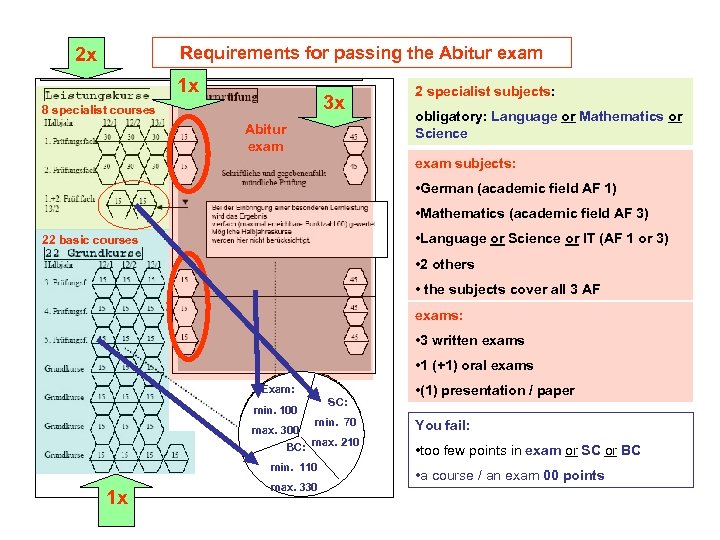
Requirements for passing the Abitur exam 2 x 1 x 3 x 8 specialist courses Abitur exam 2 specialist subjects: obligatory: Language or Mathematics or Science exam subjects: • German (academic field AF 1) • Mathematics (academic field AF 3) • Language or Science or IT (AF 1 or 3) 22 basic courses • 2 others • the subjects cover all 3 AF exams: • 3 written exams • 1 (+1) oral exams Exam: SC: min. 100 max. 300 min. 70 BC: max. 210 min. 110 1 x max. 330 • (1) presentation / paper You fail: • too few points in exam or SC or BC • a course / an exam 00 points
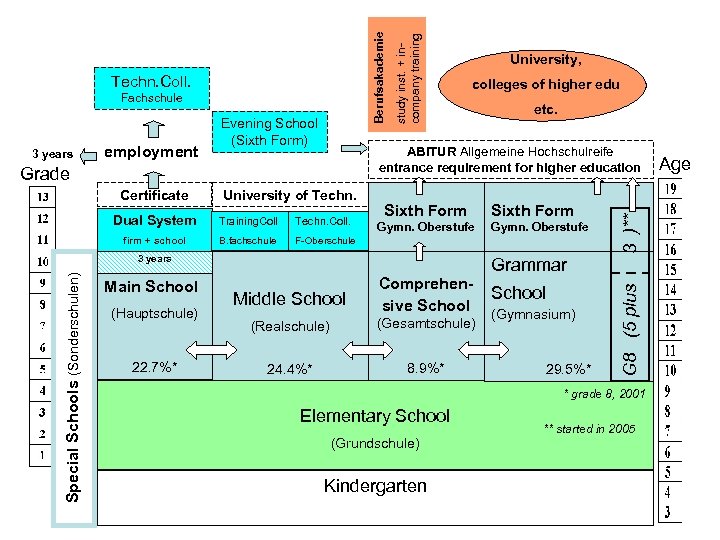
Fachschule ABITUR Allgemeine Hochschulreife entrance requirement for higher education Grade Certificate University of Techn. Dual System Training. Coll Techn. Coll. firm + school B. fachschule Sixth Form F-Oberschule Gymn. Oberstufe 3 years Special Schools (Sonderschulen) etc. Main School (Hauptschule) 22. 7%* Middle School Comprehensive School (Realschule) (Gesamtschule) 24. 4%* 8. 9%* Gymn. Oberstufe 3 )** employment colleges of higher edu Grammar School (Gymnasium) 29. 5%* G 8 (5 plus 3 years Evening School (Sixth Form) study inst. + incompany training Berufsakademie Techn. Coll. University, * grade 8, 2001 Elementary School (Grundschule) Kindergarten ** started in 2005 Age
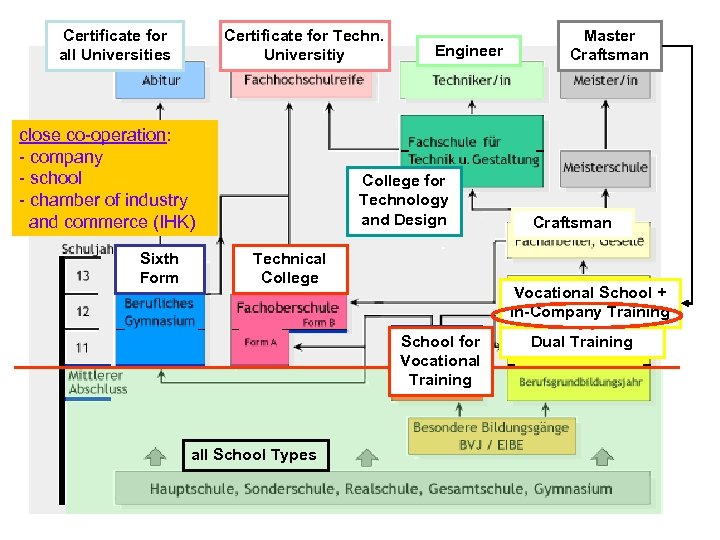
Certificate for all Universities Certificate for Techn. Universitiy close co-operation: - company - school - chamber of industry and commerce (IHK) Sixth Form Engineer College for Technology and Design Technical College Craftsman Vocational School + In-Company Training School for Vocational Training all School Types Master Craftsman Dual Training
Which way to go? ?
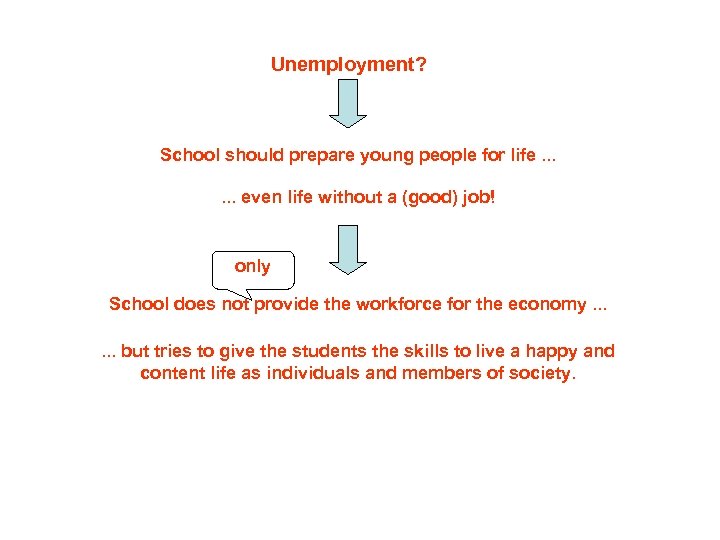
Unemployment? School should prepare young people for life. . . even life without a (good) job! only School does not provide the workforce for the economy. . . but tries to give the students the skills to live a happy and content life as individuals and members of society.
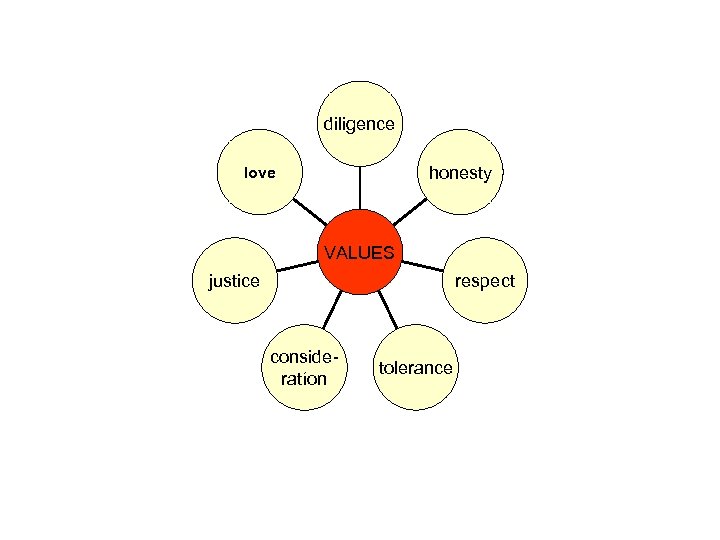
diligence honesty love VALUES respect justice consideratíon tolerance
Education is more than Mathematics and Latin.
Скачать презентацию Survey of the German Educational System by Eugen
685cecc1b4bd46616eb1402f5a30132a.ppt