 Скачать презентацию Survey Infrastructure more precisely SDSS Software Infrastructure Robert
f2e727548dea700dff66abfa6a2dba93.ppt
- Количество слайдов: 20



Survey Infrastructure more precisely, SDSS Software Infrastructure Robert Lupton (Princeton)
What's Different about Big Surveys? • Totally automated processing in the face of – Variable transparency – Variable optics/atmosphere – Every situation that your code failed to account for • A desire for uniformly high quality in the data products • A desire for total uniformity • A desire that the data be reduced (then rereduced) in finite time • Living within a large collaboration 2 (With no conception from the consumers as to quite how hard this is to assure)
SDSS Software Manifest • • • Telescope axis PID loops and other Real-Time Control A Telescope Control System A Data Acquisition (DA) System Operator Programs and Health-and-Safety monitoring Mountain Databases (tactical and strategic) Code Infrastructure Image Processing/Spectroscopy Code Calibration Code An Operational Database Quality Assurance (QA) Capability Collaboration Infrastructure A Science Database 3
Software Organisation • Distributed Development – Deserving /Establishing/Maintaining trust is crucial – We shared out distinct subsystems geographically • Collaboration Tools – Archived mailing lists – Phone ’cons – Face-to-Face meetings 4
Lessons I Learned from SDSS These are in the order that they came to mind, so I suppose that they're roughly sorted. I haven't included the technical lessons concerning such matters as how to calibrate TDI data. It hardly needs to be emphasized that these are my opinions which, for all I know, may not be those of any other person, living or dead. Some of these are obvious, but were honoured in the breach by the SDSS project. 5
Project Management You need a strong and impartial project manager. SDSS is a collaboration of a large number of institutions and we have never managed to take technical decisions unimpeded by politics. 6
Funding Don't go into a project that isn't fully funded. SDSS’s problems (see 1) have been compounded by our continuing need to placate universities that might put in money. (I'm not sure that I'm following the Rule as I get involved in Pan-STARRS and LSST; but failing to follow the Rule makes a good project manager even more important). 7
The Constitution Neither Science nor Software can be run as a democracy. Not all participants are equal, and it's folly to pretend that they are. This is not to say that the most senior (or smartest) individual should simply lay down the law. 8
When, What, and How to Review • If some component is failing, admit it even if this involves embarrassing people and institutions. You should not, of course, make this any more public than necessary. • Put resources where they're needed, not where it's politically convenient to put them. • Saying that broken code is good enough isn't a conservative approach, even if it saves resources in the short term. • Only hold reviews if you really want to 9 learn from the review board.
Standard Software Practices • Source code control at the level of files (e. g. cvs) • Code control at the level of releases that can be reconstructed, along with their dependent products • Enforced rules about tests associated with each new feature • Tools, preferably integrated with the code/release control system, to track problems and feature requests (we use Gnats). • An insistence on adhering to standards; e. g. coding to ISO C 89 and Posix 1003. 1. • All code should compile with no warnings 10
Distribute Data and Information Freely • Be as open as possible, and make all information and discussion open to the entire collaboration as soon as practical. • Make data available to the collaboration (or the world) as soon as possible, in a form as close to the final format as possible. 11
Personality Cults Avoid single points of failure. OK, so this is totally obvious, but there are subtler aspects: • If one person is allowed to become essential it implies that it's proved impossible to find someone else who could fill their role. In consequence, if they are on the critical path, and problems arise, it's hard to add resources to solve the problem. • If someone with essential knowledge isn't very good, then an essential component of your system isn't going to work very well. 12
Glory and Honour Find some way to reward people working on the project • The promise of data in the distant future doesn't help a post-doc much. • I don't think that the solution ‘Hire Professional Programmers’ is viable. <hobbyhorse> My personal belief is that the only long term way out of this is to integrate instrumentation (hardware and software) into the astronomy career path. 13 </hobbyhorse>
Be Ambitious Strive to ensure that the software takes full advantage of the hardware, even at the beginning of a project. This is partly a matter of principle, and partly because if you don't push to the instrumental limit you don't really know if things are working as well as they should. There is some tension in achieving this, and you need someone to keep the schedule. 14
Project Organisation • Don't generate an inverted management structure. Work to ensure that everyone in a position of authority has a clear view of their own strengths and weaknesses, and try to ensure that decisions are taken for technical reasons wherever possible. • If you are forced into a situation where the software effort is large, divide and conquer --manage the project as a tree with a branching ratio of less than 10. 15

Good Luck 16
Image Processing Code • SSC – Read and reformat raw data files – Find image quartiles for flat fields/psp – Find stars for astrometry/PSF determination • PSP – Determine the flat fields, scattered light, bias drift, PSF, aperture corrections. • Astrom – Find the astrometric solution using positions of stars measured in the PSP • Frames – Perform all the standard per-field processing (trim; flatfield; linearise; interpolate bad columns/saturation trails; find and patch cosmic rays – Find objects; merge bands; deblend; measure properties – about 4000 instructions/pixel/band 17
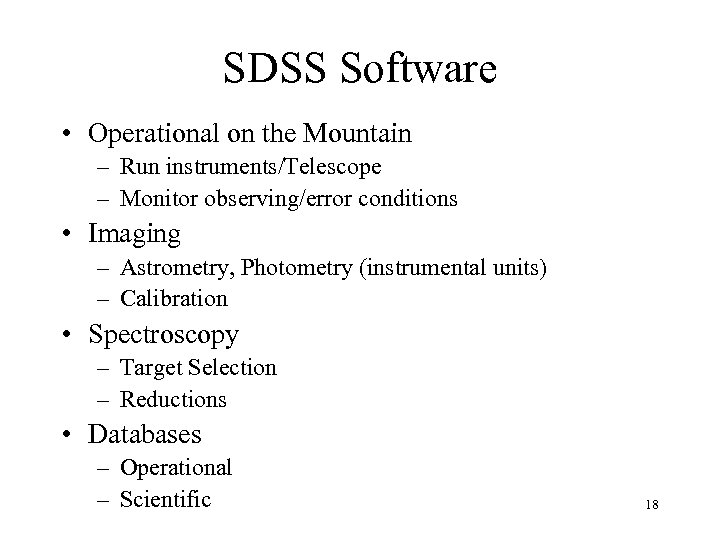
SDSS Software • Operational on the Mountain – Run instruments/Telescope – Monitor observing/error conditions • Imaging – Astrometry, Photometry (instrumental units) – Calibration • Spectroscopy – Target Selection – Reductions • Databases – Operational – Scientific 18
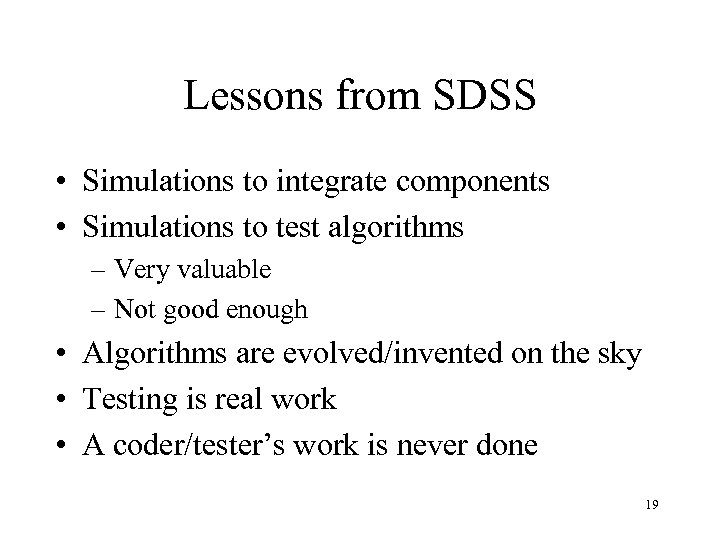
Lessons from SDSS • Simulations to integrate components • Simulations to test algorithms – Very valuable – Not good enough • Algorithms are evolved/invented on the sky • Testing is real work • A coder/tester’s work is never done 19
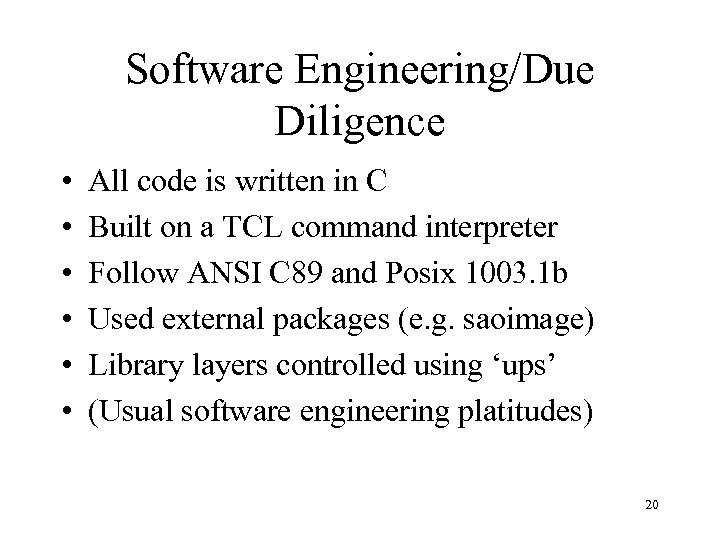
Software Engineering/Due Diligence • • • All code is written in C Built on a TCL command interpreter Follow ANSI C 89 and Posix 1003. 1 b Used external packages (e. g. saoimage) Library layers controlled using ‘ups’ (Usual software engineering platitudes) 20
Скачать презентацию Survey Infrastructure more precisely SDSS Software Infrastructure Robert
f2e727548dea700dff66abfa6a2dba93.ppt