


 Скачать презентацию SURGICAL LEGACY OF SUSHRUTHA S IN ANCIENT INDIA Dr
4b622a9f9ecd988bac8dc533aadc9609.ppt
- Количество слайдов: 31
 SURGICAL LEGACY OF SUSHRUTHA’S IN ANCIENT INDIA… Dr. ANIL PANDE Neurosurgeon, VHS Hospital, Chennai, India. Click for the next
 The beginning of the medical sciences in India have been traced to the proficiency of the Indus valley people in town planning, sanitation, and hygiene, representing the oldest surviving examples of town planning…… indicate remarkable concern for public health. . D. P. SINGHAL India and world civilization Click for the next
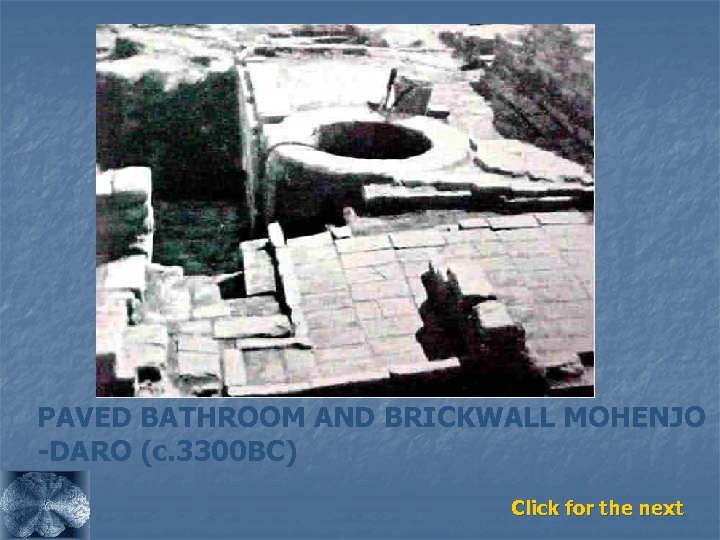 PAVED BATHROOM AND BRICKWALL MOHENJO -DARO (c. 3300 BC) Click for the next
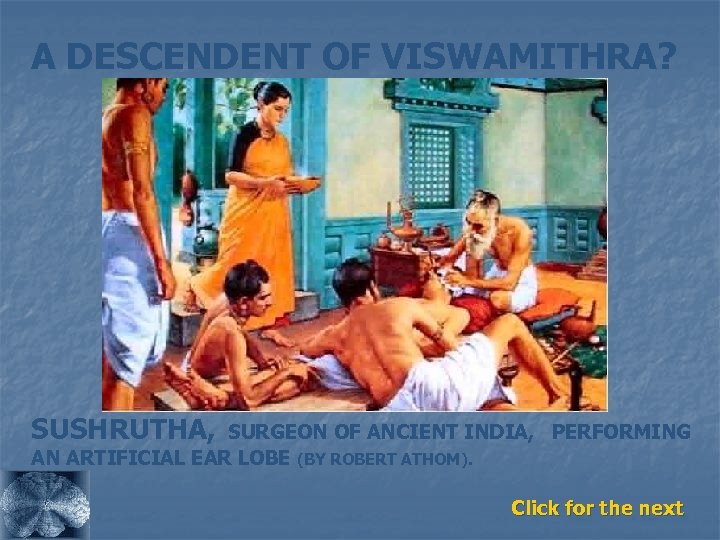 A DESCENDENT OF VISWAMITHRA? SUSHRUTHA, SURGEON OF ANCIENT INDIA, PERFORMING AN ARTIFICIAL EAR LOBE (BY ROBERT ATHOM). Click for the next
 WHEN DID HE LIVE ? MENTIONED IN THE MAHABHARATHA (1000 BC). WESTERN SCHOLARS PLACE HIM 2 nd TO 4 th CENTURY A. D. --- NOT ACCEPTED BY MANY. Click for the next
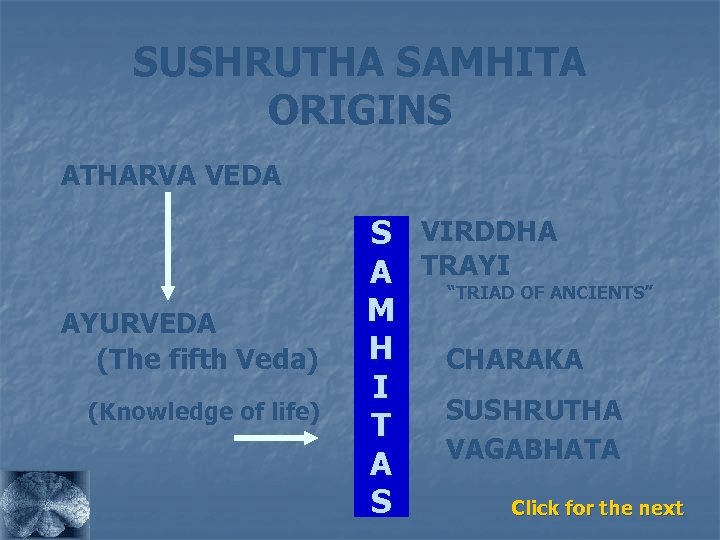 SUSHRUTHA SAMHITA ORIGINS ATHARVA VEDA AYURVEDA (The fifth Veda) (Knowledge of life) S VIRDDHA A TRAYI “TRIAD OF ANCIENTS” M H CHARAKA I SUSHRUTHA T VAGABHATA A S Click for the next
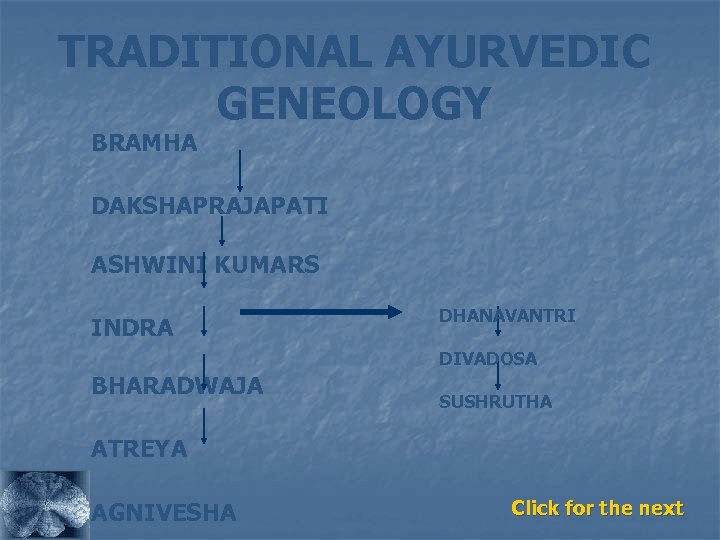 TRADITIONAL AYURVEDIC GENEOLOGY BRAMHA DAKSHAPRAJAPATI ASHWINI KUMARS INDRA DHANAVANTRI DIVADOSA BHARADWAJA SUSHRUTHA ATREYA AGNIVESHA Click for the next
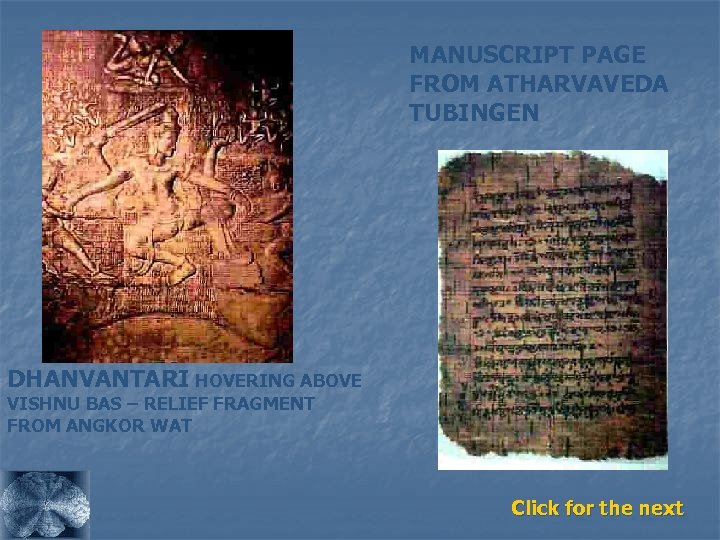 MANUSCRIPT PAGE FROM ATHARVAVEDA TUBINGEN DHANVANTARI HOVERING ABOVE VISHNU BAS – RELIEF FRAGMENT FROM ANGKOR WAT Click for the next
 “THE ENCYCLOPEDIC WORKS OF CHARAKA AND SUSHRUTHA ARE THE PRODUCTS OF A FULLY EVOLVED SYSTEM WHICH RESEMBLES THOSE OF HIPPOCRATES, AND GALEN IN SOME RESPECTS; AND WHICH IN OTHERS HAD DEVELOPED BEYOND THEM”. A. L. BASHAM “The Wonder that was India” Click for the next
 SUSHRUTHA SAMHITA TEACHING INITIALLY BY WORD OF MOUTH -- THEREFORE THE TIME OF ORIGIN IS STILL CONTROVERSIAL. PRESENT THOUGHT: 10 – 6 TH BC. Revised by NAGARJUNA 2 nd – 4 thcentury BC KITAB-I-SUSRURD 8 th Century AD (Mentioned by Rhazes as authority on surgery) Click for the next
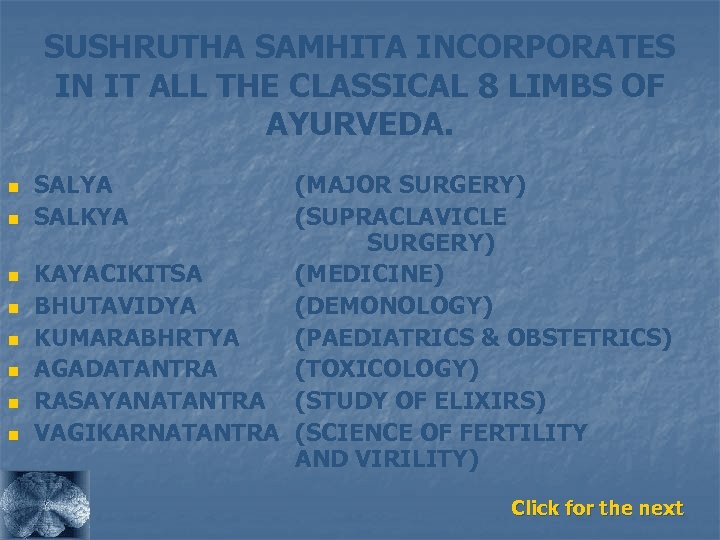 SUSHRUTHA SAMHITA INCORPORATES IN IT ALL THE CLASSICAL 8 LIMBS OF AYURVEDA. n n n n SALYA SALKYA (MAJOR SURGERY) (SUPRACLAVICLE SURGERY) KAYACIKITSA (MEDICINE) BHUTAVIDYA (DEMONOLOGY) KUMARABHRTYA (PAEDIATRICS & OBSTETRICS) AGADATANTRA (TOXICOLOGY) RASAYANATANTRA (STUDY OF ELIXIRS) VAGIKARNATANTRA (SCIENCE OF FERTILITY AND VIRILITY) Click for the next
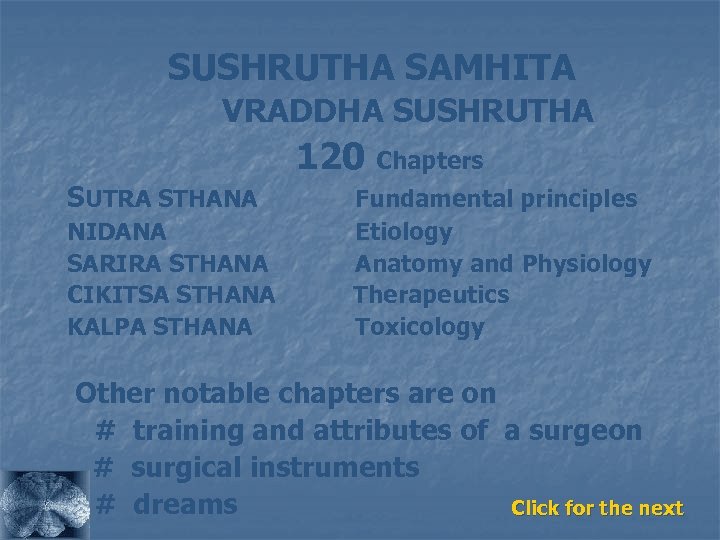 SUSHRUTHA SAMHITA VRADDHA SUSHRUTHA 120 Chapters SUTRA STHANA NIDANA SARIRA STHANA CIKITSA STHANA KALPA STHANA Fundamental principles Etiology Anatomy and Physiology Therapeutics Toxicology Other notable chapters are on # training and attributes of a surgeon # surgical instruments # dreams Click for the next
 SUSHRUTHA SAMHITA UTTARA TANTRA An addendum ? Work of later authors and commentators. Click for the next
 Sushrutha Samhita SUTRA STHANA THERE ARE FOUR DIFFERENT TYPES OF DISEASES. # AGANTUKA TRAUMATIC OR EXTRANEOUS ORIGIN # SARIRA BODILY # MANASA ? MENTAL # SWABAVIKA NATURAL (Excessive anger, grief, fear, joy, despondency, envy, misery, pride, greed, lust, desire, malice, are included within the category of manasa disorders. ) Click for the next
 FACT OR MYTH ? “ANOTHER SIGNIFICANT FEATURE OF HINDU MEDICINE WAS THE ABSENCE OF ANY ATTEMPT TO RECOGNIZE DISEASES OF THE BRAIN”. H. J. J WINTER In A. L. BASHAM ’s A cultural History of India 1974, Oxford. Click for the next
 Rare mention about the Brain? ! SARIRA STHANA In the fifth month the fetus is endowed with the mind and wakes up from the sleep of his subconscious existence. In the sixth month cognition (Buddhi)comes in. In the seventh month all the limbs and members of its body are markedly developed. SANUKA says that probably the head of the fetus is the first developed since head is the only organ that makes the functions of all other organs possible. Click for the next
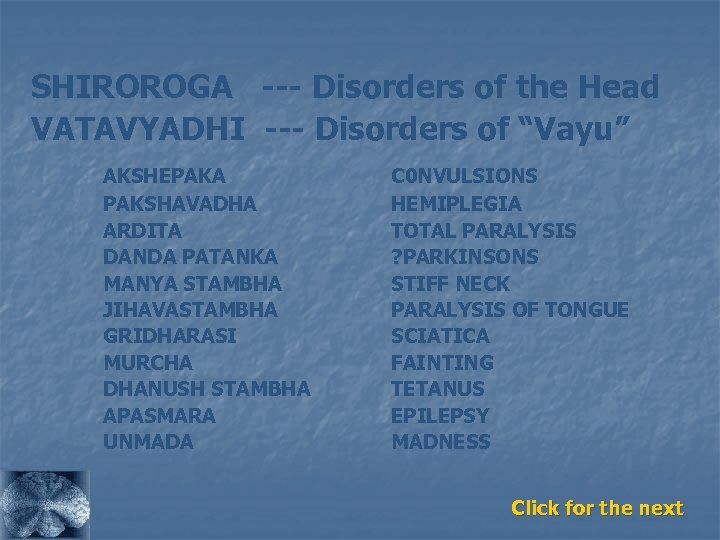 SHIROROGA --- Disorders of the Head VATAVYADHI --- Disorders of “Vayu” AKSHEPAKA PAKSHAVADHA ARDITA DANDA PATANKA MANYA STAMBHA JIHAVASTAMBHA GRIDHARASI MURCHA DHANUSH STAMBHA APASMARA UNMADA C 0 NVULSIONS HEMIPLEGIA TOTAL PARALYSIS ? PARKINSONS STIFF NECK PARALYSIS OF TONGUE SCIATICA FAINTING TETANUS EPILEPSY MADNESS Click for the next
 SUSHRUTHA CONSIDERED THE HEAD AS THE CENTER OF ALL SPECIAL SENSES, AND DESCRIBES CERTAIN CRANIAL NERVES CONNECTED WITH SPECIFIC SENSORY FUNCTIONS. Click for the next
 # two nerves lower down at the back of ear (vidhura) which if cut produce deafness. # a pair of nerves inside the two nostrils which if cut cause anosmia. # a pair of nerves below the end of the eyebrow which if cut causes blindness. -Keswani. N. H. Medical Heritage of India Click for the next
 “Ten nerves maintain the functions of the body by carrying impulses of sound, touch, vision, taste, smell, respiration, sighing, yawning, hunger, laughing, speech, and crying…” “A pair of nerve each responds to sound, touch, vision, taste, and smell. ” Sushrutha Samhita Click for the next
 SVASTIKA YANTRAS Total no of instruments mentioned in the Sushrutha tantra 125 Forceps 20 types Specula Scalpels Scissors Saws Cauteries Syringes Needles Trocars Catheters Click for the next
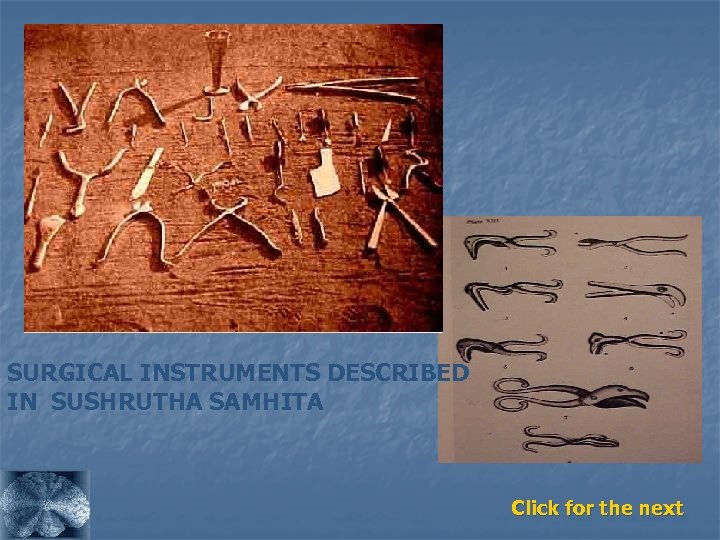 SURGICAL INSTRUMENTS DESCRIBED IN SUSHRUTHA SAMHITA Click for the next
 SURGERY Specific fumigation techniques, Cautery with fire and alkali, Use of Ants to staple wounds, POORVAKARMA PRADHANAKARMA PACHATHAKARMA # Pre operative sedation. # Sammohini. # Sanjivini. Click for the next
 Influence on the world The patronage of the Abbasid Caliphs at BAGHDAD 762. A. D. and most especially HARUN AL RASHID (786 -809) kept the torch of learning alive during the dark ages. Indian Physicians were in charge of their hospitals, and one Manak translated the SUSHRUTHA SAMITHA into ARABIC (8 th century AD). Click for the next
 HINDU MEDICINE WAS AN INDEPENDENT DEVELOPMENT; ARAB MEDICINE WAS FOUNDED ON TRANSLATION OF SANSKRIT TREATISE, AND EUROPEAN MEDICINE DOWN TO THE SEVENTH CENTURY WAS BASED UPON THE LATIN VERSION OF THE ARABIAN TRANSLATION. -SIR WILLIAM HUNTER (1718 -1783) Click for the next
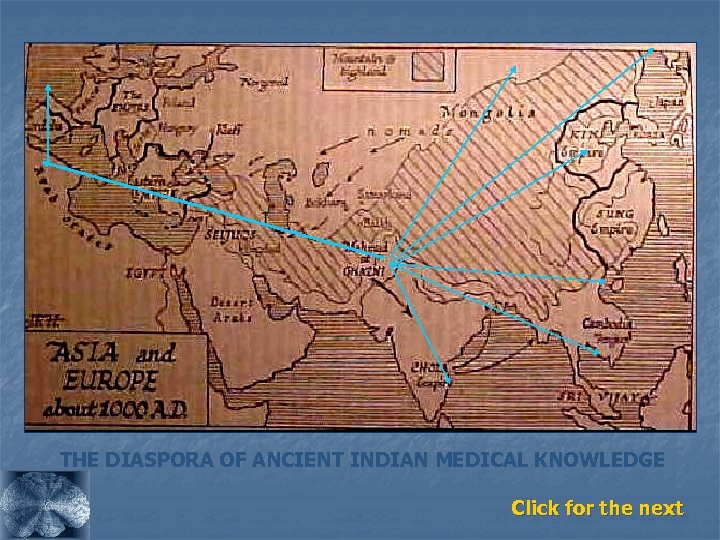 THE DIASPORA OF ANCIENT INDIAN MEDICAL KNOWLEDGE Click for the next
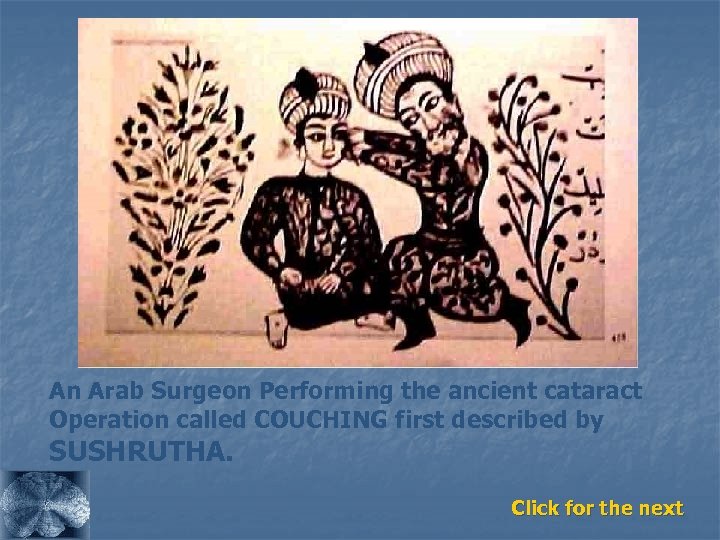 An Arab Surgeon Performing the ancient cataract Operation called COUCHING first described by SUSHRUTHA. Click for the next
 “Medicine can now be regarded as the oldest of the Indian sciences, and have been proved to be the science in which Indians specialized first”. Julius Jolly as quoted in ‘Indian Medicine’ by C. G. KASHIKAR Click for the next
 “INDIAN SURGERY REMAINED AHEAD OF EUROPEAN UNTIL THE 18 TH CENTURY, WHEN THE SURGEONS OF THE EAST INDIA COMPANY WERE NOT ASHAMED TO LEARN THE ART OF RHINOPLASTY FROM THE INDIANS”. A. L. BASHAM (The wonder that was India, 1971) Click for the next
 SUSHRUTHA SAMHITA Sushrutha divided 1120 diseases into natural and supernatural. He taught palpation and auscultation of heart, lungs, and womb; and advocated the use of special senses. He was the pioneer of most teaching techniques in experimental and clinical surgery. Click for the next
 CONCLUSION To Sushrutha, belongs the honor of being called “the FATHER OF SURGERY” and the ‘PATRON OF A SURGEON IN TRAINING’, as he was the first before all to emphasize on practical training in experimental and clinical surgery.