


 Скачать презентацию Supporting your ideas Lecture 7 Supporting your
Supporting your ideas.pptx
- Количество слайдов: 30
 Supporting your ideas Lecture 7

 Supporting your ideas • Facts and statistics • Testimony • Examples • Narratives • Techniques for using supporting materials • Deciding what support material you should use
 Facts and statistics • Most objective form of supporting material • Facts – statements that can be verified by independent observers • Statistics – numerical facts • Don’t depend on experiences of a single person • Are repeatedly confirmed by people
 Facts • A reliable form of knowledge – Most students at our university work while attending lessons – Most industrious students at our university work while attending lessons • Sometimes can be confusing – Prove that such claims are justified
 Facts • Look for support from independent sources – According to the results of National Students Survey, which had 1200 participants, most industrious students at our university work while attending lessons • What is – Information – Misinformation – Disinformation
 Statistics • Numerical facts – Describe the size of something – Make predictions – Illustrate trends – Show relationships • Especially useful in persuasive speeches
 Statistics • There are 30. 000 known human diseases, but we have treatments for only 10. 000 (Michael J. Fox, Keynote Address to the Bio International Convention, 8 May 2007) • Round off numbers to show the importance of a problem
 Statistics • Since 1988, more than one hundred thousand Kazakhstani people died in firearm suicides, homicides, and unintentional injuries. In 1995 alone, 761 Kazakhstani citizens died by gunfire. . . • Use exact numbers when the topic is controversial
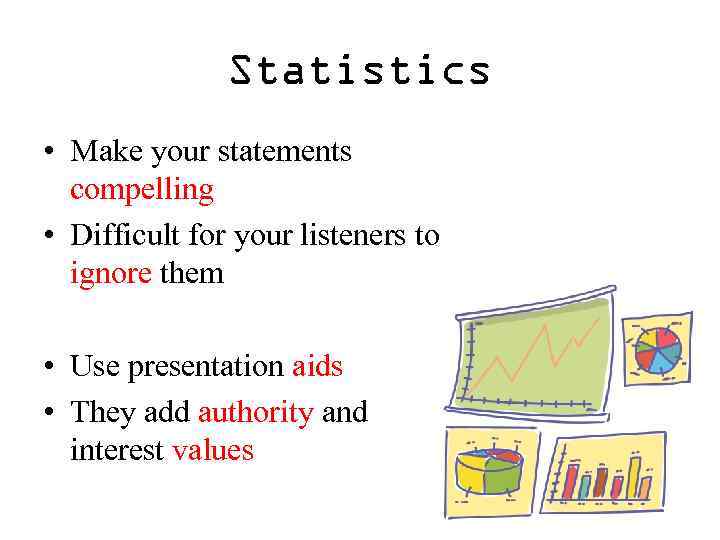 Statistics • Make your statements compelling • Difficult for your listeners to ignore them • Use presentation aids • They add authority and interest values
 Evaluating facts and statistics • Have a good collection of facts and statistics – Relevant – Representative – Current – Come from credible sources – Consistent – Complete
 Using facts and statistics Definitions • Translate unfamiliar or technical terms into words your listeners will understand Descriptions Explanations • Help clarify a topic or demonstrate how it works • “a word picture” to help listeners visualize what you are talking about
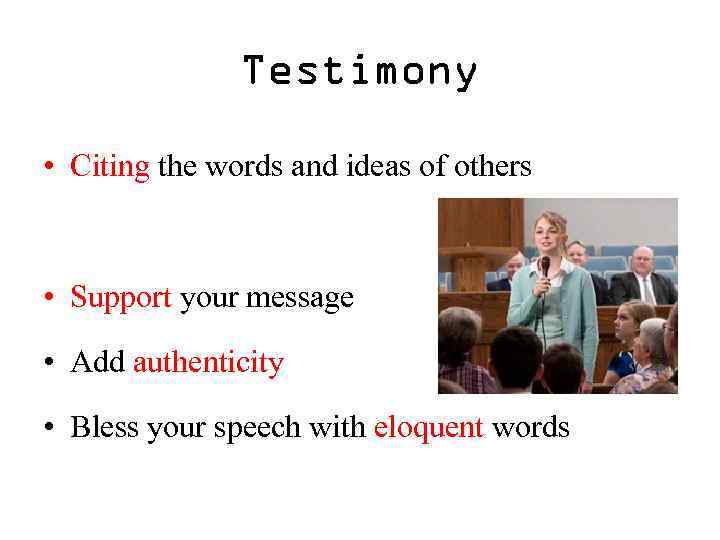 Testimony • Citing the words and ideas of others • Support your message • Add authenticity • Bless your speech with eloquent words
 Expert testimony • Comes from people who are qualified by training or experience Dr. Frances Golzales, chair of Criminal Justice Department and former member of the Presidential Task Force on Inner-City Violence, said last week in the Washington Post that a law requiring the licensing of handguns …
 Prestige testimony • Associates your message with words of a respected public figure Twenty years after D-Day, former President Eisenhower returned to his place and walked through these rows. He spoke of his joy of being a grandfather and then he said, “When I look at all these graves, I think of the parents back in the states whose only son is buried here”
 Lay testimony • Represents the wisdom of ordinary people • Comes from people who have firsthand experience with a topic • People who have strong feelings about it • Understanding or real-life consequences of issues • Adds authenticity and compassion to ideas
 Evaluating testimony • Consider the relevance • Expert testimony – Evaluate your source • Lay testimony – Consider whether it will help listeners understand the human aspect of your message • Prestige testimony – Think about how your listeners may feel about the person you are citing
 Using testimony • Direct quotation – When you repeat the exact words of others • Paraphrase – When you restate in your own words what others have said • Quoting out of context – Twist the meaning to fit your purposes
 Examples • Bring a speech to life • Serve as verbal illustrations for a message • Good examples – Illuminate the message – Make it clearer – Make it more vivid for the audience
 Types of examples • Brief example – Mentions a specific instance to demonstrate a more general statement One percent is not merely a number on a balance sheet. One percent is the girl in Africa who gets to go to school, thanks to you. One percent is the AIDS patient who gets her medicine, thanks to you. One percent is the African entrepreneur who can start a small family business, thanks to you.
 Types of examples • Extended examples – Contain more details and allows you to concentrate more fully on the illustration • Factual examples – Is based on an actual event or the experiences of a real person • Hypothetical examples – A composite of actual people, situations and events. It claims to represent reality
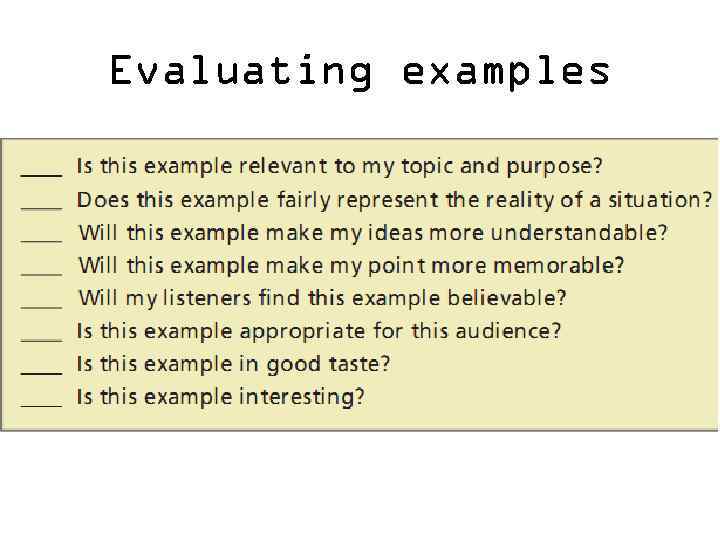 Evaluating examples
 Using examples • Use examples to – Emphasize major points – Attract and hold attention – Clarify abstract ideas • Keep examples brief • Make use of transitions to move smoothly – For instance…. , as you can see…. .
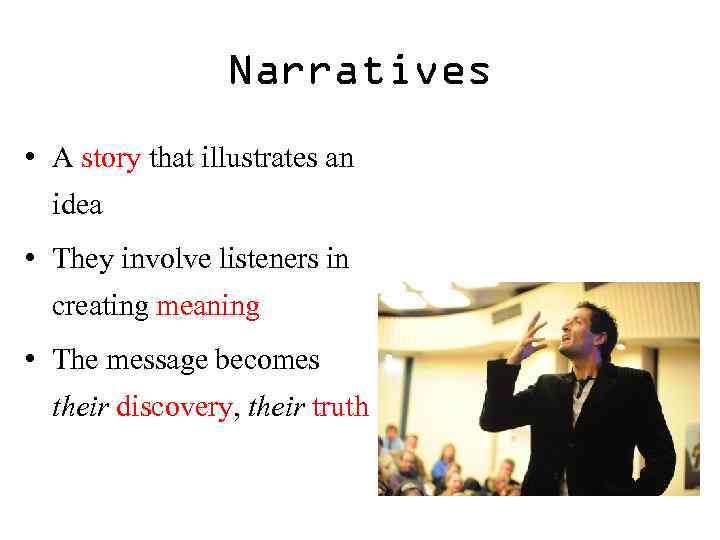 Narratives • A story that illustrates an idea • They involve listeners in creating meaning • The message becomes their discovery, their truth
 Narratives • Narratives can – Add interest to a message – Attract and sustain attention – Draw listeners into a message – Provide models of good and poor behavior – Bridge cultural differences – Be remembered after facts and statistics have been forgotten
 Evaluating narratives • Narratives should – Be relevant to your message – Help you make your point – Illustrate a situation as it actually is – Help listeners better understand your message – Help listeners create identification
 Using narratives • • • Use stories to involve the audience Practice to ensure the smooth flow Make the characters come to life Use voice and dialect changes for characters Use dialogue rather than paraphrase Use colorful, vivid language
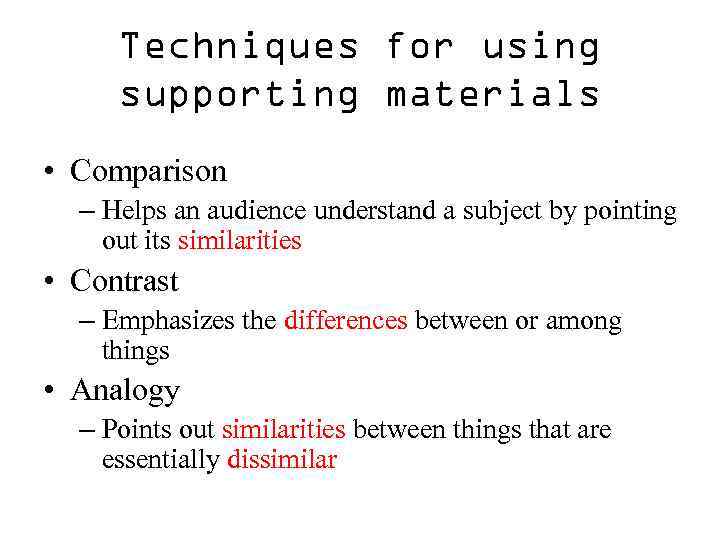 Techniques for using supporting materials • Comparison – Helps an audience understand a subject by pointing out its similarities • Contrast – Emphasizes the differences between or among things • Analogy – Points out similarities between things that are essentially dissimilar
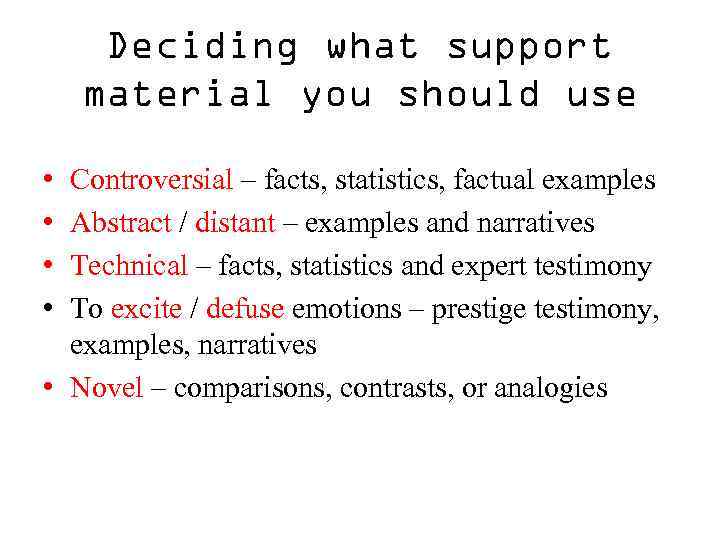 Deciding what support material you should use • • Controversial – facts, statistics, factual examples Abstract / distant – examples and narratives Technical – facts, statistics and expert testimony To excite / defuse emotions – prestige testimony, examples, narratives • Novel – comparisons, contrasts, or analogies
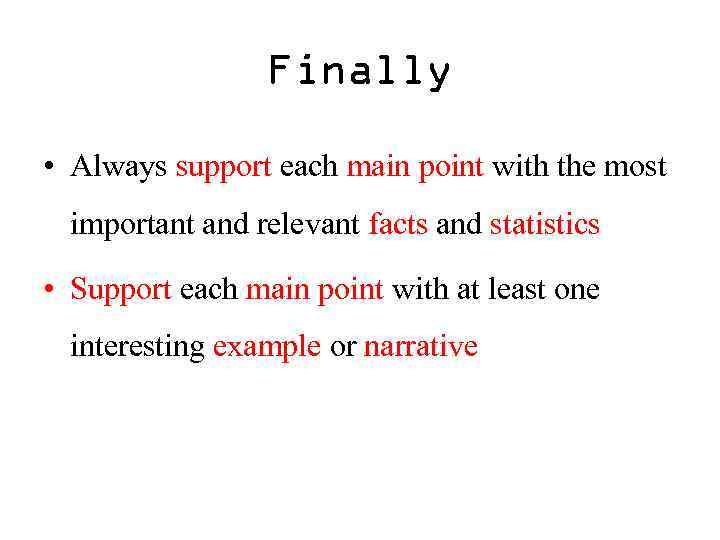 Finally • Always support each main point with the most important and relevant facts and statistics • Support each main point with at least one interesting example or narrative