 Скачать презентацию Supporting Talent During Times of Change Business Administration
bdeded46564dde5c388655da06edcd43.ppt
- Количество слайдов: 23



Supporting Talent During Times of Change Business Administration & Economics Department
Supporting Talent During Times of Change Dr. Leslie T. Szamosi Senior Lecturer Academic Director Executive MBA Kyiv Thessaloniki Belgrade Bucharest Istanbul Co-Director of the Laboratory for Strategic People Management
“My” Background • Ph. D in Management (OB/HR), MMS in International Business and Marketing, Carleton University, Ottawa • Academic Director MBA at the International Faculty of the University of Sheffield, CITY College • 5 Years as Marketing Manager in Bio-Medicals • 20 Years consulting in Organisational Change, Human Resource Management & Marketing / International business (both CEE and SEE and North America) – CIBC / Royal Bank of Canada / TELUS - GTE / World Bank (IFC) / PTK / European Union / MAKTEL – MOBIMAC / M-TEL • email: szamosi@city. academic. gr
Do you need to support your employees differently during times of crisis to KEEP talent? Yes, and Yes
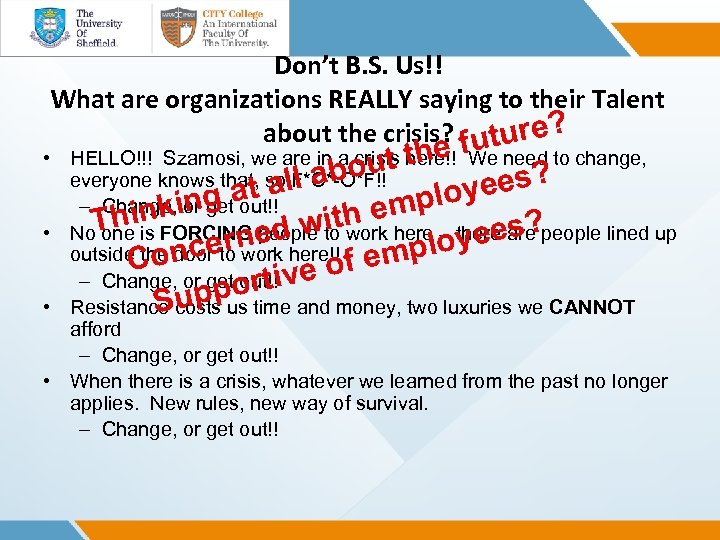
Don’t B. S. Us!! What are organizations REALLY saying to their Talent about the crisis? future? • HELLO!!! Szamosi, we are in a crisis here!! We need to change, t the abou everyone knows that, so F*C*-O*F!! ees? t all – Change, or get out!! ing a mploy ith e Think • No one is FORCING people to work here – there are people lined up ed w ees? y outside the door to work here!! emplo ncern Co of – Change, or get out!!ive port Sup • Resistance costs us time and money, two luxuries we CANNOT afford – Change, or get out!! • When there is a crisis, whatever we learned from the past no longer applies. New rules, new way of survival. – Change, or get out!!
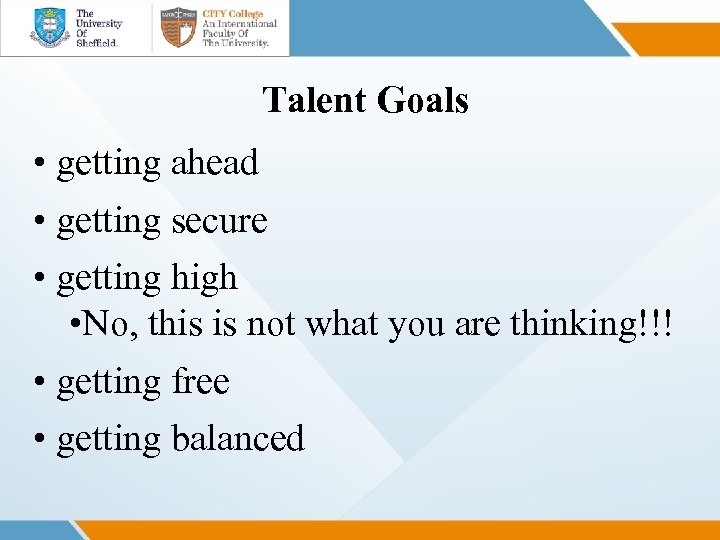
Talent Goals • getting ahead • getting secure • getting high • No, this is not what you are thinking!!! • getting free • getting balanced
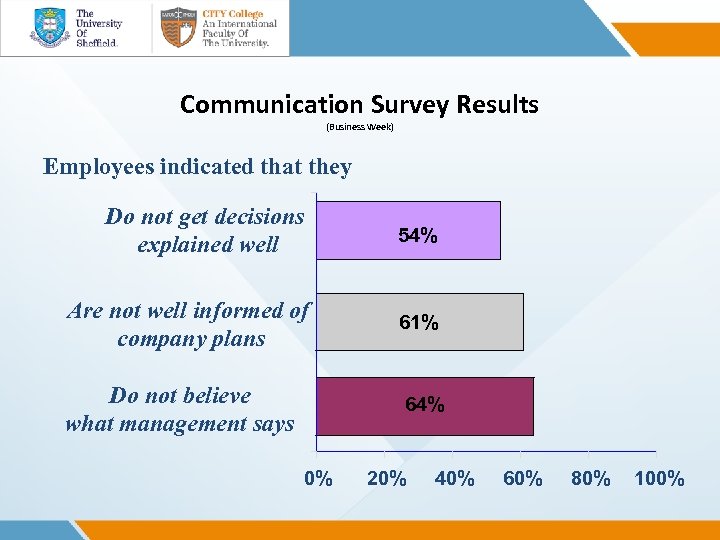
Communication Survey Results (Business Week) Employees indicated that they Do not get decisions explained well 54% Are not well informed of company plans 61% Do not believe what management says 64% 0% 20% 40% 60% 80% 100%
fact the modern era is characterized by constant organisational restructuring that involves flattening of organisational hierarchies, redundancies, internal job transfers and cost cutting. this has affected the responsibility for talent management this locus is shifting from the organisation towards a partnership between the organisation and the employee, or even solely the employee
In organization change, it is all about the ‘sell’ • Organizations simply need to find a better way to ‘sell’ ourselves to the talent • Sell properly and talent will ‘buy-in’ and stay PRESTO!!! The Talent Leaves!!!
Why Talent Leave During a Crisis • Talent view crisis as a threat, fearing it will adversely affect them in some significant way. • Talent understands that the crisis brings both benefits and costs, but feel that the costs far outweigh the benefits. • Talent may view crisis as potentially positive, BUT believe that the organization’s management is mishandling the change process. • Talent may believe in the crisis effort, but still believe that the organization is not likely to succeed.
Supporting Talent • Analysis has shown that managers in Central and South Eastern Europe are: – More supportive in technical skills – Less supportive in the ‘softer’ human-oriented skills
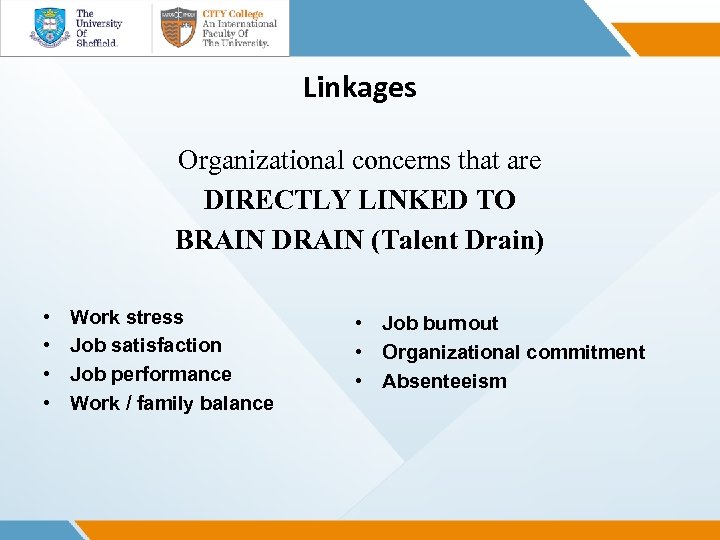
Linkages Organizational concerns that are DIRECTLY LINKED TO BRAIN DRAIN (Talent Drain) • • Work stress Job satisfaction Job performance Work / family balance • Job burnout • Organizational commitment • Absenteeism
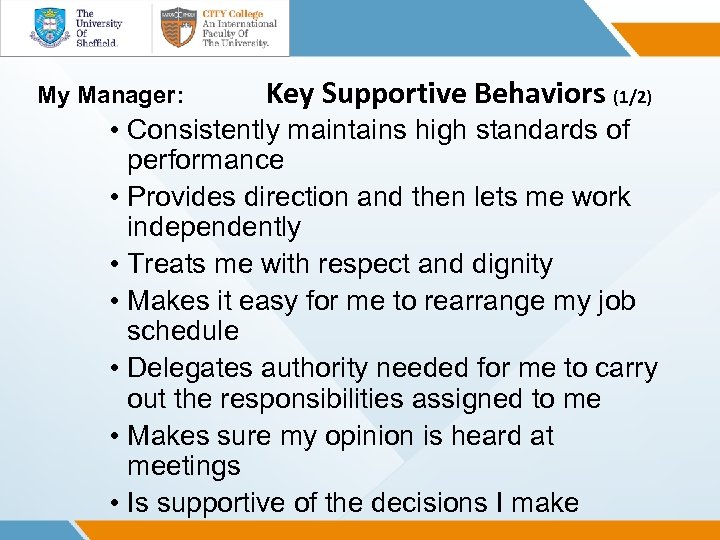
My Manager: Key Supportive Behaviors (1/2) • Consistently maintains high standards of performance • Provides direction and then lets me work independently • Treats me with respect and dignity • Makes it easy for me to rearrange my job schedule • Delegates authority needed for me to carry out the responsibilities assigned to me • Makes sure my opinion is heard at meetings • Is supportive of the decisions I make
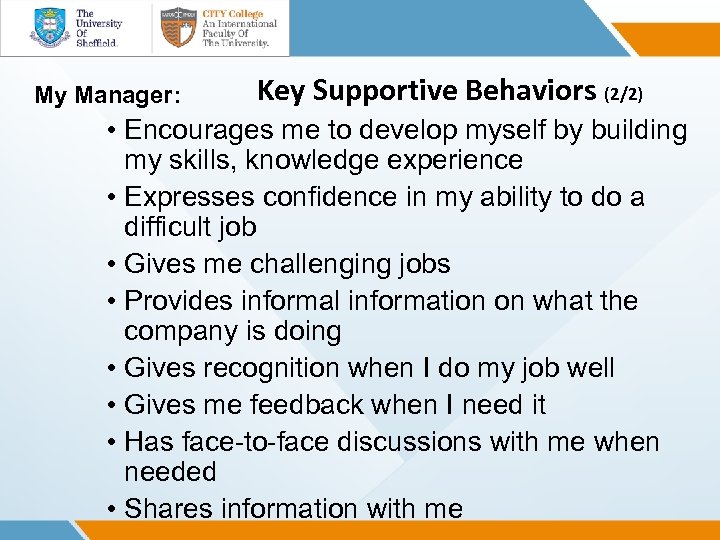
My Manager: Key Supportive Behaviors (2/2) • Encourages me to develop myself by building my skills, knowledge experience • Expresses confidence in my ability to do a difficult job • Gives me challenging jobs • Provides informal information on what the company is doing • Gives recognition when I do my job well • Gives me feedback when I need it • Has face-to-face discussions with me when needed • Shares information with me
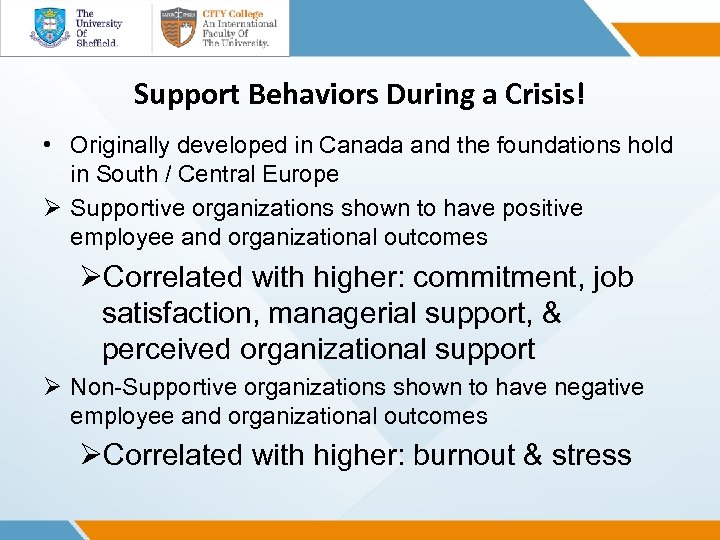
Support Behaviors During a Crisis! • Originally developed in Canada and the foundations hold in South / Central Europe Ø Supportive organizations shown to have positive employee and organizational outcomes ØCorrelated with higher: commitment, job satisfaction, managerial support, & perceived organizational support Ø Non-Supportive organizations shown to have negative employee and organizational outcomes ØCorrelated with higher: burnout & stress
Support That This is “Practically” Valid? Ø “Organizational Support for Revolutionary Change”, http: //www 2 a. cdc. gov/niosh-workorg/detail. asp? id=100, published by the Centre for Disease Control – National Institute for Occupational Health and Safety Ø Company groups that have used the measure:
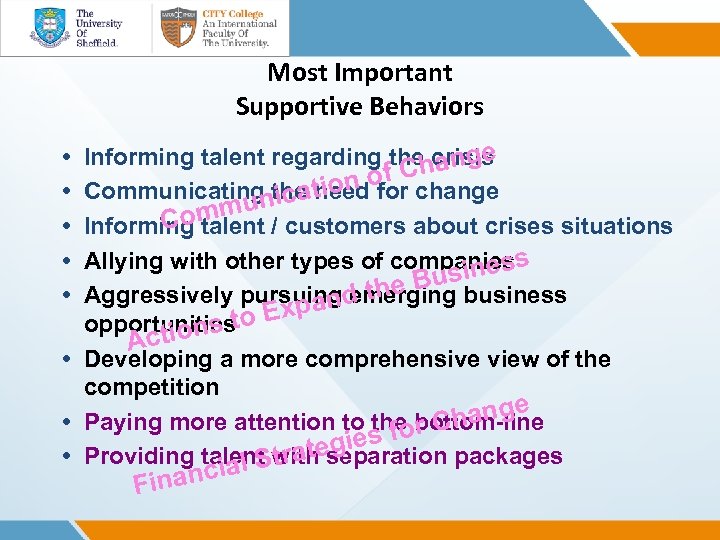
Most Important Supportive Behaviors Informing talent regarding the crisis hange n of Cchange Communicatingnthe tio for ica need ommu / customers about crises situations C Informing talent Allying with other types of companies s sines he Bu business Aggressively pursuing d t pan emerging x t opportunities o E ctions A Developing a more comprehensive view of the competition hange Paying more attention to the bottom-line for C gies teseparation packages a Providing talent with al Str i c Finan
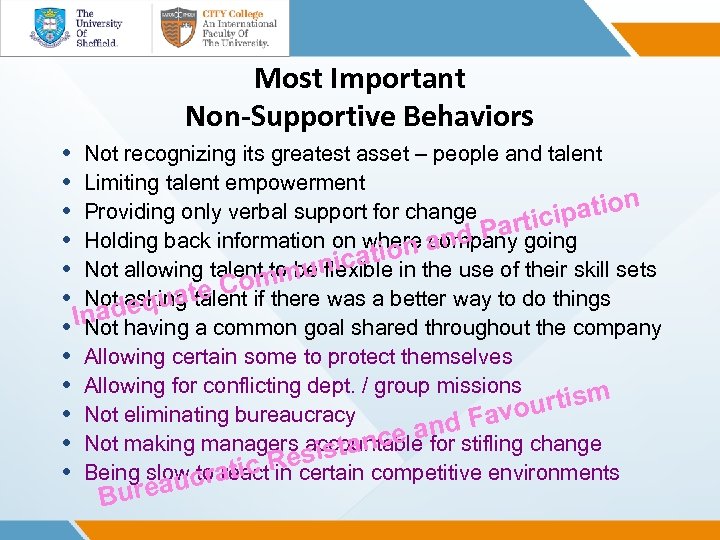
Most Important Non-Supportive Behaviors Not recognizing its greatest asset – people and talent Limiting talent empowerment Providing only verbal support for change pation i Partic d Holding back information on where company going on an nicati Not allowing talent to be flexible in the use of their skill sets ommu ate C Not asking talent if there was a better way to do things adequ In Not having a common goal shared throughout the company Allowing certain some to protect themselves Allowing for conflicting dept. / group missions urtism Not eliminating bureaucracy Favo d ce an Not making managers accountable for stifling change sistan tic Re Being slow to react in certain competitive environments ucra Burea
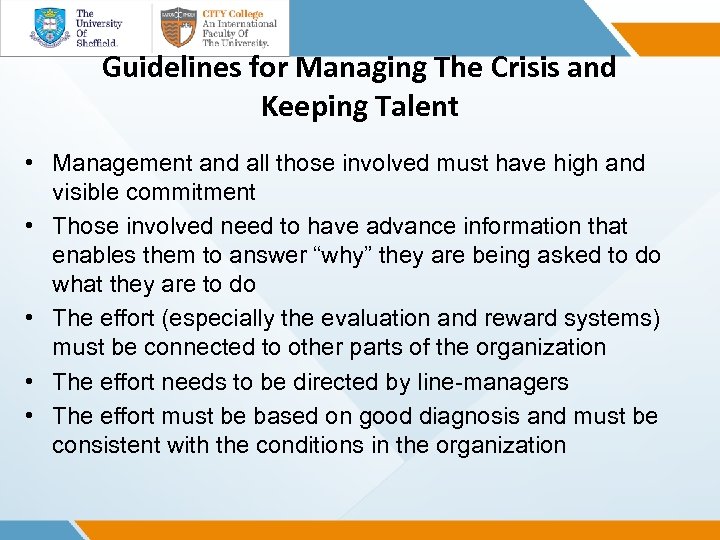
Guidelines for Managing The Crisis and Keeping Talent • Management and all those involved must have high and visible commitment • Those involved need to have advance information that enables them to answer “why” they are being asked to do what they are to do • The effort (especially the evaluation and reward systems) must be connected to other parts of the organization • The effort needs to be directed by line-managers • The effort must be based on good diagnosis and must be consistent with the conditions in the organization
Guidelines for Managing Talent (continued) • Management must remain committed to the effort throughout all its steps, from diagnosis through implementation and evaluation • Evaluation is essential and must consist of more than asking talent how they felt about the effort • Talent must see clearly the relationship between the effort and the organization’s mission and goals
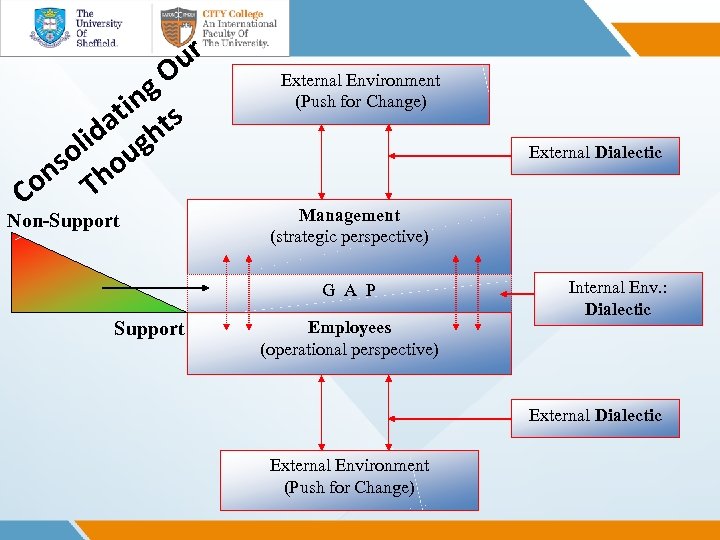
ur O ng ti ts da gh li u so ho on T C Non-Support External Environment (Push for Change) External Dialectic Management (strategic perspective) G A P Support Employees (operational perspective) Internal Env. : Dialectic External Environment (Push for Change)
To Take Away Change has been, will be, and will continue to be all about PEOPLE, PEOPLE We need to support workforces through crisis in order to have a chance to retain the talent! Thank-you!!! szamosi@city. academic. gr
Скачать презентацию Supporting Talent During Times of Change Business Administration
bdeded46564dde5c388655da06edcd43.ppt