 Скачать презентацию Supporting Research with Weblogs A Study on Web
278bf11ba722faa54a7aec20e5b11ad5.ppt
- Количество слайдов: 24




Supporting Research with Weblogs: A Study on Web based Research Support Systems Jing. Tao Yao Department of Computer Science, University or Regina CANADA S 4 S 0 A 2 jtyao@cs. uregina. ca http: //www 2. cs. uregina. ca/~jtyao J T Yao: Weblogs
Advances in Computer and Web Technology • More opportunities – Information Availability, accessibility, flexibility • More challenges – Find the right information/tools, – Learn/use the existing tools • Faster changes – Keep up with the pace of the changes. J T Yao: Weblogs 2
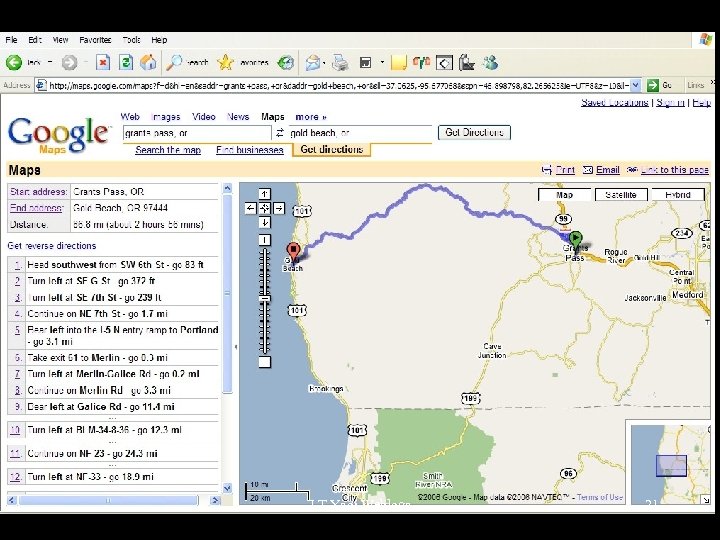
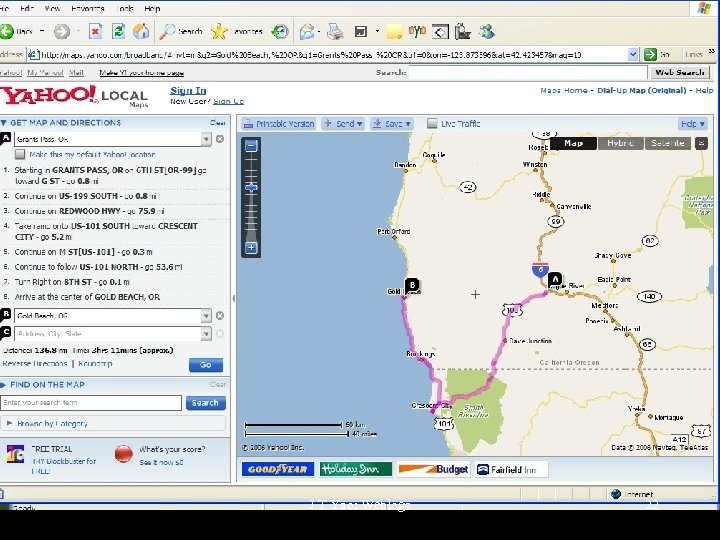
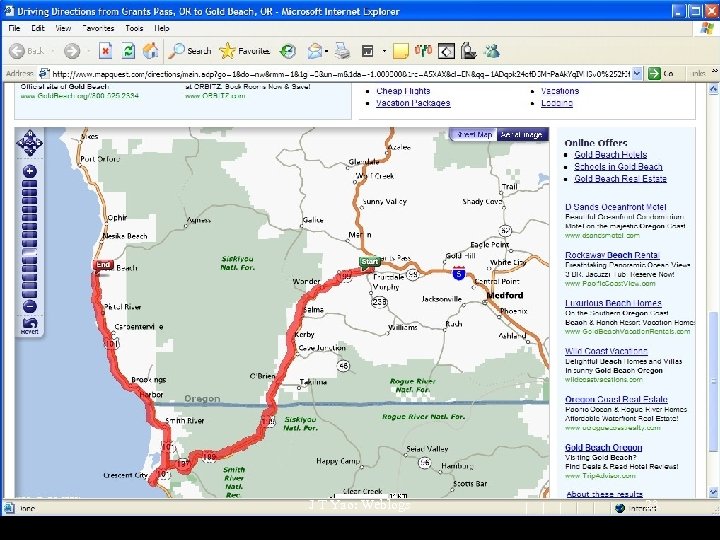
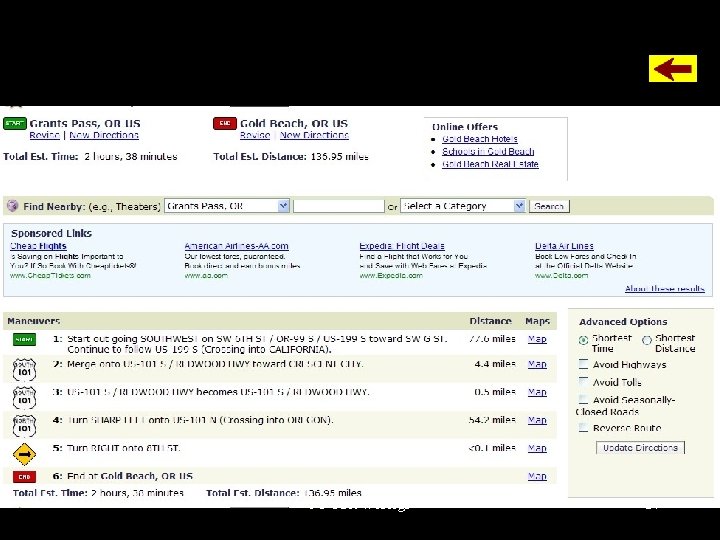
James Kim Tragedy • San Francisco Chronicle: MAPS: Internet travel directions need to be checked carefully • The Age, Australia: Faulty online mapping linked to wrong turn disaster • How reliable are these free online maps? – Google Maps – Yahoo Maps – Map. Quest J T Yao: Weblogs 3
Web-based Support Systems • A multidisciplinary research that focuses on supporting various human activities in specific domains/fields based on computer science, information technology, and Web technology. • Take the opportunities of the Web • Meet the challenges of the Web • Extend the human physical limitations of information processing • Keep up with the advance of technology advances J T Yao: Weblogs 4

Computerized Support systems • It is impossible to develop a fully automated computer system. • More practical substitute systems – Decision support systems (DSS), – Computer aided software engineering (CASE) – Computer aided design (CAD) – Computer aided education (CAE) J T Yao: Weblogs 5
What Can We Do with the Web? • Provides a distributed infrastructure for information processing. • Delivers timely, secure information and tools with user friendly interface. • Has no time or geographic restrictions. • Results can be controlled and retrieved remotely and instantly. • Collaboration: a channel for research discussion J T Yao: Weblogs 6
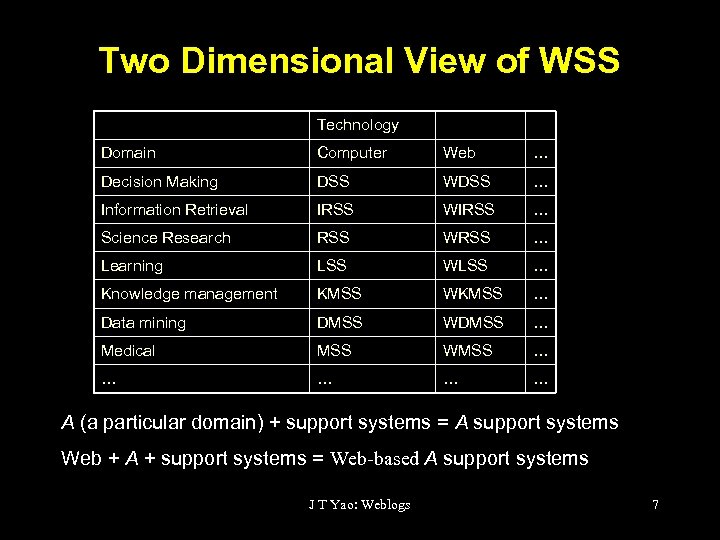
Two Dimensional View of WSS Technology Domain Computer Web … Decision Making DSS WDSS … Information Retrieval IRSS WIRSS … Science Research RSS WRSS … Learning LSS WLSS … Knowledge management KMSS WKMSS … Data mining DMSS WDMSS … Medical MSS WMSS … … … A (a particular domain) + support systems = A support systems Web + A + support systems = Web-based A support systems J T Yao: Weblogs 7
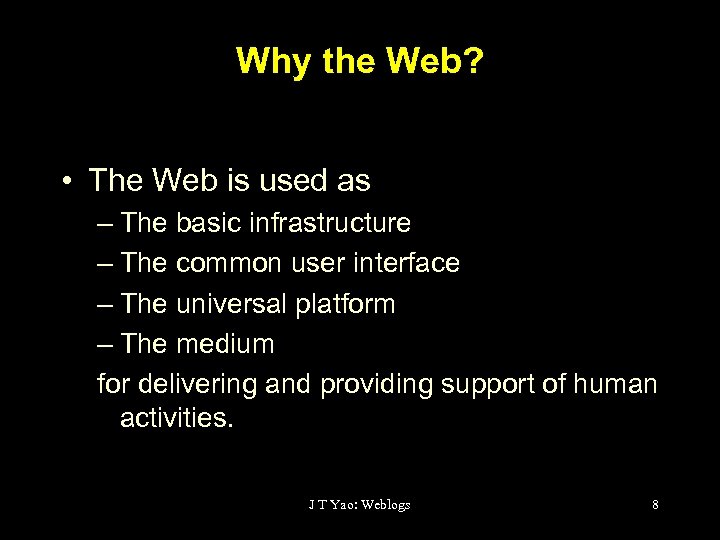
Why the Web? • The Web is used as – The basic infrastructure – The common user interface – The universal platform – The medium for delivering and providing support of human activities. J T Yao: Weblogs 8
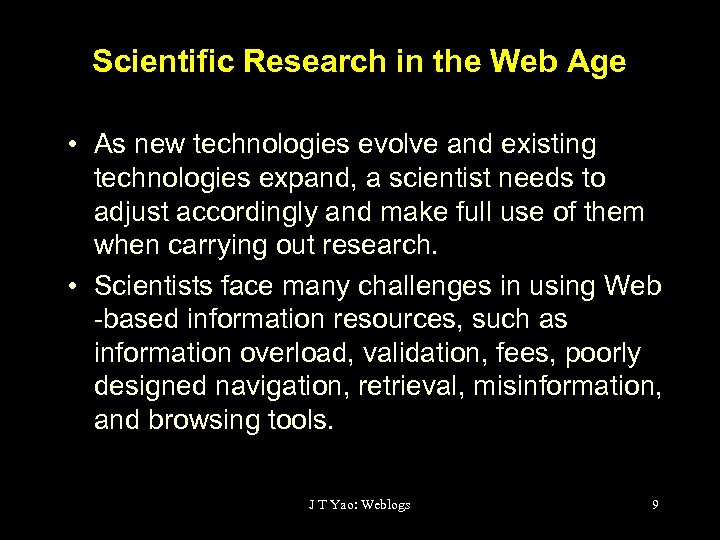
Scientific Research in the Web Age • As new technologies evolve and existing technologies expand, a scientist needs to adjust accordingly and make full use of them when carrying out research. • Scientists face many challenges in using Web based information resources, such as information overload, validation, fees, poorly designed navigation, retrieval, misinformation, and browsing tools. J T Yao: Weblogs 9
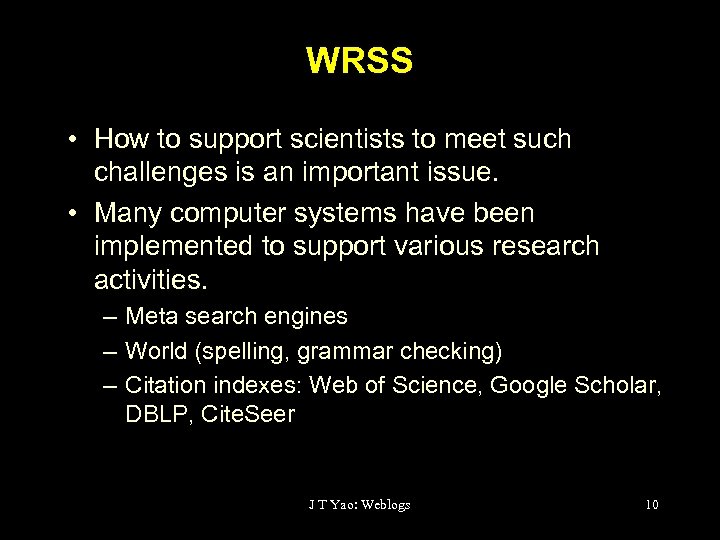
WRSS • How to support scientists to meet such challenges is an important issue. • Many computer systems have been implemented to support various research activities. – Meta search engines – World (spelling, grammar checking) – Citation indexes: Web of Science, Google Scholar, DBLP, Cite. Seer J T Yao: Weblogs 10
The Study of Research Support Systems is Interdisciplinary • Research methodologies: – Purpose of research (science), research methods, research activities, etc. • Computer science – Computer systems that support various research activities. • Web – As an infrastructure and a medium of support delivery, as an common user interface. • WRSS integrates and extends existing computer technologies and systems to serve scientists. J T Yao: Weblogs 11
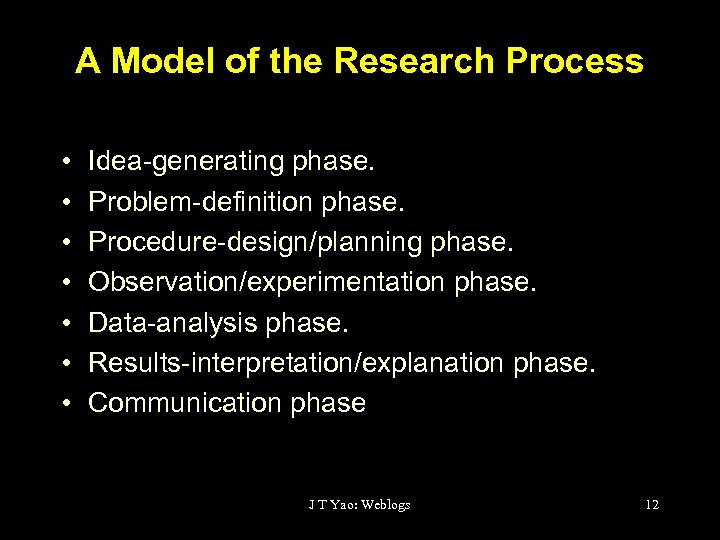
A Model of the Research Process • • Idea generating phase. Problem definition phase. Procedure design/planning phase. Observation/experimentation phase. Data analysis phase. Results interpretation/explanation phase. Communication phase J T Yao: Weblogs 12
Role of WRSS • Active role of WRSS: scientists play an active role in using a passive system vs. WRSS play a more active role to assist scientists. • Rationality and feasibility: Research process is relatively discipline independent, which makes WRSS feasible. – Separation of general research process and discipline specific knowledge. J T Yao: Weblogs 13
Characteristics of WRSS • Conceptual organization of WRSS: Sequentially according to the sequence of research phases, hierarchically based on the complexity of research activities. • Personalized support. • Adaptation over time. • Web platform. J T Yao: Weblogs 14
Functionalities of WRSS • Profile management: to collect, organize, and store all relevant information the scientists. • Resource management: – Many types of resources exist for supporting research, such as human resources, tool resources, and information/knowledge resources. – The objective is to identify the suitable resource to support scientists' research needs. • Data/knowledge management: to record, store and retrieve the useful data, information and knowledge during the entire research process. J T Yao: Weblogs 15
Specific Supporting Functionalities • • • Exploring support Retrieval support Reading support Analyzing support Writing support J T Yao: Weblogs 16
Weblogs • Weblog (or Blog) – A new form of mainstream personal communication. – A new voice for traditional media. – A new way for general public to express their opinion in contract traditional one way street. – Technorati. com, a Weblog tracking company, tracks 62. 6 million blogs (Dec 12, 2006) • 55. 4 in Sept 2006, • 4. 2 in Oct 2004. • 175, 000 new blogs per day, 1. 6 million posts per day, or over 18 updates a second. J T Yao: Weblogs 17
Wikipedia • Free online encyclopedia • 1, 529, 503 English articles • You may add, edit, comment, link entries • Warning: do not use Wikipedia as a primary source. J T Yao: Weblogs 18
Using Weblog • • Research journal, diary, forum Keep track idea evolution Keep track contribution Easier information retrieval, hyperlinks • System management – – Sort/store by idea, time, author Access level: user, group, others. Citation management Search J T Yao: Weblogs 19
Conclusion • The research on WSS is a natural evolution of the existing research. – DSS => WSS – DSS => Computerized SS => WSS • WSS provide a potential solution for information/tool overload and the complexity of modern problems. • WRSS will enhance researchers research ability. • Weblog provides a new tool for research support. J T Yao: Weblogs 20
J T Yao: Weblogs 21
J T Yao: Weblogs 22
J T Yao: Weblogs 23
J T Yao: Weblogs 24
Скачать презентацию Supporting Research with Weblogs A Study on Web
278bf11ba722faa54a7aec20e5b11ad5.ppt