


 Скачать презентацию Supporting People Caerphilly Supporting People Team Floating Support
5a98ef7dbd648bacd724900585601507.ppt
- Количество слайдов: 76
 Supporting People Caerphilly Supporting People Team Floating Support Forum 16 th December 2011
 Contents n. Redistribution and Handover - Mal n. Accreditation & Outcomes - Edwin n. Commissioning and Framework - Shelly n. Centralising Referrals and Use of Sprint - Tiffeny n. Break n. Governance – Mal n. Eligibility and Monitoring – Edwin n. Future Scheme Proposals (local/regional) -Shelly
 Redistribution and Handover Malcolm Topping
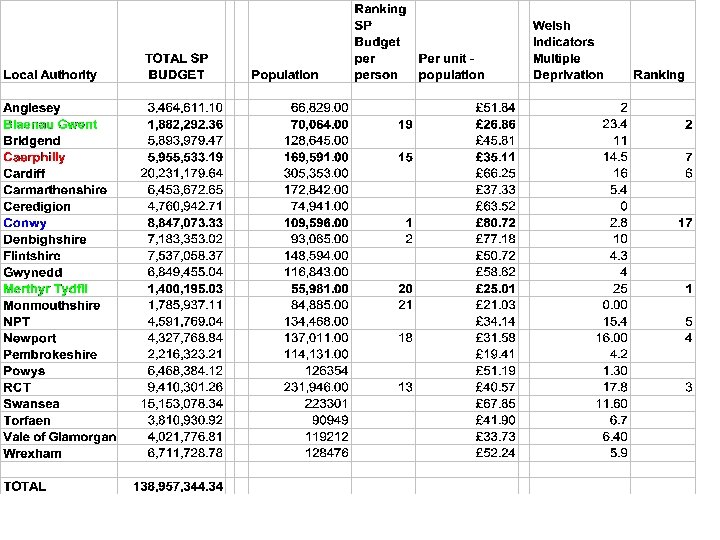
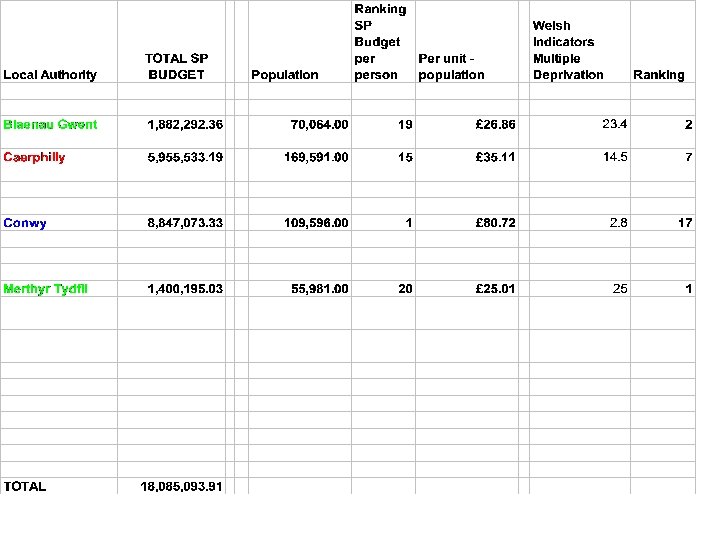
 Distribution of Supporting People funding was not fair in 2003 Amount of SP Grant was not linked to the needs of the population – SEE TABLE OVERLEAF n How do you decide what each Local Authority should receive? n Introduce formula that identifies % of population needing housing related support n
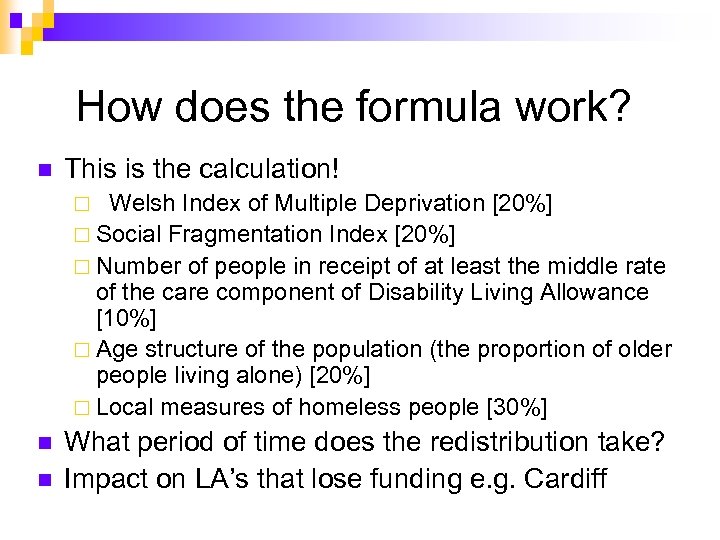 How does the formula work? n This is the calculation! ¨ Welsh Index of Multiple Deprivation [20%] ¨ Social Fragmentation Index [20%] ¨ Number of people in receipt of at least the middle rate of the care component of Disability Living Allowance [10%] ¨ Age structure of the population (the proportion of older people living alone) [20%] ¨ Local measures of homeless people [30%] n n What period of time does the redistribution take? Impact on LA’s that lose funding e. g. Cardiff
 What will the formula mean to Caerphilly? n Insert modelling work being completed by WG
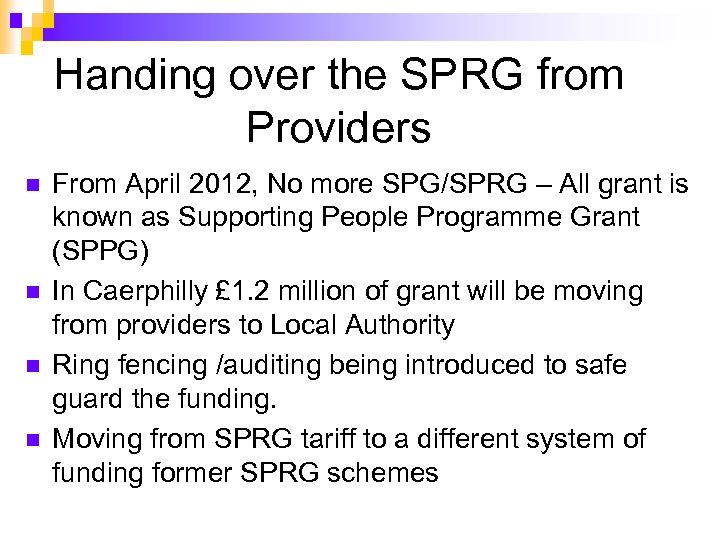 Handing over the SPRG from Providers n n From April 2012, No more SPG/SPRG – All grant is known as Supporting People Programme Grant (SPPG) In Caerphilly £ 1. 2 million of grant will be moving from providers to Local Authority Ring fencing /auditing being introduced to safe guard the funding. Moving from SPRG tariff to a different system of funding former SPRG schemes
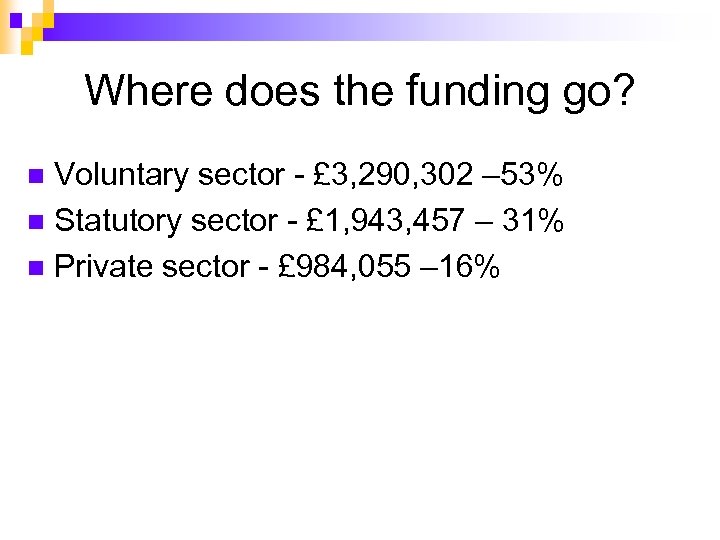 Where does the funding go? Voluntary sector - £ 3, 290, 302 – 53% n Statutory sector - £ 1, 943, 457 – 31% n Private sector - £ 984, 055 – 16% n
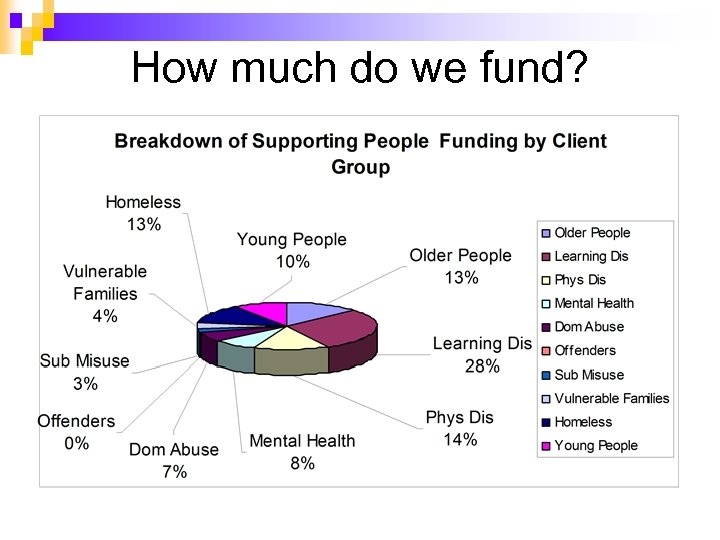 How much do we fund?
 Accreditation and Outcomes Edwin Yhap
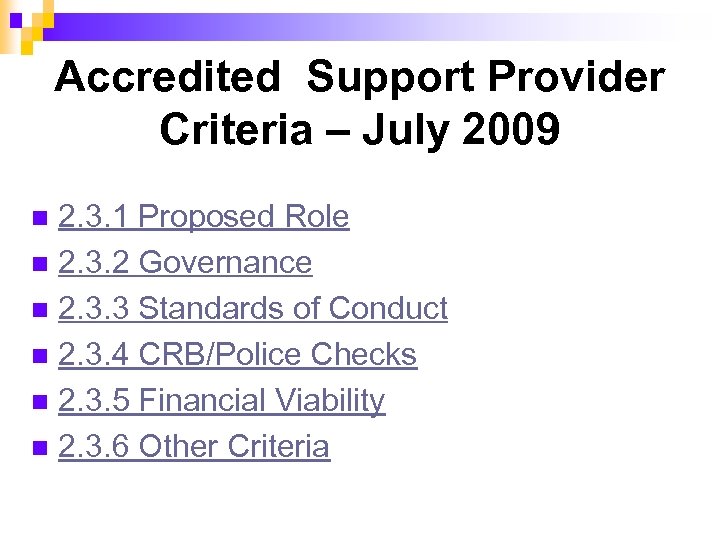 Accredited Support Provider Criteria – July 2009 2. 3. 1 Proposed Role n 2. 3. 2 Governance n 2. 3. 3 Standards of Conduct n 2. 3. 4 CRB/Police Checks n 2. 3. 5 Financial Viability n 2. 3. 6 Other Criteria n
 Accreditation In exercise of the powers conferred, by Sections 180, 181 and 182 of the Housing Act 1996 and Section 93 of the Local Government Act 2000, and in conjunction with Section 70 and Section 71 of the Government of Wales Act 2006, the Welsh Ministers of the Welsh Assembly Government have established the criteria, which must be satisfied by a body which is seeking accreditation on or after the date of this document.
 Who can apply? n n n a registered charity, a society registered under the Industrial and Provident Societies Act 1965 which satisfies the conditions in Subsection (2), is a Welsh Local Authority. Where an Accredited SP is contracting with such Co, robust subcontracting, selection and financial procedures must be in place to manage risks. Private and ‘for Profit Companies’ are not eligible to apply, as the Welsh Ministers do not have the powers under SPRG Schemes to make direct payment to providers (2. 2. 3)
 Criteria for accreditation 2. 3. 1 Proposed Role n A support provider must provide a statement of organisational aims and objectives n Accredited bodies should not contract any part of a grant funded service unless or until they are satisfied that the contractor is able to provide the specified service as set out in the Grant Conditions, at a level which is likely to be acceptable to the Welsh Ministers. (Ref private Co).
 Criteria for accreditation 2. 3. 2 Governance n The support provider must be under the control of a Board of Directors or a Committee or of trustees, except where the provider is a local authority , and must be a ‘fit and proper person’
 Criteria for accreditation 2. 3. 3 Standards of Conduct n Members must understands their own role and responsibilities n understands the constitution and statutory requirements within which they will operate n understands and has policies that reflect the regulatory regime, which governs accredited support providers including Protection of Vulnerable Adults (POVA) guidelines. (Safeguarding Vulnerable Group Act 2006).
 Criteria for accreditation 2. 3. 4 Criminal Records Bureau (“CRB”)/Police Checks n has obtained enhanced CRB checks for all staff working directly with vulnerable service users n has obtained standard CRB checks for all other staff including Board Members, Managers who have contact with or access to personal information on vulnerable service users n It is a condition of continuing accreditation that all checks are updated every 3 years.
 Criteria for accreditation 2. 3. 5 Financial Viability n All applicant bodies must be able to demonstrate their financial viability and fundability n (SP teams have an updated Cost Calculation document which provides guidance).
 Criteria for accreditation 2. 3. 6 Other Criteria n accredited support providers must adopt and implement acceptable policies and procedures across various activities, which must include policies on: ¨ equal opportunities ¨ service user participation ¨ access to the service staff training/ development ¨ protection of vulnerable adults ¨ health and safety policy
 Outcomes WG has decided that it will be mandatory from April 2012 for all SP schemes to implement a means by which support provided can be measured-’outcomes’. 1. Outcomes spreadsheet-following on from pilot 2009. 2. Outcomes measurement. -working tool n
 1. Outcomes spreadsheet n In 2009 SPIN (Supporting People Information Network) agreed to develop an Outcomes Framework to try to evidence: § Achievements § Best practice § Value for money of the Supporting People Programme across Wales.
 Outcomes Spreadsheet -cont’d n Intended that the framework would be used across Wales by all Providers & Local Authorities to: ¨ Encourage consistent data collection ¨ Evidence SP success ¨ Reduce the number of varying & burdensome collection tools used by the 22 LA’s ¨ Reduce the frustrations of providers who are sometimes providing multiple sets of information to their commissioner ¨ This is still being worked on
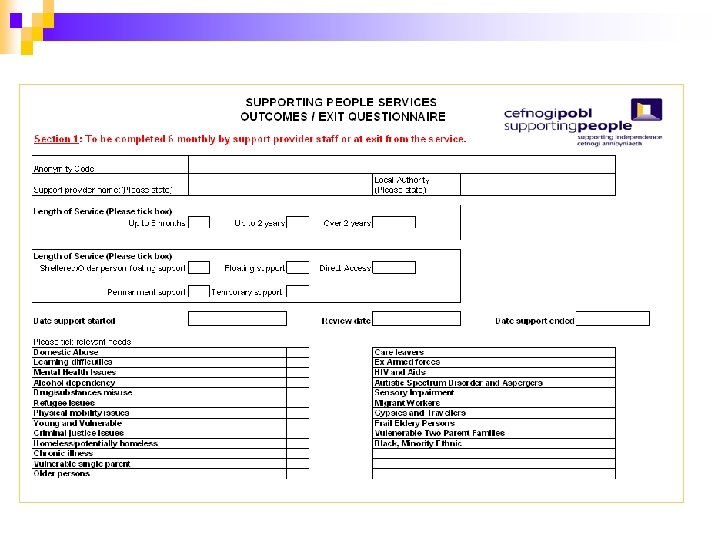
 Outcomes Spreadsheet -cont’d Excel spreadsheet utilised & collected at a local level: n Exit Questionnaire for individual service user n Data Collection spreadsheet-Collate all service user information per scheme-still not quite completed. n § Exit questionnaire overleaf
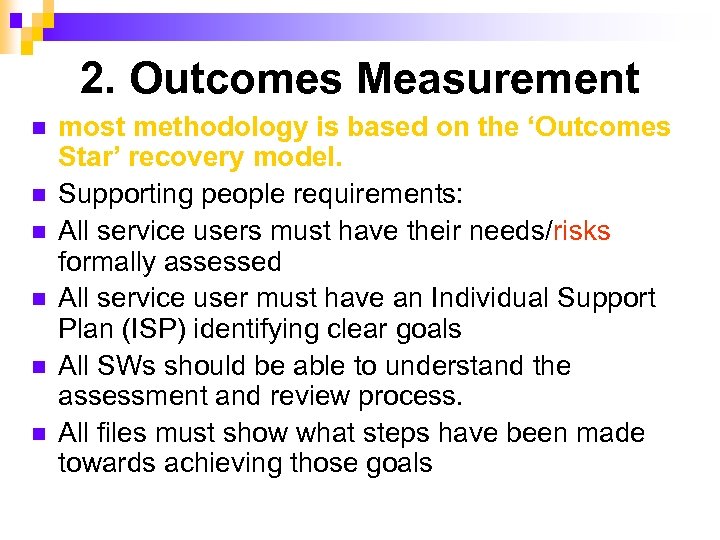 2. Outcomes Measurement n n n most methodology is based on the ‘Outcomes Star’ recovery model. Supporting people requirements: All service users must have their needs/risks formally assessed All service user must have an Individual Support Plan (ISP) identifying clear goals All SWs should be able to understand the assessment and review process. All files must show what steps have been made towards achieving those goals
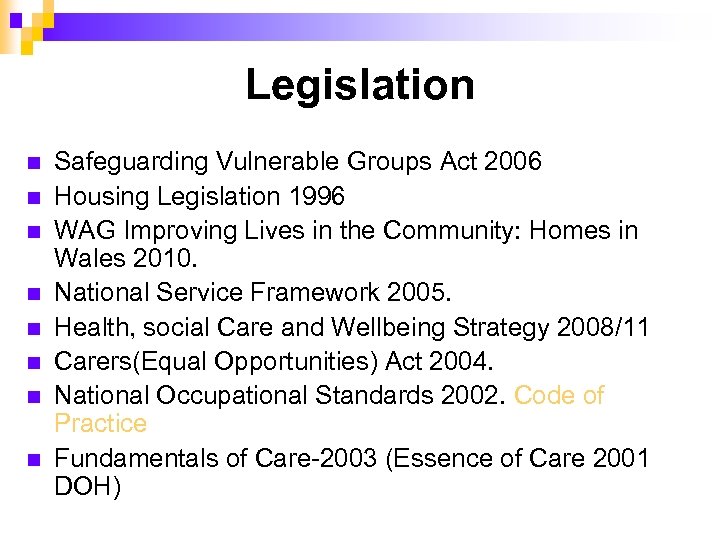 Legislation n n n n Safeguarding Vulnerable Groups Act 2006 Housing Legislation 1996 WAG Improving Lives in the Community: Homes in Wales 2010. National Service Framework 2005. Health, social Care and Wellbeing Strategy 2008/11 Carers(Equal Opportunities) Act 2004. National Occupational Standards 2002. Code of Practice Fundamentals of Care-2003 (Essence of Care 2001 DOH)
 Methodology n n Shows the continuous process Commences with referral -right through to exit New documents should detail the assessment process-SU’s identification of needs-risk assessment- summary of the ISP Methods for monitoring/reviewing
 Methodology Cont’d n n The process should enable SUs to recognise where they are, where they would like to be and what steps they need to take to get there. Control/empowerment It should be designed to assess the changes that SU is making in their attitudes and behaviour which will move them towards being able to live more independently.
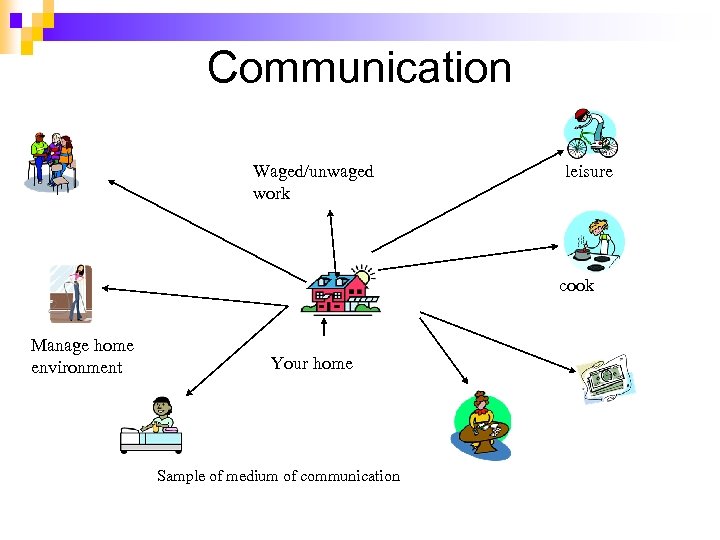 Communication Waged/unwaged work leisure cook Manage home environment Your home Sample of medium of communication
 Outcomes-Journey of Change n n n The journey is from the SU’s first assessment through to independent living (hopefully!) and everything in between! Methodology outlines key steps - each step depicts a transition (outcomes) from dependence towards independence. It should show where a SU is on their journey, what support they need, and to measure this at various points during their support Workshop-this can be arranged with the SP team.
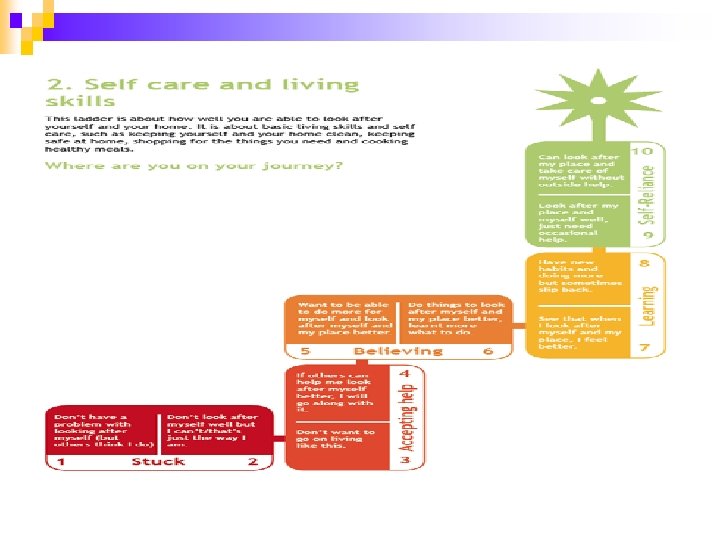
 OS LADDER The ladders and detailed scales n For each outcome area measured by the Star there is a brief description of the behaviour and attitudes expected at each scale point. For example, below is the Self care and living skills ladder from the Outcomes Star™ for homelessness
 Outcomes-Finally n n n Hoped that the framework –when completed-will be instrumental in demonstrating the SP programmes effectiveness It is intended to provide some awareness sessions of its use. Its contribution to a number of different national agendas And most importantly…. will allow staff to focus on positive work that they are already doing with service users, highlighting their strengths, & the excellent outcomes that they are achieving
 Commissioning and Framework Shelly Jones
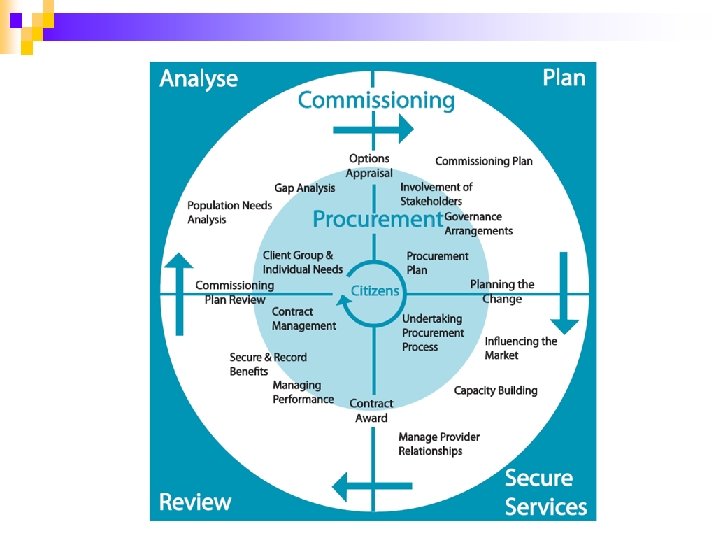
 Commissioning What is Commissioning? n What is Procurement? n Collaborative Approach n ¨ Strategic themes ¨ Teams/providers/services users ¨ Boundaries
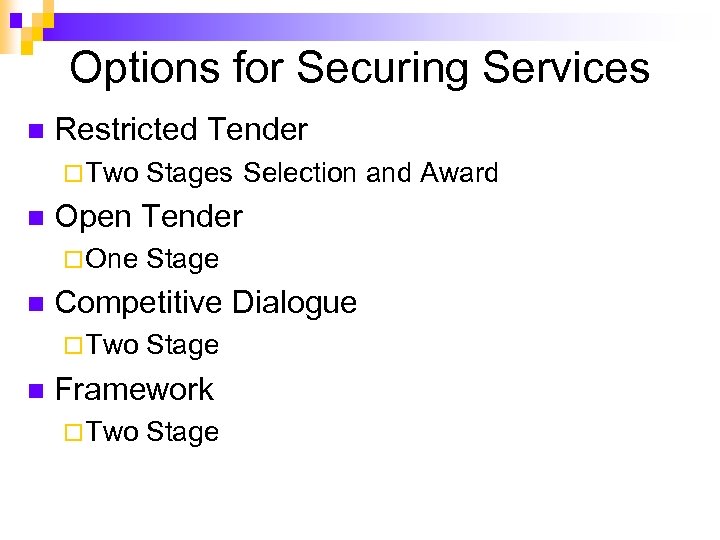 Options for Securing Services n Restricted Tender ¨ Two Stages n Selection and Award Open Tender ¨ One Stage n Competitive Dialogue ¨ Two Stage n Framework ¨ Two Stage
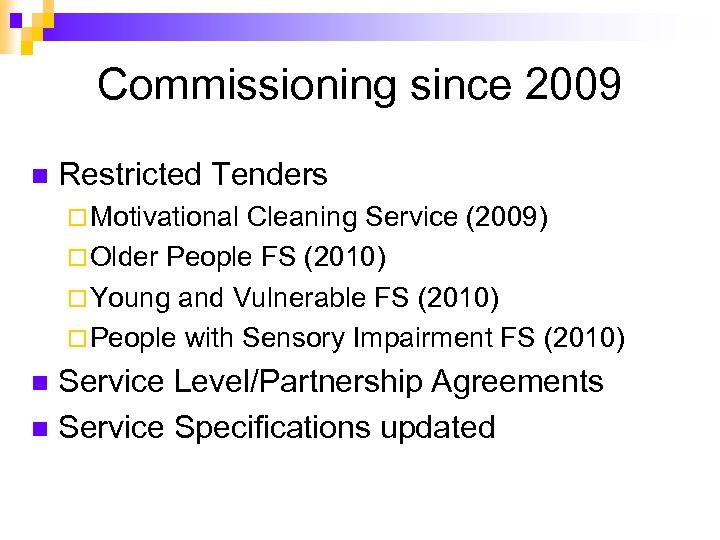 Commissioning since 2009 n Restricted Tenders ¨ Motivational Cleaning Service (2009) ¨ Older People FS (2010) ¨ Young and Vulnerable FS (2010) ¨ People with Sensory Impairment FS (2010) Service Level/Partnership Agreements n Service Specifications updated n
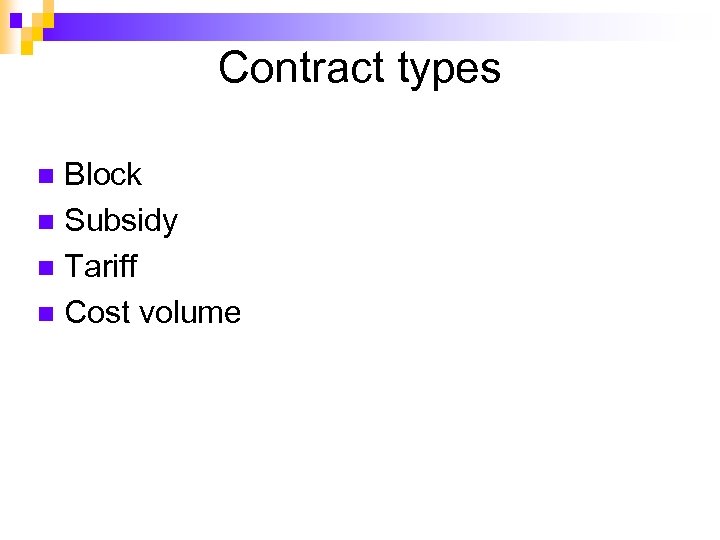 Contract types Block n Subsidy n Tariff n Cost volume n
 Centralising referrals and use of Sprint Tiffeny Davies
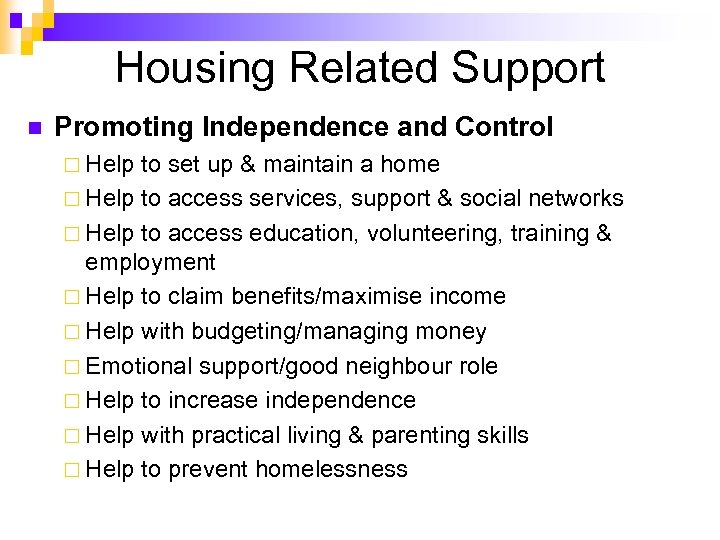 Housing Related Support n Promoting Independence and Control ¨ Help to set up & maintain a home ¨ Help to access services, support & social networks ¨ Help to access education, volunteering, training & employment ¨ Help to claim benefits/maximise income ¨ Help with budgeting/managing money ¨ Emotional support/good neighbour role ¨ Help to increase independence ¨ Help with practical living & parenting skills ¨ Help to prevent homelessness
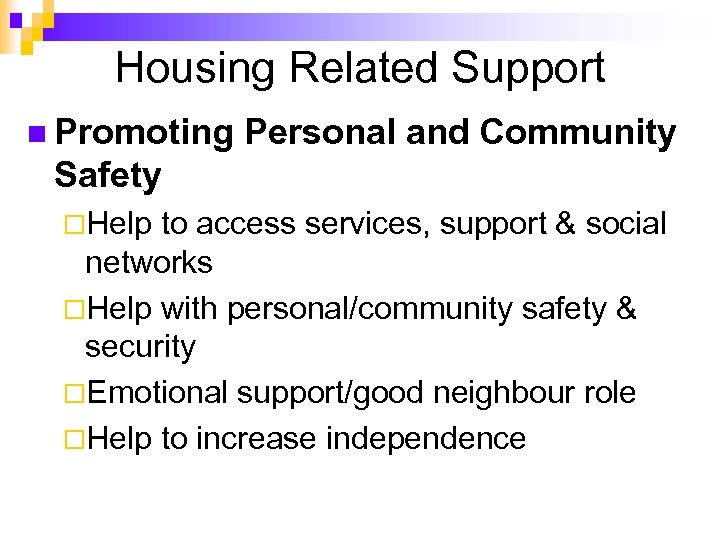 Housing Related Support n Promoting Personal and Community Safety ¨Help to access services, support & social networks ¨Help with personal/community safety & security ¨Emotional support/good neighbour role ¨Help to increase independence
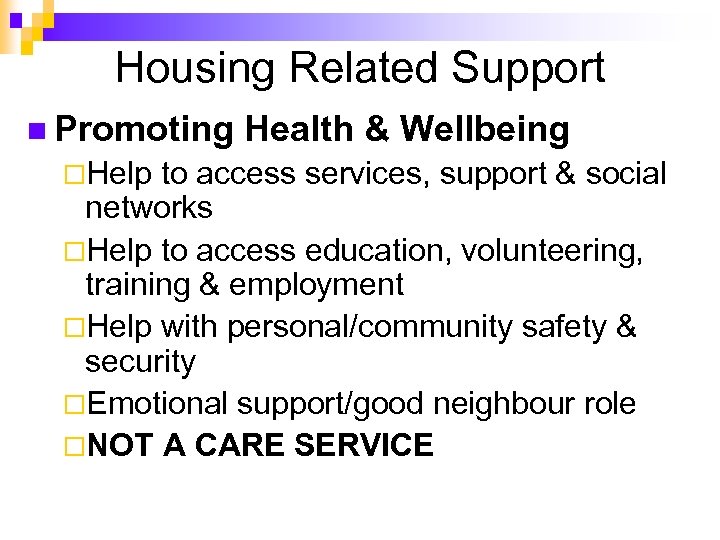 Housing Related Support n Promoting Health & Wellbeing ¨Help to access services, support & social networks ¨Help to access education, volunteering, training & employment ¨Help with personal/community safety & security ¨Emotional support/good neighbour role ¨NOT A CARE SERVICE
 Housing Related Support n Promoting Economic Progress and Financial Control ¨Help to access education, volunteering, training & employment ¨Help to claim benefits/maximise income ¨Help with budgeting/managing money
 Why Centralise Referrals? Streamline the management of referrals n One central point of contact n Initial risk assessments n Ensure appropriateness of referrals n Prioritise those with the greatest need n Help reduce providers’ initial workload n
 Current Position n SPT are currently taking all referrals for ¨Gwalia ¨Solas ¨Reach Generic ¨Reach Older Persons’ (Via Age Concern) ¨Domestics
 Introduction of Sprint Waiting Lists n Risk and Needs Assessments n Support Planning n Improved communication (referrals / schedules etc) n Access to R&M information n Data Protection n
 Governance Malcolm Topping
 Governance n The way in which a organisation takes decisions and allocates resources
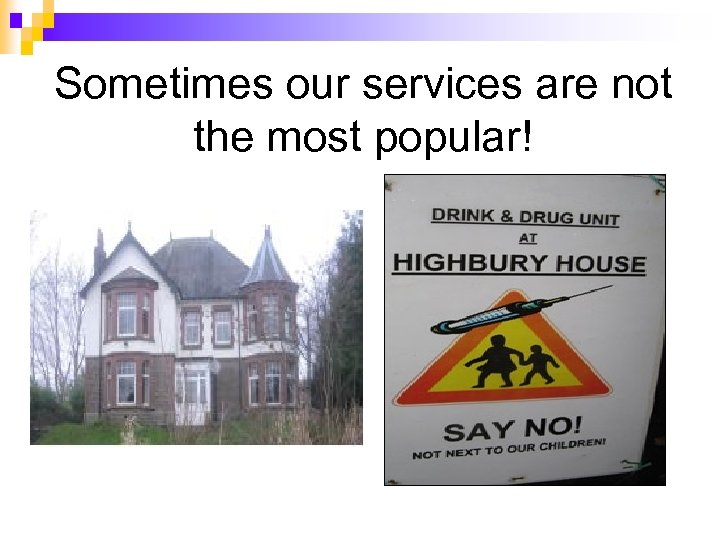 Sometimes our services are not the most popular!
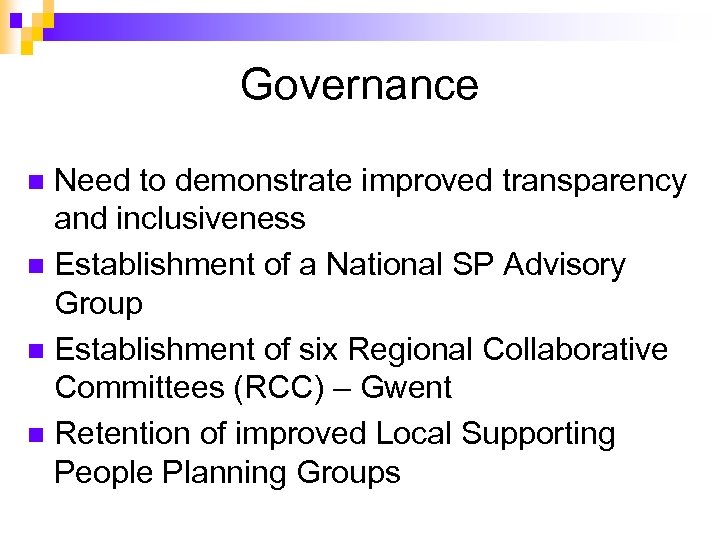 Governance Need to demonstrate improved transparency and inclusiveness n Establishment of a National SP Advisory Group n Establishment of six Regional Collaborative Committees (RCC) – Gwent n Retention of improved Local Supporting People Planning Groups n
 National Advisory Group Chaired by Huw Lewis – Housing and regeneration n Membership n Roles and responsibilities n
 Regional Governance Chaired by Local Authority Rep n Membership n Roles and responsibilities n
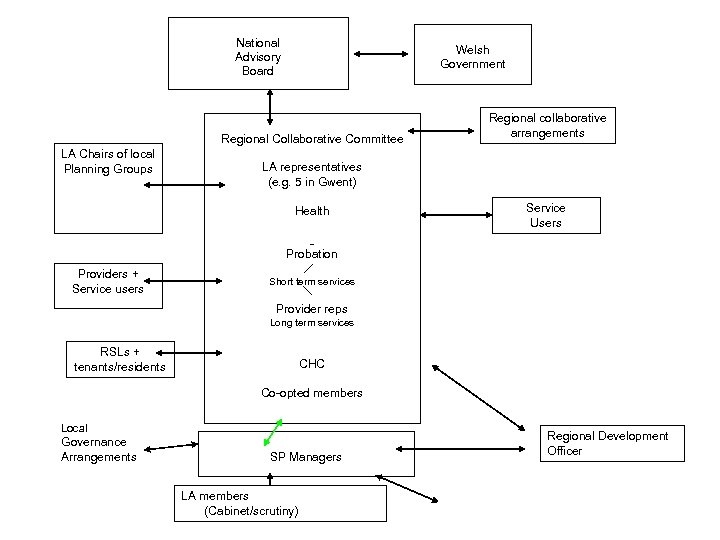 National Advisory Board Regional Collaborative Committee LA representatives (e. g. 5 in Gwent) Health Probation LA Chairs of local Planning Groups Providers + Service users Welsh Government Regional collaborative arrangements Service Users Short term services Provider reps Long term services CHC Co-opted members RSLs + tenants/residents Local Governance Arrangements SP Managers LA members (Cabinet/scrutiny) Regional Development Officer
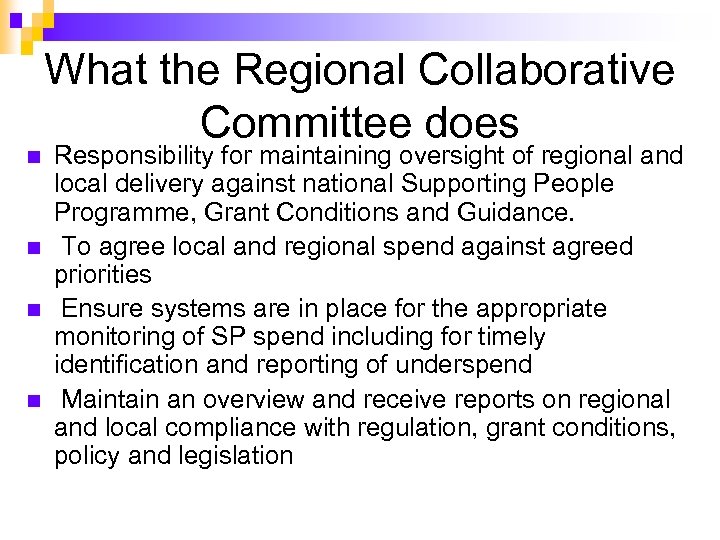 n n What the Regional Collaborative Committee does Responsibility for maintaining oversight of regional and local delivery against national Supporting People Programme, Grant Conditions and Guidance. To agree local and regional spend against agreed priorities Ensure systems are in place for the appropriate monitoring of SP spend including for timely identification and reporting of underspend Maintain an overview and receive reports on regional and local compliance with regulation, grant conditions, policy and legislation
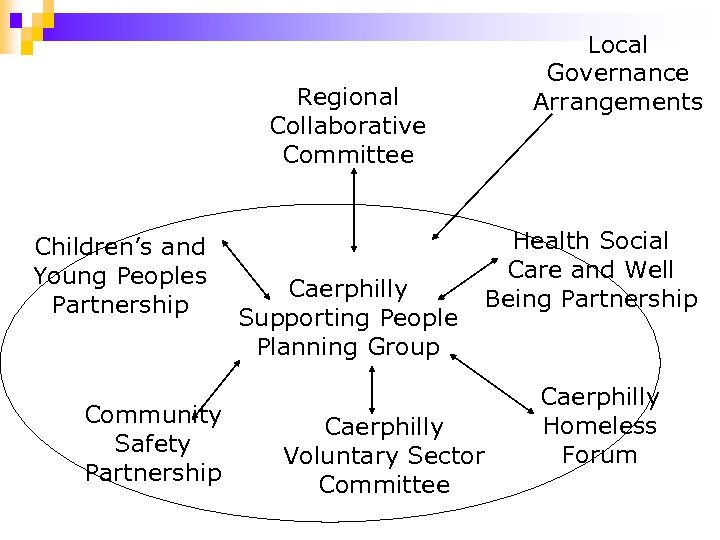 Local Governance Arrangements Regional Collaborative Committee Children’s and Young Peoples Partnership Community Safety Partnership Caerphilly Supporting People Planning Group Health Social Care and Well Being Partnership Caerphilly Voluntary Sector Committee Caerphilly Homeless Forum
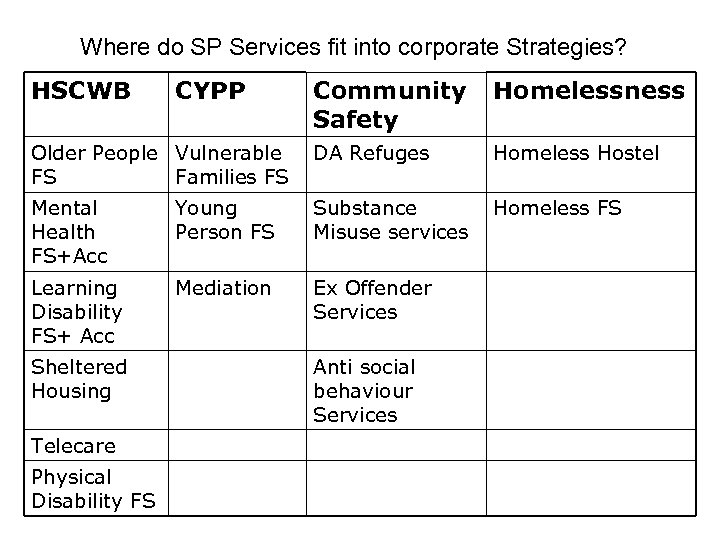 Where do SP Services fit into corporate Strategies? HSCWB Community Safety Homelessness Older People Vulnerable FS Families FS DA Refuges Homeless Hostel Mental Health FS+Acc Young Person FS Substance Misuse services Homeless FS Learning Disability FS+ Acc Mediation Ex Offender Services Sheltered Housing Telecare Physical Disability FS CYPP Anti social behaviour Services
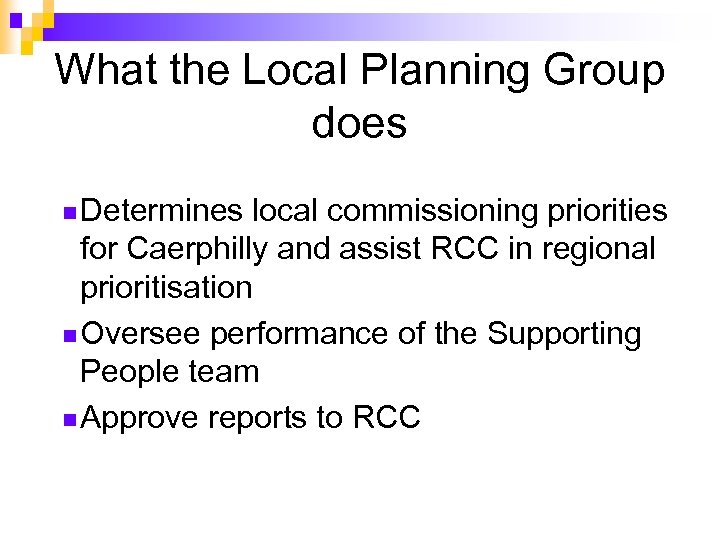 What the Local Planning Group does n Determines local commissioning priorities for Caerphilly and assist RCC in regional prioritisation n Oversee performance of the Supporting People team n Approve reports to RCC
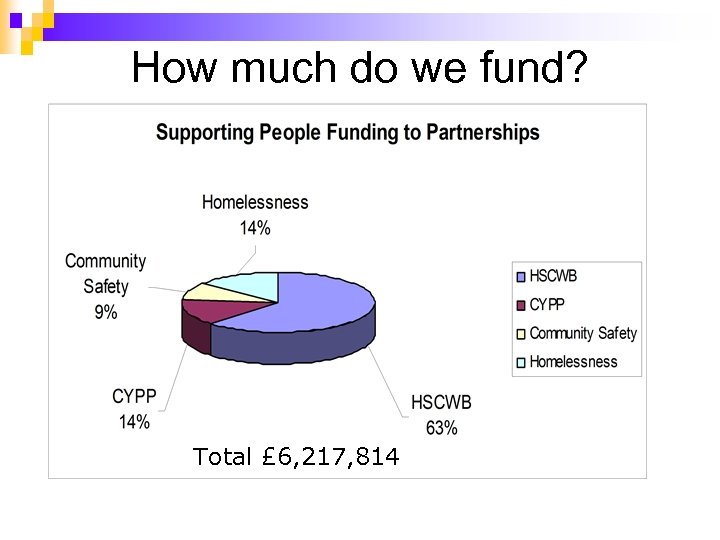 How much do we fund? Total £ 6, 217, 814
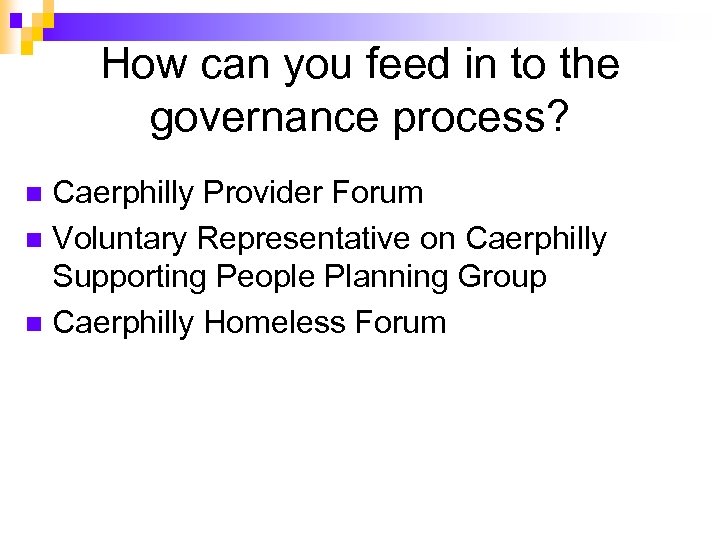 How can you feed in to the governance process? Caerphilly Provider Forum n Voluntary Representative on Caerphilly Supporting People Planning Group n Caerphilly Homeless Forum n
 Eligibility and Monitoring Edwin Yhap
 Eligibility Based on the Gwent Supporting People allowable activities and definitions of Housing Related Support (HRS) (8/12/07) n Why is a definition needed? n ¨ To assist providers, service users and referrers to understand the purpose, function, and boundaries of HRS.
 Eligibility n Interpretation of support ¨ The document is task based criteria only, and it is recognised that outcome measurements and monitoring will be key to evidencing the strategic relevance of SP services. n Mandatory service aims ¨ Provision of services need to reflect these and options under SP funding.
 Eligibility Integrated model of service provision n The need to be creative, flexible, innovative and integrated with primary care services. n It is not a ‘stand alone service’ n Length of time service should be provided n
 Monitoring Arrangements Compliancy n SP service aims n Legislative framework-housing, Equalities, Safeguarding, fit for purpose n Financial viability n Welsh Government expectations n Support n ‘Fulfilling the promise’ n
 Monitoring Training n Engaging with Service users n Networking n Sharing good practice. n GNME n Service development n
 Future Scheme Proposals Shelly Jones
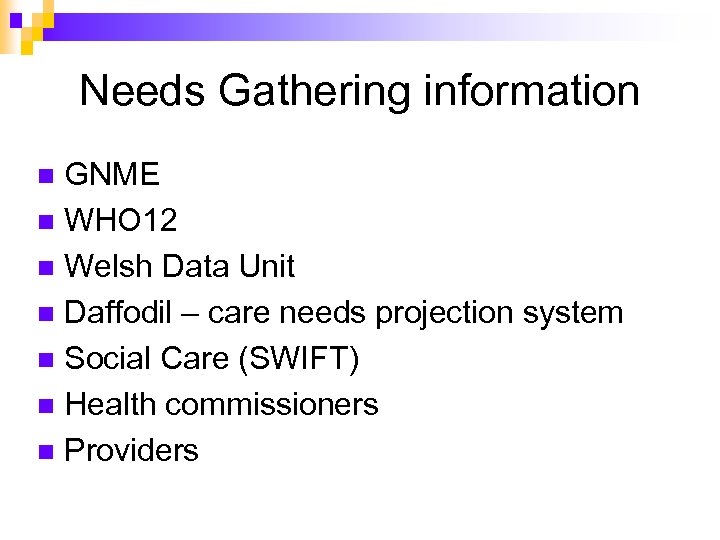 Needs Gathering information GNME n WHO 12 n Welsh Data Unit n Daffodil – care needs projection system n Social Care (SWIFT) n Health commissioners n Providers n
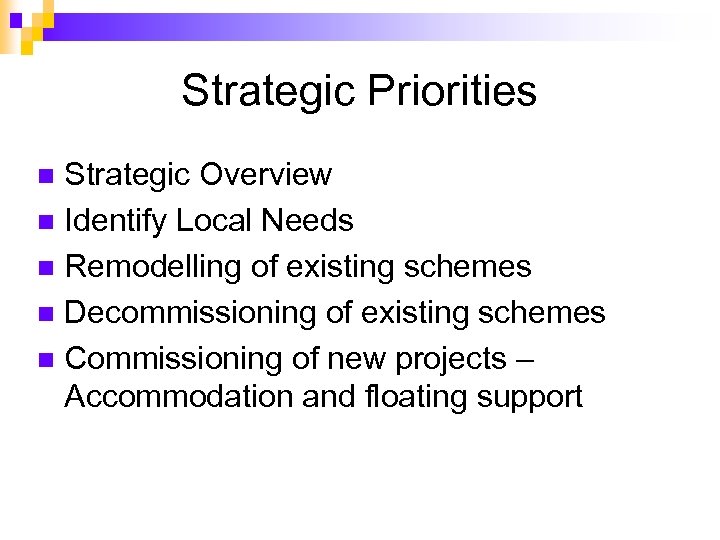 Strategic Priorities Strategic Overview n Identify Local Needs n Remodelling of existing schemes n Decommissioning of existing schemes n Commissioning of new projects – Accommodation and floating support n
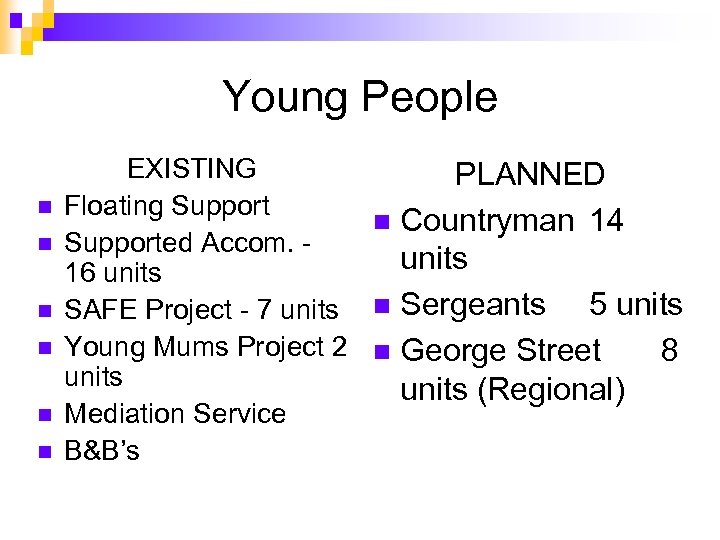 Young People n n n EXISTING PLANNED Floating Support n Countryman 14 Supported Accom. - units 16 units 5 units SAFE Project - 7 units n Sergeants Young Mums Project 2 n George Street 8 units (Regional) Mediation Service B&B’s
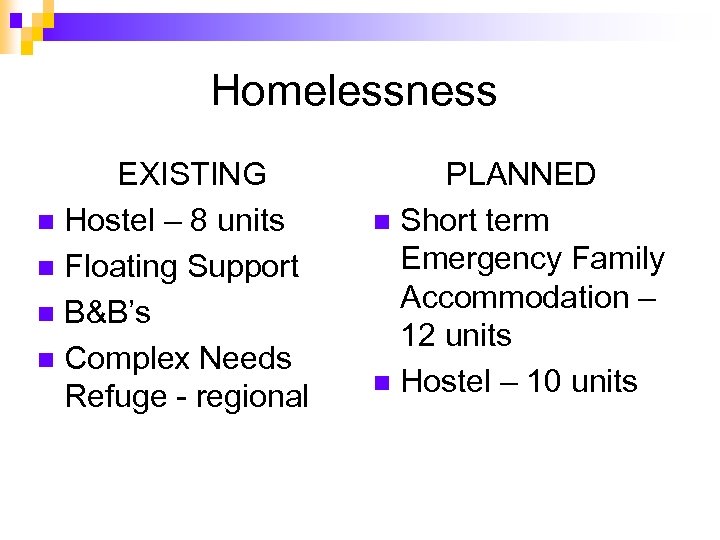 Homelessness EXISTING n Hostel – 8 units n Floating Support n B&B’s n Complex Needs Refuge - regional PLANNED n Short term Emergency Family Accommodation – 12 units n Hostel – 10 units
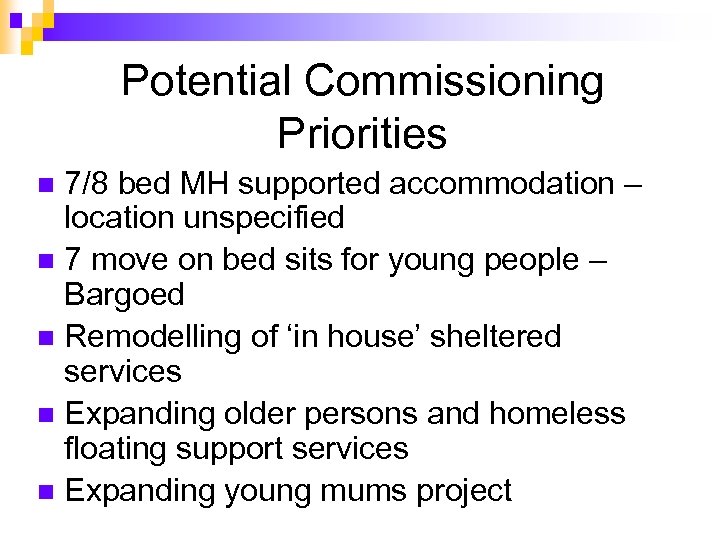 Potential Commissioning Priorities 7/8 bed MH supported accommodation – location unspecified n 7 move on bed sits for young people – Bargoed n Remodelling of ‘in house’ sheltered services n Expanding older persons and homeless floating support services n Expanding young mums project n
 THANK YOU SUPPORTING PEOPLE TEAM CONTACT DETAILS n 01443 864548 n Supportingpeople@caerphilly. gov. uk n WWW. CAERPHILLY. GOV. UK/SUPPORTINGPEOPLE Any questions?