


 Скачать презентацию Supporting Families Across the Life Course Michelle Sheli
505e5067af6886a414f87e582ca7a641.ppt
- Количество слайдов: 41
 Supporting Families Across the Life. Course Michelle “Sheli” Reynolds, SIBLING, Ph. D Missouri Family-to-Family Resource Center University of Missouri- Kansas City Institute for Human Development University Center on Developmental Disabilities July 24, 2013
 About Me p p Sibling of 31 year old brother with developmental disability Director Individual Advocacy & Family Support UMKC Institute for Human Development n n n 12 years supporting self-advocacy movement (People First of MO and SABE) Director of Mo Family-to-Family Disability & Health Information Center Technical assistance to continue moving policy and practices to support the “national agenda for supporting families with disabilities”
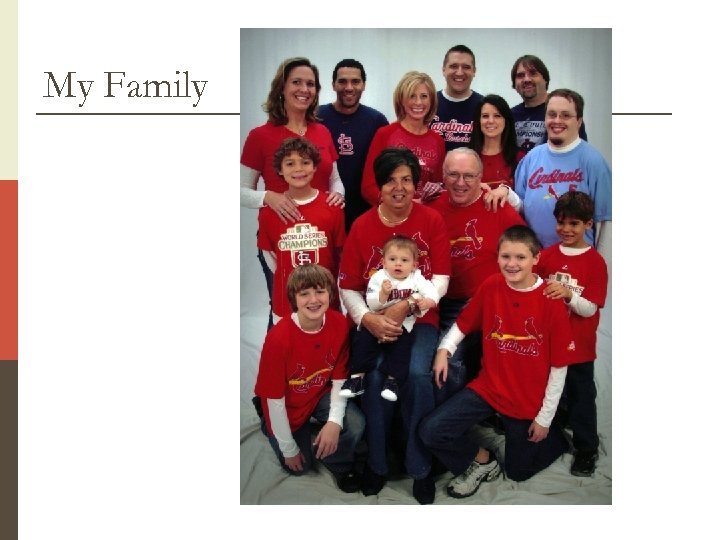 My Family
 Goals of Presentation Challenge everyone to think beyond their current beliefs and understanding p Show the impact of history on supports and services now p Provide an overview of the role of the family throughout the lifespan p Describe a new agenda for supports to individuals and their families across the life course p
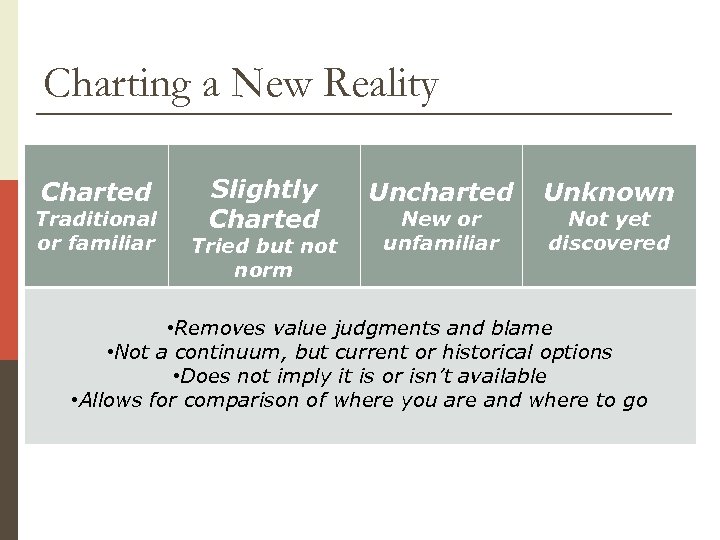 Charting a New Reality Charted Traditional or familiar Slightly Charted Tried but norm Uncharted New or unfamiliar Unknown Not yet discovered • Removes value judgments and blame • Not a continuum, but current or historical options • Does not imply it is or isn’t available • Allows for comparison of where you are and where to go
 Why Uncharted Waters? Journey: Recognizing life is not static p Exploring: identifying new options and possibilities p Navigating together: Sharing responsibility p Our overall compass is “quality of life” p
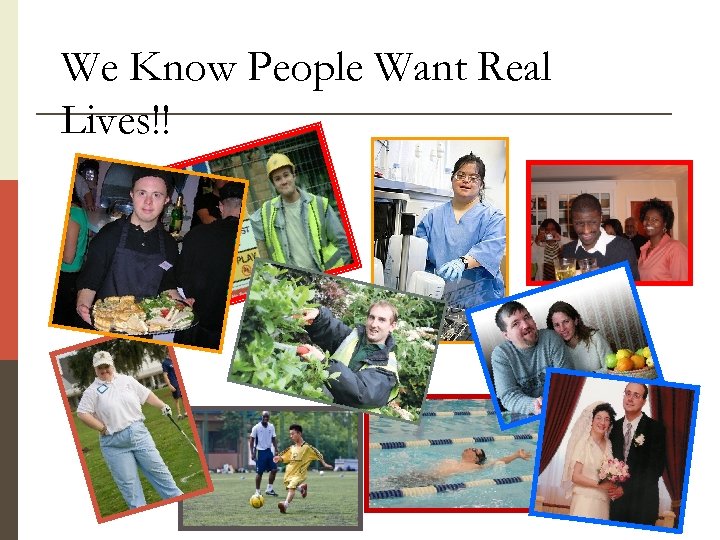 We Know People Want Real Lives!! 7
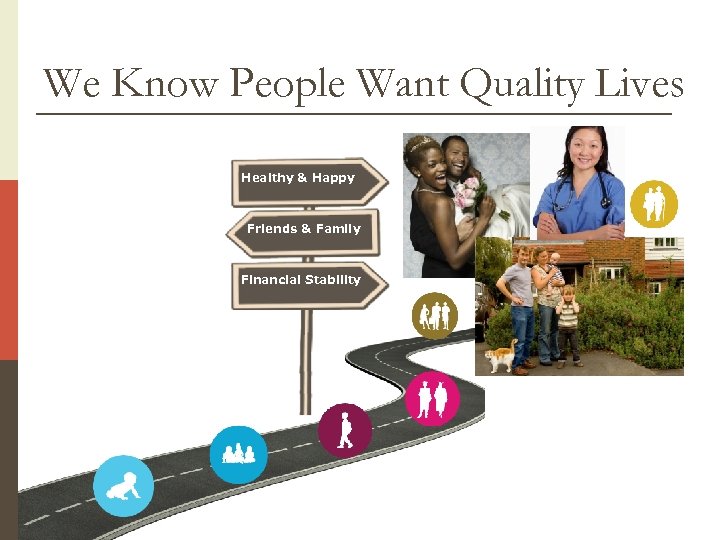 We Know People Want Quality Lives Healthy & Happy Friends & Family Financial Stability
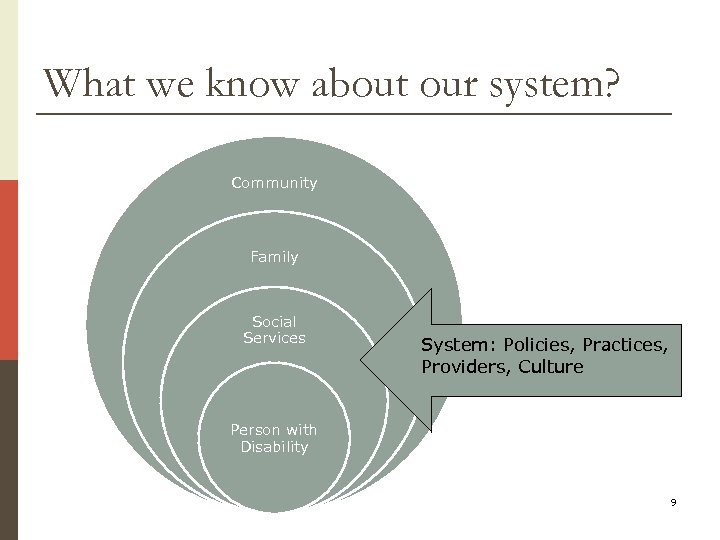 What we know about our system? Community Family Social Services System: Policies, Practices, Providers, Culture Person with Disability 9
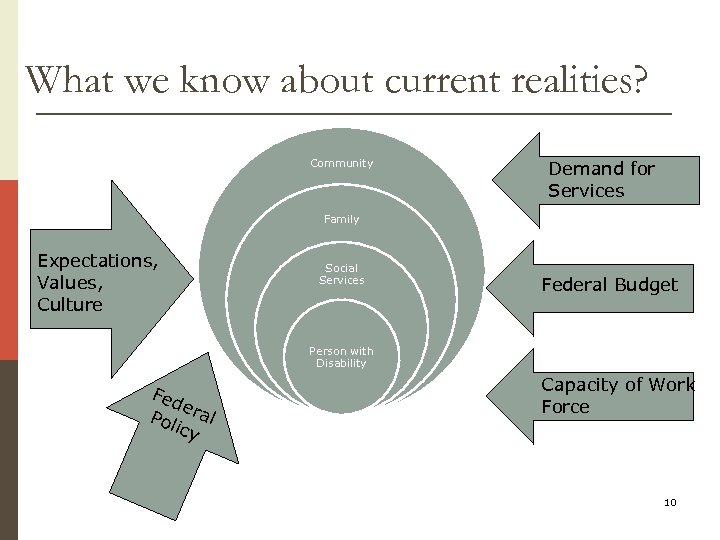 What we know about current realities? Community Demand for Services Family Expectations, Values, Culture Social Services Federal Budget Person with Disability Fed e Pol ral icy Capacity of Work Force 10
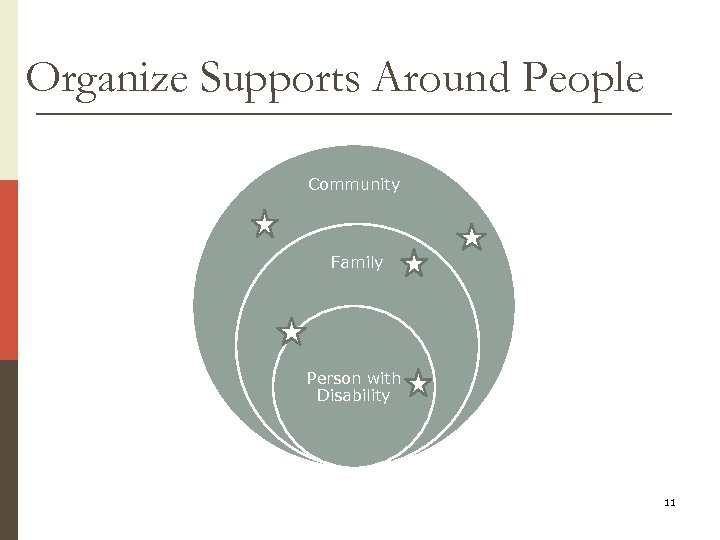 Organize Supports Around People Community Family Person with Disability 11
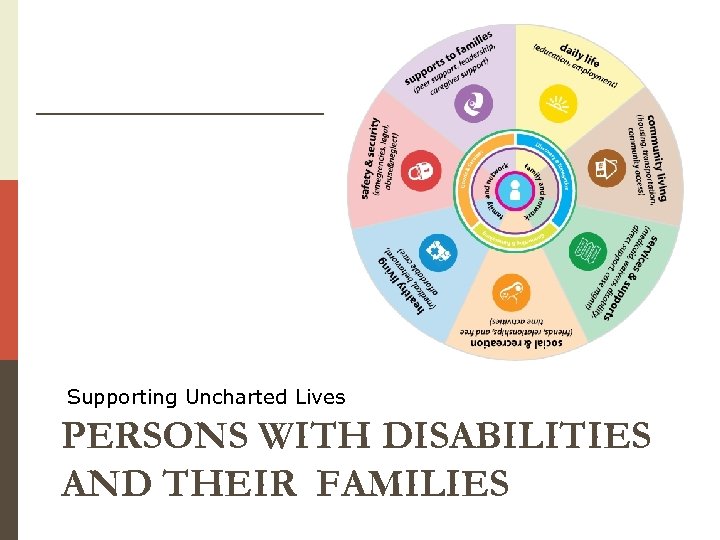 Supporting Uncharted Lives PERSONS WITH DISABILITIES AND THEIR FAMILIES
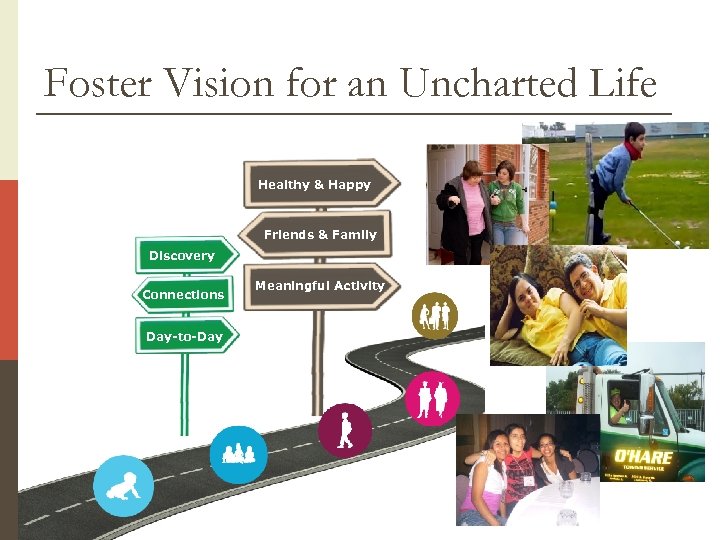 Foster Vision for an Uncharted Life Healthy & Happy Friends & Family Discovery Connections Day-to-Day Meaningful Activity
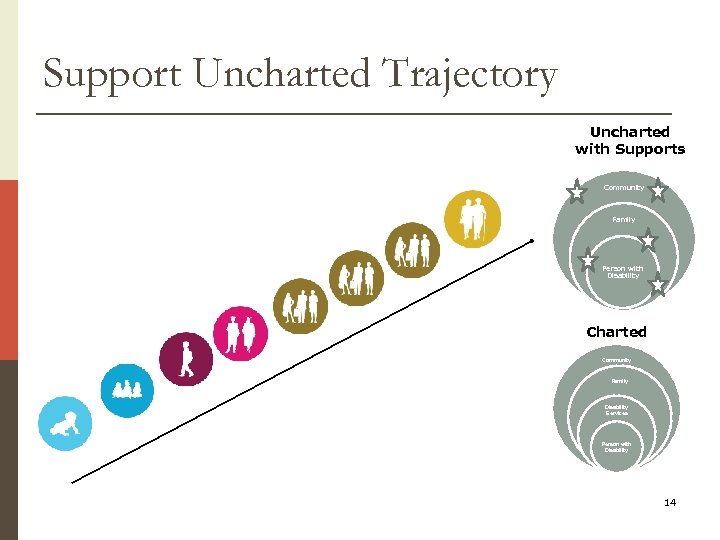 Support Uncharted Trajectory Uncharted with Supports Community Family Person with Disability Charted Community Family Disability Services Person with Disability 14
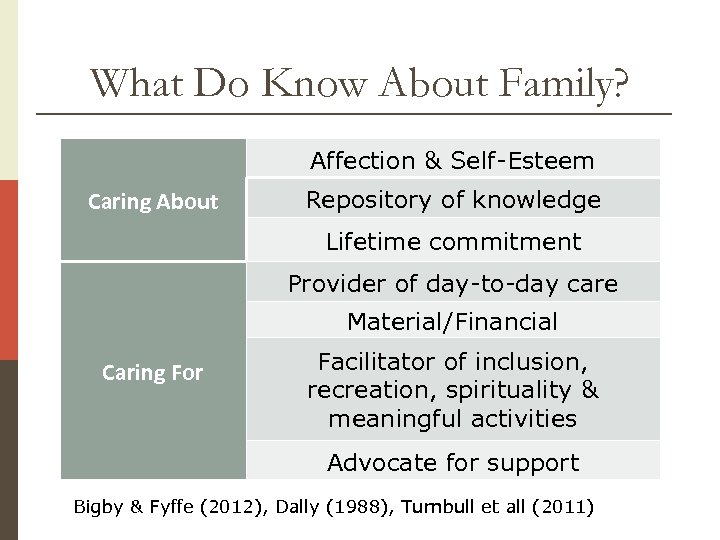 What Do Know About Family? Affection & Self-Esteem Caring About Repository of knowledge Lifetime commitment Provider of day-to-day care Material/Financial Caring For Facilitator of inclusion, recreation, spirituality & meaningful activities Advocate for support Bigby & Fyffe (2012), Dally (1988), Turnbull et all (2011)
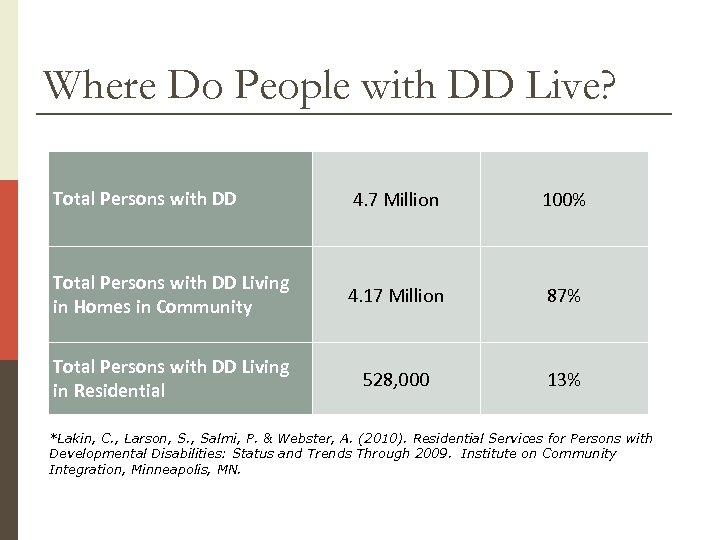 Where Do People with DD Live? Total Persons with DD 4. 7 Million 100% Total Persons with DD Living in Homes in Community 4. 17 Million 87% Total Persons with DD Living in Residential 528, 000 13% *Lakin, C. , Larson, S. , Salmi, P. & Webster, A. (2010). Residential Services for Persons with Developmental Disabilities: Status and Trends Through 2009. Institute on Community Integration, Minneapolis, MN.
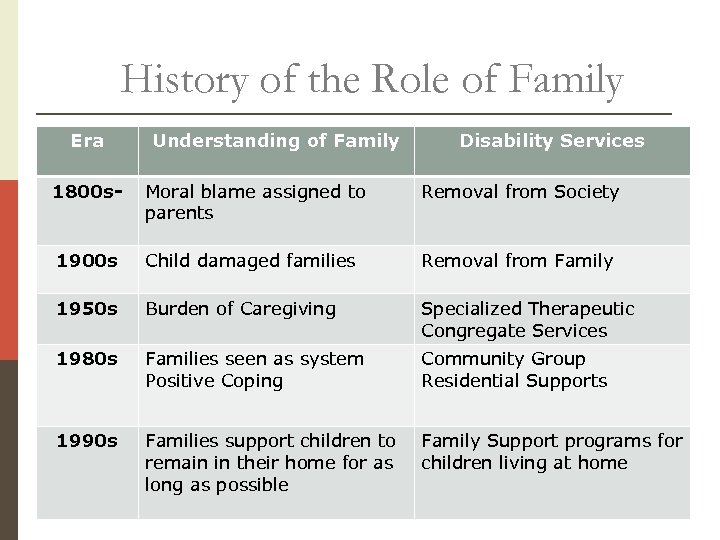 History of the Role of Family Era Understanding of Family Disability Services 1800 s- Moral blame assigned to parents Removal from Society 1900 s Child damaged families Removal from Family 1950 s Burden of Caregiving Specialized Therapeutic Congregate Services 1980 s Families seen as system Positive Coping Community Group Residential Supports 1990 s Families support children to remain in their home for as long as possible Family Support programs for children living at home
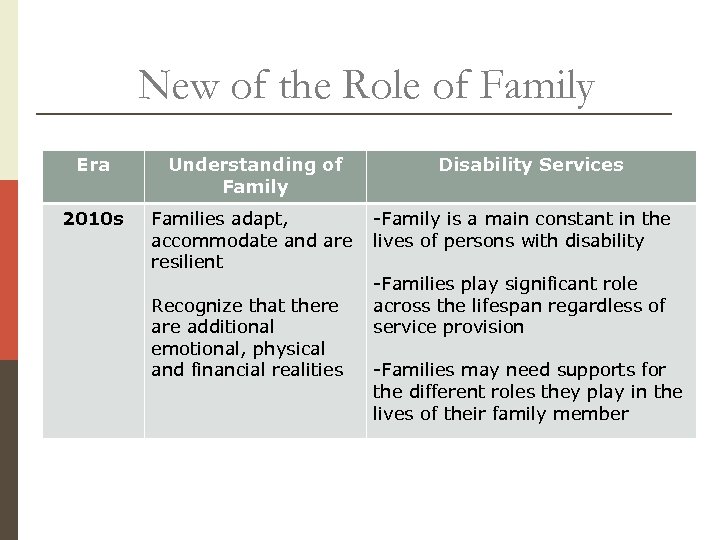 New of the Role of Family Era 2010 s Understanding of Family Disability Services Families adapt, -Family is a main constant in the accommodate and are lives of persons with disability resilient -Families play significant role Recognize that there across the lifespan regardless of are additional service provision emotional, physical and financial realities -Families may need supports for the different roles they play in the lives of their family member
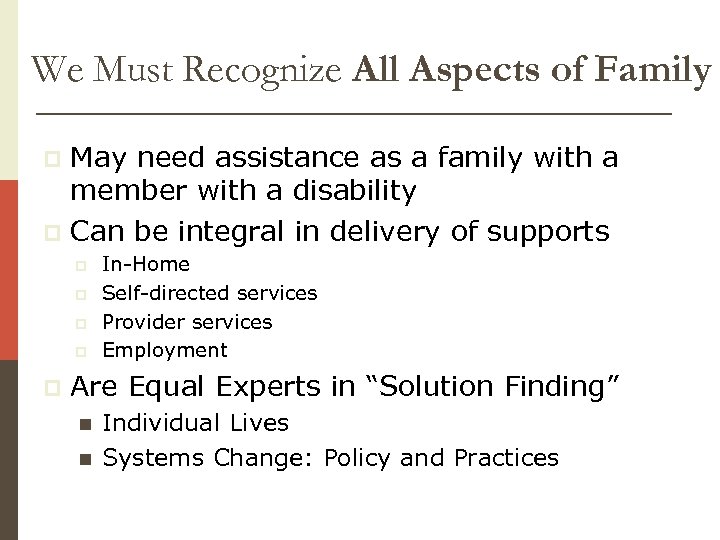 We Must Recognize All Aspects of Family May need assistance as a family with a member with a disability p Can be integral in delivery of supports p p p In-Home Self-directed services Provider services Employment Are Equal Experts in “Solution Finding” n n Individual Lives Systems Change: Policy and Practices
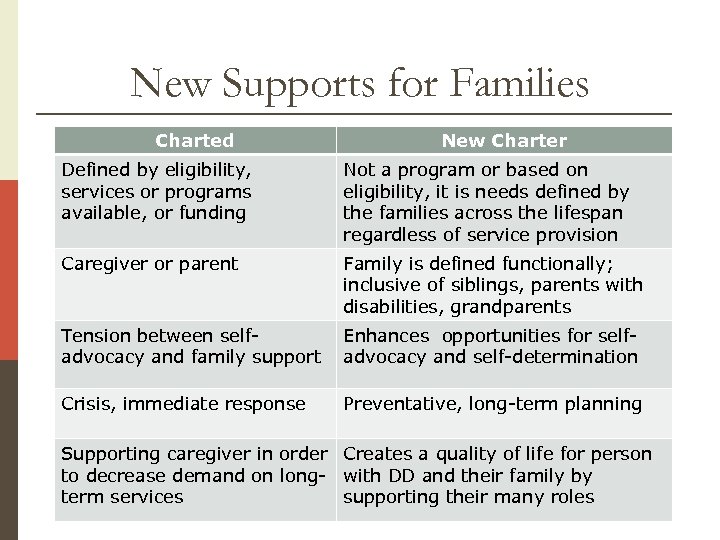 New Supports for Families Charted New Charter Defined by eligibility, services or programs available, or funding Not a program or based on eligibility, it is needs defined by the families across the lifespan regardless of service provision Caregiver or parent Family is defined functionally; inclusive of siblings, parents with disabilities, grandparents Tension between selfadvocacy and family support Enhances opportunities for selfadvocacy and self-determination Crisis, immediate response Preventative, long-term planning Supporting caregiver in order Creates a quality of life for person to decrease demand on long- with DD and their family by term services supporting their many roles
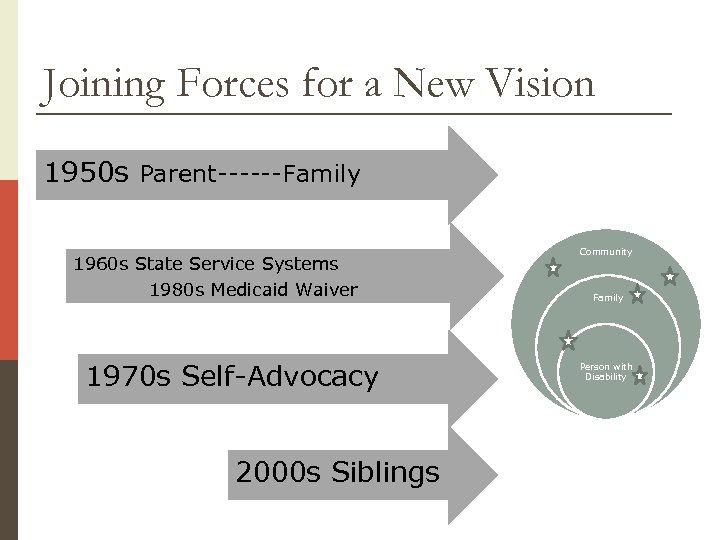 Joining Forces for a New Vision 1950 s Parent------Family 1960 s State Service Systems 1980 s Medicaid Waiver 1970 s Self-Advocacy 2000 s Siblings Community Family Person with Disability
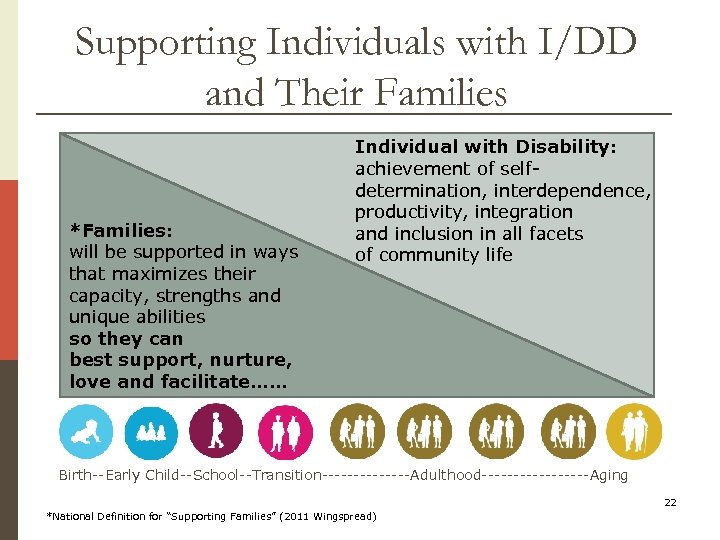 Supporting Individuals with I/DD and Their Families *Families: will be supported in ways that maximizes their capacity, strengths and unique abilities so they can best support, nurture, love and facilitate…… Individual with Disability: achievement of selfdetermination, interdependence, productivity, integration and inclusion in all facets of community life Birth--Early Child--School--Transition-------Adulthood---------Aging 22 *National Definition for “Supporting Families” (2011 Wingspread)
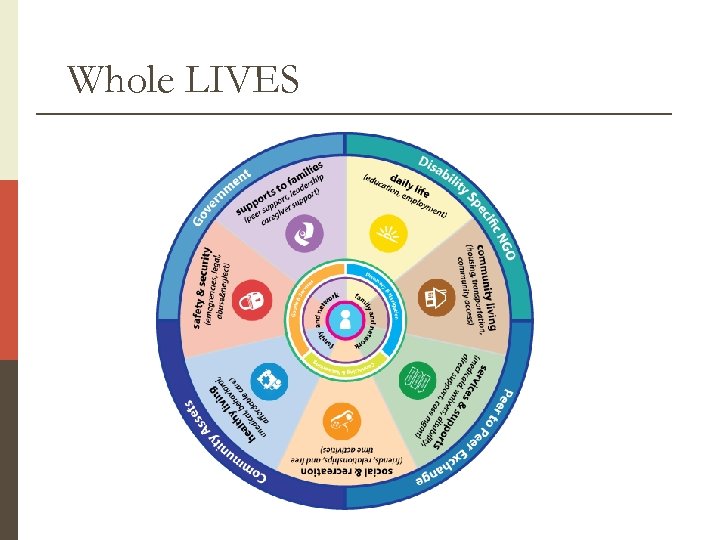 Whole LIVES
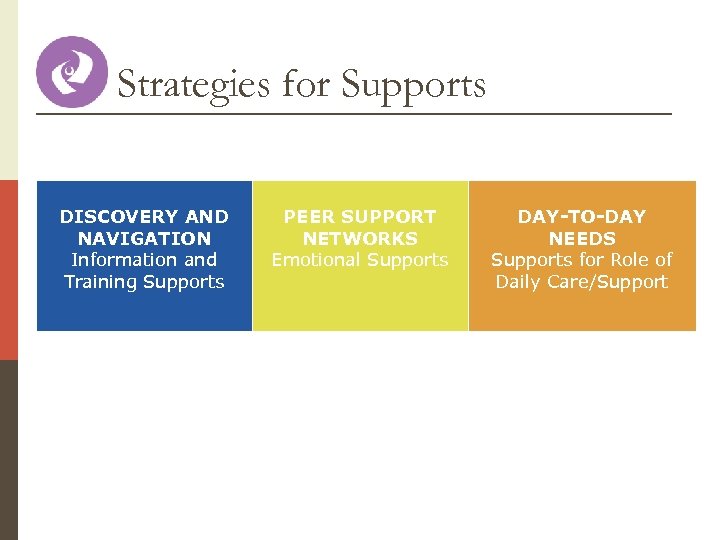 Strategies for Supports DISCOVERY AND NAVIGATION Information and Training Supports PEER SUPPORT NETWORKS Emotional Supports DAY-TO-DAY NEEDS Supports for Role of Daily Care/Support
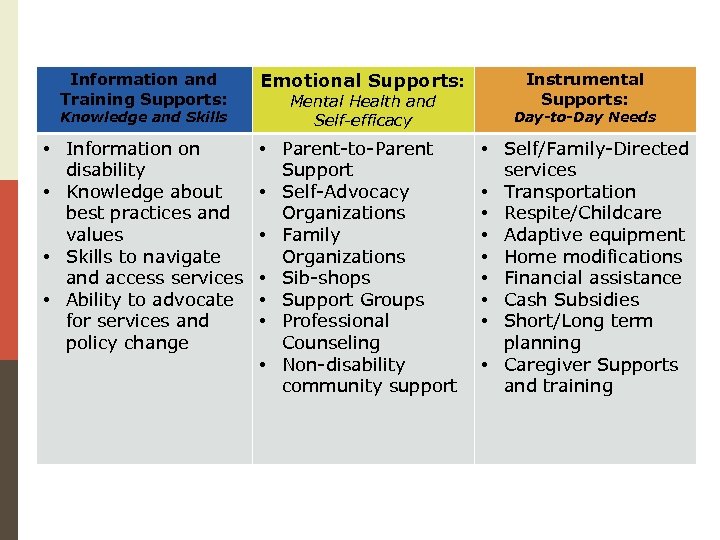 Information and Training Supports: Emotional Supports: • Information on disability • Knowledge about best practices and values • Skills to navigate and access services • Ability to advocate for services and policy change • Parent-to-Parent Support • Self-Advocacy Organizations • Family Organizations • Sib-shops • Support Groups • Professional Counseling • Non-disability community support Knowledge and Skills Mental Health and Self-efficacy Instrumental Supports: Day-to-Day Needs • Self/Family-Directed services • Transportation • Respite/Childcare • Adaptive equipment • Home modifications • Financial assistance • Cash Subsidies • Short/Long term planning • Caregiver Supports and training
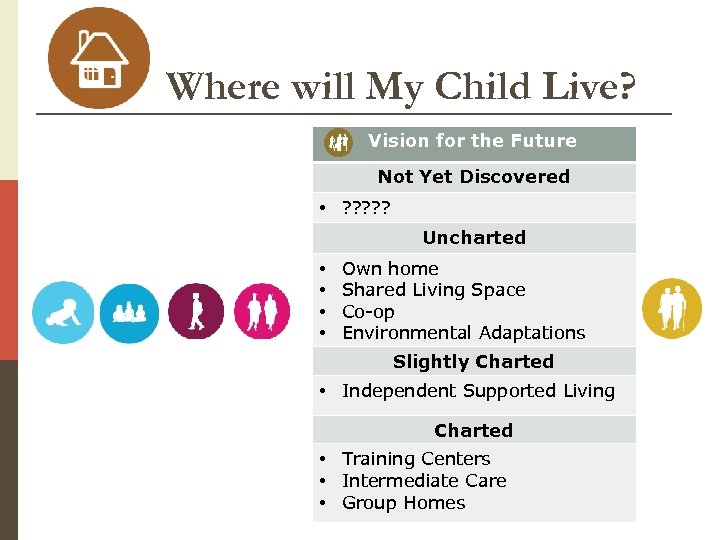 Where will My Child Live? Vision for the Future Not Yet Discovered • ? ? ? Uncharted • • Own home Shared Living Space Co-op Environmental Adaptations Slightly Charted • Independent Supported Living Charted • Training Centers • Intermediate Care • Group Homes
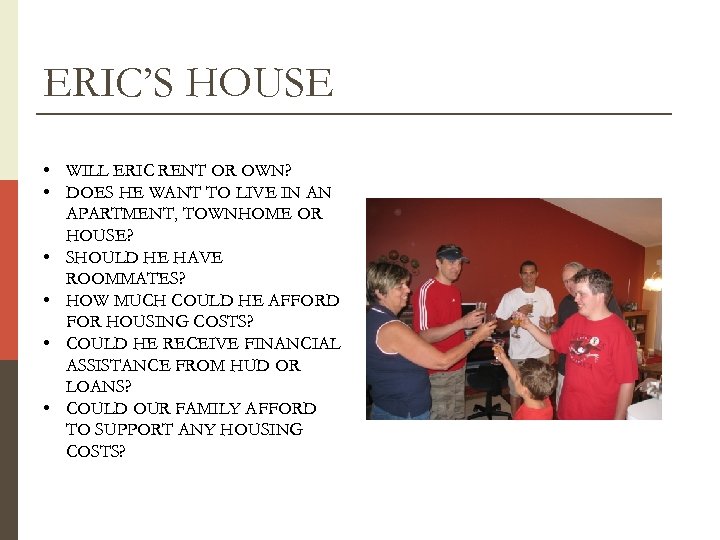 ERIC’S HOUSE • WILL ERIC RENT OR OWN? • DOES HE WANT TO LIVE IN AN APARTMENT, TOWNHOME OR HOUSE? • SHOULD HE HAVE ROOMMATES? • HOW MUCH COULD HE AFFORD FOR HOUSING COSTS? • COULD HE RECEIVE FINANCIAL ASSISTANCE FROM HUD OR LOANS? • COULD OUR FAMILY AFFORD TO SUPPORT ANY HOUSING COSTS?
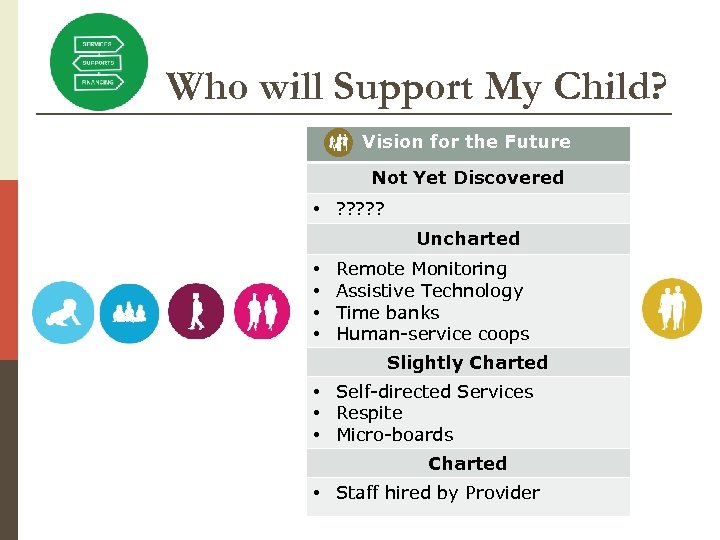 Who will Support My Child? Vision for the Future Not Yet Discovered • ? ? ? Uncharted • • Remote Monitoring Assistive Technology Time banks Human-service coops Slightly Charted • Self-directed Services • Respite • Micro-boards Charted • Staff hired by Provider
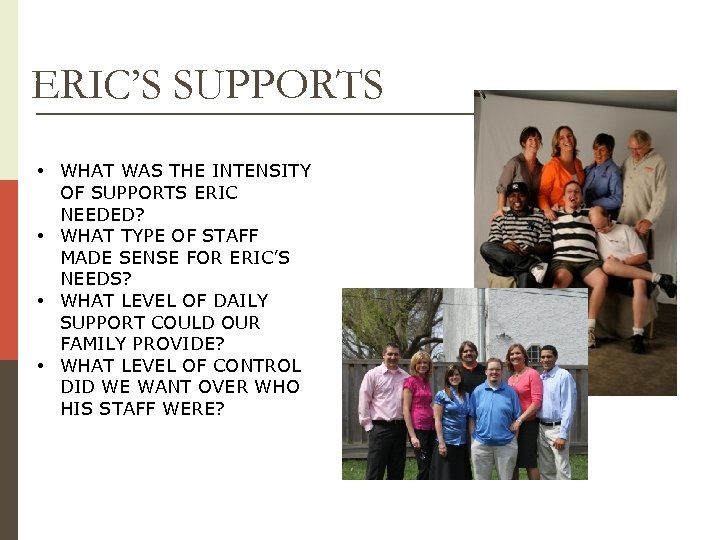 ERIC’S SUPPORTS • WHAT WAS THE INTENSITY OF SUPPORTS ERIC NEEDED? • WHAT TYPE OF STAFF MADE SENSE FOR ERIC’S NEEDS? • WHAT LEVEL OF DAILY SUPPORT COULD OUR FAMILY PROVIDE? • WHAT LEVEL OF CONTROL DID WE WANT OVER WHO HIS STAFF WERE?
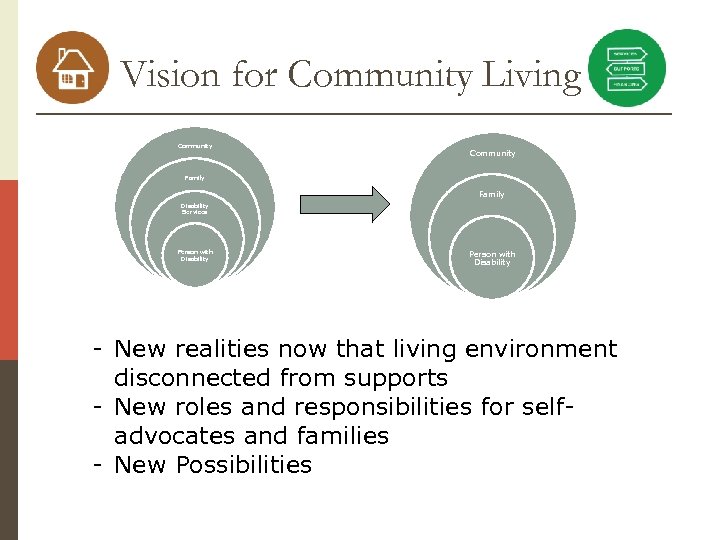 Vision for Community Living Community Family Disability Services Person with Disability - New realities now that living environment disconnected from supports - New roles and responsibilities for selfadvocates and families - New Possibilities
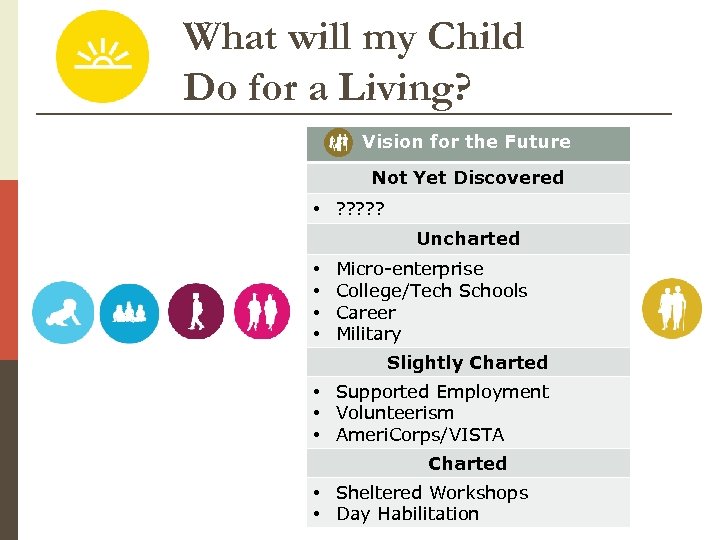 What will my Child Do for a Living? Vision for the Future Not Yet Discovered • ? ? ? Uncharted • • Micro-enterprise College/Tech Schools Career Military Slightly Charted • Supported Employment • Volunteerism • Ameri. Corps/VISTA Charted • Sheltered Workshops • Day Habilitation
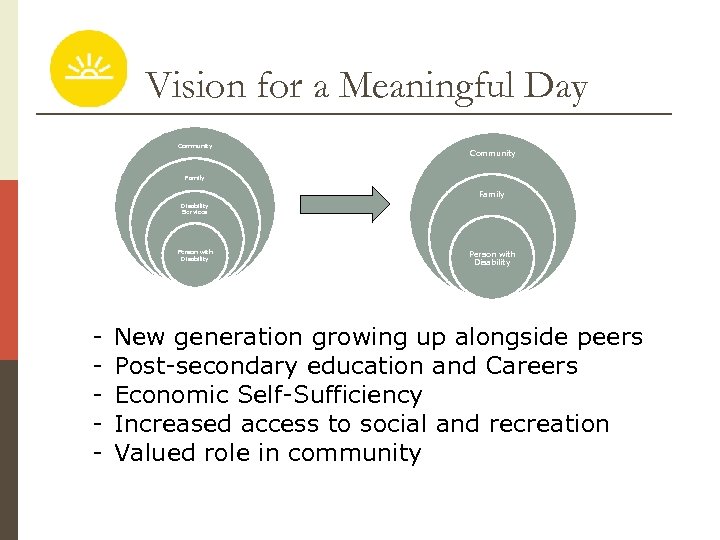 Vision for a Meaningful Day Community Family Disability Services Person with Disability - Person with Disability New generation growing up alongside peers Post-secondary education and Careers Economic Self-Sufficiency Increased access to social and recreation Valued role in community
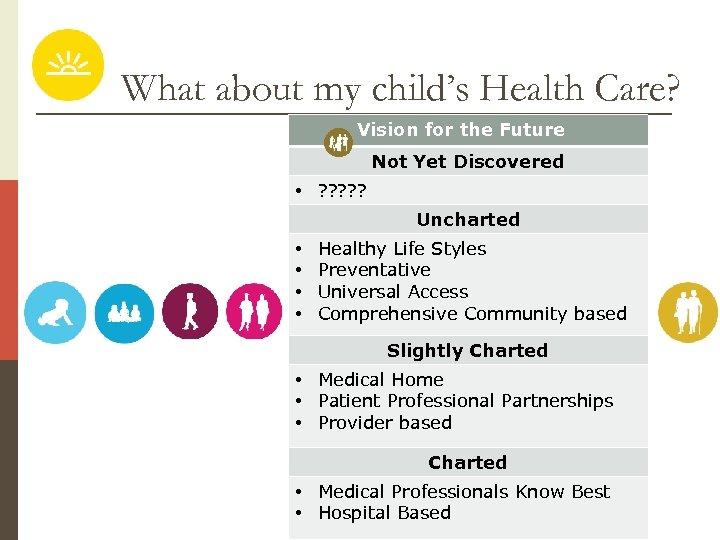 What about my child’s Health Care? Vision for the Future Not Yet Discovered • ? ? ? Uncharted • • Healthy Life Styles Preventative Universal Access Comprehensive Community based Slightly Charted • Medical Home • Patient Professional Partnerships • Provider based Charted • Medical Professionals Know Best • Hospital Based
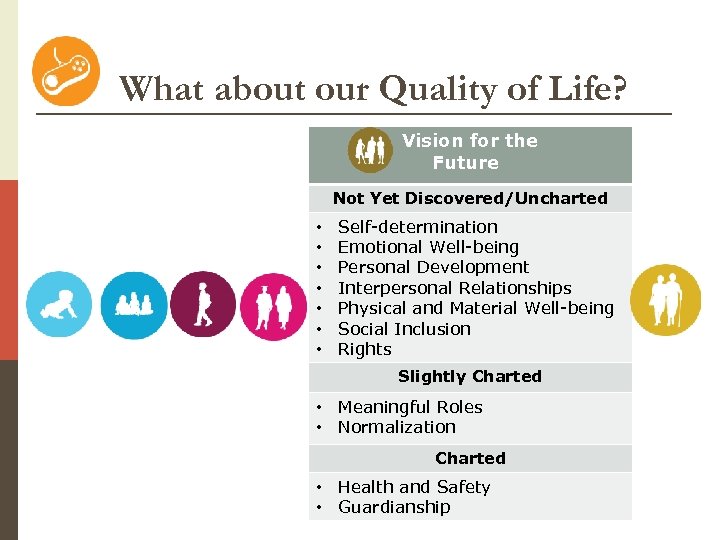 What about our Quality of Life? Vision for the Future Not Yet Discovered/Uncharted • • Self-determination Emotional Well-being Personal Development Interpersonal Relationships Physical and Material Well-being Social Inclusion Rights Slightly Charted • Meaningful Roles • Normalization Charted • Health and Safety • Guardianship
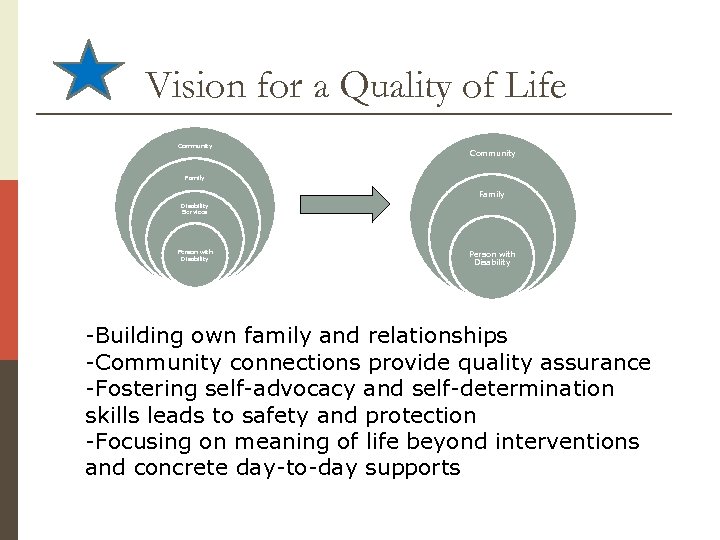 Vision for a Quality of Life Community Family Disability Services Person with Disability -Building own family and relationships -Community connections provide quality assurance -Fostering self-advocacy and self-determination skills leads to safety and protection -Focusing on meaning of life beyond interventions and concrete day-to-day supports
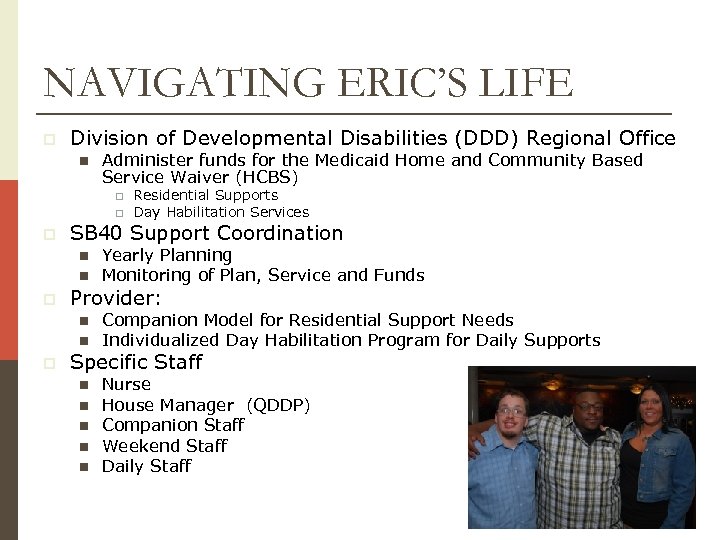 NAVIGATING ERIC’S LIFE p Division of Developmental Disabilities (DDD) Regional Office n Administer funds for the Medicaid Home and Community Based Service Waiver (HCBS) p p p SB 40 Support Coordination n n p Yearly Planning Monitoring of Plan, Service and Funds Provider: n n p Residential Supports Day Habilitation Services Companion Model for Residential Support Needs Individualized Day Habilitation Program for Daily Supports Specific Staff n n n Nurse House Manager (QDDP) Companion Staff Weekend Staff Daily Staff
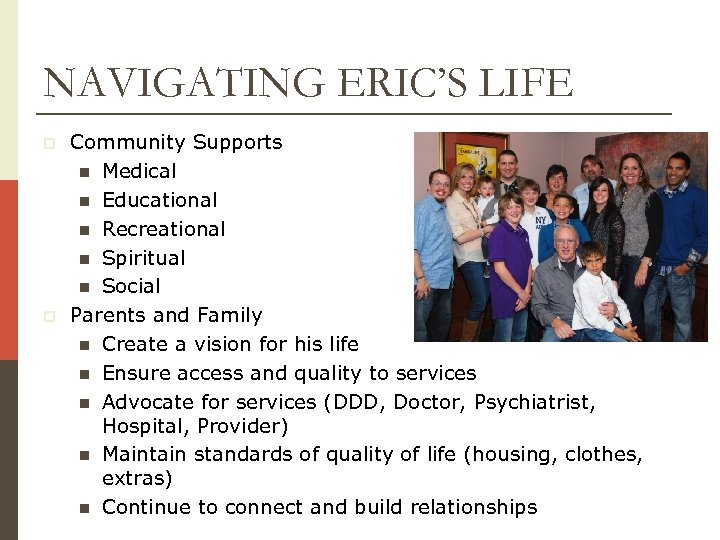 NAVIGATING ERIC’S LIFE p p Community Supports n Medical n Educational n Recreational n Spiritual n Social Parents and Family n Create a vision for his life n Ensure access and quality to services n Advocate for services (DDD, Doctor, Psychiatrist, Hospital, Provider) n Maintain standards of quality of life (housing, clothes, extras) n Continue to connect and build relationships
 Life isn’t about how to survive the storm, but how to dance in the rain. -unknown
 References Ben-Shlomo, Y. , & Kuh, D. (2002). A life course approach to chronic disease epidemiology: conceptual models, empirical challenges and interdisciplinary perspectives. International Journal of Epidemiology, 31: 285 -293. Bigby, C. , & Fyffe. C. (2012). Services and Families Working Together to Support Adults with Intellectual Disability. Proceedings of the Sixth Roundtable on Intellectual Disability Policy. Bundoora: La Trobe University. Calkins, C. , Wehmeyer, M. , Bacon, A. , Heller, T. , & Walker, H. M. (2011) Introduction to the special issue on scaling up efforts to promote the self-determination of people with developmental disabilities. Exceptionality, 19(1): 2 -5. Dalley, G. (1988). Ideologies of caring: Rethinking community and collectivism. Basingstoke: Mac. Millan. Developmental Disabilities Assistance and Bill of Rights Act of 2000. Public Law 106 -402 U. S. Code 42 2000 § 15001. Family Support Agenda (2012). Building a national agenda for supporting famiies wit a member with intellectual and developmental disabilities. Fine, A. , Kotelchuck, M. , Adess, N. , & Pies, C. (2009). Policy brief. A new agenda for MCH policy and programs: Integrating a life course perspective. Martinez, CA: Family, Maternal, and Child Health Programs Contra Costa Health Services. Hutchison, E. D. (2007). A Life course perspective. In Hutchison, E. D. , Dimensions of human behavior: The changing life course(4 th ed, pp. 1 -38). Thousand Oaks, CA: SAGE. Kuh, D. , Ben. Shlomo, Y. , Lynch, J. , Hallqvist, J. , & Power, C. (2003). Life course epidemiology. Journal of Epidemiology and Community Health, 57(10): 778 -783.
 References (continued) Missouri Family to Family (2012). Charting the life course: A guide for individuals, families, and professionals. Kansas City, MO: Institute for Human Development, University of Missouri-Kansas City. Lakin, C. , Larson, S. , Salmi, P. , & Webster, A. (2010). Residential services for persons with developmental disabilities: Status and trends through 2009. Institute on Community Integration, Minneapolis, MN. National Gateway to Self-Determination (2011). Research to practice in selfdetermination series. National Training Initiative on Self-Determination and the Association of University Centers on Disabilities. Hareven, T. (2000). Families, history, and social change: Life course and cross-cultural perspectives. Boulder, CO: Westview Press. Riley, M. W. , & Riley Jr, J. W. (1996). Generational relations: A future perspective. Aging and Generational Relations: Life-course and Cross-cultural perspectives, 283 -291. Seltzer, M. M. (1985). Informal supports for aging mentally retarded persons. American journal of mental deficiency, 90(3), 259. Turnbull, A. , Turnbull, R. , Erwin, E. , Soodak, L. , & Shogen, K. (2011). Families, professionals, and exceptionality: Positive outcomes through partnership and trust. Boston MA: Pearson.
 Contact Information Sheli Reynolds reynoldsmc@umkc. edu 816. 235. 1759