 Скачать презентацию Supporting Business Decision-Making Good Information is Essential for
61264edbfe805f1707fd2e4915106aa5.ppt
- Количество слайдов: 50



Supporting Business Decision-Making Good Information is Essential for Fact-Based Decision. Making
The Importance of Knowledge For centuries managers have used the knowledge available to them to make decisions n The amount of knowledge used to make decisions has increased exponentially n The Importance of Decision Making n ¨ Decisions today determine the landscape of tomorrow's world
Decision Making The common thread that runs through all managerial functions n Decision = a choice of one course of action from a number of alternatives leading to a certain desired objective n
Classifying Decisions n Functional area ¨ Finance decisions ¨ Marketing decisions ¨ Production decisions ¨ Personnel decisions, etc. n Managerial Function ¨ Planning decisions ¨ Organizing decisions ¨ Control decisions, etc.
Classifying Decisions n Management Level ¨ Strategic decisions ¨ Tactical decisions ¨ Operational decisions n Structure of decision ¨ Structured/Programmed decisions ¨ Semi-structured decisions ¨ Unstructured decisions
Decision Support System Definition n A decision Support System is an interactive computer-based system or subsystem that helps people use computer communications, data, documents, knowledge and models to identify and solve problems, complete decision process tasks, and make decision n “DSS comprise a class of information system that draws on transaction processing systems and interacts with the other parts of the overall information system to support the decision-making activities of managers and other knowledge workers in organizations” (Sprague and Carlson, 1982, p. 9). n DSS are ancillary or auxiliary systems; they are not intended to replace skilled decision-makers Reference - Power (2008)
DSS Assumptions Is good information and analysis essential for fact-based decision-making? n Build DSS when good information is likely to improve decision-making n Build DSS when managers need and want computerized decision support n Reference - Power (2008)
MIS and DSS Brief History n n n n n Late 1960 s, MIS focused on providing structured, periodic reports Late 1960 s, first DSS built using interactive computer systems, Scott -Morton 1975 -1980 DSS using financial models with “What if? ” analysis 1975 Steve Alter MIT dissertation 1979 -1982 Theoretical foundations Mid-1980 s Executive Information Systems and GDSS Early 1990 s shift to client/server DSS, Business Intelligence, Bill Inmon and Ralph Kimball 1995 Data warehousing, data mining and the world-wide web 1998 Enterprise performance management and balanced scorecard 2000 Application service providers (ASPs) and portals Reference - Power (2008)
DSS History - Specifics n n n n n 1951 Lyons Tea Shops used LEO 1 digital computer to factor in weather forecasts to determine what “fresh produce” delivery vans would carry to Lyon’s UK shops Later SAGE a control system for tracking aircraft used by NORAD from the 1950 s to the early 1980 s (real time control, communications) Mid-1960 s NLS first hypermedia groupware system was the forerunner to GDSS 1965 more cost effective due to the IBM System 360 and other more powerful mainframes and minicomputer systems 1970 s companies were implementing a variety of DSS 1982 DSS considered a new class of IS 1980 s financial planning systems became popular “What-if” analysis Mid-1980 s DSS were supporting managers in operations, financial management, management control and strategic decision making (scope, purpose and targeted user base was expanding) 1985 P&G built a DSS that linked sales information and retail scanner data Reference - Power (2008)
DSS Conceptual Perspective n n DSS are both off-the-shelf, packaged application and custom designed systems. Alter (1980) ¨ Designed specifically to facilitate a decision process ¨ Should support rather than automate decision making ¨ Should be able to respond quickly to changing needs of decision makers n Business intelligence, knowledge management Reference - Power (2008)
Characteristics of DSS n n n n n Body of knowledge Record keeping Provide structure for a particular decision Decision maker interacts directly with DSS Facilitation Ancillary. Not intended to replace decision makers Repeated used Task-oriented Identifiable Decision impact. Improve accuracy, timeliness, quality and overall effectiveness of a specific decision or a set of related decision Reference - Power (2008)
Characteristics of Decision Support Information Right Information – accurate, relevant and complete n Right Time – current, timely information n Right Formation – easy to understand manipulate n Right Cost – Cost/Benefit Trade-off n Reference - Power (2008)
Is a DSS an MIS? n n MIS describe a broad, general category of information systems or a functional reporting system. MIS is used to identify an academic major Data-Driven DSS meet management reporting needs Decision Support Systems is a broad category of interactive, analytical management information systems Reference - Power (2008)
Transaction Processing What is a transaction? A work task recorded by a data capture system. i. e. , Purchase, order, payment n Record current information but does not maintain a database of historical information n Emphasize data integrity and consistency n Reference - Power (2008)
DSS vs. Transaction Processing Systems (TPS) n n n TPS is designed to expedite and automate transaction processing, record keeping, and business reporting TPS is related to DSS because TPS provides data for reporting systems and data warehouses DSS are designed to aid in decision-making tasks and/or decision implementation Reference - Power (2008)
DSS Applications n n n n Major airlines use DSS for many tasks including pricing and route selection DSS aid in corporate planning and forecasting Specialists use DSS that focus on financial and simulation models Frito-Lay has a DSS that aids in pricing, advertising, and promotion Monsanto, Fed. Ex and most transportation companies use DSS for scheduling trucks, airplanes and ship Wal-Mart has large data warehouses and data mining systems There are many DSS on the Internet that help track and manage stock portfolios, choose stocks, plan trips, and suggest gifts
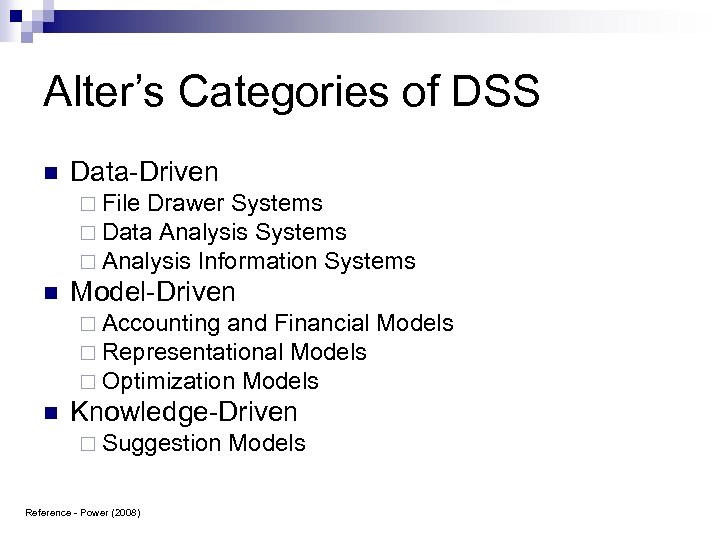
Alter’s Categories of DSS n Data-Driven ¨ File Drawer Systems ¨ Data Analysis Systems ¨ Analysis Information Systems n Model-Driven ¨ Accounting and Financial ¨ Representational Models ¨ Optimization Models n Knowledge-Driven ¨ Suggestion Reference - Power (2008) Models
Alter’s Categories of DSS n Data-Driven ¨ File Drawer Systems ¨ Data Analysis Systems ¨ Analysis Information Systems Reference - Power (2008)
Alter’s Categories of DSS n Model-Driven ¨ Accounting and Financial Models ¨ Representational Models ¨ Optimization Models Reference - Power (2008)
Alter’s Categories of DSS n Knowledge-Driven ¨ Suggestion Reference - Power (2008) Models
Framework Primary framework dimension is the dominant component or driver of the decision support system (Power, 2002) n Secondary dimensions are n ¨ The intended or targeted users, ¨ The specific purpose of the system ¨ The primary deployment or enabling technology Reference - Power (2008)
Identify the system component that provides primary functionality dominant component Communication technologies n Data and data management n Documents and document management n Knowledge base and processing n Models and model processing n Reference - Power (2008)
DSS Framework n Communications-driven DSS ¨ Interactive computer-based systems intended to facilitate the solution of problems by decision-makers working as a group ¨ Group DSS may be communications-driven or model-driven Reference - Power (2008)
DSS Framework n Data-driven ¨ Includes File Drawer/Management Reporting, Data Warehousing and Analysis Systems, Executive information Systems (EIS), and Geographic Information Systems external data n n Emphasize access to and manipulation of large databases and especially a time-series of internal company data and sometimes external data Document-driven DSS ¨ Retrieve and manage unstructured documents and web pages Reference - Power (2008)
DSS Framework n Knowledge-driven ¨ Built using AI tools, data mining tools and management expert systems n Model-driven ¨ Include systems that use accounting and financial models, representative models, and optimization models n Emphasize access to and manipulation of a model, Whit If? analysis Reference - Power (2008)
DSS Framework n Intended Users, e. g. Inter-Organizational DSS ¨ Designed for customers and suppliers ¨ Data, model, document, knowledge, or communications-driven n Purpose, e. g. Function and Industry-Specific DSS ¨A DSS that is designed specifically for a narrow task ¨ Specific rather than General purpose ¨ Vertical Market/Industry-Specific Reference - Power (2008)
Describing a Specific DSS n n A web-based, model-driven DSS for truck routing used by a dispatcher A handheld PC-based, knowledge-driven DSS for accident scene triage used by an EMT A web-enabled, data-driven DSS for real-time performance monitoring used by a factory manager A PC-based, model-driven DSS for planning supply chain activities used by logistics staff Reference - Power (2008)
Enabling Technology USE the Web to deliver and category of DSS = Web-based DSS n Web-based, Communications-driven DSS n Web-based, Data-driven DSS n Web-based, Document-driven DSS n Web-based, Knowledge-driven DSS n Web-based, Model-driven DSS n Reference - Power (2008)
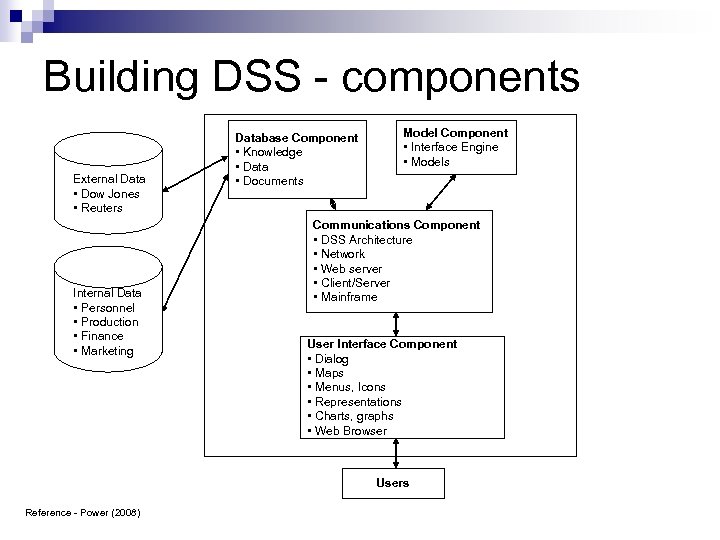
Building DSS - components External Data • Dow Jones • Reuters Internal Data • Personnel • Production • Finance • Marketing Database Component • Knowledge • Data • Documents Model Component • Interface Engine • Models Communications Component • DSS Architecture • Network • Web server • Client/Server • Mainframe User Interface Component • Dialog • Maps • Menus, Icons • Representations • Charts, graphs • Web Browser Users Reference - Power (2008)
Building DSS – User Interface n User Interface ¨ Most Important Component ¨ Tools needed DSS Generator n Query & Reporting Tools n Front-End Development Packages n Reference - Power (2008)
Building DSS – Database n Database ¨ Collection of current and historical data from a number of sources ¨ Large databases are called data warehouses or data marts ¨ Size of data warehouses are discussed in terms of multiple Terabytes (TB) Reference - Power (2008)
Building DSS – Models n Mathematical and Analytical Tools ¨ Used and manipulated by managers ¨ Each Model-driven DSS has a specific purpose ¨ Values of key variables and parameters are frequently changed – “What IF? ” analysis Reference - Power (2008)
Building DSS – Architecture n DSS Architecture and Networking ¨ How hardware is organized ¨ How software and data are distributed and organized ¨ How components of the system are integrated and connected ¨ Communications component Reference - Power (2008)
Challenges of DSS n n n Rapid technology change Managers as users and customers Major issues ¨ What to computerize? ¨ What data? Source? ¨ What processing and presentation? ¨ Are current DSS results decision-impelling? ¨ What technology for a new DSS? Reference - Power (2008)
Gaining Competitive Advantage n DSS can create a Competitive Advantage if the following 3 criteria are met ¨ Must be a major or significant strength or capability of the organization ¨ DSS must be unique and proprietary to the organization ¨ DSS must be sustainable for approximately 3 years
How can DSS provide a competitive advantage? Internet technologies have opened doors for innovative Web-based DSS n Inter-organizational DSS can improve linkages with customers and suppliers n Increasing efficiency and eliminate staff and activities, cost advantage n New products and services, differentiation n
How can DSS provide a competitive advantage? Communications-Driven DSS can remove time and location barriers n Increase focus on specific customer segments n Better fact-based decision-making n Decrease decision cycle time n
Strategic DSS Examples Frito-Lay n L. L. Bean n Lockheed - Georgia n Mrs. Fields Cookies n Wal-Mart n Classic examples!! A company needs to continually invest in a Strategic DSS to maintain any advantage. Reference - Power (2008)
Frito-Lay n Route Sales people were all given a handheld computer ¨ Enables sales people to have decision-making role ¨ Allows Frito-Lay to track products ¨ The data is put into a Data-Driven DSS n Automated a cumbersome process and improved the quality of data Reference - Power (2008)
L. L. Bean n n Consultants hired to design a system that would provide better allocation of resources in telemarketing Economic Optimization Model System (EOM) ¨ This Model-Driven DSS examined variables such as the number of telephone lines to carry incoming traffic, number of agents, and the queue capacity ¨ System generates specific resource amounts the company should deploy to be most economically advantageous Reference - Power (2008)
Mrs. Fields Cookies n Developed MIS in early 1980’s to provide uniformity in store management; also supporting rapid expansion ¨ Designed to serve two purposes n Control and better management decisionmaking ¨ Enabled each store to be run as Debbie Field ran the original store Reference - Power (2008)
Mrs. Fields Cookies n Knowledge-Driven DSS developed that automated routine activities and responded to exceptions by prompting the store manager for input ¨ Tracked financial performance of each store, provided comprehensive scheduling of operations, including market support, hourly sales goals, and assisted with candidate interview selection Reference - Power (2008)
Wal-Mart n Creates a competitive advantage that other retailers have tried to mimic but have not duplicated ¨ Result of Retail Link and FAR n Less inventory in stores, more inventory of the right products at the right time and place, and improved revenues for both supplier and retailer n Collaborative Forecasting and Replenishment Initiative (CFAR) ¨ Evaluating ways to apply wireless technology in stores. Testing emerging RFID smart-tag systems, to replace bar codes with a more efficient product-tracking mechanism. Reference - Power (2008)
Advanced Scout n IBM has prototyped software to help National Basketball Association (NBA) coaches and league officials organize and interpret the data collected at every game. Using software called Advanced Scout to prepare for a game, a coach can quickly review countless stats: shots attempted, shots blocked, assists made, personal fouls. But Advanced Scout can also detect patterns in these statistics that a coach may not have known about. Advanced Scout software provides an easy and meaningful way to process information. "It helps coaches easily mine through and analyze a lot of data and no computer training or data analysis background is required, " says Dr. Inderpal Bhandari, computer scientist at IBM's T. J. Watson Research Center. Patterns found through analysis are linked to the video of the game. Coaches can look at just those clips that make up an interesting pattern.
Fed. Ex Business Intelligence System n Federal Express, based in Memphis, Tenn. , rolled out Business Intelligence capabilities to a global base of 700 end-users. Fed. Ex created a central, integrated data warehouse hub, which provides Web-based, real-time access to financial and logistical information necessary for planning and decision-making. The solution, from Pinnacle Solutions Inc. , was deployed on a group of Dell Power. Edge servers running Windows NT Server 4. 0. Data is stored in an Oracle database, and analytical queries are run against a separate server running Hyperion Essbase, an online analytical processing (OLAP) engine. Most access is from browsers over the corporate intranet, along with some standard client/server deployments using Excel spreadsheets.
DSS Benefits Improve personal efficiency n Expedite problem solving and improve decision quality n Facilitate interpersonal communication n Promote learning or training n Increase organizational control n Reference - Power (2008)
Other DSS Benefits n n n Extending decision-makers’ ability to process information and analyze it Helping decision-makers deal with complex, large-scale problems Decreasing the amount of time needed to make a decision, reducing the decision cycle Improving the reliability and enforcing the structure of a decision process Encouraging exploration and discovery by the decision-maker in less structured or more novel decision situations related to the domain or scope of the DSS; Creating a competitive or strategic advantage for an organization. Some DSS development opportunities are better than others. Reference - Power (2008)
Risks n n n Gaining any advantage may require large financial investments Competitors’ responses may result in a heated race to gain or regain market share Technology risks include: ¨ Picking the wrong vendor, using new technology too early in technology life cycle, and using a technology that might soon become obsolete Reference - Power (2008)
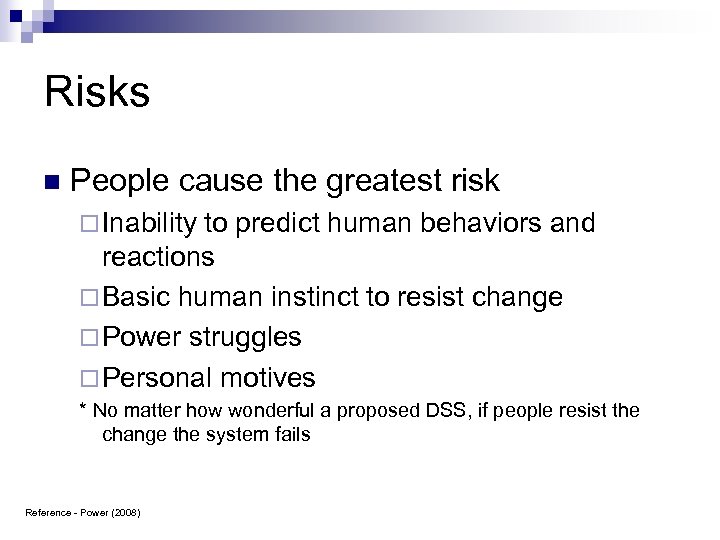
Risks n People cause the greatest risk ¨ Inability to predict human behaviors and reactions ¨ Basic human instinct to resist change ¨ Power struggles ¨ Personal motives * No matter how wonderful a proposed DSS, if people resist the change the system fails Reference - Power (2008)
Questions for Further Thought Do managers need the support provided by DSS? n Do managers want to use DSS? n
Скачать презентацию Supporting Business Decision-Making Good Information is Essential for
61264edbfe805f1707fd2e4915106aa5.ppt