 Скачать презентацию Supportability Optimization to Achieve Availability Goals in Acquisitions
914c244d7230376a8d1c449ebce5825f.ppt
- Количество слайдов: 25



Supportability Optimization to Achieve Availability Goals in Acquisitions BERNARD PRICE Certified Professional Logistician
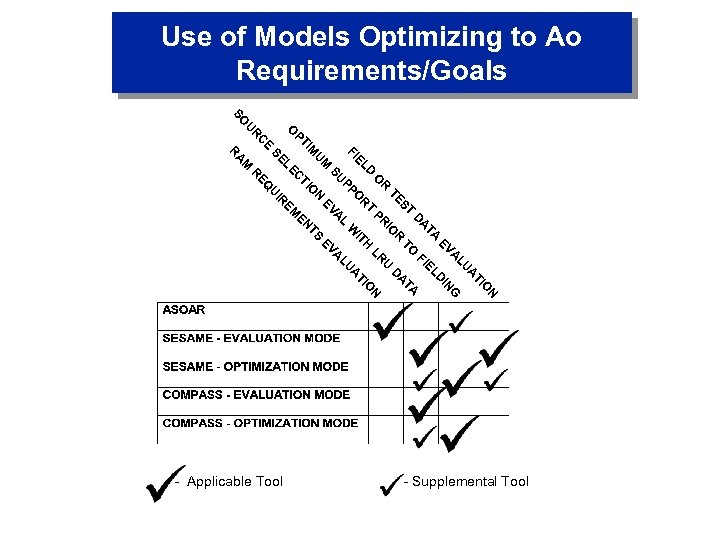
Achieving a System Operational Availability Requirement (ASOAR) Model • Optimally Allocates System Ao to an End Item Ao goal for the End Item Being Acquired • Integrated Macro-Level RAM and Supportability Analysis to Help Generate Early-On Requirements • Considers End Item Redundancy and Floats, Periodic Maintenance Actions, and Reliability of Other End Items In System in Ao Goal • Determines Ao Inputs to Use in Supportability Optimization Models • Drawback – Today Only DCSOPS Systems Analysis can Run ASOAR
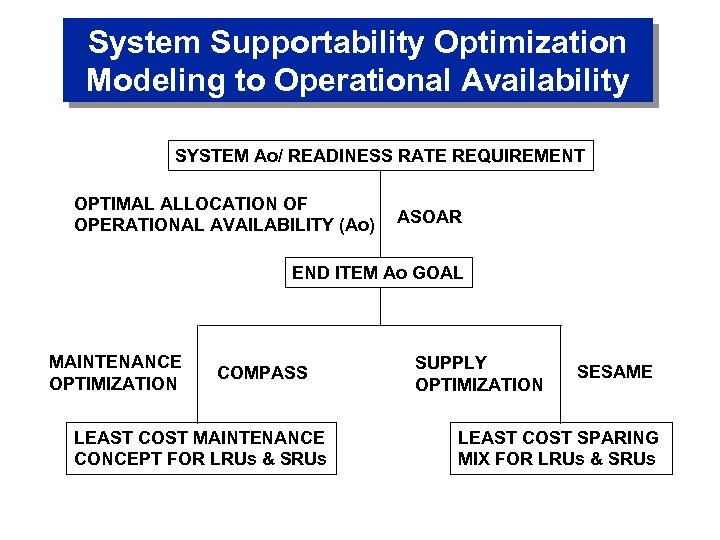
System Supportability Optimization Modeling to Operational Availability SYSTEM Ao/ READINESS RATE REQUIREMENT OPTIMAL ALLOCATION OF OPERATIONAL AVAILABILITY (Ao) ASOAR END ITEM Ao GOAL MAINTENANCE OPTIMIZATION COMPASS LEAST COST MAINTENANCE CONCEPT FOR LRUs & SRUs SUPPLY OPTIMIZATION SESAME LEAST COST SPARING MIX FOR LRUs & SRUs
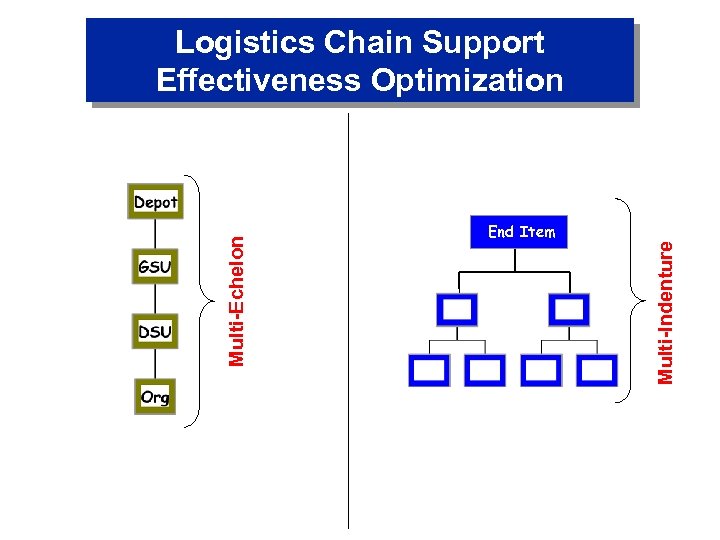
End Item Multi-Indenture Multi-Echelon Logistics Chain Support Effectiveness Optimization
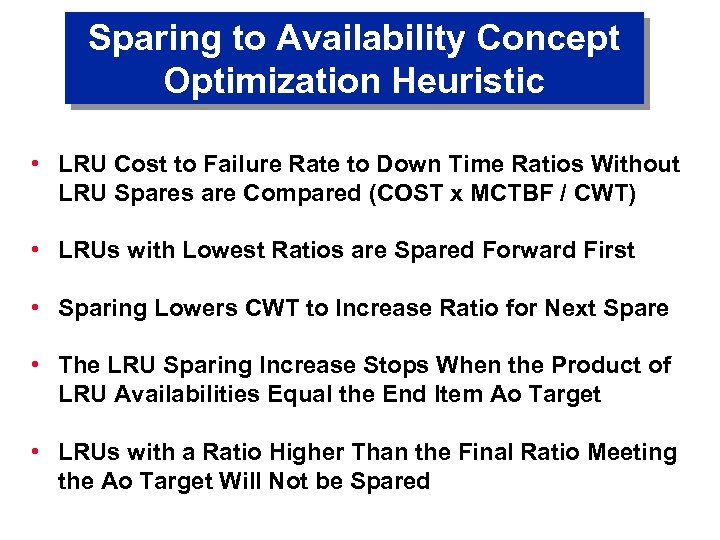
Sparing to Availability Concept Optimization Heuristic • LRU Cost to Failure Rate to Down Time Ratios Without LRU Spares are Compared (COST x MCTBF / CWT) • LRUs with Lowest Ratios are Spared Forward First • Sparing Lowers CWT to Increase Ratio for Next Spare • The LRU Sparing Increase Stops When the Product of LRU Availabilities Equal the End Item Ao Target • LRUs with a Ratio Higher Than the Final Ratio Meeting the Ao Target Will Not be Spared
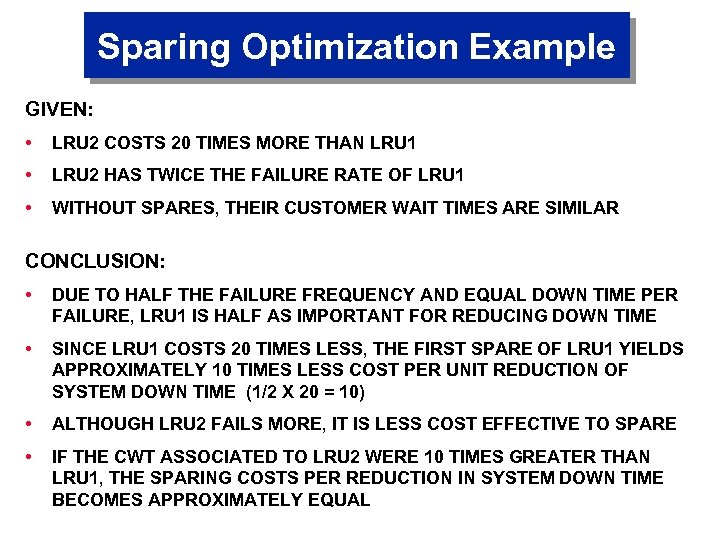
Sparing Optimization Example GIVEN: • LRU 2 COSTS 20 TIMES MORE THAN LRU 1 • LRU 2 HAS TWICE THE FAILURE RATE OF LRU 1 • WITHOUT SPARES, THEIR CUSTOMER WAIT TIMES ARE SIMILAR CONCLUSION: • DUE TO HALF THE FAILURE FREQUENCY AND EQUAL DOWN TIME PER FAILURE, LRU 1 IS HALF AS IMPORTANT FOR REDUCING DOWN TIME • SINCE LRU 1 COSTS 20 TIMES LESS, THE FIRST SPARE OF LRU 1 YIELDS APPROXIMATELY 10 TIMES LESS COST PER UNIT REDUCTION OF SYSTEM DOWN TIME (1/2 X 20 = 10) • ALTHOUGH LRU 2 FAILS MORE, IT IS LESS COST EFFECTIVE TO SPARE • IF THE CWT ASSOCIATED TO LRU 2 WERE 10 TIMES GREATER THAN LRU 1, THE SPARING COSTS PER REDUCTION IN SYSTEM DOWN TIME BECOMES APPROXIMATELY EQUAL
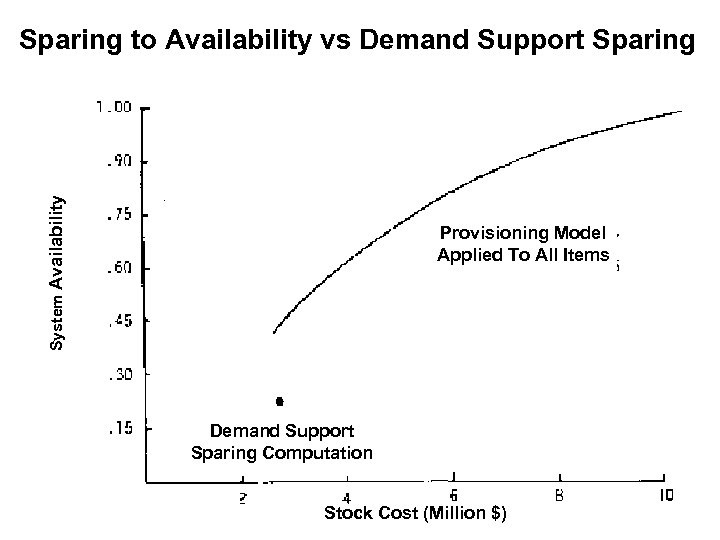
System Availability Sparing to Availability vs Demand Support Sparing Provisioning Model Applied To All Items Demand Support Sparing Computation Stock Cost (Million $)
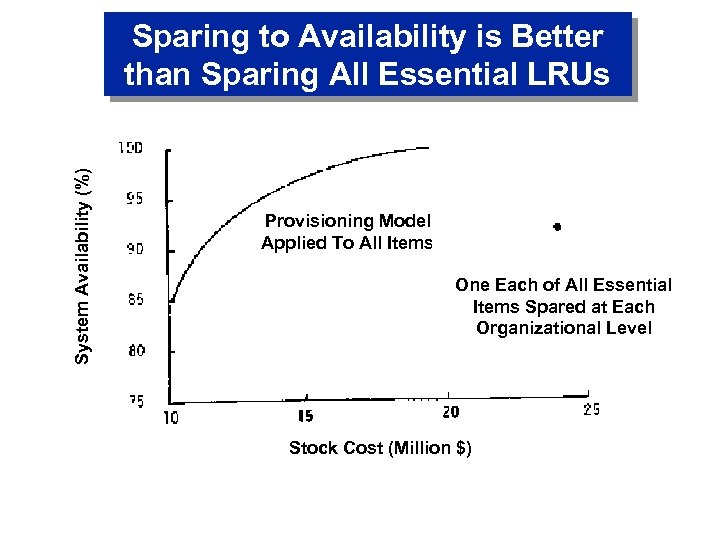
System Availability (%) Sparing to Availability is Better than Sparing All Essential LRUs Provisioning Model Applied To All Items One Each of All Essential Items Spared at Each Organizational Level Stock Cost (Million $)
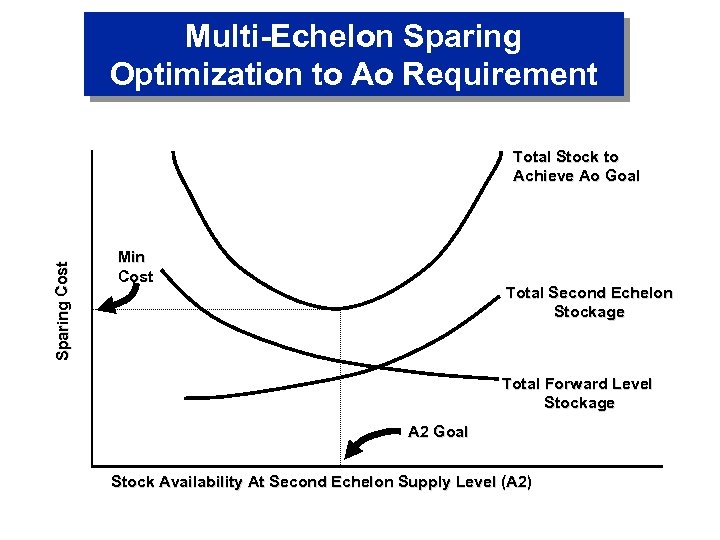
Multi-Echelon Sparing Optimization to Ao Requirement Sparing Cost Total Stock to Achieve Ao Goal Min Cost Total Second Echelon Stockage Total Forward Level Stockage A 2 Goal Stock Availability At Second Echelon Supply Level (A 2)
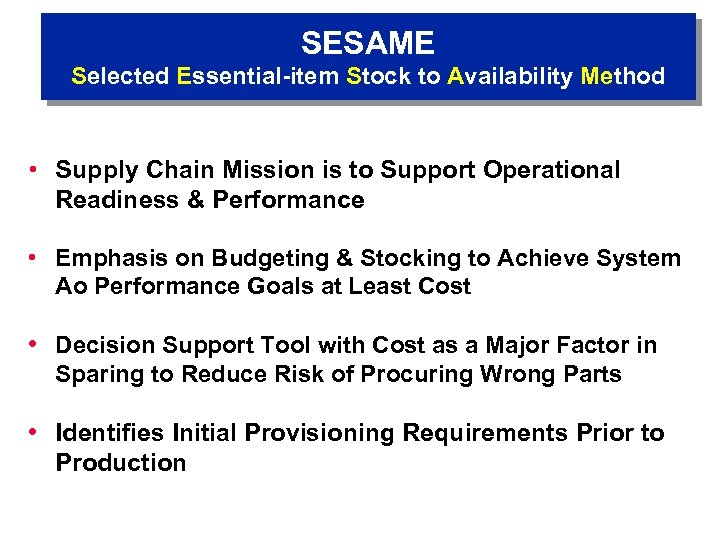
SESAME Selected Essential-item Stock to Availability Method • Supply Chain Mission is to Support Operational Readiness & Performance • Emphasis on Budgeting & Stocking to Achieve System Ao Performance Goals at Least Cost • Decision Support Tool with Cost as a Major Factor in Sparing to Reduce Risk of Procuring Wrong Parts • Identifies Initial Provisioning Requirements Prior to Production
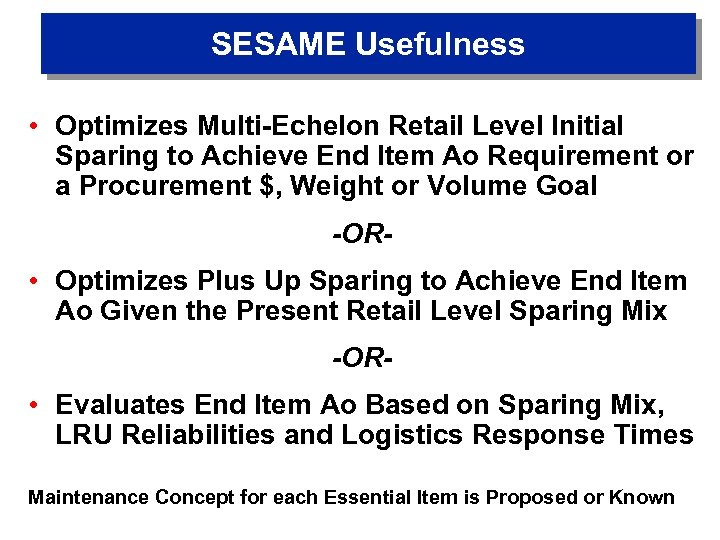
SESAME Usefulness • Optimizes Multi-Echelon Retail Level Initial Sparing to Achieve End Item Ao Requirement or a Procurement $, Weight or Volume Goal -OR- • Optimizes Plus Up Sparing to Achieve End Item Ao Given the Present Retail Level Sparing Mix -OR- • Evaluates End Item Ao Based on Sparing Mix, LRU Reliabilities and Logistics Response Times Maintenance Concept for each Essential Item is Proposed or Known
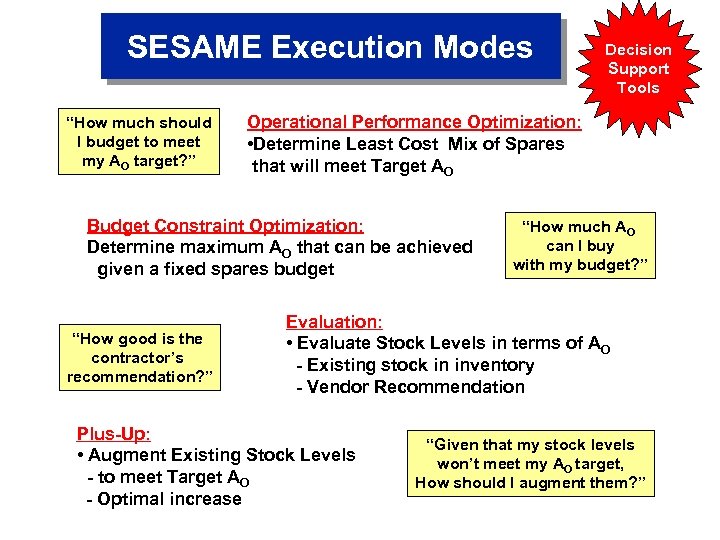
SESAME Execution Modes “How much should I budget to meet my AO target? ” Operational Performance Optimization: • Determine Least Cost Mix of Spares that will meet Target AO Budget Constraint Optimization: Determine maximum AO that can be achieved given a fixed spares budget “How good is the contractor’s recommendation? ” Decision Support Tools “How much AO can I buy with my budget? ” Evaluation: • Evaluate Stock Levels in terms of AO - Existing stock in inventory - Vendor Recommendation Plus-Up: • Augment Existing Stock Levels - to meet Target AO - Optimal increase “Given that my stock levels won’t meet my AO target, How should I augment them? ”
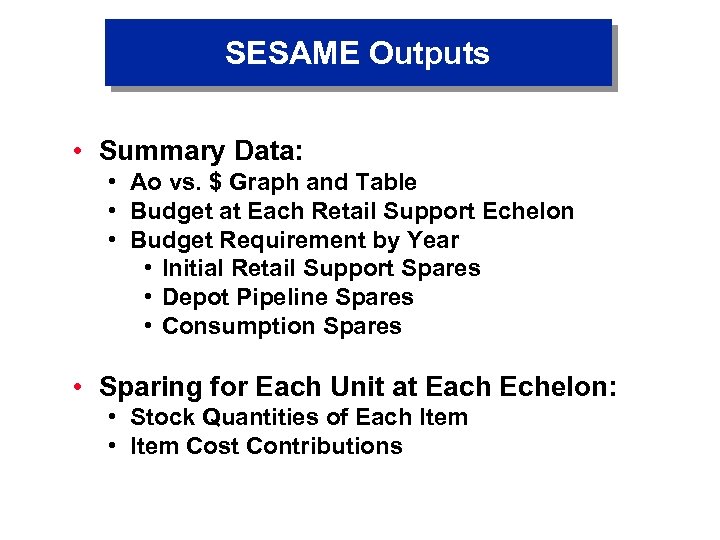
SESAME Outputs • Summary Data: • Ao vs. $ Graph and Table • Budget at Each Retail Support Echelon • Budget Requirement by Year • Initial Retail Support Spares • Depot Pipeline Spares • Consumption Spares • Sparing for Each Unit at Each Echelon: • Stock Quantities of Each Item • Item Cost Contributions
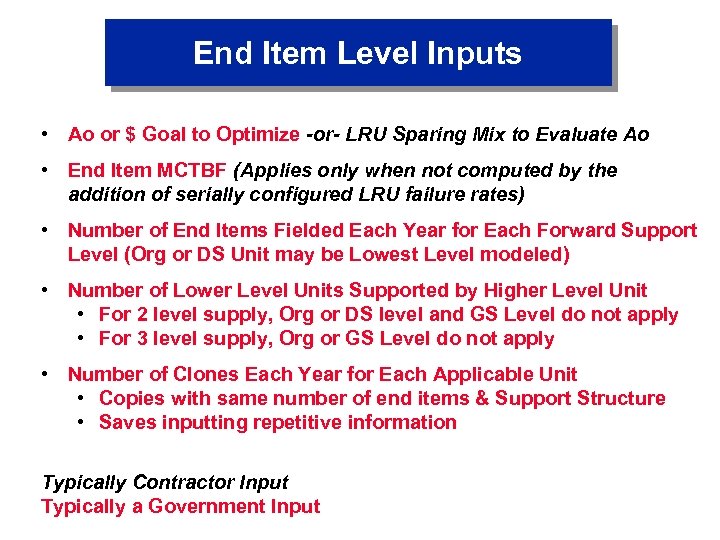
End Item Level Inputs • Ao or $ Goal to Optimize -or- LRU Sparing Mix to Evaluate Ao • End Item MCTBF (Applies only when not computed by the addition of serially configured LRU failure rates) • Number of End Items Fielded Each Year for Each Forward Support Level (Org or DS Unit may be Lowest Level modeled) • Number of Lower Level Units Supported by Higher Level Unit • For 2 level supply, Org or DS level and GS Level do not apply • For 3 level supply, Org or GS Level do not apply • Number of Clones Each Year for Each Applicable Unit • Copies with same number of end items & Support Structure • Saves inputting repetitive information Typically Contractor Input Typically a Government Input
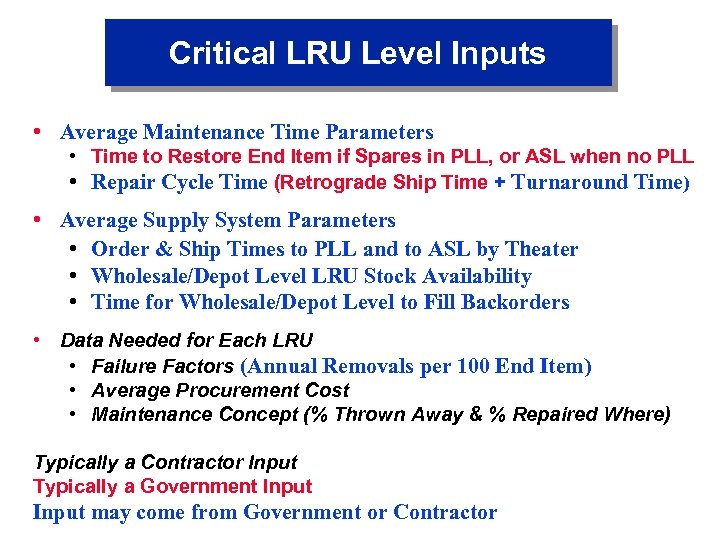
Critical LRU Level Inputs • Average Maintenance Time Parameters • Time to Restore End Item if Spares in PLL, or ASL when no PLL • Repair Cycle Time (Retrograde Ship Time + Turnaround Time) • Average Supply System Parameters • Order & Ship Times to PLL and to ASL by Theater • Wholesale/Depot Level LRU Stock Availability • Time for Wholesale/Depot Level to Fill Backorders • Data Needed for Each LRU • Failure Factors (Annual Removals per 100 End Item) • Average Procurement Cost • Maintenance Concept (% Thrown Away & % Repaired Where) Typically a Contractor Input Typically a Government Input may come from Government or Contractor
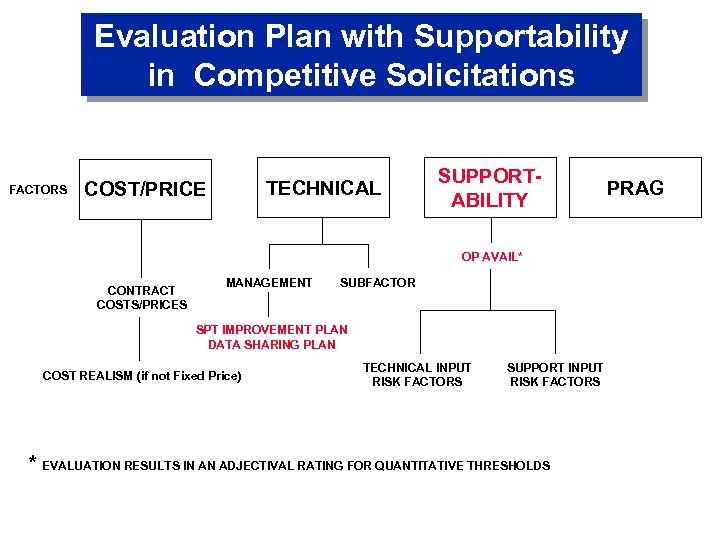
Evaluation Plan with Supportability in Competitive Solicitations FACTORS TECHNICAL COST/PRICE SUPPORTABILITY OP AVAIL* CONTRACT COSTS/PRICES MANAGEMENT SUBFACTOR SPT IMPROVEMENT PLAN DATA SHARING PLAN COST REALISM (if not Fixed Price) TECHNICAL INPUT RISK FACTORS SUPPORT INPUT RISK FACTORS * EVALUATION RESULTS IN AN ADJECTIVAL RATING FOR QUANTITATIVE THRESHOLDS PRAG
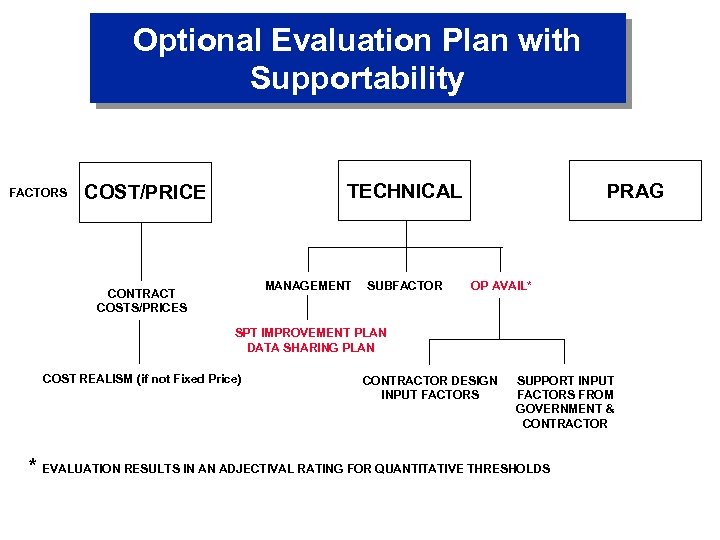
Optional Evaluation Plan with Supportability FACTORS TECHNICAL COST/PRICE MANAGEMENT CONTRACT COSTS/PRICES SUBFACTOR PRAG OP AVAIL* SPT IMPROVEMENT PLAN DATA SHARING PLAN COST REALISM (if not Fixed Price) CONTRACTOR DESIGN INPUT FACTORS SUPPORT INPUT FACTORS FROM GOVERNMENT & CONTRACTOR * EVALUATION RESULTS IN AN ADJECTIVAL RATING FOR QUANTITATIVE THRESHOLDS
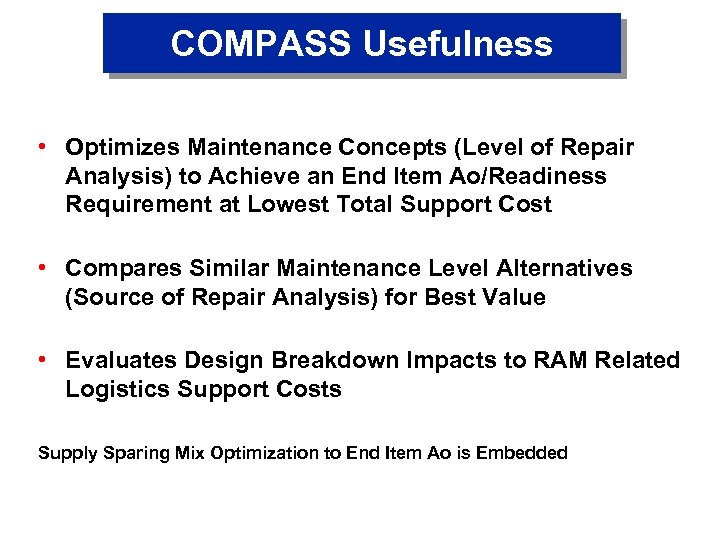
COMPASS Usefulness • Optimizes Maintenance Concepts (Level of Repair Analysis) to Achieve an End Item Ao/Readiness Requirement at Lowest Total Support Cost • Compares Similar Maintenance Level Alternatives (Source of Repair Analysis) for Best Value • Evaluates Design Breakdown Impacts to RAM Related Logistics Support Costs Supply Sparing Mix Optimization to End Item Ao is Embedded
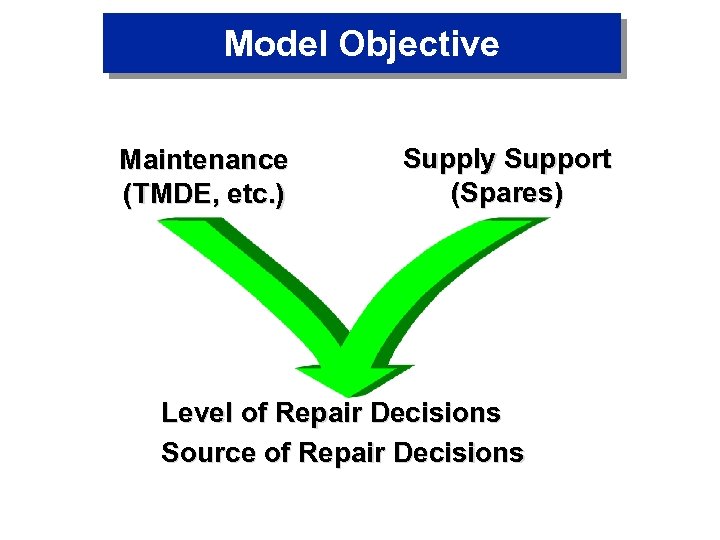
Model Objective Maintenance (TMDE, etc. ) Supply Support (Spares) Level of Repair Decisions Source of Repair Decisions
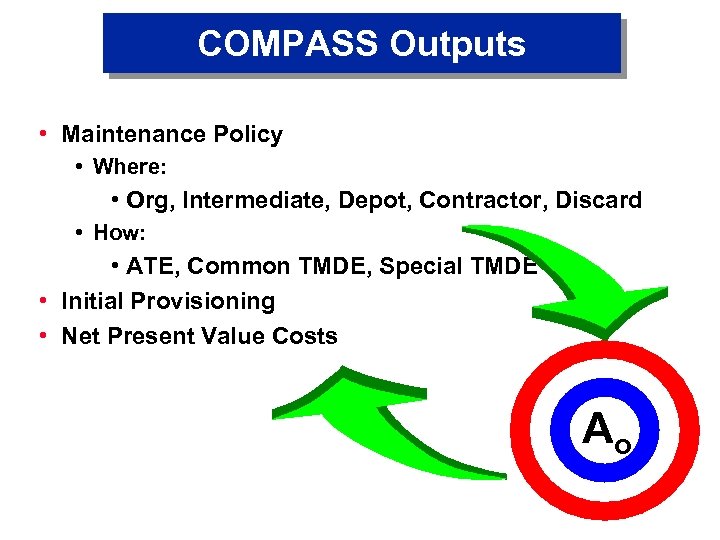
COMPASS Outputs • Maintenance Policy • Where: • Org, Intermediate, Depot, Contractor, Discard • How: • ATE, Common TMDE, Special TMDE • Initial Provisioning • Net Present Value Costs Ao
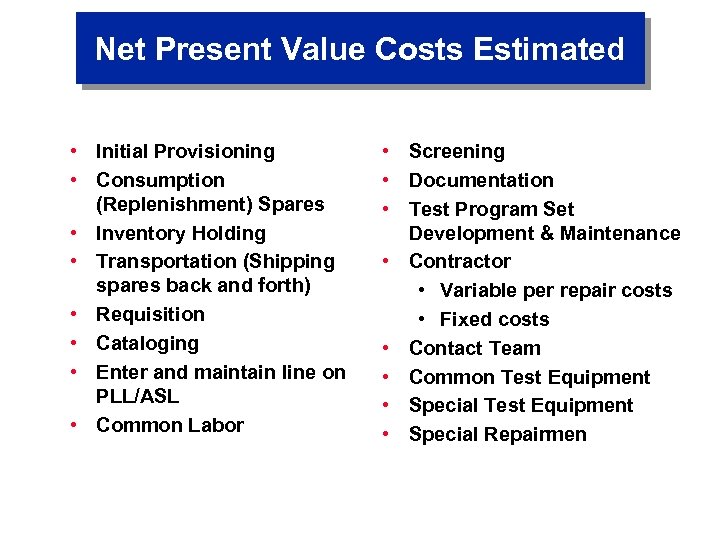
Net Present Value Costs Estimated • Initial Provisioning • Consumption (Replenishment) Spares • Inventory Holding • Transportation (Shipping spares back and forth) • Requisition • Cataloging • Enter and maintain line on PLL/ASL • Common Labor • Screening • Documentation • Test Program Set Development & Maintenance • Contractor • Variable per repair costs • Fixed costs • Contact Team • Common Test Equipment • Special Repairmen
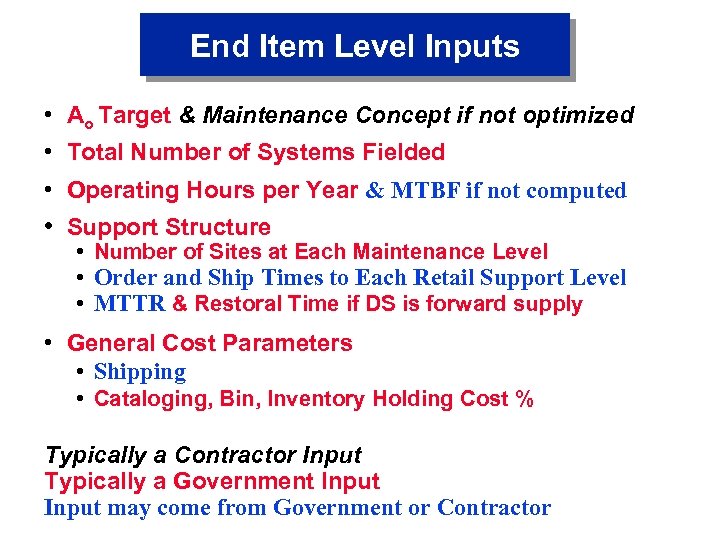
End Item Level Inputs • Ao Target & Maintenance Concept if not optimized • Total Number of Systems Fielded • Operating Hours per Year & MTBF if not computed • Support Structure • Number of Sites at Each Maintenance Level • Order and Ship Times to Each Retail Support Level • MTTR & Restoral Time if DS is forward supply • General Cost Parameters • Shipping • Cataloging, Bin, Inventory Holding Cost % Typically a Contractor Input Typically a Government Input may come from Government or Contractor
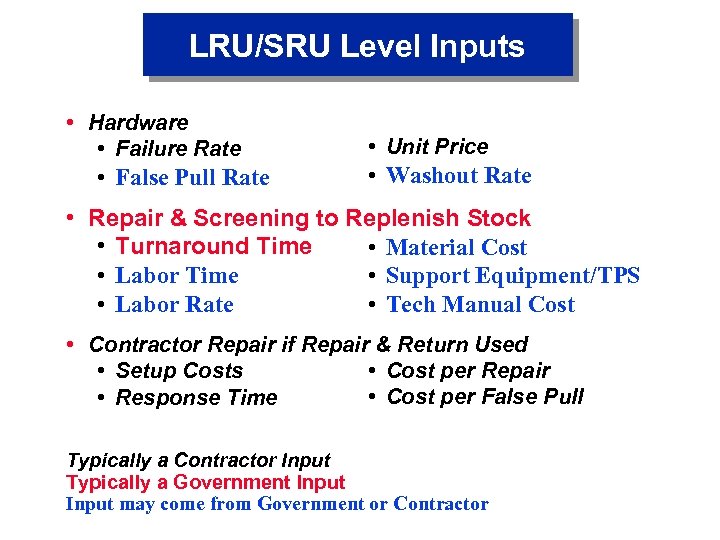
Critical Inputs LRU/SRU Level • Hardware • Failure Rate • False Pull Rate • Unit Price • Washout Rate • Repair & Screening to Replenish Stock • Turnaround Time • Material Cost • Labor Time • Support Equipment/TPS • Labor Rate • Tech Manual Cost • Contractor Repair if Repair & Return Used • Cost per Repair • Setup Costs • Cost per False Pull • Response Time Typically a Contractor Input Typically a Government Input may come from Government or Contractor
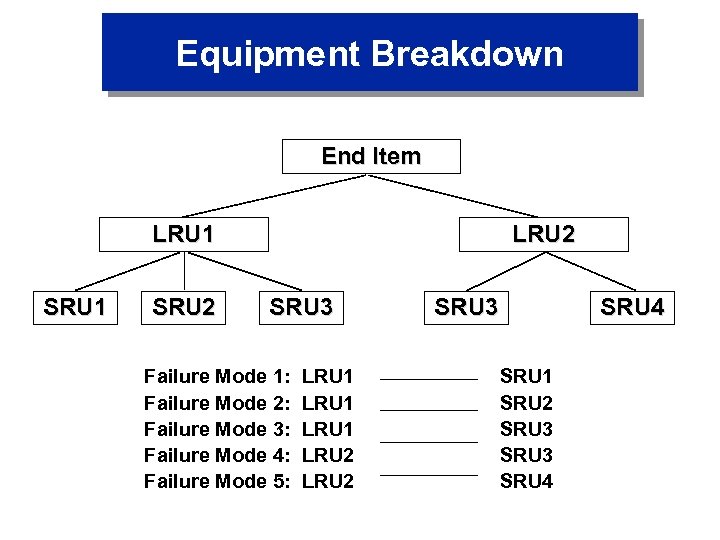
Equipment Breakdown End Item LRU 1 SRU 2 LRU 2 SRU 3 Failure Mode 1: Failure Mode 2: Failure Mode 3: Failure Mode 4: Failure Mode 5: LRU 1 LRU 2 SRU 3 SRU 4 SRU 1 SRU 2 SRU 3 SRU 4
Use of Models Optimizing to Ao Requirements/Goals FI R R O TE ST T TA A D R N O TI A G IN D TA A N O TI D EL FI LU A EV TO U LR A LU A EV H IT TS W IO PR L A EV R O PP SU D EL M N O TI EN EM IR U EQ R EC M A L SE U IM PT O E C R U SO - Supplemental Tool - Applicable Tool
Скачать презентацию Supportability Optimization to Achieve Availability Goals in Acquisitions
914c244d7230376a8d1c449ebce5825f.ppt