


 Скачать презентацию Support Sat CDR 2 April 2004 Support Sat
bef6123b3668a24752dfcaf0214ce369.ppt
- Количество слайдов: 59
 Support. Sat CDR 2 April, 2004 Support. Sat Critical Design Review University of Colorado Boulder 2 April, 2004 Project Managers: John Chouinard Brian Taylor
 Support. Sat CDR 2 April 2004 Mission Description • Gather magnetometer interference data • Test intelligent pixel matching operations
 Support. Sat CDR 2 April 2004 Mission Goals and NASA Benefits • Show effect of flight equipment on magnetometer readings • Demonstrate intelligent pixel matching algorithm – Scale and make images linear – Find ground features – Match pixels between subsequent pictures • Steps for stereoscopic imaging
 Support. Sat CDR 2 April 2004 System Requirements • Testing equipment to be used on DINO spacecraft – Mission: determine cloud heights from space • All sub-systems using DINO equipment except for power and thermal • Power and thermal – Must remain powered throughout flight and above 0 o C – Components should be light weight
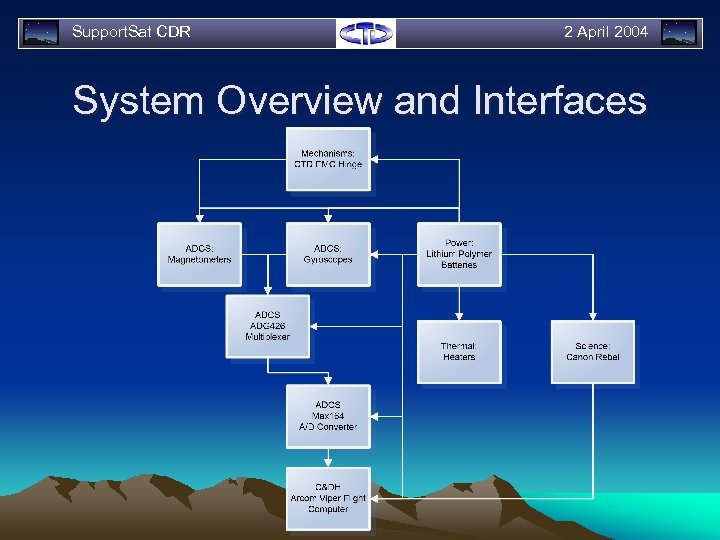 Support. Sat CDR 2 April 2004 System Overview and Interfaces
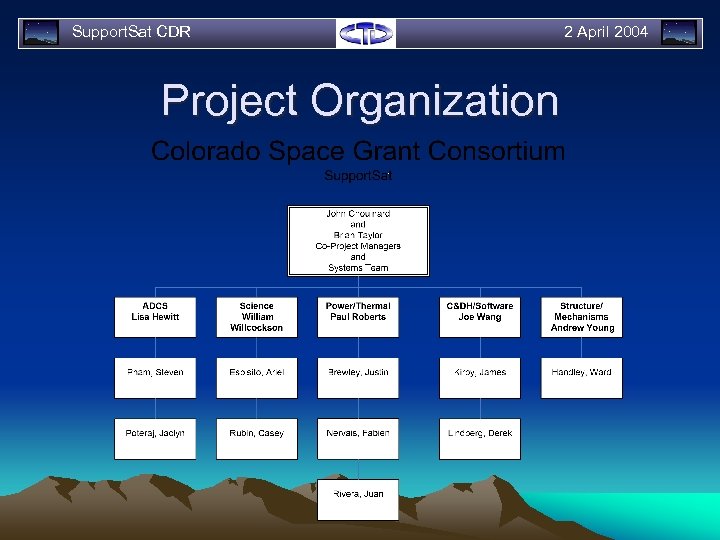 Support. Sat CDR Project Organization 2 April 2004
 Support. Sat CDR 2 April 2004 Attitude and Determination Control Systems Team Lead: Lisa Hewitt
 Support. Sat CDR 2 April 2004 Mission • To use gyroscopes to determine attitude of Support. Sat aiding intelligent imaging operations • To test DINO’s magnetometers, gyroscopes, and their respective interfaces
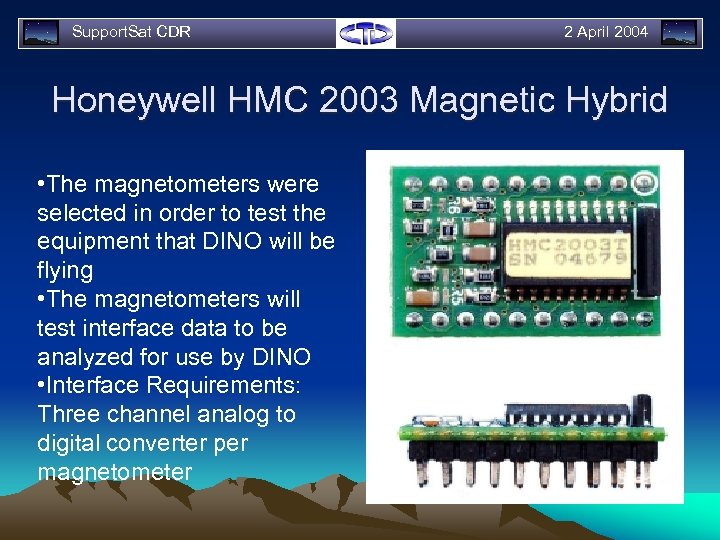 Support. Sat CDR 2 April 2004 Honeywell HMC 2003 Magnetic Hybrid • The magnetometers were selected in order to test the equipment that DINO will be flying • The magnetometers will test interface data to be analyzed for use by DINO • Interface Requirements: Three channel analog to digital converter per magnetometer
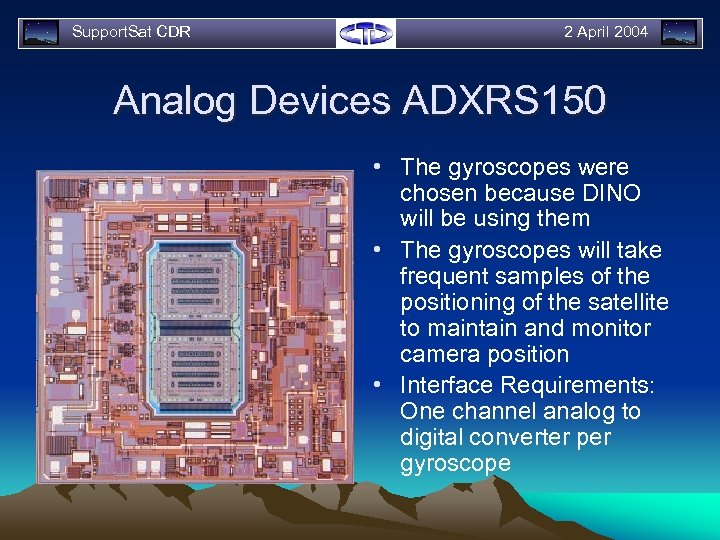 Support. Sat CDR 2 April 2004 Analog Devices ADXRS 150 • The gyroscopes were chosen because DINO will be using them • The gyroscopes will take frequent samples of the positioning of the satellite to maintain and monitor camera position • Interface Requirements: One channel analog to digital converter per gyroscope
 Support. Sat CDR 2 April 2004 Analog to Digital Converters Multiplexer: ADG 426 - 16 channels - Low power - Low resistance Will sample data from each device then relay data through one output to converter A/D Converter Max 164 - 12 bit - CMOS Will take analog input data from multiplexer and convert to digital data to be sent to the flight computer
 Support. Sat CDR 2 April 2004 Flight Readiness • Order parts • Test interfaces once parts are received • Test equipment under wind simulations comparable to flight conditions
 Support. Sat CDR 2 April 2004 Test Plan • Run equipment under similar flight circumstances to ensure properation and interface
 Support. Sat CDR 2 April 2004 Issues and Concerns • Possible software incompatibility of the converters with the flight computer
 Support. Sat CDR 2 April 2004 Budget Name Cost Weight Power Thermal Magnetomete rs $398 <200 g 12 V @ 20 m. A -40 C to 85 C $99 < 1. 5 g 5 V @ 6 m. A -40 C to 85 C Free (Samples) ~ 2 g 5 V @ 6 m. A -40 C to 85 C ~5 g 12 V @ 20 m. A -40 C to 85 C Gyroscopes A/D converter Multiplexer Free (Samples)
 Support. Sat CDR 2 April 2004 Science Team Lead: William Willcockson
 Support. Sat CDR 2 April 2004 Mission • Prepare Canon Digital Rebel camera for flight • Develop image analysis algorithm to be used in-flight
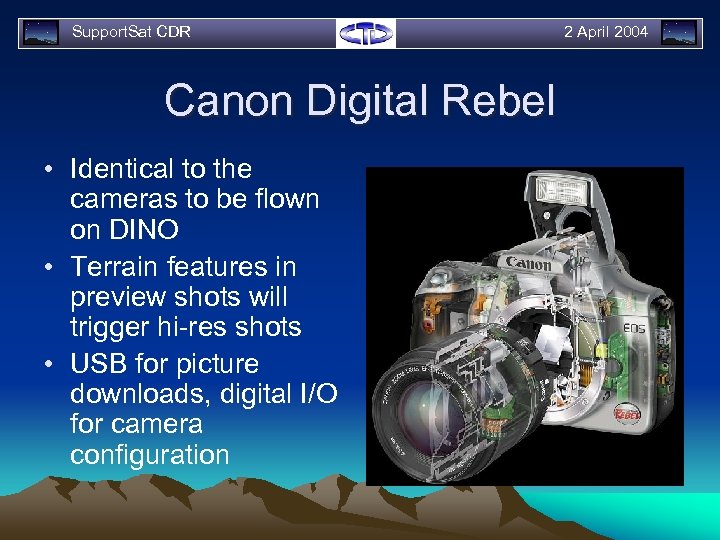 Support. Sat CDR Canon Digital Rebel • Identical to the cameras to be flown on DINO • Terrain features in preview shots will trigger hi-res shots • USB for picture downloads, digital I/O for camera configuration 2 April 2004
 Support. Sat CDR 2 April 2004 Sub-System Interfaces • Digital I/O inputs from the flight controller to receive configuration commands • USB for image capture commands and image uploading
 Support. Sat CDR 2 April 2004 Flight Readiness • Camera must be hooked up to its digital I/O lines • Camera must be integrated into the balloon-sat
 Support. Sat CDR 2 April 2004 Test Plan • Image analysis algorithm will undergo ground testing • Camera will be tested to confirm its operational readiness within the balloonsat
 Support. Sat CDR 2 April 2004 Issues and Concerns • Digital I/O lines will need to be routed through the camera body
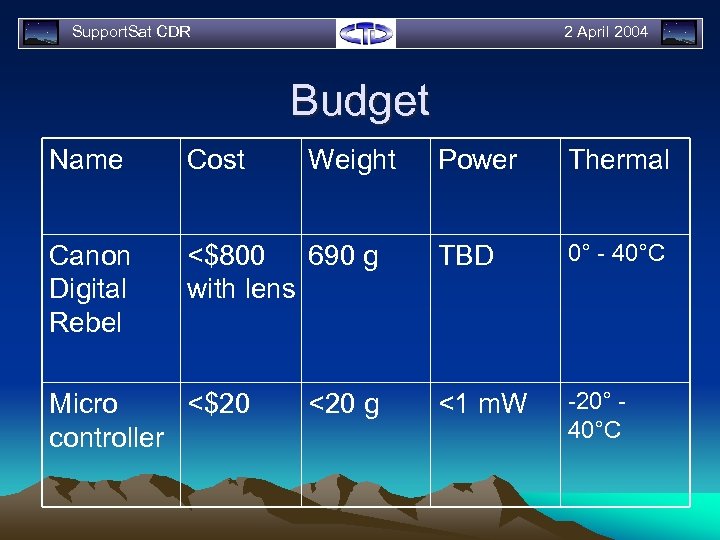 Support. Sat CDR 2 April 2004 Budget Name Cost Canon Digital Rebel <$800 690 g with lens Micro <$20 controller Weight <20 g Power Thermal TBD 0° - 40°C <1 m. W -20° 40°C
 Support. Sat CDR 2 April 2004 Command Data Handling / Software Team Lead: Joe Wang
 Support. Sat CDR 2 April 2004 Mission • To coordinate data handling and satellite operations • Requirements: – Collect data from magnetometer, gyros and camera – Create software for subsystems – Create pixel matching software – Interface flight computer (Arcom VIPER) with peripheral devices
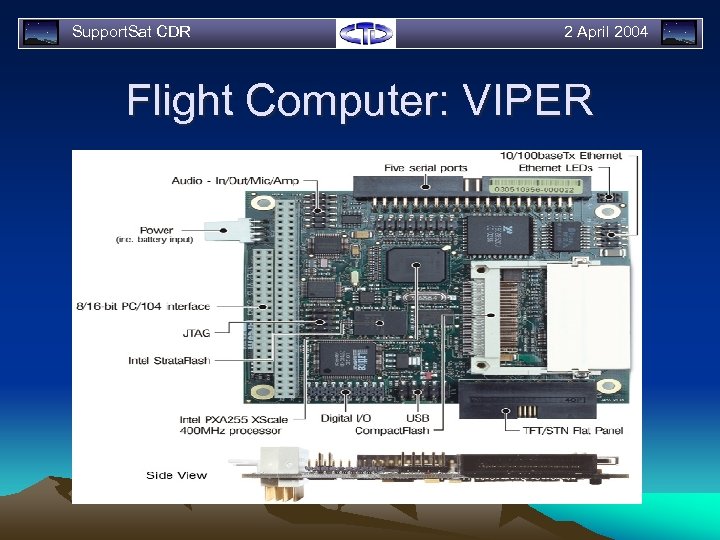 Support. Sat CDR 2 April 2004 Flight Computer: VIPER
 Support. Sat CDR 2 April 2004 Flight Computer: VIPER • Reasons this component was initially chosen: – Low power consumption of 1. 6 W – Has most number of serial ports (5) as compared with other boards plus 2 USB – Has 8 general purpose I/O pins with expansion possibilities – Meets all interface and design requirements – Good processing speed of 400 MHz – Allows for Compact Flash • The flight computer will function as a central control unit, compiling data and running algorithms
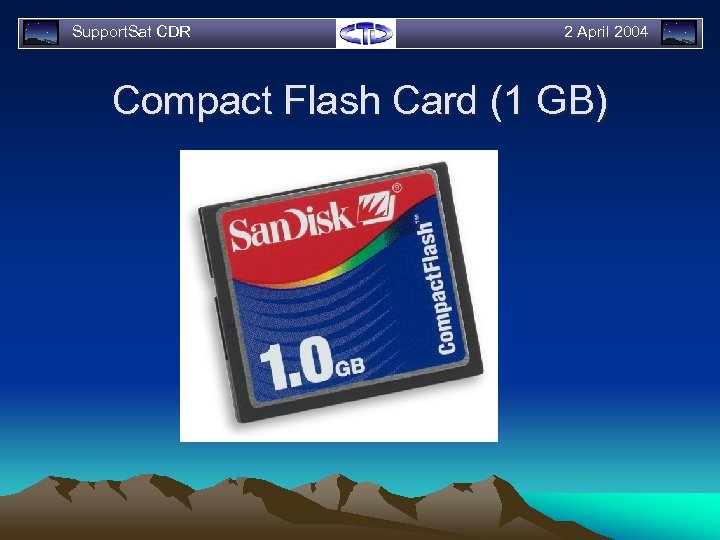 Support. Sat CDR 2 April 2004 Compact Flash Card (1 GB)
 Support. Sat CDR 2 April 2004 Compact Flash Card (1 GB) • Compact flash memory format is compatible with both the VIPER board and digital camera • Provides inexpensive storage for large amounts of data, which will be necessary to hold the digital pictures taken in-flight
 Support. Sat CDR 2 April 2004 Sub-System Interfaces • The following devices are inputs to the flight computer: – Magnetometer – Gyros – Digital Camera – 5 volt power supply
 Support. Sat CDR 2 April 2004 Flight Readiness • Complete software for data transfers from peripheral devices • Debug Software • Obtain components and wire to the peripheral devices • Test hardware and software once successfully implementation
 Support. Sat CDR 2 April 2004 Test Plan • Hardware Testing – Automated scripts will test all functions of all subsystems in a logical and safe manner • Low-level Code Testing – Language Unit Test Framework – Automatically tests code to make sure it performs as expected • Document all code thoroughly as it is written
 Support. Sat CDR 2 April 2004 Issues and Concerns • The proficient completion of all necessary software
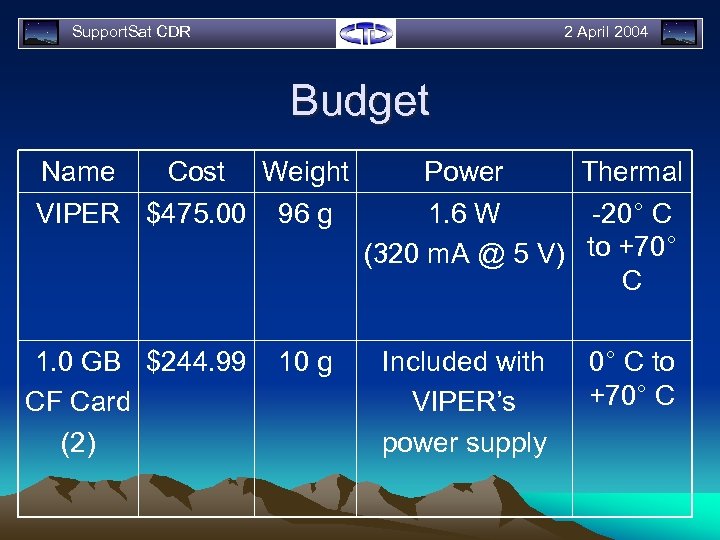 Support. Sat CDR 2 April 2004 Budget Name Cost Weight VIPER $475. 00 96 g 1. 0 GB $244. 99 CF Card (2) 10 g Power Thermal 1. 6 W -20° C (320 m. A @ 5 V) to +70° C Included with VIPER’s power supply 0° C to +70° C
 Support. Sat CDR Power / Thermal Team Lead: Paul Roberts 2 April 2004
 Support. Sat CDR 2 April 2004 Mission • To ensure that all subsystems retain power and temperature requirements throughout the duration of the flight.
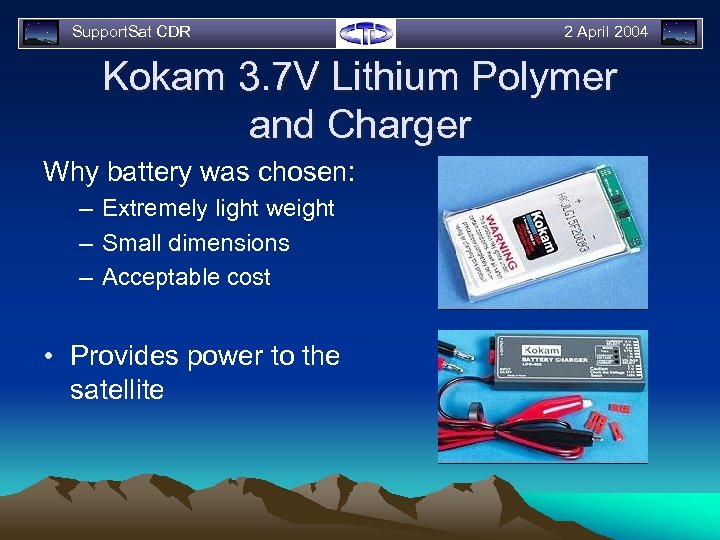 Support. Sat CDR 2 April 2004 Kokam 3. 7 V Lithium Polymer and Charger Why battery was chosen: – Extremely light weight – Small dimensions – Acceptable cost • Provides power to the satellite
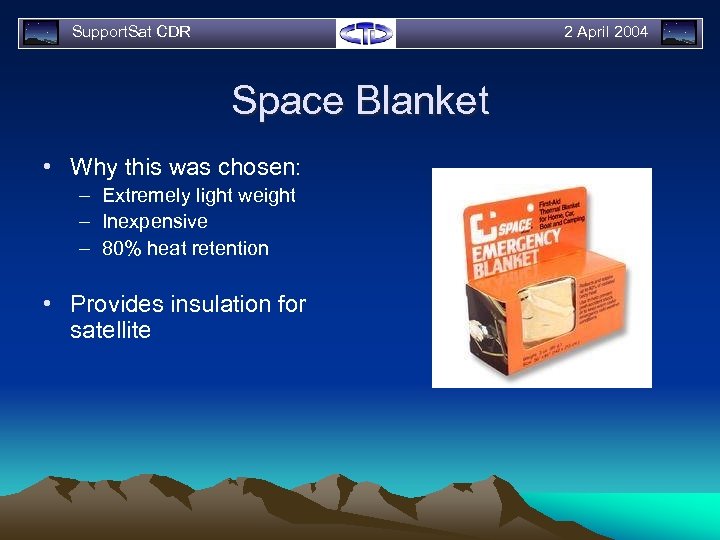 Support. Sat CDR 2 April 2004 Space Blanket • Why this was chosen: – Extremely light weight – Inexpensive – 80% heat retention • Provides insulation for satellite
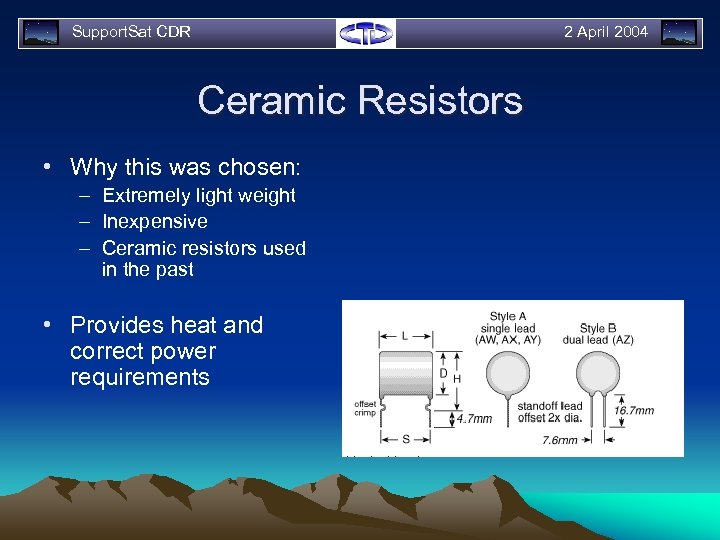 Support. Sat CDR 2 April 2004 Ceramic Resistors • Why this was chosen: – Extremely light weight – Inexpensive – Ceramic resistors used in the past • Provides heat and correct power requirements
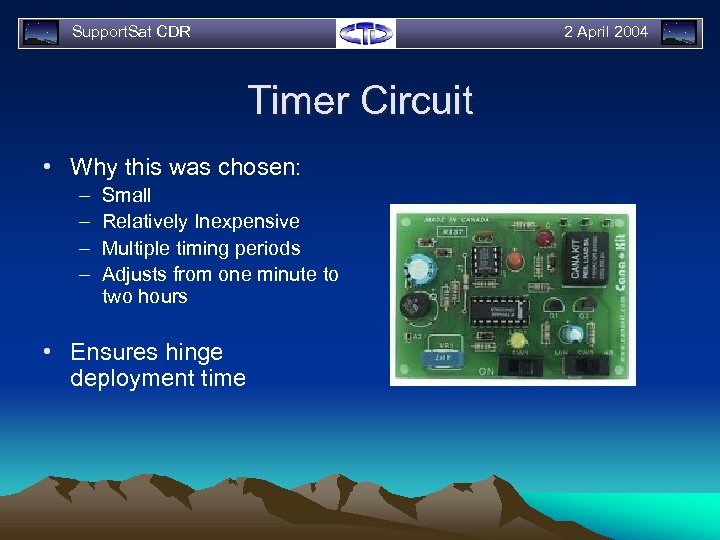 Support. Sat CDR 2 April 2004 Timer Circuit • Why this was chosen: – – Small Relatively Inexpensive Multiple timing periods Adjusts from one minute to two hours • Ensures hinge deployment time
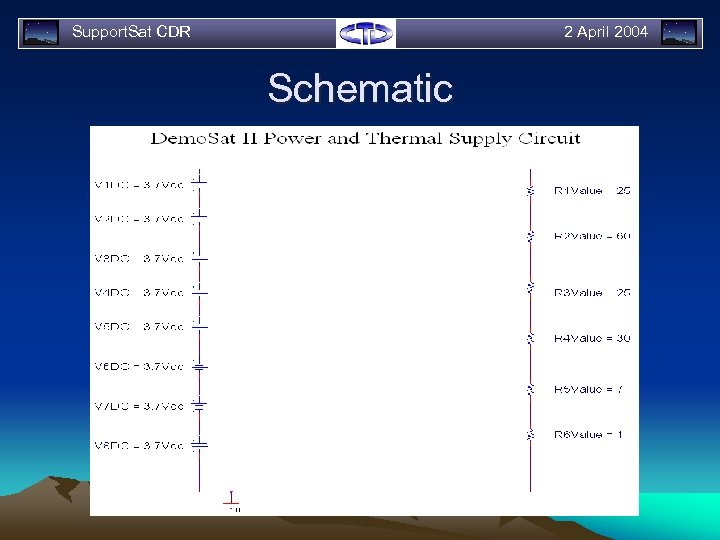 Support. Sat CDR 2 April 2004 Schematic
 Support. Sat CDR 2 April 2004 Flight Readiness • Obtain parts • Cold tests • Interface, wire and solder
 Support. Sat CDR 2 April 2004 Test Plan • Cold Tests – Resistors – Insulation • Power – Timer circuit – Energy dissipated by resistors – Correct voltage requirements
 Support. Sat CDR 2 April 2004 Issues and Concerns • Heat from resistors • Battery life due to resistors • Voltage regulator for hinge deployment
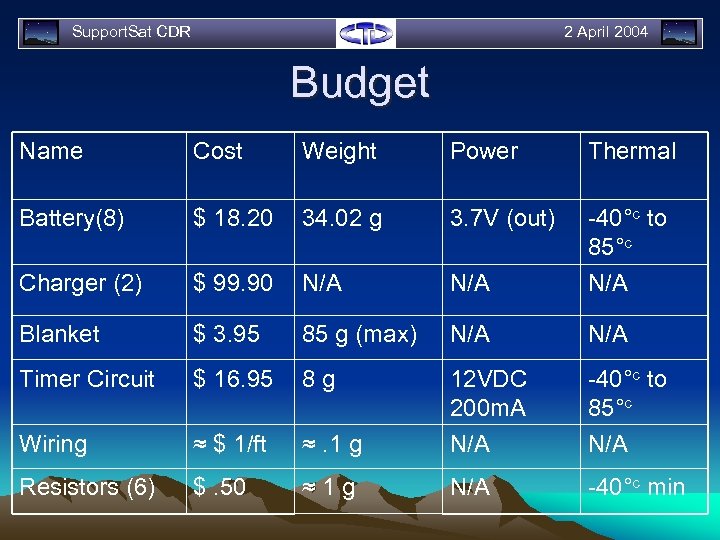 Support. Sat CDR 2 April 2004 Budget Name Cost Weight Power Thermal Battery(8) $ 18. 20 34. 02 g 3. 7 V (out) -40°c to 85°c Charger (2) $ 99. 90 N/A N/A Blanket $ 3. 95 85 g (max) N/A Timer Circuit $ 16. 95 8 g Wiring ≈ $ 1/ft ≈. 1 g 12 VDC 200 m. A N/A -40°c to 85°c N/A Resistors (6) $. 50 ≈1 g N/A -40°c min
 Support. Sat CDR 2 April 2004 Structure and Mechanisms Team Lead: Andrew Young
 Support. Sat CDR 2 April 2004 Mission • To supply a sturdy structure that will aid in the success of the mission • To keep components safe from the elements for reuse • To deploy a magnetometer attached to a CTD hinge
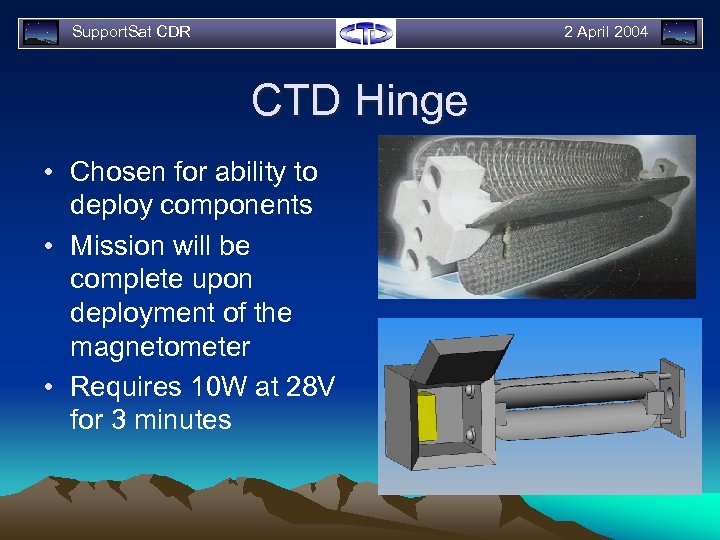 Support. Sat CDR 2 April 2004 CTD Hinge • Chosen for ability to deploy components • Mission will be complete upon deployment of the magnetometer • Requires 10 W at 28 V for 3 minutes
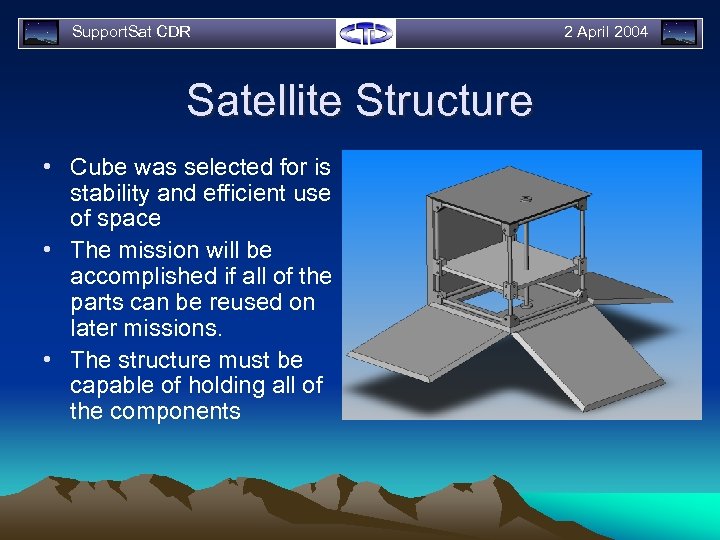 Support. Sat CDR Satellite Structure • Cube was selected for is stability and efficient use of space • The mission will be accomplished if all of the parts can be reused on later missions. • The structure must be capable of holding all of the components 2 April 2004
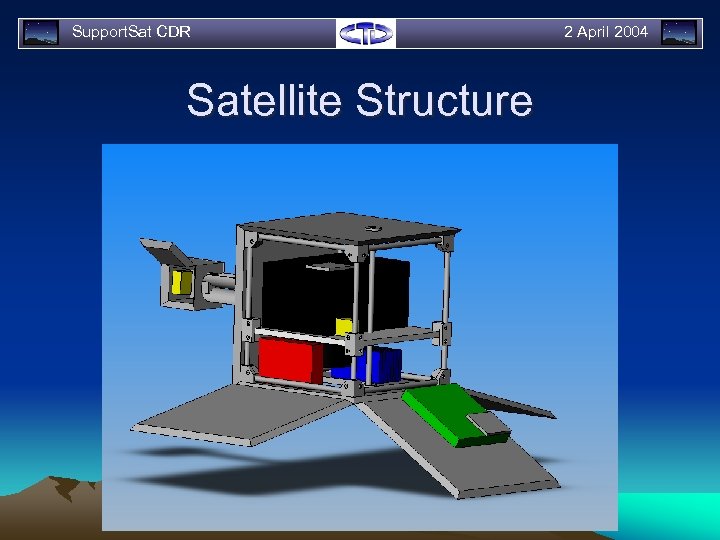 Support. Sat CDR Satellite Structure 2 April 2004
 Support. Sat CDR 2 April 2004 Sub-System Interfaces • The CTD hinge requires 28 V of power from the batteries. • The satellite is required to hold all of the Sub-Systems inside the structure. – ADCS, Science, Power/Thermal • The CTD hinge must be mounted on the outside
 Support. Sat CDR 2 April 2004 Flight Readiness • The CTD hinge will be bent to the appropriate angle • The structure will be closed up and sealed • All of the components will be turned on • The structure will be attached to the balloon
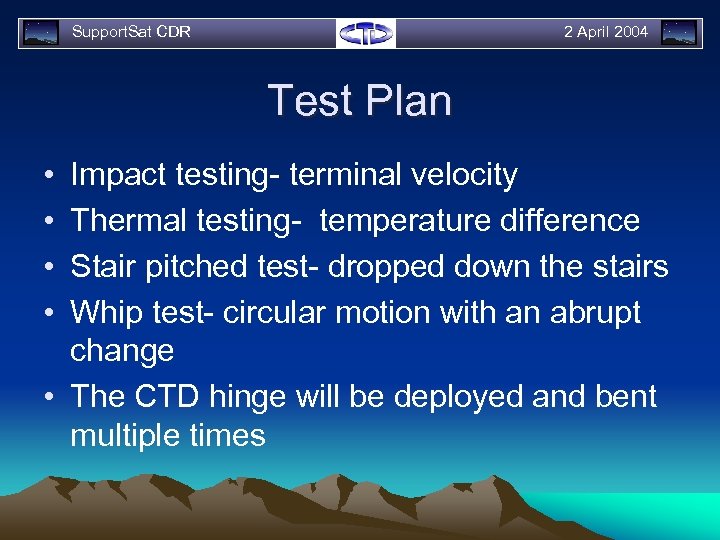 Support. Sat CDR 2 April 2004 Test Plan • • Impact testing- terminal velocity Thermal testing- temperature difference Stair pitched test- dropped down the stairs Whip test- circular motion with an abrupt change • The CTD hinge will be deployed and bent multiple times
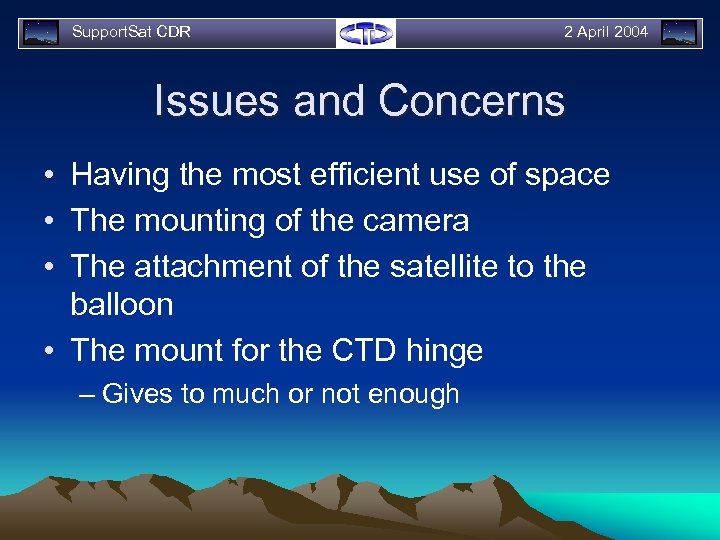 Support. Sat CDR 2 April 2004 Issues and Concerns • Having the most efficient use of space • The mounting of the camera • The attachment of the satellite to the balloon • The mount for the CTD hinge – Gives to much or not enough
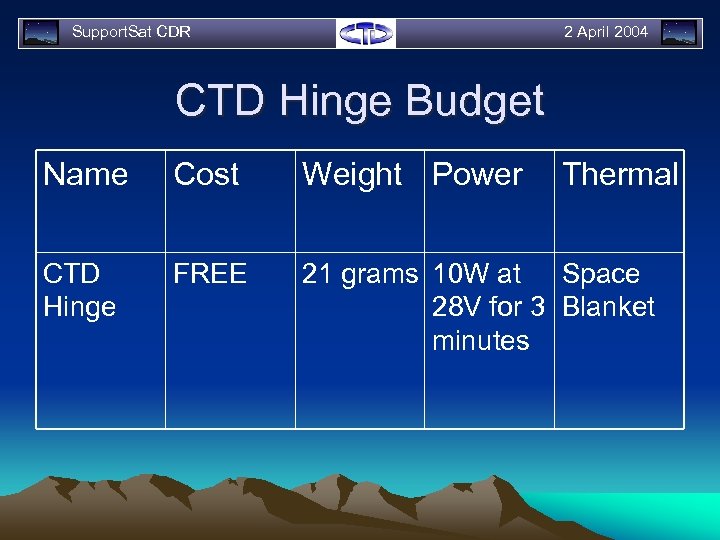 Support. Sat CDR 2 April 2004 CTD Hinge Budget Name Cost Weight Power Thermal CTD Hinge FREE 21 grams 10 W at Space 28 V for 3 Blanket minutes
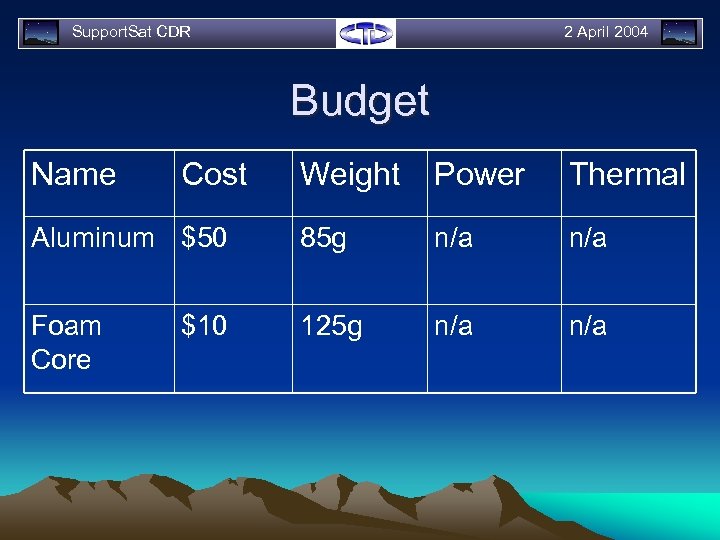 Support. Sat CDR 2 April 2004 Budget Name Cost Weight Power Thermal Aluminum $50 85 g n/a Foam Core 125 g n/a $10
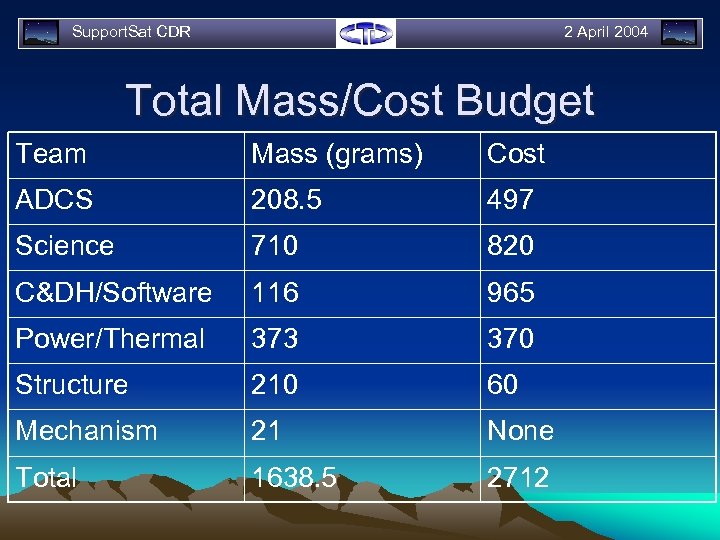 Support. Sat CDR 2 April 2004 Total Mass/Cost Budget Team Mass (grams) Cost ADCS 208. 5 497 Science 710 820 C&DH/Software 116 965 Power/Thermal 373 370 Structure 210 60 Mechanism 21 None Total 1638. 5 2712
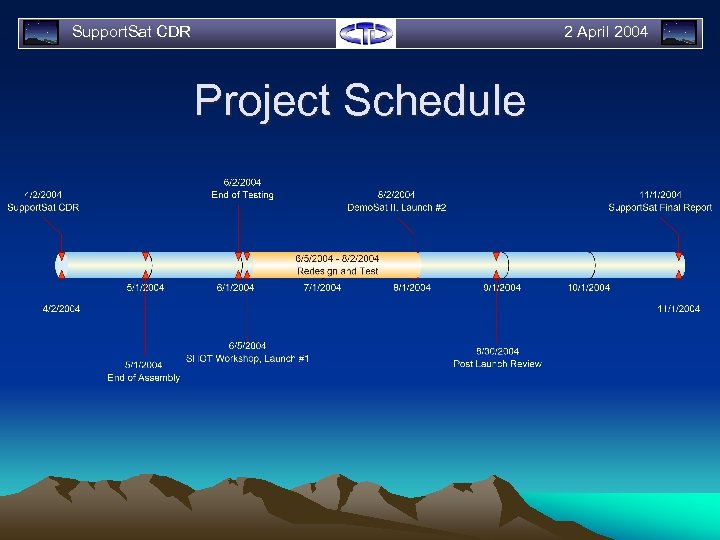 Support. Sat CDR 2 April 2004 Project Schedule
 Support. Sat CDR 2 April 2004 Questions?