 Скачать презентацию SUPPORT RESPONSIBLE FORESTRY SFI Who We Are
069d0a434bc8a2314f34bab883ea9505.ppt
- Количество слайдов: 14



SUPPORT RESPONSIBLE FORESTRY. SFI – Who We Are May 2011
What is Forest Certification? A voluntary process to manage forest lands and promote sustainable forest management through principles, criteria and objectives consistent with government processes around the world Began in the 1990 s in response to concerns about logging practices and forest conversion, especially in tropical regions 2 Today there are more than 50 different standards worldwide
Factors Driving Forest Certification • Growing concern over deforestation and illegal logging • Increasing concern about the environmental provenance of goods people buy • Flow of wood – open market • Industry and public authorities are looking for proof of legality and sustainability in products they buy, whether paper or solid wood products 3
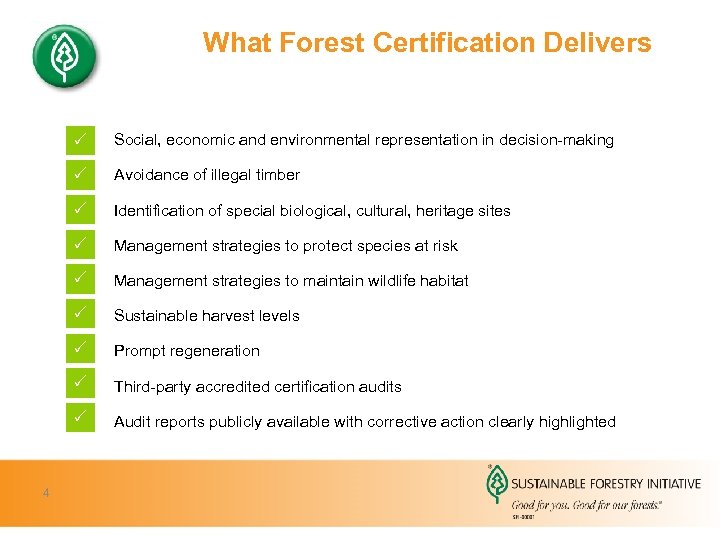
What Forest Certification Delivers ü P Avoidance of illegal timber ü P Identification of special biological, cultural, heritage sites P ü Management strategies to protect species at risk P ü Management strategies to maintain wildlife habitat P ü Sustainable harvest levels P ü Prompt regeneration P ü Third-party accredited certification audits P ü 4 Social, economic and environmental representation in decision-making Audit reports publicly available with corrective action clearly highlighted
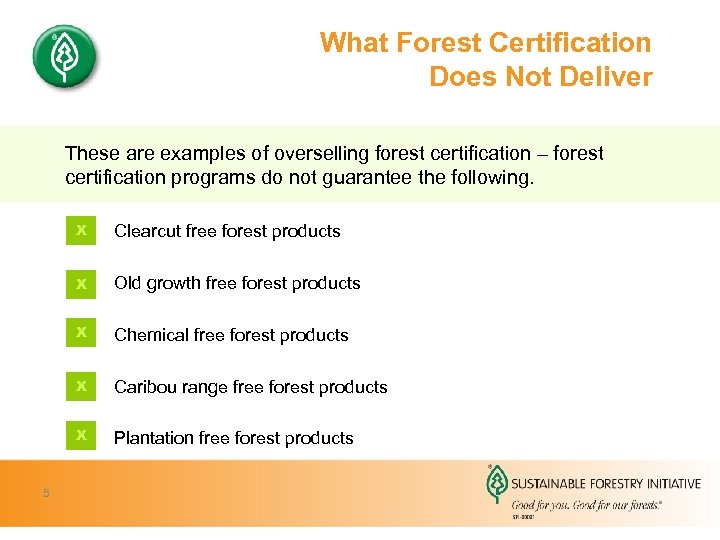
What Forest Certification Does Not Deliver These are examples of overselling forest certification – forest certification programs do not guarantee the following. X • • X Old growth free forest products X • Chemical free forest products X • Caribou range free forest products X • 5 Clearcut free forest products Plantation free forest products
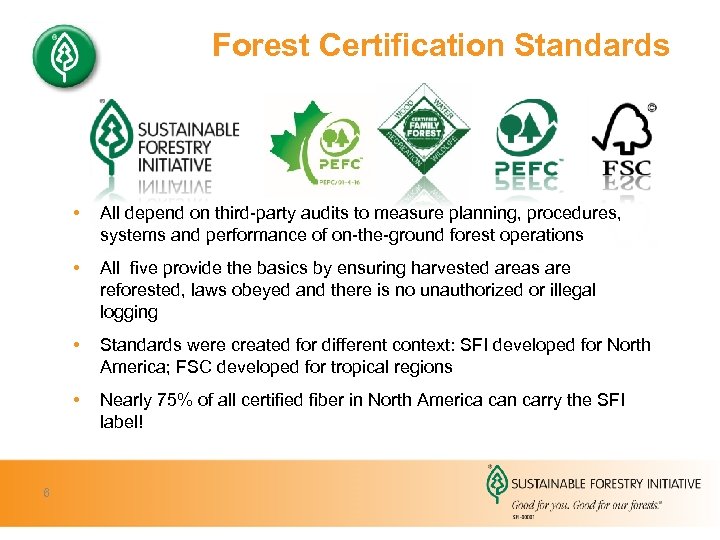
Forest Certification Standards • • All five provide the basics by ensuring harvested areas are reforested, laws obeyed and there is no unauthorized or illegal logging • Standards were created for different context: SFI developed for North America; FSC developed for tropical regions • 6 All depend on third-party audits to measure planning, procedures, systems and performance of on-the-ground forest operations Nearly 75% of all certified fiber in North America can carry the SFI label!
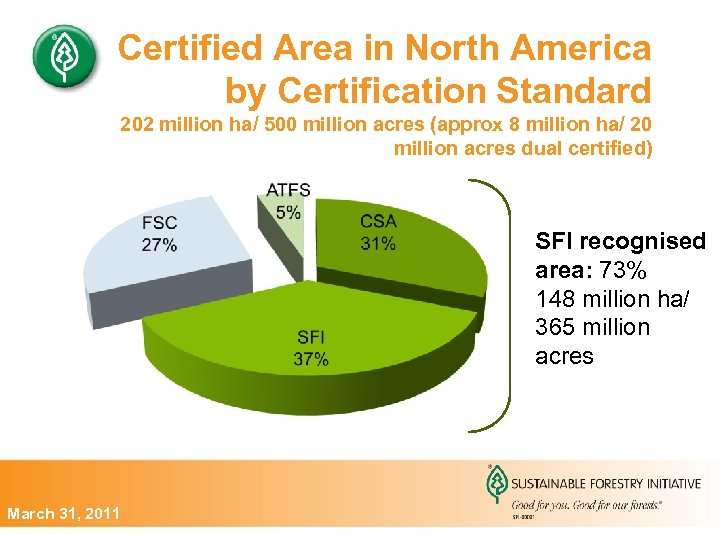
Certified Area in North America by Certification Standard 202 million ha/ 500 million acres (approx 8 million ha/ 20 million acres dual certified) SFI recognised area: 73% 148 million ha/ 365 million acres March 31, 2011
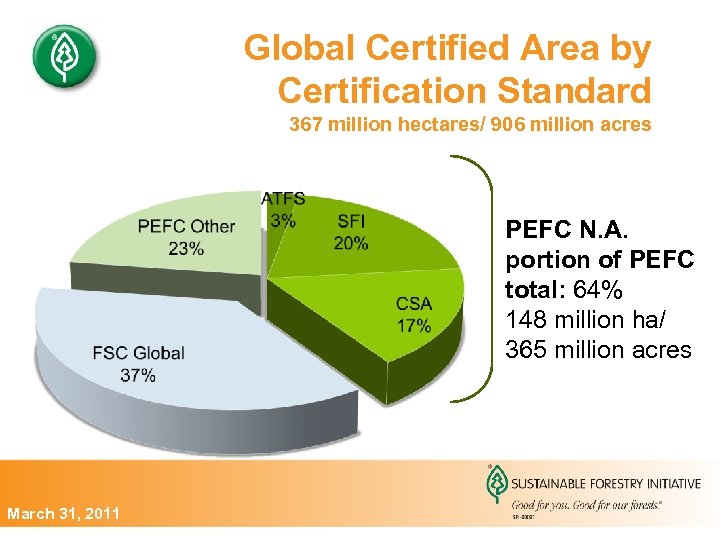
Global Certified Area by Certification Standard 367 million hectares/ 906 million acres PEFC N. A. portion of PEFC total: 64% 148 million ha/ 365 million acres March 31, 2011
Forest Certification Convergence? “Significant changes have occurred within the major certification programs in recent years, and, in several ways, it is increasingly difficult to differentiate between certification systems in North America. ” Dr. Jeff Howe Dovetail Partners 9 “Over the years, many of the issues that previously divided the systems have become much less distinct. The largest certification systems now generally have the same structural programmatic requirements. ” UN Forest Products Annual Review
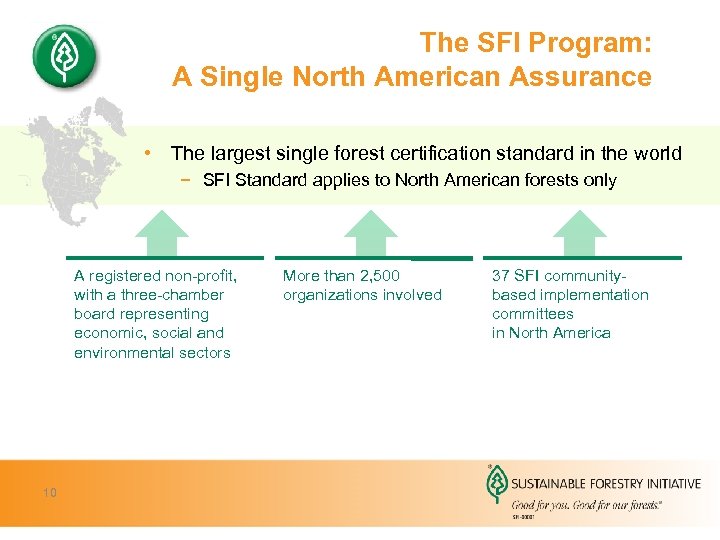
The SFI Program: A Single North American Assurance • The largest single forest certification standard in the world − SFI Standard applies to North American forests only A registered non-profit, with a three-chamber board representing economic, social and environmental sectors 10 More than 2, 500 organizations involved 37 SFI communitybased implementation committees in North America
The SFI Program: A Single North American Assurance Our Mission “Ensure the integrity of the SFI program is strong, grounded in science and research, and based on conservation and community collaboration resulting in a program that is recognized globally as supporting responsible forestry. ” 11
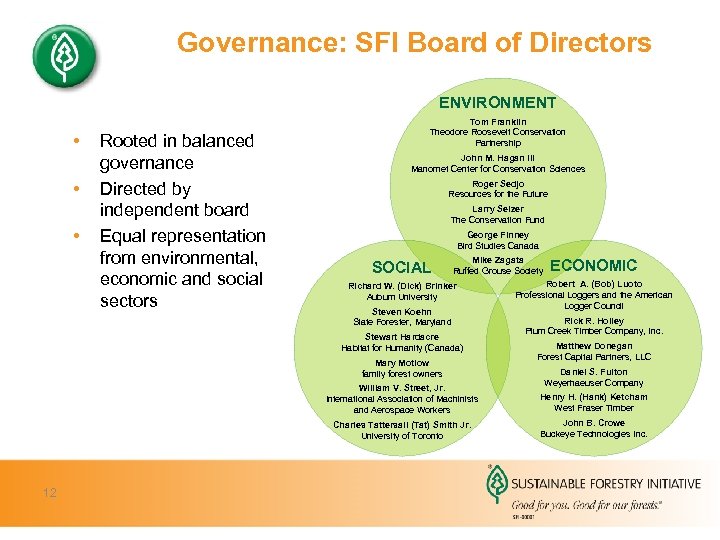
Governance: SFI Board of Directors ENVIRONMENT • • • Rooted in balanced governance Directed by independent board Equal representation from environmental, economic and social sectors Tom Franklin Theodore Roosevelt Conservation Partnership John M. Hagan III Manomet Center for Conservation Sciences Roger Sedjo Resources for the Future Larry Selzer The Conservation Fund George Finney Bird Studies Canada SOCIAL Mike Zagata Ruffed Grouse Society Richard W. (Dick) Brinker Auburn University Steven Koehn State Forester, Maryland Stewart Hardacre Habitat for Humanity (Canada) Mary Motlow family forest owners ECONOMIC Robert A. (Bob) Luoto Professional Loggers and the American Logger Council Rick R. Holley Plum Creek Timber Company, Inc. Matthew Donegan Forest Capital Partners, LLC Daniel S. Fulton Weyerhaeuser Company William V. Street, Jr. International Association of Machinists and Aerospace Workers Charles Tattersall (Tat) Smith Jr. University of Toronto 12 Henry H. (Hank) Ketcham West Fraser Timber John B. Crowe Buckeye Technologies Inc.
Need to Reach Us? Kathy Abusow Kathy. Abusow@sfiprogram. org Rick Cantrell Vice President & COO Rick. Cantrell@sfiprogram. org Karen Brandt Vice President, Market Affairs Karen. Brandt@sfiprogram. org Jason Metnick Senior Director, Market Access & Label Use Jason. Metnick@sfiprogram. org Nadine Block Senior Director, Government Outreach Nadine. Block@sfiprogram. org Allison Welde Director, Conservation Partnerships & Communications Allison. Welde@sfiprogram. org Sue Mc. Millan Director, Marketing Sue. Mc. Millan@sfiprogram. org Danny Karch National Director, Green Building Danny. Karch@sfiprogram. org Amy Doty Manager, Community Outreach Amy. Doty@sfiprogram. org Rachel Dierolf Secretary, PEFC U. S. Governing Body Manager, Statistics and Labeling Rachel. Dierolf@sfiprogram. org Julia Hershberger Office Manager Julia. Hershberger@sfiprogram. org Jennifer Farrant 13 President & CEO Executive Assistant to Kathy Abusow Jennifer. Farrant@sfiprogram. org
SUPPORT RESPONSIBLE FORESTRY. SFI - Who We Are May 2011
Скачать презентацию SUPPORT RESPONSIBLE FORESTRY SFI Who We Are
069d0a434bc8a2314f34bab883ea9505.ppt