


 Скачать презентацию Support of the foreign language profile of law
2097c3eb24cd2be91cda316f97d8519d.ppt
- Количество слайдов: 75
 Support of the foreign language profile of law tuition at the Faculty of Law in Olomouc CZ. 1. 07/2. 2. 00/15. 0288
 European civil procedure – Mutual recognition and enforcement of judgments Brussels I Regulation
 The importance of international jurisdiction • Different attitudes of Europe and USA. • USA (non – continental law) – „fairness“, „reasonableness“, „forum non conveniens“. • Basic source – US Constitution – Due Process Clause. • European – formal rules. • Hague convention (worldwide) – not successful. • Yahoo! case
 Brussels I Regulation • Council Regulation n. 44/2001 of 22 December 2000 • Called by the Commission as „matrix“ of judicial cooperation in civil and commercial matters • Substitutes the Brussels I Convention (some changes have been accepted) • Deals with jurisdiction of courts and the recognition and enforcement of judgments in civil and commercial matters.
 Brussels I Regulation – The Denmark situation • In 1997 when creating the Amsterdam Treaty the member states agreed upon The Protocol on the position of Denmark – Denmark is not cooperating within this field. • However in 2005 -mutual negotiations led to coclusions of an international agreement between the European Community and the Kingdom of Denmark on jurisdiction and the recognition and enforcement of judgments in civil and commercial matters (OJ 16/11/2005 L 299 p. 62)
 The Brusssels I Regulation The Denmark situation • Upon this agreement the provisions of the Brussels I regulation shall apply to the relations between the Community and the Denmark (with the exception given in the agreement). • Entered into force – 1. 7. 2007.
 The Brussels I Regulation General Characteristics • 76 articles, divided into eight chapters: I – Scope of application II – Jurisdiction III – Recognition and enforcement IV – Authentic instruments and court settlements V – General Provisions VI – Transitional Provisions VII – Relations with other instruments VIII- Final Provisions
 The Brussels I Regulation Scope of application • Material scope of application – article 1 of the Regulation – civil and commercial matters • Territorial scope of application – Domicile of the defendant in a Member state (all without Denmark) • Temporal scope of application – proceedings after 1 March 2002
 The Brussels I Regulation Scope of application • • International element (extensive interpretation- Owusu case – ECJ Case C 281/02 of 1 March 2005) On 10 October 1997, Mr Owusu (‘the claimant’), a British national domiciled in the United Kingdom, suffered a very serious accident during a holiday in Jamaica. He walked into the sea, and when the water was up to his waist he dived in, struck his head against a submerged sand bank and sustained a fracture of his fifth cervical vertebra which rendered him tetraplegic. Following that accident, Mr Owusu brought an action in the United Kingdom for breach of contract against Mr Jackson, who is also domiciled in that State. Mr Jackson had let to Mr Owusu a holiday villa in Mammee Bay (Jamaica). Mr Owusu claims that the contract, which provided that he would have access to a private beach, contained an implied term that the beach would be reasonably safe or free from hidden dangers. The Brussels I regulation precludes a court of a Contracting State (Member state) from declining the jurisdiction conferred on it by Article 2 of that regulation on the ground that a court of a non-member State would be a more appropriate forum for the trial of the action even if the jurisdiction of no other Member State is in issue or the proceedings have no connecting factors to any other Member State.
 The Brussels I Regulation The material scope of application • Article 1 of the Regulation : civil and commercial matters, whatever the nature of the court or tribunal.
 The Brussels I Regulation Scope of application • Matters of private law? – Case Volker Sonntag v. A. Waidman ECJ Case – C- 172/91 of 21 April 1993 • A claim for compensation for loss to an individual resulting from a criminal offence, even though made in the context of criminal proceedings, is civil in nature unless the person against whom it is made is to be regarded as a public authority which acted in the exercise of its powers. That is not the case where the activity called in question is the supervision by a state-school teacher of his pupils during a school trip. It follows that "civil matters" within the meaning of the first sentence of the first paragraph of Article 1 of the Convention of 27 September 1968 on jurisdiction and the enforcement of judgments in civil and commercial matters covers a claim for damages brought before a criminal court against a state-school teacher who, during a school trip, occasioned loss to a pupil as a result of a culpable and unlawful breach of his duties of supervision, even where there is coverage by a scheme of social insurance under public law.
 The Brussels I Regulation The material scope of application • Negative – exemptions in art. 1 para 2 • The Regulation shall not apply to: (a) the status or legal capacity of natural persons, rights in property arising out of a matrimonial relationship, wills and succession; (b) bankruptcy, proceedings relating to the winding-up of insolvent companies or other legal persons, judicial arrangements, compositions and analogous proceedings; (c) social security; (d) arbitration.
 The Brussels I Regulation The material scope of application • • • The exclusion of arbitration – governed by the New York Convention, to which all member states are parties. Case C-185/07 West Tankers In August 2000 the Front Comor, a vessel owned by West Tankers and chartered by Erg Petroli Sp. A (‘Erg’), collided in Syracuse (Italy) with a jetty owned by Erg and caused damage. The charterparty was governed by English law and contained a clause providing for arbitration in London (United Kingdom). Erg claimed compensation from its insurers Allianz and Generali up to the limit of its insurance cover and commenced arbitration proceedings in London against West Tankers for the excess. West Tankers denied liability for the damage caused by the collision. Having paid Erg compensation under the insurance policies for the loss it had suffered, Allianz and Generali brought proceedings on 30 July 2003 against West Tankers before the Tribunale di Siracusa (Italy) in order to recover the sums they had paid to Erg. The action was based on their statutory right of subrogation to Erg’s claims, in accordance with Article 1916 of the Italian Civil Code. West Tankers raised an objection of lack of jurisdiction on the basis of the existence of the arbitration agreement.
 The Brussels I Regulation The material scope of application • In parallel, West Tankers brought proceedings, on 10 September 2004, before the High Court of Justice of England Wales, Queens Bench Division (Commercial Court), seeking a declaration that the dispute between itself, on the one hand, and Allianz and Generali, on the other, was to be settled by arbitration pursuant to the arbitration agreement. West Tankers also sought an injunction restraining Allianz and Generali from pursuing any proceedings other than arbitration and requiring them to discontinue the proceedings commenced before the Tribunale di Siracusa (‘the anti-suit injunction’). • It is incompatible with Council Regulation (EC) No 44/2001 of 22 December 2000 on jurisdiction and the recognition and enforcement of judgments in civil and commercial matters for a court of a Member State to make an order to restrain a person from commencing or continuing proceedings before the courts of another Member State on the ground that such proceedings would be contrary to an arbitration agreement.
 The Brussels I Regulation Jurisdiction • Determines the member state having jurisdiction over the case. • Has to be distinguished from internal jurisdiction – relations between courts of one member state – regulated by the national law. e. g. – the regulation -----> Czech courts Which Czech court? -------> Czech civil procedure code
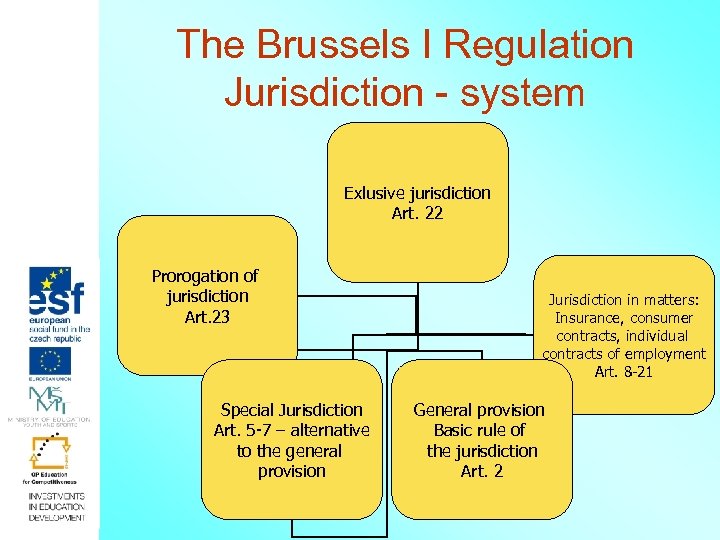 The Brussels I Regulation Jurisdiction - system Exlusive jurisdiction Art. 22 Prorogation of jurisdiction Art. 23 Special Jurisdiction Art. 5 -7 – alternative to the general provision Jurisdiction in matters: Insurance, consumer contracts, individual contracts of employment Art. 8 -21 General provision Basic rule of the jurisdiction Art. 2
 The Brussels I Regulation Jurisdiction – Basic rule • The Basic rule of the jurisdiction – art. 2 of the Regulation: „Subject to this Regulation, persons domiciled in a Member state shall, whatever their nationality, be sued in that Member state“. Actor sequitur forum rei (The claimant follows the defendant).
 The Brussels I Regulation Special jurisdiction • Articles 5 -7 – alternative jurisdiction to the jurisdiction based upon the general (basic) principle in article 2. • Brings the possibility to „opt out“ the most suitable courts – the possibility to „keep“ the proceedings in „my“ state.
 The Brussels I Regulation Special Jurisdiction Article 5 – a) Place of performance b) Maintenance claims c) Tort d) Civil claims for damages or restitution based upon act giving rise to criminal proceedings e) Disputes arising out of the operation of a branch, agency or other establishment f) Trust operations g) Payment of remuneration claimed in respect of the salvage of a cargo or freight.
 The Brussels I Regulation Special Jurisdiction Article 5 para 1 – Place of performance The person domiciled in one Member state, may be sued in another member state: a) in matters relating to a contract, in the courts for the place of performance of the obligation in question; In matters relating to a contract – in the courts for the place of performance of the obligation in question. Place of performance – interpreted directly in the Regulation: • for the purpose of this provision and unless otherwise agreed, the Place of performance of the obligation in question shall be: — in the case of the sale of goods, the place in a Member State where, under the contract, the goods were delivered or should have been delivered, — in the case of the provision of services, the place in a Member State where, under the contract, the services were provided or should have been provided.
 The Brussels I Regulation Special Jurisdiction • (ECJ) CJEU Judgment of the Court (Fourth Chamber) of 3 May 2007, C 386/05 Color Drack Gmb. H v Lexx International Vertriebs Gmb. H. The first indent of Article 5(1)(b) of Council Regulation (EC) No 44/2001 of 22 December 2000 on jurisdiction and the recognition and enforcement of judgments in civil and commercial matters must be interpreted as applying where there are several places of delivery within a single Member State. In such a case, the court having jurisdiction to hear all the claims based on the contract for the sale of goods is that for the principal place of delivery, which must be determined on the basis of economic criteria. In the absence of determining factors for establishing the principal place of delivery, the plaintiff may sue the defendant in the court for the place of delivery of its choice.
 The Brussels I Regulation Special Jurisdiction • • Criteria for distinguishing between sale of goods and provision of services Case C 381/08 Car Trim Gmb. H v. Keysafety Systems Srl Article 5(1)(b) must be interpreted as meaning that where the purpose of contracts is the supply of goods to be manufactured or produced and, even though the purchaser has specified certain requirements with regard to the provision, fabrication and delivery of the components to be produced, the purchaser has not supplied the materials and the supplier is responsible for the quality of the goods and their compliance with the contract, those contracts must be classified as a "sale of goods" within the meaning of the first indent of Article 5(1)(b) of that regulation. The first indent of Article 5(1)(b) of Regulation No 44/2001 must be interpreted as meaning that, in the case of a sale involving carriage of goods, the place where, under the contract, the goods sold were delivered or should have been delivered must be determined on the basis of the provisions of that contract. Where it is impossible to determine the place of delivery on that basis, without reference to the substantive law applicable to the contract, that place is the place where the physical transfer of the goods took place, as a result of which the purchaser obtained, or should have obtained, actual power of disposal over those goods at the final destination of the sales transaction.
 The Brussels I Regulation Special Jurisdiction • Performance in several Member States • C 19/09 Wood Floor • The second indent of Article 5(1)(b) must be interpreted as meaning that provision is applicable in the case where services are provided in several Member States; • The second indent of Article 5(1)(b) of must be interpreted as meaning that where services are provided in several Member States, the court which has jurisdiction to hear and determine all the claims arising from the contract is the court in whose jurisdiction the place of the main provision of services is situated. For a commercial agency contract, that place is the place of the main provision of services by the agent, as it appears from the provisions of the contract or, in the absence of such provisions, the actual performance of that contract or, where it cannot be established on that basis, the place where the agent is domiciled.
 The Brussels I Regulation Special jurisdiction • Art. 5 para 2 – maintenance claims , , , the courts for the place, where the maintenance creditor is domiciled or habitually resident, , , , Example: ECJ Case C- 433/01 of 15 January Freistaat Bayern v Jan Blijdenstein.
 The Brussels I Regulation Special jurisdiction Mr Blijdenstein lived in the Netherlands. In the 1993/94 academic year, his daughter began training in an establishment in Munich (Germany). From 1 September 1993, she received an education grant from Freistaat Bayern brought, first, an action for recovery against Mr Blijdenstein before the Amtsgericht (Local Court) of Munich seeking reimbursement of the grant paid for the 1993/94 academic year. The action resulted in judgment being entered against the defendant. Freistaat Bayern commenced a second action before the Amtsgericht of Munich claiming reimbursement from Mr Blijdenstein of the grants paid for the 1994/95 and 1995/96 academic years. Mr Blijdenstein disputed the jurisdiction of the Amtsgericht of Munich Article 5(2) must be interpreted as meaning that it cannot be relied on by a public body which seeks, in an action for recovery, reimbursement of sums paid under public law by way of an education grant to a maintenance creditor, to whose rights it is subrogated against the maintenance debtor.
 The Brussels I Regulation Special jurisdiction • Art. 5 para 3 – tort ………. in matters relating to tort, delict or quasi delict, in the courts where the harmful event occured or may occur…… Difficult interpretation of the notion „harmful event“: Decision Mines de Potasses d´Alsace – ECJ Case 21/76 of 30 November 1976
 The Brussels I Regulation Special jurisdiction Decision Mines de Potasses d´Alsace –ECJ Case 21/76 of 30 November 1976 • WHERE THE PLACE OF THE HAPPENING OF THE EVENT WHICH MAY GIVE RISE TO LIABILITY IN TORT , DELICT OR QUASIDELICT AND THE PLACE WHERE THAT EVENT RESULTS IN DAMAGE ARE NOT IDENTICAL , THE EXPRESSION ' PLACE WHERE THE HARMFUL EVENT OCCURRED ' , IN ARTICLE 5 ( 3 ) OF THE CONVENTION OF 27 SEPTEMBER 1968 ON JURISDICTION AND THE ENFORCEMENT OF JUDGMENTS IN CIVIL AND COMMERCIAL MATTERS , MUST BE UNDERSTOOD AS BEING INTENDED TO COVER BOTH THE PLACE WHERE THE DAMAGE OCCURRED AND THE PLACE OF THE EVENT GIVING RISE TO IT. THE RESULT IS THAT THE DEFENDANT MAY BE SUED , AT THE OPTION OF THE PLAINTIFF , EITHER IN THE COURTS FOR THE PLACE WHERE THE DAMAGE OCCURRED OR IN THE COURTS FOR THE PLACE OF THE EVENT WHICH GIVES RISE TO AND IS AT THE ORIGIN OF THAT DAMAGE.
 The Brussels I Regulation Special Jurisdiction • • Harmful event – other decisions Kronhofer – ECJ Case 168/2002 Mr Kronhofer brought proceedings against the defendants in the main proceedings before the Landesgericht Feldkirch (Feldkirch Regional Court) (Austria), seeking to recover damages for financial loss which he claims to have suffered as a result of their wrongful conduct. The defendants in the main proceedings persuaded him, by telephone, to enter into a call option contract relating to shares. However, they failed to warn him of the risks involved in the transaction. As a result, Mr Kronhofer transferred a total amount of USD 82 500 in November and December 1997 to an investment account with Protectas in Germany which was then used to subscribe for highly speculative call options on the London Stock Exchange. The transaction in question resulted in the loss of part of the sum transferred and Mr Kronhofer was repaid only part of the capital invested by him. • Article 5(3) must be interpreted as meaning that the expression ‘place where the harmful event occurred’ does not refer to the place where the claimant is domiciled or where ‘his assets are concentrated’ by reason only of the fact that he has suffered financial damage there resulting from the loss of part of his assets which arose and was incurred in another Contracting State.
 The Brussels I Regulation Special jurisdiction • • Shevil case –ECJ Case 68/93 harm caused by the publication of a defamatory newspaper article On a proper construction of the expression "place where the harmful event occurred" in Article 5(3) the victim of a libel by a newspaper article distributed in several Contracting States may bring an action for damages against the publisher either before the courts of the Contracting State of the place where the publisher of the defamatory publication is established, which have jurisdiction to award damages for all the harm caused by the defamation, or before the courts of each Contracting State in which the publication was distributed and where the victim claims to have suffered injury to his reputation, which have jurisdiction to rule solely in respect of the harm caused in the State of the court seised. The criteria for assessing whether the event in question is harmful and the evidence required of the existence and extent of the harm alleged by the victim of the defamation are not governed by the Convention but by the substantive law determined by the national conflict of laws rules of the court seised, provided that the effectiveness of the Convention is not thereby impaired.
 Brussels I Regulation Special Jurisdiction • Art 6 – pending cases a) More defendants – in the place, where any of them is domiciled, b) Third party – action on waranty or guarantee c) Counter - claim actions d) Matters relating to a contract – may be combined with action in matters relating to rights in rem against the same defendant
 Brussels I Regulation Special Jurisdiction • Case C 462/06 • Glaxosmithkline and Laboratoire Glaxosmithkline v. Jean Pierre Rouard The rule of special jurisdiction provided for in Article 6(1) of Regulation No 44/2001 on jurisdiction and the recognition and enforcement of judgments in civil and commercial matters cannot be applied to a dispute falling under Section 5 of Chapter II of that regulation concerning the jurisdiction rules applicable to individual contracts of employment
 Brussels I Regulation Exclusive Jurisdiction • Art. 22 sets down rules for jurisdiction regardless the domicile of the defendant: • E. g. In proceedings which have as their object rights in rem in immovable property –the courts of member state where immovable property is situated, • In proceedings which have as their object validity of entries in public register, the courts of the member state, in which register is kept.
 The Brussels I Regulation Prorogation of jurisdiction • • Art. 23 If the parties, one or more of whom is domiciled in a Member State, have agreed that a court or the courts of a Member State are to have jurisdiction to settle any disputes which have arisen or which may arise in connection with a particular legal relationship, that court or those courts shall have jurisdiction. Such jurisdiction shall be exclusive unless the parties have agreed otherwise. Such an agreement conferring jurisdiction shall be either: (a) in writing or evidenced in writing; or (b) in a form which accords with practices which the parties have established between themselves; or (c) in international trade or commerce, in a form which accords with a usage of which the parties are or ought to have been aware and which in such trade or commerce is widely known to, and regularly observed by, parties to contracts of the type involved in the particular trade or commerce concerned. Is (in the general principle) not allowed in: Insurance contracts, consumers contracts, individual contracts of employment.
 The Brussels I Regulation Jurisdiction by appearance • Even if the jurisdiction rules in this regulation establish jurisdiction of different courts – courts of another member state shall have jurisdiction if the defendant „enters an appearance“. • Does not apply: a) In cases of exclusive jurisdiction, b) If the defendant appears only to contest the jurisdiction.
 The Brussels I Regulation Jurisdiction in matters of insurance, consumers contracts and individual contracts of employment
 The Brussels I Regulation Jurisdiction in chosen matters • The articles 8 -21 of the Regulation set down special rules for jurisdiction in chosen matters – insurance, consumer contracts and individual contracts of employment. • The reason for such provisions – protection of the „typically“ weaker party.
 The Brussels I Regulation Jurisdiction in the matters relating to insurance • Articles 8 -14 of the Regulation. • The weaker party shall be either the policyholder, either the insured person or the one who benefits from the insurance contracts (beneficiary). • The basic rule for determination of the jurisdiction in these matters – article 9 of the Regulation.
 The Brussels I Regulation Jurisdiction in the matters relating to insurance • An insurer domiciled in a Member State may be sued: (a) in the courts of the Member State where he is domiciled, or (b) in another Member State, in the case of actions brought by the policyholder, the insured or a beneficiary, in the courts for the place where the plaintiff is domiciled, (c) if he is a co-insurer, in the courts of a Member State in which proceedings are brought against the leading insurer. The prorogation agreement according to conditions set by the article 23 is not allowed contrary the provisions of the section, but there is special provision – article 13.
 The Brussels I Regulation Jurisdiction in the matters relating to insurance • Case C 463/06 FBTO Schadenverzekeringen NV v. Jack Odenbreit • On 28 December 2003 Mr Odenbreit was involved in a road traffic accident in the Netherlands with a person insured with FBTO. As the injured party he brought a direct action against the insurer before the Amtsgericht Aachen (Aachen Local Court), which is the court for the place where he is domiciled, on the basis of Articles 11(2) and 9(1)(b) of Regulation No 44/2001. • The reference in Article 11(2) of Council Regulation (EC) No 44/2001 of 22 December 2000 on jurisdiction and the recognition and enforcement of judgments in civil and commercial matters to Article 9(1)(b) of that regulation is to be interpreted as meaning that the injured party may bring an action directly against the insurer before the courts for the place in a Member State where that injured party is domiciled, provided that such a direct action is permitted and the insurer is domiciled in a Member State.
 The Brussels I Regulation Jurisdiction over consumer contracts • Articles 15 -17 of the Regulation • The weaker party – the consumer. • The contracts for a purpose which can be regarded as being outside of his trade or profession.
 The Brussels I Regulation Jurisdiction over consumer contracts • In matters relating to a contract concluded by a person, the consumer, for a purpose which can be regarded as being outside his trade or profession, jurisdiction shall be determined by this Section, without prejudice to Article 4 and point 5 of Article 5, if: • it is a contract for the sale of goods on instalment credit terms; or • it is a contract for a loan repayable by instalments, or for any other form of credit, made to finance the sale of goods; or • in all other cases, the contract has been concluded with a person who pursues commercial or professional activities in the Member State of the consumer's domicile or, by any means, directs such activities to that Member State or to several States including that Member State, and the contract falls within the scope of such activities. • This Section shall not apply to a contract of transport other than a contract which, for an inclusive price, provides for a combination of travel and accommodation.
 The Brussels I Regulation Jurisdiction over consumer contracts • A consumer may bring proceedings against the other party to a contract either in the courts of the Member State in which that party is domiciled or in the courts for the place where the consumer is domiciled. • Proceedings may be brought against a consumer by the other party to the contract only in the courts of the Member State in which the consumer is domiciled.
 The Brussels I Regulation Jurisdiction over consumer contracts • • • According to article 15 para 1 letter a – sale of goods on instalment credit: ECJ Case 150/77 Bertrand v. Paul Ott SINCE THE CONCEPT OF A CONTRACT OF SALE ON INSTALMENT CREDIT TERMS VARIES FROM ONE MEMBER STATE TO ANOTHER , IN ACCORDANCE WITH THE OBJECTIVES PURSUED BY THEIR RESPECTIVE LAWS , IT IS NECESSARY , IN THE CONTEXT OF THE CONVENTION , TO CONSIDER THAT CONCEPT AS BEING INDEPENDENT AND THEREFORE TO GIVE IT A UNIFORM SUBSTANTIVE CONTENT ALLIED TO THE COMMUNITY ORDER. ACCORDING TO THE PRINCIPLES COMMON TO THE LAWS OF THE MEMBER STATES , THE SALE OF GOODS ON INSTALMENT CREDIT TERMS IS TO BE UNDERSTOOD AS A TRANSACTION IN WHICH THE PRICE IS DISCHARGED BY WAY OF SEVERAL PAYMENTS OR WHICH IS LINKED TO A FINANCING CONTRACT. HOWEVER , A RESTRICTIVE INTERPRETATION OF THE SECOND PARAGRAPH OF ARTICLE 14 OF THE CONVENTION , IN CONFORMITY WITH THE OBJECTIVES PURSUED BY SECTION 4 , ENTAILS THE RESTRICTION OF THE JURISDICTIONAL ADVANTAGE FOR WHICH PROVISION IS MADE BY THAT ARTICLE TO BUYERS WHO ARE IN NEED OF PROTECTION , THEIR ECONOMIC POSITION BEING ONE OF WEAKNESS IN COMPARISON WITH SELLERS BY REASON OF THE FACT THAT THEY ARE PRIVATE FINAL CONSUMERS AND ARE NOT ENGAGED , WHEN BUYING THE PRODUCT ACQUIRED ON INSTALMENT CREDIT TERMS , IN TRADE OR PROFESSIONAL ACTIVITIES. THE CONCEPT OF THE SALE OF GOODS ON INSTALMENT CREDIT TERMS WITHIN THE MEANING OF ARTICLE 13 OF THE BRUSSELS CONVENTION OF 27 SEPTEMBER 1968 IS NOT TO BE UNDERSTOOD TO EXTEND TO THE SALE OF A MACHINE WHICH ONE COMPANY AGREES TO MAKE TO ANOTHER COMPANY ON THE BASIS OF A PRICE TO BE PAID BY WAY OF BILLS OF EXCHANGE SPREAD OVER A PERIOD.
 The Brussels I Regulation Jurisdiction over consumer contracts • The regulation of the consumer contracts is not satisfactory – article 15 para 1 letter c) – is focussed only on „passive consumer“ – the one who buys only in the Member state, where he is domiciled.
 The Brussels I Regulation Jurisdiction over consumer contracts • • Does not apply to contracts of transport, unless they are combined with accommodation. Case C 585/08 and C 144/09 Pammer This dispute, between Mr Pammer, who resides in Austria, and Reederei Karl Schlüter, a company established in Germany, concerns a voyage by freighter from Trieste (Italy) to the Far East organised by that company which gave rise to a contract between it and Mr Pammer (‘the voyage contract’). Mr Pammer booked the voyage through Internationale Frachtschiffreisen Pfeiffer Gmb. H, a company whose seat is in Germany (‘the intermediary company’). The intermediary company, which operates in particular via the internet, described the voyage on its website, indicating that there was a fitness room, an outdoor swimming pool, a saloon and video and television access on the vessel. Reference was also made to three double cabins with shower and toilet, to a separate living room with seating, a desk, carpeting and a fridge, and to stopping at ports of call from which excursions into towns could be undertaken. Mr Pammer refused to embark and sought reimbursement of the sum which he had paid for the voyage, on the ground that description did not, in his view, correspond to the conditions on the vessel. Since Reederei Karl Schlüter reimbursed only a part of that sum, that is to say, roughly EUR 3 500, Mr Pammer claimed payment of the balance, roughly EUR 5 000, together with interest before an Austrian court of first instance, the Bezirksgericht (District Court) Krems an der Donau. Reederei Karl Schlüter contended that it did not pursue any professional or commercial activity in Austria and raised the plea that the court lacked jurisdiction.
 The Brussels I Regulation Jurisdiction over consumer contracts • • A contract concerning a voyage by freighter, such as that at issue in the main proceedings in Case C-585/08, is a contract of transport which, for an inclusive price, provides for a combination of travel and accommodation within the meaning of Article 15(3) of Council Regulation (EC) No 44/2001 of 22 December 2000 on jurisdiction and the recognition and enforcement of judgments in civil and commercial matters. In order to determine whether a trader whose activity is presented on its website or on that of an intermediary can be considered to be ‘directing’ its activity to the Member State of the consumer’s domicile, within the meaning of Article 15(1)(c) of Regulation No 44/2001, it should be ascertained whether, before the conclusion of any contract with the consumer, it is apparent from those websites and the trader’s overall activity that the trader was envisaging doing business with consumers domiciled in one or more Member States, including the Member State of that consumer’s domicile, in the sense that it was minded to conclude a contract with them. The following matters, the list of which is not exhaustive, are capable of constituting evidence from which it may be concluded that the trader’s activity is directed to the Member State of the consumer’s domicile, namely the international nature of the activity, mention of itineraries from other Member States for going to the place where the trader is established, use of a language or a currency other than the language or currency generally used in the Member State in which the trader is established with the possibility of making and confirming the reservation in that other language, mention of telephone numbers with an international code, outlay of expenditure on an internet referencing service in order to facilitate access to the trader’s site or that of its intermediary by consumers domiciled in other Member States, use of a top-level domain name other than that of the Member State in which the trader is established, and mention of an international clientele composed of customers domiciled in various Member States. It is for the national courts to ascertain whether such evidence exists. On the other hand, the mere accessibility of the trader’s or the intermediary’s website in the Member State in which the consumer is domiciled is insufficient. The same is true of mention of an email address and of other contact details, or of use of a language or a currency which are the language and/or currency generally used in the Member State in which the trader is established.
 The Brussels I Regulation Jurisdiction over consumer contracts • The application of the article 23 contrary the provisions of this section is not allowed, however the article 17 allows prorogation agreement over consumer contracts with certain conditions.
 The Brussels I Regulation Jurisdiction over consumer contracts • A lot of decisions of EC courts in this matter, e. g. : • C-464/01 Johann Gruber v. Bay Wa AG • Bingo decisions 1)Decision Gabriel C 96/00 2)C 27/02 – Missis Engler Case 180/06 Ilsinger
 The Brussels I Regulation Jurisdiction over consumer contracts • • C-464/01 Johann Gruber v. Bay Wa AG According to the documents in the main proceedings Mr Gruber, a farmer, owns a farm building constructed around a square (‘Vierkanthof’), situated in Upper Austria, close to the German border. He uses about a dozen rooms as a dwelling for himself and his family. In addition over 200 pigs are kept there, and there are fodder silos and a large machine room. Between 10% and 15% of the total fodder necessary for the farm is also stored there. The area of the farm building used for residential purposes is slightly more than 60% of the total floor area of the building. Bay Wa operates a number of separately managed businesses in Germany. In Pocking (Germany), not far from the Austrian border, it has a building materials business and a DIY and garden centre. The latter published brochures which were also distributed in Austria. Wishing to replace the roof tiles of his farm building, Mr Gruber became aware of those advertising brochures, which were sent out with the Braunauer Rundschau , a local periodical distributed to households. The tiles offered for sale by Bay Wa’s building materials department in Pocking did not feature in those brochures. Mr Gruber made several telephone enquiries to an employee of Bay Wa concerning the different types of tiles and the prices, stating his name and address but not mentioning the fact that he was a farmer. The employee made him an offer by telephone but Mr Gruber wished to inspect the tiles on site. On his visit to Bay Wa’s premises, he was given by the employee a written quotation dated 23 July 1998. During that meeting Mr Gruber told Bay Wa’s employee that he had a farm and wished to tile the roof of the farm building. He stated that he also owned ancillary buildings that were used principally for the farm, but did not expressly state whether the building to be tiled was used mainly for business or for private purposes. The following day, Mr Gruber called the employee, from Austria, to say that he accepted Bay Wa’s quotation. Bay Wa then faxed a confirmation of the order to Mr Gruber’s bank in Austria.
 The Brussels I Regulation Jurisdiction over consumer contracts The rules of jurisdiction laid down by the Brussels Convention must be interpreted as follows: a person who concludes a contract for goods intended for purposes which are in part within and in part outside his trade or profession may not rely on the special rules of jurisdiction laid down in Articles 13 to 15 of the Convention, unless the trade or professional purpose is so limited as to be negligible in the overall context of the supply, the fact that the private element is predominant being irrelevant in that respect; it is for the court seised to decide whether the contract at issue was concluded in order to satisfy, to a non-negligible extent, needs of the business of the person concerned or whether, on the contrary, the trade or professional purpose was negligible; to that end, that court must take account of all the relevant factual evidence objectively contained in the file. On the other hand, it must not take account of facts or circumstances of which the other party to the contract may have been aware when the contract was concluded, unless the person who claims the capacity of consumer behaved in such a way as to give the other party to the contract the legitimate impression that he was acting for the purposes of his business.
 The Brussels I Regulation Jurisdiction over consumer contracts • • • Gabriel C 96/00 19 In October 1999 Mr Gabriel received at his private address and in a sealed envelope several personalised letters from Schlank & Schick which he claims were of such a kind as to lead him to believe that, following a draw, he was the lucky winner of ATS 49 700 and that he was entitled to receive that amount simply on demand, subject only to the condition that he ordered at the same time from that company goods to a minimum value of ATS 200, to be selected in a catalogue and entered on an order form attached to those letters. The jurisdiction rules set out in the Brussels I Convention are to be construed as meaning that judicial proceedings by which a consumer seeks an order, in the Contracting State in which he is domiciled and pursuant to that State's legislation, requiring a mail-order company established in another Contracting State to pay him a financial benefit in circumstances where that company had sent to that consumer in person a letter likely to create the impression that a prize would be awarded to him on condition that he ordered goods to a specified amount, and where that consumer actually placed such an order in the State of his domicile without, however, obtaining payment of that financial benefit, are contractual in nature in the sense contemplated in Article 13, first paragraph, point 3, of that Convention.
 The Brussels I Regulation Jurisdiction over consumer contracts C 27/02 – Missis Engler At the beginning of 2001 Ms Engler received a letter personally addressed to her at her domicile from Janus Versand, which carries on business as a mail order company. That letter contained a ‘payment notice’, whose form and content led her to believe that she had won a prize of ATS 455 000 in a ‘cash prize draw’ organised by Janus Versand, and a catalogue of goods marketed by the latter (which apparently also called itself, in its relations with its customers, ‘Handelskontor Janus Gmb. H’) with a ‘request for a trial without obligation’. In the advertising brochure sent to Ms Engler Janus Versand stated that it could also be contacted on the Internet at the following address: www. janus-versand. com. Furthermore, Ms Engler was requested to affix to the ‘payment notice’, in the space provided for that purpose, the ‘official stamp of the chambers’ accompanying the letter and to return the request for the ‘trial without obligation’ to Janus Versand. A box for the date and signature, a request to ‘fill it in’ and a reference in small print to the terms and conditions and the award of the prize supposedly won also feature on the ‘payment notice’. Ms Engler had to declare on the ‘payment notice’ that she had read and accepted those conditions. Finally, it also urged the addressee to return ‘today’ the document duly completed in order that it could be processed, and an envelope was attached for that purpose. In those circumstances Ms Engler, as Janus Versand had requested, returned the ‘payment notice’ to it, as she believed that was sufficient in order to obtain the promised prize of ATS 455 000. At first Janus Versand did not react, it then refused to pay that sum to Ms Engler.
 The Brussels I Regulation Jurisdiction over consumer contracts The rules of jurisdiction of the Brussels I regulation must be interpreted in the following way: legal proceedings by which a consumer seeks an order, under the law of the Contracting State in which he is domiciled, that a mail order company established in another Contracting State award a prize ostensibly won by him is contractual in nature for the purpose of Article 5(1) of that convention, provided that, first, that company, with the intention of inducing the consumer to enter a contract, addresses to him in person a letter of such a kind as to give the impression that a prize will be awarded to him if he returns the ‘payment notice’ attached to the letter and, second, he accepts the conditions laid down by the vendor and does in fact claim payment of the prize announced; on the other hand, even though the letter also contains a catalogue advertising goods for that company and a request for a ‘trial without obligation’, the fact that the award of the prize does not depend on an order for goods and that the consumer has not, in fact, placed such an order has no bearing on that interpretation.
 The Brussels I Regulation Jurisdiction over consumer contracts Case 180/06 Ilsinger • In August 2002, Ms Ilsinger, an Austrian national domiciled in Austria, received an envelope from the mail-order company Schlank & Schick Gmb. H, established in Aachen (Germany). The envelope, on which the words ‘important documents’, ‘please open immediately’ and ‘private’ were written, contained a notification which was addressed personally to her, stating that she had won a prize of EUR 20 000. It was clear from that notification that Ms Ilsinger would obtain the prize ‘if she had the identification number which authorised her to obtain the prize’, and attached to her prize claim certificate a coupon containing the identification number and returned it to Schlank & Schick within seven days. It is also clear from the prize notification that the claim for payment of the prize was not made conditional upon ordering goods. Ms Ilsinger attached to the prize claim certificate the coupon containing the identification number and returned it to Schlank & Schick. • In December 2002, having failed to obtain payment of the prize from Schlank & Schick, Ms Ilsinger brought an action against the company before the Landesgericht St. Pölten, the court for the place where she is domiciled, under Paragraph 5 j of the Austrian Consumer Protection Law in conjunction with Article 16(1) of Regulation No 44/2001, in order to obtain payment of the prize. In the context of those proceedings, Schlank & Schick claimed that the Austrian court lacked jurisdiction. By order of 15 June 2004, the Landesgericht St. Pölten simultaneously dismissed the objection of lack of jurisdiction and rejected the claims of the applicant in the main proceedings.
 The Brussels I Regulation Jurisdiction over consumer contracts • • Article 15(1)(c) must be interpreted as meaning that the right of action by which consumers may, under the law of the Member State in which they are domiciled, claim in the courts, from undertakings established in another Member State, prizes ostensibly won by them where the undertakings send them prize notifications or other similar communications worded so as to give the impression that they have won a prize, where the claiming of that prize was not made conditional upon actually ordering goods or placing a trial order and where no goods were actually ordered but the recipient of the communication is nevertheless seeking to claim the prize, may be a right connected with a contract for the purposes of that article of the regulation in question, if a consumer contract within the meaning of that article has been concluded in the case in the main proceedings. It is for the national court to determine whether a consumer contract within the meaning of that article has been concluded in the case in the main proceedings. The right of action by which consumers may bring legal proceedings against suppliers for payment of prizes ostensibly won is a right connected with a contract for the purposes of Article 15(1)(c) of the regulation if the claim for payment of the prize was not made conditional upon ordering goods but the recipient of the communication has actually placed an order for goods.
 The Brussels I Regulation Jurisdiction over individual contracts of employment • • • Articles 18 -21. The weaker party is employee. An employer domiciled in a Member State may be sued: 1. in the courts of the Member State where he is domiciled; or 2. in another Member State: (a) in the courts for the place where the employee habitually carries out his work or in the courts for the last place where he did so, or (b) if the employee does not or did not habitually carry out his work in any one country, in the courts for the place where the business which engaged the employee is or was situated. An employer may bring proceedings only in the courts of the Member State in which the employee is domiciled.
 The Brussels I Regulation Jurisdiction over individual contracts of employment – prorogation agreement • The application of the article 23 contrary the provisions of this section is not allowed, however the article 21 allows prorogation agreement individual contracts of employment, in certain situations.
 Brussels I Regulation Jurisdiction over individual contracts of employment • Decisions: Petrus Rutten v. Cross Medical Ltd. C 383/95 Where, in the performance of a contract of employment, an employee carries out his work in several Contracting States, the place where he habitually carries out his work, is the place where he has established the effective centre of his working activities. When identifying that place, it is necessary to take into account the fact that the employee spends most of his working time in one of the Contracting States in which he has an office where he organizes his activities for his employer and to which he returns after each business trip abroad.
 Brussels I Regulation Jurisdiction over individual contracts of employment 437/00 - Giulia Pugliese v Finmeccanica Sp. A, Betriebsteil Alenia Aerospazio – two employers. In a dispute between an employee and a first employer, the place where the employee performs his obligations to a second employer can be regarded as the place where he habitually carries out his work when the first employer, with respect to whom the employee ' s contractual obligations are suspended, has, at the time of the conclusion of the second contract of employment, an interest in the performance of the service by the employee to the second employer. The existence of such an interest must be determined on a comprehensive basis, taking into consideration all the circumstances of the case.
 Lis pendens and related actions Lis pendens • Where proceedings involving the same cause of action and between the same parties are brought in the courts of different Member States, any court other than the court first seised shall of its own motion stay its proceedings until such time as the jurisdiction of the court first seised is established. • Where the jurisdiction of the court first seised is established, any court other than the court first seised shall decline jurisdiction in favour of that court.
 Lis pendens and related actions Related actions • Where related actions are pending in the courts of different Member States, any court other than the court first seised may stay its proceedings. • Where these actions are pending at first instance, any court other than the court first seised may also, on the application of one of the parties, decline jurisdiction if the court first seised has jurisdiction over the actions in question and its law permits the consolidation thereof. • For the purposes of this Article, actions are deemed to be related where they are so closely connected that it is expedient to hear and determine them together to avoid the risk of irreconcilable judgments resulting from separate proceedings.
 The Brussels I Regulation The recognition and enforcement of judgments
 The Brussels I Regulation The enforcement and recognition of judgments • Two systems of enforcement of a judgement of one Member state in another Member state: 1. The Brussels I Regulation 2. The EEO Regulation (European enforcement order for uncontested claims)
 The Brussels I Regulation The enforcement and recognition of judgments • Simpler rules than the rules about the jurisdiction. • Chapter III of the Regulation – articles 33 -56. • Basic aim – free movement of judgments • Interpretation – Court of justice
 The Brussels I Regulation The enforcement and recognition of judgments • The procedure of recognition and enforcement – 3 phases: 1. Recognition 2. Declaration of enforceability of judgment 3. Enforcement of judgment • The notion „judgment“ (article 32 of the Regulation): „any judgment given by a court or tribunal of a Member state, whatever the judgment may be called“
 The Brussels I Regulation The recognition of judgments • The principle of automatic recognition of judgments – no special procedure, no special decision is required. • No review of the substance of the judgment is allowed.
 The Brussels I Regulation The recognition of judgments A judgment shall not be recognised: 1. if such recognition is manifestly contrary to public policy in the Member State in which recognition is sought; 2. where it was given in default of appearance, if the defendant was not served with the document which instituted the proceedings or with an equivalent document in sufficient time and in such a way as to enable him to arrange for his defence, unless the defendant failed to commence proceedings to challenge the judgment when it was possible for him to do so; 3. if it is irreconcilable with a judgment given in a dispute between the same parties in the Member State in which recognition is sought; 4. if it is irreconcilable with an earlier judgment given in another Member State or in a third State involving the same cause of action and between the same parties, provided that the earlier judgment fulfils the conditions necessary for its recognition in the Member State addressed.
 The Brussels I Regulation The enforcement of judgments • Article 38 of the Regulation – a judgment of one Member state may be enforced in another Member state after it has been declared enforceable (exequatur proceeding). • Application for the declaration of enforceability is required. • Application shall be submitted to courts in Annex II of the Regulation.
 The Brussels I Regulation The enforcement of judgments • Strictly formal procedure: If the conditions required (copy of decision + certificate according to articles 54 -58) are fulfilled, the court issues decision of enforceability immediately without any review. • The defendant does not know about the application in that phase, the delivered decision is serviced to him (then only he acquires information about the procedure).
 The Brussels I Regulation The enforcement of judgments • Against the decision about enforceability – an appeal is permissible –to the courts in Annex III • The term is one month (if the defendant is domiciled in other member state, than where the decision was issued – two months). • Case C 167/08 Draka NK Cables v. Omnipol • Article 43(1) of the Regulation must be interpreted as meaning that a creditor of a debtor cannot lodge an appeal against a decision on a request for a declaration of enforceability if he has not formally appeared as a party in the proceedings in which another creditor of that debtor applied for that declaration of enforceability. • Against the decision of appeal – a remedy is permissible – regulated by national law – annex IV.
 The Brussels I Regulation The enforcement of judgments • The enforcement of the judgment which has be declared enforceable – regulated by the national law of the state. • The application for the enforcement can be raised together with the application for the declaration of the enforceability. • However, according to the possibility of raising an appeal – the decision allowing the enforcement can not come into legal force earlier than the decision about the enforceability.
 The Brussels I regulation Commission proposal of amendment
 Commission proposal • Green Paper of 21 April 2009 on the Review of Council regulation no 44/2001 on Jurisdiction and the Recognition and Enforcement of Judgments in Civil and Commercial matters 1. Abolition of the exequatur procedure for decisions of Member state courts - Procedures mostly succesful (90 up to 100 %), but take too long and are expensive
 Commission proposal 2. Third states´ judgments Commission calls for harmonisation of rules concerning recognition and enforcement of third states´ judgments. 3. Filling suits againts defendant from third states before EU courts 4. Strengthening prorogation of jurisdiction e. g standardised clauses to prorogate jurisdiction
 Commission proposal 5. Collective redress, lis pendes and related actions Problem of „torpedoes“ The rule of lis pendens allows abusive procedural tactics Admitting proceedings of several plaintiffs against one defendant (consumer protection suits and damages actions for breach of antitrust rules). 6. Extension of protective measures 7. Coordination between public courts and arbitration boards