


 Скачать презентацию Supply Chain Management Lecture 24 Semester Outline
648afc8ae9c9a0a0644f87c302f93977.ppt
- Количество слайдов: 40
 Supply Chain Management Lecture 24
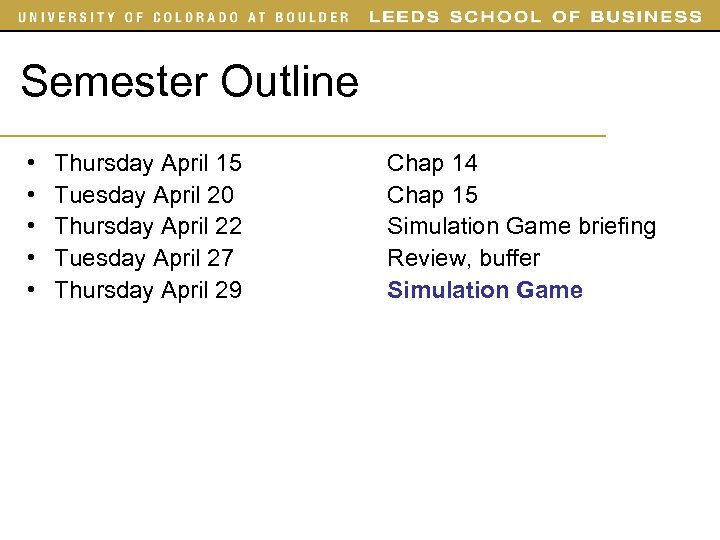 Semester Outline • • • Thursday April 15 Tuesday April 20 Thursday April 22 Tuesday April 27 Thursday April 29 Chap 14 Chap 15 Simulation Game briefing Review, buffer Simulation Game
 Outline • Today – Finish with Chapter 14 • Sections 1, 2, 3, 4, 6, 7, 8, 9 – Section 6 buyback and revenue sharing contracts only • Homework 5 due tomorrow • Next week – Chapter 15 • Sections 1, 2 – Simulation game briefing
 Summary • In-House or Outsource (make or buy)? – The decision to outsource is based on the growth in supply chain surplus provided by the third party and the increase in risk by using a third party
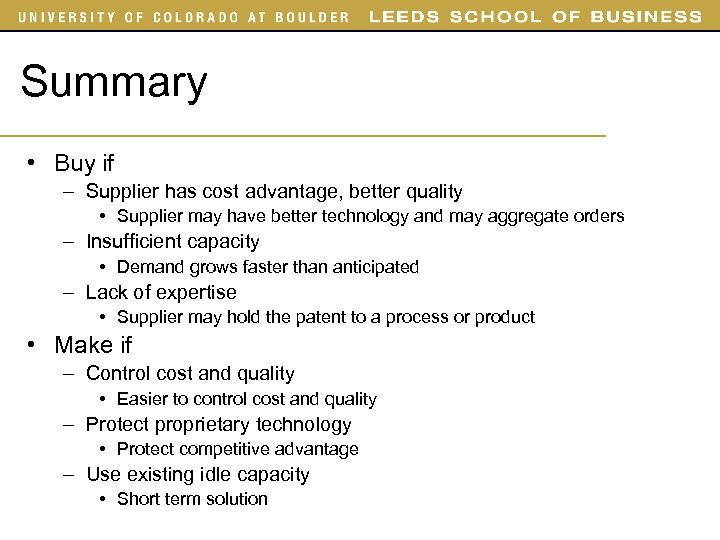 Summary • Buy if – Supplier has cost advantage, better quality • Supplier may have better technology and may aggregate orders – Insufficient capacity • Demand grows faster than anticipated – Lack of expertise • Supplier may hold the patent to a process or product • Make if – Control cost and quality • Easier to control cost and quality – Protect proprietary technology • Protect competitive advantage – Use existing idle capacity • Short term solution
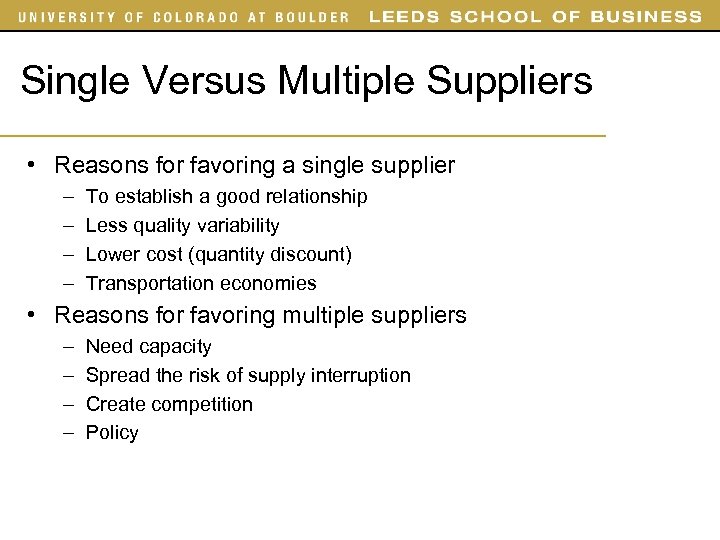 Single Versus Multiple Suppliers • Reasons for favoring a single supplier – – To establish a good relationship Less quality variability Lower cost (quantity discount) Transportation economies • Reasons for favoring multiple suppliers – – Need capacity Spread the risk of supply interruption Create competition Policy
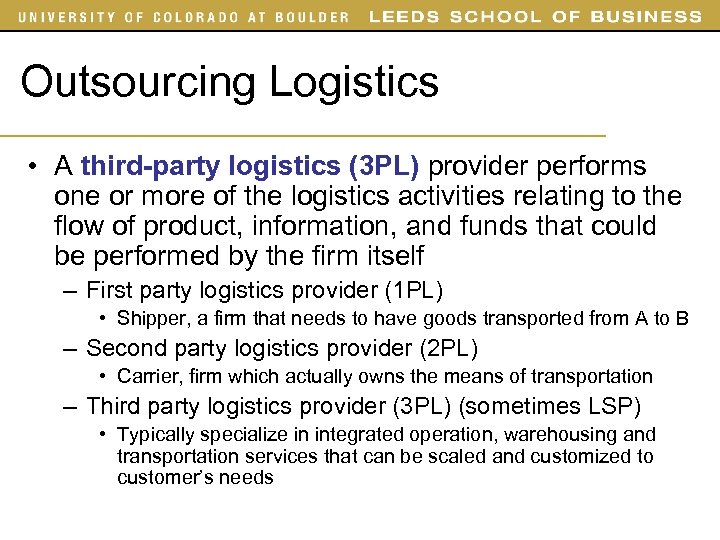 Outsourcing Logistics • A third-party logistics (3 PL) provider performs one or more of the logistics activities relating to the flow of product, information, and funds that could be performed by the firm itself – First party logistics provider (1 PL) • Shipper, a firm that needs to have goods transported from A to B – Second party logistics provider (2 PL) • Carrier, firm which actually owns the means of transportation – Third party logistics provider (3 PL) (sometimes LSP) • Typically specialize in integrated operation, warehousing and transportation services that can be scaled and customized to customer’s needs
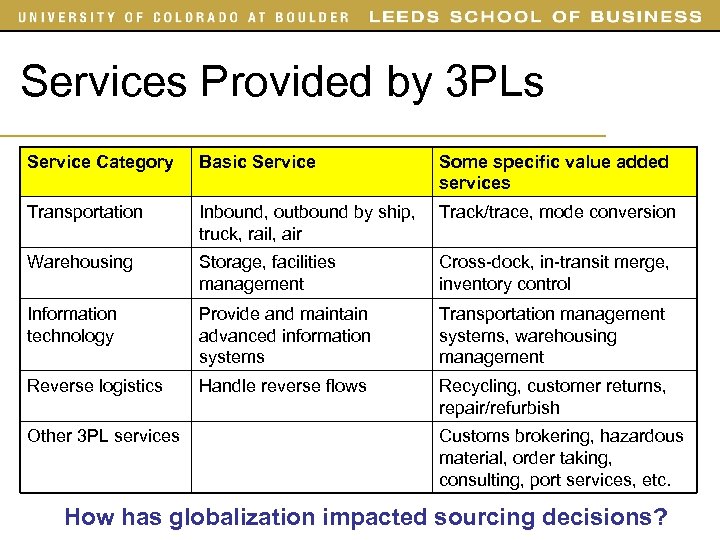 Services Provided by 3 PLs Service Category Basic Service Some specific value added services Transportation Inbound, outbound by ship, truck, rail, air Track/trace, mode conversion Warehousing Storage, facilities management Cross-dock, in-transit merge, inventory control Information technology Provide and maintain advanced information systems Transportation management systems, warehousing management Reverse logistics Handle reverse flows Recycling, customer returns, repair/refurbish Other 3 PL services Customs brokering, hazardous material, order taking, consulting, port services, etc. How has globalization impacted sourcing decisions?
 Outsourcing Logistics • A fourth-party logistics (4 PL) provider manages other 3 PLs. Whereas a 3 PL targets a function, a 4 PL targets management of an entire process – Fourth party logistics provider (4 PL) • “A 4 PL is an integrator that assembles the resources, capabilities, and technology of its own organization and other organizations to design, build and run comprehensive supply chain solutions” Source: Accenture • 4 PL use 2 PLs and/or 3 PLs to supply service to customers, owning mostly computer systems/technology
 Best Practice 4 PL • Li & Fung – The firm aggregates demand across hundreds of customers, capacity across thousands of suppliers, and uses detailed information to match supply and demand in the most cost effective manner – By sourcing appropriately Li & Fung gets around regional trade umbrellas such as the EU and NAFTA
 How do 4 PLs Add Value? • How do 4 PLs add value to a firm managing its own logistics providers? The fundamental advantage that 4 PLs may provide comes from greater visibility and coordination over a firm’s supply chain and improved handoffs between logistics providers
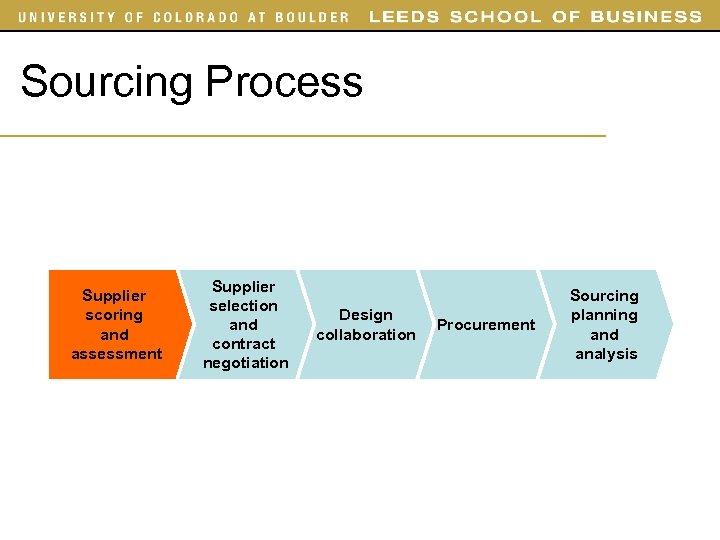
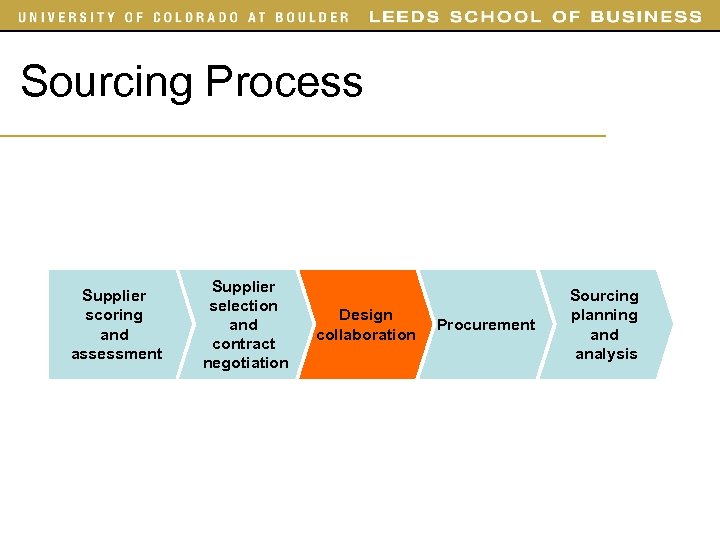
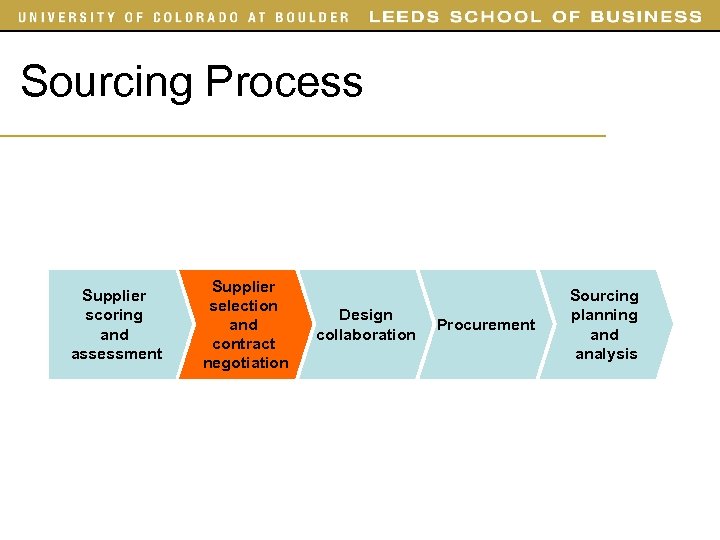
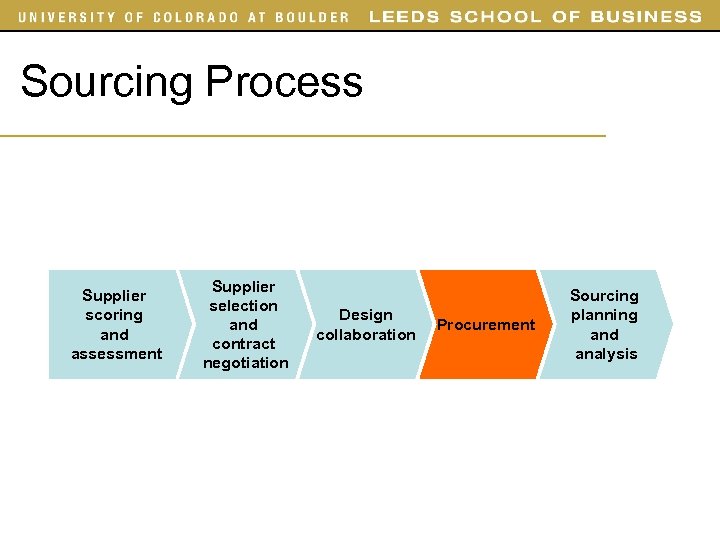
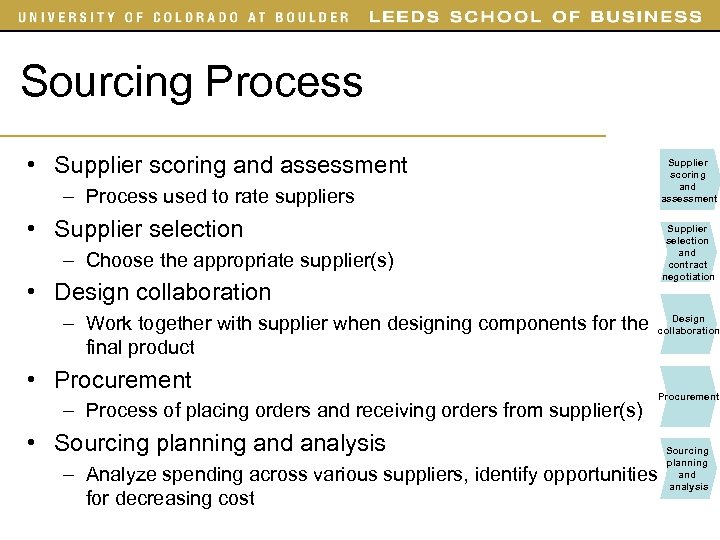 Sourcing Process • Supplier scoring and assessment – Process used to rate suppliers • Supplier selection and contract negotiation – Choose the appropriate supplier(s) • Design collaboration – Work together with supplier when designing components for the final product • Procurement – Process of placing orders and receiving orders from supplier(s) Design collaboration Procurement • Sourcing planning and analysis – Analyze spending across various suppliers, identify opportunities for decreasing cost Sourcing planning and analysis
 Sourcing Process Supplier scoring and assessment Supplier selection and contract negotiation Design collaboration Procurement Sourcing planning and analysis
 Supplier scoring and assessment • Common fundamental mistake when choosing a supplier – Only focus on quoted price Supplier performance should be compared on the basis of the supplier’s impact on total cost
 Factors besides purchase price that influence total cost • Replenishment lead times – Does it pay to select a more expensive supplier with a shorter lead time? – If lead time grows, safety inventory grows proportionally to the square root of the replenishment lead time • On-time performance – Is a more reliable supplier worth the extra pennies? – If variability of lead time grows, the required safety inventory at the firm grows
 Factors besides purchase price that influence total cost • Supply flexibility – The less flexible a supplier is, the more lead-time variability it will display as order quantities change • Delivery frequency/lot size – Delivery frequency affects the transportation cost, lot size affects the cycle inventory holding cost • Supply quality – Quality affects unit price and lead time as follow-up orders may need to be fulfilled to replace defective products • Inbound transportation cost – Sourcing a product overseas may have lower product cost, but generally incurs a higher inbound transportation cost
 Factors besides purchase price that influence total cost • Pricing terms – For example, quantity discounts (and the impact it has on cycle inventory) • Information coordination capability – Good coordination results in better planning and ultimately lower production, safety inventory, and transportation cost • Exchange rates, taxes, and duties – Important for global supply chains as it affects the unit price • Supplier viability – The likelihood that the supplier will be around to fulfill the promises it makes (uncertainty increases safety inventory) • Design collaboration capability – Can help reduce all cost, improve quality, and decrease time-tomarket
 Sourcing Process Supplier scoring and assessment Supplier selection and contract negotiation Design collaboration Procurement Sourcing planning and analysis
 Design Collaboration • 50 -70% of spending at a manufacturer is through procurement – Compared to only about 20% several decades ago • 80% of the cost of a purchased part is fixed in the design phase • Design collaboration with suppliers can result in reduced cost, improved quality, and decreased time to market
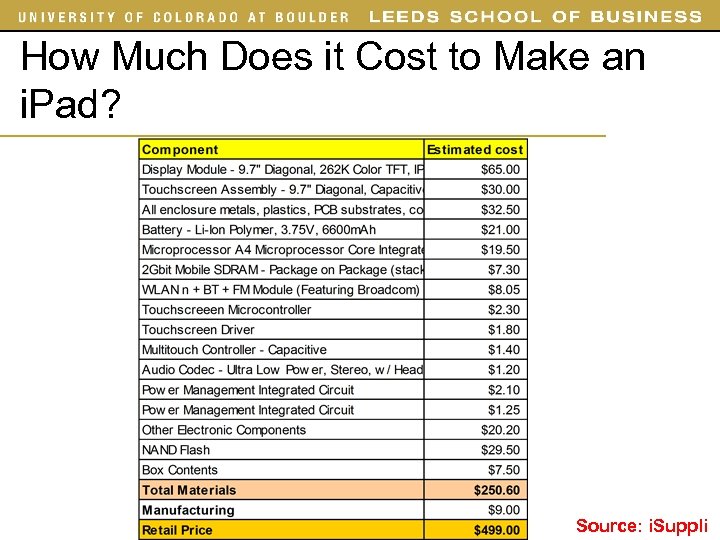 How Much Does it Cost to Make an i. Pad? Source: i. Suppli
 Supply Chain Top 25, 2009
 Design Collaboration • Design for logistics – Attempts to reduce transportation, handling, and inventory cost – Coors redesigned glass bottle reduced transportation cost • Design for manufacturability – Attempts to design products for ease of manufacture (part commonality, designing symmetrical parts, designing parts to provide access for catalog parts)
 Sourcing Process Supplier scoring and assessment Supplier selection and contract negotiation Design collaboration Procurement Sourcing planning and analysis
 Contracts and Supply Chain Performance • Many shortcomings in supply chain performance occur because the buyer and supplier each try to optimize their own profits – Total supply chain profits might therefore be lower than if the supply chain coordinated actions to have a common objective of maximizing total supply chain profits – Double marginalization results in suboptimal order quantity – The supplier must share in some of the buyer’s demand uncertainty • A contract should be structured to increase the firm’s profits and supply chain profits
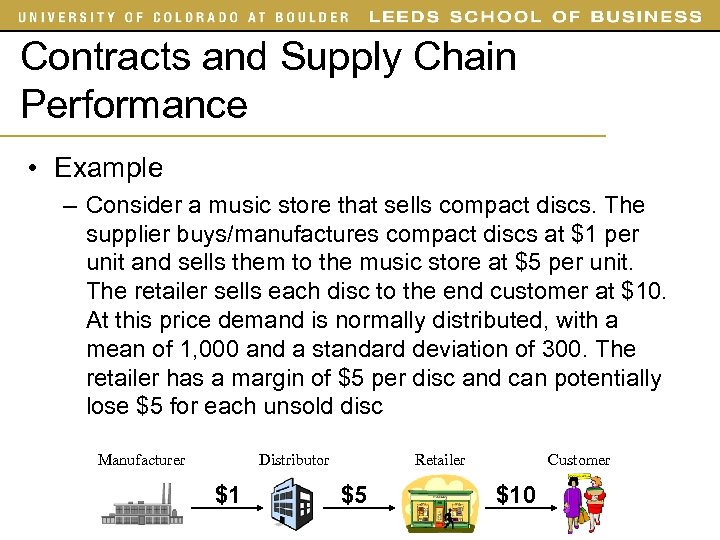 Contracts and Supply Chain Performance • Example – Consider a music store that sells compact discs. The supplier buys/manufactures compact discs at $1 per unit and sells them to the music store at $5 per unit. The retailer sells each disc to the end customer at $10. At this price demand is normally distributed, with a mean of 1, 000 and a standard deviation of 300. The retailer has a margin of $5 per disc and can potentially lose $5 for each unsold disc Manufacturer Distributor $1 Retailer $5 Customer $10
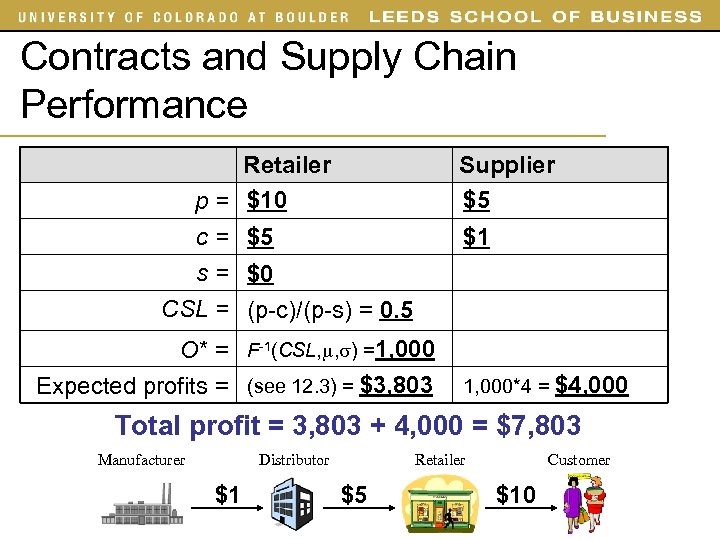 Contracts and Supply Chain Performance Retailer p = $10 c = $5 s = $0 Supplier $5 $1 CSL = (p-c)/(p-s) = 0. 5 O* = F-1(CSL, , ) =1, 000 Expected profits = (see 12. 3) = $3, 803 1, 000*4 = $4, 000 Total profit = 3, 803 + 4, 000 = $7, 803 Manufacturer Distributor $1 Retailer $5 Customer $10
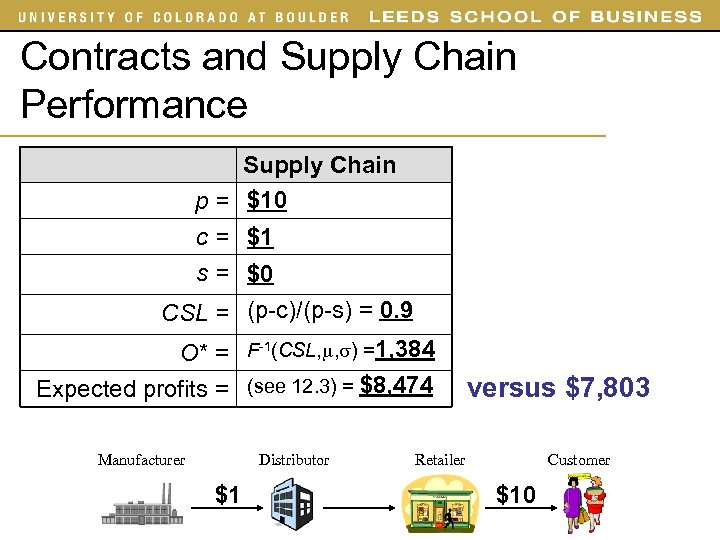 Contracts and Supply Chain Performance Supply Chain p = $10 c = $1 s = $0 CSL = (p-c)/(p-s) = 0. 9 O* = F-1(CSL, , ) =1, 384 Expected profits = (see 12. 3) = $8, 474 Manufacturer Distributor $1 versus $7, 803 Retailer Customer $10
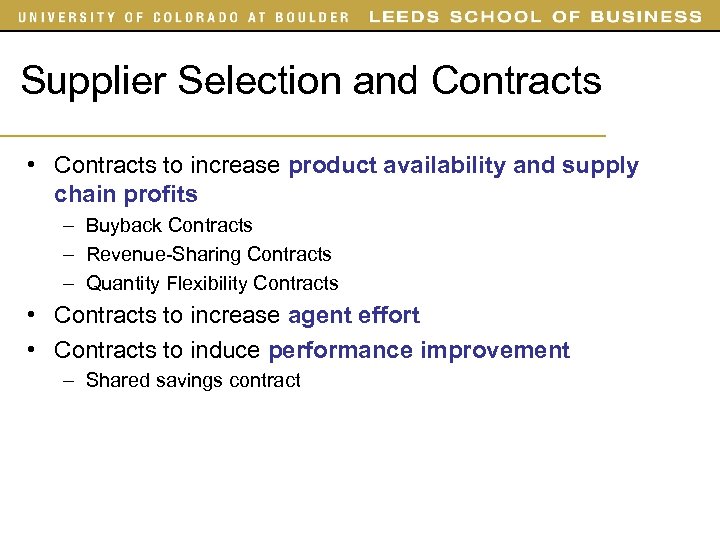 Supplier Selection and Contracts • Contracts to increase product availability and supply chain profits – Buyback Contracts – Revenue-Sharing Contracts – Quantity Flexibility Contracts • Contracts to increase agent effort • Contracts to induce performance improvement – Shared savings contract
 Buyback Contracts • Allows a retailer to return unsold inventory up to a specified amount at an agreed upon price • Increases the optimal order quantity for the retailer, resulting in higher product availability and higher profits for both the retailer and the supplier
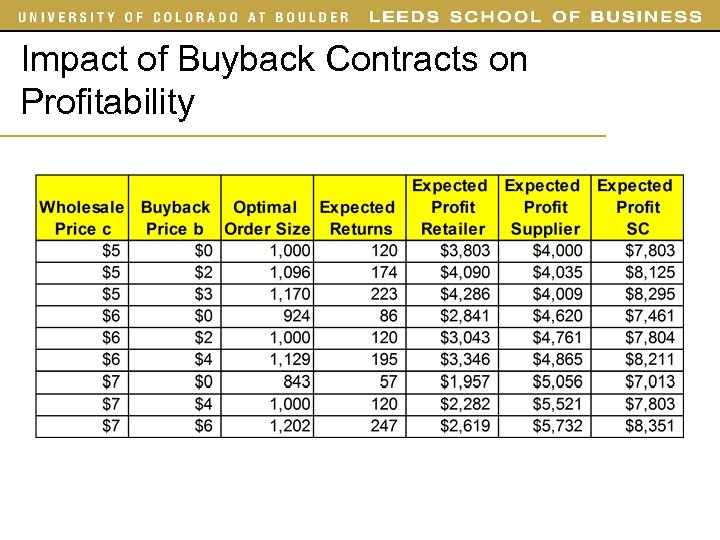 Impact of Buyback Contracts on Profitability
 Buyback Contracts • Downsides that buyback contract results in – Surplus inventory for the supplier that must be disposed of, which increases supply chain costs – Misleading for the supply chain as it reacts to (inflated) retail orders, not actual customer demand • Most effective for products with low variable cost, such as music, software, books, magazines, and newspapers so that the supplier can keep the surplus
 Revenue Sharing Contracts • The buyer pays a minimal amount for each unit purchased from the supplier but shares a fraction of the revenue for each unit sold
 Blockbuster (1998) • Blockbuster purchases a copy from a studio for $60 and rents for $3 – Blockbuster must rent the tape at least 20 times before earning profit – In 1998, 20% of surveyed customers reported that they could not rent the movie they wanted because the Blockbuster did not have that movie • In 1998, Blockbuster started revenue sharing with the major movie studios – Blockbuster pays the wholesale price of $9 per copy. – Blockbuster shares (1 -θ) =30 -45% portion of the revenue with the movie studio • The impact of revenue sharing on Blockbuster was dramatic – Rentals increased by 75% in test markets due to higher video availability
 Netflix • Blockbuster owns its DVDs • Netflix has established revenue sharing contracts with most studios – DVDs are purchased at cost – Netflix pays on average $1. 40 to the studios each time their title is rent – At end of contract Netflix acquires some percentages of the units for retention or sale, the remaining DVDs are destroyed or returned to the original studio
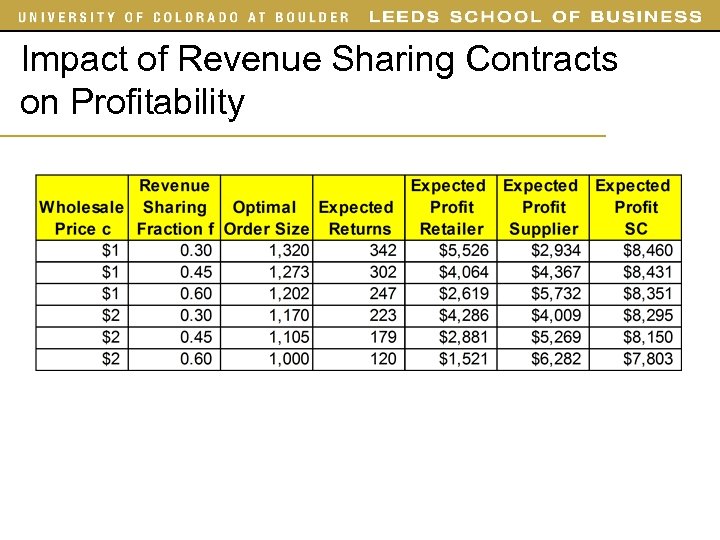 Impact of Revenue Sharing Contracts on Profitability
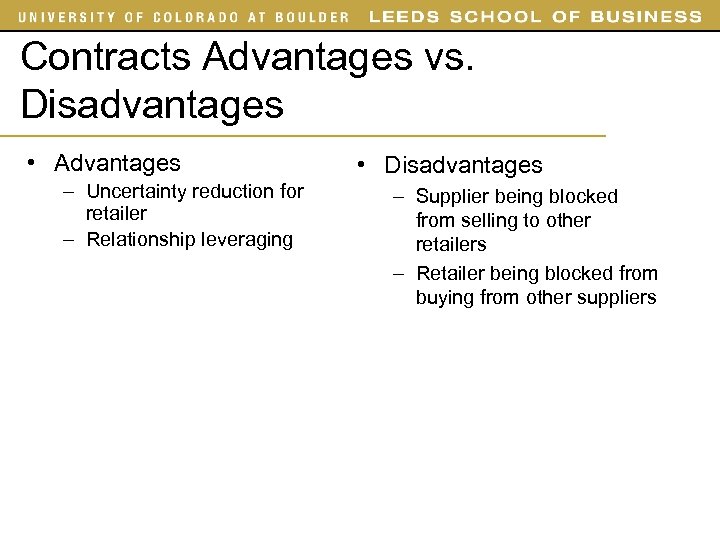 Contracts Advantages vs. Disadvantages • Advantages – Uncertainty reduction for retailer – Relationship leveraging • Disadvantages – Supplier being blocked from selling to other retailers – Retailer being blocked from buying from other suppliers
 Sourcing Process Supplier scoring and assessment Supplier selection and contract negotiation Design collaboration Procurement Sourcing planning and analysis
 Procurement • Procurement transactions begin with the buyer placing the order and end with the buyer receiving and paying for the order – Goal is to enable orders to be placed and delivered on schedule at the lowest possible overall cost • Two main categories of purchased goods: – Direct materials: components used to make finished goods • Memory, hard drives, and CD drives are direct materials for a PC – Indirect materials: goods used to support the operations of a firm • PCs are indirect materials for a car manufacturer
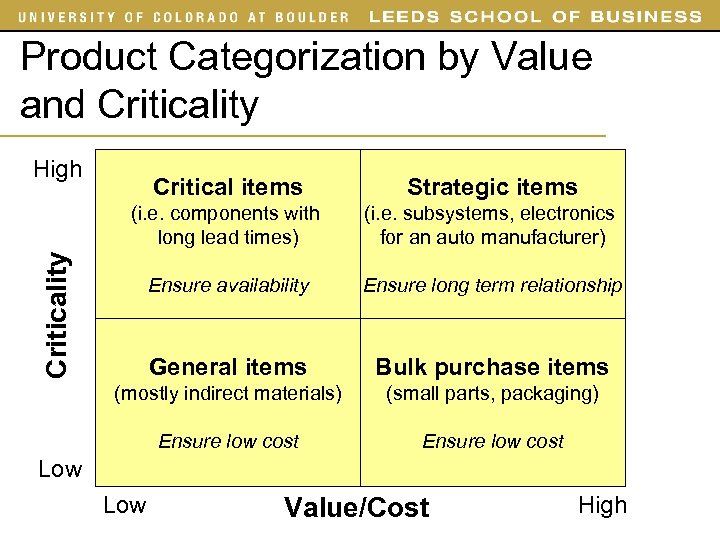 Product Categorization by Value and Criticality High Strategic items (i. e. components with long lead times) (i. e. subsystems, electronics for an auto manufacturer) Ensure availability Ensure long term relationship General items Bulk purchase items (mostly indirect materials) (small parts, packaging) Ensure low cost Criticality Critical items Low Value/Cost High
 Outsourcing at Darden Restaurants, owner of popular brands such as Olive Garden and Red Lobster, serves more than 300 million meals annually in over 1, 700 restaurants across the US and Canada. To achieve competitive advantage via its supply chain, Darden must achieve excellence at each step. With purchases from 35 countries, and seafood products with a shelf life as short as 4 days, this is a complex and challenging task. Those 300 million meals annually mean 40 million pounds of shrimp and huge quantities of tilapia, swordfish, and other fresh purchases. What are outsourcing opportunities in a restaurant?