


 Скачать презентацию Supply Chain Management Chapter 1 Understanding the Supply
bde2ac044608069f3044add96fc7ee25.ppt
- Количество слайдов: 72
 Supply Chain Management Chapter 1 Understanding the Supply Chain 1
 Office Hours n n n By appointment. Office 2220 E-mail No HW/technical questions m_othman@najah. edu
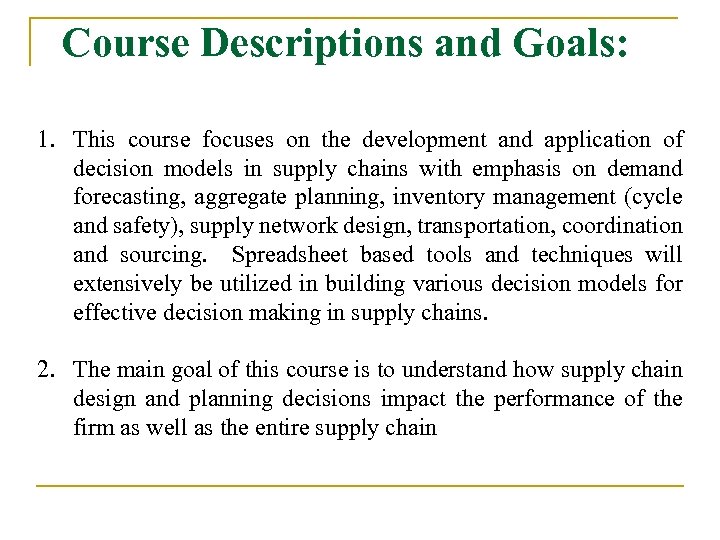 Course Descriptions and Goals: 1. This course focuses on the development and application of decision models in supply chains with emphasis on demand forecasting, aggregate planning, inventory management (cycle and safety), supply network design, transportation, coordination and sourcing. Spreadsheet based tools and techniques will extensively be utilized in building various decision models for effective decision making in supply chains. 2. The main goal of this course is to understand how supply chain design and planning decisions impact the performance of the firm as well as the entire supply chain
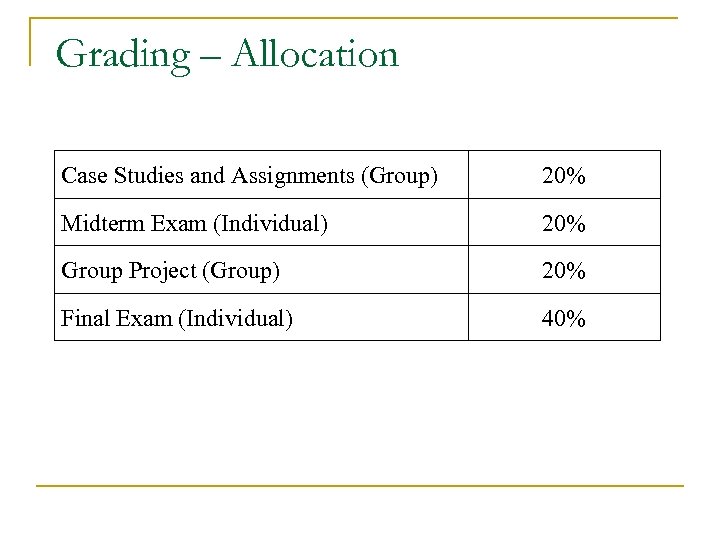 Grading – Allocation Case Studies and Assignments (Group) 20% Midterm Exam (Individual) 20% Group Project (Group) 20% Final Exam (Individual) 40%
 Classroom Rules Turn off cell phones and other communication devices No completing homework or other assignments Use common sense and be considerate of others Notify instructor when absent from class as soon as possible §Before or after the fact §Justifiable reason
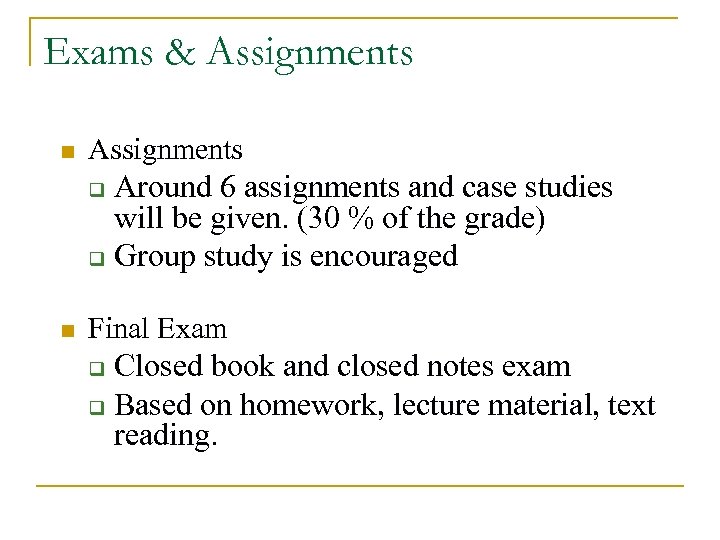 Exams & Assignments n Assignments Around 6 assignments and case studies will be given. (30 % of the grade) q Group study is encouraged q n Final Exam Closed book and closed notes exam q Based on homework, lecture material, text reading. q
 Ok, shall we start now!
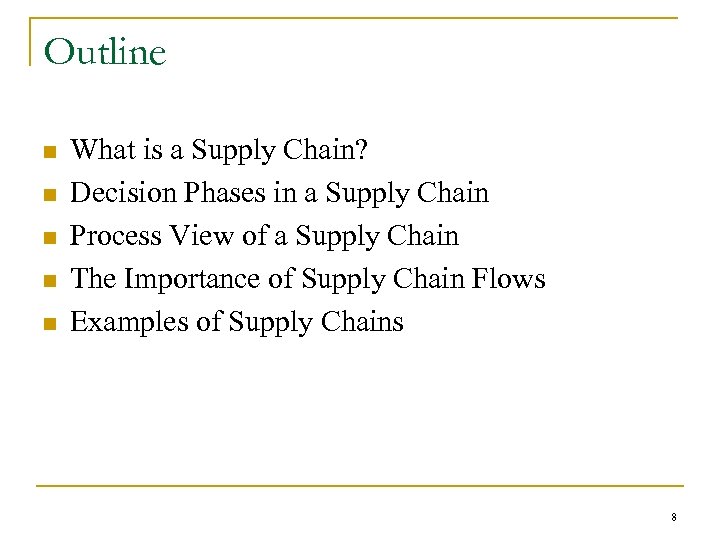 Outline n n n What is a Supply Chain? Decision Phases in a Supply Chain Process View of a Supply Chain The Importance of Supply Chain Flows Examples of Supply Chains 8
 9
9
 10
10
 11
11
 12
12
 13
13
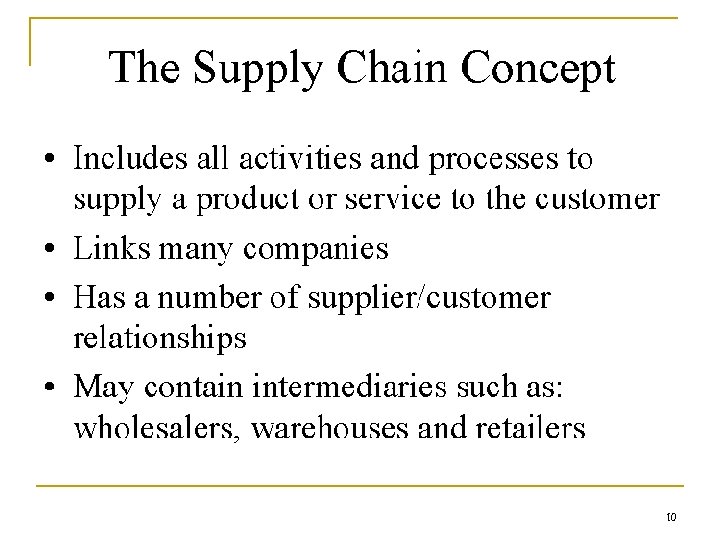
 Supply Chains n Networks of manufacturers and service providers that work together to move goods from the raw material stage through to the end user n Linked through physical, information, and monetary flows
 What is a Supply Chain? n All stages involved, directly or indirectly, in fulfilling a customer request n Includes manufacturers, suppliers, transporters, warehouses, retailers, customers n Within each company, the supply chain includes all functions involved in fulfilling a customer request (product development, marketing, operations, distribution, finance, customer service) 15
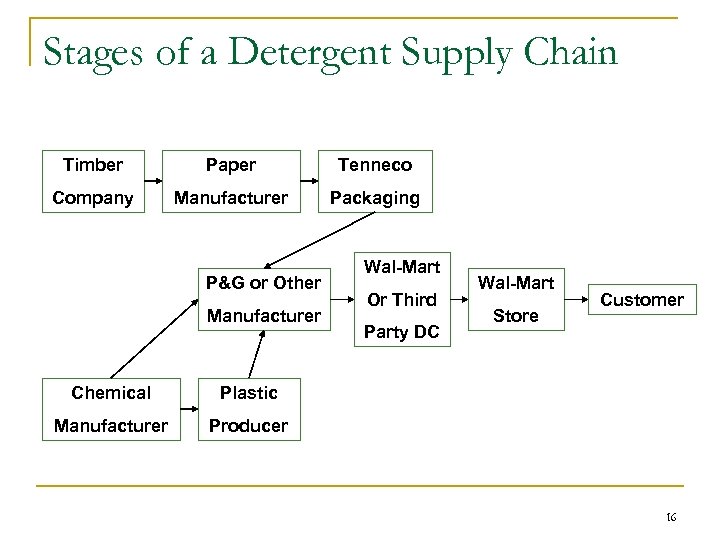 Stages of a Detergent Supply Chain Timber Paper Tenneco Company Manufacturer Packaging P&G or Other Manufacturer Chemical Or Third Party DC Wal-Mart Store Customer Plastic Manufacturer Wal-Mart Producer 16
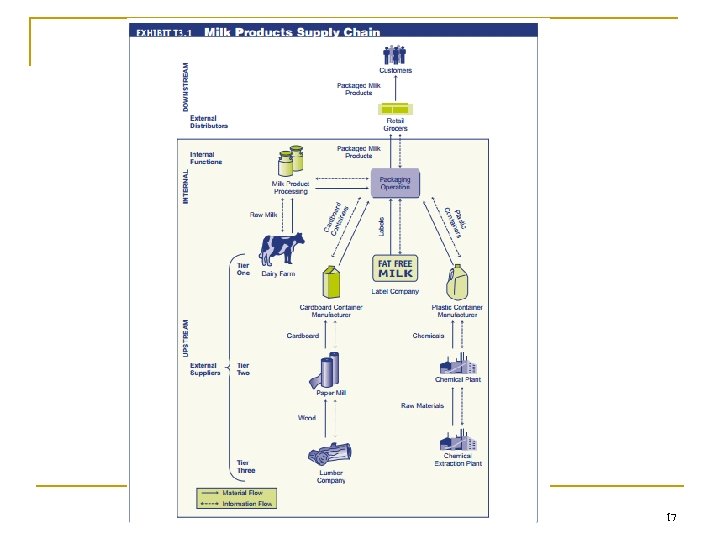 17
17
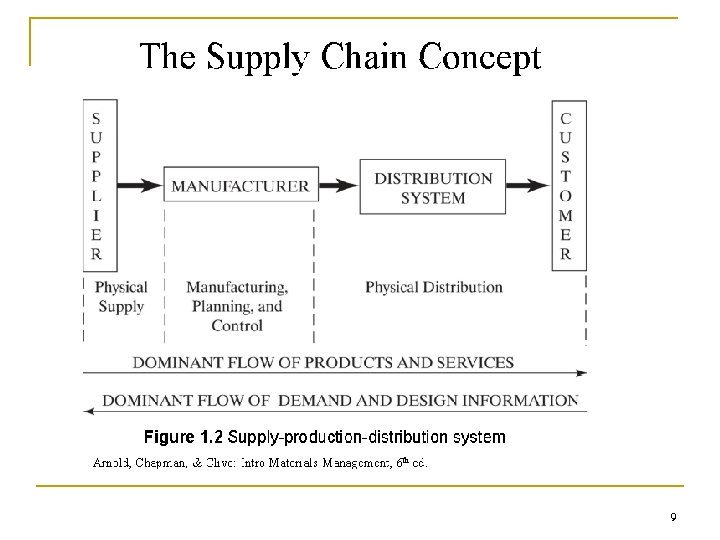
 What is a Supply Chain? n n n Customer is an integral part of the supply chain Includes movement of products from suppliers to manufacturers to distributors, but also includes movement of information, funds, and products in both directions Probably more accurate to use the term “supply network” or “supply web” Typical supply chain stages: customers, retailers, distributors, manufacturers, suppliers (Fig. 1. 2) All stages may not be present in all supply chains (e. g. , no retailer or distributor for Dell) 18
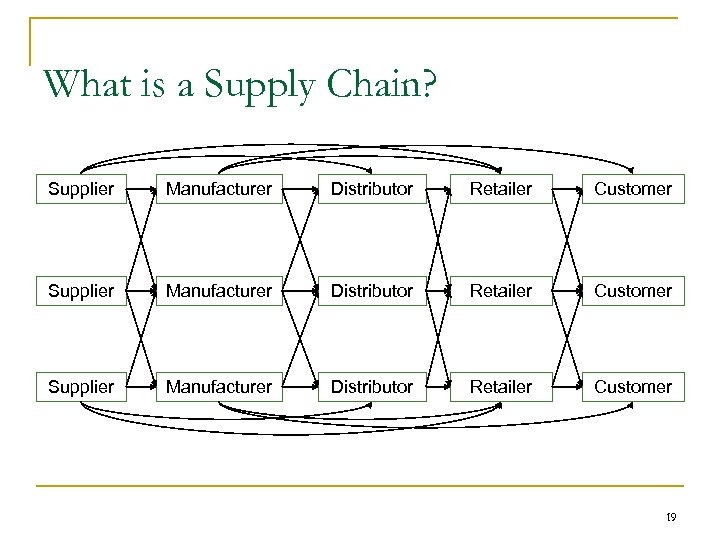 What is a Supply Chain? Supplier Manufacturer Distributor Retailer Customer 19
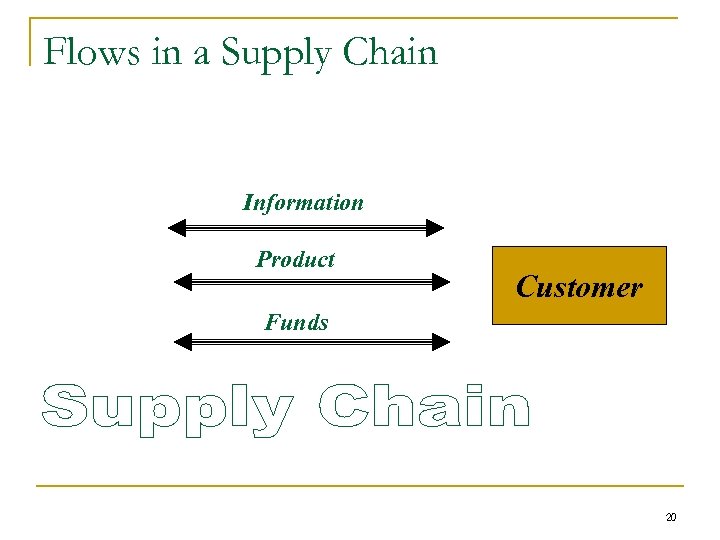 Flows in a Supply Chain Information Product Customer Funds 20
 Dell Computer n Customer ---Dell’s web site --- Dell assembly plant -- Dell’s suppliers n Website provides the customer with information regarding pricing, product variety and product availability n Customer can enter the order, pay for the product and check the status of the order 21
 The Objective of a Supply Chain n Maximize overall value created Supply chain value: difference between what the final product is worth to the customer and the effort the supply chain expends in filling the customer’s request Value is correlated to supply chain profitability q difference between revenue generated from the customer and the overall cost across the supply chain 22
 The Objective of a Supply Chain n n Example: Dell receives $2000 from a customer for a computer (revenue) Supply chain incurs costs (information, storage, transportation, components, assembly, etc. ) Difference between $2000 and the sum of all of these costs is the supply chain profit Supply chain profitability is total profit to be shared across all stages of the supply chain Supply chain success should be measured by total supply chain profitability, not profits at an individual stage 23
 The Objective of a Supply Chain n Sources of supply chain revenue: the customer n Sources of supply chain cost: flows of information, products, or funds between stages of the supply chain Supply chain management is the management of flows between and among supply chain stages to maximize total supply chain profitability n 24
 Key Point n Supply chain design, planning, and operation decisions play a significant role in the success or failure of a firm. 25
 Video!! 26
 Decision Phases in a Supply Chain SC decision phases may be categorized as (depending on the time frame during which the decisions made apply) n Supply chain strategy or design (Plant Location) n Supply chain planning (Aggregate Planning) n Supply chain operation (Shipments Scheduling) 27
 Supply Chain Strategy or Design n n Decisions about the structure of the supply chain and what processes each stage will perform Strategic supply chain decisions q q n n Locations and capacities of facilities Products to be made or stored at various locations Modes of transportation Information systems Supply chain design must support strategic objectives Supply chain design decisions are long-term and expensive to reverse – must take into account market uncertainty 28
 Supply Chain Planning n n n Definition of a set of policies that govern shortterm operations Fixed by the supply configuration from previous phase Starts with a forecast of demand in the coming year 29
 Supply Chain Planning decisions: q q q n Which markets will be supplied from which locations Planned buildup of inventories Subcontracting, backup locations Inventory policies Timing and size of market promotions Must consider in planning decisions demand uncertainty, exchange rates, competition over the time horizon 30
 Supply Chain Operation n n n Time horizon is weekly or daily Decisions regarding individual customer orders Supply chain configuration is fixed and operating policies are determined Goal is to implement the operating policies as effectively as possible Allocate orders to inventory or production, set order due dates, generate pick lists at a warehouse, allocate an order to a particular shipment, set delivery schedules, place replenishment orders Much less uncertainty (short time horizon) 31
 The Importance of Supply Chain Flows n n Close connection between design and management of supply chain flows (product, information, and cash) and supply chain success Wal-Mart, Amazon, Seven-Eleven Japan, and Dell: success Webvan, Kozmo: failure Supply chain decisions can play a significant role in the success or failure of a firm 32
 Process View of a Supply Chain n Cycle view: processes in a supply chain are divided into a series of cycles, each performed at the interfaces between two successive supply chain stages n Push/pull view: processes in a supply chain are divided into two categories depending on whether they are executed in response to a customer order (pull) or in anticipation of a customer order (push) 33
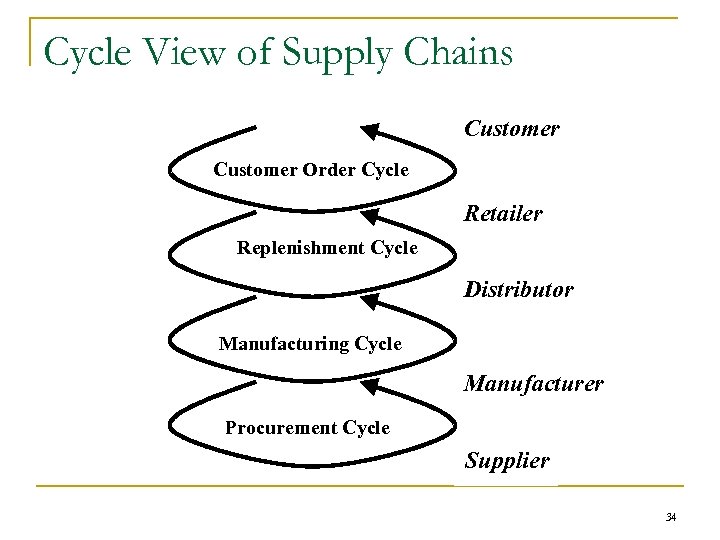 Cycle View of Supply Chains Customer Order Cycle Retailer Replenishment Cycle Distributor Manufacturing Cycle Manufacturer Procurement Cycle Supplier 34
 Cycle View of a Supply Chain n n n Each cycle occurs at the interface between two successive stages Customer order cycle (customer-retailer) Replenishment cycle (retailer-distributor) Manufacturing cycle (distributor-manufacturer) Procurement cycle (manufacturer-supplier) Cycle view clearly defines processes involved and the owners of each process. Specifies the roles and responsibilities of each member and the desired outcome of each process. 35
 Customer Order Cycle n Involves all processes directly involved in receiving and filling the customer’s order n Customer arrival Customer order entry Customer order fulfillment Customer order receiving n n n 36
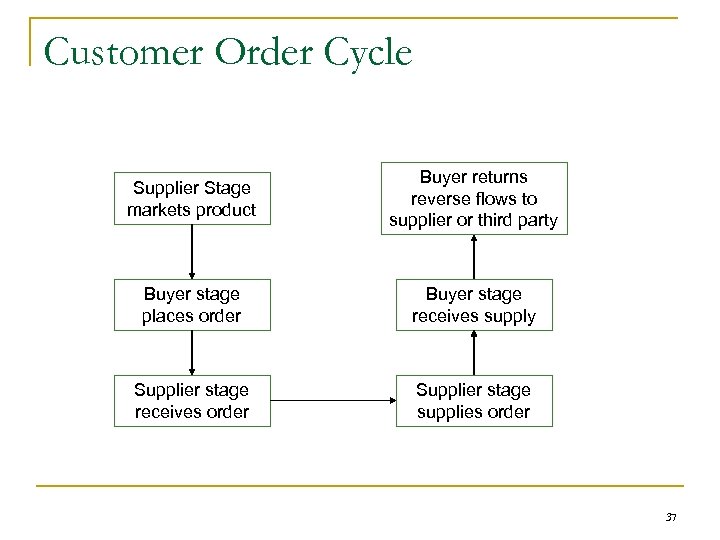 Customer Order Cycle Supplier Stage markets product Buyer returns reverse flows to supplier or third party Buyer stage places order Buyer stage receives supply Supplier stage receives order Supplier stage supplies order 37
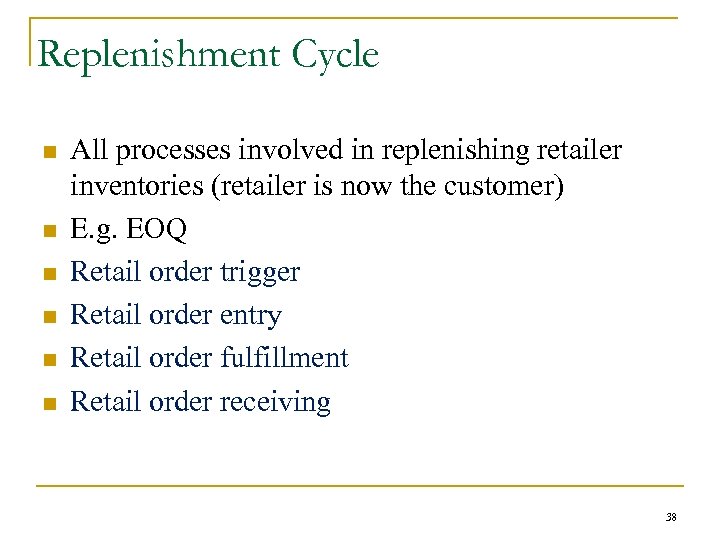 Replenishment Cycle n n n All processes involved in replenishing retailer inventories (retailer is now the customer) E. g. EOQ Retail order trigger Retail order entry Retail order fulfillment Retail order receiving 38
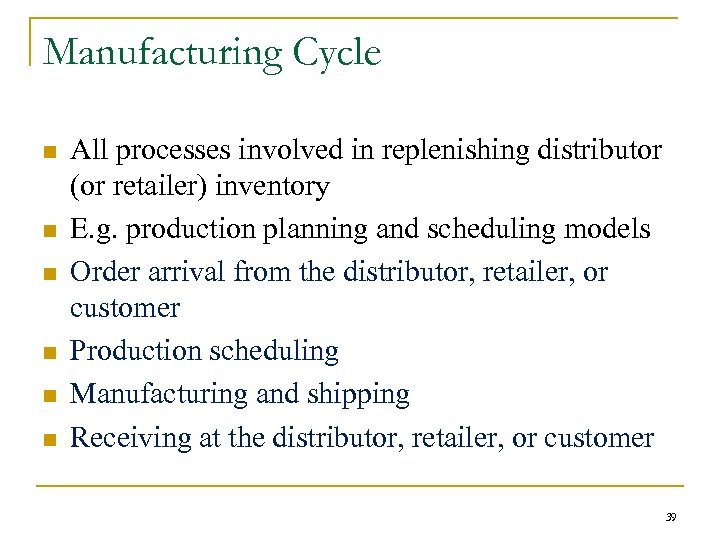 Manufacturing Cycle n n n All processes involved in replenishing distributor (or retailer) inventory E. g. production planning and scheduling models Order arrival from the distributor, retailer, or customer Production scheduling Manufacturing and shipping Receiving at the distributor, retailer, or customer 39
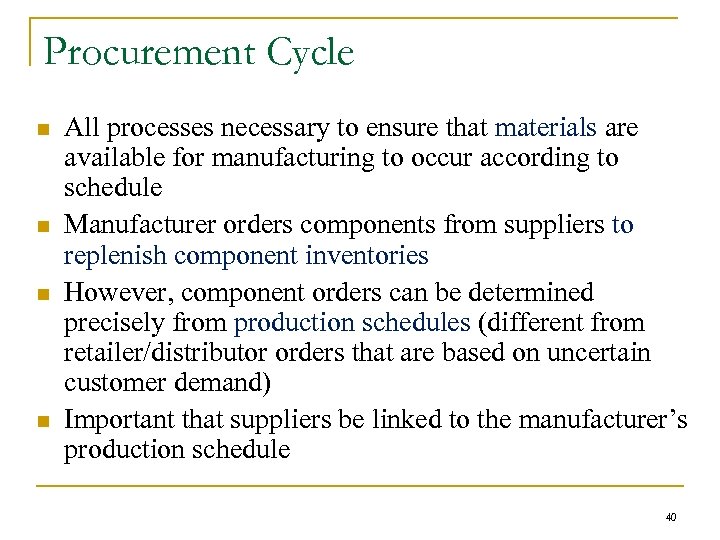 Procurement Cycle n n All processes necessary to ensure that materials are available for manufacturing to occur according to schedule Manufacturer orders components from suppliers to replenish component inventories However, component orders can be determined precisely from production schedules (different from retailer/distributor orders that are based on uncertain customer demand) Important that suppliers be linked to the manufacturer’s production schedule 40
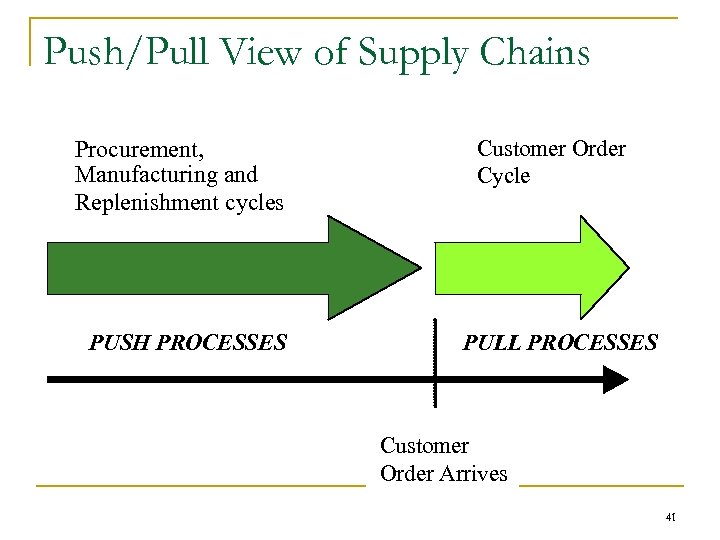 Push/Pull View of Supply Chains Procurement, Manufacturing and Replenishment cycles PUSH PROCESSES Customer Order Cycle PULL PROCESSES Customer Order Arrives 41
 Push/Pull View of Supply Chain Processes n n Supply chain processes fall into one of two categories depending on the timing of their execution relative to customer demand Pull: execution is initiated in response to a customer order (reactive) Push: execution is initiated in anticipation of customer orders (speculative) Push/pull boundary separates push processes from pull processes 42
 Push/Pull View of Supply Chain Processes n n Useful in considering strategic decisions relating to supply chain design – more global view of how supply chain processes relate to customer orders Can combine the push/pull and cycle views q q n n L. L. Bean Dell The relative proportion of push and pull processes can have an impact on supply chain performance Example, the paint industry 43
 Key point n A push/pull view of the supply chain categorizes processes based on whether they are initiated in response to a customer order (pull) or in anticipation of a customer order (push). n This view is very useful when considering strategic decision relating to supply chain design. 44
 Supply Chain in a Firm n All supply chain processes can be classified into q q q n Customer relationship management (CRM) Internal supply chain management (ISCM) Supplier relationship management (SRM) The three macro processes manage the flow of information, product, and funds required to generate, receive, and fulfill a customer request. 45
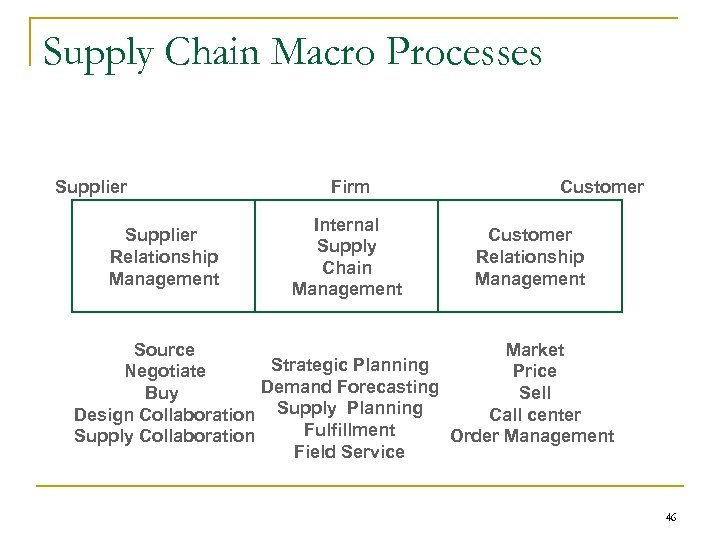 Supply Chain Macro Processes Supplier Relationship Management Firm Internal Supply Chain Management Customer Relationship Management Source Market Strategic Planning Negotiate Price Demand Forecasting Buy Sell Design Collaboration Supply Planning Call center Fulfillment Supply Collaboration Order Management Field Service 46
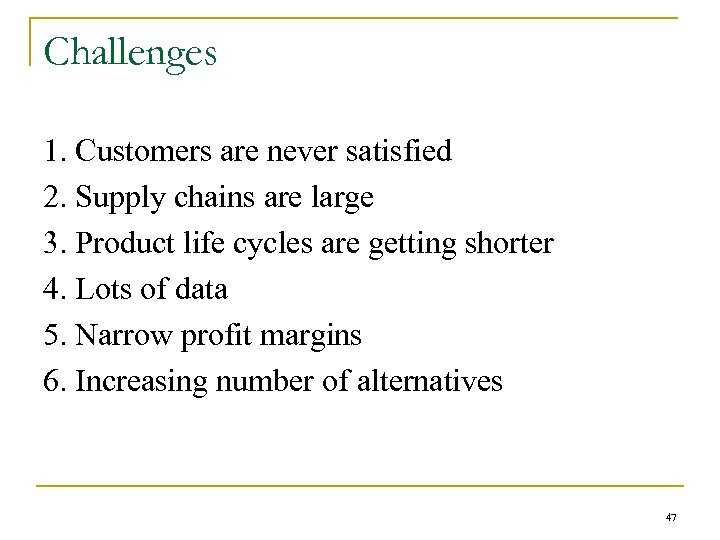 Challenges 1. Customers are never satisfied 2. Supply chains are large 3. Product life cycles are getting shorter 4. Lots of data 5. Narrow profit margins 6. Increasing number of alternatives 47
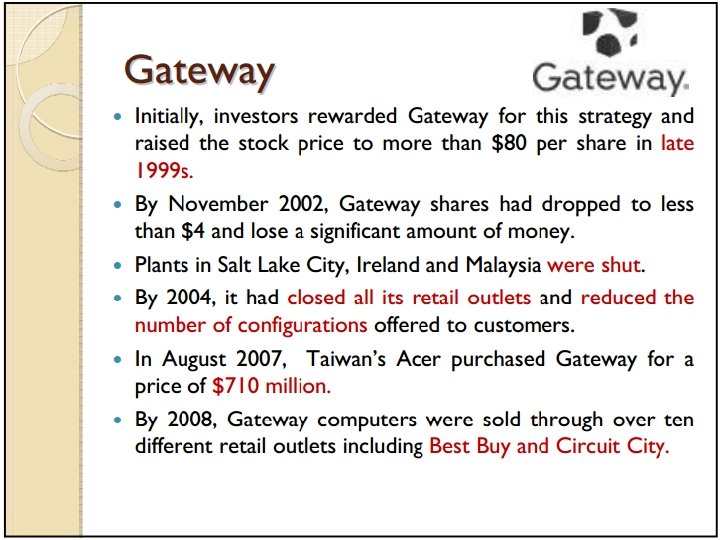
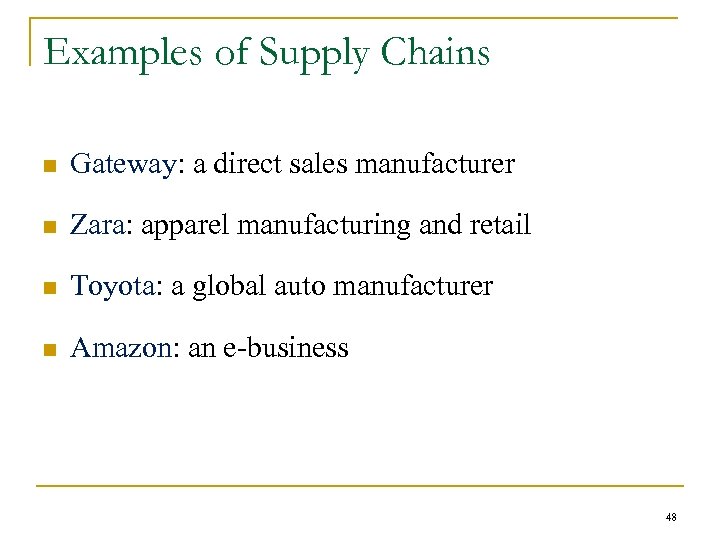 Examples of Supply Chains n Gateway: a direct sales manufacturer n Zara: apparel manufacturing and retail n Toyota: a global auto manufacturer n Amazon: an e-business 48
 49
49
 50
50
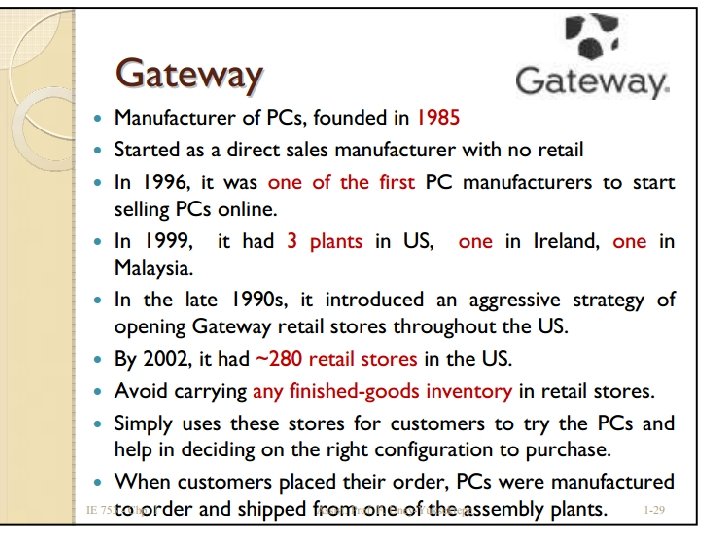
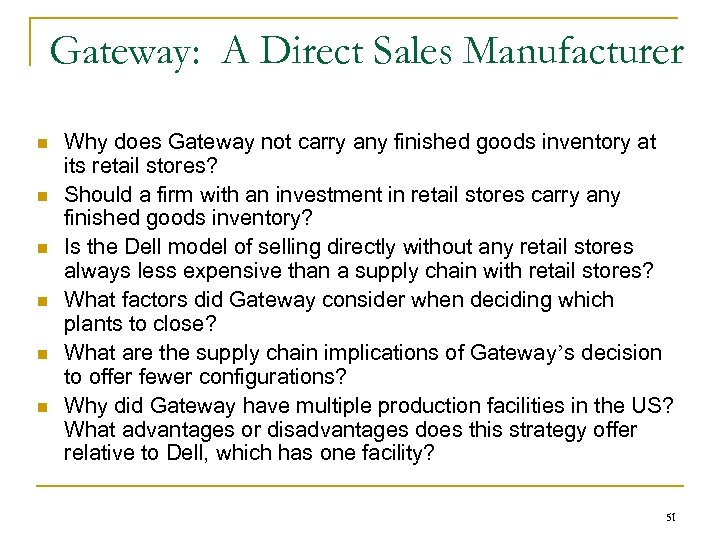 Gateway: A Direct Sales Manufacturer n n n Why does Gateway not carry any finished goods inventory at its retail stores? Should a firm with an investment in retail stores carry any finished goods inventory? Is the Dell model of selling directly without any retail stores always less expensive than a supply chain with retail stores? What factors did Gateway consider when deciding which plants to close? What are the supply chain implications of Gateway’s decision to offer fewer configurations? Why did Gateway have multiple production facilities in the US? What advantages or disadvantages does this strategy offer relative to Dell, which has one facility? 51
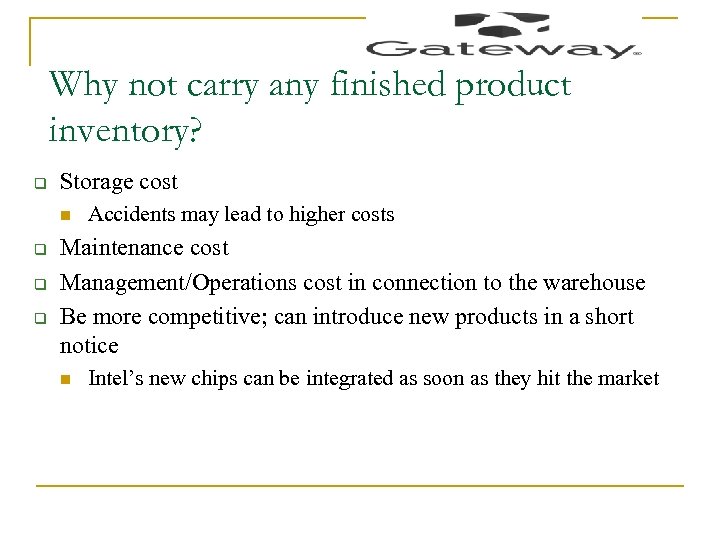 Why not carry any finished product inventory? q Storage cost n q q q Accidents may lead to higher costs Maintenance cost Management/Operations cost in connection to the warehouse Be more competitive; can introduce new products in a short notice n Intel’s new chips can be integrated as soon as they hit the market
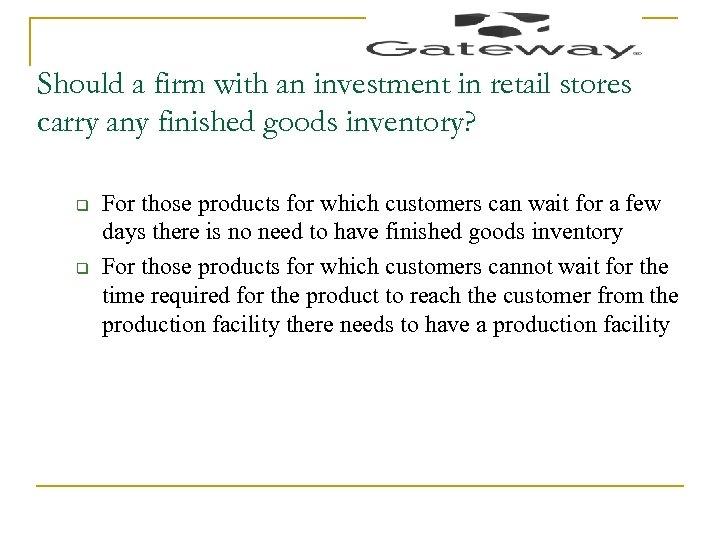 Should a firm with an investment in retail stores carry any finished goods inventory? q q For those products for which customers can wait for a few days there is no need to have finished goods inventory For those products for which customers cannot wait for the time required for the product to reach the customer from the production facility there needs to have a production facility
 Characteristics of products that are most suitable to be carried in finished goods inventory q q q Nonperishable goods can only be stored Goods that have least possible storage cost Goods that have fluctuating/seasonal demand n q Retailers store goods that have stable demand in the local market n q Where SCM systems are not adequate to have knowledge of the market demand Where there is a time gap between supply shipments from the manufacturer When there is a chance of the product price to increase
 Characterizes products that are best manufactured to order q q Where there is a demand from the customers for product customization If it’s possible to manufacture as per the customer’s demand; the production process needs to be cost effective
 Is the Dell model of selling directly without retails stores always less expensive than a supply chain with retail stores? ? ? q Generally n q In case of Customization; retail stores will incur higher cost for storage However, it is not necessarily more profitable: n If customer demand is higher for retails stores where they can check out the product first hand;
 Factors Considered When Deciding Which Plant to Close q Primary objective: Reduce overall cost and close loss making/costly production facilities n n When market demand reduces or shifts to other substitutes, whichever factory caters that market will be the first one to go Wherever raw material is least available/transportation is costly Whichever facility requires higher transportation cost Whichever factory has higher production cost q q Least available workforce/costly manpower Power/Energy costs
 What are the supply chain implications of Gateway’s decision to offer fewer configurations? ? ? q Supplier n n q Internal Supply Chain: Transport of components within the factory is much less complex n n q Suppliers needs to send fewer varieties of components Management/Operational complexity/costs reduces Retailers/Dealers: n n Suppliers needs to send fewer varieties of components Management/Operational complexity/costs reduces
 Why Multiple Production Facilities? ? ? q q q Reach the local markets Increase production facilities to meet the higher local demand Locate in low wage areas Near parts suppliers Avoid higher tax areas/states
 Toyota n n n Where should plants be located, what degree of flexibility should each have, and what capacity should each have? Should plants be able to produce for all markets? How should markets be allocated to plants? What kind of flexibility should be built into the distribution system? How should this flexible investment be valued? What actions may be taken during product design to facilitate this flexibility? 60
 About Toyota n n n 7 th largest company in the world. 2 nd largest manufacturer of automobiles. Production facilities in 28 nations around the world. Toyota has 52 overseas manufacturing companies in 27 countries outside Japan Toyota markets vehicles in more than 170 regions
 Question 1 Where should the plants be located and what degree of flexibility should be built into each? What capacity should each plant have? Ø Apply its “global complementation” strategy to its part plants Ø Each plant should be designed with the capacity to supply its regional factories
 Question 2 Should plants be able to produce for all markets or only specific contingency markets? Ø Flexibility to supply other markets when their local market demand is weakened Ø Plants must be able to supply at least one more market/region
 Question 3 How should markets be allocated to plants and how frequently should this allocation be revised? n Standard allocation should be optimized during the planning phase n Adjusted when necessary, reviewed either annually or bi-annually
 Question 4 What kind of flexibility should be built into the distribution system? Ø Optimized regionally between the factories and their supplying parts plants Ø It will be necessary for cost effective distribution to occur between plants & factories to non-local markets
 Question 5 How should this flexible investment be valued? Ø Toyota to capture demand revenue from non-local markets Ø Toyota's supply chain will have greater access to markets and has the potential to capture greater value
 Question 6 What actions may be taken during product design to facilitate this flexibility? Ø Uniformity among global products for flexibility among markets Ø Product design engineers should craft elements that both maximize uniformity and satisfy local needs
 68
68
 69
69
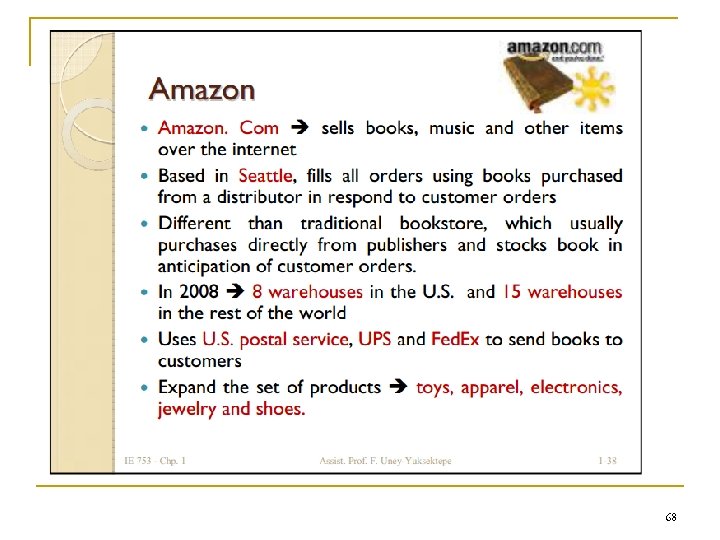
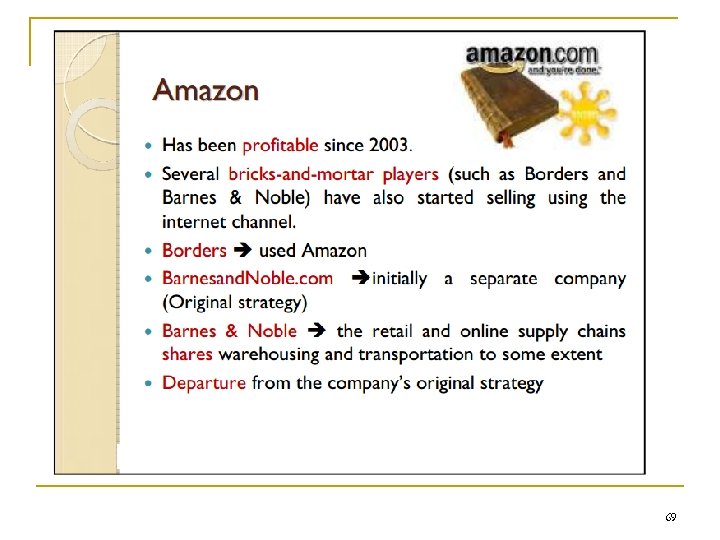
 Amazon. com n n n Why is Amazon building more warehouses as it grows? How many warehouses should it have and where should they be located? What advantages does selling books via the Internet provide? Are there disadvantages? Should Amazon stock every product it sells? 70
 Operations and Supply Chain Management and You Some of the many career positions n n n Analyst Commodity Manager Customer Service Manager International Logistics Manager Logistics Services Salesperson Production Manager n n n n Sourcing Analyst Logistics and Material Planner Systems Support Manager (MIS) Transportation Manager Process Analyst Scheduler Purchasing Agent Chapter 1, Slide 71
 Summary of Learning Objectives n n What are the cycle and push/pull views of a supply chain? How can supply chain macro processes be classified? What are three key supply chain decision phases and what is the significance of each? What is the goal of a supply chain and what is the impact of supply chain decisions on the success of the firm? 72