


 Скачать презентацию Supplementary Training Modules on Good Manufacturing Practice Good
3243f1e0ffd9f23843916a989e0046b2.ppt
- Количество слайдов: 27
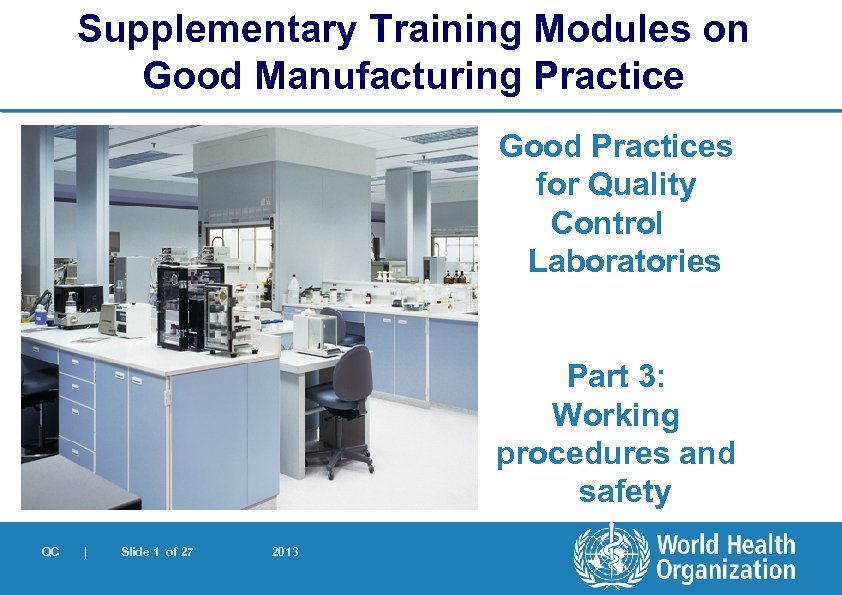 Supplementary Training Modules on Good Manufacturing Practice Good Practices for Quality Control Laboratories Part 3: Working procedures and safety QC | Slide 1 of 27 2013
 Quality Control Incoming samples l Sampling procedure and sampling plan l No mix-up or contamination during sampling l Representative of the batch (statistics? ) – See also WHO Guidelines on sampling l Records of sampling maintained l Ensure test request accompany sample, and appropriate tests will be used for analysis before testing starts 14. 4. , 14. 7. QC | Slide 2 of 27 2013
 Quality Control Test request form with a sample submitted for testing Contains information e. g. : l name of the person / sampler l source of the material; l description of the sample / material / product l dosage form, concentration or strength, batch number 14. 5. – 14. 6. l sample size QC | Slide 3 of 27 2013
 Quality Control Test request (2) l reason for analysis l date on which the sample was collected l size of the consignment from which it was taken l expiry date / retest date l specification to be used for testing l any other remarks or comments (e. g. discrepancies found or associated hazard) and storage conditions 14. 6. QC | Slide 4 of 27 2013
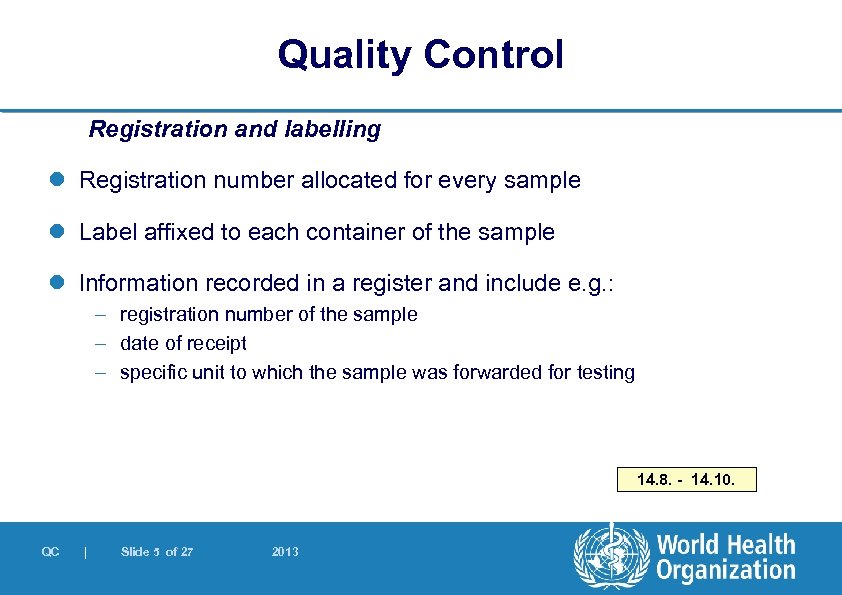 Quality Control Registration and labelling l Registration number allocated for every sample l Label affixed to each container of the sample l Information recorded in a register and include e. g. : – registration number of the sample – date of receipt – specific unit to which the sample was forwarded for testing 14. 8. - 14. 10. QC | Slide 5 of 27 2013
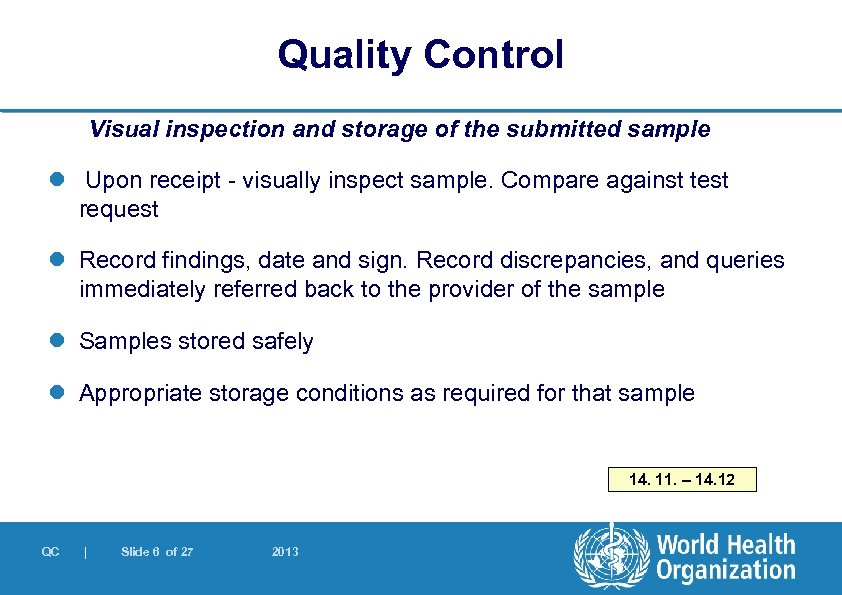 Quality Control Visual inspection and storage of the submitted sample l Upon receipt - visually inspect sample. Compare against test request l Record findings, date and sign. Record discrepancies, and queries immediately referred back to the provider of the sample l Samples stored safely l Appropriate storage conditions as required for that sample 14. 11. – 14. 12 QC | Slide 6 of 27 2013
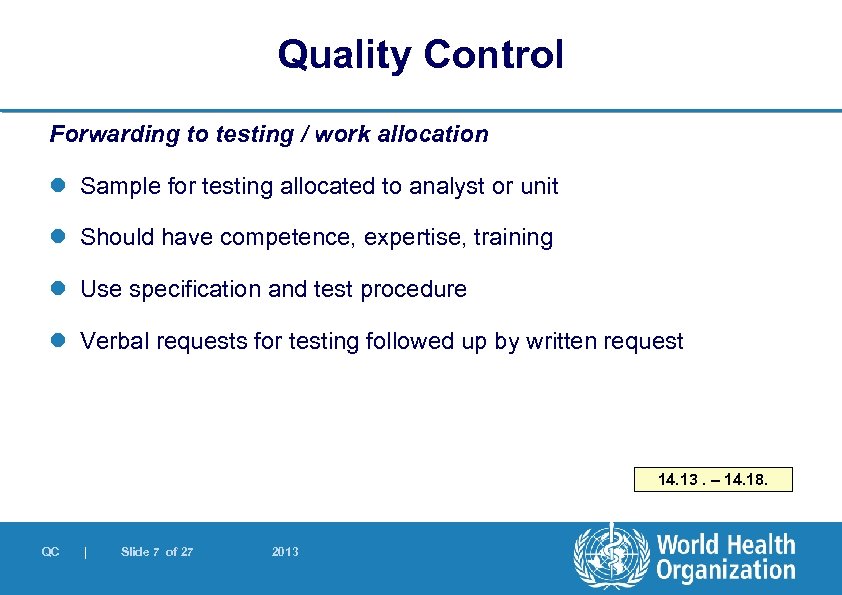 Quality Control Forwarding to testing / work allocation l Sample for testing allocated to analyst or unit l Should have competence, expertise, training l Use specification and test procedure l Verbal requests for testing followed up by written request 14. 13. – 14. 18. QC | Slide 7 of 27 2013
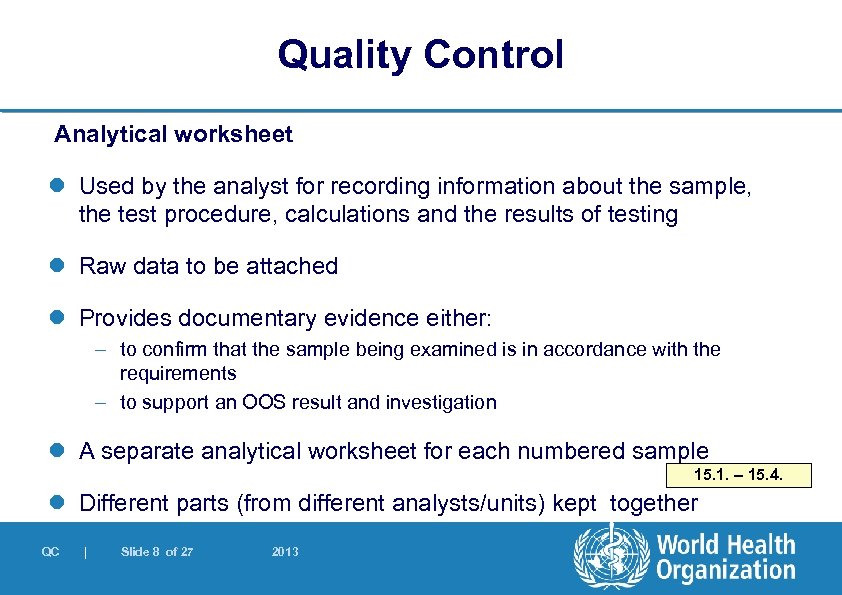 Quality Control Analytical worksheet l Used by the analyst for recording information about the sample, the test procedure, calculations and the results of testing l Raw data to be attached l Provides documentary evidence either: – to confirm that the sample being examined is in accordance with the requirements – to support an OOS result and investigation l A separate analytical worksheet for each numbered sample 15. 1. – 15. 4. l Different parts (from different analysts/units) kept together QC | Slide 8 of 27 2013
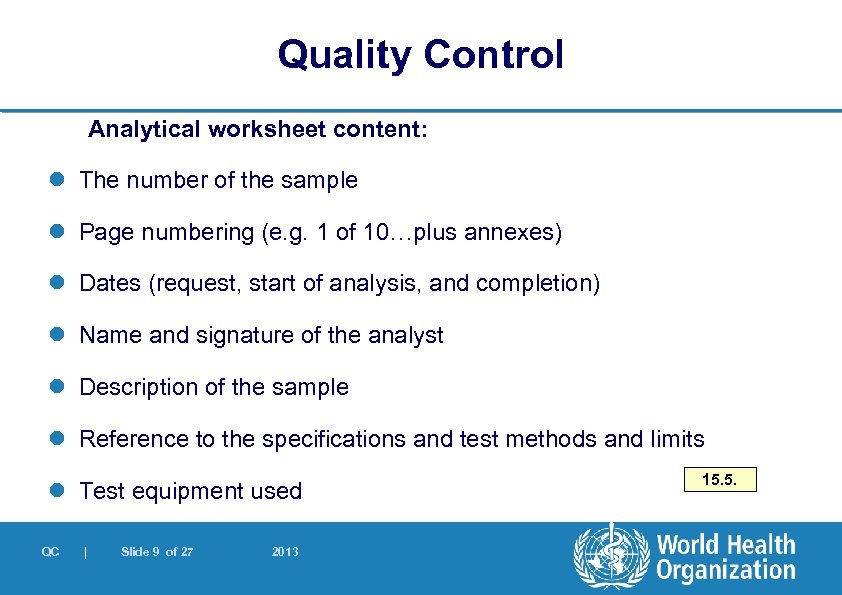 Quality Control Analytical worksheet content: l The number of the sample l Page numbering (e. g. 1 of 10…plus annexes) l Dates (request, start of analysis, and completion) l Name and signature of the analyst l Description of the sample l Reference to the specifications and test methods and limits l Test equipment used QC | Slide 9 of 27 2013 15. 5.
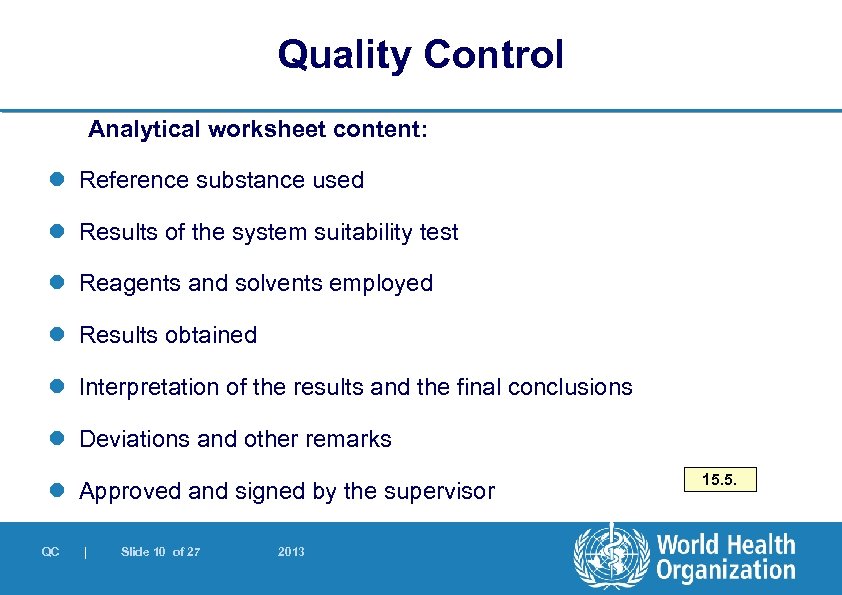 Quality Control Analytical worksheet content: l Reference substance used l Results of the system suitability test l Reagents and solvents employed l Results obtained l Interpretation of the results and the final conclusions l Deviations and other remarks l Approved and signed by the supervisor QC | Slide 10 of 27 2013 15. 5.
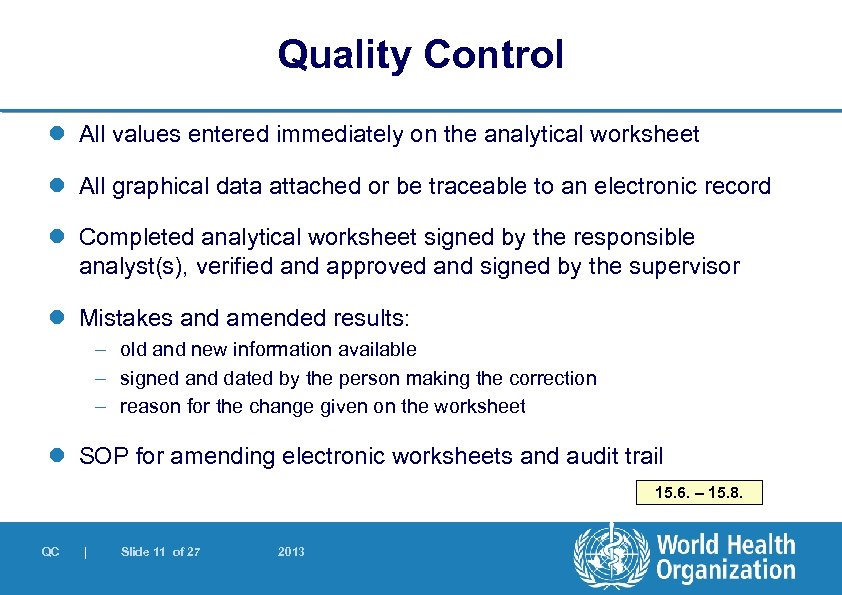 Quality Control l All values entered immediately on the analytical worksheet l All graphical data attached or be traceable to an electronic record l Completed analytical worksheet signed by the responsible analyst(s), verified and approved and signed by the supervisor l Mistakes and amended results: – old and new information available – signed and dated by the person making the correction – reason for the change given on the worksheet l SOP for amending electronic worksheets and audit trail 15. 6. – 15. 8. QC | Slide 11 of 27 2013
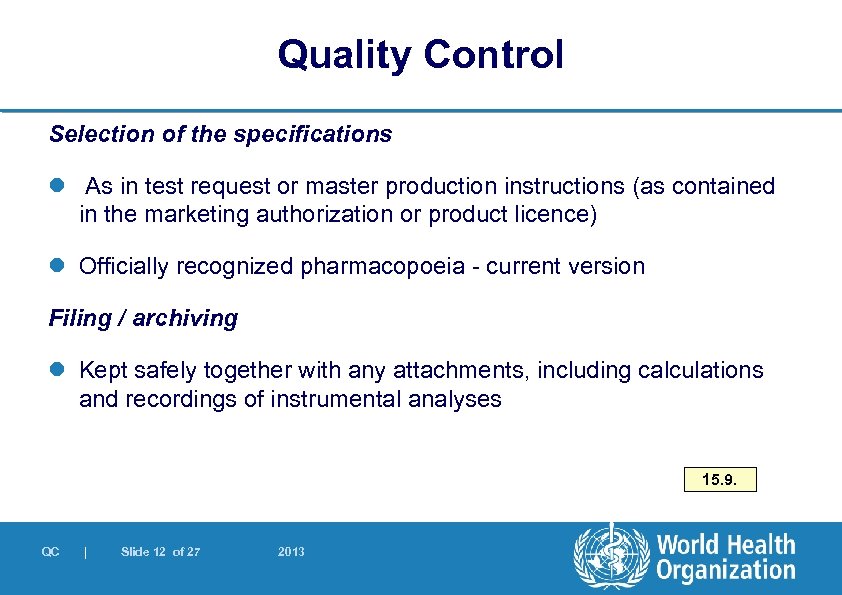 Quality Control Selection of the specifications l As in test request or master production instructions (as contained in the marketing authorization or product licence) l Officially recognized pharmacopoeia - current version Filing / archiving l Kept safely together with any attachments, including calculations and recordings of instrumental analyses 15. 9. QC | Slide 12 of 27 2013
 Quality Control Validation of analytical procedures l All analytical procedures employed for testing should be suitable for the intended use - demonstrated by validation l Validation done according to a validation protocol l Includes analytical performance characteristics e. g. robustness, accuracy and precision l Validation report l Pharmacopoeial methods to be confirmed as suitable for use. If adapted for another use then to be validated 16. 1. – 16. 3. QC | Slide 13 of 27 2013
 Quality Control System suitability testing l An integral part of many analytical procedures l Shows that equipment, electronics, analytical operations are appropriate/suitable for the samples to be analysed l To be performed prior to the analysis l In case of a large number of samples analysed in sequence - then appropriate system suitability tests are to be performed throughout the sequence l Verification not required for basic pharmacopoeial methods – E. g. p. H, loss on drying and wet chemical methods QC | Slide 14 of 27 2013 16. 4.
 Quality Control l In case of a major change (e. g. analytical procedure / composition of the product tested / synthesis of the API) - revalidation may be required More guidelines and further reading: – WHO TRS 937, Annex 4. 2006 – International Conference on Harmonisation of Technical Requirements for Registration of Pharmaceuticals for Human Use (ICH) – European Network of Official Medicines Control Laboratories (OMCL) – General chapters of the US Pharmacopeia on Validation of compendial procedures and on Verification of compendial procedures 16. 5. QC | Slide 15 of 27 2013
 Quality Control Testing l Sample tested in accordance with the work plan l If not tested without delay - reasons given in analytical worksheet. Appropriate storage of sample needed l When specific tests are to be done outside the laboratory – test request and samples transferred. l Test procedures detailed and followed l Deviations from the test procedure should be approved and 17. 1. – 17. 3. documented l QC | Slide 16 of 27 2013
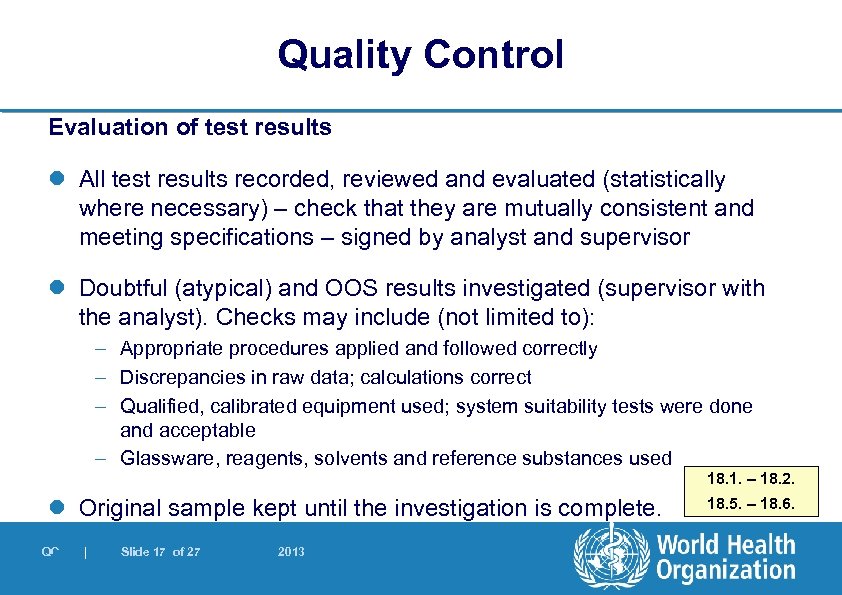 Quality Control Evaluation of test results l All test results recorded, reviewed and evaluated (statistically where necessary) – check that they are mutually consistent and meeting specifications – signed by analyst and supervisor l Doubtful (atypical) and OOS results investigated (supervisor with the analyst). Checks may include (not limited to): – Appropriate procedures applied and followed correctly – Discrepancies in raw data; calculations correct – Qualified, calibrated equipment used; system suitability tests were done and acceptable – Glassware, reagents, solvents and reference substances used 18. 1. – 18. 2. l Original sample kept until the investigation is complete. QC | l Slide 17 of 27 2013 18. 5. – 18. 6.
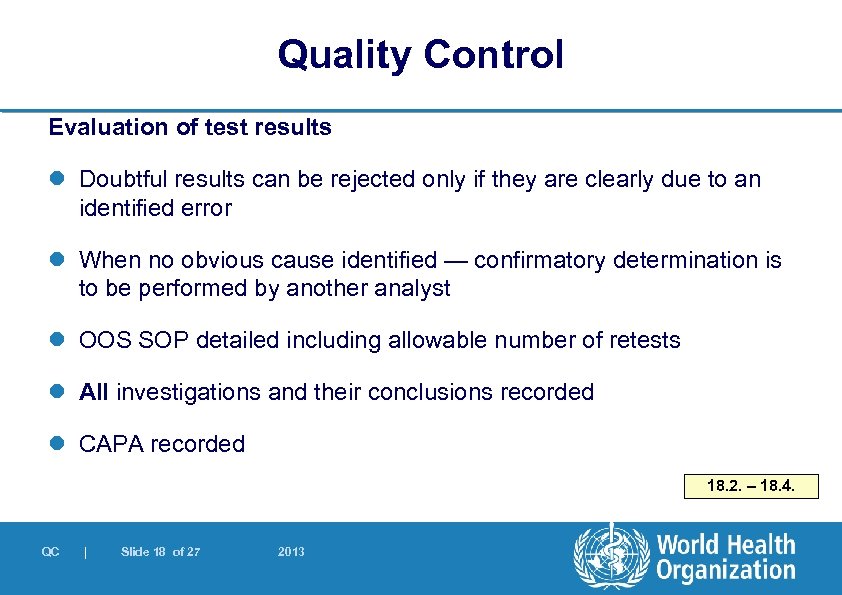 Quality Control Evaluation of test results l Doubtful results can be rejected only if they are clearly due to an identified error l When no obvious cause identified — confirmatory determination is to be performed by another analyst l OOS SOP detailed including allowable number of retests l All investigations and their conclusions recorded l CAPA recorded 18. 2. – 18. 4. QC | Slide 18 of 27 2013
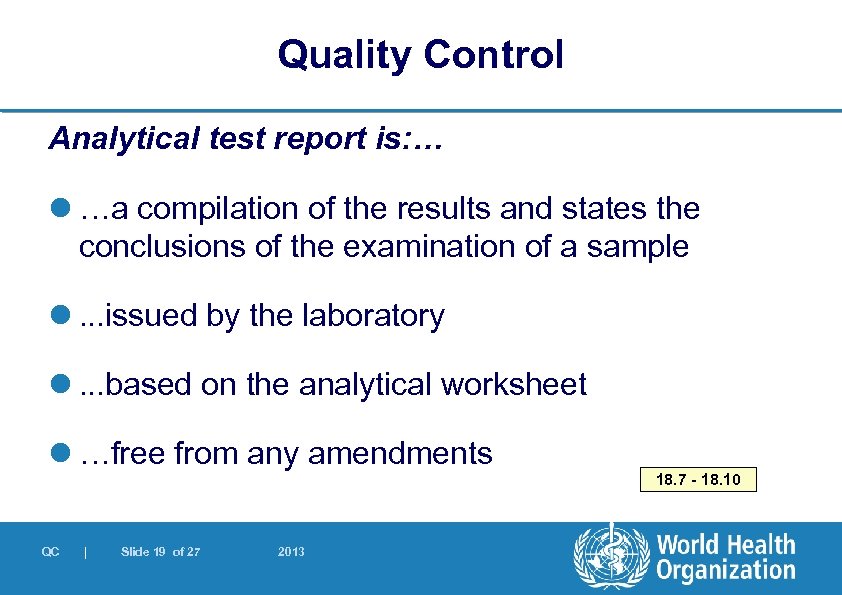 Quality Control Analytical test report is: … l …a compilation of the results and states the conclusions of the examination of a sample l. . . issued by the laboratory l. . . based on the analytical worksheet l …free from any amendments QC | Slide 19 of 27 2013 18. 7 - 18. 10
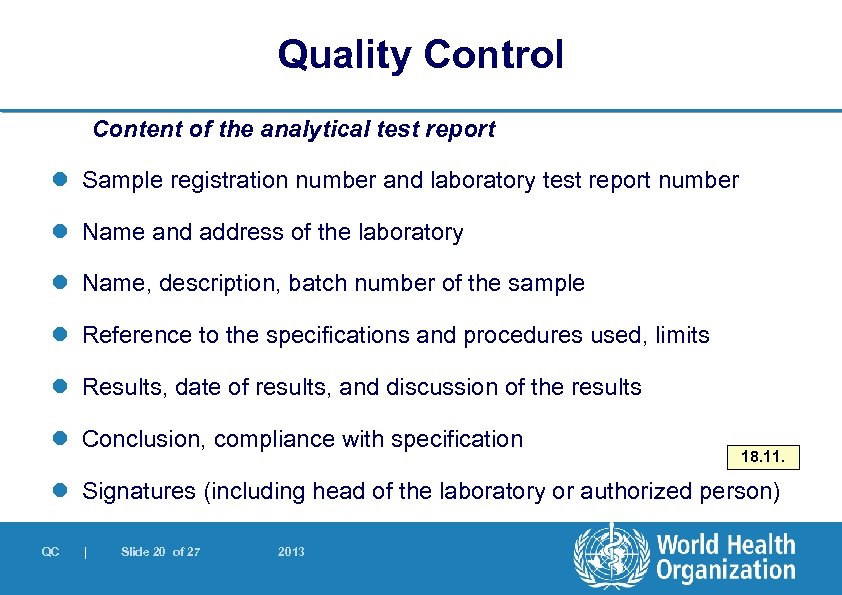 Quality Control Content of the analytical test report l Sample registration number and laboratory test report number l Name and address of the laboratory l Name, description, batch number of the sample l Reference to the specifications and procedures used, limits l Results, date of results, and discussion of the results l Conclusion, compliance with specification 18. 11. l Signatures (including head of the laboratory or authorized person) QC | Slide 20 of 27 2013
 Quality Control Certificate of analysis (1) A certificate of analysis is prepared for each batch and contains e. g. : l registration number of the sample; date of receipt; l name and address of the laboratory; l name, description and batch number of the sample l reference to the specification; results of all tests performed (mean and standard deviation, if applicable) with the prescribed limits; l conclusion (within the limits of the specification) QC | Slide 21 of 27 2013 19. 1.
 Quality Control Certificate of analysis contains (2) l Expiry date or retest date if applicable l Date of completion of tests l Signature of the head of laboratory or other authorized person Note: See also The Guideline on model certificate of 19. 1. analysis QC | Slide 22 of 27 2013
 Quality Control Retained samples l As required by the legislation or by the originator of the request for analysis l Appropriate storage conditions l Sufficient amount to allow at least two re-analyses l Kept in its final pack 20. QC | Slide 23 of 27 2013
 Quality Control Safety (1) l General and specific safety instructions available based on identified risk - in line with national regulations and SOPs l Available to each staff member and supplemented with e. g. written material, poster displays, safety data sheets, audiovisual material, occasional seminars and in line with national regulations and SOPs l No smoking, eating and drinking in the laboratory l Know how to use of fire-fighting equipment l Wear laboratory coats and use eye protection QC | Slide 24 of 27 2013 21. 1. – 21. 2.
 Quality Control Safety (2) l Special care - in handling highly potent, infectious or volatile substances l Highly toxic and/or genotoxic samples only in a specially designed facility to avoid the risk of contamination l Containers of chemicals should be fully labelled and include prominent warnings e. g. “poison”, “flammable”, “radioactive” l Adequate insulation and spark-proofing l Cylinders of compressed gases QC | Slide 25 of 27 2013 21. 1. – 21. 2.
 Quality Control Safety (3) l Avoid working alone in the laboratory l First-aid materials are provided and staff trained l Protective clothing – e. g. eye protection, masks and gloves, safety showers l Rubber suction bulbs used, safe handling of glassware, corrosive reagents and solvents l Warnings, precautions and instructions l Safe disposal with neutralization or deactivation QC | Slide 26 of 27 2013 21. 2. – 21. 3.
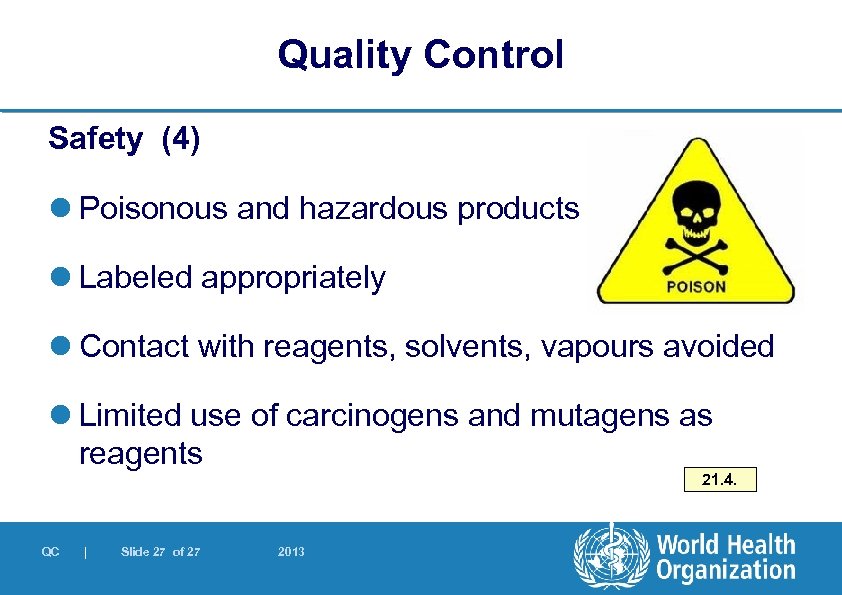 Quality Control Safety (4) l Poisonous and hazardous products l Labeled appropriately l Contact with reagents, solvents, vapours avoided l Limited use of carcinogens and mutagens as reagents 21. 4. QC | Slide 27 of 27 2013