


 Скачать презентацию Supplementary Slides for Software Engineering A Practitioner s Approach
8341b695de5270ad31575de537774733.ppt
- Количество слайдов: 12
 Supplementary Slides for Software Engineering: A Practitioner's Approach, 5/e copyright © 1996, 2001 R. S. Pressman & Associates, Inc. For University Use Only May be reproduced ONLY for student use at the university level when used in conjunction with Software Engineering: A Practitioner's Approach. Any other reproduction or use is expressly prohibited. This presentation, slides, or hardcopy may NOT be used for short courses, industry seminars, or consulting purposes. These courseware materials are to be used in conjunction with Software Engineering: A Practitioner’s Approach, 5/e and are provided with permission by R. S. Pressman & Associates, Inc. , copyright © 1996, 2001 1
 Chapter 7 Project Scheduling and Tracking These courseware materials are to be used in conjunction with Software Engineering: A Practitioner’s Approach, 5/e and are provided with permission by R. S. Pressman & Associates, Inc. , copyright © 1996, 2001 2
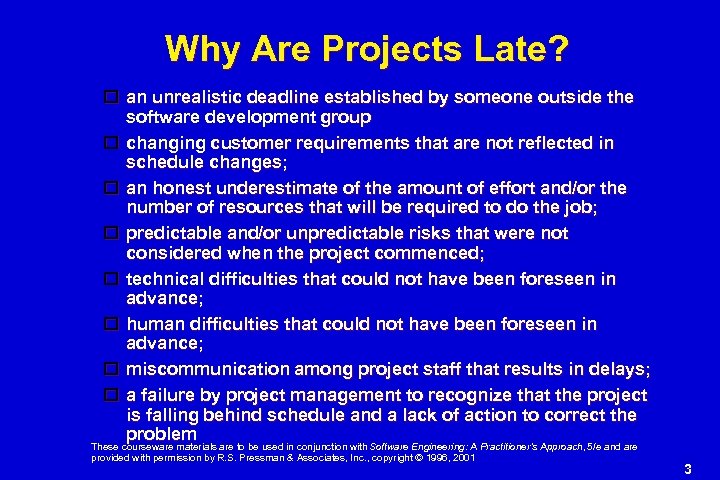 Why Are Projects Late? an unrealistic deadline established by someone outside the software development group changing customer requirements that are not reflected in schedule changes; an honest underestimate of the amount of effort and/or the number of resources that will be required to do the job; predictable and/or unpredictable risks that were not considered when the project commenced; technical difficulties that could not have been foreseen in advance; human difficulties that could not have been foreseen in advance; miscommunication among project staff that results in delays; a failure by project management to recognize that the project is falling behind schedule and a lack of action to correct the problem These courseware materials are to be used in conjunction with Software Engineering: A Practitioner’s Approach, 5/e and are provided with permission by R. S. Pressman & Associates, Inc. , copyright © 1996, 2001 3
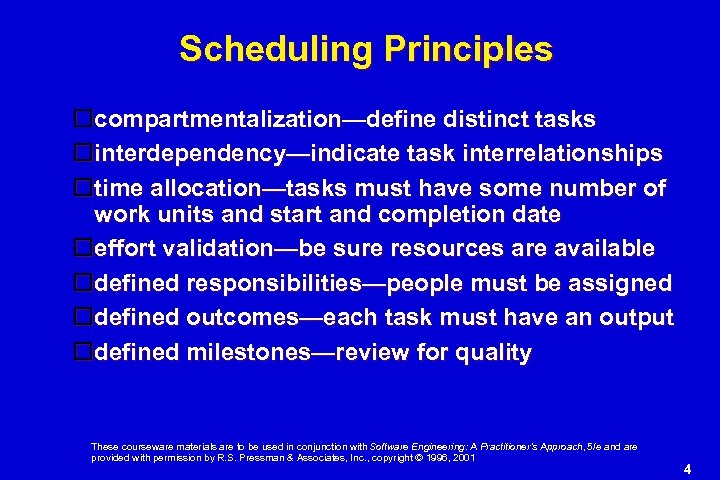 Scheduling Principles compartmentalization—define distinct tasks interdependency—indicate task interrelationships time allocation—tasks must have some number of work units and start and completion date effort validation—be sure resources are available defined responsibilities—people must be assigned defined outcomes—each task must have an output defined milestones—review for quality These courseware materials are to be used in conjunction with Software Engineering: A Practitioner’s Approach, 5/e and are provided with permission by R. S. Pressman & Associates, Inc. , copyright © 1996, 2001 4
 Defining Task Sets determine type of project assess the degree of rigor required identify adaptation criteria compute task set selector (TSS) value interpret TSS to determine degree of rigor select appropriate software engineering tasks These courseware materials are to be used in conjunction with Software Engineering: A Practitioner’s Approach, 5/e and are provided with permission by R. S. Pressman & Associates, Inc. , copyright © 1996, 2001 5
 Type of Project Concept development – some new business concepts or new technology. New application development – a consequence of specific customer request Application enhancement – major modification of existing software that observable by enduser Application maintenance – correct, adapt, or extend existing software, may not obvious to the end-user Reengineering – rebuilding an existing system in whole or in part. These courseware materials are to be used in conjunction with Software Engineering: A Practitioner’s Approach, 5/e and are provided with permission by R. S. Pressman & Associates, Inc. , copyright © 1996, 2001 6
 Adaptation Criteria are used to determine the recommended degree of rigor Size of the project Number of potential users Mission criticality Application longevity Stability of requirements Ease of customer / developer communication Maturity of applicable technology Performance constraints Embedded and nonembedded characteristics Project staff Reengineering factors These courseware materials are to be used in conjunction with Software Engineering: A Practitioner’s Approach, 5/e and are provided with permission by R. S. Pressman & Associates, Inc. , copyright © 1996, 2001 7
 Selecting Tasks of Concept Development Project Concept Scoping – overall scope of project Preliminary concept planning – organization’s ability to undertake the work implied by project scope Technology risk assessment – risk associated with the technology Proof of concept – viability of a new technology Concept implementation – concept representation viewable by the customer Customer reaction of the concept – solicits feedback These courseware materials are to be used in conjunction with Software Engineering: A Practitioner’s Approach, 5/e and are provided with permission by R. S. Pressman & Associates, Inc. , copyright © 1996, 2001 8
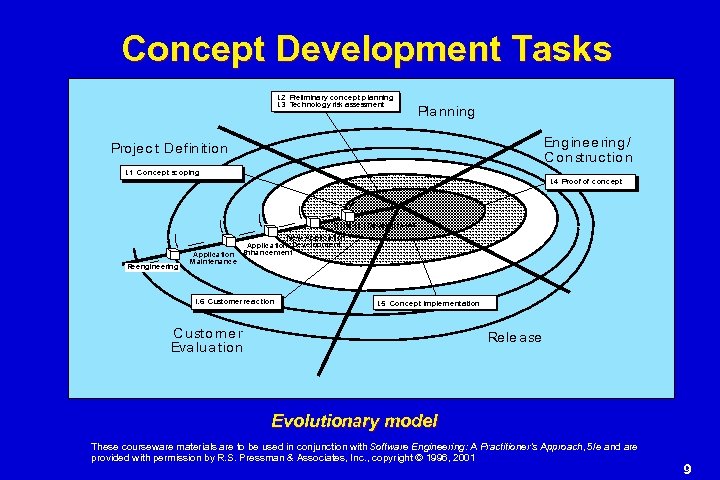 Concept Development Tasks I. 2 Pre lim ina ry c o nc e p t p la nnin g I. 3 Te c hno log y risk a sse ssm e nt Pla nning Eng inee ring / C onstruc tio n Proje c t De finitio n I. 1 C o nc e p t sc o p ing I. 4 Pro o f c o nc e p t Conc e pt De velopme nt Ree ngine e ring Applica tion M a inte na nc e New Applica tion Applic a tion Developme nt Enha nc em e nt I. 6 C usto m e r re a c tion I. 5 Co n c e p t im p le m e nta tio n C usto m e r Eva lua tio n Rele a se Evolutionary model These courseware materials are to be used in conjunction with Software Engineering: A Practitioner’s Approach, 5/e and are provided with permission by R. S. Pressman & Associates, Inc. , copyright © 1996, 2001 9
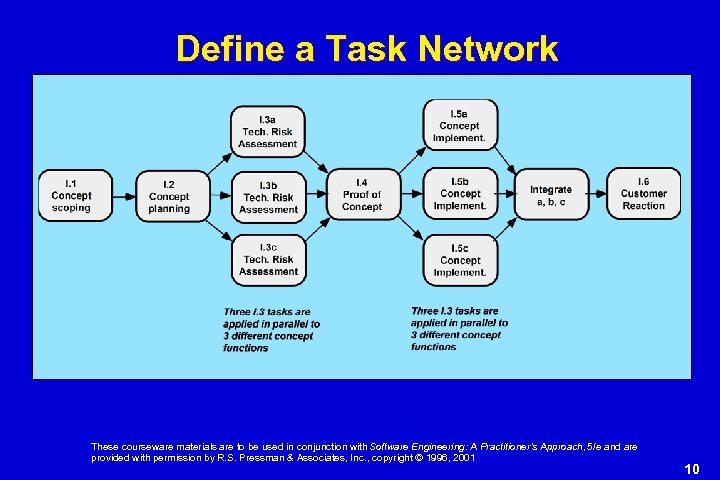 Define a Task Network These courseware materials are to be used in conjunction with Software Engineering: A Practitioner’s Approach, 5/e and are provided with permission by R. S. Pressman & Associates, Inc. , copyright © 1996, 2001 10
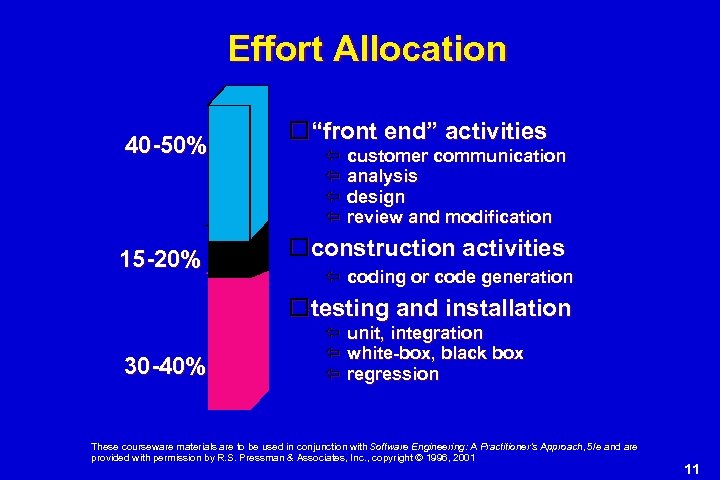 Effort Allocation 40 -50% 15 -20% “front end” activities customer communication analysis design review and modification construction activities coding or code generation testing and installation 30 -40% unit, integration white-box, black box regression These courseware materials are to be used in conjunction with Software Engineering: A Practitioner’s Approach, 5/e and are provided with permission by R. S. Pressman & Associates, Inc. , copyright © 1996, 2001 11
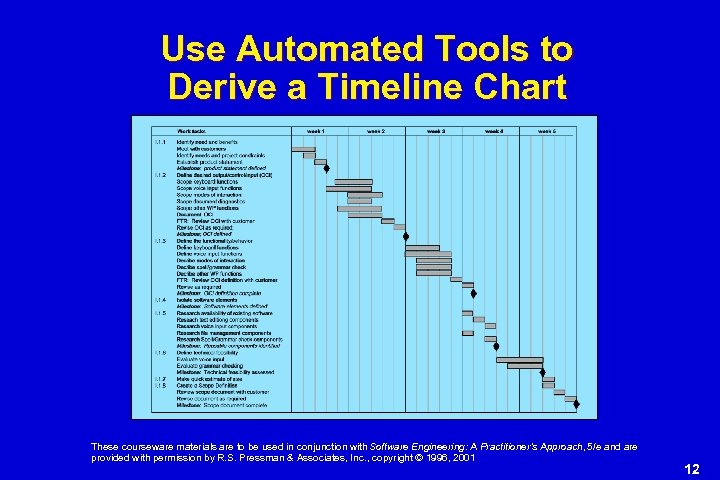 Use Automated Tools to Derive a Timeline Chart These courseware materials are to be used in conjunction with Software Engineering: A Practitioner’s Approach, 5/e and are provided with permission by R. S. Pressman & Associates, Inc. , copyright © 1996, 2001 12