


 Скачать презентацию Supersoft sources in M 31 Comparing the XMM-Newton
dec62f1b53654878499c37647758c39d.ppt
- Количество слайдов: 24
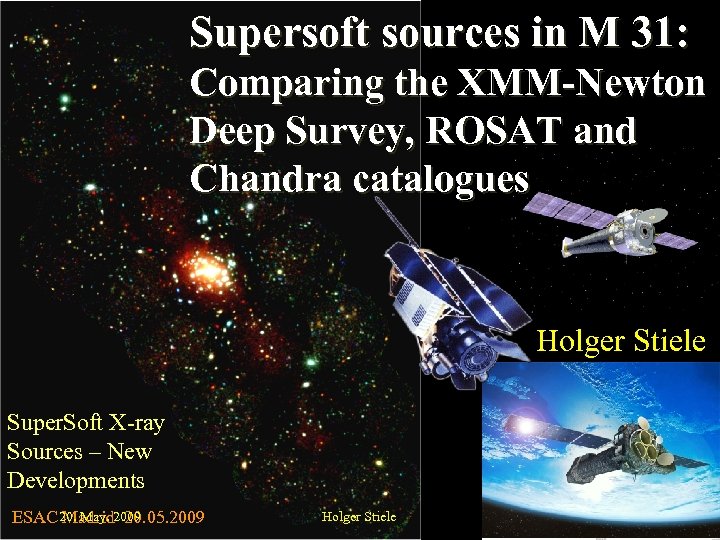 Supersoft sources in M 31: Comparing the XMM-Newton Deep Survey, ROSAT and Chandra catalogues Holger Stiele Super. Soft X-ray Sources – New Developments ESAC 20. May. 2009 Madrid 20. 05. 2009 Holger Stiele
 The Large Program Collaboration 19 scientists from 7 countries • PI: W. Pietsch (MPE) • MPE: V. Burwitz, M. Freyberg, J. Greiner, F. Haberl, H. Stiele • And: R. Barnard (The Open University), D. Hatzidimitriou (University of Crete), M. Hernanz (CSIC-IEEC), G. Israel (INAF), U. Kolb (The Open University), A. Kong (National Tsing Hua University), P. Plucinsky (Harvard-Smithsonian Centre for Astrophysics), P. Reig (IESL), G. Sala (UPC/IEEC), M. Sasaki (Harvard-Smithsonian Centre for Astrophysics), L. Shaw Greening (The Open University), L. Stella (INAF), B. Williams (Pennsylvania State University) 20. May. 2009 Holger Stiele 2
 Outline ü The XMM-Newton Deep Survey catalogue Ø Supersoft sources optical novae ü Comparing the XMM-Newton Deep Survey, ROSAT and Chandra catalogues Ø The method Ø The results 20. May. 2009 Holger Stiele 3
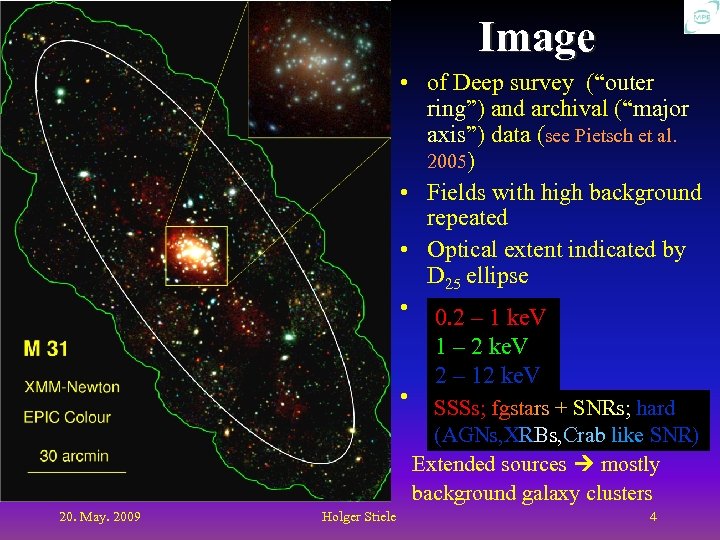 Image • of Deep survey (“outer ring”) and archival (“major axis”) data (see Pietsch et al. 2005) • Fields with high background repeated • Optical extent indicated by D 25 ellipse • 0. 2 – 1 ke. V • 20. May. 2009 Holger Stiele 1 – 2 ke. V 2 – 12 ke. V SSSs; fgstars + SNRs; hard (AGNs, XRBs, Crab like SNR) Extended sources mostly background galaxy clusters 4
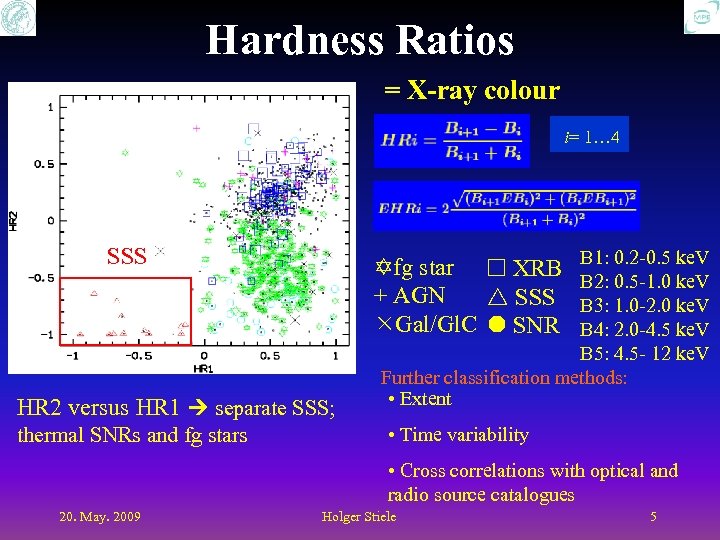 Hardness Ratios = X-ray colour i= 1… 4 SSS HR 2 versus HR 1 separate SSS; thermal SNRs and fg stars B 1: 0. 2 -0. 5 ke. V B 2: 0. 5 -1. 0 ke. V B 3: 1. 0 -2. 0 ke. V B 4: 2. 0 -4. 5 ke. V B 5: 4. 5 - 12 ke. V Further classification methods: • Extent Yfg star XRB + AGN SSS Gal/Gl. C SNR • Time variability • Cross correlations with optical and radio source catalogues 20. May. 2009 Holger Stiele 5
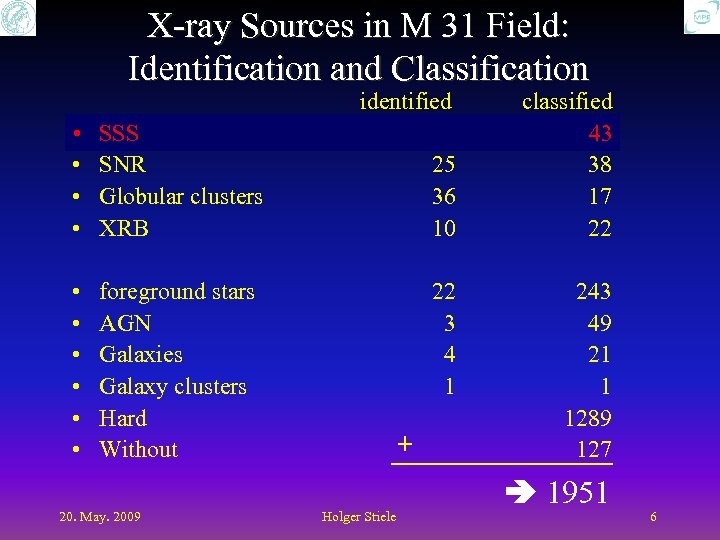 X-ray Sources in M 31 Field: Identification and Classification identified • • SSS SNR Globular clusters XRB • • • foreground stars AGN Galaxies Galaxy clusters Hard Without 20. May. 2009 25 36 10 22 3 4 1 + Holger Stiele classified 43 38 17 22 243 49 21 1 1289 127 1951 6
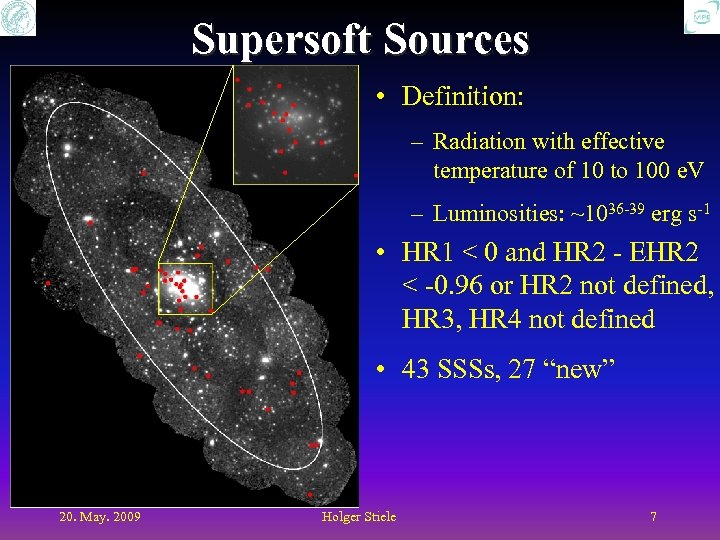 Supersoft Sources • Definition: – Radiation with effective temperature of 10 to 100 e. V – Luminosities: ~1036 -39 erg s-1 • HR 1 < 0 and HR 2 - EHR 2 < -0. 96 or HR 2 not defined, HR 3, HR 4 not defined • 43 SSSs, 27 “new” 20. May. 2009 Holger Stiele 7
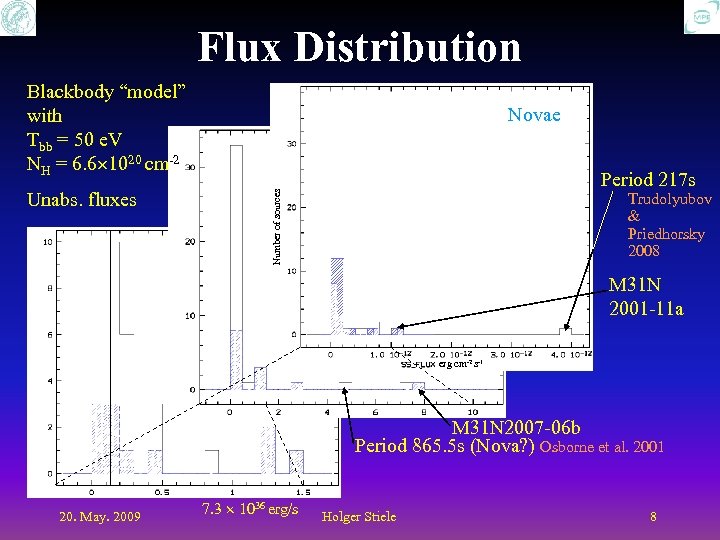 Flux Distribution Blackbody “model” with Tbb = 50 e. V NH = 6. 6 1020 cm-2 Period 217 s Number of sources Unabs. fluxes Novae Trudolyubov & Priedhorsky 2008 M 31 N 2001 -11 a M 31 N 2005 -01 c erg cm-2 s-1 M 31 N 2007 -06 b Period 865. 5 s (Nova? ) Osborne et al. 2001 20. May. 2009 7. 3 1036 erg/s Holger Stiele 8
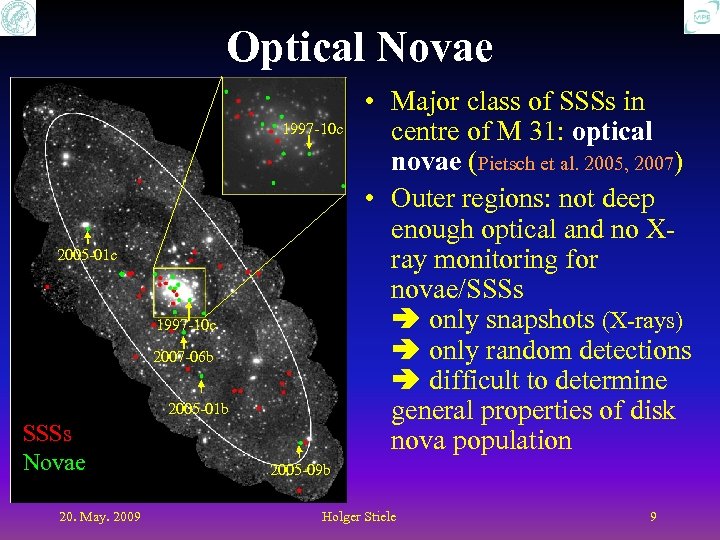 Optical Novae 1997 -10 c 2005 -01 c 1997 -10 c 2007 -06 b 2005 -01 b SSSs Novae 20. May. 2009 • Major class of SSSs in centre of M 31: optical novae (Pietsch et al. 2005, 2007) • Outer regions: not deep enough optical and no Xray monitoring for novae/SSSs only snapshots (X-rays) only random detections difficult to determine general properties of disk nova population 2005 -09 b Holger Stiele 9
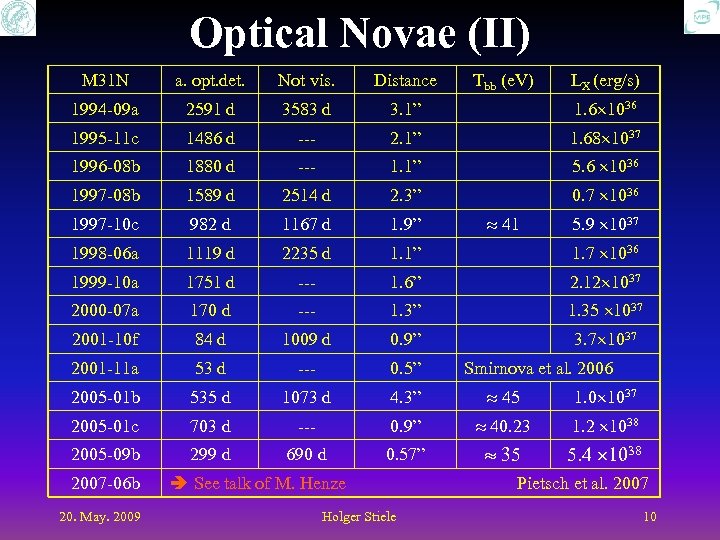 Optical Novae (II) M 31 N a. opt. det. Not vis. Distance 1994 -09 a 2591 d 3583 d 3. 1” 1. 6 1036 1995 -11 c 1486 d --- 2. 1” 1. 68 1037 1996 -08 b 1880 d --- 1. 1” 5. 6 1036 1997 -08 b 1589 d 2514 d 2. 3” 0. 7 1036 1997 -10 c 982 d 1167 d 1. 9” 1998 -06 a 1119 d 2235 d 1. 1” 1. 7 1036 1999 -10 a 1751 d --- 1. 6” 2. 12 1037 2000 -07 a 170 d --- 1. 3” 1. 35 1037 2001 -10 f 84 d 1009 d 0. 9” 3. 7 1037 2001 -11 a 53 d --- 0. 5” 2005 -01 b 535 d 1073 d 4. 3” 45 1. 0 1037 2005 -01 c 703 d --- 0. 9” 40. 23 1. 2 1038 2005 -09 b 299 d 690 d 0. 57” 35 5. 4 1038 2007 -06 b 20. May. 2009 See talk of M. Henze Holger Stiele Tbb (e. V) 41 LX (erg/s) 5. 9 1037 Smirnova et al. 2006 Pietsch et al. 2007 10
 Comparing the XMMNewton Deep Survey, ROSAT and Chandra catalogues XMM-Newton Deep Survey • 1951 sources • 43 Supersoft sources 20. May. 2009 Holger Stiele 11
 ROSAT PSPC Survey • PSPC survey covering the entire galaxy twice 560 X-ray sources Supper et al. 1997, 2001 • Supersoft sources selected from Greiner 2000 and Kahabka 1999: – Similar selection criterion (as used for XMM-Newton) – Two hardness ratios (based on standard ROSAT energy bands) – band separation energies at ~ 0. 5 ke. V, and ~ 1 ke. V – ROSAT observations taken about > 10 yr earlier than XMM-Newton observations ( investigation of long term variability) 20. May. 2009 Holger Stiele 12
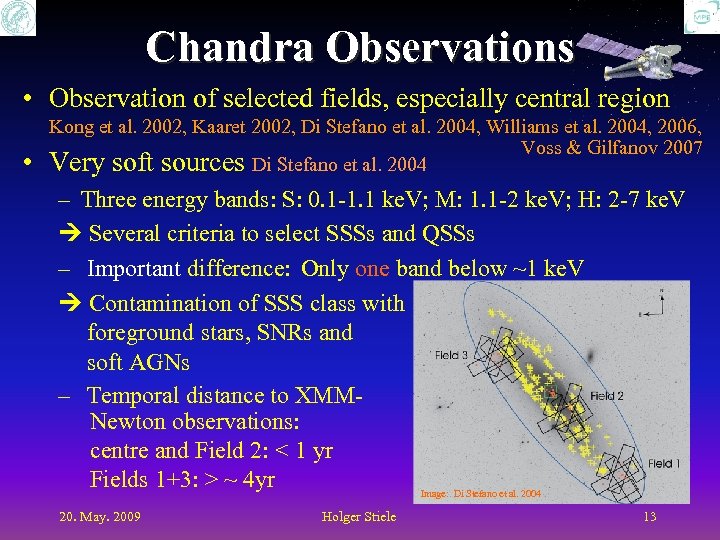 Chandra Observations • Observation of selected fields, especially central region • Kong et al. 2002, Kaaret 2002, Di Stefano et al. 2004, Williams et al. 2004, 2006, Voss & Gilfanov 2007 Very soft sources Di Stefano et al. 2004 – Three energy bands: S: 0. 1 -1. 1 ke. V; M: 1. 1 -2 ke. V; H: 2 -7 ke. V Several criteria to select SSSs and QSSs – Important difference: Only one band below ~1 ke. V Contamination of SSS class with foreground stars, SNRs and soft AGNs – Temporal distance to XMMNewton observations: centre and Field 2: < 1 yr Fields 1+3: > ~ 4 yr Image: Di Stefano et al. 2004 20. May. 2009 Holger Stiele 13
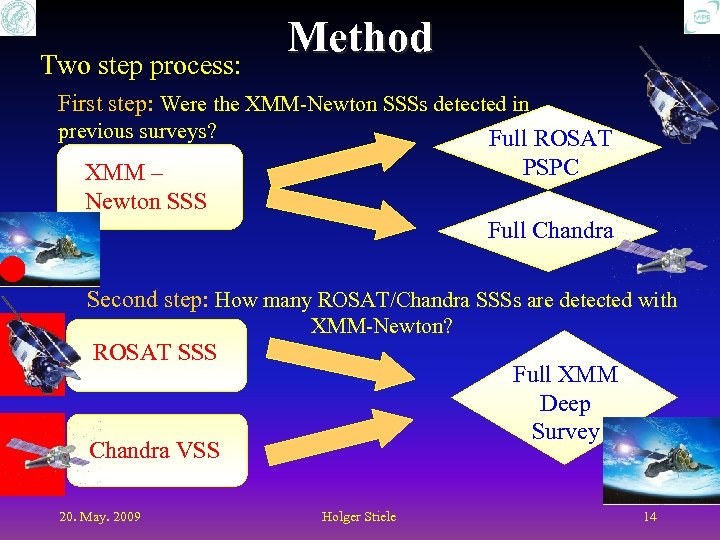 Two step process: Method First step: Were the XMM-Newton SSSs detected in previous surveys? Full ROSAT PSPC XMM – Newton SSS Full Chandra Second step: How many ROSAT/Chandra SSSs are detected with XMM-Newton? ROSAT SSS Full XMM Deep Survey Chandra VSS 20. May. 2009 Holger Stiele 14
 XMM-Newton SSS to ROSAT PSPC Surveys • 43 XMM-Newton SSS, 12 brighter than ROSAT detection threshold (~5. 3 10 -15 erg cm-2 s-1): – 2 also found as ROSAT SSSs – 10 not detected with ROSAT: 6 recent novae, 1 transient, 1 variable 2 must be transient/highly variable • 31 XMM-Newton SSS with fluxes below ROSAT detection threshold: – 1 also found as ROSAT SSSs (~factor 22 -25 brighter in ROSAT observations) – 3 chance coincidences – 27 remaining sources: 7 recent novae, 1 transient (Di Stefano et al. 2004) 20. May. 2009 Holger Stiele 15
 XMM-Newton SSS to Chandra Surveys • 9 XMM-Newton SSSs have Chandra counterparts: – 6 are also classified as SSSs from Chandra – 8 of the 9 sources are located in the centre of M 31 • 34 sources do not have Chandra counterparts: – 7 are in regions not covered with Chandra – 10 are novae (4 after 2005, 6 no Chandra detections (see Pietsch et al. 2005, 2007 and M 31 N 1999 -10 c, M 31 N 2001 -11 a)) – 1 variable 20. May. 2009 Holger Stiele 16
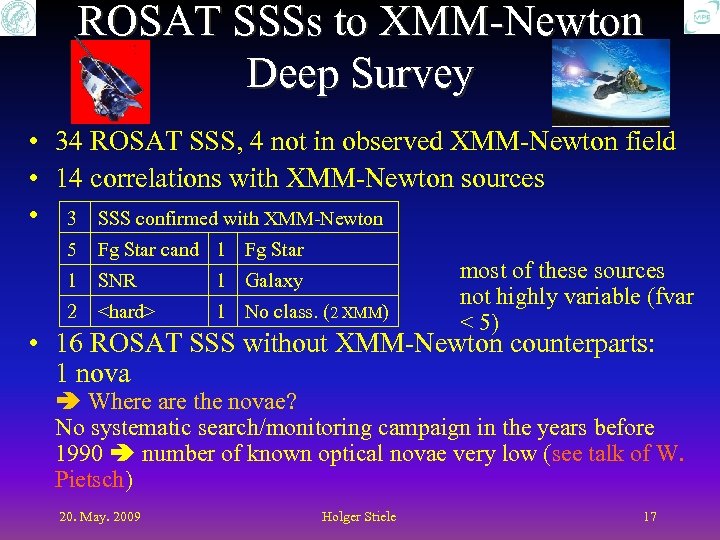 ROSAT SSSs to XMM-Newton Deep Survey • 34 ROSAT SSS, 4 not in observed XMM-Newton field • 14 correlations with XMM-Newton sources • 3 SSS confirmed with XMM-Newton 5 Fg Star cand 1 Fg Star 1 SNR 1 Galaxy 2
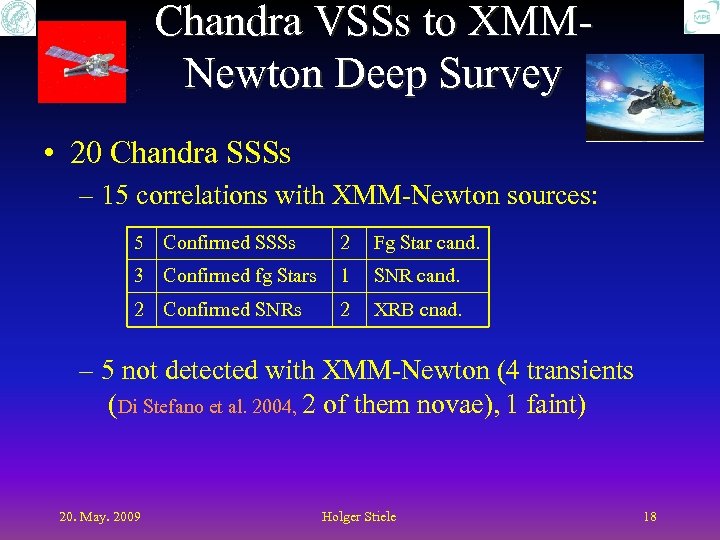 Chandra VSSs to XMMNewton Deep Survey • 20 Chandra SSSs – 15 correlations with XMM-Newton sources: 5 Confirmed SSSs 2 Fg Star cand. 3 Confirmed fg Stars 1 SNR cand. 2 Confirmed SNRs 2 XRB cnad. – 5 not detected with XMM-Newton (4 transients (Di Stefano et al. 2004, 2 of them novae), 1 faint) 20. May. 2009 Holger Stiele 18
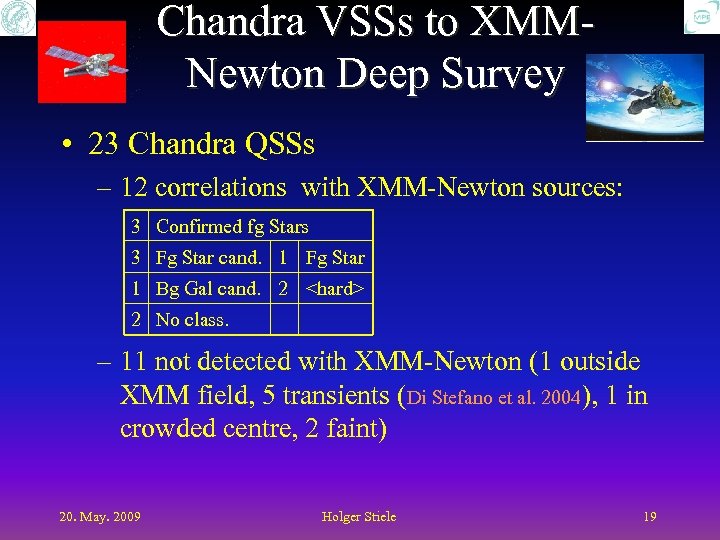 Chandra VSSs to XMMNewton Deep Survey • 23 Chandra QSSs – 12 correlations with XMM-Newton sources: 3 Confirmed fg Stars 3 Fg Star cand. 1 Fg Star 1 Bg Gal cand. 2
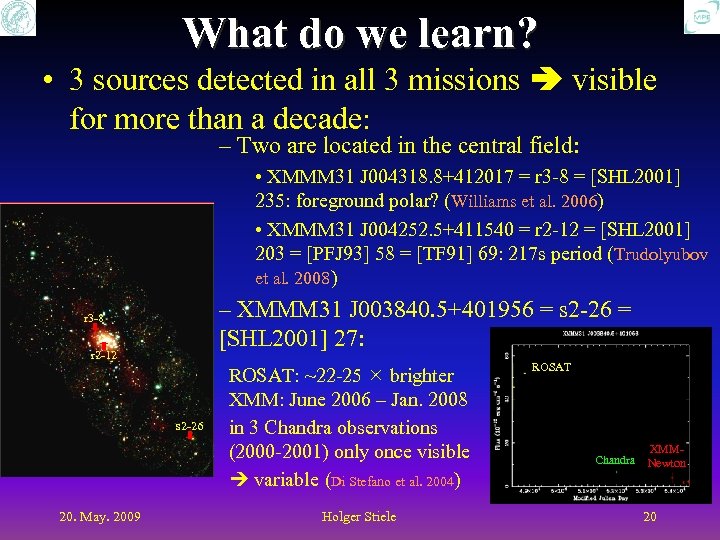 What do we learn? • 3 sources detected in all 3 missions visible for more than a decade: – Two are located in the central field: • XMMM 31 J 004318. 8+412017 = r 3 -8 = [SHL 2001] 235: foreground polar? (Williams et al. 2006) • XMMM 31 J 004252. 5+411540 = r 2 -12 = [SHL 2001] 203 = [PFJ 93] 58 = [TF 91] 69: 217 s period (Trudolyubov et al. 2008) – XMMM 31 J 003840. 5+401956 = s 2 -26 = [SHL 2001] 27: r 3 -8 r 2 -12 s 2 -26 20. May. 2009 ROSAT: ~22 -25 brighter XMM: June 2006 – Jan. 2008 in 3 Chandra observations (2000 -2001) only once visible variable (Di Stefano et al. 2004) Holger Stiele ROSAT Chandra XMMNewton 20
 What do we learn? (II) • Of 12 XMM-Newton sources with brightness above ROSAT threshold, only 2 observed by ROSAT underlines variability of the source class on long time scales (~83% variable, cf. Greiner et al. 2004) • ROSAT as well as Chandra SSSs contain sources of other classes 20. May. 2009 Holger Stiele 21
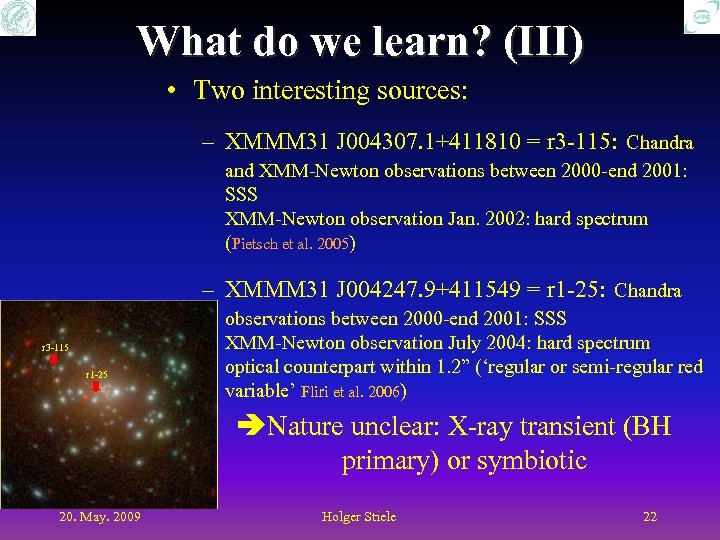 What do we learn? (III) • Two interesting sources: – XMMM 31 J 004307. 1+411810 = r 3 -115: Chandra and XMM-Newton observations between 2000 -end 2001: SSS XMM-Newton observation Jan. 2002: hard spectrum (Pietsch et al. 2005) – XMMM 31 J 004247. 9+411549 = r 1 -25: Chandra r 3 -115 r 1 -25 observations between 2000 -end 2001: SSS XMM-Newton observation July 2004: hard spectrum optical counterpart within 1. 2” (‘regular or semi-regular red variable’ Fliri et al. 2006) Nature unclear: X-ray transient (BH primary) or symbiotic 20. May. 2009 Holger Stiele 22
 Summary 1. Deep XMM-Newton survey of M 31 1951 X-ray sources, 43 Supersoft sources 2. Optical novae are an important class of SSSs in M 31 (5 in addition to Pietsch et al. 2005, 2007) 3. Correlation with ROSAT PSPC surveys and Chandra catalogues 4. 3 persistent SSSs 5. SSSs are a highly variable source class 6. Many ROSAT and Chandra SSSs get other classes from XMM-Newton observations 7. Two sources that show supersoft-hard transition between Chandra and XMM-Newton observations 20. May. 2009 Holger Stiele 23
 The large program collaboration: • PI: W. Pietsch (MPE) • MPE: V. Burwitz, M. Freyberg, J. Greiner, F. Haberl, H. Stiele • And: R. Barnard (The Open University), D. Hatzidimitriou (University of Crete), M. Hernanz (CSIC-IEEC), G. Israel (INAF), U. Kolb (The Open University), A. Kong (National Tsing Hua University), P. Plucinsky (Harvard-Smithsonian Centre for Astrophysics), P. Reig (IESL), G. Sala (UPC/IEEC), M. Sasaki (Harvard-Smithsonian Centre for Astrophysics), L. Shaw Greening (The Open University), L. Stella (INAF), B. Williams (Pennsylvania State University) 20. May. 2009 Holger Stiele 24