


 Скачать презентацию Superfluid insulator transition in a moving condensate Anatoli
869ba14d6f7297f2a19fcdb4a202c9ea.ppt
- Количество слайдов: 45
 Superfluid insulator transition in a moving condensate Anatoli Polkovnikov Ehud Altman, Eugene Demler, Bertrand Halperin, Misha Lukin Harvard University
 Plan of the talk 1. General motivation and overview. 2. Bosons in optical lattices. Equilibrium phase diagram. Examples of quantum dynamics. 3. Superfluid-insulator transition in a moving condensate. • Qualitative picture • Non-equilibrium phase diagram. • Role of quantum fluctuations 4. Conclusions and experimental implications.
 Why is the physics of cold atoms interesting? It is possible to realize strongly interacting systems, both fermionic and bosonic. No coupling to the environment. Parameters of the Hamiltonian are well known and well controlled. One can address not only conventional thermodynamic questions but also problems of quantum dynamics far from equilibrium.
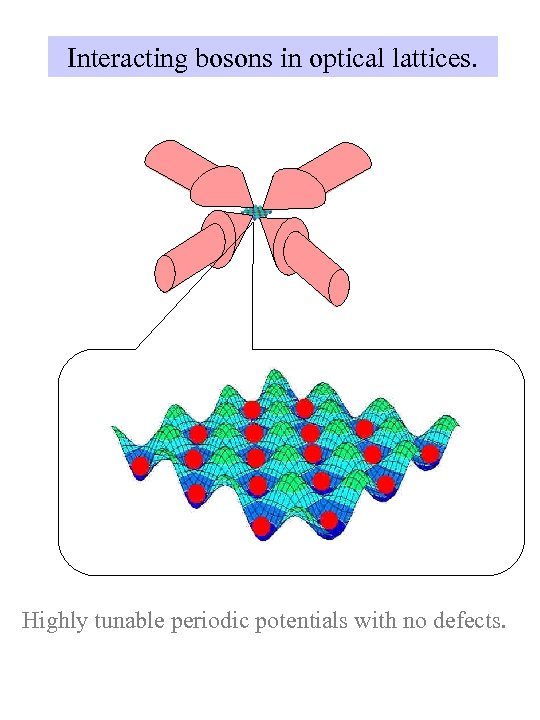 Interacting bosons in optical lattices. Highly tunable periodic potentials with no defects.
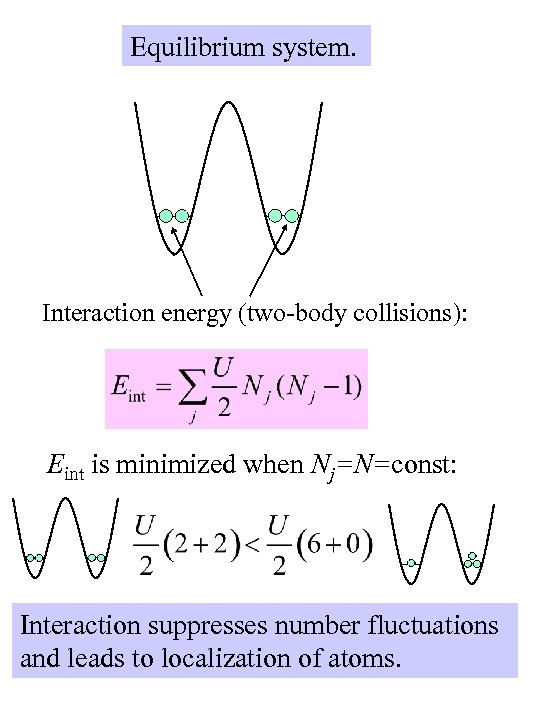 Equilibrium system. Interaction energy (two-body collisions): Eint is minimized when Nj=N=const: Interaction suppresses number fluctuations and leads to localization of atoms.
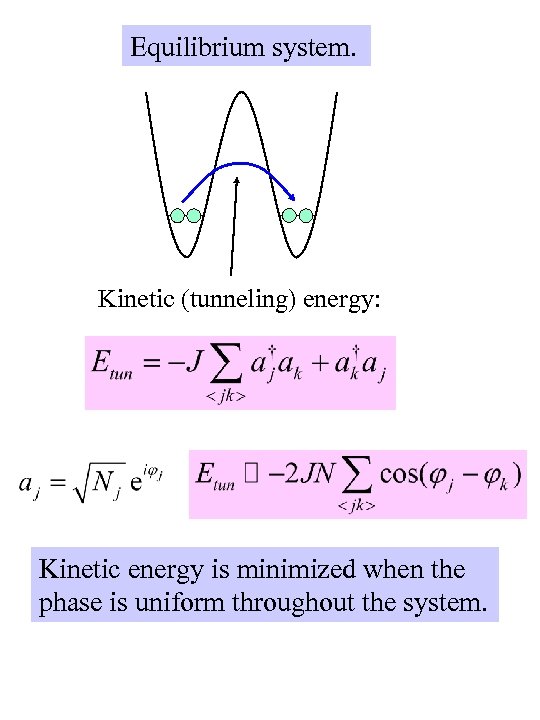 Equilibrium system. Kinetic (tunneling) energy: Kinetic energy is minimized when the phase is uniform throughout the system.
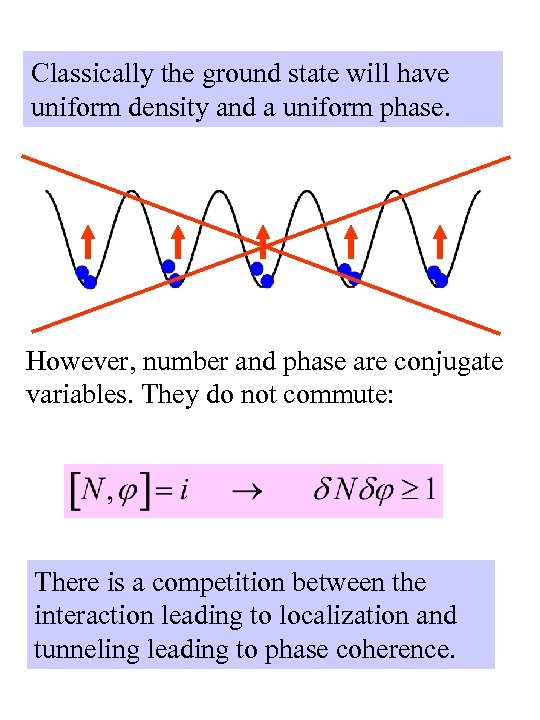 Classically the ground state will have uniform density and a uniform phase. However, number and phase are conjugate variables. They do not commute: There is a competition between the interaction leading to localization and tunneling leading to phase coherence.
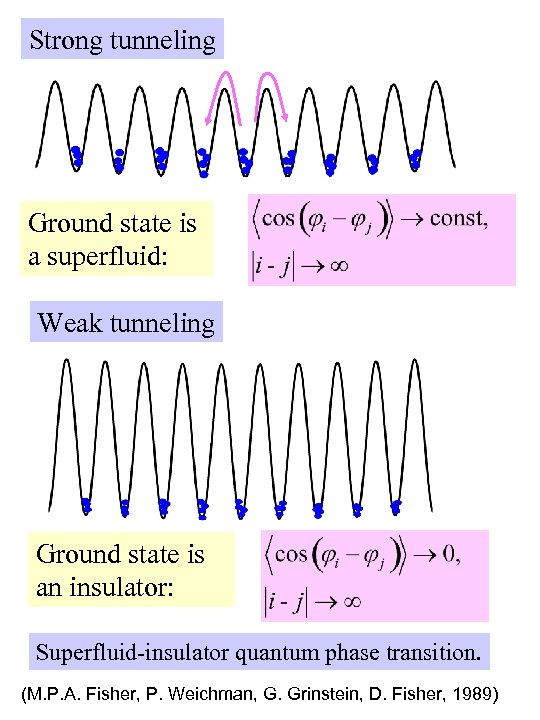 Strong tunneling Ground state is a superfluid: Weak tunneling Ground state is an insulator: Superfluid-insulator quantum phase transition. (M. P. A. Fisher, P. Weichman, G. Grinstein, D. Fisher, 1989)
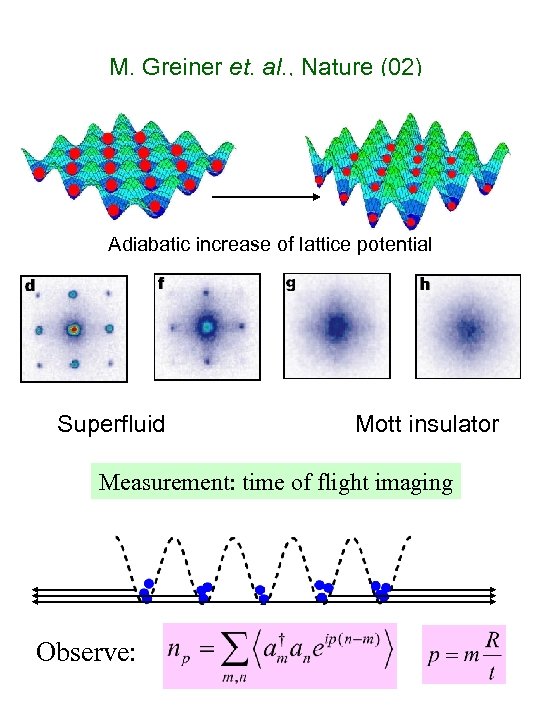 M. Greiner et. al. , Nature (02) Adiabatic increase of lattice potential Superfluid Mott insulator Measurement: time of flight imaging Observe:
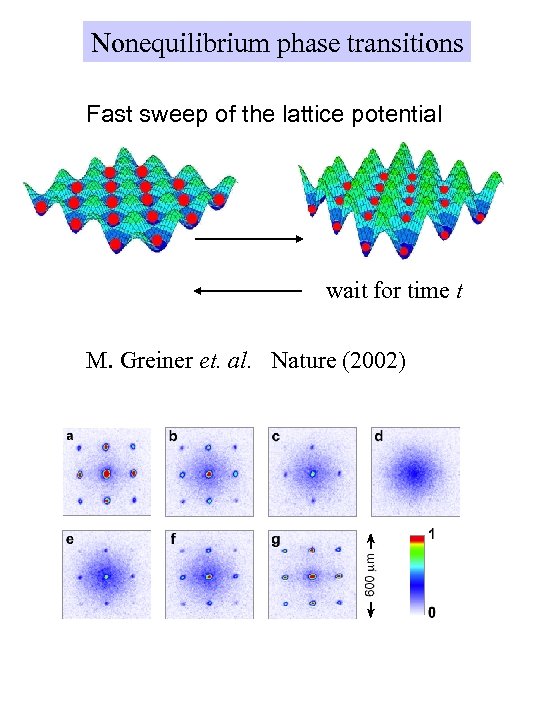 Nonequilibrium phase transitions Fast sweep of the lattice potential wait for time t M. Greiner et. al. Nature (2002)
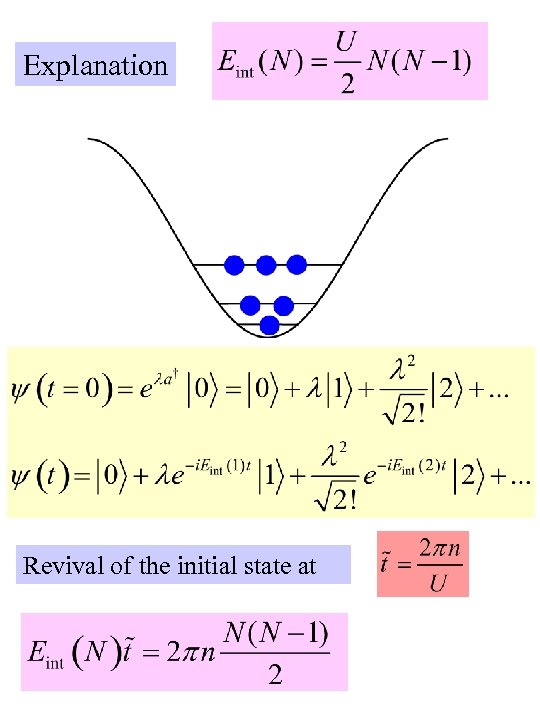 Explanation Revival of the initial state at
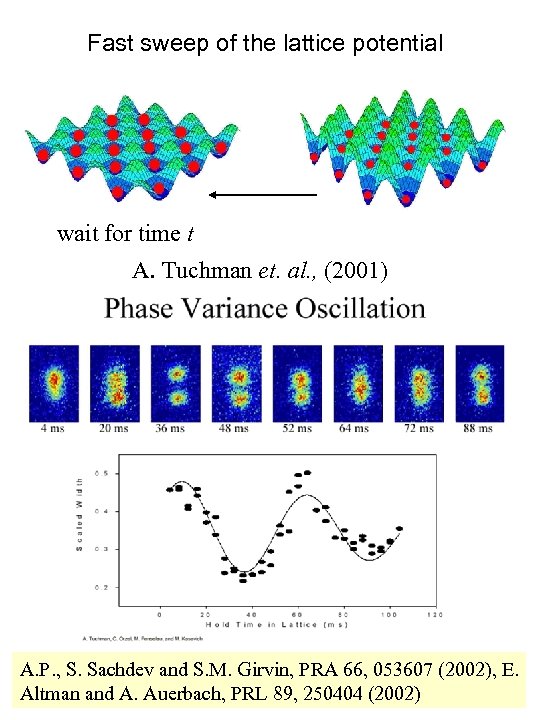 Fast sweep of the lattice potential wait for time t A. Tuchman et. al. , (2001) A. P. , S. Sachdev and S. M. Girvin, PRA 66, 053607 (2002), E. Altman and A. Auerbach, PRL 89, 250404 (2002)
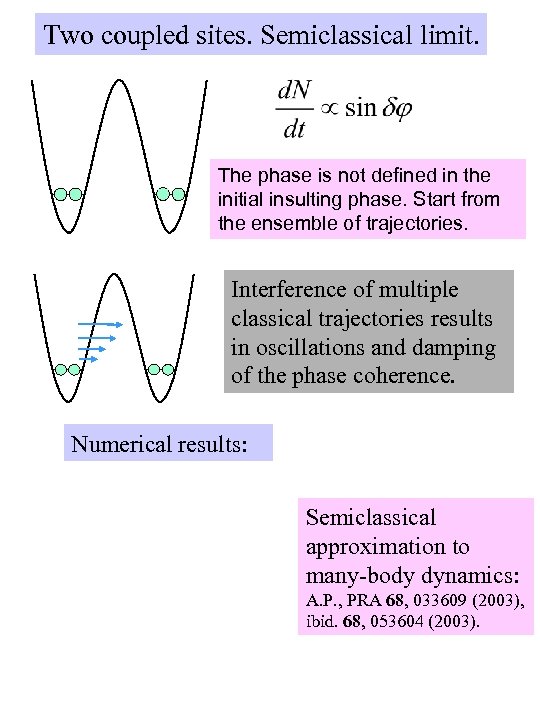 Two coupled sites. Semiclassical limit. The phase is not defined in the initial insulting phase. Start from the ensemble of trajectories. Interference of multiple classical trajectories results in oscillations and damping of the phase coherence. Numerical results: Semiclassical approximation to many-body dynamics: A. P. , PRA 68, 033609 (2003), ibid. 68, 053604 (2003).
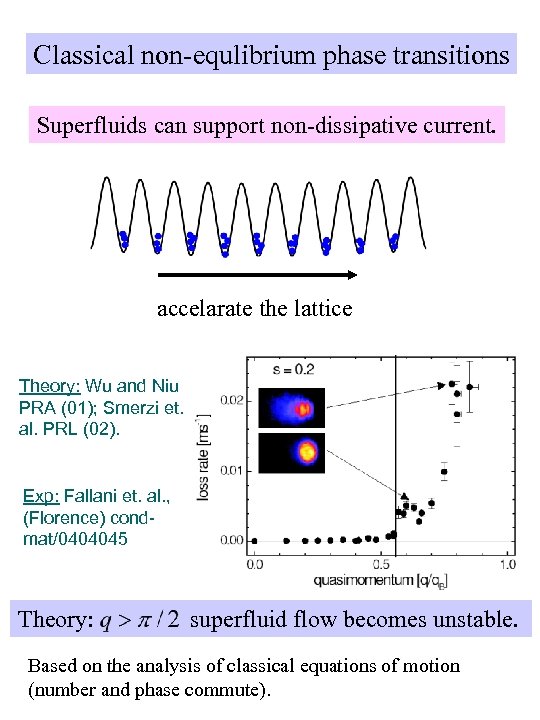 Classical non-equlibrium phase transitions Superfluids can support non-dissipative current. accelarate the lattice Theory: Wu and Niu PRA (01); Smerzi et. al. PRL (02). Exp: Fallani et. al. , (Florence) condmat/0404045 Theory: superfluid flow becomes unstable. Based on the analysis of classical equations of motion (number and phase commute).
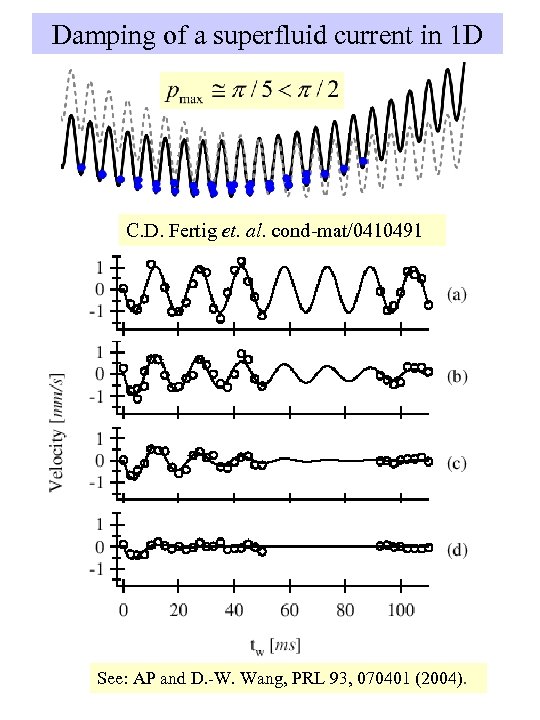 Damping of a superfluid current in 1 D C. D. Fertig et. al. cond-mat/0410491 See: AP and D. -W. Wang, PRL 93, 070401 (2004).
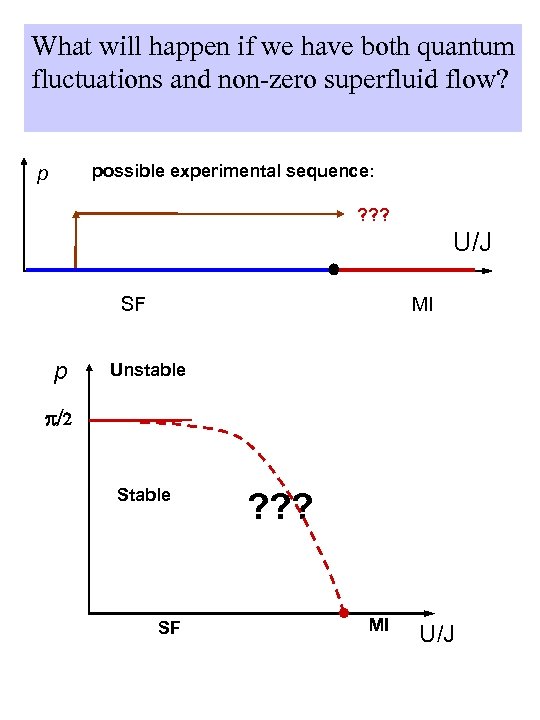 What will happen if we have both quantum fluctuations and non-zero superfluid flow? possible experimental sequence: p ? ? ? U/J SF p MI Unstable p/2 Stable SF ? ? ? MI U/J
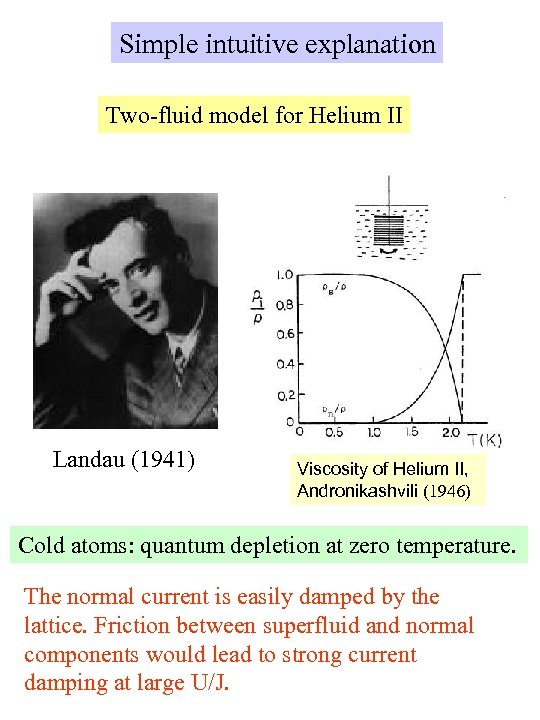 Simple intuitive explanation Two-fluid model for Helium II Landau (1941) Viscosity of Helium II, Andronikashvili (1946) Cold atoms: quantum depletion at zero temperature. The normal current is easily damped by the lattice. Friction between superfluid and normal components would lead to strong current damping at large U/J.
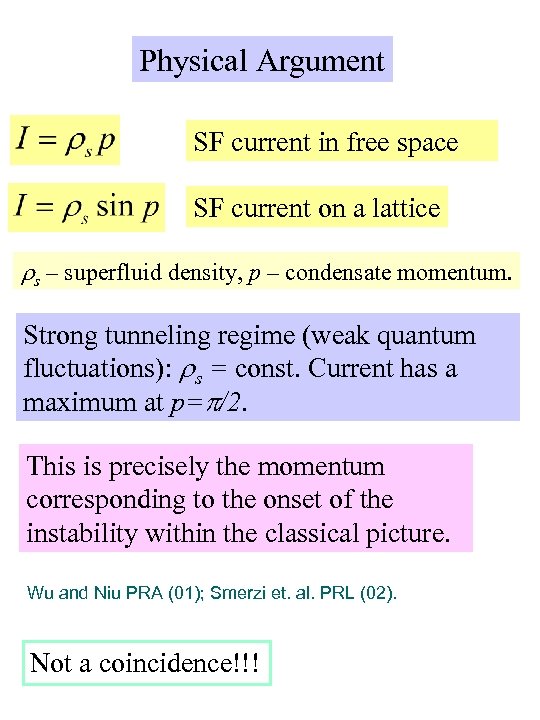 Physical Argument SF current in free space SF current on a lattice s – superfluid density, p – condensate momentum. Strong tunneling regime (weak quantum fluctuations): s = const. Current has a maximum at p= /2. This is precisely the momentum corresponding to the onset of the instability within the classical picture. Wu and Niu PRA (01); Smerzi et. al. PRL (02). Not a coincidence!!!
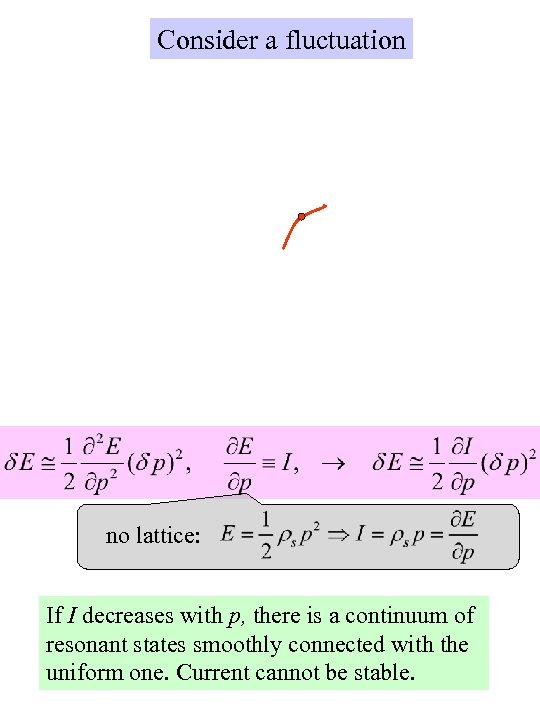 Consider a fluctuation no lattice: If I decreases with p, there is a continuum of resonant states smoothly connected with the uniform one. Current cannot be stable.
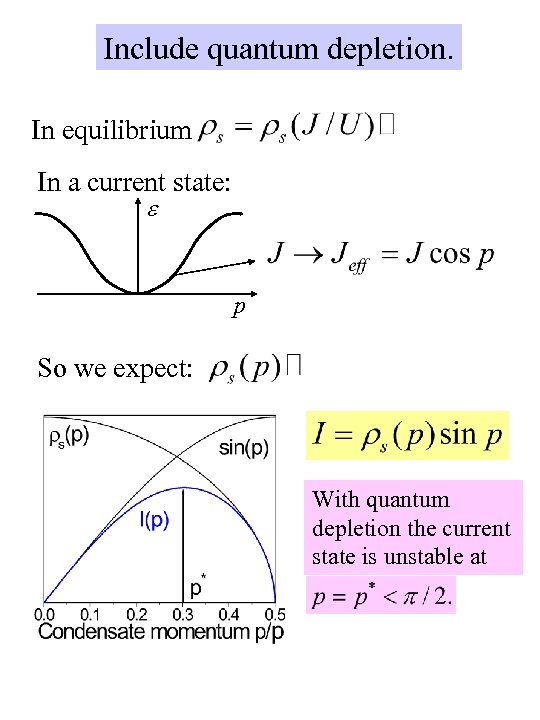 Include quantum depletion. In equilibrium In a current state: p So we expect: With quantum depletion the current state is unstable at
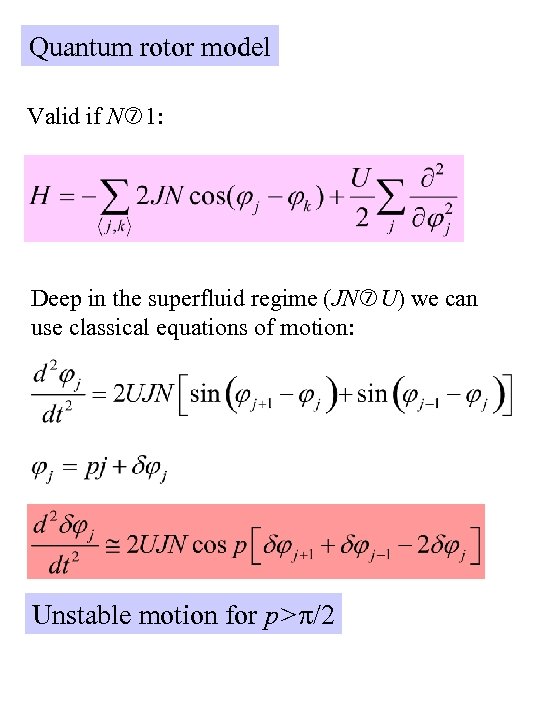 Quantum rotor model Valid if N 1: Deep in the superfluid regime (JN U) we can use classical equations of motion: Unstable motion for p> /2
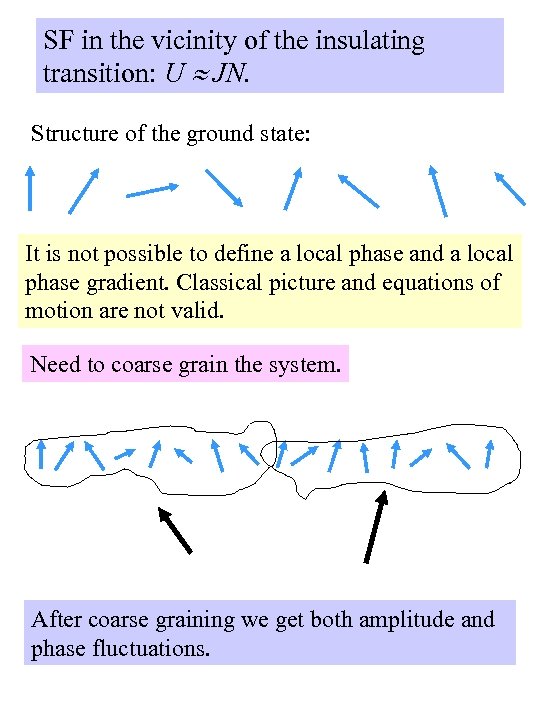 SF in the vicinity of the insulating transition: U JN. Structure of the ground state: It is not possible to define a local phase and a local phase gradient. Classical picture and equations of motion are not valid. Need to coarse grain the system. After coarse graining we get both amplitude and phase fluctuations.
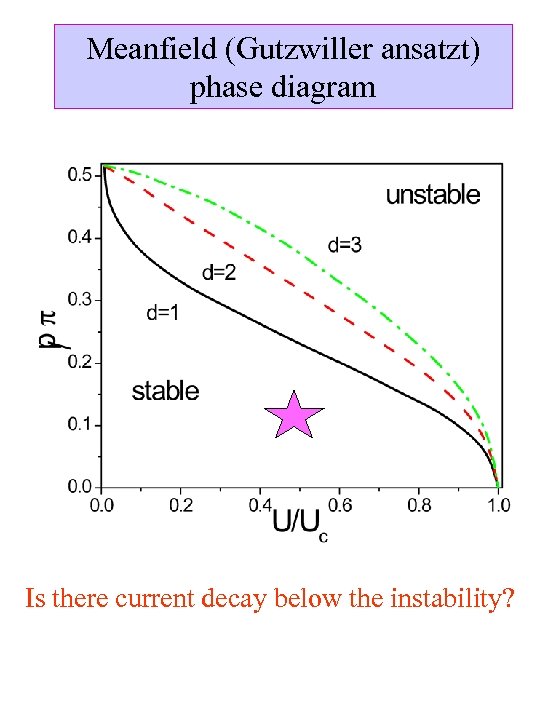
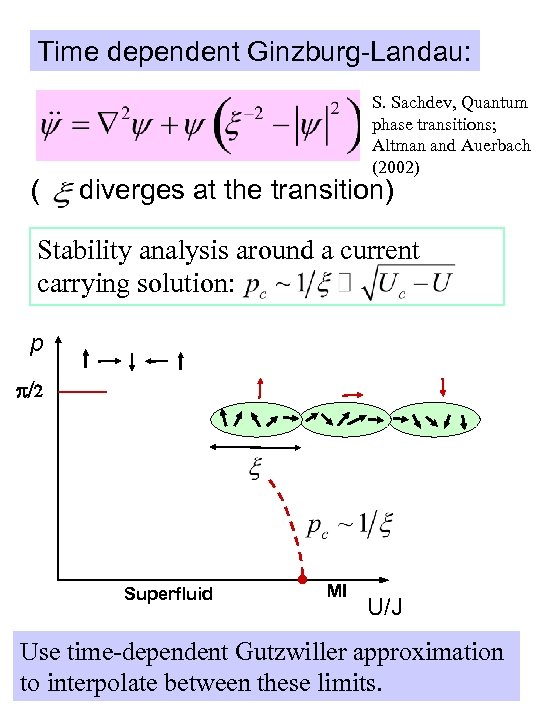 Time dependent Ginzburg-Landau: ( S. Sachdev, Quantum phase transitions; Altman and Auerbach (2002) diverges at the transition) Stability analysis around a current carrying solution: p p/2 Superfluid MI U/J Use time-dependent Gutzwiller approximation to interpolate between these limits.
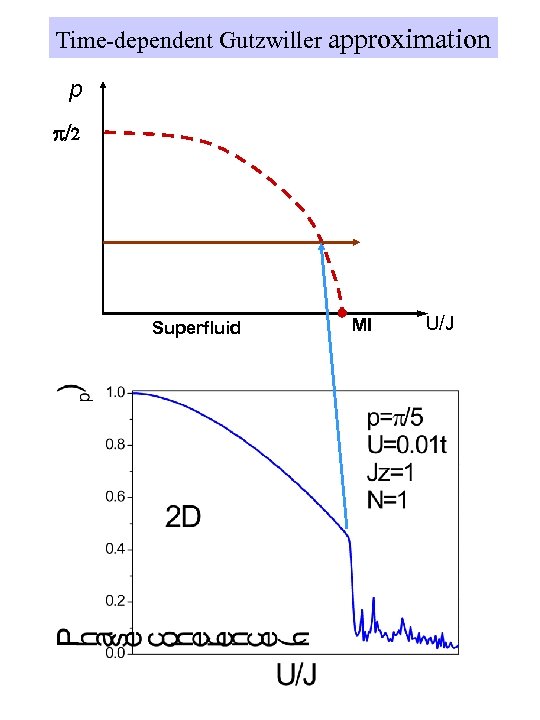 Time-dependent Gutzwiller approximation p p/2 Superfluid MI U/J
 Meanfield (Gutzwiller ansatzt) phase diagram Is there current decay below the instability?
 Role of fluctuations Phase slip E p Below the mean field transition superfluid current can decay via quantum tunneling or thermal decay.
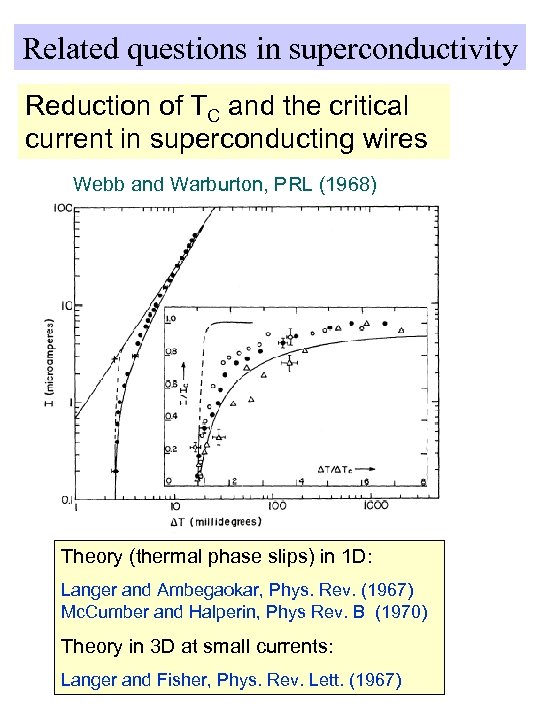 Related questions in superconductivity Reduction of TC and the critical current in superconducting wires Webb and Warburton, PRL (1968) Theory (thermal phase slips) in 1 D: Langer and Ambegaokar, Phys. Rev. (1967) Mc. Cumber and Halperin, Phys Rev. B (1970) Theory in 3 D at small currents: Langer and Fisher, Phys. Rev. Lett. (1967)
 Current decay far from the insulating transition
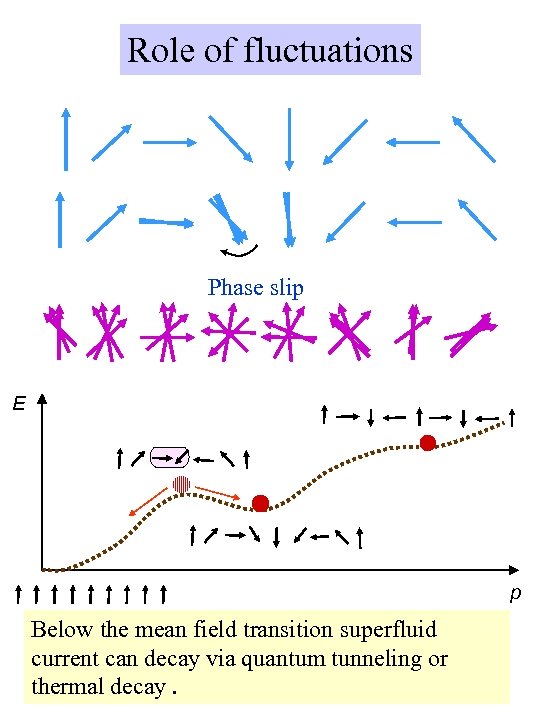
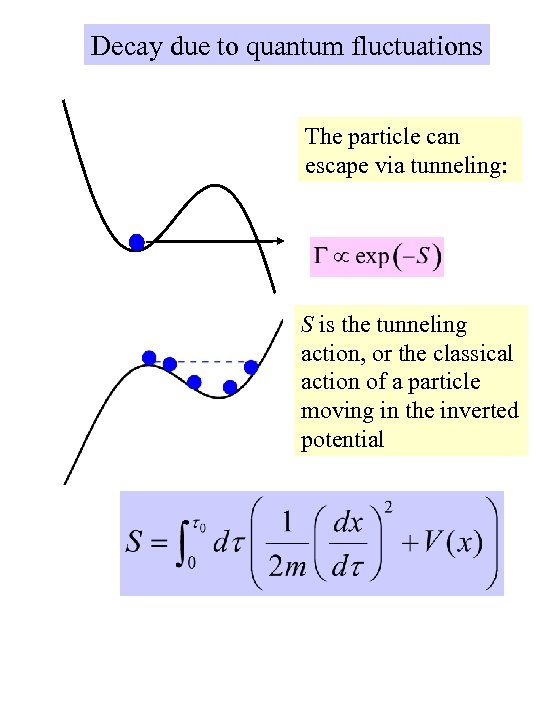 Decay due to quantum fluctuations The particle can escape via tunneling: S is the tunneling action, or the classical action of a particle moving in the inverted potential
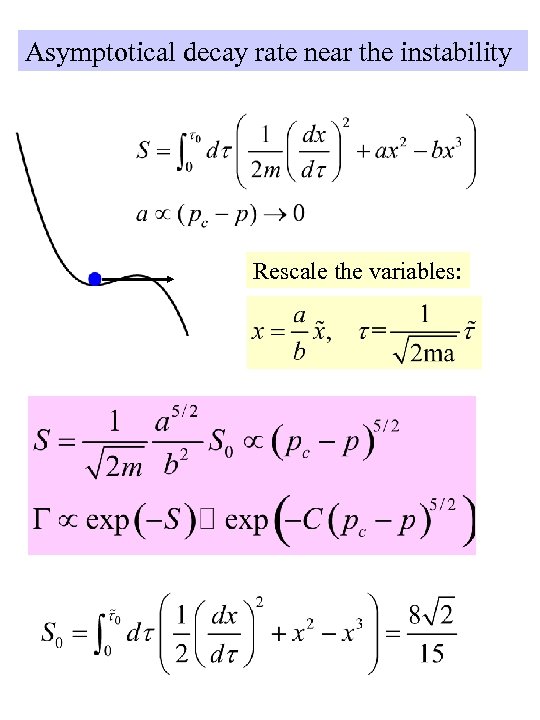 Asymptotical decay rate near the instability Rescale the variables:
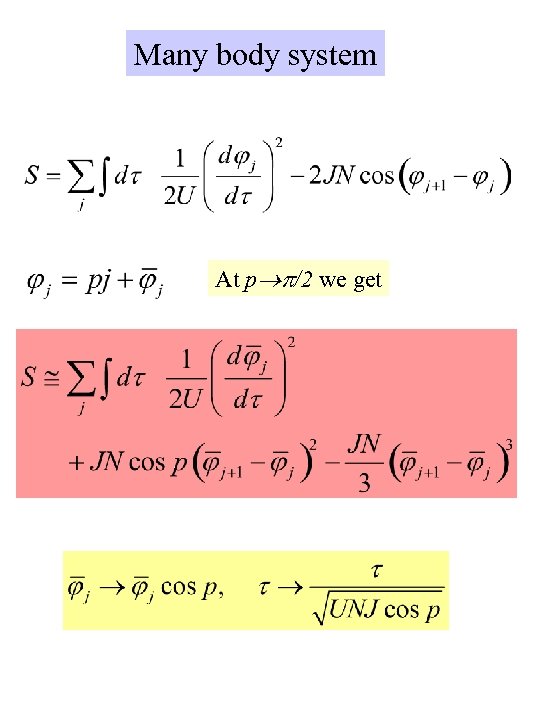 Many body system At p /2 we get
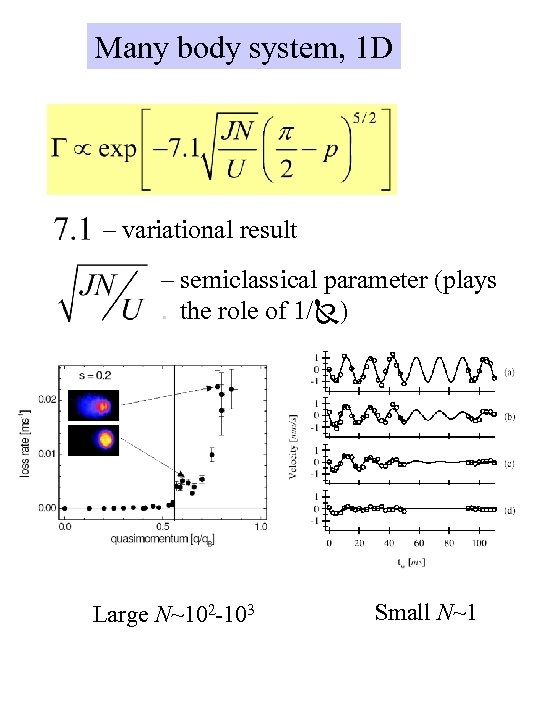 Many body system, 1 D – variational result – semiclassical parameter (plays. the role of 1/ ) Large N~102 -103 Small N~1
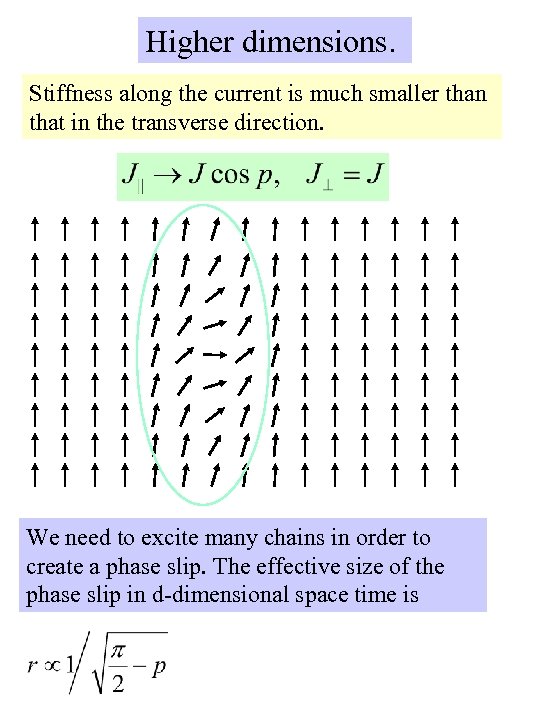 Higher dimensions. Stiffness along the current is much smaller than that in the transverse direction. We need to excite many chains in order to create a phase slip. The effective size of the phase slip in d-dimensional space time is
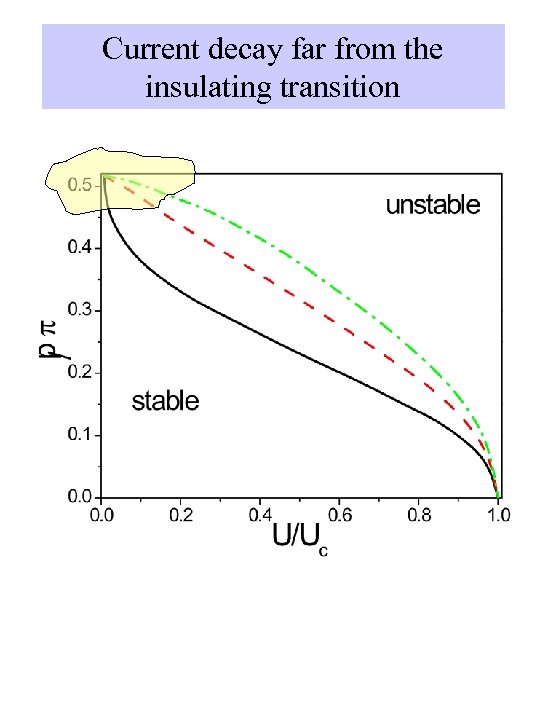
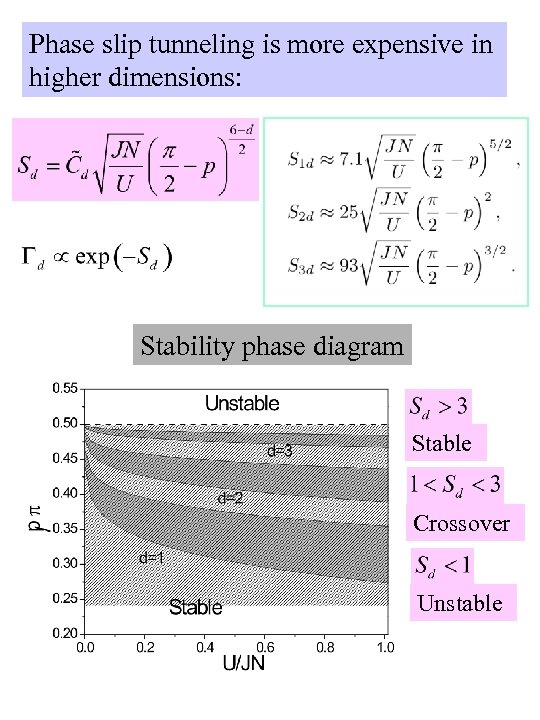 Phase slip tunneling is more expensive in higher dimensions: Stability phase diagram Stable Crossover Unstable
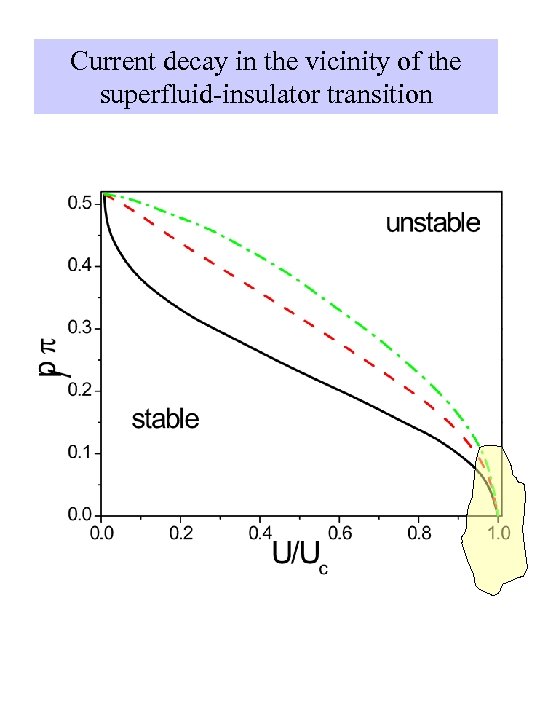 Current decay in the vicinity of the superfluid-insulator transition
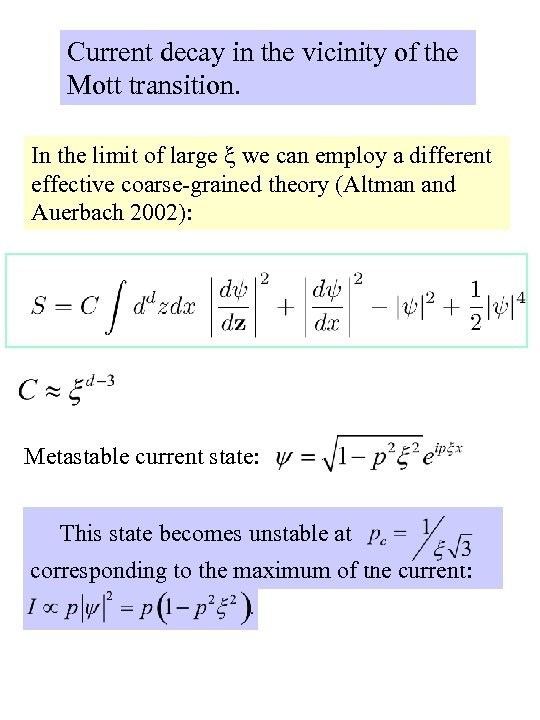 Current decay in the vicinity of the Mott transition. In the limit of large we can employ a different effective coarse-grained theory (Altman and Auerbach 2002): Metastable current state: This state becomes unstable at corresponding to the maximum of the current:
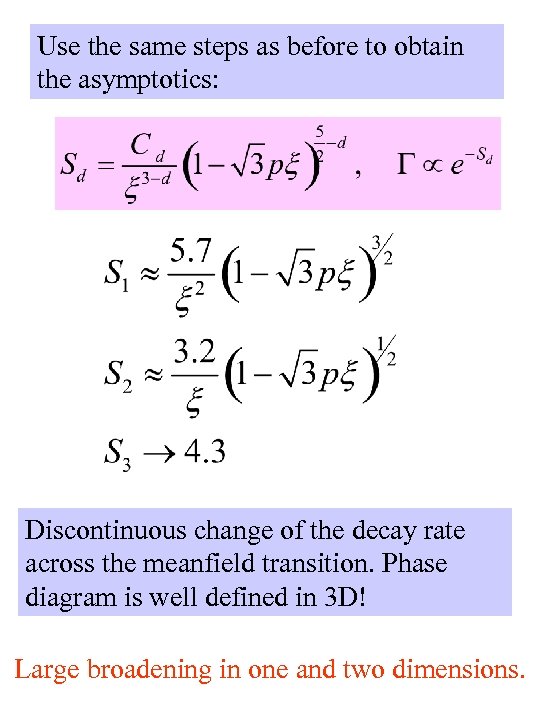 Use the same steps as before to obtain the asymptotics: Discontinuous change of the decay rate across the meanfield transition. Phase diagram is well defined in 3 D! Large broadening in one and two dimensions.
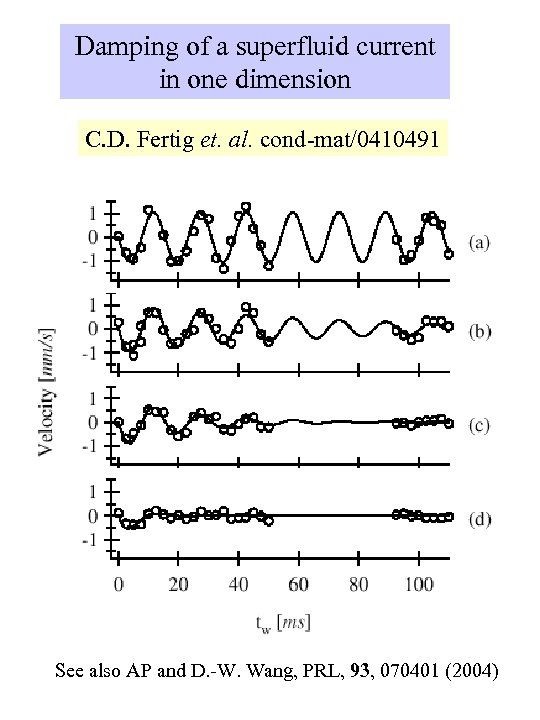 Damping of a superfluid current in one dimension C. D. Fertig et. al. cond-mat/0410491 See also AP and D. -W. Wang, PRL, 93, 070401 (2004)
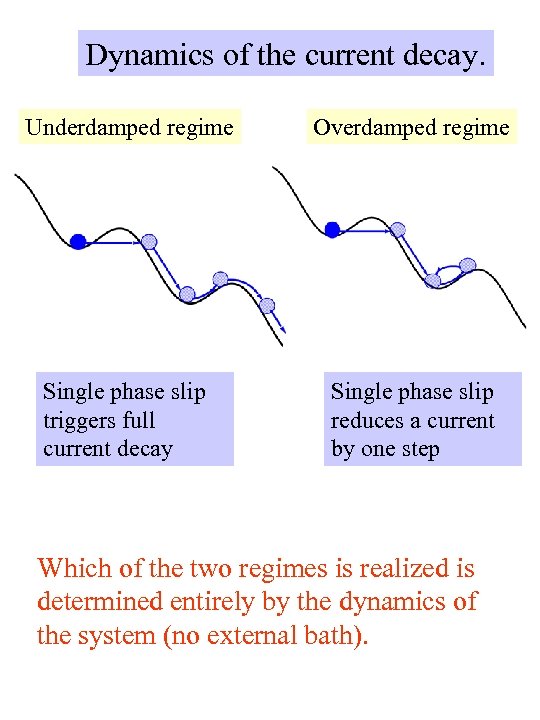 Dynamics of the current decay. Underdamped regime Overdamped regime Single phase slip triggers full current decay Single phase slip reduces a current by one step Which of the two regimes is realized is determined entirely by the dynamics of the system (no external bath).
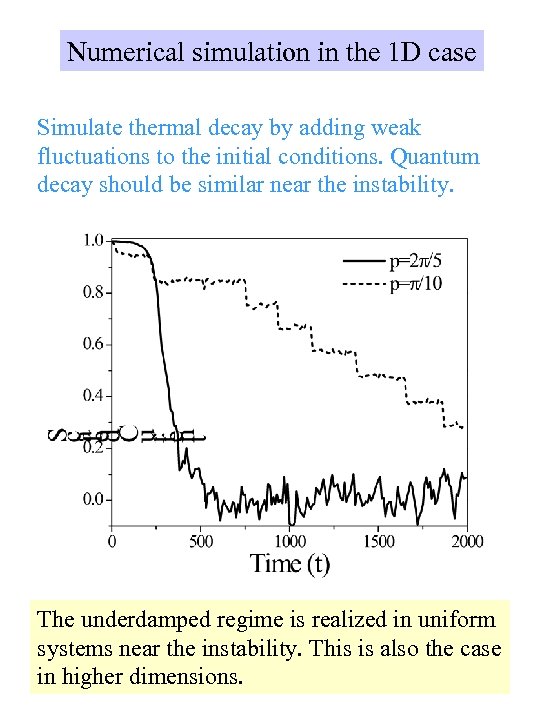 Numerical simulation in the 1 D case Simulate thermal decay by adding weak fluctuations to the initial conditions. Quantum decay should be similar near the instability. The underdamped regime is realized in uniform systems near the instability. This is also the case in higher dimensions.
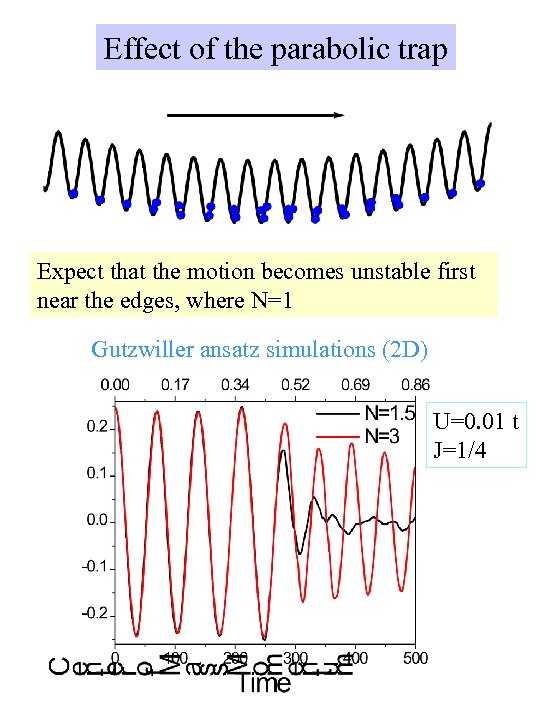 Effect of the parabolic trap Expect that the motion becomes unstable first near the edges, where N=1 Gutzwiller ansatz simulations (2 D) U=0. 01 t J=1/4
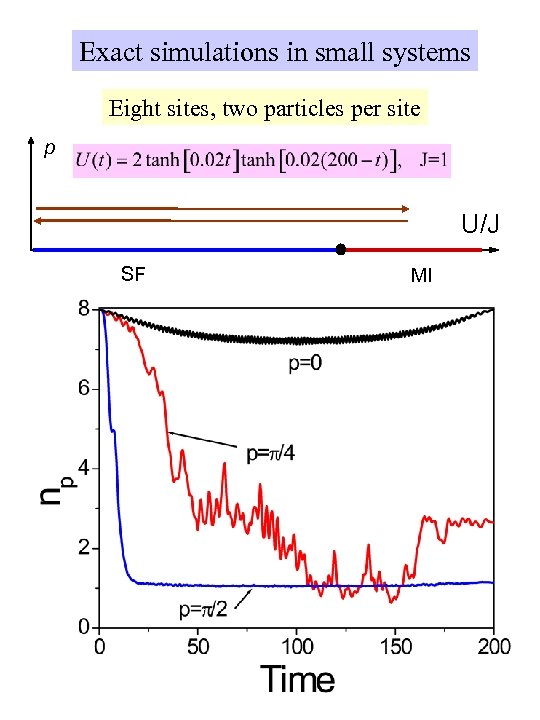 Exact simulations in small systems Eight sites, two particles per site p U/J SF MI
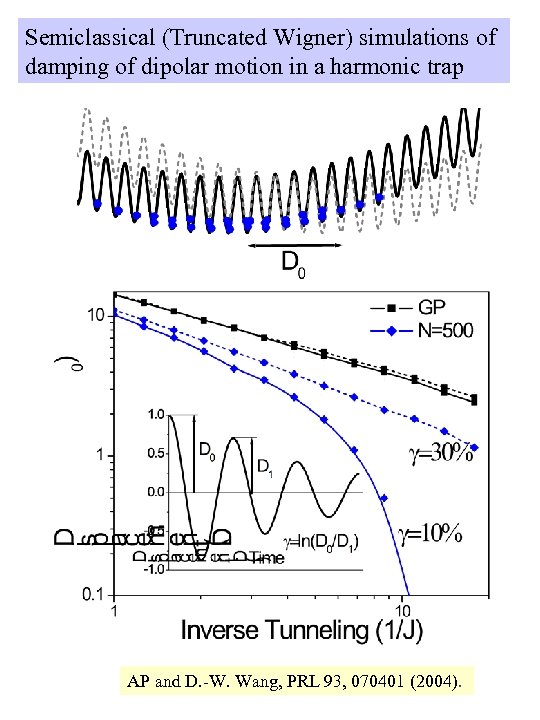 Semiclassical (Truncated Wigner) simulations of damping of dipolar motion in a harmonic trap AP and D. -W. Wang, PRL 93, 070401 (2004).
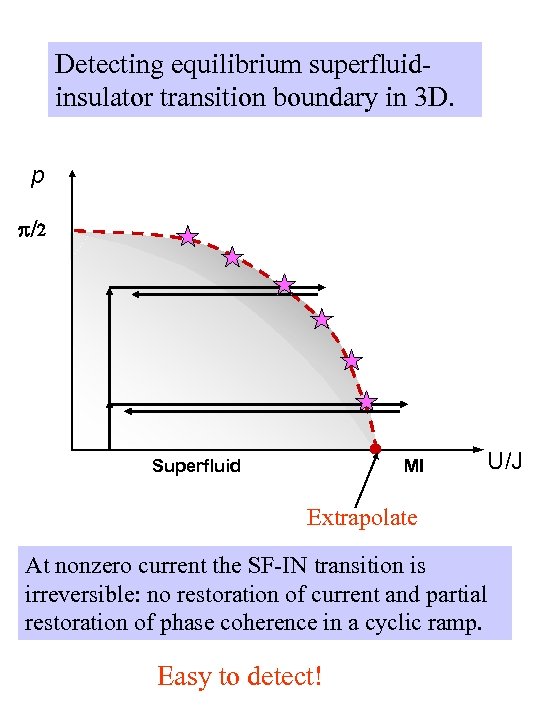 Detecting equilibrium superfluidinsulator transition boundary in 3 D. p p/2 Superfluid MI Extrapolate At nonzero current the SF-IN transition is irreversible: no restoration of current and partial restoration of phase coherence in a cyclic ramp. Easy to detect! U/J
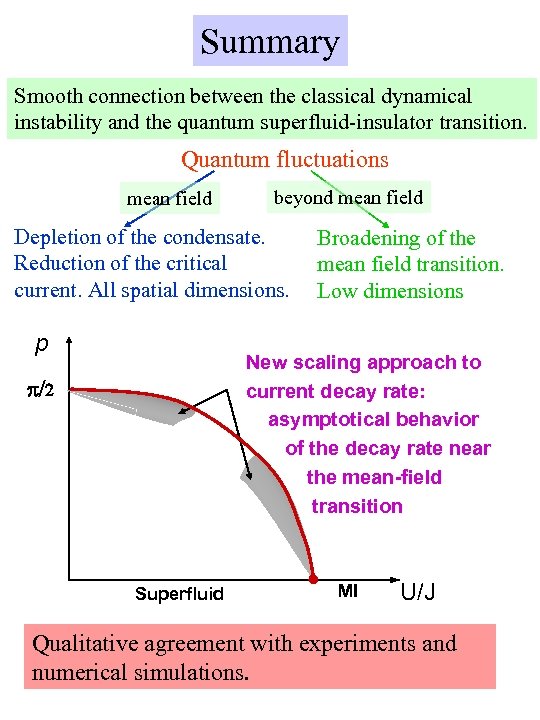 Summary Smooth connection between the classical dynamical instability and the quantum superfluid-insulator transition. Quantum fluctuations mean field beyond mean field Depletion of the condensate. Reduction of the critical current. All spatial dimensions. p Broadening of the mean field transition. Low dimensions New scaling approach to current decay rate: asymptotical behavior of the decay rate near the mean-field transition p/2 Superfluid MI U/J Qualitative agreement with experiments and numerical simulations.