 Скачать презентацию Supercourse 2001 -2002 Abel Murgio M D
7f0a3e6ee110714b8989b7e0f992dd58.ppt
- Количество слайдов: 31




Supercourse 2001 -2002 Abel Murgio, M. D.
“Is the CT Scan important at the 24 Hours in Children with Mild Traumatic Brain Injury? International Multicentre Study” Authors: °Murgio A. , *Mutluer S. , **Fong D. , #Hotz G. , ^Di Rocco C. , ^^Herrera EJ. , ^^Viano JC. ºI. S. H. I. P. Group Argentina , *Turkey; **China; #USA; ^Italy; ^^Argentina;
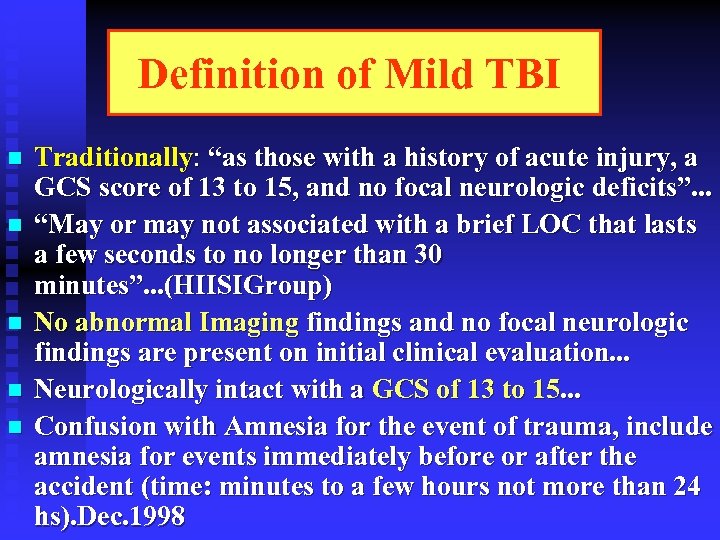
Definition of Mild TBI n n n Traditionally: “as those with a history of acute injury, a GCS score of 13 to 15, and no focal neurologic deficits”. . . “May or may not associated with a brief LOC that lasts a few seconds to no longer than 30 minutes”. . . (HIISIGroup) No abnormal Imaging findings and no focal neurologic findings are present on initial clinical evaluation. . . Neurologically intact with a GCS of 13 to 15. . . Confusion with Amnesia for the event of trauma, include amnesia for events immediately before or after the accident (time: minutes to a few hours not more than 24 hs). Dec. 1998
Objectives The principal idea of this study was to evaluate –using an international and multicentre populationthe relationships between severity of injury, risk factor and imaging findings by attending physicians.
I. S. H. I. P. group Countries 1996 -98 Phase I 5 countries 1999 -2001 Phase II 22 countries Web Site: www. iship-international. org
Methods Multicentre prospective, randomized, study of children who serially presented to Emergency Department with Traumatic Brain Injury. Phase I: 1996 -98 with 4, 690 Patients; Phase II: 1999 -01 with 4, 770 Patients. Neurological Evaluations: GCS and PGCS Follow-up: GOS
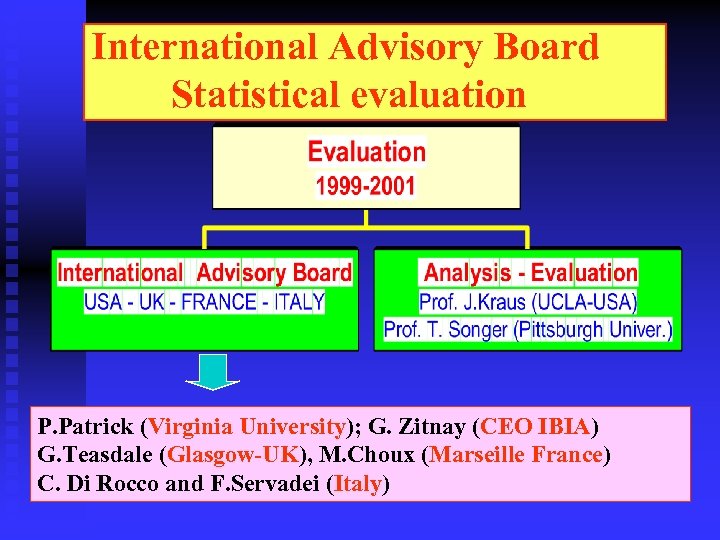
International Advisory Board Statistical evaluation P. Patrick (Virginia University); G. Zitnay (CEO IBIA) G. Teasdale (Glasgow-UK), M. Choux (Marseille France) C. Di Rocco and F. Servadei (Italy)
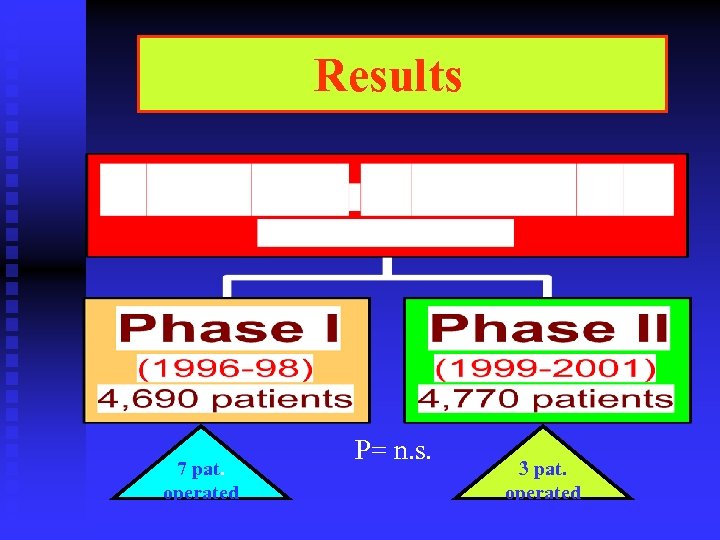
Results 7 pat. operated P= n. s. 3 pat. operated
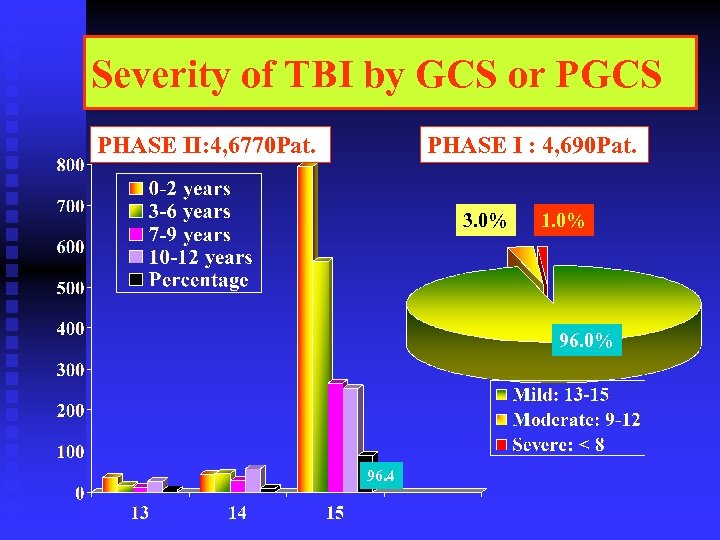
Severity of TBI by GCS or PGCS PHASE II: 4, 6770 Pat. PHASE I : 4, 690 Pat. 3. 0% 1. 0% 96. 4
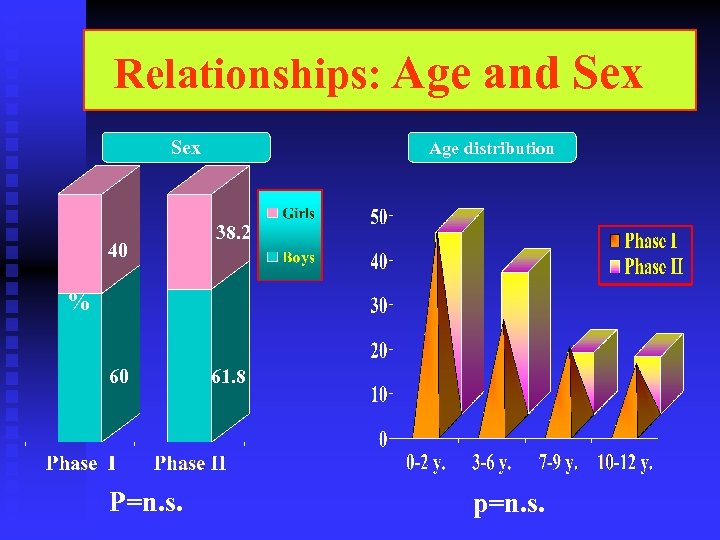
Relationships: Age and Sex 40 Age distribution 38. 2 % 60 P=n. s. 61. 8 p=n. s.
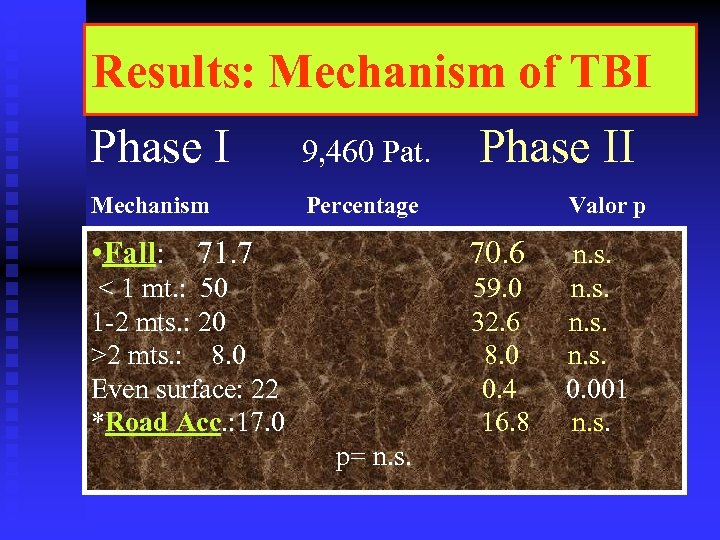
Results: Mechanism of TBI Phase I 9, 460 Pat. Mechanism Phase II Percentage Valor p • Fall: 71. 7 70. 6 < 1 mt. : 50 1 -2 mts. : 20 >2 mts. : 8. 0 Even surface: 22 *Road Acc. : 17. 0 59. 0 32. 6 8. 0 0. 4 16. 8 p= n. s. 0. 001 n. s.
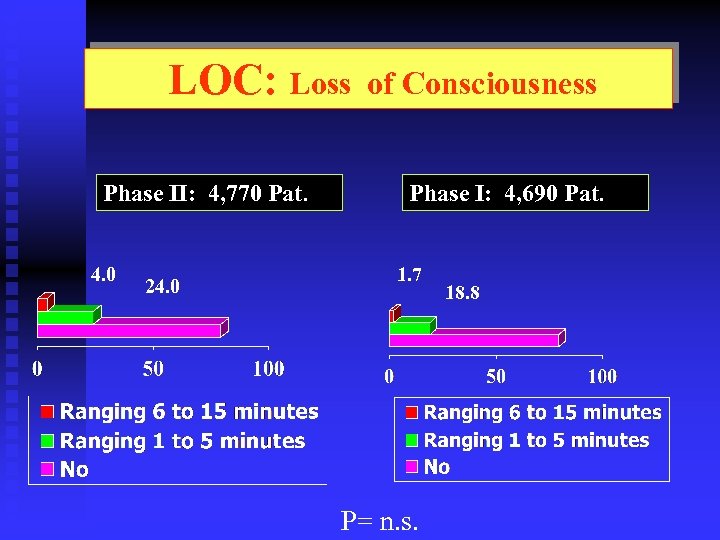
LOC: Loss Phase II: 4, 770 Pat. 4. 0 24. 0 of Consciousness Phase I: 4, 690 Pat. 1. 7 P= n. s. 18. 8
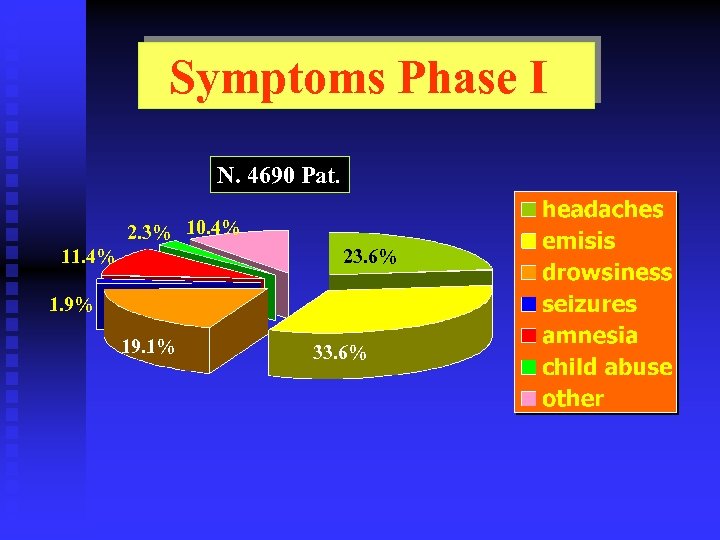
Symptoms Phase I N. 4690 Pat. 2. 3% 10. 4% 11. 4% 23. 6% 1. 9% 19. 1% 33. 6%
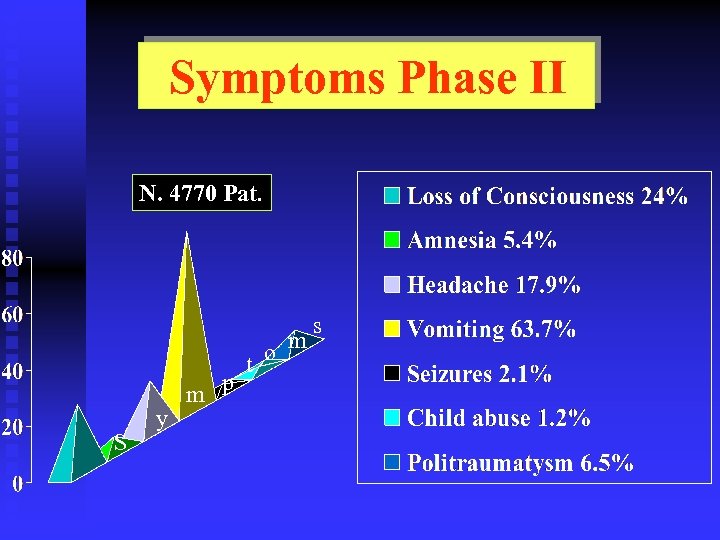
Symptoms Phase II N. 4770 Pat. S y m p o m t s
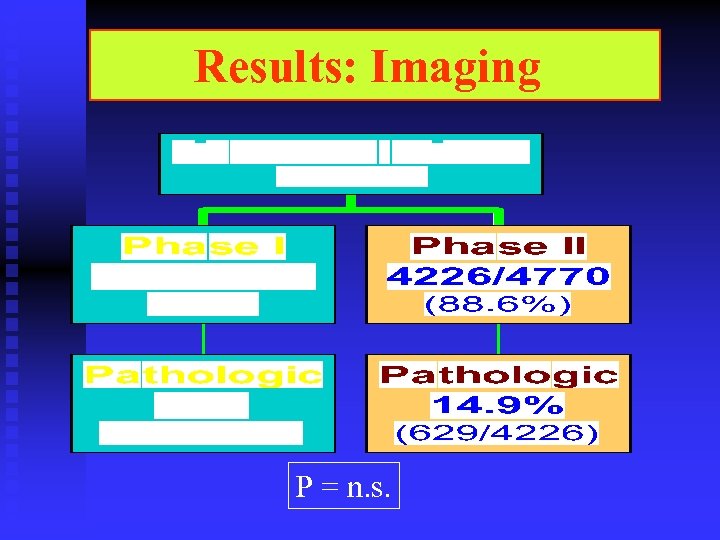
Results: Imaging P = n. s.
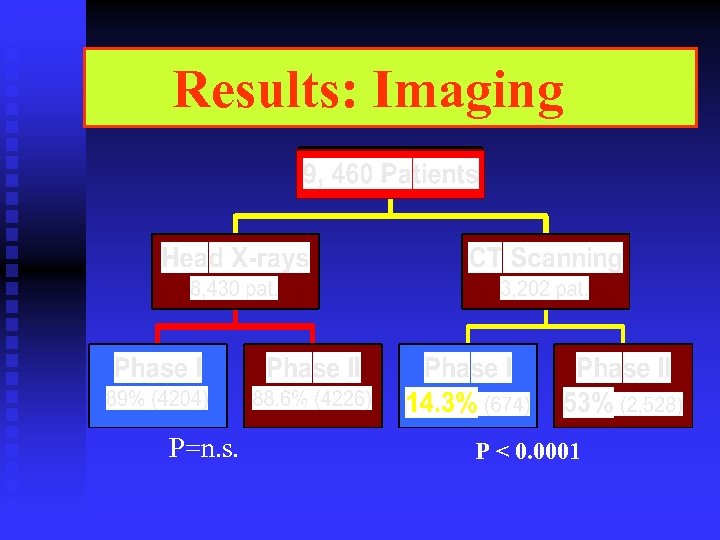
Results: Imaging P=n. s. P < 0. 0001
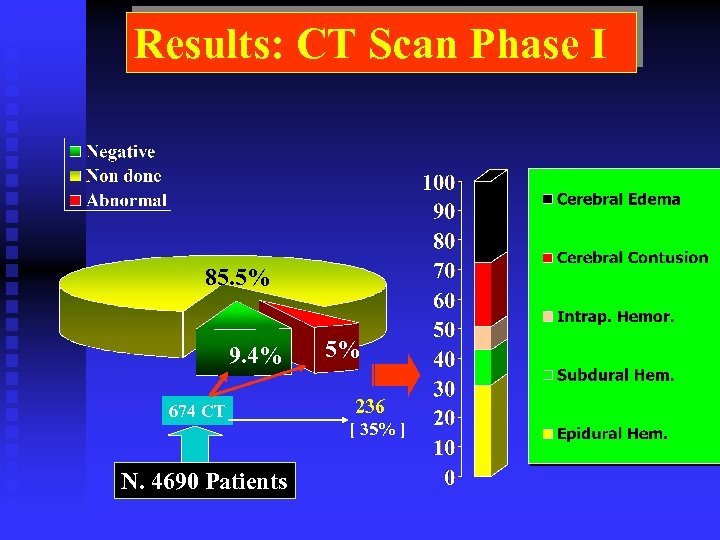
Results: CT Scan Phase I 85. 5% 9. 4% 674 CT N. 4690 Patients 5% 236 [ 35% ]
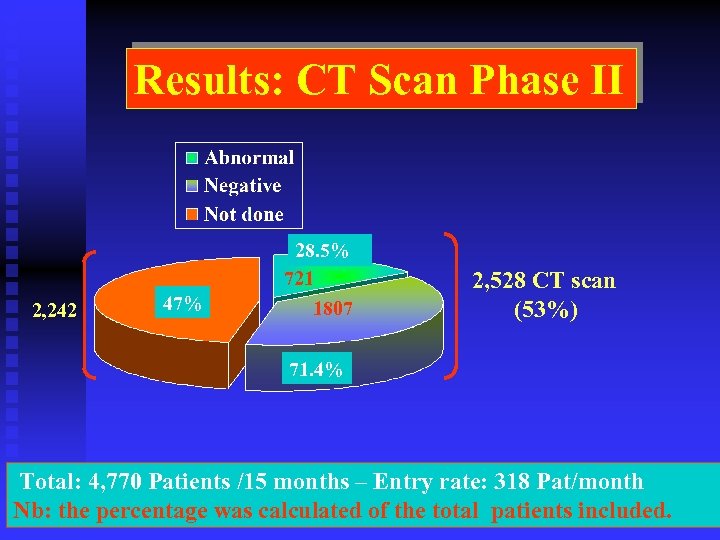
Results: CT Scan Phase II 2, 242 47% 28. 5% 721 1807 2, 528 CT scan (53%) 71. 4% Total: 4, 770 Patients /15 months – Entry rate: 318 Pat/month Nb: the percentage was calculated of the total patients included.
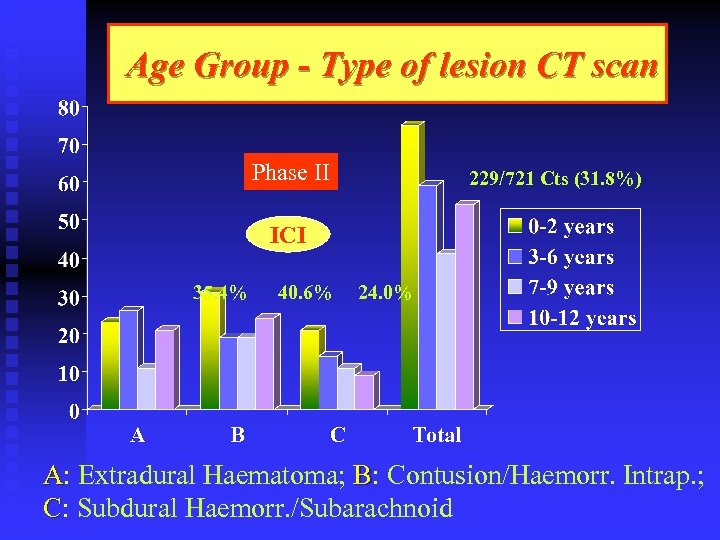
Age Group - Type of lesion CT scan Phase II 229/721 Cts (31. 8%) ICI 35. 4% 40. 6% 24. 0% A: Extradural Haematoma; B: Contusion/Haemorr. Intrap. ; C: Subdural Haemorr. /Subarachnoid
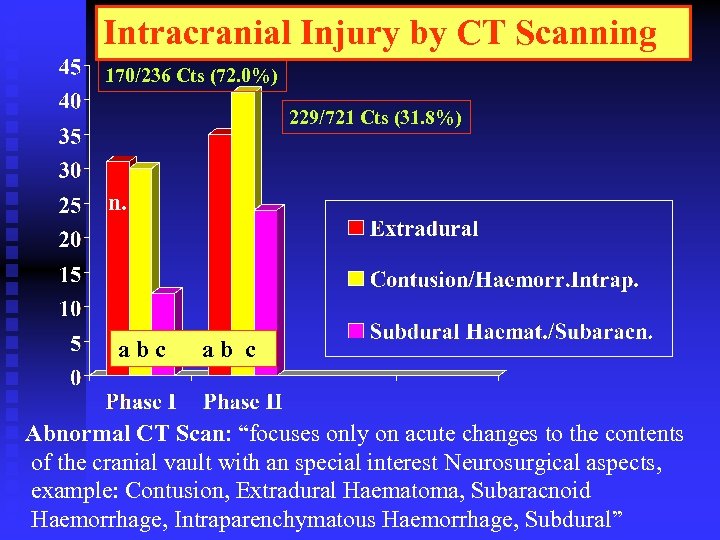
Intracranial Injury by CT Scanning 170/236 Cts (72. 0%) 229/721 Cts (31. 8%) n. abc ab c Abnormal CT Scan: “focuses only on acute changes to the contents of the cranial vault with an special interest Neurosurgical aspects, example: Contusion, Extradural Haematoma, Subaracnoid Haemorrhage, Intraparenchymatous Haemorrhage, Subdural”
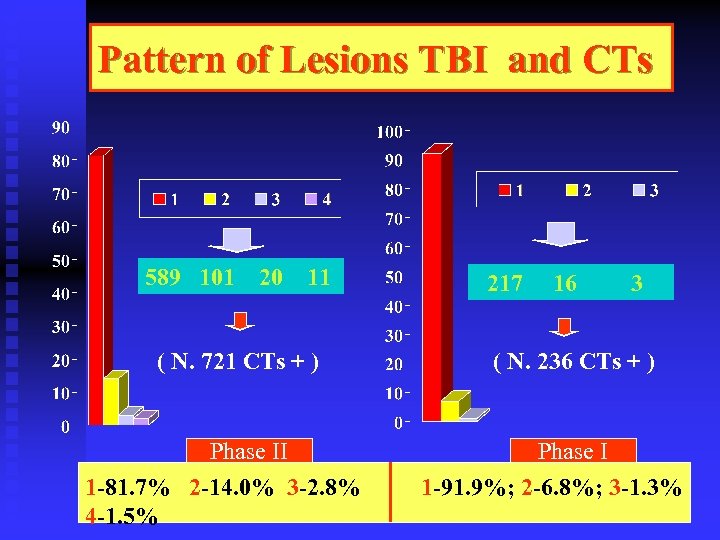
Pattern of Lesions TBI and CTs 589 101 20 11 ( N. 721 CTs + ) Phase II 1 -81. 7% 2 -14. 0% 3 -2. 8% 4 -1. 5% 217 16 3 ( N. 236 CTs + ) Phase I 1 -91. 9%; 2 -6. 8%; 3 -1. 3%
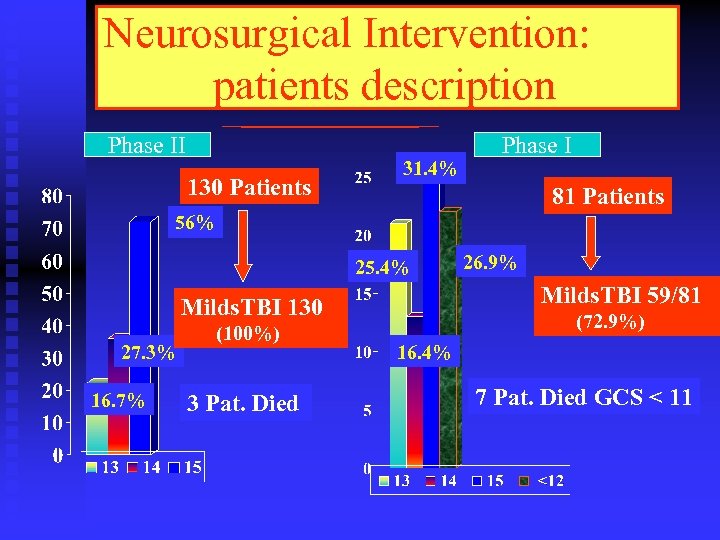
Neurosurgical Intervention: patients description Phase II 130 Patients 31. 4% Phase I 81 Patients 56% 25. 4% Milds. TBI 59/81 Milds. TBI 130 27. 3% 16. 7% (100%) 3 Pat. Died 26. 9% (72. 9%) 16. 4% 7 Pat. Died GCS < 11
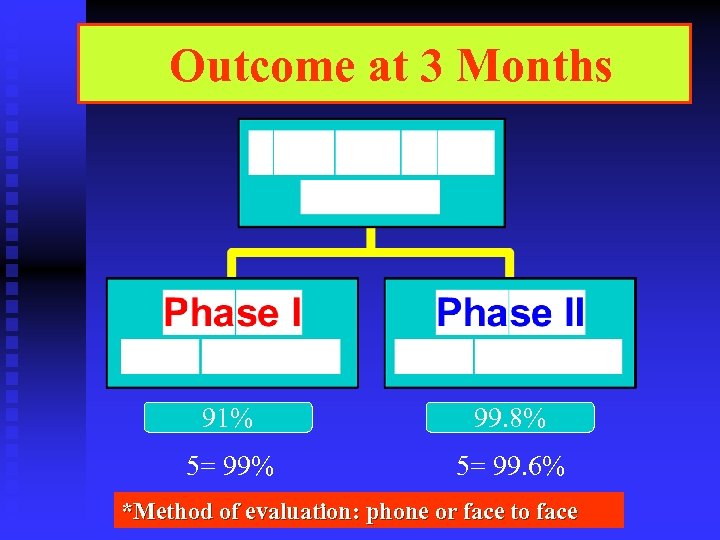
Outcome at 3 Months 91% 99. 8% 5= 99. 6% *Method of evaluation: phone or face to face
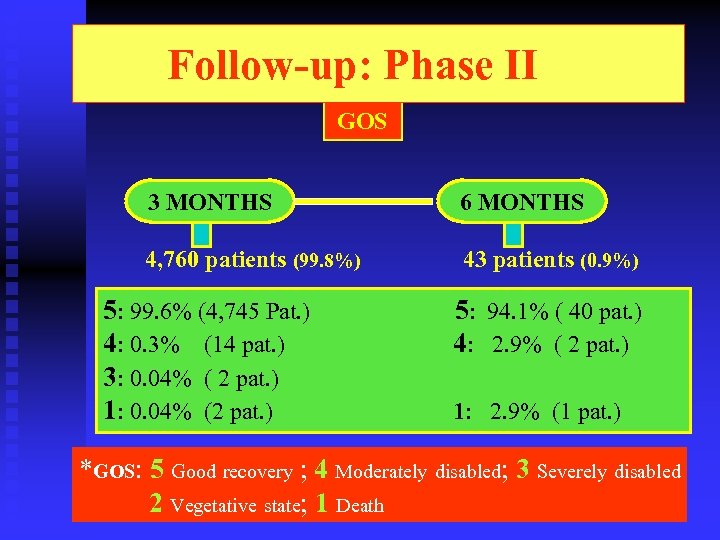
Follow-up: Phase II GOS 3 MONTHS 6 MONTHS 4, 760 patients (99. 8%) 43 patients (0. 9%) 5: 99. 6% (4, 745 Pat. ) 4: 0. 3% (14 pat. ) 3: 0. 04% ( 2 pat. ) 1: 0. 04% (2 pat. ) 5: 94. 1% ( 40 pat. ) 4: 2. 9% ( 2 pat. ) 1: 2. 9% (1 pat. ) *GOS: 5 Good recovery ; 4 Moderately disabled; 3 Severely disabled 2 Vegetative state; 1 Death
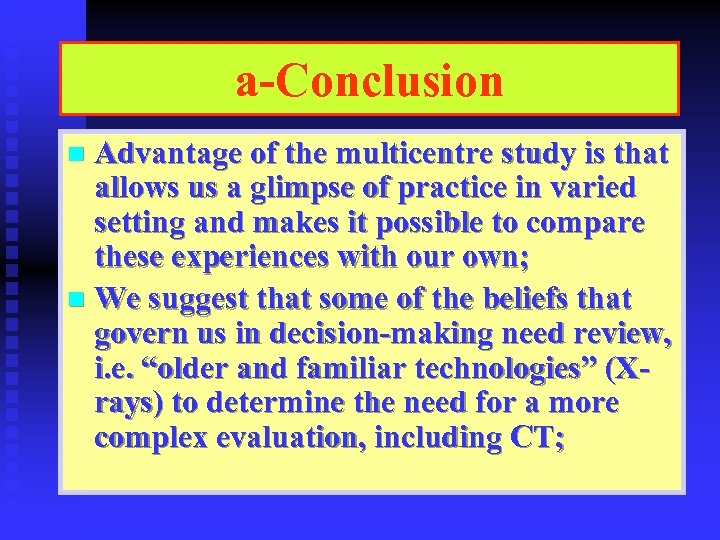
a-Conclusion Advantage of the multicentre study is that allows us a glimpse of practice in varied setting and makes it possible to compare these experiences with our own; n We suggest that some of the beliefs that govern us in decision-making need review, i. e. “older and familiar technologies” (Xrays) to determine the need for a more complex evaluation, including CT; n
b-Conclusion The physical and neurological examination are inadequate “predictors” of ICI; n The CT Scan is “more sensitive”; n Liberal use of CT scans in children under 6 years of age and younger with TBI is because they “may present without symptoms”; n
c-Conclusion n Until more definitive information is available, clinicians should be liberal in their use of CT so that early identification of significant ICI can be obtained and appropriate management of the injuries initiated.
International Society of Pediatric Neurosurgery : I. S. P. N. n “The critical issue will be to have guidelines that, when used would identify all patients who need surgery, with as few negative scans to achieve this. ” n “Should we now try to use the data to create guidelines and then validate them…”
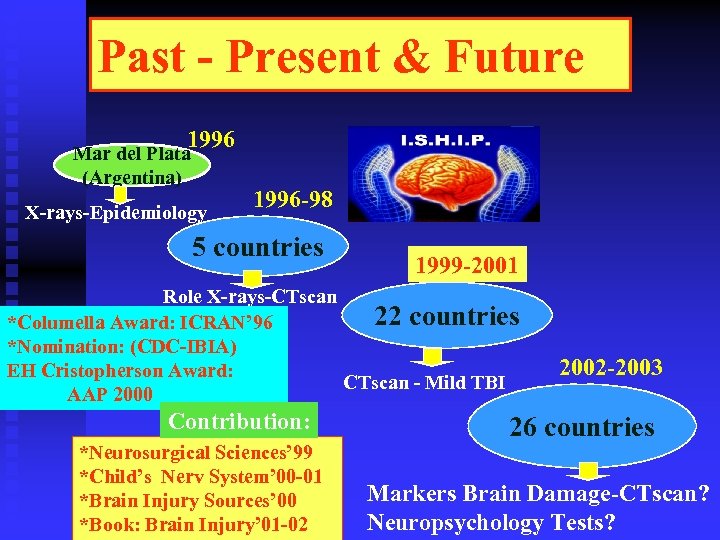
Past - Present & Future 1996 Mar del Plata (Argentina) X-rays-Epidemiology 1996 -98 5 countries 1999 -2001 Role X-rays-CTscan 22 countries *Columella Award: ICRAN’ 96 *Nomination: (CDC-IBIA) EH Cristopherson Award: CTscan - Mild TBI AAP 2000 Contribution: *Neurosurgical Sciences’ 99 *Child’s Nerv System’ 00 -01 *Brain Injury Sources’ 00 *Book: Brain Injury’ 01 -02 2002 -2003 26 countries Markers Brain Damage-CTscan? Neuropsychology Tests?
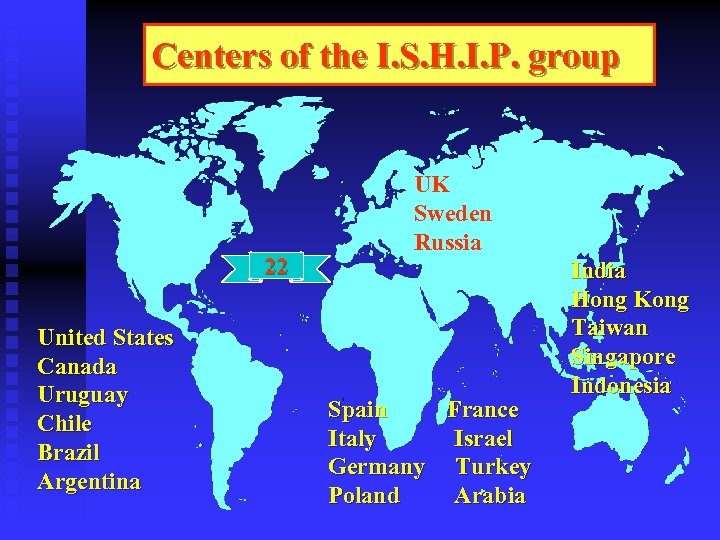
Centers of the I. S. H. I. P. group 22 United States Canada Uruguay Chile Brazil Argentina UK Sweden Russia Spain France Italy Israel Germany Turkey Poland Arabia India Hong Kong Taiwan Singapore Indonesia
d-Conclusion n We think that is necessary to make an accurate evaluation of each patient with Mild TBI under 12 years of age and considerer order a CT scan into 24 hours to identify ICI and guarantee a good out come.
Скачать презентацию Supercourse 2001 -2002 Abel Murgio M D
7f0a3e6ee110714b8989b7e0f992dd58.ppt