


 Скачать презентацию Superconductivity Malygin Georgiy Andreevich Group 25 RF 112
Superconductivity.ppt
- Количество слайдов: 9
 Superconductivity Malygin Georgiy Andreevich Group: 25 RF 112
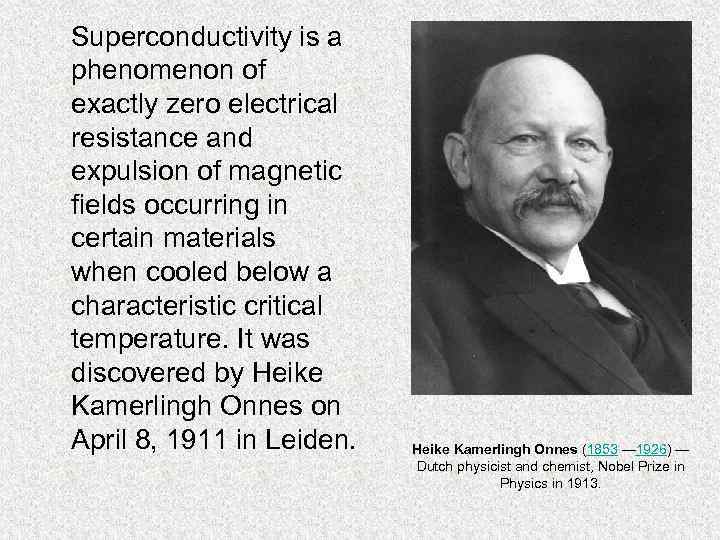 Superconductivity is a phenomenon of exactly zero electrical resistance and expulsion of magnetic fields occurring in certain materials when cooled below a characteristic critical temperature. It was discovered by Heike Kamerlingh Onnes on April 8, 1911 in Leiden. Heike Kamerlingh Onnes (1853 — 1926) — Dutch physicist and chemist, Nobel Prize in Physics in 1913.
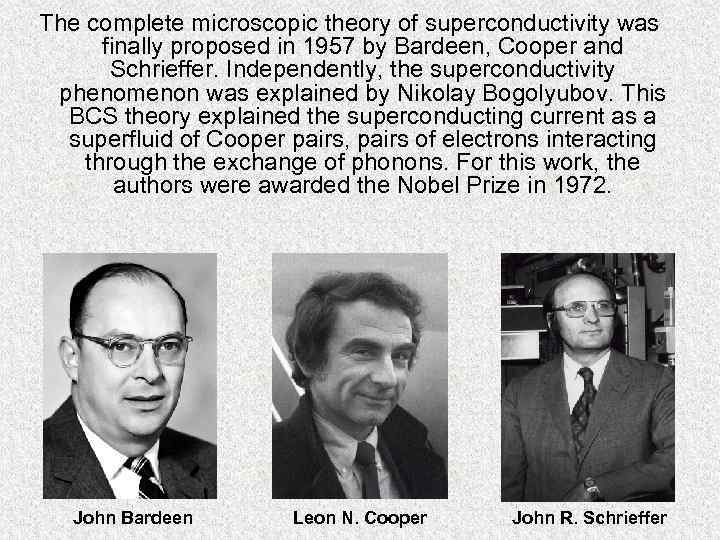 The complete microscopic theory of superconductivity was finally proposed in 1957 by Bardeen, Cooper and Schrieffer. Independently, the superconductivity phenomenon was explained by Nikolay Bogolyubov. This BCS theory explained the superconducting current as a superfluid of Cooper pairs, pairs of electrons interacting through the exchange of phonons. For this work, the authors were awarded the Nobel Prize in 1972. John Bardeen Leon N. Cooper John R. Schrieffer
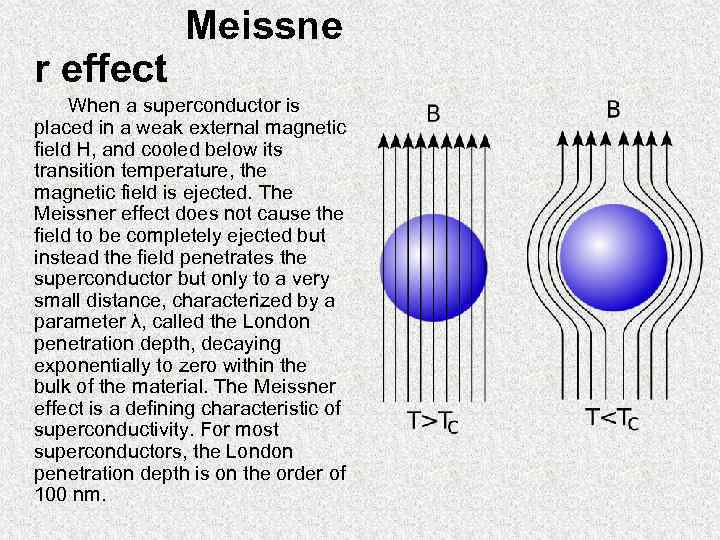 r effect Meissne When a superconductor is placed in a weak external magnetic field H, and cooled below its transition temperature, the magnetic field is ejected. The Meissner effect does not cause the field to be completely ejected but instead the field penetrates the superconductor but only to a very small distance, characterized by a parameter λ, called the London penetration depth, decaying exponentially to zero within the bulk of the material. The Meissner effect is a defining characteristic of superconductivity. For most superconductors, the London penetration depth is on the order of 100 nm.
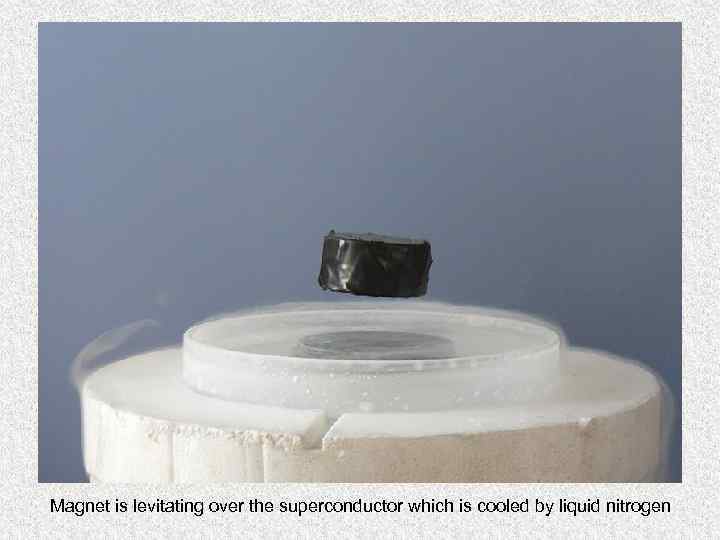 Magnet is levitating over the superconductor which is cooled by liquid nitrogen
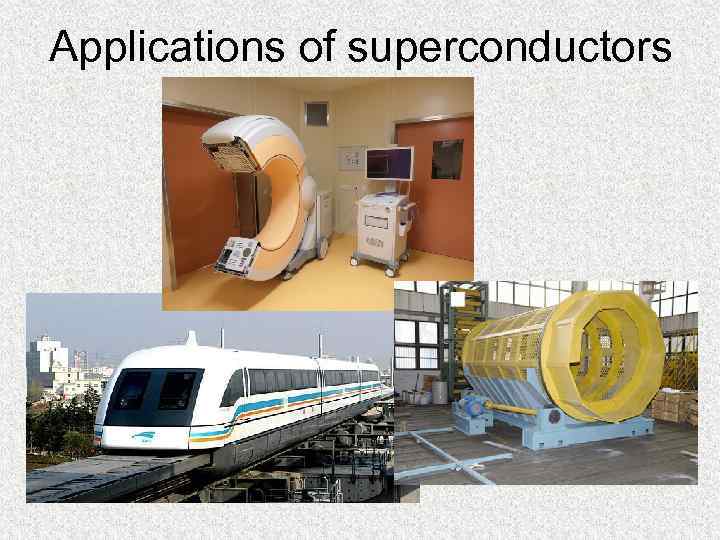 Applications of superconductors
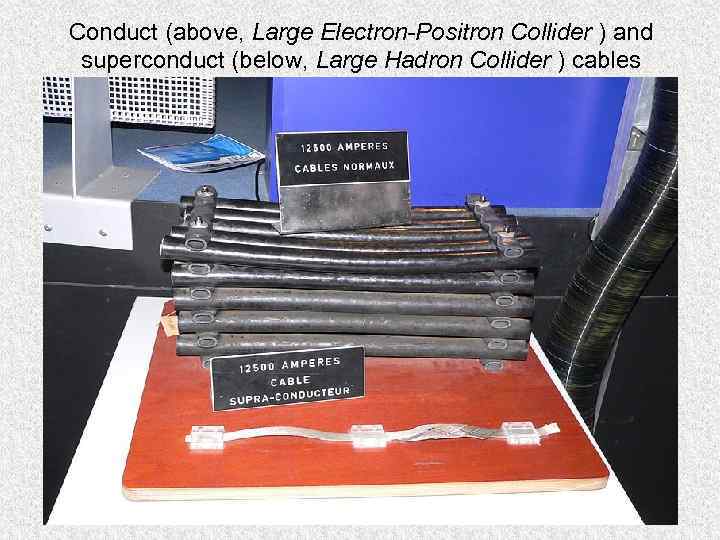 Conduct (above, Large Electron-Positron Collider ) and superconduct (below, Large Hadron Collider ) cables
 Superconductors are used in many different spheres of science and technology and enter in modern more and more. Using superconductors opens the great opportunities for energy economy and for making decision of many modern ecological problems.
 Thanks for your attention!