


 Скачать презентацию Superconductivity — An overview of science and technology
3735e183d4b0ea6ac883ca2624dd552a.ppt
- Количество слайдов: 50
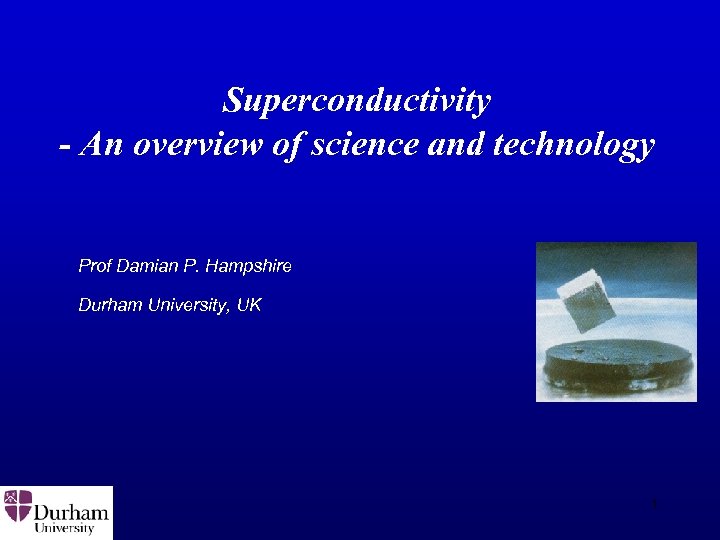 Superconductivity - An overview of science and technology Prof Damian P. Hampshire Durham University, UK 1
 2 Structure of the Talk I) The fundamental building blocks - II) (G-L) Ginzburg-Landau and (B-C-S) Bardeen-Cooper. Schrieffer theories The Josephson effect Critical current and pinning (zero resistance) The important materials Classic LTS high field materials – Nb. Ti and Nb 3 Sn The high temperature superconductors The pnictides (Superconductivity and magnetism) III) Technology – MRI, LHC, ITER and beyond. .
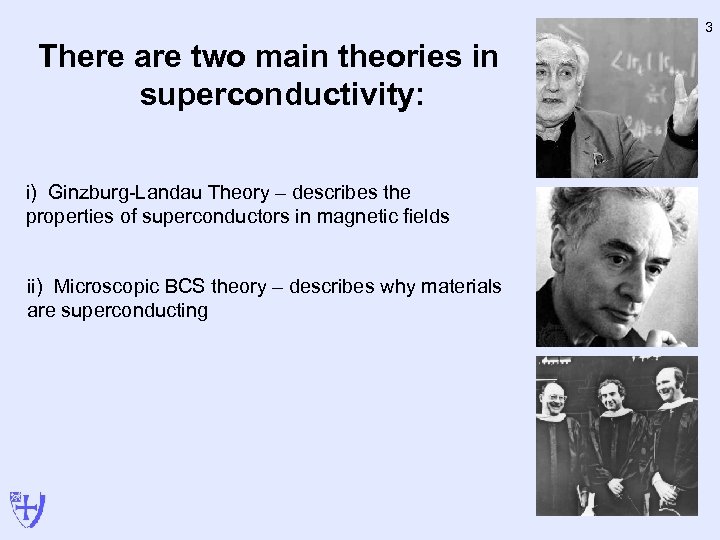 3 There are two main theories in superconductivity: i) Ginzburg-Landau Theory – describes the properties of superconductors in magnetic fields ii) Microscopic BCS theory – describes why materials are superconducting
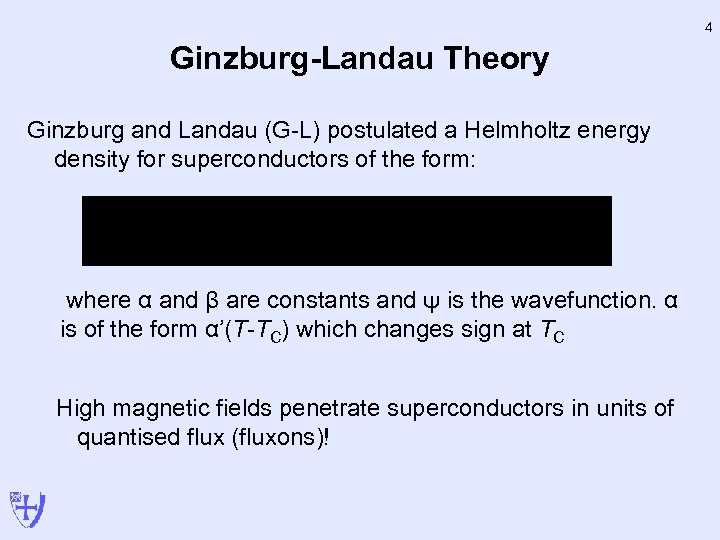 4 Ginzburg-Landau Theory Ginzburg and Landau (G-L) postulated a Helmholtz energy density for superconductors of the form: where α and β are constants and ψ is the wavefunction. α is of the form α’(T-TC) which changes sign at TC High magnetic fields penetrate superconductors in units of quantised flux (fluxons)!
 A fluxon has quantised magnetic flux - its structure is like a tornado 5
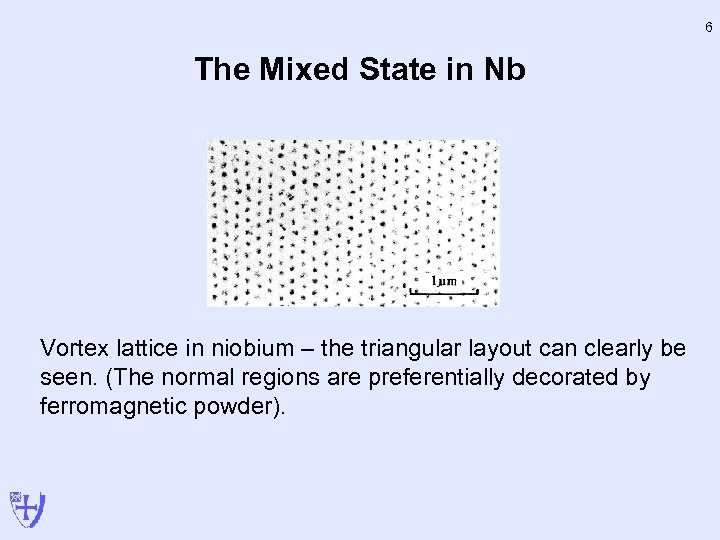 6 The Mixed State in Nb Vortex lattice in niobium – the triangular layout can clearly be seen. (The normal regions are preferentially decorated by ferromagnetic powder).
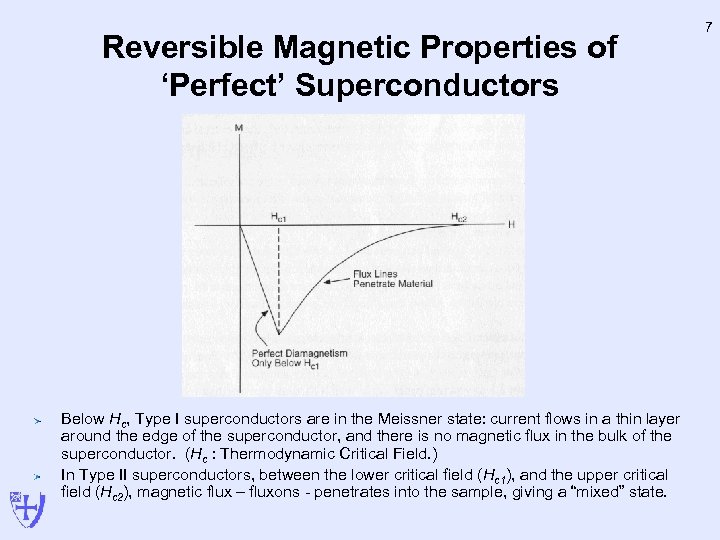 Reversible Magnetic Properties of ‘Perfect’ Superconductors Below Hc, Type I superconductors are in the Meissner state: current flows in a thin layer around the edge of the superconductor, and there is no magnetic flux in the bulk of the superconductor. (Hc : Thermodynamic Critical Field. ) In Type II superconductors, between the lower critical field (Hc 1), and the upper critical field (Hc 2), magnetic flux – fluxons - penetrates into the sample, giving a “mixed” state. 7
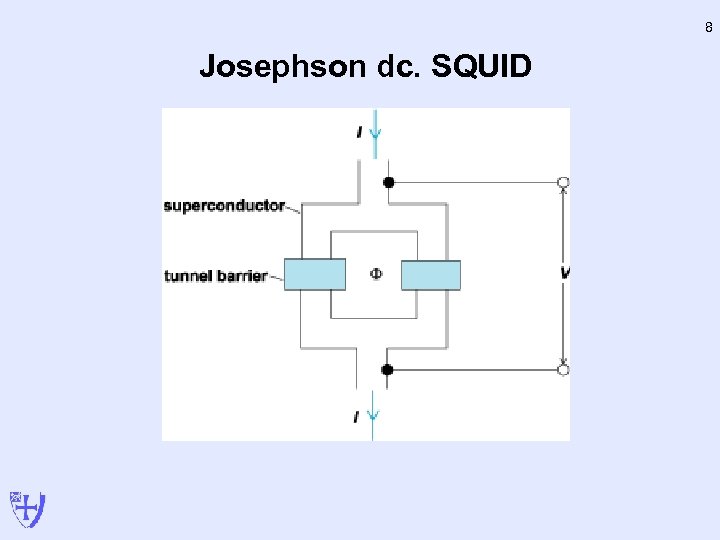 8 Josephson dc. SQUID
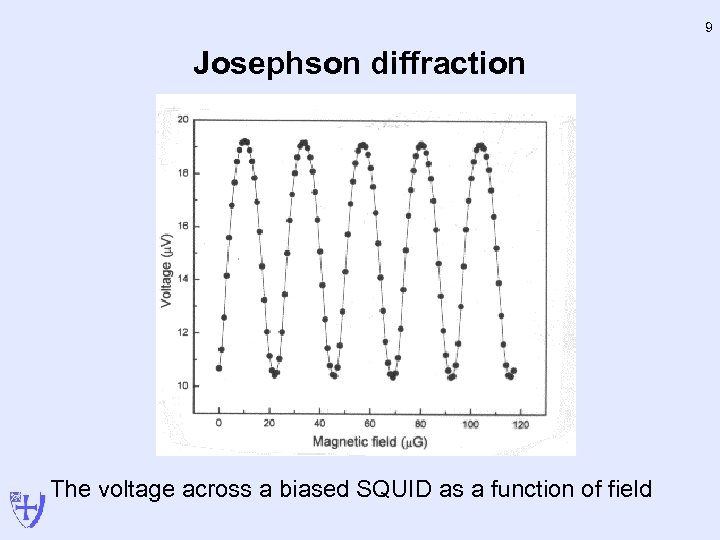 9 Josephson diffraction The voltage across a biased SQUID as a function of field
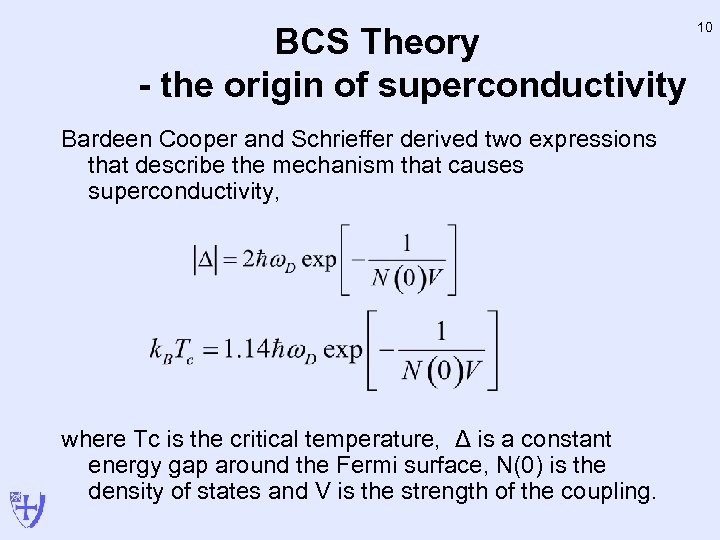 BCS Theory - the origin of superconductivity Bardeen Cooper and Schrieffer derived two expressions that describe the mechanism that causes superconductivity, where Tc is the critical temperature, Δ is a constant energy gap around the Fermi surface, N(0) is the density of states and V is the strength of the coupling. 10
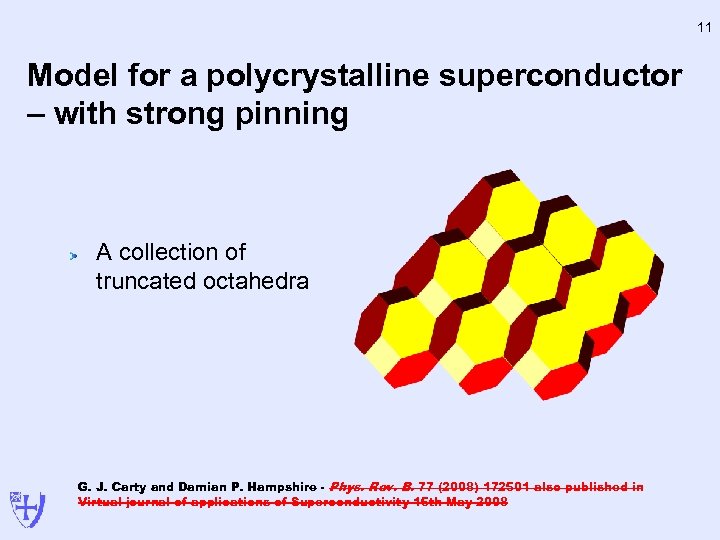 11 Model for a polycrystalline superconductor – with strong pinning A collection of truncated octahedra G. J. Carty and Damian P. Hampshire - Phys. Rev. B. 77 (2008) 172501 also published in Virtual journal of applications of Superconductivity 15 th May 2008
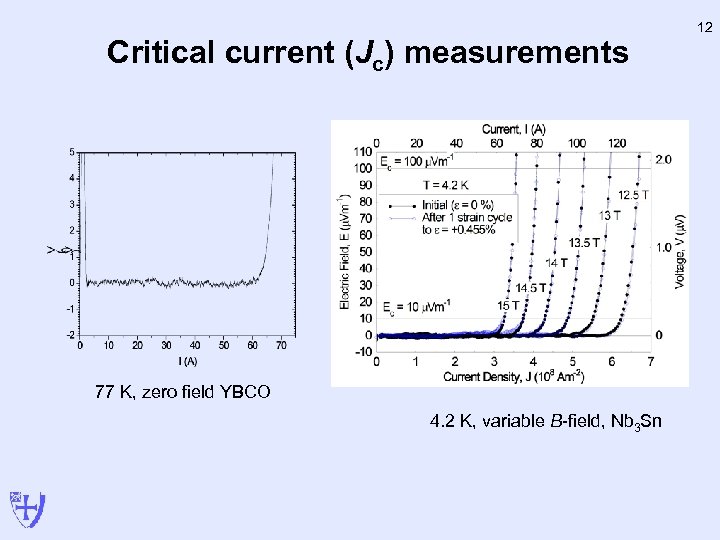 Critical current (Jc) measurements 77 K, zero field YBCO 4. 2 K, variable B-field, Nb 3 Sn 12
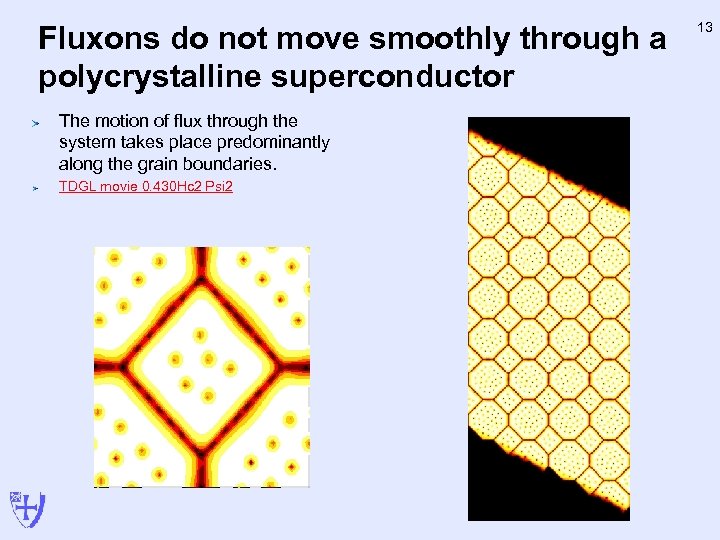 Fluxons do not move smoothly through a polycrystalline superconductor The motion of flux through the system takes place predominantly along the grain boundaries. TDGL movie 0. 430 Hc 2 Psi 2 13
 14 Structure of the Talk I) The fundamental building blocks - II) (G-L) Ginzburg-Landau and (B-C-S) Bardeen-Cooper. Schrieffer theories The Josephson effect Critical current and pinning (zero resistance) The important materials Classic LTS high field materials – Nb. Ti and Nb 3 Sn The high temperature superconductors The pnictides (Superconductivity and magnetism) III) Technology – MRI, LHC, ITER and beyond. .
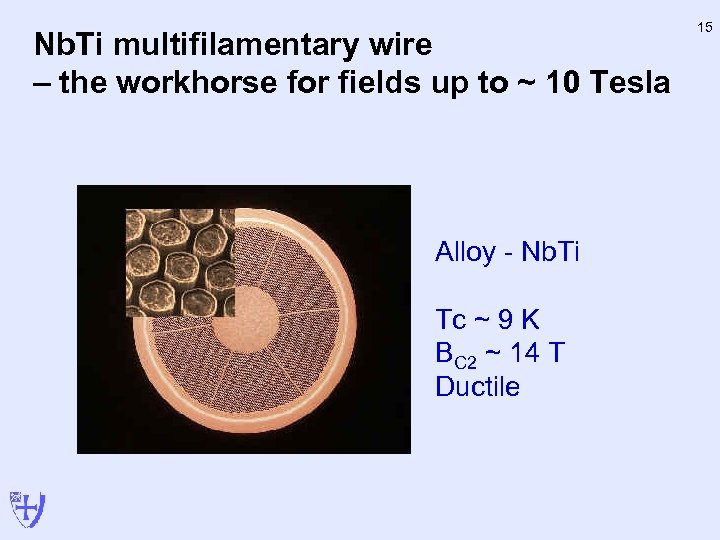 Nb. Ti multifilamentary wire – the workhorse for fields up to ~ 10 Tesla Alloy - Nb. Ti Tc ~ 9 K BC 2 ~ 14 T Ductile 15
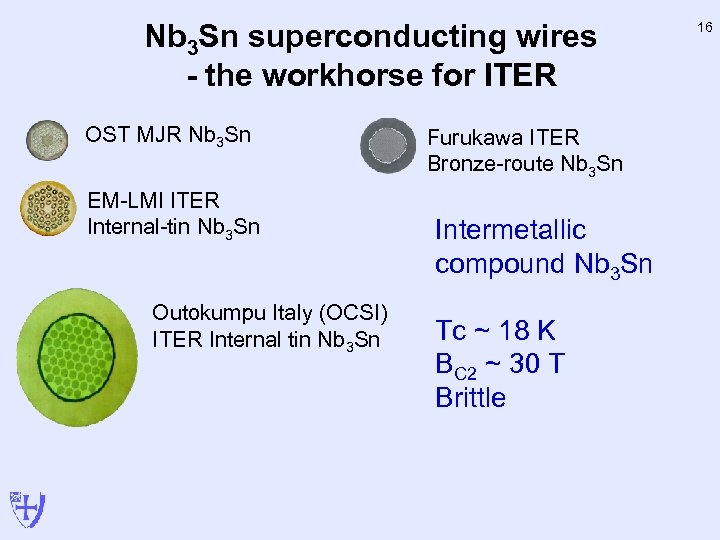 Nb 3 Sn superconducting wires - the workhorse for ITER OST MJR Nb 3 Sn EM-LMI ITER Internal-tin Nb 3 Sn Outokumpu Italy (OCSI) ITER Internal tin Nb 3 Sn Furukawa ITER Bronze-route Nb 3 Sn Intermetallic compound Nb 3 Sn Tc ~ 18 K BC 2 ~ 30 T Brittle 16
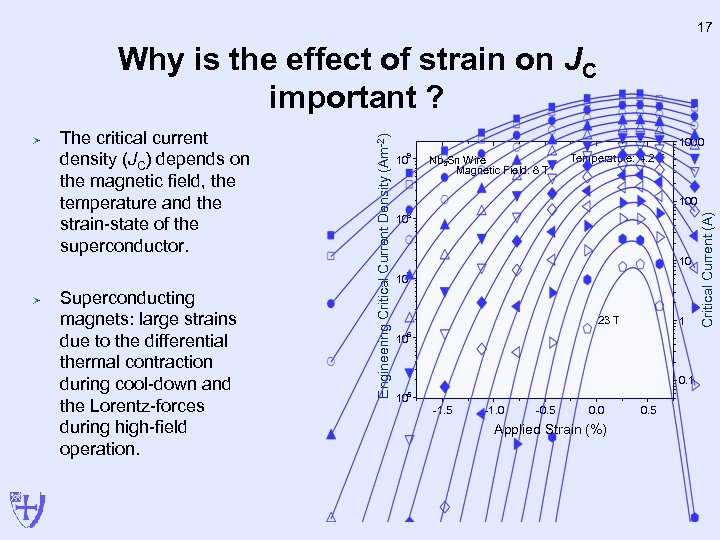 17 1000 9 10 Nb 3 Sn Wire Magnetic Field: 8 T Temperature: 4. 2 K 100 8 10 10 7 10 23 T 1 6 10 0. 1 5 10 -1. 5 -1. 0 -0. 5 0. 0 Applied Strain (%) 0. 5 Critical Current (A) Superconducting magnets: large strains due to the differential thermal contraction during cool-down and the Lorentz-forces during high-field operation. The critical current density (JC) depends on the magnetic field, the temperature and the strain-state of the superconductor. Engineering Critical Current Density (Am-2) Why is the effect of strain on JC important ?
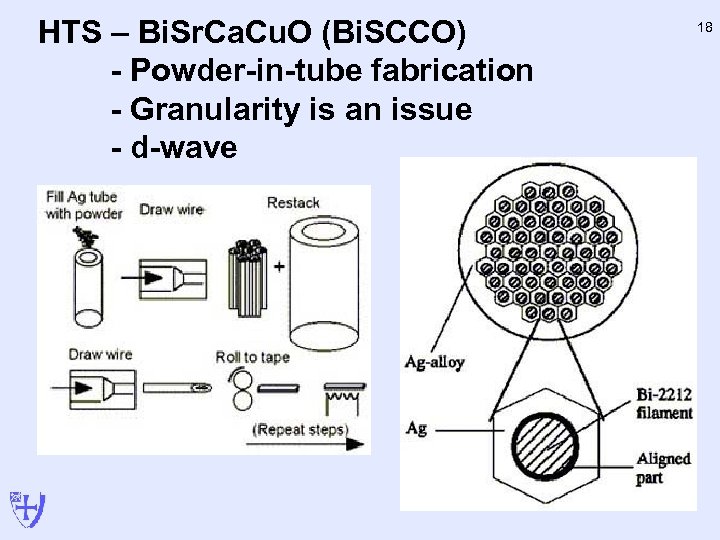 HTS – Bi. Sr. Ca. Cu. O (Bi. SCCO) - Powder-in-tube fabrication - Granularity is an issue - d-wave 18
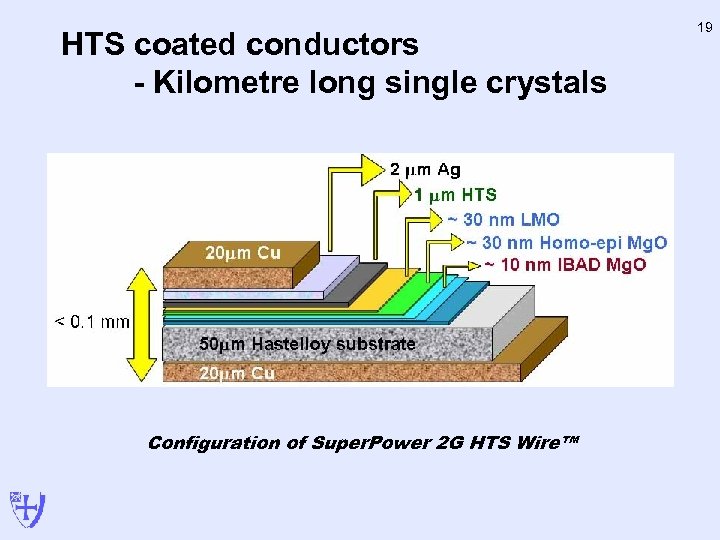 HTS coated conductors - Kilometre long single crystals Configuration of Super. Power 2 G HTS Wire™ 19
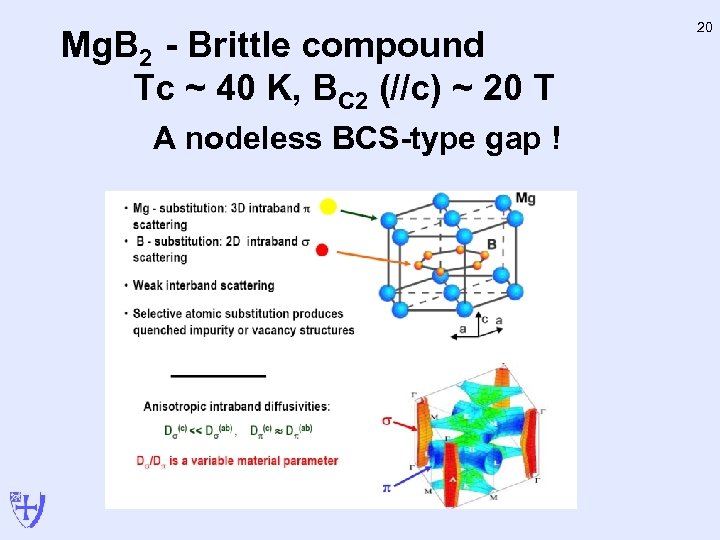 Mg. B 2 - Brittle compound Tc ~ 40 K, BC 2 (//c) ~ 20 T A nodeless BCS-type gap ! 20
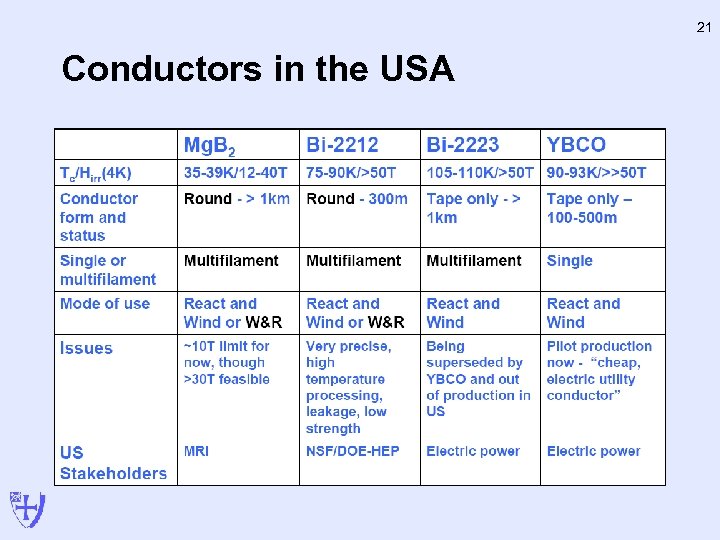 21 Conductors in the USA
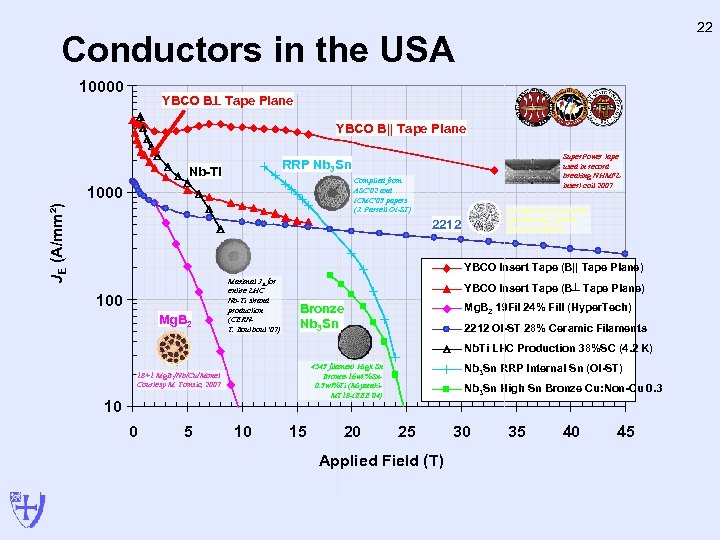 22 Conductors in the USA 10000 YBCO B Tape Plane YBCO B|| Tape Plane Nb-Ti Complied from ASC'02 and ICMC'03 papers (J. Parrell OI ST) 1000 JE (A/mm²) Super. Power tape used in record breaking NHMFL insert coil 2007 RRP Nb 3 Sn 427 filament strand with Ag alloy outer sheath tested at NHMFL 2212 YBCO Insert Tape (B|| Tape Plane) 100 Mg. B 2 Maximal JE for entire LHC Nb Ti strand production (CERN T. Boutboul '07) YBCO Insert Tape (B Tape Plane) Bronze Nb 3 Sn Mg. B 2 19 Fil 24% Fill (Hyper. Tech) 2212 OI-ST 28% Ceramic Filaments Nb. Ti LHC Production 38%SC (4. 2 K) 4543 filament High Sn Bronze 16 wt. %Sn 0. 3 wt%Ti (Miyazaki MT 18 IEEE’ 04) 18+1 Mg. B 2/Nb/Cu/Monel Courtesy M. Tomsic, 2007 10 0 5 10 15 20 Nb 3 Sn RRP Internal Sn (OI-ST) Nb 3 Sn High Sn Bronze Cu: Non-Cu 0. 3 25 Applied Field (T) 30 35 40 45
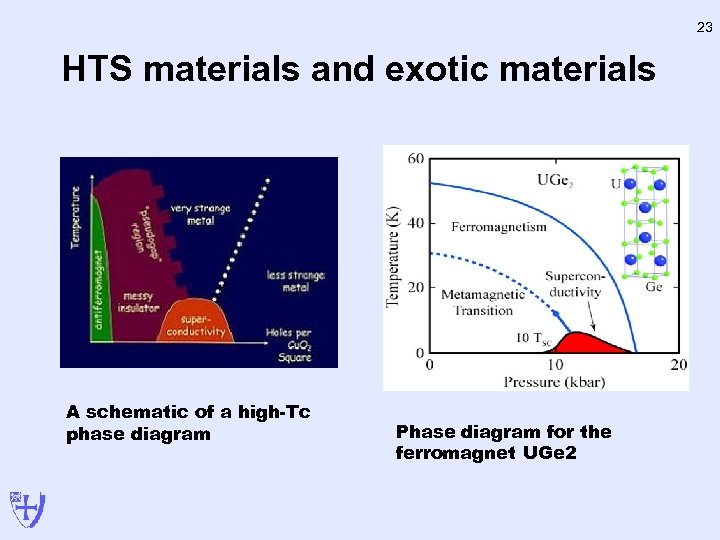 23 HTS materials and exotic materials A schematic of a high-Tc phase diagram Phase diagram for the ferromagnet UGe 2
 The Pnictide Superconductors – the iron age revisited Iron Man : In cinemas now from Paramount Pictures and Marvel Entertainment 24
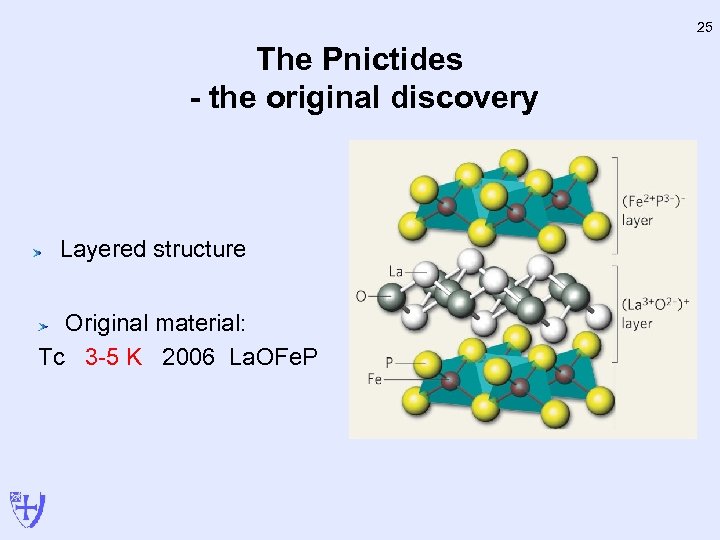 25 The Pnictides - the original discovery Layered structure Original material: Tc 3 -5 K 2006 La. OFe. P
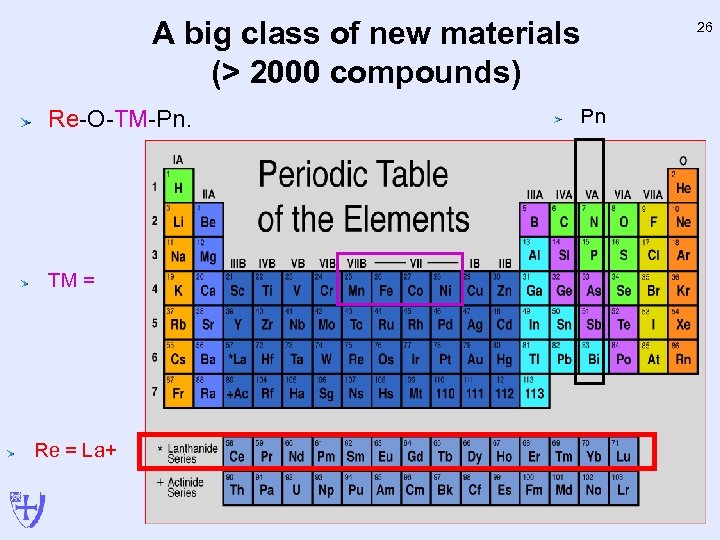 A big class of new materials (> 2000 compounds) Re-O-TM-Pn. TM = Re = La+ Pn 26
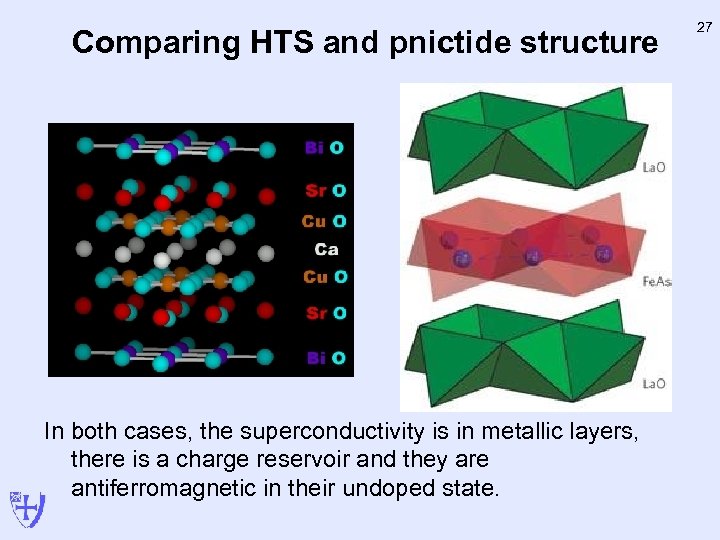 Comparing HTS and pnictide structure In both cases, the superconductivity is in metallic layers, there is a charge reservoir and they are antiferromagnetic in their undoped state. 27
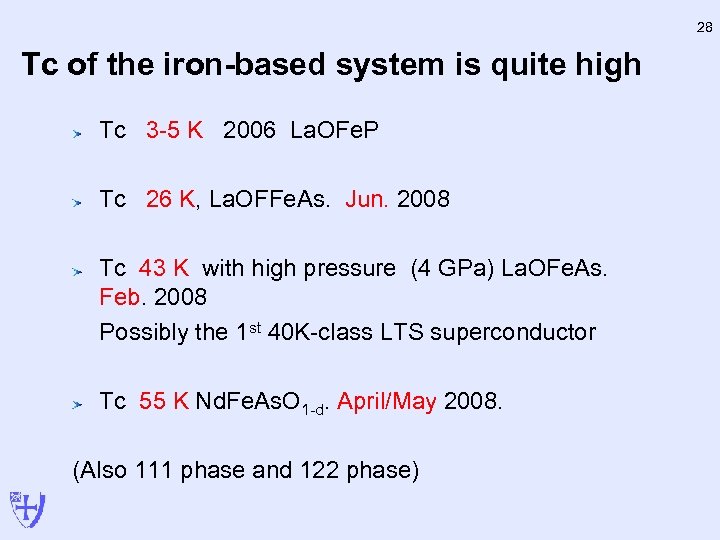 28 Tc of the iron-based system is quite high Tc 3 -5 K 2006 La. OFe. P Tc 26 K, La. OFFe. As. Jun. 2008 Tc 43 K with high pressure (4 GPa) La. OFe. As. Feb. 2008 Possibly the 1 st 40 K-class LTS superconductor Tc 55 K Nd. Fe. As. O 1 -d. April/May 2008. (Also 111 phase and 122 phase)
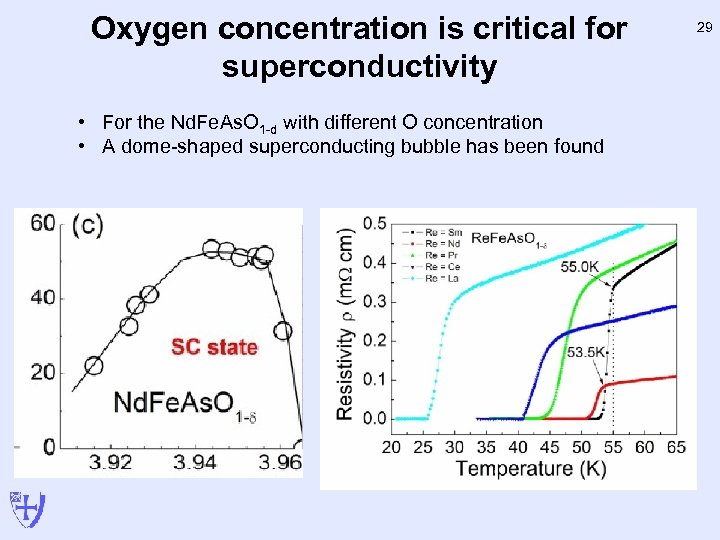 Oxygen concentration is critical for superconductivity • For the Nd. Fe. As. O 1 -d with different O concentration • A dome-shaped superconducting bubble has been found 29
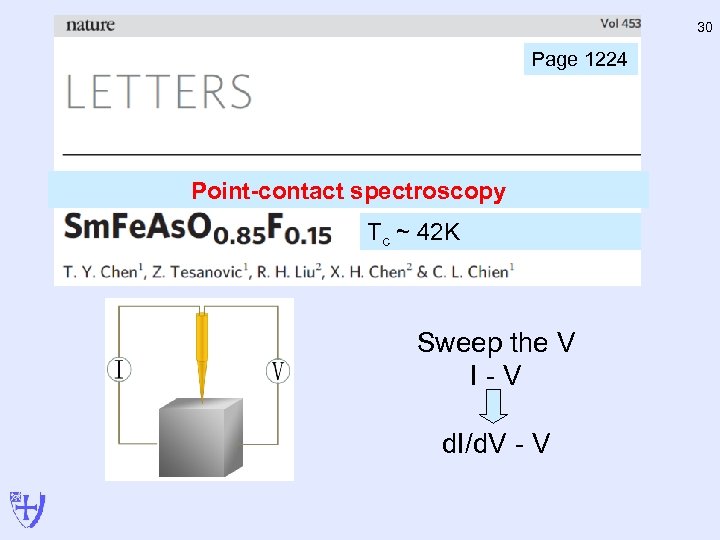 30 Page 1224 Point-contact spectroscopy Tc ~ 42 K Sweep the V I - V d. I/d. V - V
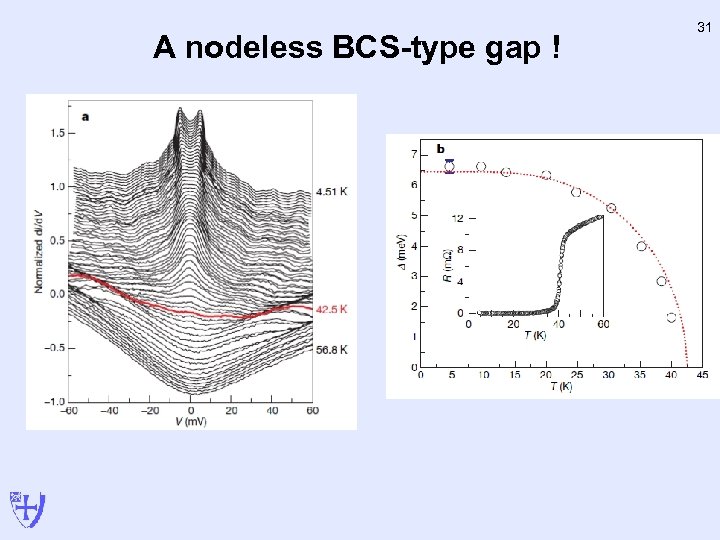 A nodeless BCS-type gap ! 31
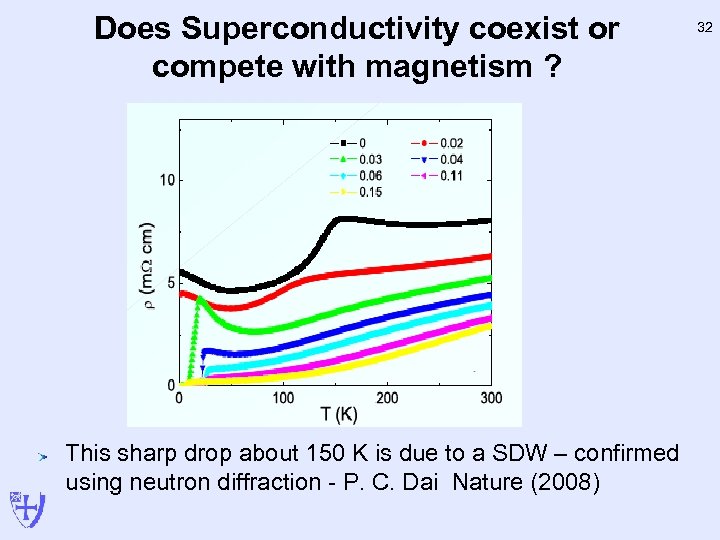 Does Superconductivity coexist or compete with magnetism ? This sharp drop about 150 K is due to a SDW – confirmed using neutron diffraction - P. C. Dai Nature (2008) 32
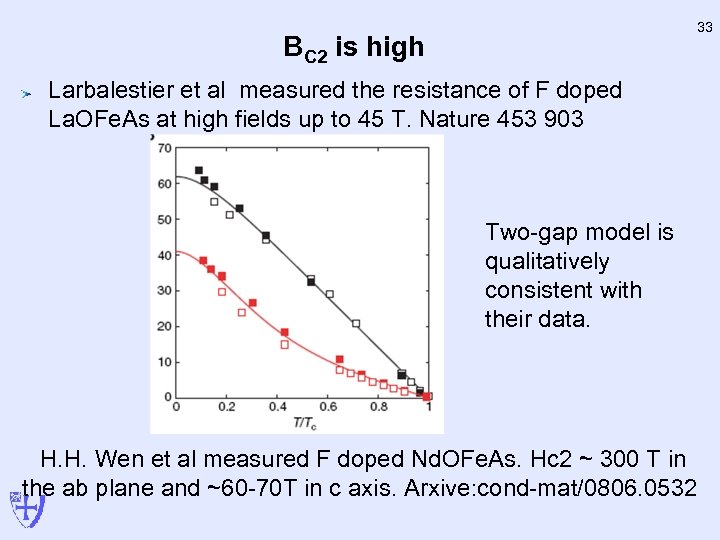 33 BC 2 is high Larbalestier et al measured the resistance of F doped La. OFe. As at high fields up to 45 T. Nature 453 903 Two-gap model is qualitatively consistent with their data. H. H. Wen et al measured F doped Nd. OFe. As. Hc 2 ~ 300 T in the ab plane and ~60 -70 T in c axis. Arxive: cond-mat/0806. 0532
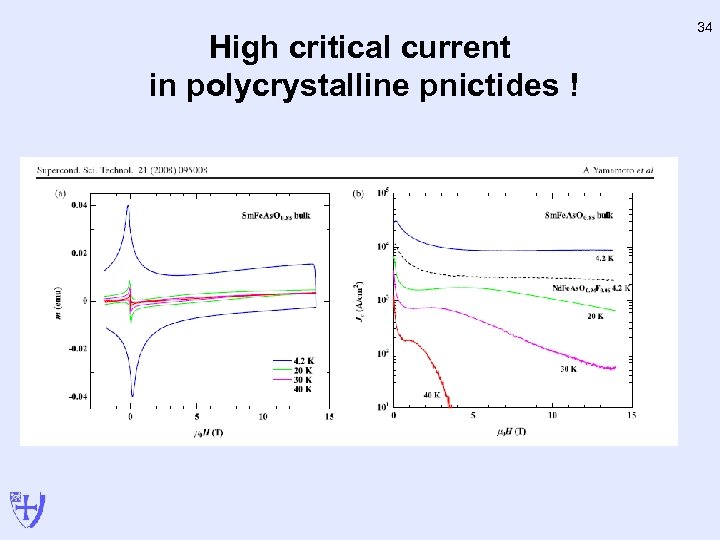 High critical current in polycrystalline pnictides ! 34
 35 Structure of the Talk I) The fundamental building blocks - II) (G-L) Ginzburg-Landau and (B-C-S) Bardeen-Cooper. Schrieffer theories The Josephson effect Critical current and pinning (zero resistance) The important materials Classic LTS high field materials – Nb. Ti and Nb 3 Sn The high temperature superconductors The pnictides (Superconductivity and magnetism) III) Technology – MRI, LHC, ITER and beyond. .
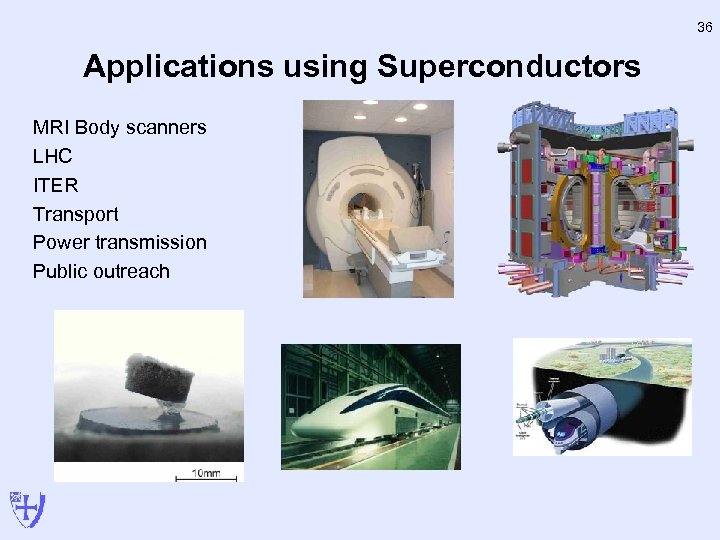 36 Applications using Superconductors MRI Body scanners LHC ITER Transport Power transmission Public outreach
 MRI - $1 B annual market 37
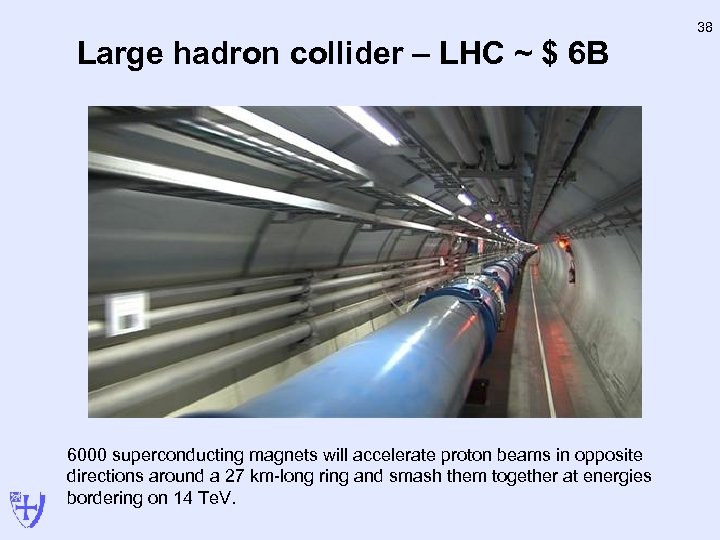 Large hadron collider – LHC ~ $ 6 B 6000 superconducting magnets will accelerate proton beams in opposite directions around a 27 km-long ring and smash them together at energies bordering on 14 Te. V. 38
 39 Some facts about the LHC Protons are accelerated to 99. 99991% of the speed of light The LHC lets us glimpse the conditions 1/100 th of a billionth of a second after the Big Bang: a travel back in time by 13. 7 billion years High energy collisions create particles that haven’t existed in nature since the Big Bang Find out what makes the Universe tick at the most fundamental level
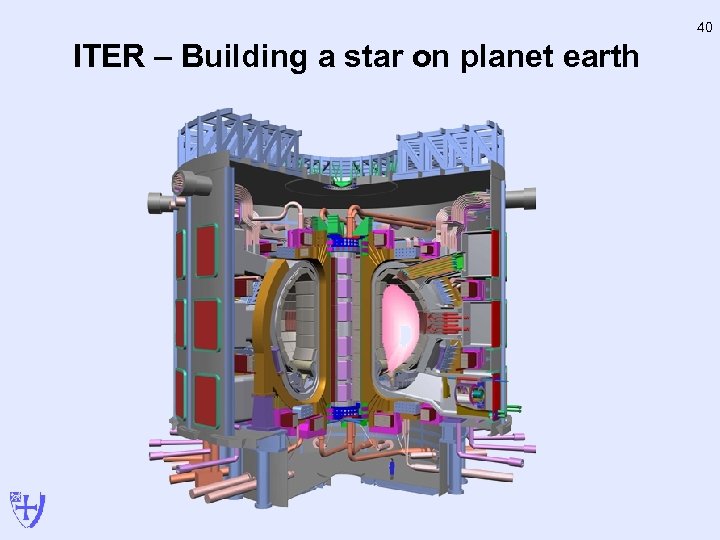 40 ITER – Building a star on planet earth
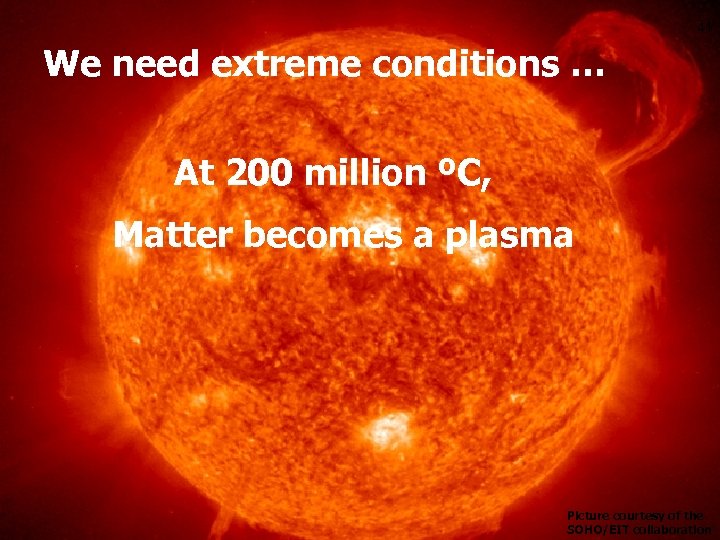 41 We need extreme conditions … At 200 million ºC, Matter becomes a plasma Picture courtesy of the SOHO/EIT collaboration
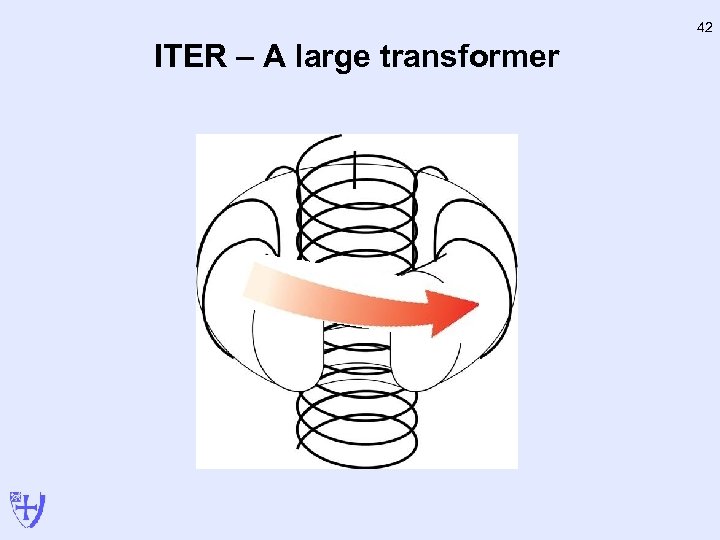 42 ITER – A large transformer
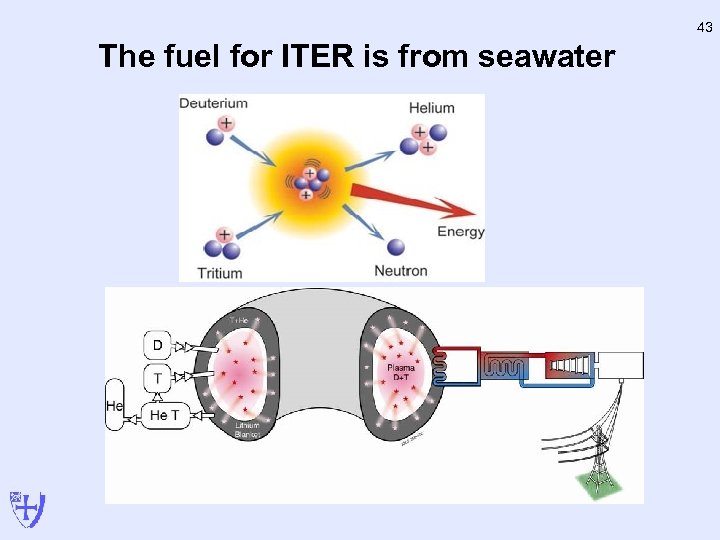 43 The fuel for ITER is from seawater
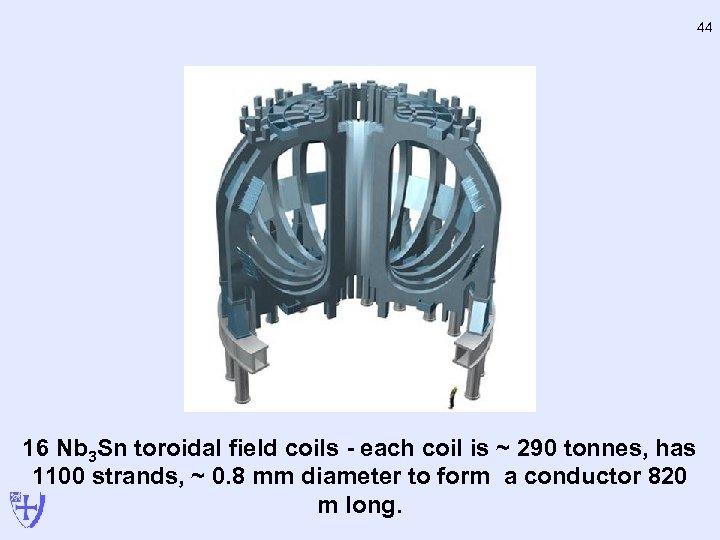 44 16 Nb 3 Sn toroidal field coils - each coil is ~ 290 tonnes, has 1100 strands, ~ 0. 8 mm diameter to form a conductor 820 m long.
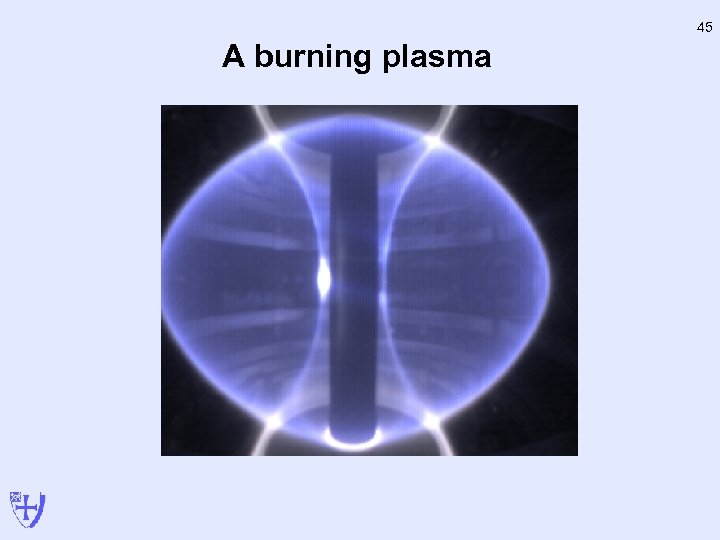 45 A burning plasma
 46 Fusion powers the Sun and stars and has many potential attractions • Essentially limitless fuel • No green house gases • Major accidents impossible • No long-lived radioactive waste • Could be a reality in 30 years
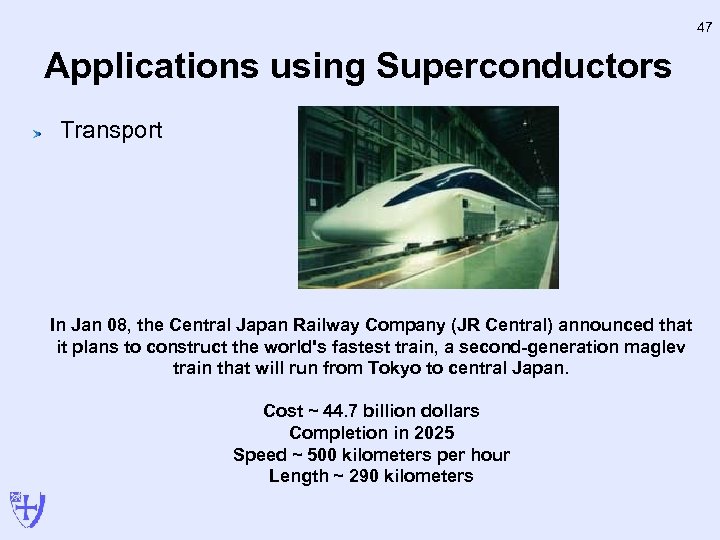 47 Applications using Superconductors Transport In Jan 08, the Central Japan Railway Company (JR Central) announced that it plans to construct the world's fastest train, a second-generation maglev train that will run from Tokyo to central Japan. Cost ~ 44. 7 billion dollars Completion in 2025 Speed ~ 500 kilometers per hour Length ~ 290 kilometers
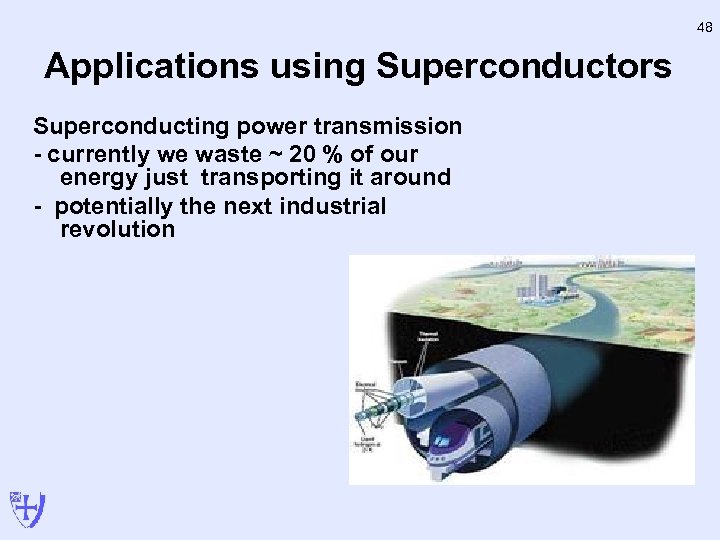 48 Applications using Superconductors Superconducting power transmission - currently we waste ~ 20 % of our energy just transporting it around - potentially the next industrial revolution
 Conclusions 49 The many uses for superconductivity means that many of the technological tools required to exploit new materials are in place. The new materials discovered in the last 20 years were found by relatively small determined groups. Using world-class science to produce technology is tough. It requires first class scientists, time, perserverance, creativity, luck and funding. Superconductivity offers excellent science, excellent technology, excellent training and the possibility of saving the planet !!
 50 References + Acknowledgements: Xifeng Lu + colleagues in Beijing, Mark Raine, Georg Weiglein (IPPP, Durham), Eric Hellstrom (ASC Florida), Chris Carpenter (Culham) + many others ……. Bibliography/electronic version of all talks and publications are available at: http: //www. dur. ac. uk/superconductivity. durham/