


 Скачать презентацию Supercomputing in Plain English An Overview of High
dad3cb682b5607ee6ee390d596e30db1.ppt
- Количество слайдов: 79
 Supercomputing in Plain English An Overview of High Performance Computing Henry Neeman, Director OU Supercomputing Center for Education & Research University of Oklahoma Wednesday August 29 2007 OU Supercomputing Center for Education & Research
 This is an experiment! It’s the nature of these kinds of videoconferences that failures are guaranteed to happen! NO PROMISES! So, please bear with us. Hopefully everything will work out well enough. Supercomputing in Plain English: Overview Wednesday August 29 2007 2
 Access Grid/VRVS If you’re connecting via the Access Grid or VRVS, the venue should have been sent to you by e-mail, hopefully. NOTE: So far, we haven’t had a very successful test of AG or VRVS. Supercomputing in Plain English: Overview Wednesday August 29 2007 3
 i. Linc We only have about 40 -45 simultaneous i. Linc connections available. Therefore, each institution has at most one i. Linc person designated. If you’re the i. Linc person for your institution, you’ve already gotten e-mail about it, so please follow the directions. If you aren’t, you can’t become it, because we’re completely out of i. Linc connections. Supercomputing in Plain English: Overview Wednesday August 29 2007 4
 Quicktime Broadcast If you don’t have i. Linc, you can connect via Quicktime: rtsp: //129. 15. 254. 141/neeman_02. sdp We strongly recommend using Quicktime player, since we’ve seen it work. When you run it, traverse the menus File -> Open URL Then paste in the rstp URL the Movie URL space, and click OK. Supercomputing in Plain English: Overview Wednesday August 29 2007 5
 Phone Bridge If all else fails, you can call into our phone bridge: 1 -866 -285 -7778, access code 6483137# Please mute yourself and use the phone to listen. Don’t worry, I’ll call out slide numbers as we go. To ask questions, please use Google Talk. Supercomputing in Plain English: Overview Wednesday August 29 2007 6
 Google Talk To ask questions, please use our Google Talk group chat session (text only). You need to have (or create) a gmail. com account to use Google Talk. Once you’ve logged in to your gmail. com account, go to: http: //www. google. com/talk/ and then contact the user named: oscer. sipe Alternatively, you can send your questions by e-mail to oscer. sipe@gmail. com. Supercomputing in Plain English: Overview Wednesday August 29 2007 7
 This is an experiment! REMINDER: It’s the nature of these kinds of videoconferences that failures are guaranteed to happen! NO PROMISES! So, please bear with us. Hopefully everything will work out well enough. Supercomputing in Plain English: Overview Wednesday August 29 2007 8
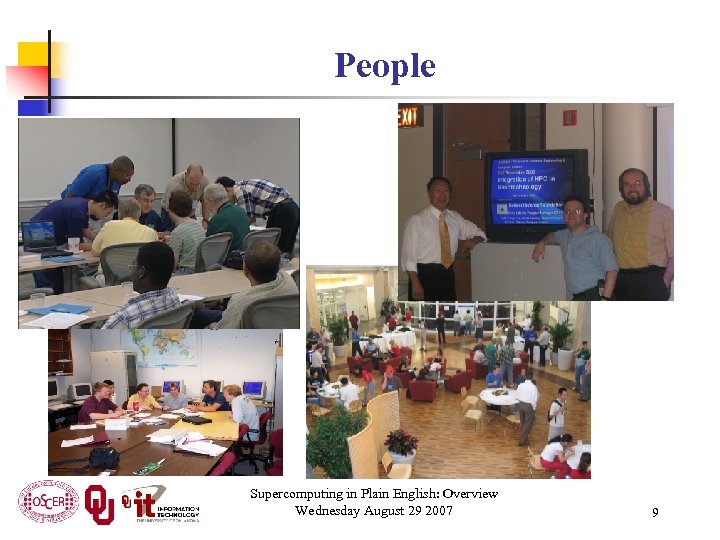 People Supercomputing in Plain English: Overview Wednesday August 29 2007 9
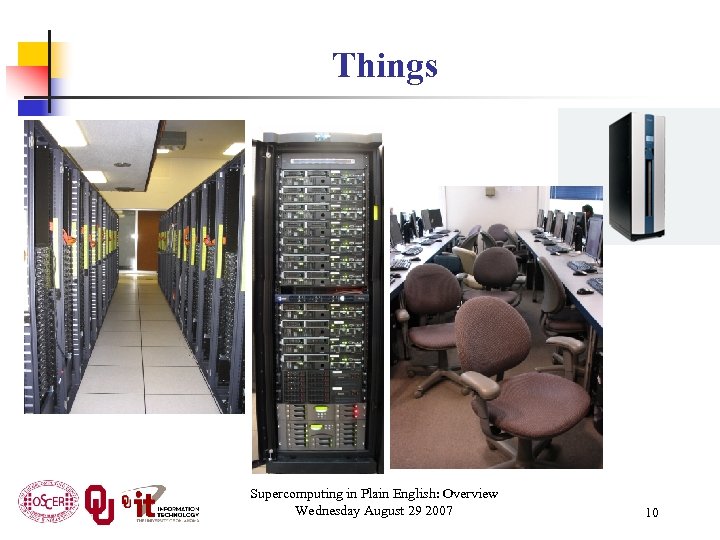 Things Supercomputing in Plain English: Overview Wednesday August 29 2007 10
 What is Supercomputing? Supercomputing is the biggest, fastest computing right this minute. Likewise, a supercomputer is one of the biggest, fastest computers right this minute. So, the definition of supercomputing is constantly changing. Rule of Thumb: A supercomputer is typically at least 100 times as powerful as a PC. Jargon: Supercomputing is also known as High Performance Computing (HPC) or High End Computing (HEC) or Cyberinfrastructure (CI). Supercomputing in Plain English: Overview Wednesday August 29 2007 11
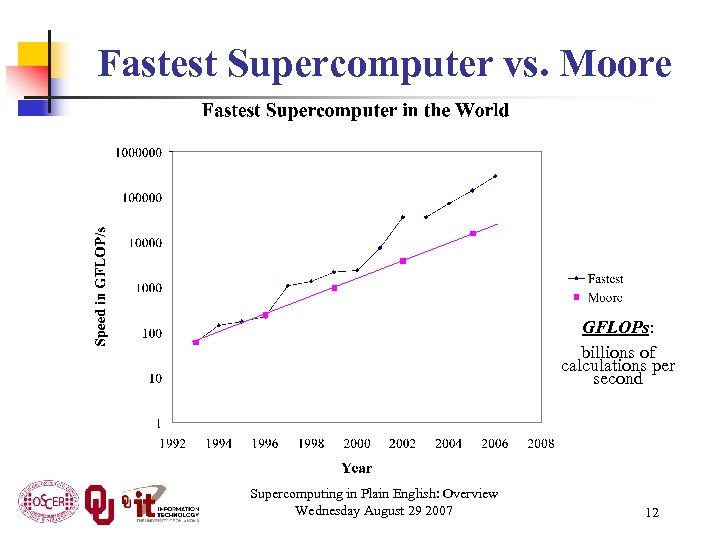 Fastest Supercomputer vs. Moore GFLOPs: billions of calculations per second Supercomputing in Plain English: Overview Wednesday August 29 2007 12
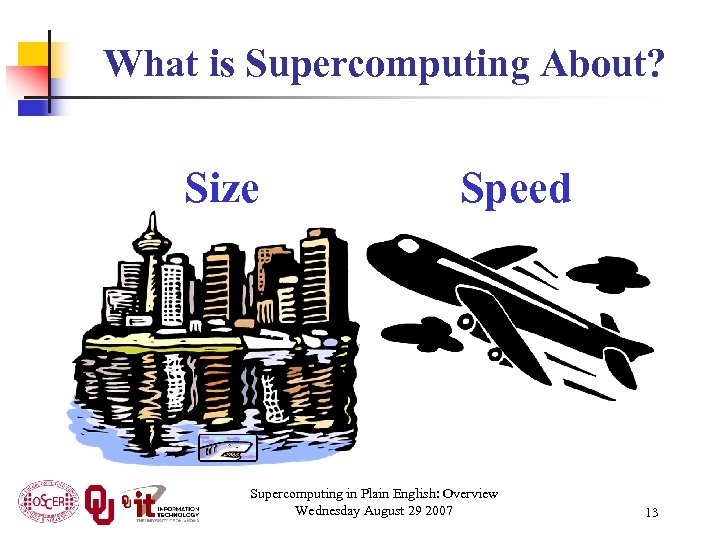 What is Supercomputing About? Size Speed Supercomputing in Plain English: Overview Wednesday August 29 2007 13
 What is Supercomputing About? n n Size: Many problems that are interesting to scientists and engineers can’t fit on a PC – usually because they need more than a few GB of RAM, or more than a few 100 GB of disk. Speed: Many problems that are interesting to scientists and engineers would take a very long time to run on a PC: months or even years. But a problem that would take a month on a PC might take only a few hours on a supercomputer. Supercomputing in Plain English: Overview Wednesday August 29 2007 14
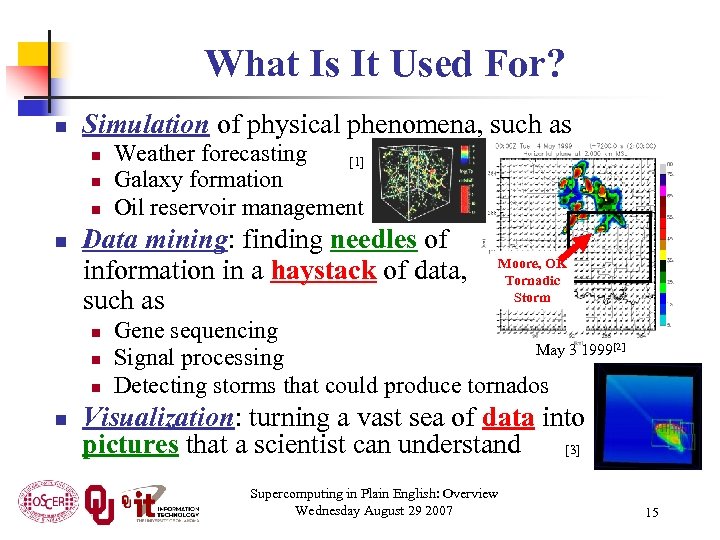 What Is It Used For? n Simulation of physical phenomena, such as n n Data mining: finding needles of information in a haystack of data, such as n n Weather forecasting [1] Galaxy formation Oil reservoir management Moore, OK Tornadic Storm Gene sequencing May 3 1999[2] Signal processing Detecting storms that could produce tornados Visualization: turning a vast sea of data into pictures that a scientist can understand [3] Supercomputing in Plain English: Overview Wednesday August 29 2007 15
 What is OSCER? n n n Multidisciplinary center Division of OU Information Technology Provides: n n Supercomputing education Supercomputing expertise Supercomputing resources: hardware, storage, software For: n n n Undergrad students Grad students Staff Faculty Their collaborators (including off campus) Supercomputing in Plain English: Overview Wednesday August 29 2007 16
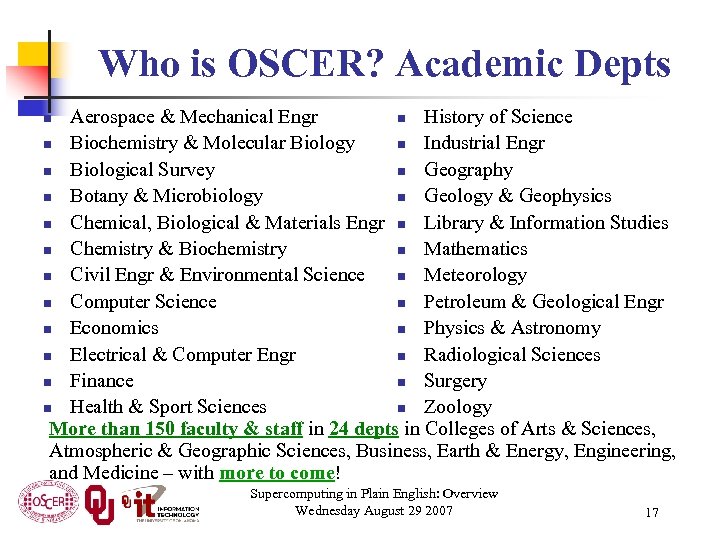 Who is OSCER? Academic Depts Aerospace & Mechanical Engr n History of Science n Biochemistry & Molecular Biology n Industrial Engr n Biological Survey n Geography n Botany & Microbiology n Geology & Geophysics n Chemical, Biological & Materials Engr n Library & Information Studies n Chemistry & Biochemistry n Mathematics n Civil Engr & Environmental Science n Meteorology n Computer Science n Petroleum & Geological Engr n Economics n Physics & Astronomy n Electrical & Computer Engr n Radiological Sciences n Finance n Surgery n Health & Sport Sciences n Zoology More than 150 faculty & staff in 24 depts in Colleges of Arts & Sciences, Atmospheric & Geographic Sciences, Business, Earth & Energy, Engineering, and Medicine – with more to come! n Supercomputing in Plain English: Overview Wednesday August 29 2007 17
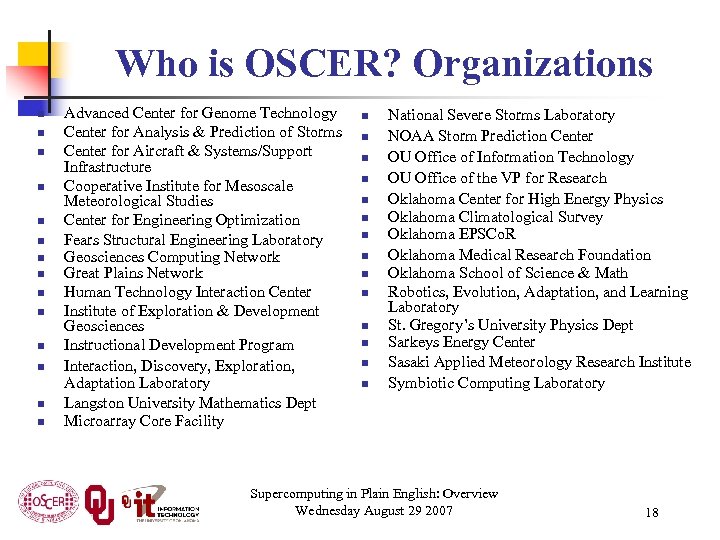 Who is OSCER? Organizations n n n n Advanced Center for Genome Technology Center for Analysis & Prediction of Storms Center for Aircraft & Systems/Support Infrastructure Cooperative Institute for Mesoscale Meteorological Studies Center for Engineering Optimization Fears Structural Engineering Laboratory Geosciences Computing Network Great Plains Network Human Technology Interaction Center Institute of Exploration & Development Geosciences Instructional Development Program Interaction, Discovery, Exploration, Adaptation Laboratory Langston University Mathematics Dept Microarray Core Facility n n n n National Severe Storms Laboratory NOAA Storm Prediction Center OU Office of Information Technology OU Office of the VP for Research Oklahoma Center for High Energy Physics Oklahoma Climatological Survey Oklahoma EPSCo. R Oklahoma Medical Research Foundation Oklahoma School of Science & Math Robotics, Evolution, Adaptation, and Learning Laboratory St. Gregory’s University Physics Dept Sarkeys Energy Center Sasaki Applied Meteorology Research Institute Symbiotic Computing Laboratory Supercomputing in Plain English: Overview Wednesday August 29 2007 18
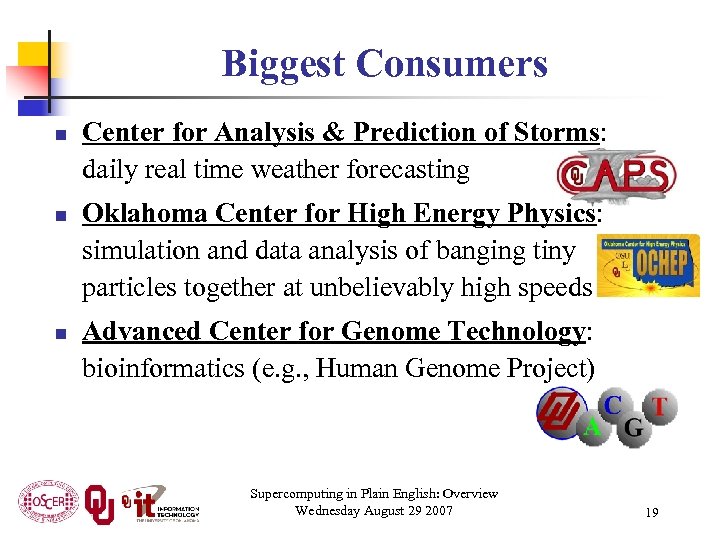 Biggest Consumers n n n Center for Analysis & Prediction of Storms: daily real time weather forecasting Oklahoma Center for High Energy Physics: simulation and data analysis of banging tiny particles together at unbelievably high speeds Advanced Center for Genome Technology: bioinformatics (e. g. , Human Genome Project) Supercomputing in Plain English: Overview Wednesday August 29 2007 19
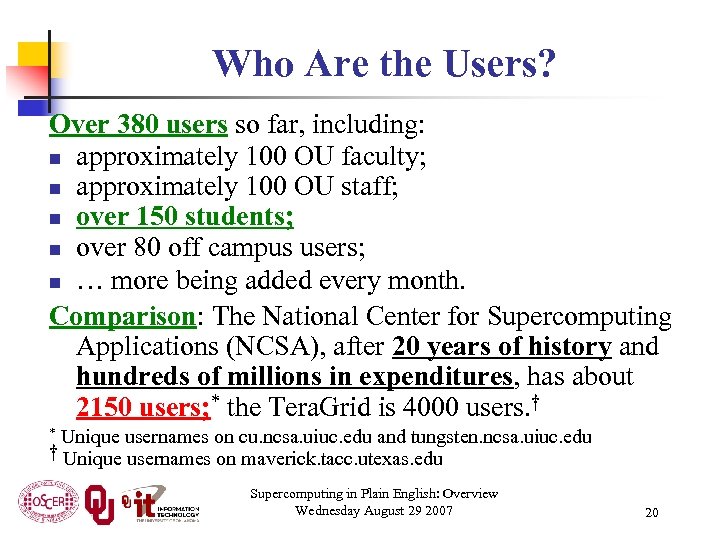 Who Are the Users? Over 380 users so far, including: n approximately 100 OU faculty; n approximately 100 OU staff; n over 150 students; n over 80 off campus users; n … more being added every month. Comparison: The National Center for Supercomputing Applications (NCSA), after 20 years of history and hundreds of millions in expenditures, has about 2150 users; * the Tera. Grid is 4000 users. † Unique usernames on cu. ncsa. uiuc. edu and tungsten. ncsa. uiuc. edu † Unique usernames on maverick. tacc. utexas. edu * Supercomputing in Plain English: Overview Wednesday August 29 2007 20
 Why OSCER? n n Computational Science & Engineering has become sophisticated enough to take its place alongside experimentation and theory. Most students – and most faculty and staff – don’t learn much CSE, because it’s seen as needing too much computing background, and needs HPC, which is seen as very hard to learn. HPC can be hard to learn: few materials for novices; most documents written for experts as reference guides. We need a new approach: HPC and CSE for computing novices – OSCER’s mandate! Supercomputing in Plain English: Overview Wednesday August 29 2007 21
 Why Bother Teaching Novices? n n n Application scientists & engineers typically know their applications very well, much better than a collaborating computer scientist ever would. Commercial software lags far behind the research community. Many potential CSE users don’t need full time CSE and HPC staff, just some help. One HPC expert can help dozens of research groups. Today’s novices are tomorrow’s top researchers, especially because today’s top researchers will eventually retire. Supercomputing in Plain English: Overview Wednesday August 29 2007 22
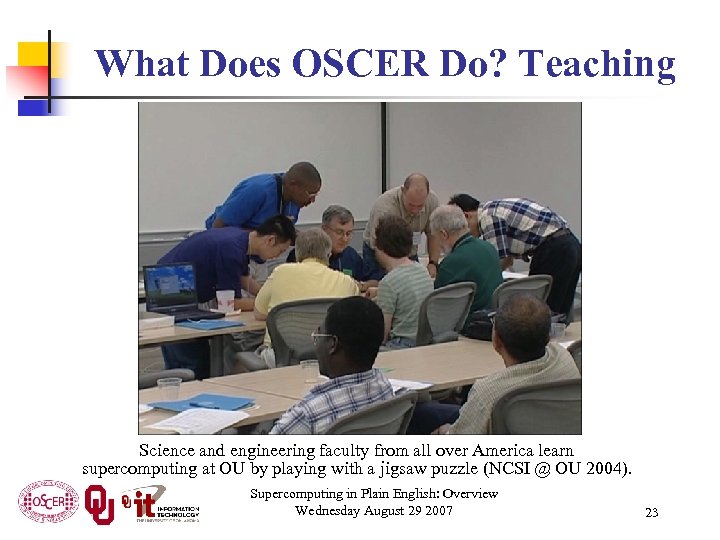 What Does OSCER Do? Teaching Science and engineering faculty from all over America learn supercomputing at OU by playing with a jigsaw puzzle (NCSI @ OU 2004). Supercomputing in Plain English: Overview Wednesday August 29 2007 23
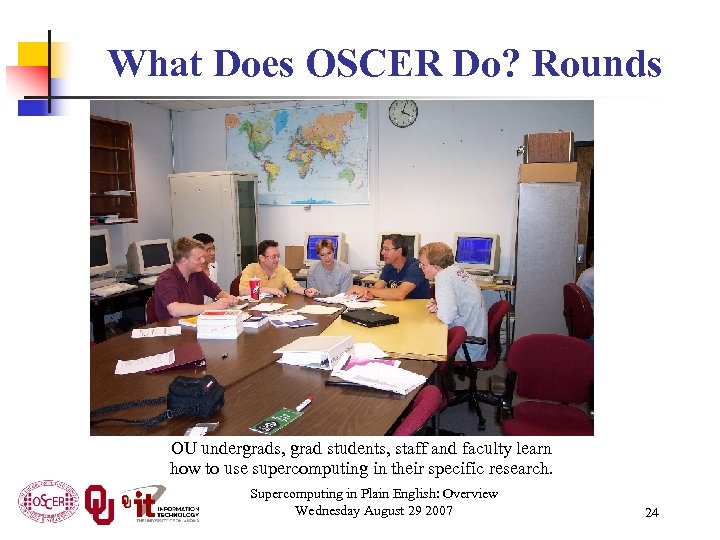 What Does OSCER Do? Rounds OU undergrads, grad students, staff and faculty learn how to use supercomputing in their specific research. Supercomputing in Plain English: Overview Wednesday August 29 2007 24
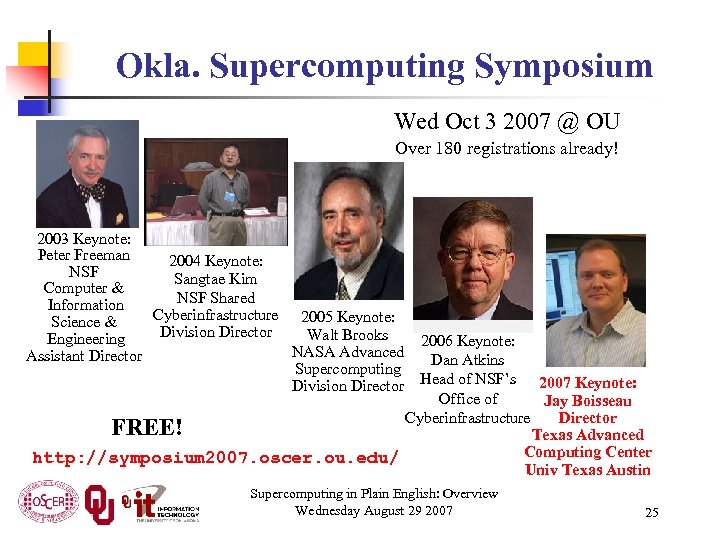 Okla. Supercomputing Symposium Wed Oct 3 2007 @ OU Over 180 registrations already! 2003 Keynote: Peter Freeman 2004 Keynote: NSF Sangtae Kim Computer & NSF Shared Information Cyberinfrastructure 2005 Keynote: Science & Division Director Walt Brooks Engineering 2006 Keynote: NASA Advanced Assistant Director Dan Atkins Supercomputing Division Director Head of NSF’s 2007 Keynote: Office of Jay Boisseau Cyberinfrastructure Director FREE! Texas Advanced Computing Center http: //symposium 2007. oscer. ou. edu/ Univ Texas Austin Supercomputing in Plain English: Overview Wednesday August 29 2007 25
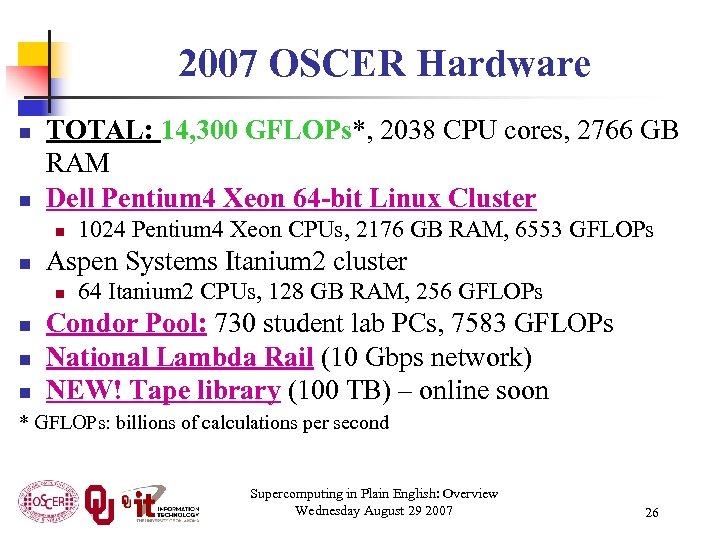 2007 OSCER Hardware n n TOTAL: 14, 300 GFLOPs*, 2038 CPU cores, 2766 GB RAM Dell Pentium 4 Xeon 64 -bit Linux Cluster n n Aspen Systems Itanium 2 cluster n n 1024 Pentium 4 Xeon CPUs, 2176 GB RAM, 6553 GFLOPs 64 Itanium 2 CPUs, 128 GB RAM, 256 GFLOPs Condor Pool: 730 student lab PCs, 7583 GFLOPs National Lambda Rail (10 Gbps network) NEW! Tape library (100 TB) – online soon * GFLOPs: billions of calculations per second Supercomputing in Plain English: Overview Wednesday August 29 2007 26
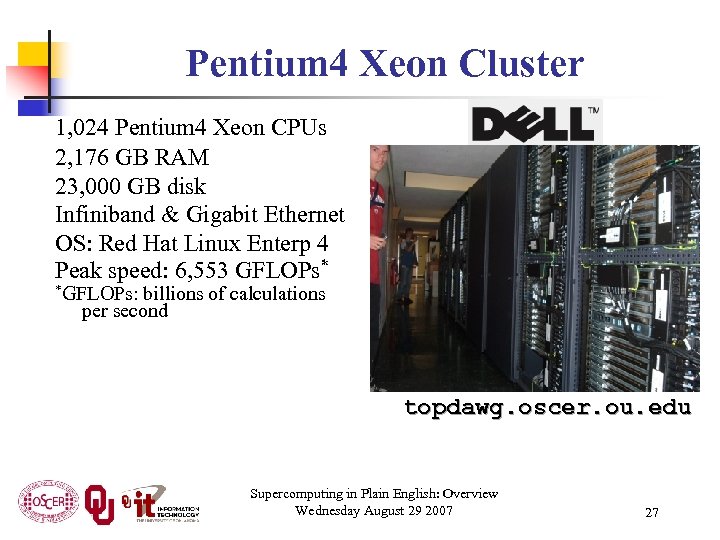 Pentium 4 Xeon Cluster 1, 024 Pentium 4 Xeon CPUs 2, 176 GB RAM 23, 000 GB disk Infiniband & Gigabit Ethernet OS: Red Hat Linux Enterp 4 Peak speed: 6, 553 GFLOPs* *GFLOPs: billions of calculations per second topdawg. oscer. ou. edu Supercomputing in Plain English: Overview Wednesday August 29 2007 27
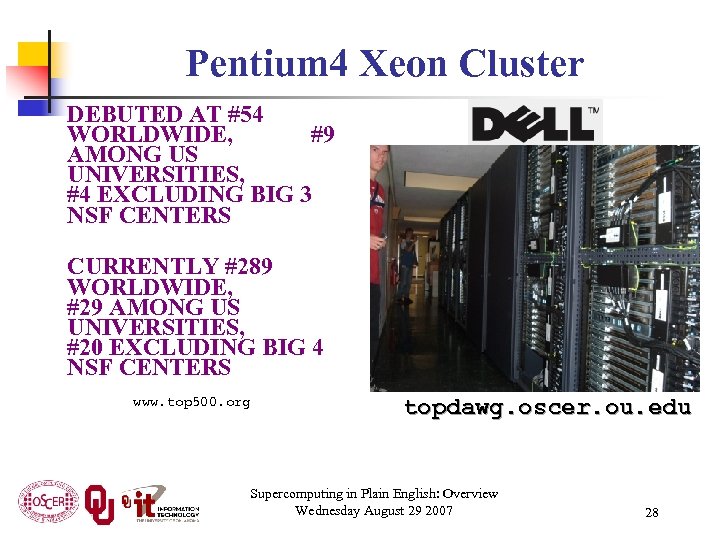 Pentium 4 Xeon Cluster DEBUTED AT #54 WORLDWIDE, #9 AMONG US UNIVERSITIES, #4 EXCLUDING BIG 3 NSF CENTERS CURRENTLY #289 WORLDWIDE, #29 AMONG US UNIVERSITIES, #20 EXCLUDING BIG 4 NSF CENTERS www. top 500. org topdawg. oscer. ou. edu Supercomputing in Plain English: Overview Wednesday August 29 2007 28
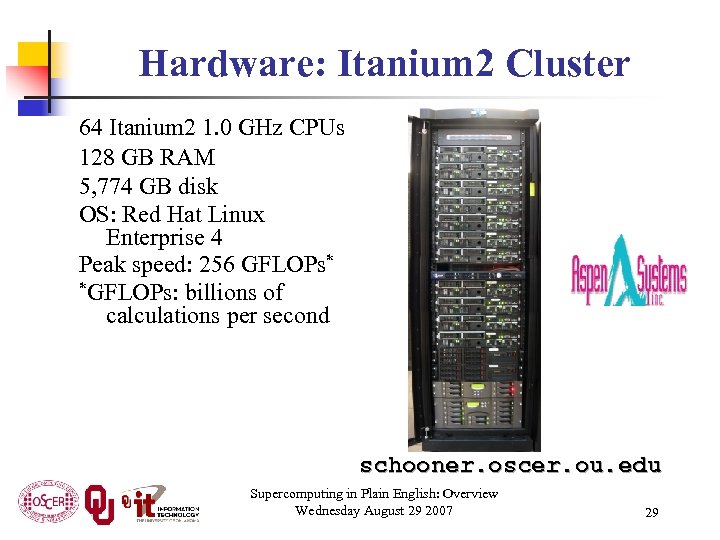 Hardware: Itanium 2 Cluster 64 Itanium 2 1. 0 GHz CPUs 128 GB RAM 5, 774 GB disk OS: Red Hat Linux Enterprise 4 Peak speed: 256 GFLOPs* *GFLOPs: billions of calculations per second schooner. oscer. ou. edu Supercomputing in Plain English: Overview Wednesday August 29 2007 29
![What is a Cluster? “… [W]hat a ship is … It's not just a](https://present5.com/presentation/dad3cb682b5607ee6ee390d596e30db1/image-30.jpg "What is a Cluster? “… [W]hat a ship is … It's not just a") What is a Cluster? “… [W]hat a ship is … It's not just a keel and hull and a deck and sails. That's what a ship needs. But what a ship is. . . is freedom. ” – Captain Jack Sparrow “Pirates of the Caribbean” Supercomputing in Plain English: Overview Wednesday August 29 2007 30
What is a Cluster? “… [W]hat a ship is … It's not just a keel and hull and a deck and sails. That's what a ship needs. But what a ship is. . . is freedom. ” – Captain Jack Sparrow “Pirates of the Caribbean” Supercomputing in Plain English: Overview Wednesday August 29 2007 30
 What a Cluster is …. A cluster needs of a collection of small computers, called nodes, hooked together by an interconnection network (or interconnect for short). It also needs software that allows the nodes to communicate over the interconnect. But what a cluster is … is all of these components working together as if they’re one big computer. . . a super computer. Supercomputing in Plain English: Overview Wednesday August 29 2007 31
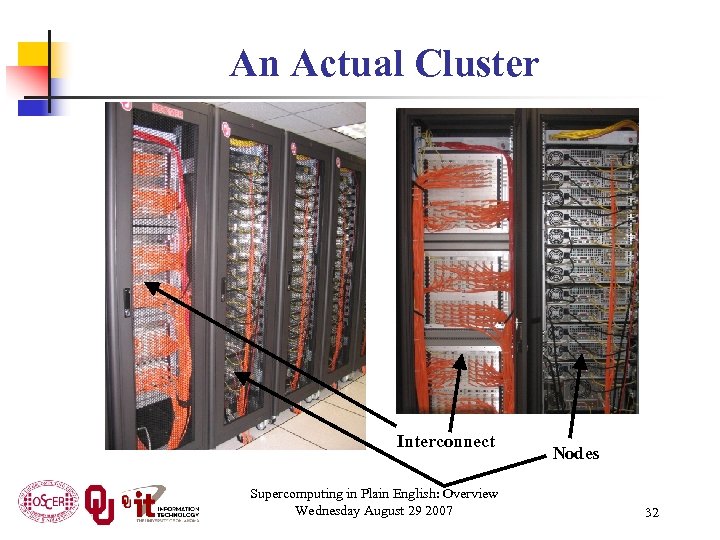 An Actual Cluster Interconnect Supercomputing in Plain English: Overview Wednesday August 29 2007 Nodes 32
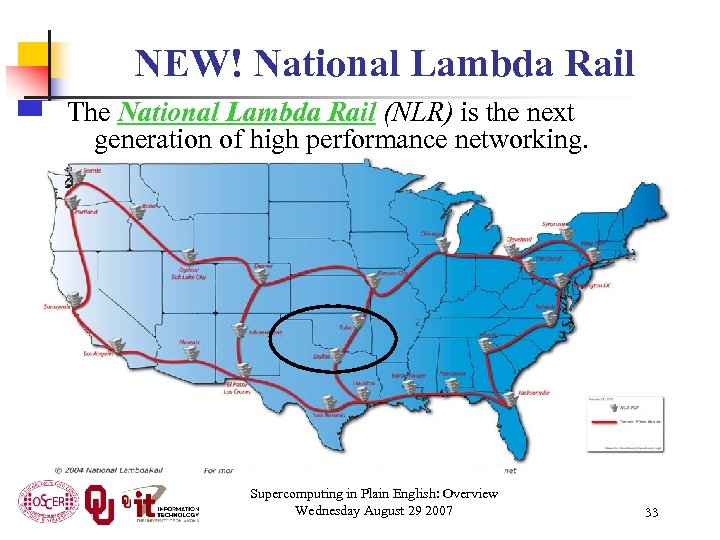 NEW! National Lambda Rail The National Lambda Rail (NLR) is the next generation of high performance networking. Supercomputing in Plain English: Overview Wednesday August 29 2007 33
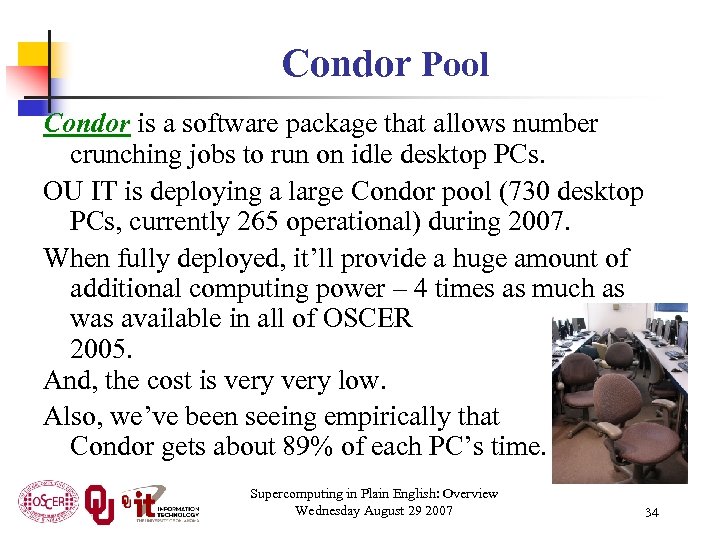 Condor Pool Condor is a software package that allows number crunching jobs to run on idle desktop PCs. OU IT is deploying a large Condor pool (730 desktop PCs, currently 265 operational) during 2007. When fully deployed, it’ll provide a huge amount of additional computing power – 4 times as much as was available in all of OSCER in 2005. And, the cost is very low. Also, we’ve been seeing empirically that Condor gets about 89% of each PC’s time. Supercomputing in Plain English: Overview Wednesday August 29 2007 34
 NSF CI-TEAM Project In 2006, OSCER received a grant from the National Science Foundation’s Cyberinfrastructure Training, Education, Advancement, and Mentoring for Our 21 st Century Workforce (CI-TEAM) program. Objectives: n Teach Cyberinfrastructure to EVERYBODY! n Provide Condor resources to the national community n Teach users to use Condor and sysadmins to deploy and administer it n Teach bioinformatics students to use BLAST over Condor Supercomputing in Plain English: Overview Wednesday August 29 2007 35
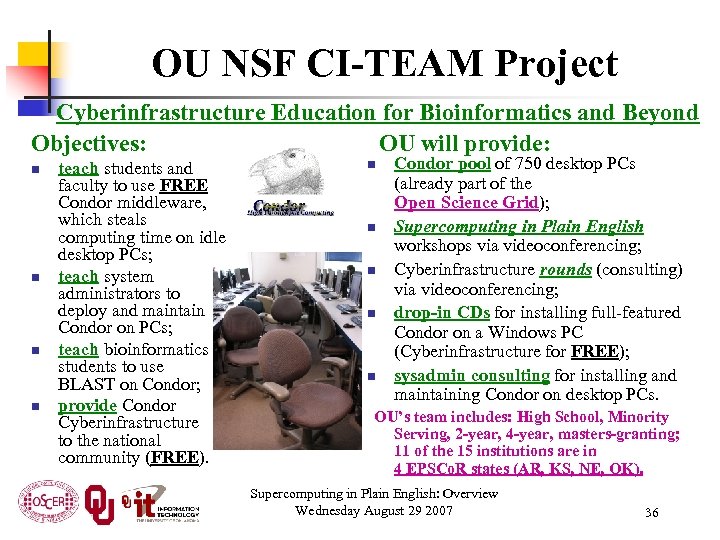 OU NSF CI-TEAM Project Cyberinfrastructure Education for Bioinformatics and Beyond Objectives: OU will provide: n n teach students and faculty to use FREE Condor middleware, which steals computing time on idle desktop PCs; teach system administrators to deploy and maintain Condor on PCs; teach bioinformatics students to use BLAST on Condor; provide Condor Cyberinfrastructure to the national community (FREE). n n n Condor pool of 750 desktop PCs (already part of the Open Science Grid); Supercomputing in Plain English workshops via videoconferencing; Cyberinfrastructure rounds (consulting) via videoconferencing; drop-in CDs for installing full-featured Condor on a Windows PC (Cyberinfrastructure for FREE); sysadmin consulting for installing and maintaining Condor on desktop PCs. OU’s team includes: High School, Minority Serving, 2 -year, 4 -year, masters-granting; 11 of the 15 institutions are in 4 EPSCo. R states (AR, KS, NE, OK). Supercomputing in Plain English: Overview Wednesday August 29 2007 36
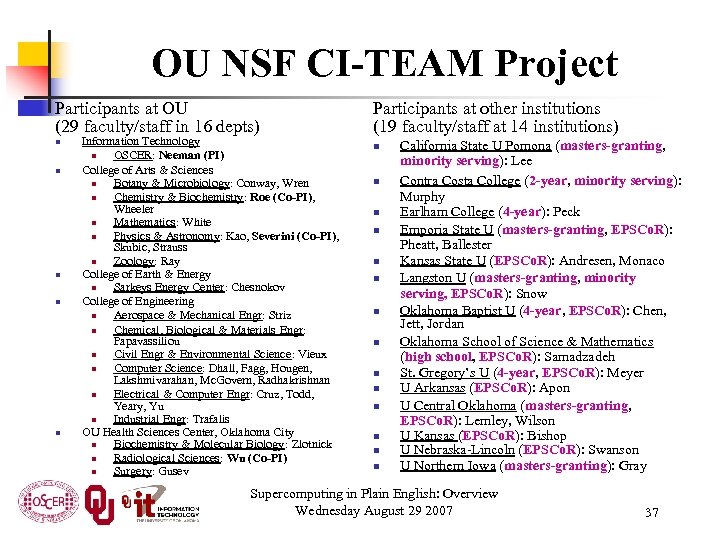 OU NSF CI-TEAM Project Participants at OU (29 faculty/staff in 16 depts) Participants at other institutions (19 faculty/staff at 14 institutions) n n n Information Technology n OSCER: Neeman (PI) College of Arts & Sciences n Botany & Microbiology: Conway, Wren n Chemistry & Biochemistry: Roe (Co-PI), Wheeler n Mathematics: White n Physics & Astronomy: Kao, Severini (Co-PI), Skubic, Strauss n Zoology: Ray College of Earth & Energy n Sarkeys Energy Center: Chesnokov College of Engineering n Aerospace & Mechanical Engr: Striz n Chemical, Biological & Materials Engr: Papavassiliou n Civil Engr & Environmental Science: Vieux n Computer Science: Dhall, Fagg, Hougen, Lakshmivarahan, Mc. Govern, Radhakrishnan n Electrical & Computer Engr: Cruz, Todd, Yeary, Yu n Industrial Engr: Trafalis OU Health Sciences Center, Oklahoma City n Biochemistry & Molecular Biology: Zlotnick n Radiological Sciences: Wu (Co-PI) n Surgery: Gusev n n n n California State U Pomona (masters-granting, minority serving): Lee Contra Costa College (2 -year, minority serving): Murphy Earlham College (4 -year): Peck Emporia State U (masters-granting, EPSCo. R): Pheatt, Ballester Kansas State U (EPSCo. R): Andresen, Monaco Langston U (masters-granting, minority serving, EPSCo. R): Snow Oklahoma Baptist U (4 -year, EPSCo. R): Chen, Jett, Jordan Oklahoma School of Science & Mathematics (high school, EPSCo. R): Samadzadeh St. Gregory’s U (4 -year, EPSCo. R): Meyer U Arkansas (EPSCo. R): Apon U Central Oklahoma (masters-granting, EPSCo. R): Lemley, Wilson U Kansas (EPSCo. R): Bishop U Nebraska-Lincoln (EPSCo. R): Swanson U Northern Iowa (masters-granting): Gray Supercomputing in Plain English: Overview Wednesday August 29 2007 37
 Supercomputing OU Supercomputing Center for Education & Research
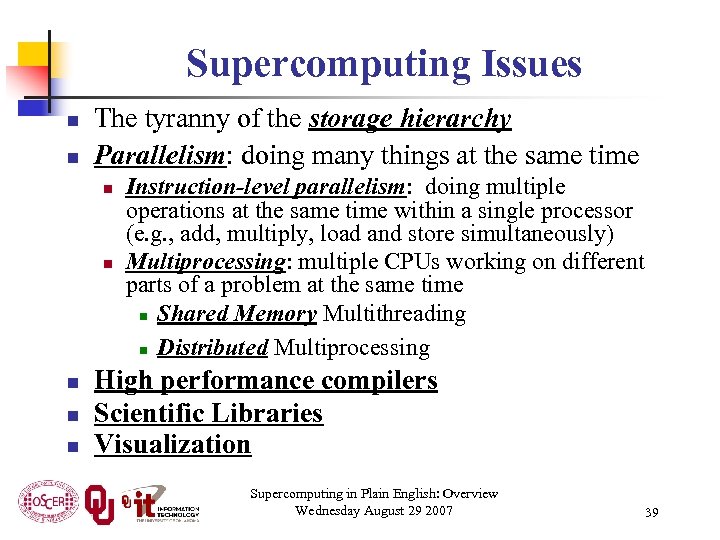 Supercomputing Issues n n The tyranny of the storage hierarchy Parallelism: doing many things at the same time n n n Instruction-level parallelism: doing multiple operations at the same time within a single processor (e. g. , add, multiply, load and store simultaneously) Multiprocessing: multiple CPUs working on different parts of a problem at the same time n Shared Memory Multithreading n Distributed Multiprocessing High performance compilers Scientific Libraries Visualization Supercomputing in Plain English: Overview Wednesday August 29 2007 39
 A Quick Primer on Hardware OU Supercomputing Center for Education & Research
![Henry’s Laptop Dell Latitude D 620[4] n n n Pentium 4 Core Duo T](https://present5.com/presentation/dad3cb682b5607ee6ee390d596e30db1/image-41.jpg "Henry’s Laptop Dell Latitude D 620[4] n n n Pentium 4 Core Duo T") Henry’s Laptop Dell Latitude D 620[4] n n n Pentium 4 Core Duo T 2400 1. 83 GHz w/2 MB L 2 Cache 2 GB (2048 MB) 667 MHz DDR 2 SDRAM 100 GB 7200 RPM SATA Hard Drive DVD+RW/CD-RW Drive (8 x) 1 Gbps Ethernet Adapter 56 Kbps Phone Modem Supercomputing in Plain English: Overview Wednesday August 29 2007 41
Henry’s Laptop Dell Latitude D 620[4] n n n Pentium 4 Core Duo T 2400 1. 83 GHz w/2 MB L 2 Cache 2 GB (2048 MB) 667 MHz DDR 2 SDRAM 100 GB 7200 RPM SATA Hard Drive DVD+RW/CD-RW Drive (8 x) 1 Gbps Ethernet Adapter 56 Kbps Phone Modem Supercomputing in Plain English: Overview Wednesday August 29 2007 41
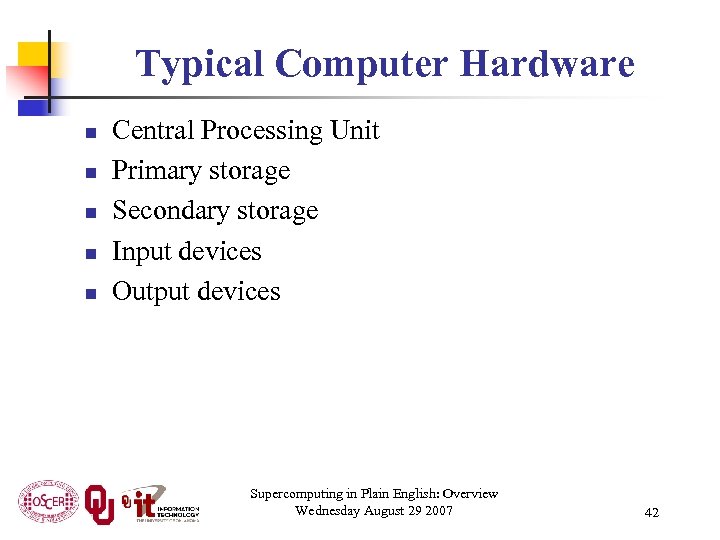 Typical Computer Hardware n n n Central Processing Unit Primary storage Secondary storage Input devices Output devices Supercomputing in Plain English: Overview Wednesday August 29 2007 42
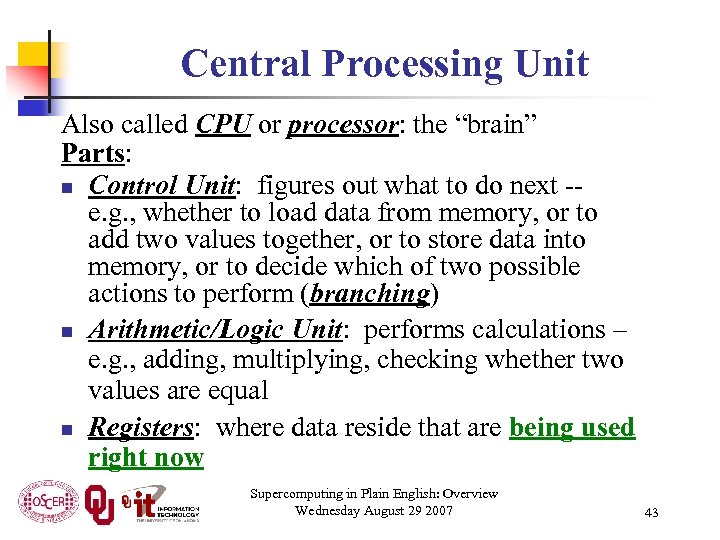 Central Processing Unit Also called CPU or processor: the “brain” Parts: n Control Unit: figures out what to do next -e. g. , whether to load data from memory, or to add two values together, or to store data into memory, or to decide which of two possible actions to perform (branching) n Arithmetic/Logic Unit: performs calculations – e. g. , adding, multiplying, checking whether two values are equal n Registers: where data reside that are being used right now Supercomputing in Plain English: Overview Wednesday August 29 2007 43
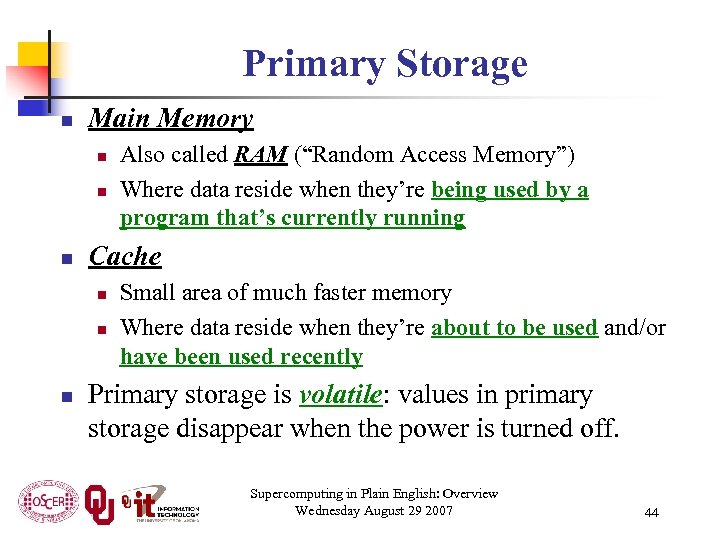 Primary Storage n Main Memory n n n Cache n n n Also called RAM (“Random Access Memory”) Where data reside when they’re being used by a program that’s currently running Small area of much faster memory Where data reside when they’re about to be used and/or have been used recently Primary storage is volatile: values in primary storage disappear when the power is turned off. Supercomputing in Plain English: Overview Wednesday August 29 2007 44
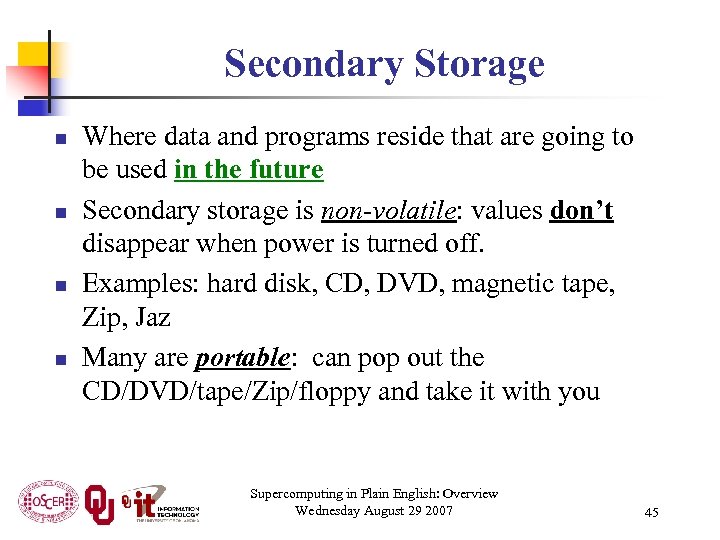 Secondary Storage n n Where data and programs reside that are going to be used in the future Secondary storage is non-volatile: values don’t disappear when power is turned off. Examples: hard disk, CD, DVD, magnetic tape, Zip, Jaz Many are portable: can pop out the CD/DVD/tape/Zip/floppy and take it with you Supercomputing in Plain English: Overview Wednesday August 29 2007 45
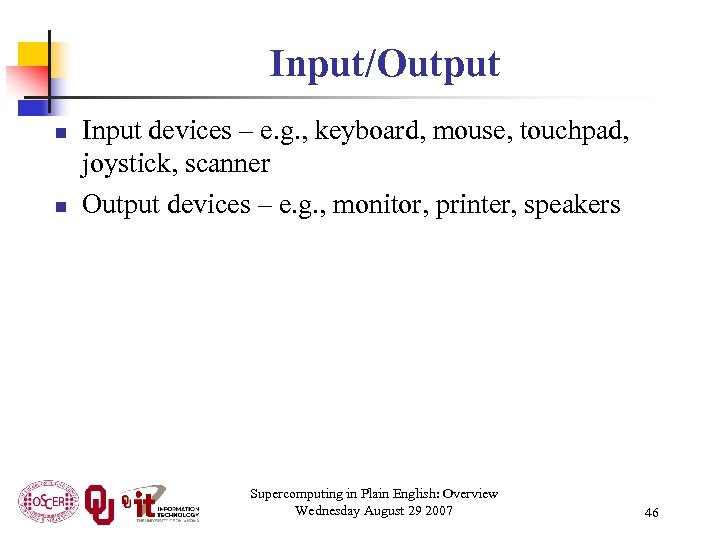 Input/Output n n Input devices – e. g. , keyboard, mouse, touchpad, joystick, scanner Output devices – e. g. , monitor, printer, speakers Supercomputing in Plain English: Overview Wednesday August 29 2007 46
 The Tyranny of the Storage Hierarchy OU Supercomputing Center for Education & Research
![The Storage Hierarchy [5] Fast, expensive, few n Registers n Cache memory n Main](https://present5.com/presentation/dad3cb682b5607ee6ee390d596e30db1/image-48.jpg "The Storage Hierarchy [5] Fast, expensive, few n Registers n Cache memory n Main") The Storage Hierarchy [5] Fast, expensive, few n Registers n Cache memory n Main memory (RAM) n Hard disk n Removable media (e. g. , DVD) Slow, cheap, a lot n Internet [6] Supercomputing in Plain English: Overview Wednesday August 29 2007 48
The Storage Hierarchy [5] Fast, expensive, few n Registers n Cache memory n Main memory (RAM) n Hard disk n Removable media (e. g. , DVD) Slow, cheap, a lot n Internet [6] Supercomputing in Plain English: Overview Wednesday August 29 2007 48
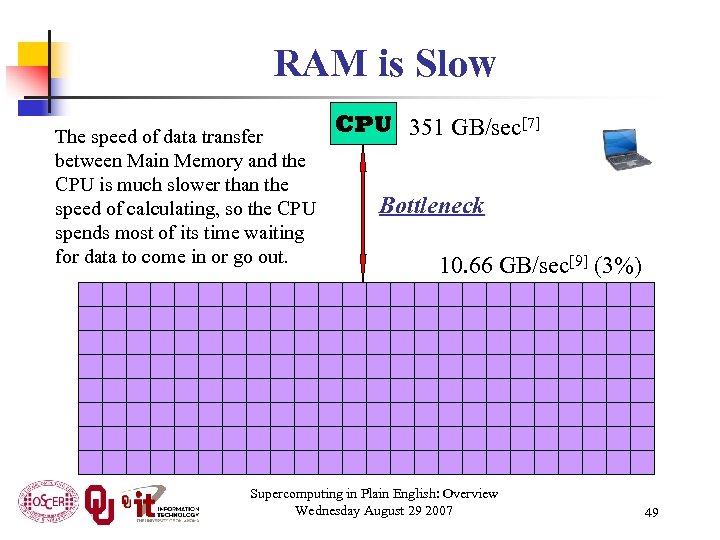 RAM is Slow The speed of data transfer between Main Memory and the CPU is much slower than the speed of calculating, so the CPU spends most of its time waiting for data to come in or go out. CPU 351 GB/sec[7] Bottleneck 10. 66 GB/sec[9] (3%) Supercomputing in Plain English: Overview Wednesday August 29 2007 49
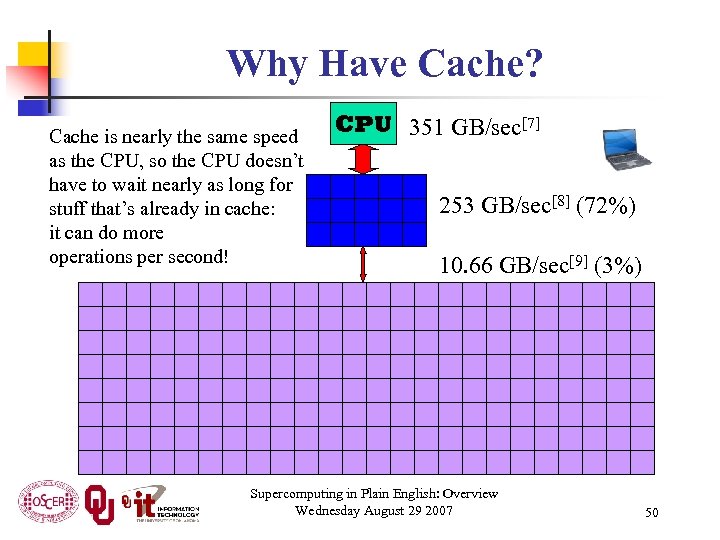 Why Have Cache? Cache is nearly the same speed as the CPU, so the CPU doesn’t have to wait nearly as long for stuff that’s already in cache: it can do more operations per second! CPU 351 GB/sec[7] 253 GB/sec[8] (72%) 10. 66 GB/sec[9] (3%) Supercomputing in Plain English: Overview Wednesday August 29 2007 50
![Henry’s Laptop, Again Dell Latitude D 620[4] n n n Pentium 4 Core Duo](https://present5.com/presentation/dad3cb682b5607ee6ee390d596e30db1/image-51.jpg "Henry’s Laptop, Again Dell Latitude D 620[4] n n n Pentium 4 Core Duo") Henry’s Laptop, Again Dell Latitude D 620[4] n n n Pentium 4 Core Duo T 2400 1. 83 GHz w/2 MB L 2 Cache 2 GB (2048 MB) 667 MHz DDR 2 SDRAM 100 GB 7200 RPM SATA Hard Drive DVD+RW/CD-RW Drive (8 x) 1 Gbps Ethernet Adapter 56 Kbps Phone Modem Supercomputing in Plain English: Overview Wednesday August 29 2007 51
Henry’s Laptop, Again Dell Latitude D 620[4] n n n Pentium 4 Core Duo T 2400 1. 83 GHz w/2 MB L 2 Cache 2 GB (2048 MB) 667 MHz DDR 2 SDRAM 100 GB 7200 RPM SATA Hard Drive DVD+RW/CD-RW Drive (8 x) 1 Gbps Ethernet Adapter 56 Kbps Phone Modem Supercomputing in Plain English: Overview Wednesday August 29 2007 51
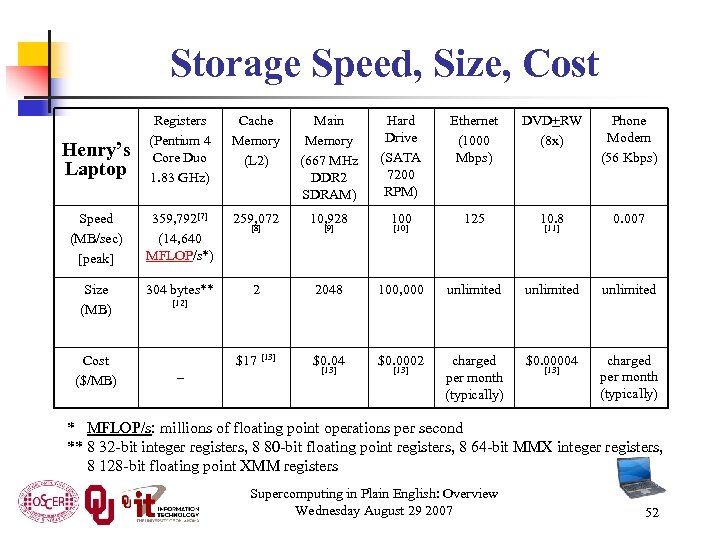 Storage Speed, Size, Cost Henry’s Laptop Registers (Pentium 4 Core Duo 1. 83 GHz) Cache Memory (L 2) Main Memory (667 MHz DDR 2 SDRAM) Hard Drive (SATA 7200 RPM) Ethernet (1000 Mbps) DVD+RW (8 x) Phone Modem (56 Kbps) Speed (MB/sec) [peak] 359, 792[7] (14, 640 MFLOP/s*) 259, 072 10, 928 100 125 10. 8 0. 007 Size (MB) 304 bytes** 2 2048 100, 000 unlimited $17 [13] $0. 04 $0. 0002 charged per month (typically) $0. 00004 charged per month (typically) Cost ($/MB) [8] [9] [10] [11] [12] – [13] * MFLOP/s: millions of floating point operations per second ** 8 32 -bit integer registers, 8 80 -bit floating point registers, 8 64 -bit MMX integer registers, 8 128 -bit floating point XMM registers Supercomputing in Plain English: Overview Wednesday August 29 2007 52
 Storage Use Strategies n n Register reuse: do a lot of work on the same data before working on new data. Cache reuse: the program is much more efficient if all of the data and instructions fit in cache; if not, try to use what’s in cache a lot before using anything that isn’t in cache. Data locality: try to access data that are near each other in memory before data that are far. I/O efficiency: do a bunch of I/O all at once rather than a little bit at a time; don’t mix calculations and I/O. Supercomputing in Plain English: Overview Wednesday August 29 2007 53
 Parallelism OU Supercomputing Center for Education & Research
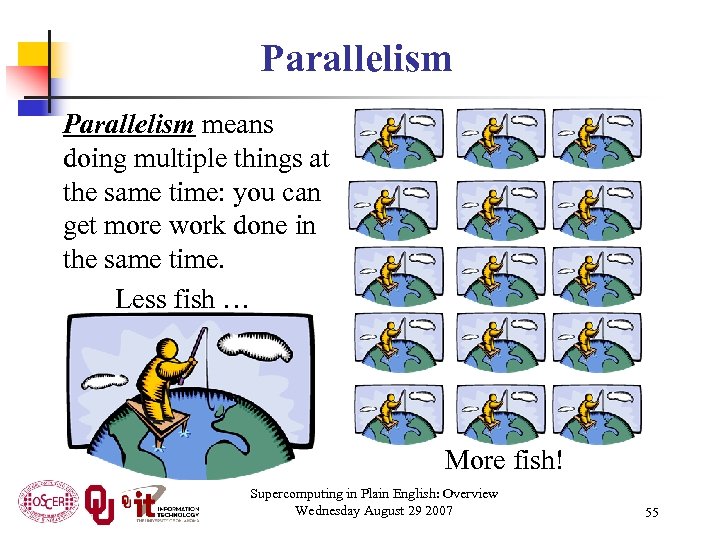 Parallelism means doing multiple things at the same time: you can get more work done in the same time. Less fish … More fish! Supercomputing in Plain English: Overview Wednesday August 29 2007 55
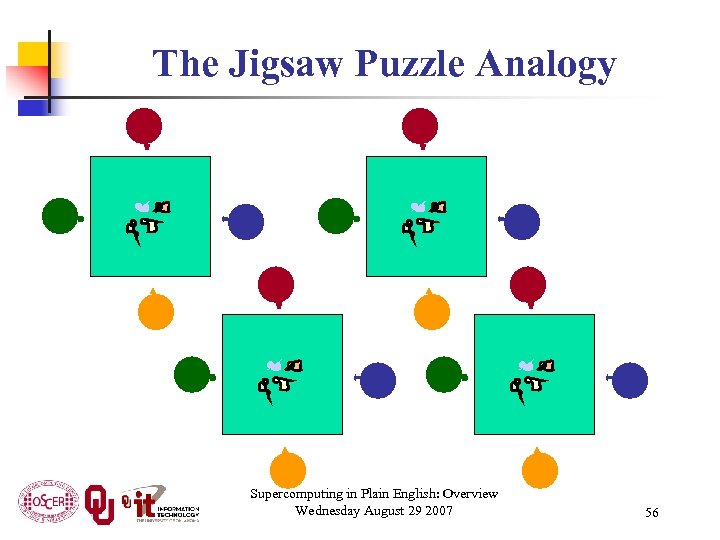 The Jigsaw Puzzle Analogy Supercomputing in Plain English: Overview Wednesday August 29 2007 56
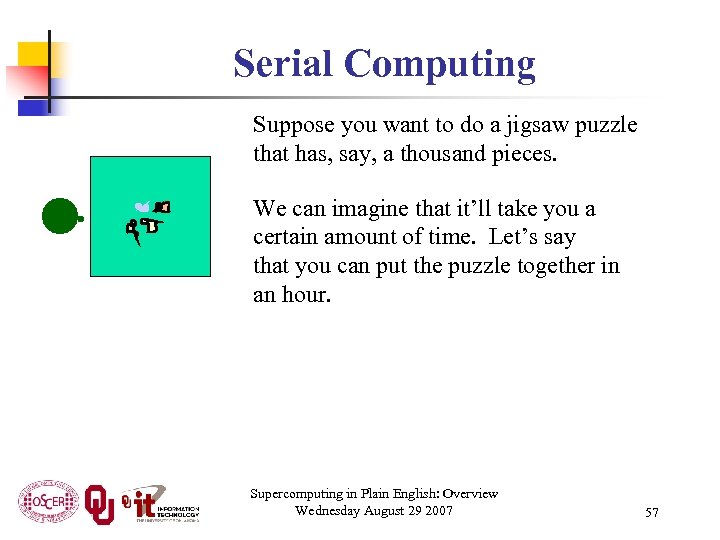 Serial Computing Suppose you want to do a jigsaw puzzle that has, say, a thousand pieces. We can imagine that it’ll take you a certain amount of time. Let’s say that you can put the puzzle together in an hour. Supercomputing in Plain English: Overview Wednesday August 29 2007 57
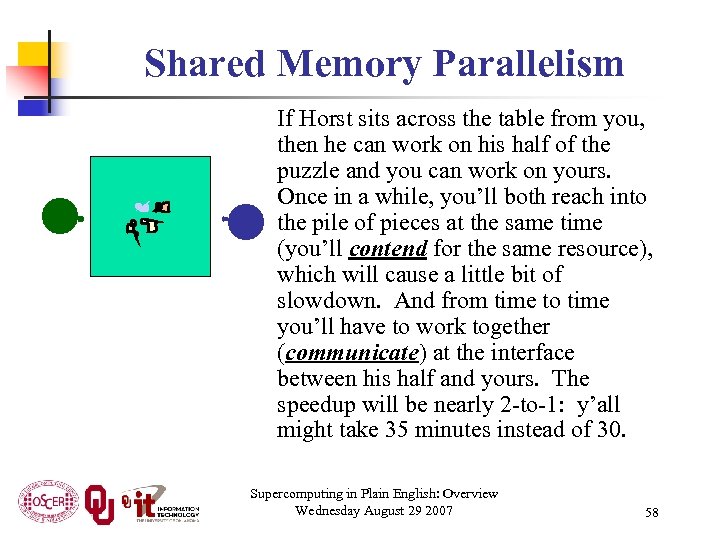 Shared Memory Parallelism If Horst sits across the table from you, then he can work on his half of the puzzle and you can work on yours. Once in a while, you’ll both reach into the pile of pieces at the same time (you’ll contend for the same resource), which will cause a little bit of slowdown. And from time to time you’ll have to work together (communicate) at the interface between his half and yours. The speedup will be nearly 2 -to-1: y’all might take 35 minutes instead of 30. Supercomputing in Plain English: Overview Wednesday August 29 2007 58
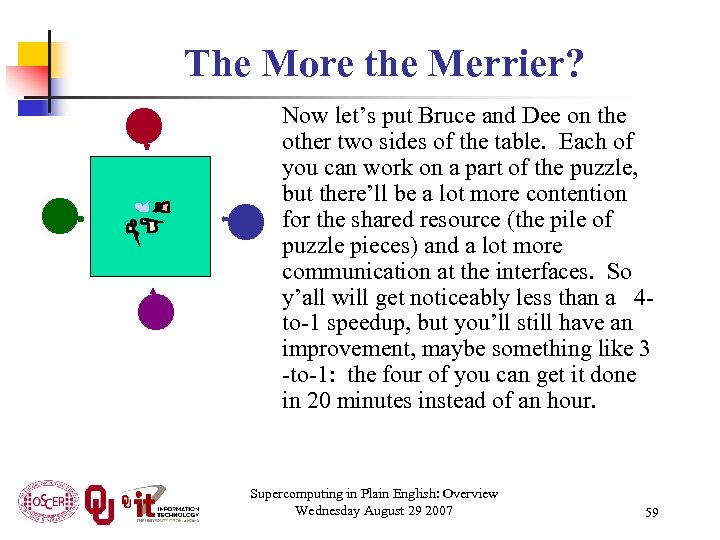 The More the Merrier? Now let’s put Bruce and Dee on the other two sides of the table. Each of you can work on a part of the puzzle, but there’ll be a lot more contention for the shared resource (the pile of puzzle pieces) and a lot more communication at the interfaces. So y’all will get noticeably less than a 4 to-1 speedup, but you’ll still have an improvement, maybe something like 3 -to-1: the four of you can get it done in 20 minutes instead of an hour. Supercomputing in Plain English: Overview Wednesday August 29 2007 59
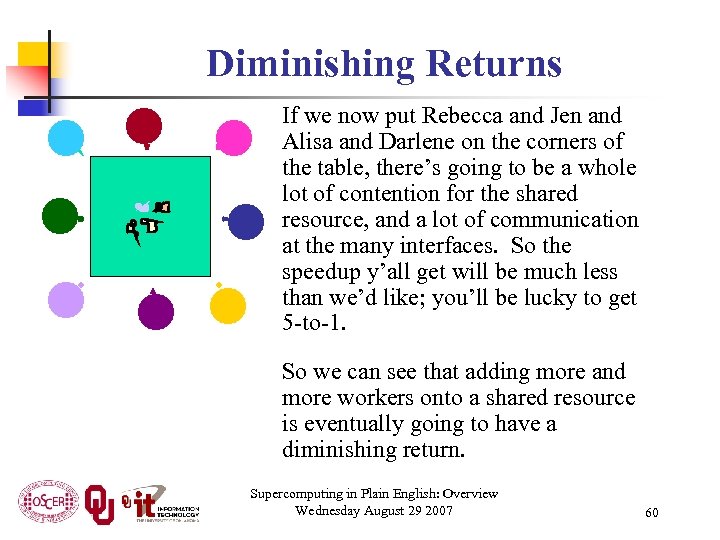 Diminishing Returns If we now put Rebecca and Jen and Alisa and Darlene on the corners of the table, there’s going to be a whole lot of contention for the shared resource, and a lot of communication at the many interfaces. So the speedup y’all get will be much less than we’d like; you’ll be lucky to get 5 -to-1. So we can see that adding more and more workers onto a shared resource is eventually going to have a diminishing return. Supercomputing in Plain English: Overview Wednesday August 29 2007 60
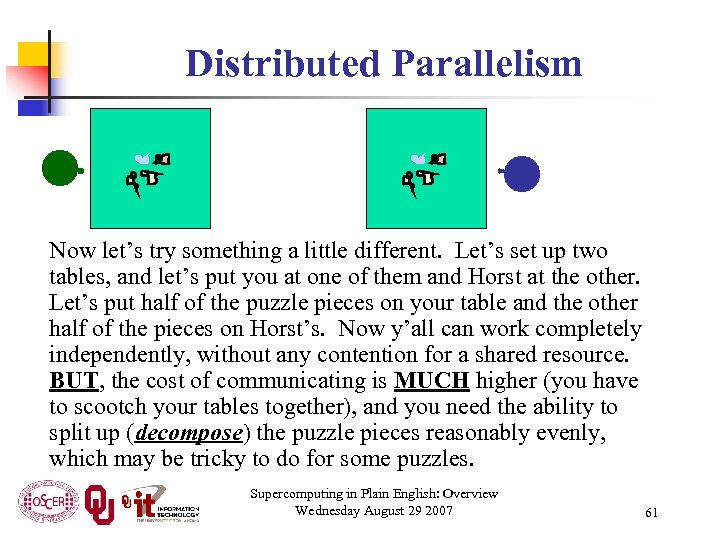 Distributed Parallelism Now let’s try something a little different. Let’s set up two tables, and let’s put you at one of them and Horst at the other. Let’s put half of the puzzle pieces on your table and the other half of the pieces on Horst’s. Now y’all can work completely independently, without any contention for a shared resource. BUT, the cost of communicating is MUCH higher (you have to scootch your tables together), and you need the ability to split up (decompose) the puzzle pieces reasonably evenly, which may be tricky to do for some puzzles. Supercomputing in Plain English: Overview Wednesday August 29 2007 61
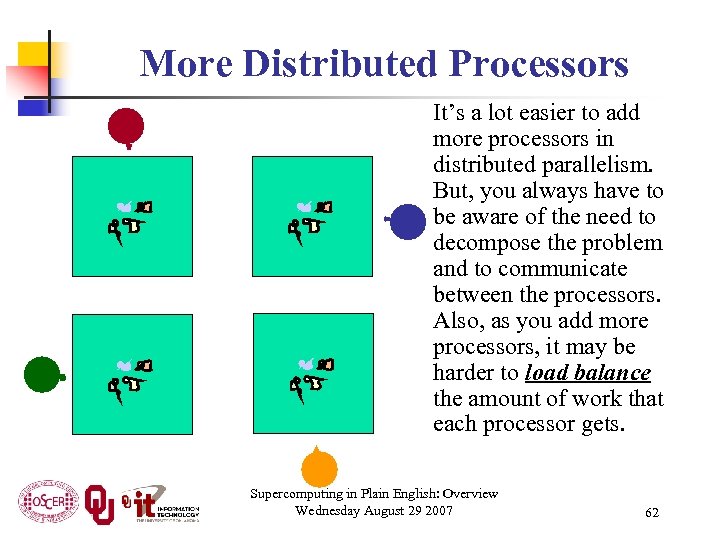 More Distributed Processors It’s a lot easier to add more processors in distributed parallelism. But, you always have to be aware of the need to decompose the problem and to communicate between the processors. Also, as you add more processors, it may be harder to load balance the amount of work that each processor gets. Supercomputing in Plain English: Overview Wednesday August 29 2007 62
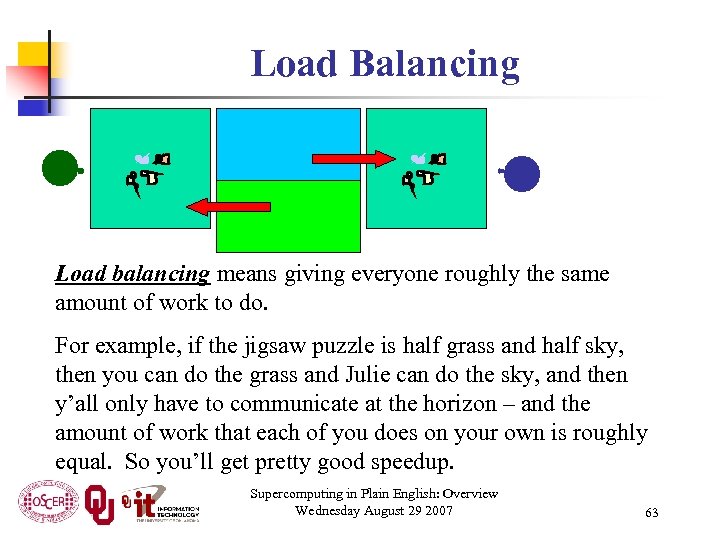 Load Balancing Load balancing means giving everyone roughly the same amount of work to do. For example, if the jigsaw puzzle is half grass and half sky, then you can do the grass and Julie can do the sky, and then y’all only have to communicate at the horizon – and the amount of work that each of you does on your own is roughly equal. So you’ll get pretty good speedup. Supercomputing in Plain English: Overview Wednesday August 29 2007 63
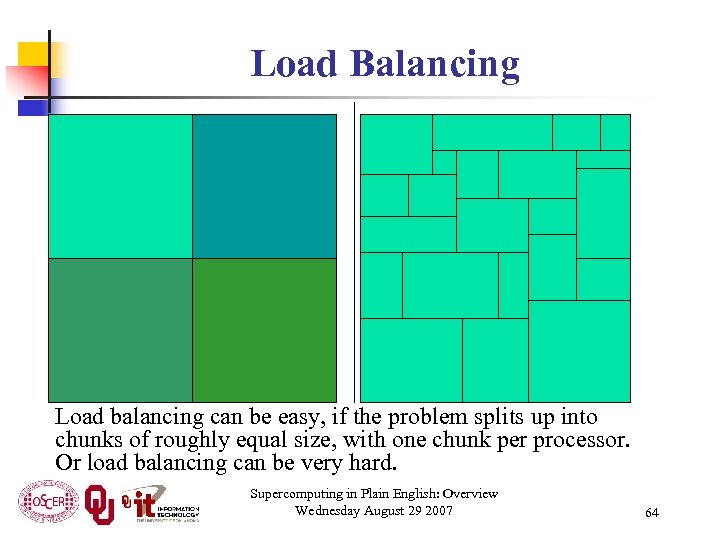 Load Balancing Load balancing can be easy, if the problem splits up into chunks of roughly equal size, with one chunk per processor. Or load balancing can be very hard. Supercomputing in Plain English: Overview Wednesday August 29 2007 64
 Moore’s Law OU Supercomputing Center for Education & Research
 Moore’s Law In 1965, Gordon Moore was an engineer at Fairchild Semiconductor. He noticed that the number of transistors that could be squeezed onto a chip was doubling about every 18 months. It turns out that computer speed is roughly proportional to the number of transistors per unit area. Moore wrote a paper about this concept, which became known as “Moore’s Law. ” Supercomputing in Plain English: Overview Wednesday August 29 2007 66
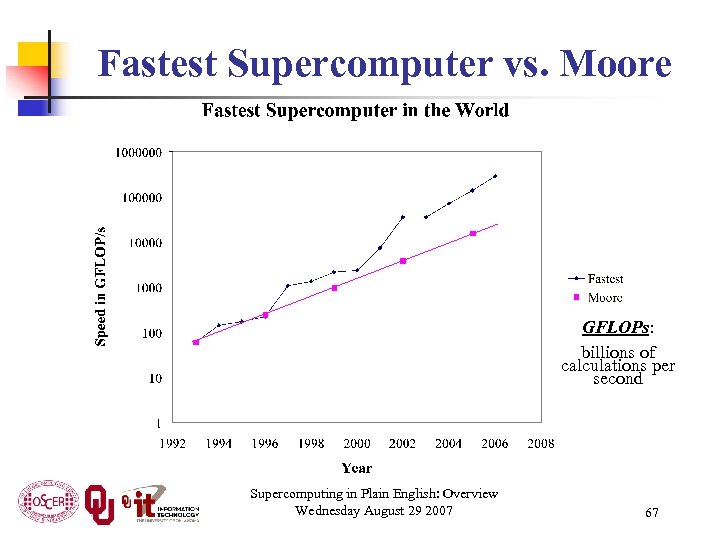 Fastest Supercomputer vs. Moore GFLOPs: billions of calculations per second Supercomputing in Plain English: Overview Wednesday August 29 2007 67
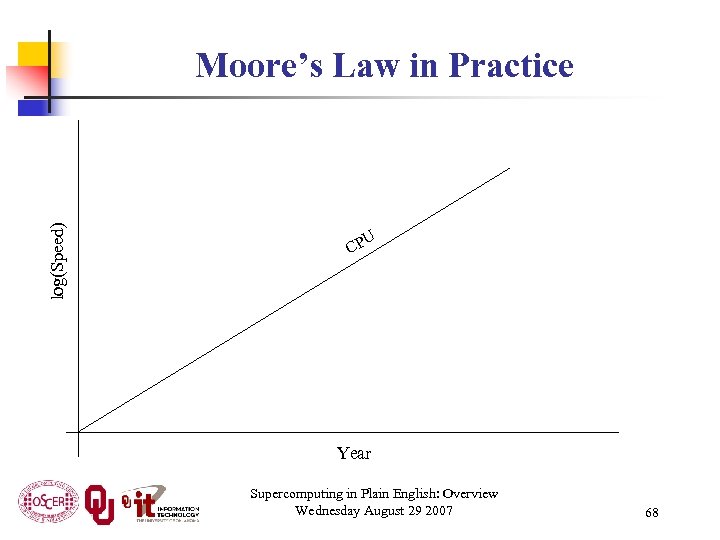 log(Speed) Moore’s Law in Practice U CP Year Supercomputing in Plain English: Overview Wednesday August 29 2007 68
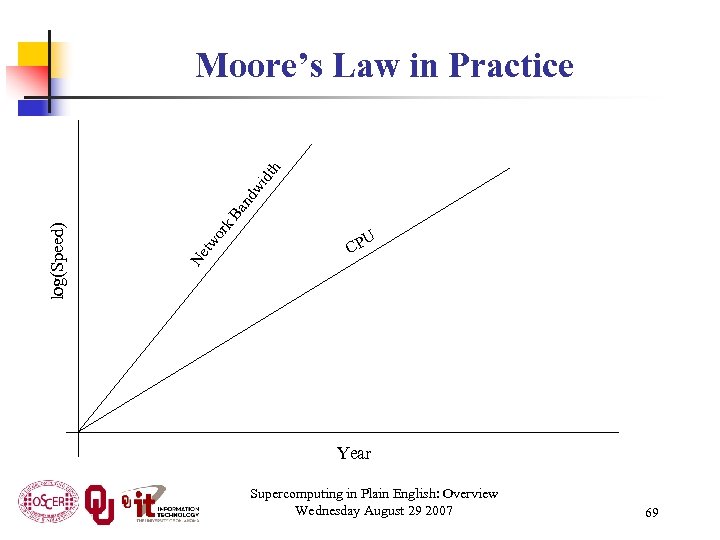 k. B an dw idt h or Ne tw log(Speed) Moore’s Law in Practice U CP Year Supercomputing in Plain English: Overview Wednesday August 29 2007 69
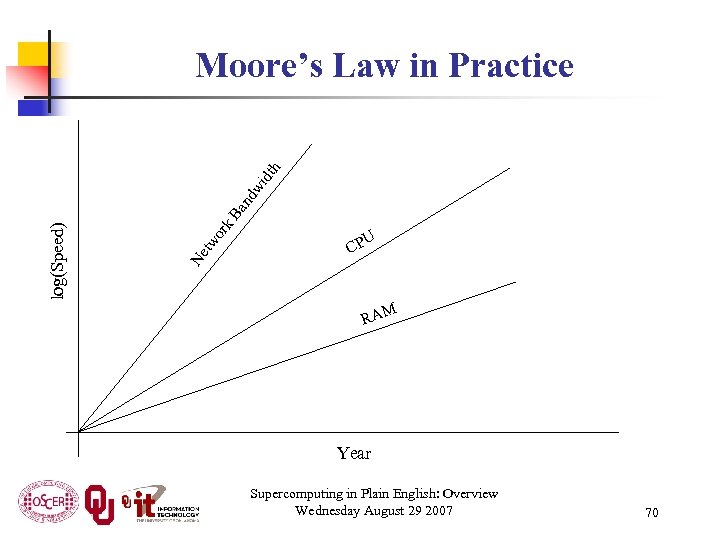 k. B an dw idt h or Ne tw log(Speed) Moore’s Law in Practice U CP RAM Year Supercomputing in Plain English: Overview Wednesday August 29 2007 70
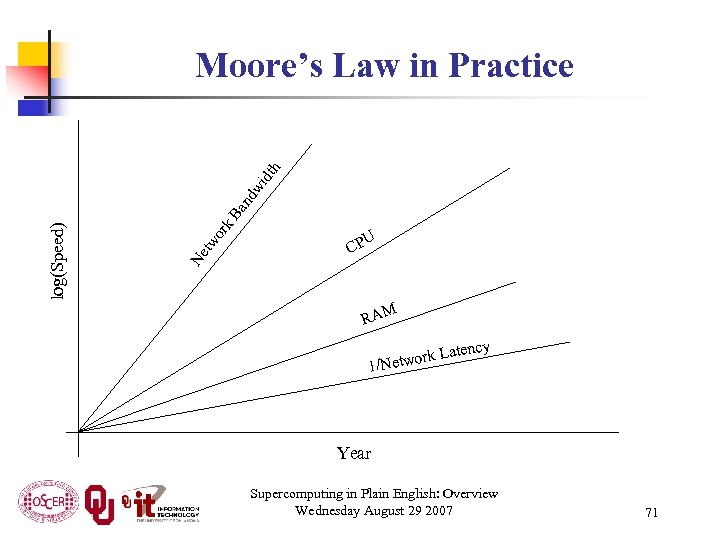 k. B an dw idt h or Ne tw log(Speed) Moore’s Law in Practice U CP RAM ency ork Lat 1/Netw Year Supercomputing in Plain English: Overview Wednesday August 29 2007 71
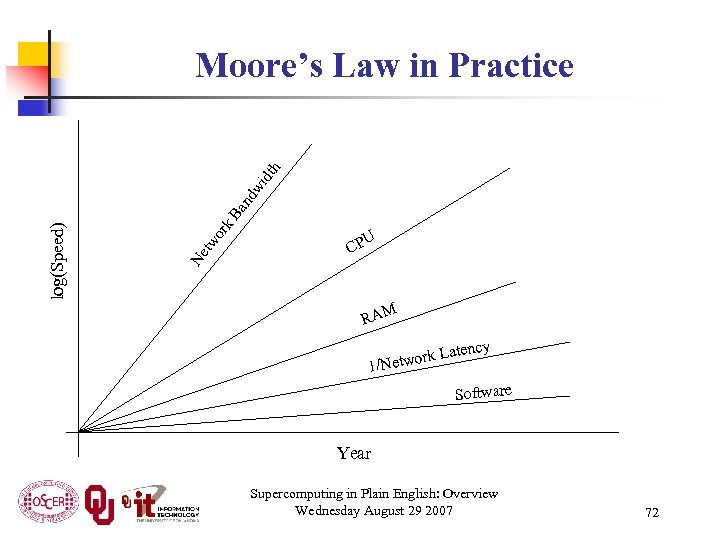 k. B an dw idt h or Ne tw log(Speed) Moore’s Law in Practice U CP RAM ency ork Lat 1/Netw Software Year Supercomputing in Plain English: Overview Wednesday August 29 2007 72
 Why Bother? OU Supercomputing Center for Education & Research
 Why Bother with HPC at All? It’s clear that making effective use of HPC takes quite a bit of effort, both learning how and developing software. That seems like a lot of trouble to go to just to get your code to run faster. It’s nice to have a code that used to take a day run in an hour. But if you can afford to wait a day, what’s the point of HPC? Why go to all that trouble just to get your code to run faster? Supercomputing in Plain English: Overview Wednesday August 29 2007 74
 Why HPC is Worth the Bother n n What HPC gives you that you won’t get elsewhere is the ability to do bigger, better, more exciting science. If your code can run faster, that means that you can tackle much bigger problems in the same amount of time that you used to need for smaller problems. HPC is important not only for its own sake, but also because what happens in HPC today will be on your desktop in about 15 years: it puts you ahead of the curve. Supercomputing in Plain English: Overview Wednesday August 29 2007 75
 The Future is Now Historically, this has always been true: Whatever happens in supercomputing today will be on your desktop in 10 – 15 years. So, if you have experience with supercomputing, you’ll be ahead of the curve when things get to the desktop. Supercomputing in Plain English: Overview Wednesday August 29 2007 76
 To Learn More Supercomputing http: //www. oscer. ou. edu/education. php http: //symposium 2007. oscer. ou. edu/ Supercomputing in Plain English: Overview Wednesday August 29 2007 77
 Thanks for your attention! Questions? OU Supercomputing Center for Education & Research
![References [1] Image by Greg Bryan, MIT: http: //zeus. ncsa. uiuc. edu: 8080/chdm_script. html](https://present5.com/presentation/dad3cb682b5607ee6ee390d596e30db1/image-79.jpg "References [1] Image by Greg Bryan, MIT: http: //zeus. ncsa. uiuc. edu: 8080/chdm_script. html") References [1] Image by Greg Bryan, MIT: http: //zeus. ncsa. uiuc. edu: 8080/chdm_script. html [2] “Update on the Collaborative Radar Acquisition Field Test (CRAFT): Planning for the Next Steps. ” Presented to NWS Headquarters August 30 2001. [3] See http: //scarecrow. caps. ou. edu/~hneeman/hamr. html for details. [4] http: //www. dell. com/ [5] http: //www. f 1 photo. com/ [6] http: //www. vw. com/newbeetle/ [7] Richard Gerber, The Software Optimization Cookbook: High-performance Recipes for the Intel Architecture. Intel Press, 2002, pp. 161 -168. [8] http: //www. anandtech. com/showdoc. html? i=1460&p=2 [9] ftp: //download. intel. com/design/Pentium 4/papers/24943801. pdf [10] http: //www. seagate. com/cda/products/discsales/personal/family/0, 1085, 621, 00. html [11] http: //www. samsung. com/Products/Optical. Disc. Drive/Slim. Drive/Optical. Disc. Drive_Slim. Drive_SN_S 082 D. asp? page=Specifications [12] ftp: //download. intel. com/design/Pentium 4/manuals/24896606. pdf [13] http: //www. pricewatch. com/ [14] Steve Behling et al, The POWER 4 Processor Introduction and Tuning Guide, IBM, 2001, p. 8. [15] Kevin Dowd and Charles Severance, High Performance Computing, 2 nd ed. O’Reilly, 1998, p. 16. [16] http: //emeagwali. biz/photos/stock/supercomputer/black-shirt/ Supercomputing in Plain English: Overview Wednesday August 29 2007 79
References [1] Image by Greg Bryan, MIT: http: //zeus. ncsa. uiuc. edu: 8080/chdm_script. html [2] “Update on the Collaborative Radar Acquisition Field Test (CRAFT): Planning for the Next Steps. ” Presented to NWS Headquarters August 30 2001. [3] See http: //scarecrow. caps. ou. edu/~hneeman/hamr. html for details. [4] http: //www. dell. com/ [5] http: //www. f 1 photo. com/ [6] http: //www. vw. com/newbeetle/ [7] Richard Gerber, The Software Optimization Cookbook: High-performance Recipes for the Intel Architecture. Intel Press, 2002, pp. 161 -168. [8] http: //www. anandtech. com/showdoc. html? i=1460&p=2 [9] ftp: //download. intel. com/design/Pentium 4/papers/24943801. pdf [10] http: //www. seagate. com/cda/products/discsales/personal/family/0, 1085, 621, 00. html [11] http: //www. samsung. com/Products/Optical. Disc. Drive/Slim. Drive/Optical. Disc. Drive_Slim. Drive_SN_S 082 D. asp? page=Specifications [12] ftp: //download. intel. com/design/Pentium 4/manuals/24896606. pdf [13] http: //www. pricewatch. com/ [14] Steve Behling et al, The POWER 4 Processor Introduction and Tuning Guide, IBM, 2001, p. 8. [15] Kevin Dowd and Charles Severance, High Performance Computing, 2 nd ed. O’Reilly, 1998, p. 16. [16] http: //emeagwali. biz/photos/stock/supercomputer/black-shirt/ Supercomputing in Plain English: Overview Wednesday August 29 2007 79