 Скачать презентацию Super Bfactory Detector plan Recent status Junji Haba
a4316c1176470b94e36c42fa3789e294.ppt
- Количество слайдов: 40



Super. Bfactory Detector plan Recent status Junji Haba
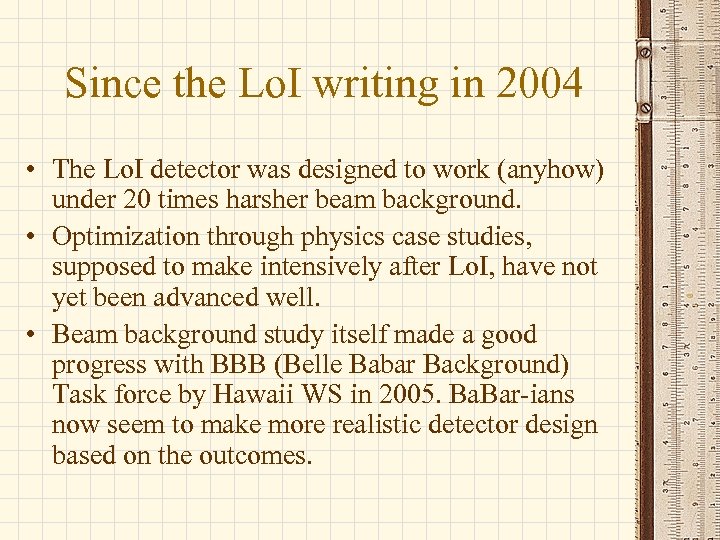
Since the Lo. I writing in 2004 • The Lo. I detector was designed to work (anyhow) under 20 times harsher beam background. • Optimization through physics case studies, supposed to make intensively after Lo. I, have not yet been advanced well. • Beam background study itself made a good progress with BBB (Belle Babar Background) Task force by Hawaii WS in 2005. Bar-ians now seem to make more realistic detector design based on the outcomes.
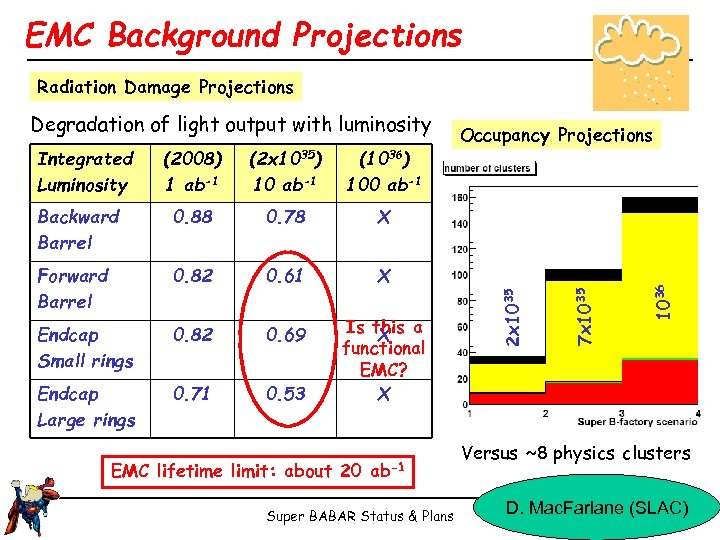
EMC Background Projections Radiation Damage Projections Degradation of light output with luminosity (1036) 100 ab-1 Backward Barrel 0. 88 0. 78 X Forward Barrel 0. 82 0. 61 X Endcap Small rings 0. 82 0. 69 Endcap Large rings 0. 71 0. 53 Is this a X functional EMC? X EMC lifetime limit: about 20 ab-1 Super BABAR Status & Plans 1036 (2 x 1035) 10 ab-1 7 x 1035 (2008) 1 ab-1 2 x 1035 Integrated Luminosity Occupancy Projections Versus ~8 physics clusters D. Mac. Farlane (SLAC)
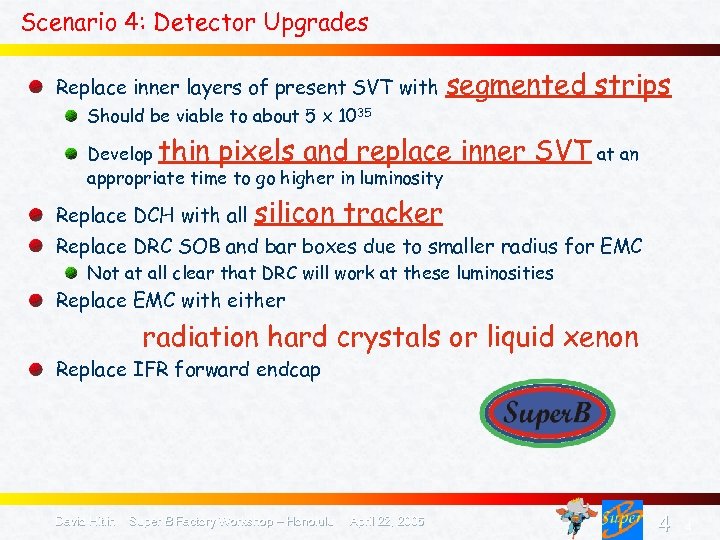
Scenario 4: Detector Upgrades Replace inner layers of present SVT with segmented strips Should be viable to about 5 x 1035 Develop thin pixels and replace appropriate time to go higher in luminosity Replace DCH with all inner SVT at an silicon tracker Replace DRC SOB and bar boxes due to smaller radius for EMC Not at all clear that DRC will work at these luminosities Replace EMC with either radiation hard crystals or liquid xenon Replace IFR forward endcap David Hitlin Super B Factory Workshop – Honolulu April 22, 2005 4 4
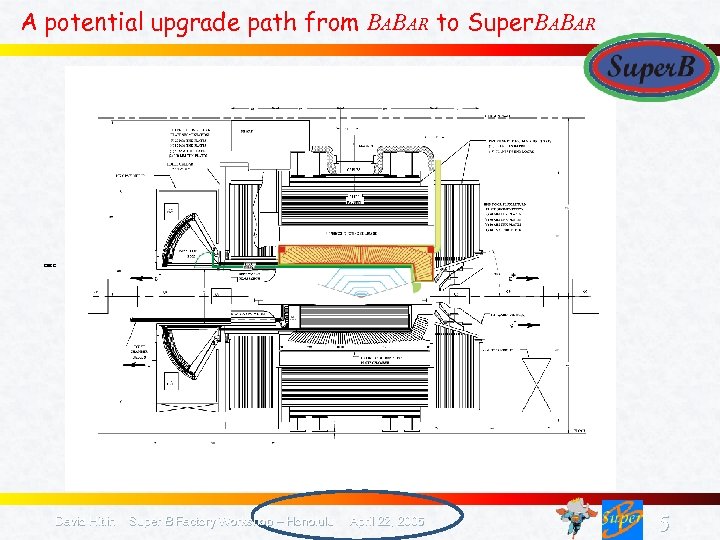
A potential upgrade path from BABAR to Super. BABAR DIRC David Hitlin Super B Factory Workshop – Honolulu April 22, 2005 5 5
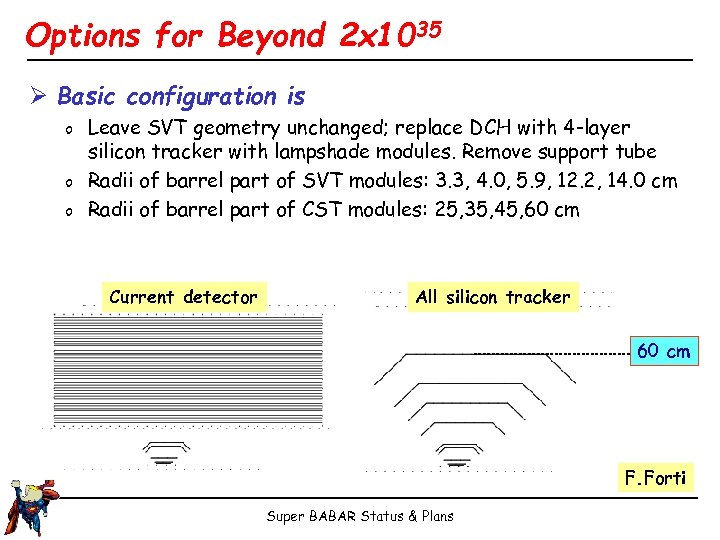
Options for Beyond 2 x 1035 Ø Basic configuration is o o o Leave SVT geometry unchanged; replace DCH with 4 -layer silicon tracker with lampshade modules. Remove support tube Radii of barrel part of SVT modules: 3. 3, 4. 0, 5. 9, 12. 2, 14. 0 cm Radii of barrel part of CST modules: 25, 35, 45, 60 cm Current detector All silicon tracker 60 cm F. Forti Super BABAR Status & Plans
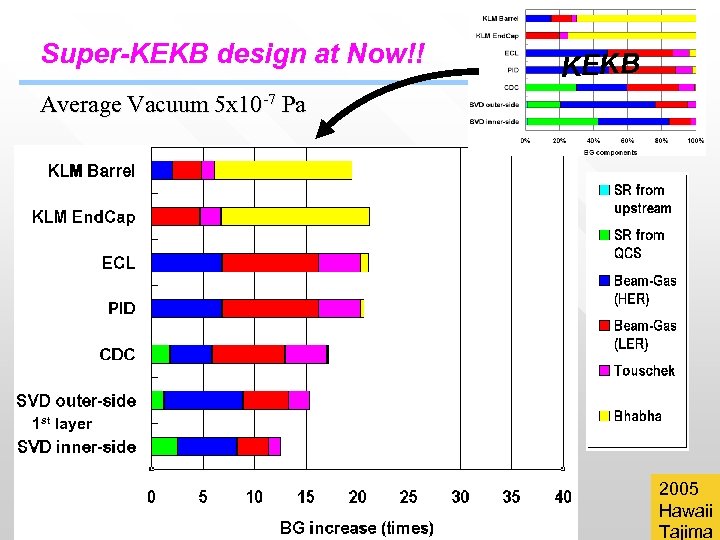
Super-KEKB design at Now!! KEKB Average Vacuum 5 x 10 -7 Pa 1 st layer 2005 Hawaii Tajima
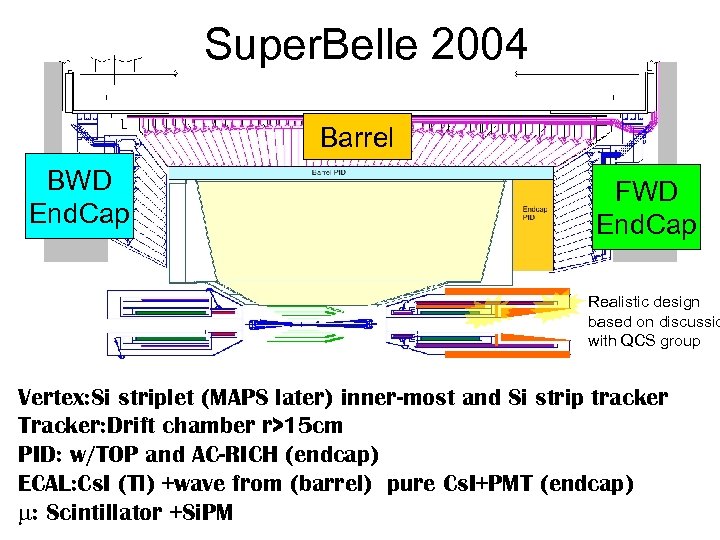
Super. Belle 2004 Barrel BWD End. Cap FWD End. Cap Realistic design based on discussio with QCS group Vertex: Si striplet (MAPS later) inner-most and Si strip tracker Tracker: Drift chamber r>15 cm PID: w/TOP and AC-RICH (endcap) ECAL: Cs. I (Tl) +wave from (barrel) pure Cs. I+PMT (endcap) m: Scintillator +Si. PM
Babar-ians move to Italy Nov. 2006 The baseline is… • As much of the Ba. Bar detector as makes sense • Upgrades to the Ba. Bar detector that are necessary to cope with higher luminosity • Optional upgrades have to be: – Not too expensive – Not interfering with another sub-system – Justified by the physics
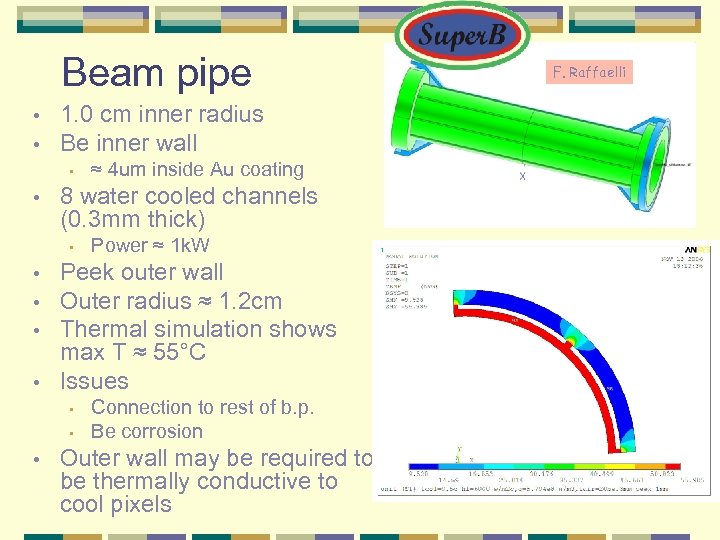
Beam pipe • • 1. 0 cm inner radius Be inner wall • • ≈ 4 um inside Au coating 8 water cooled channels (0. 3 mm thick) • Power ≈ 1 k. W Peek outer wall Outer radius ≈ 1. 2 cm Thermal simulation shows max T ≈ 55°C • Issues • • • Connection to rest of b. p. Be corrosion Outer wall may be required to be thermally conductive to cool pixels F. Raffaelli
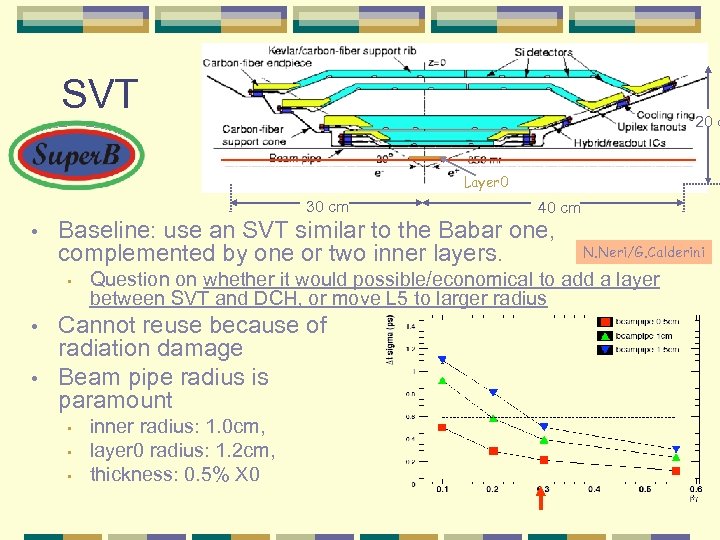
SVT 20 c Layer 0 30 cm • 40 cm Baseline: use an SVT similar to the Babar one, complemented by one or two inner layers. • Question on whether it would possible/economical to add a layer between SVT and DCH, or move L 5 to larger radius Cannot reuse because of radiation damage • Beam pipe radius is paramount • • N. Neri/G. Calderini inner radius: 1. 0 cm, layer 0 radius: 1. 2 cm, thickness: 0. 5% X 0
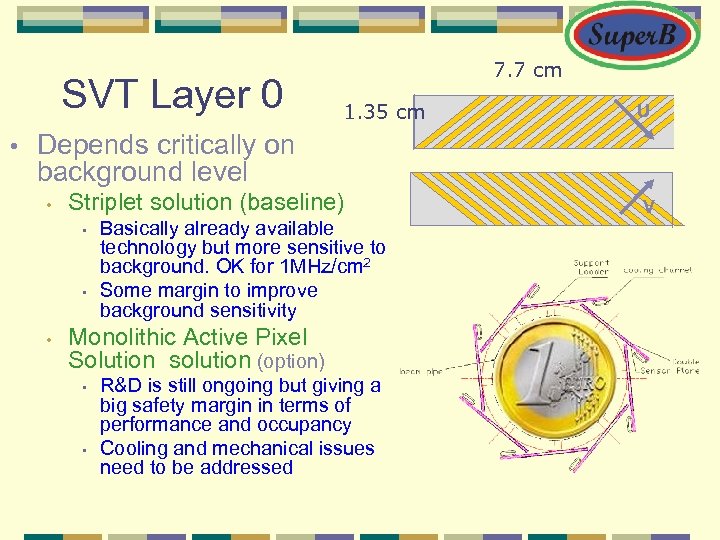
SVT Layer 0 • 7. 7 cm 1. 35 cm U Depends critically on background level • Striplet solution (baseline) • • • Basically already available technology but more sensitive to background. OK for 1 MHz/cm 2 Some margin to improve background sensitivity Monolithic Active Pixel Solution solution (option) • • R&D is still ongoing but giving a big safety margin in terms of performance and occupancy Cooling and mechanical issues need to be addressed V
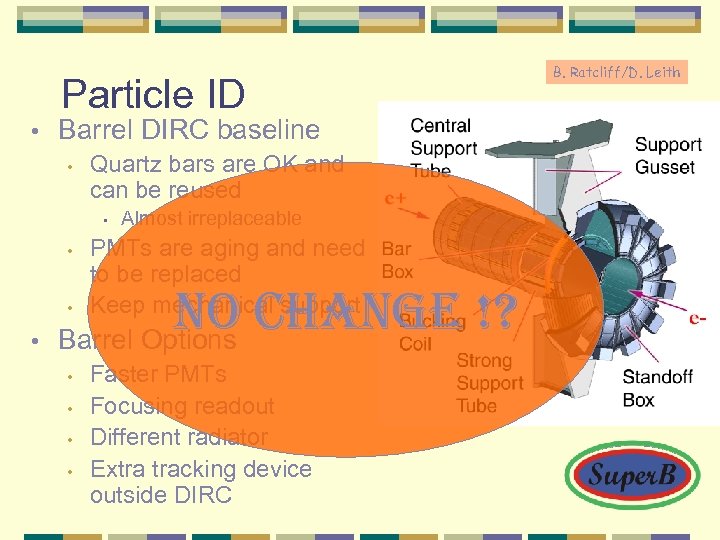
Particle ID • Barrel DIRC baseline • Quartz bars are OK and can be reused • • PMTs are aging and need to be replaced Keep mechanical support no change !? Barrel Options • • Almost irreplaceable • • Faster PMTs Focusing readout Different radiator Extra tracking device outside DIRC B. Ratcliff/D. Leith
EMC • Barrel Cs. I(Tl) crystals • • • Has worked fine in Ba. Bar and Belle No problems with radiation damage of Cs. I(Tl) crystals so far Pileup can be handled by feature extraction of waveform digitisations • • Need to upgrade readout electronics Forward Endcap EMC • • S. Playfer/S. Robertson Ba. Bar crystal are damaged by radiation and need to be replaced Occupancy at low angle makes Cs. I(Tl) too slow No doubt we need a forward calorimeter Backward EMC option • Because of material in front will have a degraded performance • • Maybe just a VETO device for rare channels such as B . Physics impact needs to be quantitatively assessed DIRC bars are necessarily in the middle DCH electronics relocation is critical for the perfomance
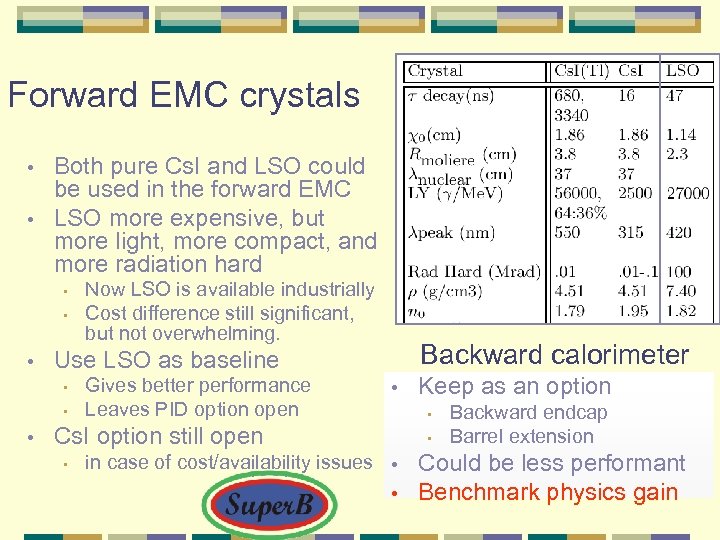
Forward EMC crystals Both pure Cs. I and LSO could be used in the forward EMC • LSO more expensive, but more light, more compact, and more radiation hard • • Backward calorimeter Use LSO as baseline • • • Now LSO is available industrially Cost difference still significant, but not overwhelming. Gives better performance Leaves PID option open • Cs. I option still open • in case of cost/availability issues • • Keep as an option • • Backward endcap Barrel extension Could be less performant Benchmark physics gain
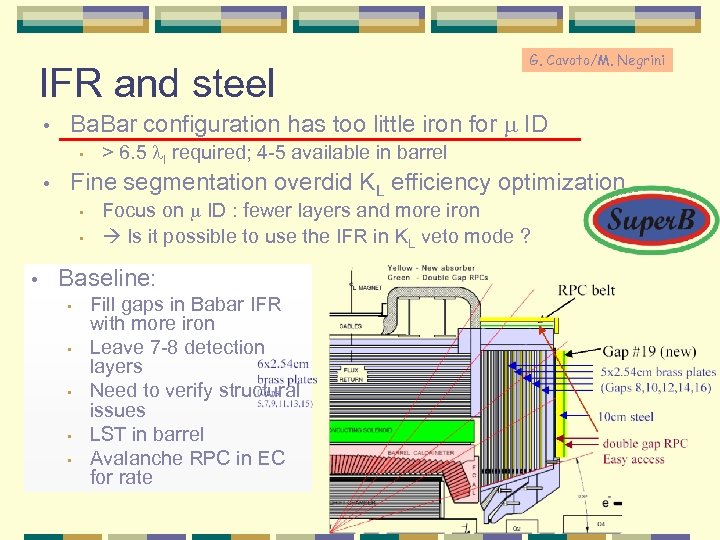
IFR and steel • Ba. Bar configuration has too little iron for m ID • • > 6. 5 l. I required; 4 -5 available in barrel Fine segmentation overdid KL efficiency optimization • • • G. Cavoto/M. Negrini Focus on m ID : fewer layers and more iron Is it possible to use the IFR in KL veto mode ? Baseline: • • • Fill gaps in Babar IFR with more iron Leave 7 -8 detection layers Need to verify structural issues LST in barrel Avalanche RPC in EC for rate
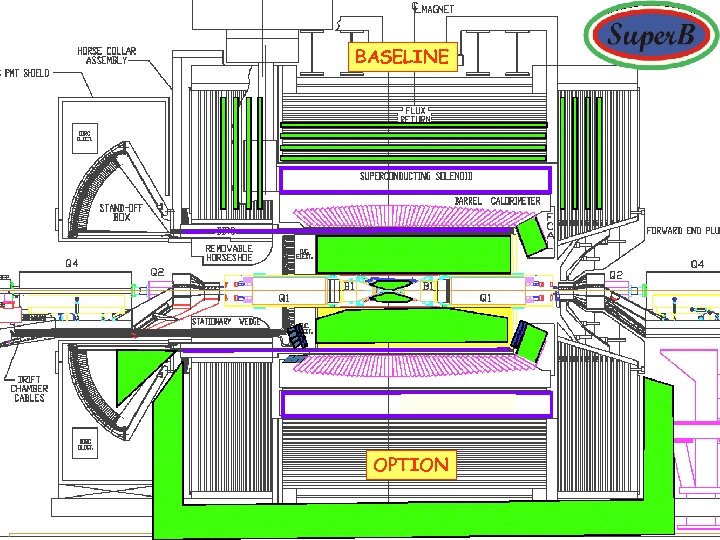
BASELINE Detector Layout OPTION
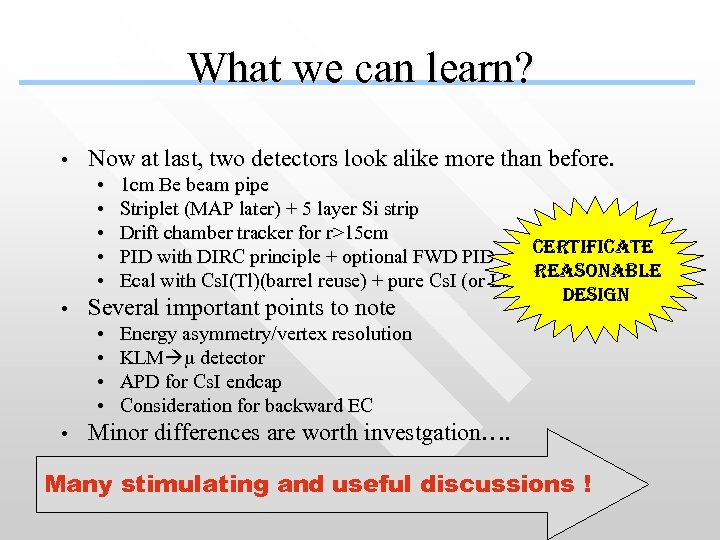
What we can learn? • Now at last, two detectors look alike more than before. • • • Several important points to note • • • 1 cm Be beam pipe Striplet (MAP later) + 5 layer Si strip Drift chamber tracker for r>15 cm certificate PID with DIRC principle + optional FWD PID Ecal with Cs. I(Tl)(barrel reuse) + pure Cs. I (or LSO)reasonable design Energy asymmetry/vertex resolution KLM m detector APD for Cs. I endcap Consideration for backward EC Minor differences are worth investgation…. Many stimulating and useful discussions !
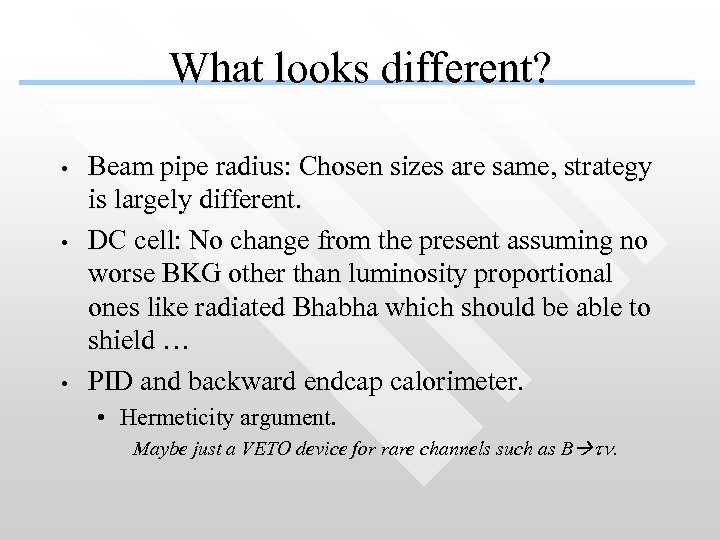
What looks different? • • • Beam pipe radius: Chosen sizes are same, strategy is largely different. DC cell: No change from the present assuming no worse BKG other than luminosity proportional ones like radiated Bhabha which should be able to shield … PID and backward endcap calorimeter. • Hermeticity argument. Maybe just a VETO device for rare channels such as B tn.
Better vertex and a small radius (or super flat) beam pipe
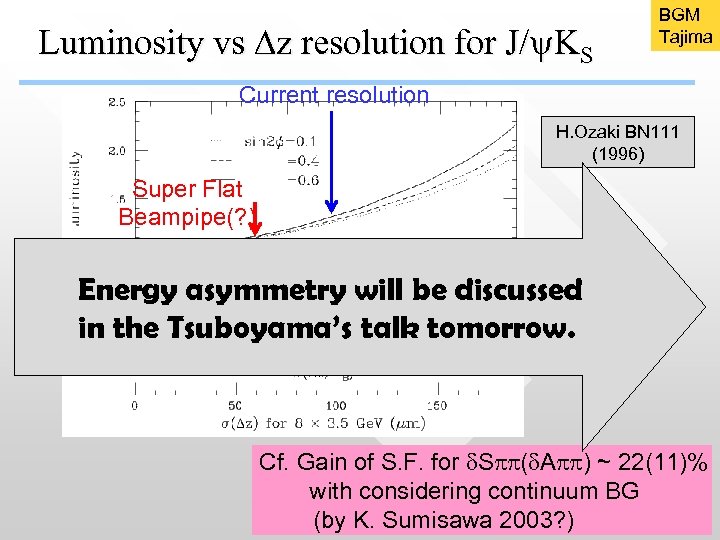
Luminosity vs Dz resolution for J/y. KS BGM Tajima Current resolution H. Ozaki BN 111 (1996) Super Flat Beampipe(? ) Can be improvemed w/ better vtx resolution Energy asymmetry will be discussed ~½ s +20 % gain of luminosity in the Tsuboyama’s talk tomorrow. Cf. Gain of S. F. for d. Spp(d. App) ~ 22(11)% with considering continuum BG (by K. Sumisawa 2003? )
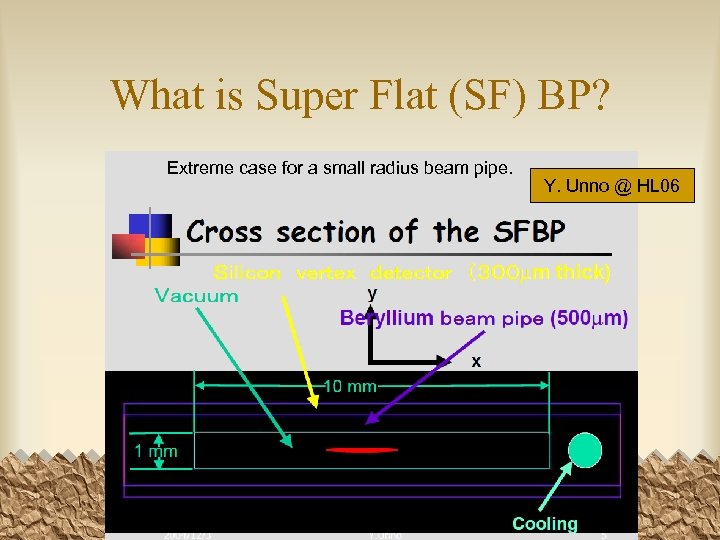
What is Super Flat (SF) BP? Extreme case for a small radius beam pipe. Y. Unno @ HL 06
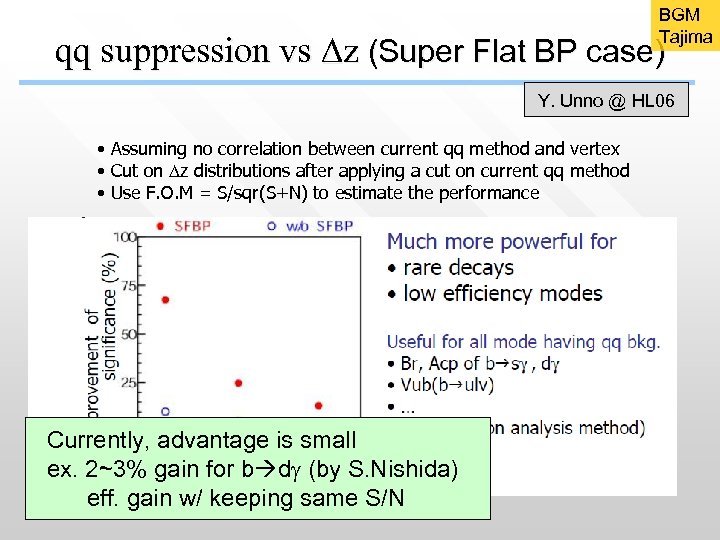
BGM Tajima qq suppression vs Dz (Super Flat BP case) Y. Unno @ HL 06 • Assuming no correlation between current qq method and vertex • Cut on Dz distributions after applying a cut on current qq method • Use F. O. M = S/sqr(S+N) to estimate the performance Currently, advantage is small ex. 2~3% gain for b dg (by S. Nishida) eff. gain w/ keeping same S/N
No more armchair plan. Should be demonstrated in simulations under realistic occupancy.
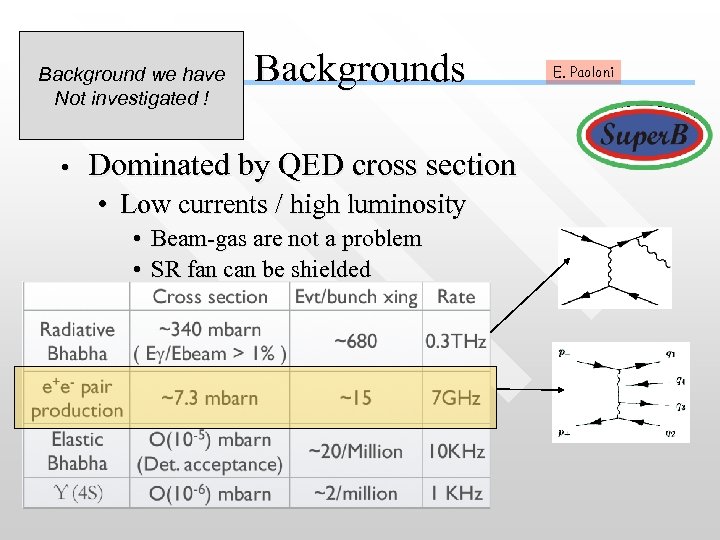
Background we have Not investigated ! • Backgrounds Dominated by QED cross section • Low currents / high luminosity • Beam-gas are not a problem • SR fan can be shielded E. Paoloni
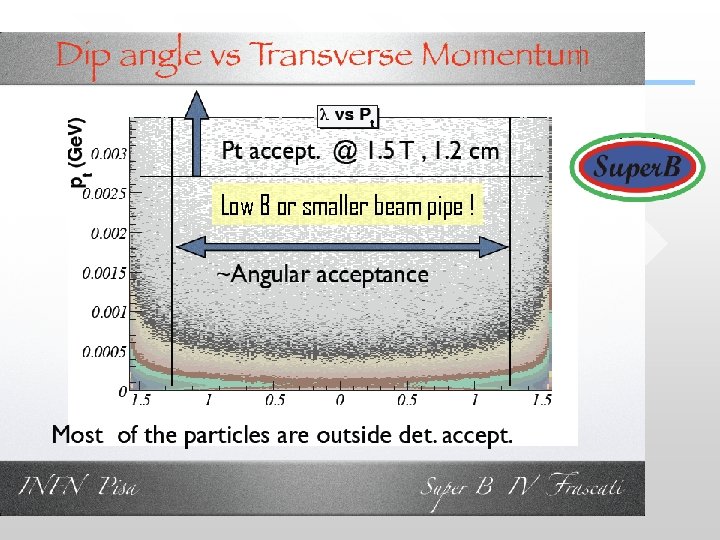
Low B or smaller beam pipe !
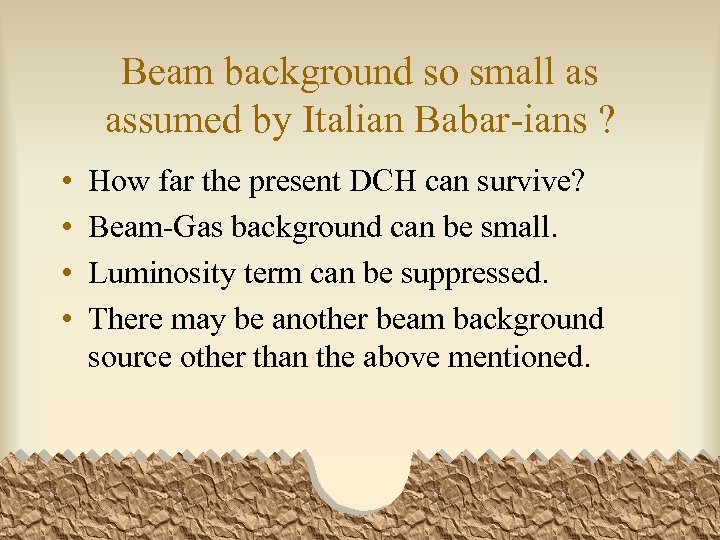
Beam background so small as assumed by Italian Babar-ians ? • • How far the present DCH can survive? Beam-Gas background can be small. Luminosity term can be suppressed. There may be another beam background source other than the above mentioned.
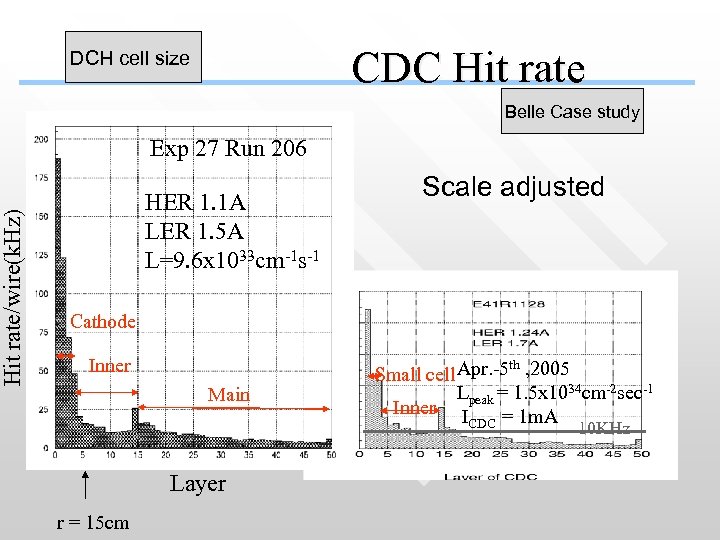
Hit rate/wire(k. Hz) CDC Hit rate DCH cell size Belle Case study Exp 27 Run 206 HER 1. 1 A LER 1. 5 A L=9. 6 x 1033 cm-1 s-1 Scale adjusted Cathode Inner Main th Small cell Apr. -5 , 2005 Lpeak = 1. 5 x 1034 cm-2 sec-1 Inner I CDC = 1 m. A 10 KHz Layer r = 15 cm
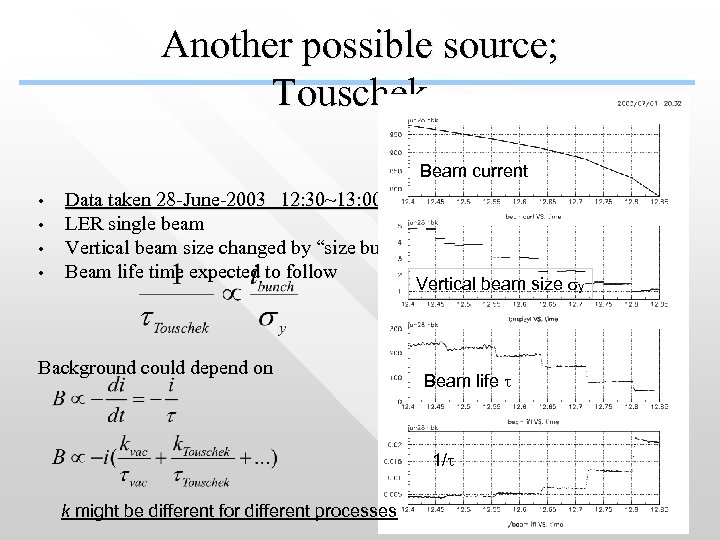
Another possible source; Touschek Beam current • • Data taken 28 -June-2003 12: 30~13: 00 LER single beam Vertical beam size changed by “size bump” Beam life time expected to follow Vertical beam size sy Background could depend on Beam life 1/ k might be different for different processes
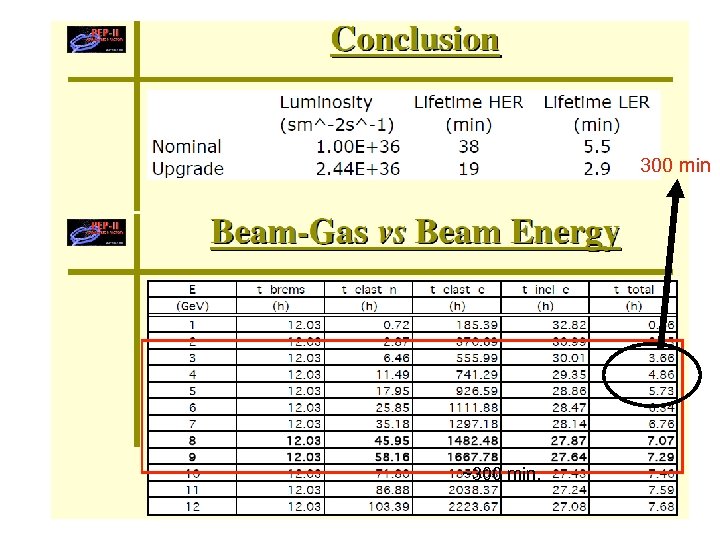
300 min ~300 min.
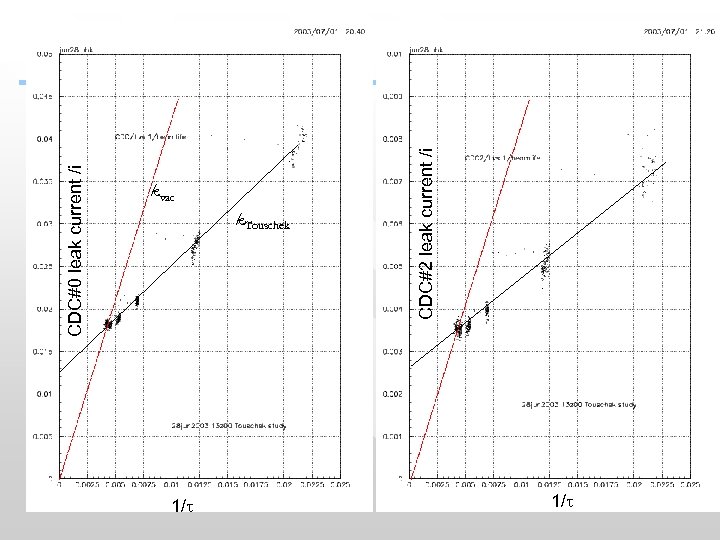
CDC#0 leak current /i k. Touschek 1/ CDC#2 leak current /i kvac 1/
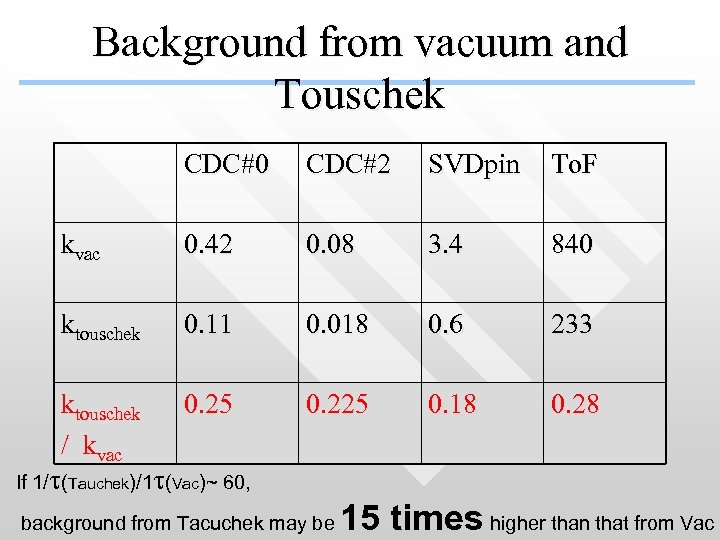
Background from vacuum and Touschek CDC#0 CDC#2 SVDpin To. F kvac 0. 42 0. 08 3. 4 840 ktouschek 0. 11 0. 018 0. 6 233 0. 225 0. 18 0. 28 ktouschek 0. 25 / kvac If 1/ (Tauchek)/1 (Vac)~ 60, background from Tacuchek may be 15 times higher than that from Vac
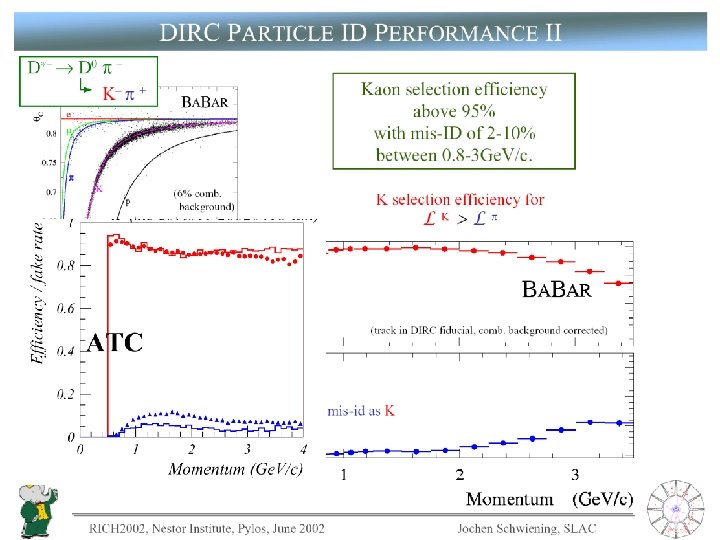
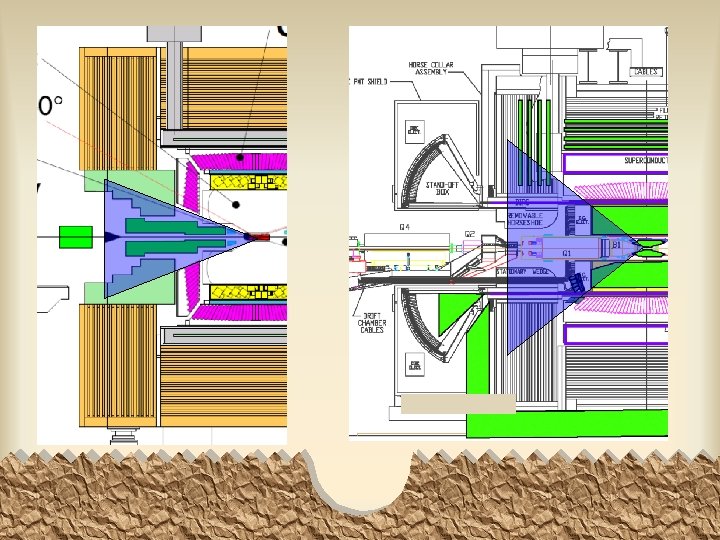
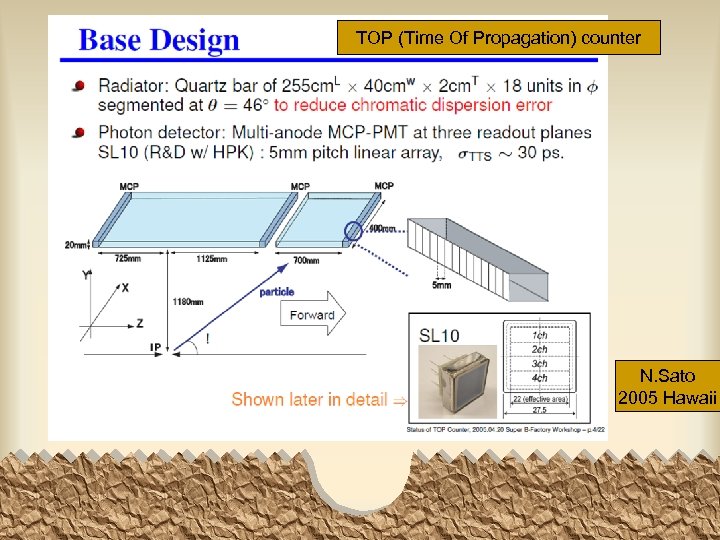
Particle ID and. . • Babar DIRC is very successful. Good target for long to Belle PID group. • Another feature of BB DIRC is its penetrating readout bars and SOB. • Not consistent with backward EC or any “hermetic detector”.
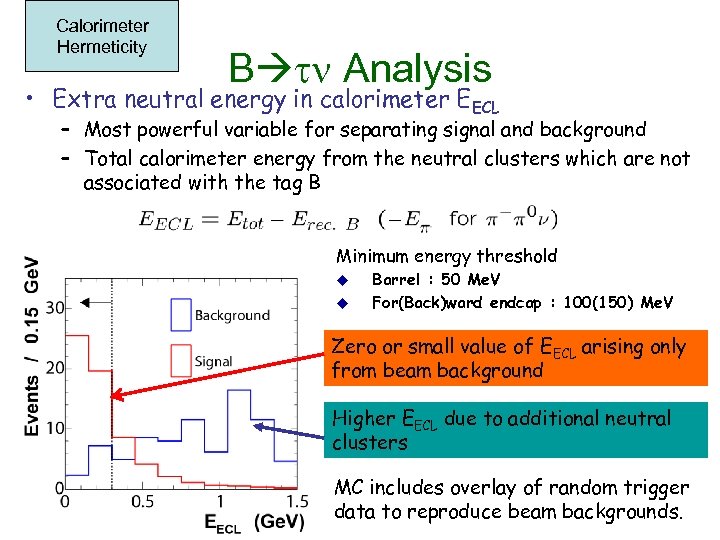
Calorimeter Hermeticity B Analysis • Extra neutral energy in calorimeter EECL – Most powerful variable for separating signal and background – Total calorimeter energy from the neutral clusters which are not associated with the tag B Minimum energy threshold u u Barrel : 50 Me. V For(Back)ward endcap : 100(150) Me. V Zero or small value of EECL arising only from beam background Higher EECL due to additional neutral clusters MC includes overlay of random trigger data to reproduce beam backgrounds.
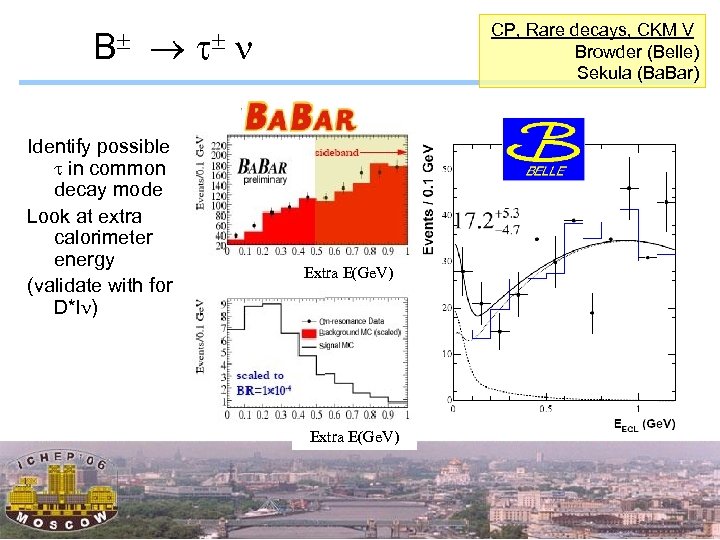
CP, Rare decays, CKM V Browder (Belle) Sekula (Ba. Bar) B Identify possible in common decay mode Look at extra calorimeter energy (validate with for D*l ) H+? Extra E(Ge. V)
Good Pid, hermeticity or both? • If hermeticity is a key feature of the Super. B detector, DIRC without projection (SOB) like TOP or Focusing DIRC is an essential technology. • The practical system (a 50 psec precision photon sensor with matching electronicics) is not yet demonstarted to be available soon.
TOP (Time Of Propagation) counter N. Sato 2005 Hawaii
To make the Lo. I model more realistic • Only physics case study can justify/finalize the key concepts/parameters; – – – BP radius/IP resolution Outer radius of vertex Hermeticity/resolution for back EC Ebeam asymmetry (not only economy) Pid requirement (perfoamance, coverage) B field • Status of R&D for the ambitious components should be reviewed to assess their availability in view of the construction schedule.
Скачать презентацию Super Bfactory Detector plan Recent status Junji Haba
a4316c1176470b94e36c42fa3789e294.ppt