


 Скачать презентацию Super Awesome and Most Triumphant Adventures in History
71989f0860a51a6e3cf45f50137787e4.ppt
- Количество слайдов: 16
 Super Awesome and Most Triumphant Adventures in History
 Hi, Kids!!! I’m Mr. Ribskinopolous. But you can just call me Mr. History!!!!! I want to take you on a little journey today. Are you ready? Danggggggg, here we go!!!!!
 However, before we depart on our learning adventure, I must change my outfit. It’ll only take a second.
 That’s better. Now that I have my headband cape we can begin to learn. Are you excited you filthy animals? Get ready to be educated. OFF, OFF AND AWAY!!!!!!! Oooooohhh!! Where will Mr. History be taking us? We love you Mr. History! You complete us! Thank you!!! It’s my pleasure. Now concentrate or I will totally slap you.
 History rules and I do too. Don’t be jealous of me. Kids, if you study lots and pay attention, one day you could be just like me. Wouldn’t you like that? Now it’s time to learn, you dirty orangutangs. Count with me to 3, ok? Here we go… One! Two! Three!!! The Scientific Revolution, The Enlightenment… and beyond!!!
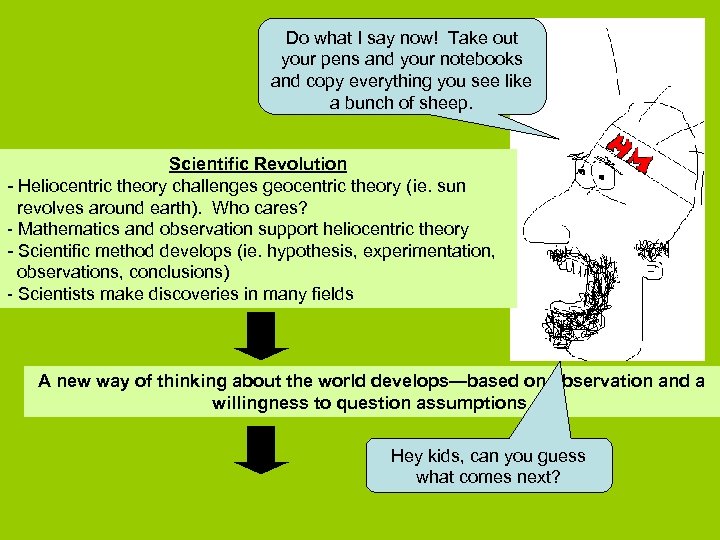 Do what I say now! Take out your pens and your notebooks and copy everything you see like a bunch of sheep. Scientific Revolution - Heliocentric theory challenges geocentric theory (ie. sun revolves around earth). Who cares? - Mathematics and observation support heliocentric theory - Scientific method develops (ie. hypothesis, experimentation, observations, conclusions) - Scientists make discoveries in many fields A new way of thinking about the world develops—based on observation and a willingness to question assumptions. Hey kids, can you guess what comes next?
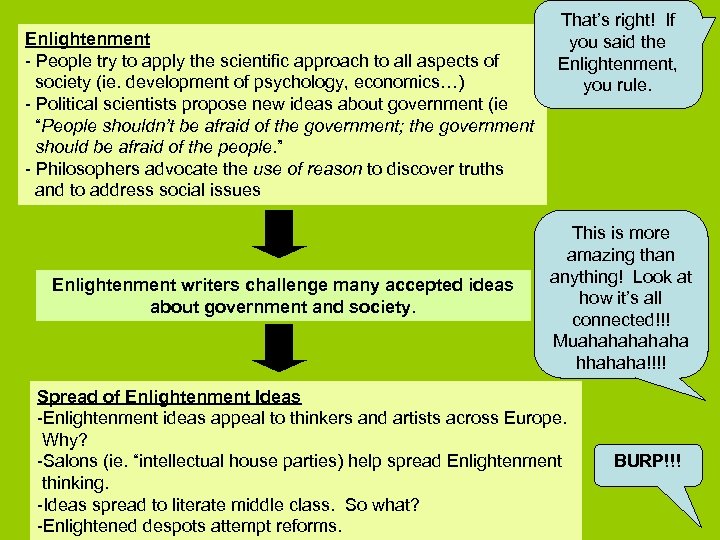 Enlightenment - People try to apply the scientific approach to all aspects of society (ie. development of psychology, economics…) - Political scientists propose new ideas about government (ie “People shouldn’t be afraid of the government; the government should be afraid of the people. ” - Philosophers advocate the use of reason to discover truths and to address social issues Enlightenment writers challenge many accepted ideas about government and society. That’s right! If you said the Enlightenment, you rule. This is more amazing than anything! Look at how it’s all connected!!! Muahahaha hhahaha!!!! Spread of Enlightenment Ideas -Enlightenment ideas appeal to thinkers and artists across Europe. Why? -Salons (ie. “intellectual house parties) help spread Enlightenment thinking. -Ideas spread to literate middle class. So what? -Enlightened despots attempt reforms. BURP!!!
 Uhhhh…. uhhhhh…. hey, where did you come from? You know something, you weren’t supposed to see me eating this guys brains. Nope, not one bit. Oh well, haha, I guess the cat’s out of the bag! You see kids, I eat brains to make me smarter. You should try sometime.
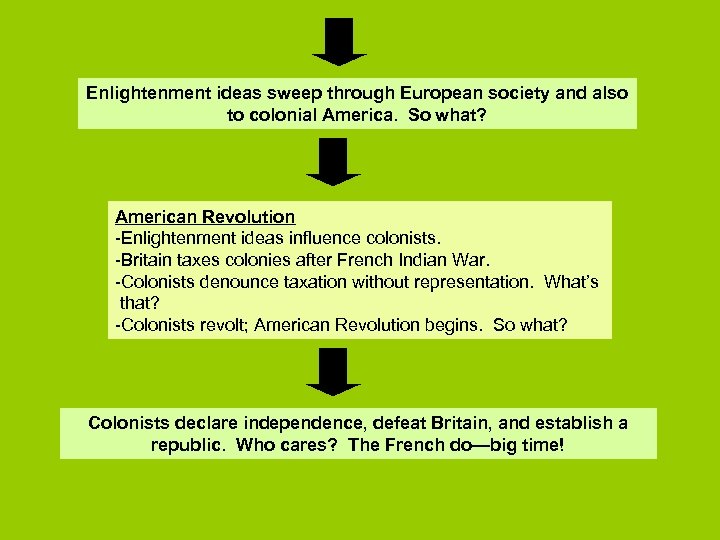 Enlightenment ideas sweep through European society and also to colonial America. So what? American Revolution -Enlightenment ideas influence colonists. -Britain taxes colonies after French Indian War. -Colonists denounce taxation without representation. What’s that? -Colonists revolt; American Revolution begins. So what? Colonists declare independence, defeat Britain, and establish a republic. Who cares? The French do—big time!
 Stupid rays ZOIKS!!!! It’s the Stupid Monster, my arch enemy! I hate this guy more than an un-read textbook! No wait, I hate him more than Lindsay Lohan! HE’S SO STUPID!!!!!!
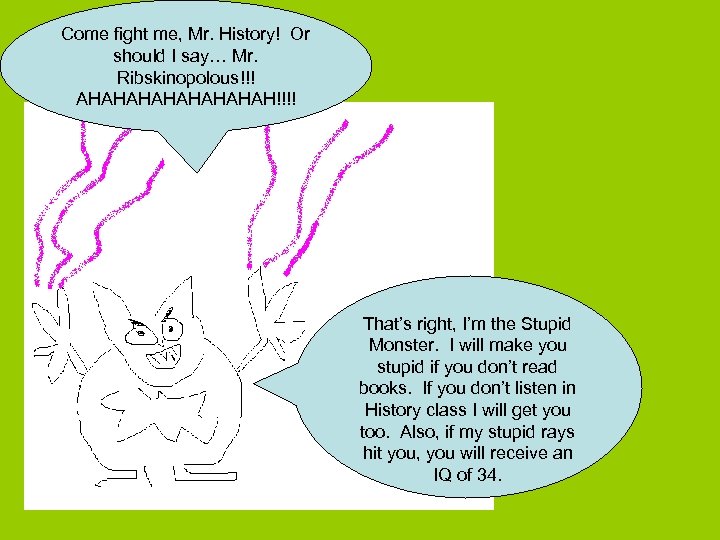 Come fight me, Mr. History! Or should I say… Mr. Ribskinopolous!!! AHAHAHAH!!!! That’s right, I’m the Stupid Monster. I will make you stupid if you don’t read books. If you don’t listen in History class I will get you too. Also, if my stupid rays hit you, you will receive an IQ of 34.
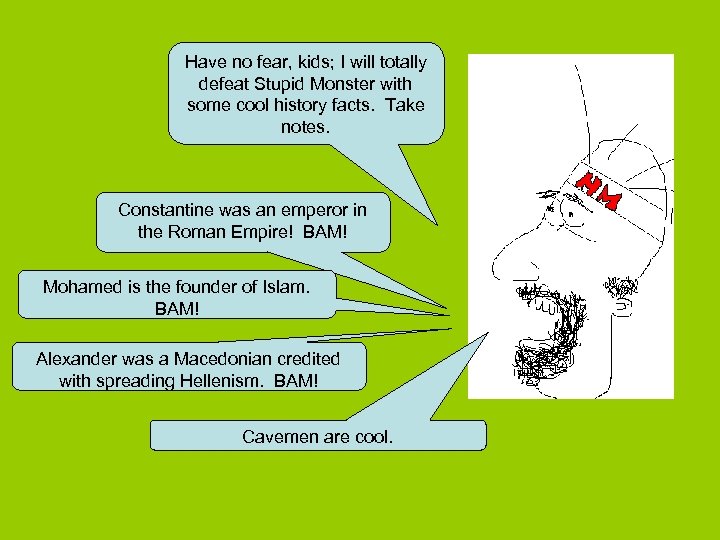 Have no fear, kids; I will totally defeat Stupid Monster with some cool history facts. Take notes. Constantine was an emperor in the Roman Empire! BAM! Mohamed is the founder of Islam. BAM! Alexander was a Macedonian credited with spreading Hellenism. BAM! Cavemen are cool.
 Arggggggghhh…it’s too much information…I’m melting!!! I’ll get you next time Mr. History. NEXT TIME……. !!!
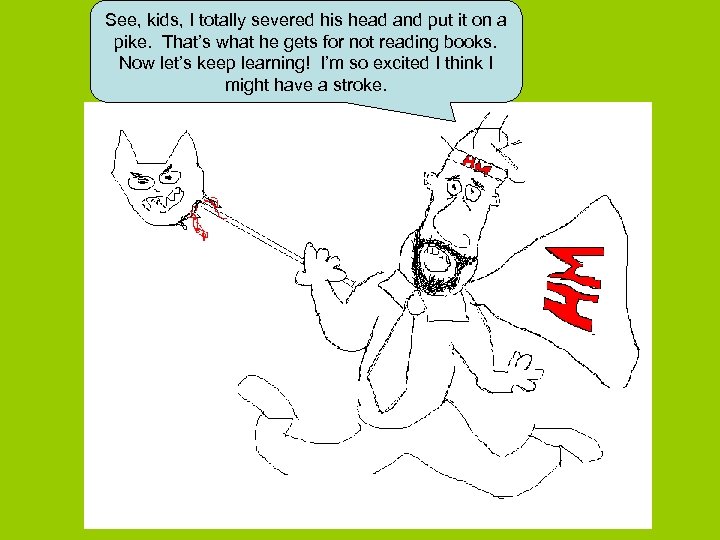 See, kids, I totally severed his head and put it on a pike. That’s what he gets for not reading books. Now let’s keep learning! I’m so excited I think I might have a stroke.
 The American Revolution proved to be an example for the French, who were fed up with proud aristocrats and an oppressive king who kept wasting money and bankrupting the country. 3% of people controlled the entire country (ie. royalty, aristocrats, religious leaders). The rest of the people had virtually no power (ie. bourgeoisie, peasants, urban lower classes) Enlightenment ideas took hold. The masses demanded rights and a voice that would be listened to. When those in power refused to change quickly enough, the French people revolted. They went on a bloody rampage and started hunting people down— people of power. Eventually the king himself was executed by the mob. He had his head cut off by the guillotine. This was a BIG DEAL! The people swept away the privileges of the nobility and the clergy. Thousands of nobles were brutally executed, including women. A new constitution was created which ended the monarchy. Napoleon, a military general, came to power and led France into war. He conquered almost all of Europe. France and America were examples for other countries. Personal freedom, human rights, equality, fair justice…
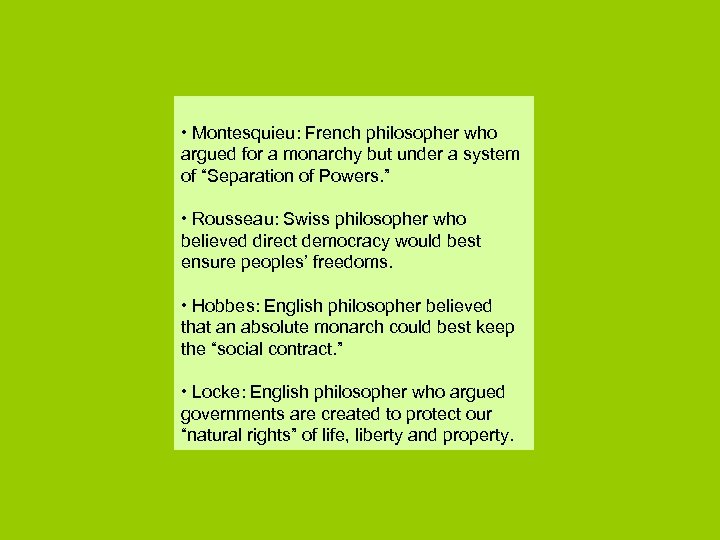 • Montesquieu: French philosopher who argued for a monarchy but under a system of “Separation of Powers. ” • Rousseau: Swiss philosopher who believed direct democracy would best ensure peoples’ freedoms. • Hobbes: English philosopher believed that an absolute monarch could best keep the “social contract. ” • Locke: English philosopher who argued governments are created to protect our “natural rights” of life, liberty and property.