 Скачать презентацию Sunday December 1 2013 Speaker Doug Virgint The
dcc081c8b420fced6e4c13b812ad91e9.ppt
- Количество слайдов: 45



Sunday, December 1, 2013 Speaker: Doug Virgint The First Martyr Acts 7: 1 -8: 4 Message 12 in our 12 -part series on the Acts of the Apostles.
Our outline The context The Sanhedrin’s accusations Stephen’s defense Stephen’s attack The execution The results The applications 2
Our outline The context The Sanhedrin’s accusations Stephen’s defense Stephen’s attack The execution The results The applications 3
Our outline The context The Sanhedrin’s accusations Stephen’s defense Stephen’s attack The execution The results The applications 4
The context The church had existed for 4 or 5 years In disobedience to Christ’s last instructions, the church was still stuck in Jerusalem Was the church going to be just another Jewish sect? 5
The context Was the Church going to become stagnated – reaching out to only: one people? one nation? one small strip of land? be subject to a ceremonial law? worship a God who is present in only one temple? 6
The context But God’s eternal purpose was to reach out to all nations and all peoples: “But you will receive power when the Holy Spirit has come upon you, and you will be my witnesses in Jerusalem and in all Judea and Samaria, and to the end of the earth. ” Acts 1: 8 7
The context “But you will receive power when the Holy Spirit has come upon you, and you will be my witnesses in Jerusalem and in all Judea and Samaria, and to the end of the earth. ” (Acts 1: 8) “And in you all the families of the earth shall be blessed. ” (Genesis 12: 3) 8
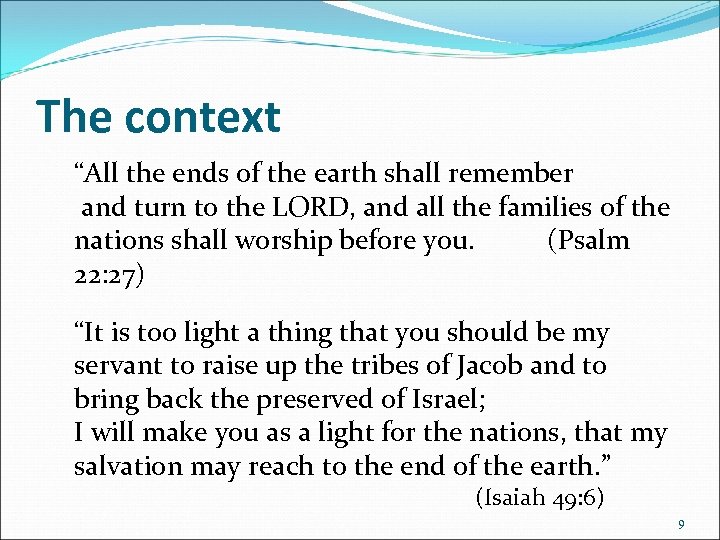
The context “All the ends of the earth shall remember and turn to the LORD, and all the families of the nations shall worship before you. (Psalm 22: 27) “It is too light a thing that you should be my servant to raise up the tribes of Jacob and to bring back the preserved of Israel; I will make you as a light for the nations, that my salvation may reach to the end of the earth. ” (Isaiah 49: 6) 9
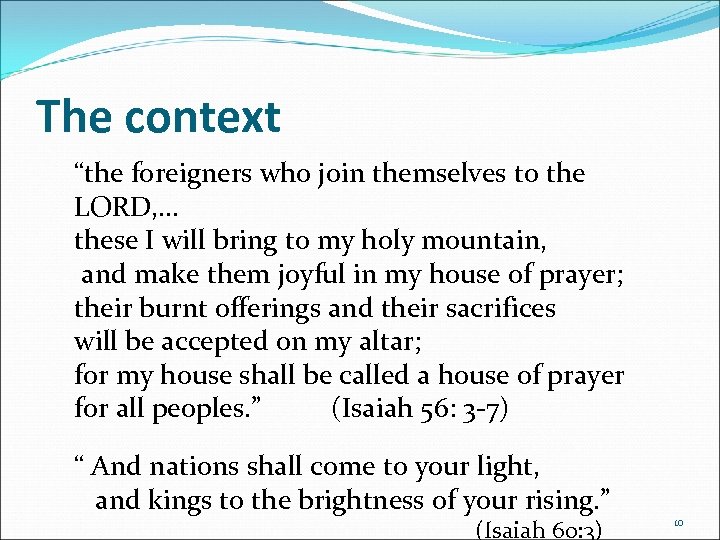
The context “the foreigners who join themselves to the LORD, … these I will bring to my holy mountain, and make them joyful in my house of prayer; their burnt offerings and their sacrifices will be accepted on my altar; for my house shall be called a house of prayer for all peoples. ” (Isaiah 56: 3 -7) “ And nations shall come to your light, and kings to the brightness of your rising. ” (Isaiah 60: 3) 10
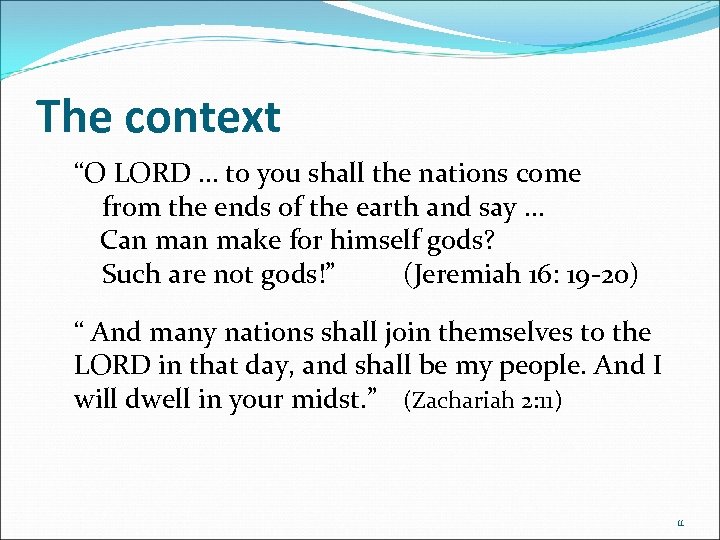
The context “O LORD … to you shall the nations come from the ends of the earth and say … Can make for himself gods? Such are not gods!” (Jeremiah 16: 19 -20) “ And many nations shall join themselves to the LORD in that day, and shall be my people. And I will dwell in your midst. ” (Zachariah 2: 11) 11
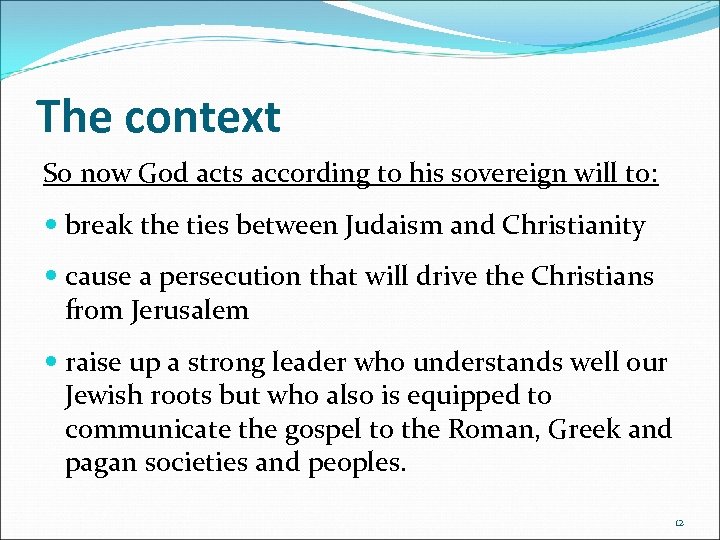
The context So now God acts according to his sovereign will to: break the ties between Judaism and Christianity cause a persecution that will drive the Christians from Jerusalem raise up a strong leader who understands well our Jewish roots but who also is equipped to communicate the gospel to the Roman, Greek and pagan societies and peoples. 12
The context And God has prepared his servant Stephen for this task: he was a “Hellenistic” Jew he was a member of the synagogue of the “Freedmen” he knew the Old Testament thoroughly he understood Christ’s message well 13
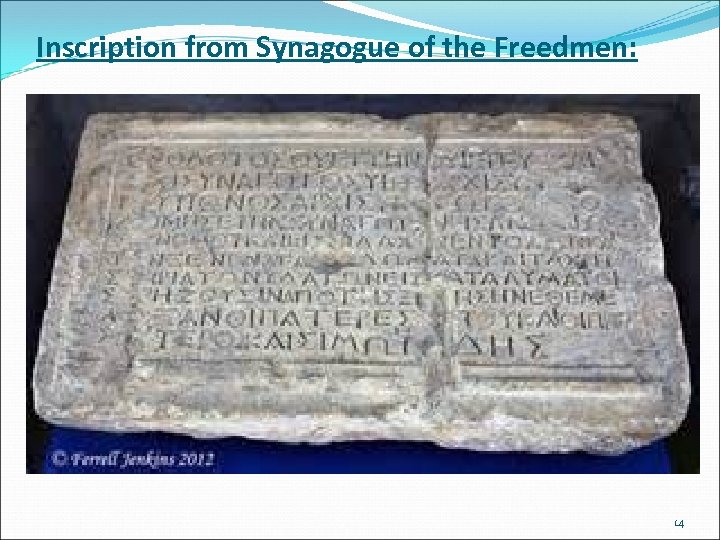
Inscription from Synagogue of the Freedmen: 14
Inscription from Synagogue of the Freedmen: “Theodotus son of Vettenus, priest and synagogue leader, son of a synagogue leader, grandson of a synagogue leader, rebuilt this synagogue for the reading of the Law and the teaching of the commandments, and the hostelry, rooms and baths, for the lodging of those who have need from abroad. It was established by his forefathers, the elders and Simonides. 15
Our outline The context The Sanhedrin’s accusations Stephen’s defense Stephen’s attack The execution The results The applications 16
The accusations speaking blasphemous words against Moses speaking blasphemous words against God speaking against the temple speaking against the law stating that this Jesus of Nazareth will destroy the temple and change Mosaic customs 17
The accusations Notice how similar these are to the accusations against Jesus at his “trial”: speaking blasphemous words against God “Then the high priest tore his robes and said, “He has uttered blasphemy” (Matt 26: 65) speaking against the temple “This man said, ‘I am able to destroy the temple of God, and to rebuild it in three days. ” (Matt 26: 61) 18
Our outline The context The Sanhedrin’s accusations Stephen’s defense Stephen’s attack The execution The results The applications 19
The defense a) blaspheming the temple God called Abraham in Mesopotamia before there was a temple, some 1000 miles from Jerusalem Joseph was in Egypt before the temple was built, some 500 miles from Jerusalem – and God multiplied his people there Moses was born in Egypt and met God at Sinai, not at a temple the burning bush was holy ground. 20
The defense a) blaspheming the temple Stephen quotes Amos 5 to prove that Israel was idolatrous even when they had the tabernacle in the desert, as well as when they had the temple. He also refers to Solomon, who prayed at the dedication of the temple, and said that God was too immense to be limited to a building made by men. 21
The defense a) blaspheming the temple He further quotes Isaiah: “Yet the Most High does not dwell in houses made by hands, as the prophet says, ““Heaven is my throne, and the earth is my footstool. What kind of house will you build for me, says the Lord, or what is the place of my rest? Did not my hand make all these things? ”” (Acts 7: 48 -50) 22
The defense a) blaspheming the temple His points : God’s people worshipped God in many countries and during many periods when there was no temple God ordained the tabernacle – he tolerated David and Solomon’s desire to build a temple. The Jews had been idolaters even while the tabernacle and temple existed. God cannot be limited to any building made by men. 23
The defense b) blaspheming God Stephen starts off by calling his accusers “brothers” and “fathers” – showing much respect and demonstrating solidarity with them. He refers to God as the “God of glory”. He calls Abraham “our father” and shows God’s sovereignty in redemptive history. He shows Abraham as the father of faith, even though he never owned any land in Palestine (except a funeral plot!) 24
The defense b) blaspheming God He affirms the great covenant work of God through Abraham and the patriarchs He thus pleads not guilty to this charge ! 25
The defense c) blaspheming Moses (law) Stephen uses respectful language concerning Moses (beautiful in God’s sight”, “mighty in words and deeds”) He shows that he knows and understands Moses. place in Jewish history and redemption. He affirms that Moses received the law of God through the mediation of angels God is therefore the author of the law – Stephen has pleaded not guilty ! 26
Our outline The context The Sanhedrin’s accusations Stephen’s defense Stephen’s attack The execution The results The applications 27
The attack Stephen has proven that Israel systematically rejected every deliverer God sent them Joseph was rejected by his brothers, the patriarchs, but later accomplished God’s plans by delivering them. Israel rejected Moses, but he also eventually delivered God’s people Israel. Stephen generalizes and says. “Which of the prophets did your fathers not persecute”. 28
The attack Stephen also shows that the Jews systematically disobeyed the law of God starting on the very day it was given to them at the mountain. Their idolatry continued during the 40 years of tabernacle worship in the desert. Their nation had received the law as delivered by angels, but had not kept it. 29
The attack Stephen shows how Moses had announced the coming of Messiah – Jesus. The Jews had rejected Jesus just as they had rejected Joseph and Moses, and even killed him, just as they had killed the prophets. Now they are going to continue in their wicked sin by killing God’s messenger, Stephen. 30
Our outline The context The Sanhedrin’s accusations Stephen’s defense Stephen’s attack The execution The results The applications 31
The execution The members of the Sanhedrin were “cut to the quick” (in Greek diaprio – sawn in half) “Stephen’s words in verses 51 -53 ripped apart the veneer of their false spirituality and exposed them for the blasphemous hypocrites they were. ” (John Mac. Arthur) Like the sinners during the Great Tribulation, they gnash their teeth but refuse to repent. 32
The execution In contrast, Stephen is “full of the Holy Spirit”. He is calm, in control of himself. This is the result of his way of life, his habitual submission to the Holy Spirit’s guidance. Stephen is granted a vision of heaven and our Lord standing at God’s right – the position of power and glory. 33
The execution This execution is highly illegal. Only the Roman authorities could impose capital punishment. Stoning was supposed to be preceded by being pushed off a 10 foot cliff to ensure instant death. Jewish law imposed a 24 hour waiting period, to allow “sober second thought”, between sentencing and carrying out the penalty. Many similarities with our Lord’s execution. Jesus’ followers are treated just as he was treated. 34
The execution Joseph had interceded for his brothers Moses had interceded for his people Jesus had interceded for those who executed him And in the same way, Stephen intercedes for those who mistreated and stoned him. 35
Our outline The context The Sanhedrin’s accusations Stephen’s defense Stephen’s attack The execution The results The applications 36
The results A great persecution breaks out, and the Christians are forced to disperse throughout Judea and Samaria – accomplishing God’s plan to evangelize those areas. Saul is present at the execution and consents to it. Stephen’s message must have tormented him for months. Stephen’s demeanor must have touched him as well. ( perhaps one of those pricks he was kicking against!) Persecution fortifies and energizes the Church 37
Our outline The context The Sanhedrin’s accusations Stephen’s defense Stephen’s attack The execution The results The applications 38
The applications God sometimes cuts off the promising ministry of talented young people in his service. He knows what he is is doing. Often we don’t understand We simply have to trust Stephen, James the brother of John Jim Elliott 39
The applications What price are we willing to pay for our Christian service ? We complain and fear when we are scoffed at. Throughout the world Christians are paying with their lives. Stephen was willing to pay the ultimate price. Mom and dad – are we preparing our children to pay the price? 40
The applications When churches become stagnant, God often acts to make things move. We would often be better off to plan for expansion or a hive-off rather than allow stagnation. 41
The applications When he wants to get things done, God uses a man or a women. Are we ready and willing as a church to discern those men and women God is calling out for his service, to get behind them and to support them in every possible way? Often that type of person can disrupt us – bother us. In French we say, “il nous dérange!” 42
The applications For a long time, Paul resisted the voice of the Lord in his heart. He paid the price for the rest of his life. If the Lord is speaking to you, listen and obey now. Don’t force the Lord to blind you on a Damascus road ! 43
The applications God has a plan to evangelize the world. We need to be part of that plan. Our church needs to be part of that plan. God is going to succeed in implementing his plan. Christians must not be pessimistic. God is sovereign in his timing and his decisions about where to work during different eras of church history ! The Church is triumphant ! 44
The first martyr Acts 7: 1 – 8: 4 45
Скачать презентацию Sunday December 1 2013 Speaker Doug Virgint The
dcc081c8b420fced6e4c13b812ad91e9.ppt