 Скачать презентацию Sumter County Schools Standards Assessment Report October 6
5eea130e17a7239c31bde470765801dc.ppt
- Количество слайдов: 18



Sumter County Schools Standards Assessment Report October 6, 2009
Highlights System SPT members facilitated the work for each of the seven standards ~ SACS Executive Committee Standard One ~ Dr. Monica Kearse Standard Two ~ Mrs. Bari Geeslin Standard Three ~ Mr. Donnie Smith Standard Four ~ Ms. Gayla Braziel Standard Five ~ Ms. Carolyn Brown Standard Six ~ Ms. Natacha Merritt and Mr. Chris Usrey Standard Seven ~ Mrs. Barbee Cowan
Highlights The District Committee included stakeholders from every school. The District Committee included school and system-based representatives for every SACS standard. This Committee was chaired by Executive Committee Members. Evidence was gathered through a ‘carousel activity’ which was completed by the District Committee and then by each school. This led to the gathering and compilation of evidence for the individual schools’ SARs and was compiled by the committee for the system SAR. SCS District SACS Committee members found evidence to designate each standard OPERATIONAL.
1. Vision and Purpose HIGHLIGHTS Parent/Stakeholder Survey via website and hardcopy 1. 1, 1. 2 Community Input with Organizations via Luncheons, Meetings 1. 1, 1. 2 District’s Mission and Vision Announced Daily and at Athletic Events 1. 2 Character Based Curriculum – I CARE 1. 5 Nine Weeks Expectations Communicated to Parents and Students 1. 3 Public Relations via Newsletters, Media, etc. 1. 2 Career, Technical & Agricultural Education (CTAE), After School Time Enrichment Program (ASTEP), Reading First Program 1. 5 PROCESSES AND PRACTICES Parent/Teacher Conferences, Open House, PTO, Parent Workshops, and School Councils 1. 2 Study Groups , Data Driven Instruction, Student Performance Team Observations, Vertical Alignment Teams, Leadership Team Meetings 1. 3, 1. 5, 1. 6 Involvement of Community Partners in Education 1. 3 District Leadership Academies and Institute 1. 3 Parents are Informed about Student Progress via Progress Reports, Report Cards, Test. Gate/Elements Results, and Standardized Test Results 1. 4 BOE Administrative Retreat and BOE Retreat 1. 6 Schools Develop and Review School Improvement Plans Each Year 1. 3
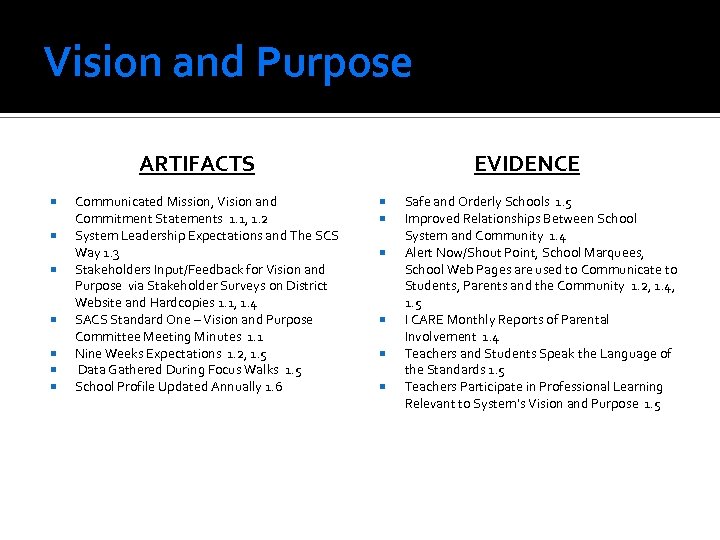
Vision and Purpose ARTIFACTS Communicated Mission, Vision and Commitment Statements 1. 1, 1. 2 System Leadership Expectations and The SCS Way 1. 3 Stakeholders Input/Feedback for Vision and Purpose via Stakeholder Surveys on District Website and Hardcopies 1. 1, 1. 4 SACS Standard One – Vision and Purpose Committee Meeting Minutes 1. 1 Nine Weeks Expectations 1. 2, 1. 5 Data Gathered During Focus Walks 1. 5 School Profile Updated Annually 1. 6 EVIDENCE Safe and Orderly Schools 1. 5 Improved Relationships Between School System and Community 1. 4 Alert Now/Shout Point, School Marquees, School Web Pages are used to Communicate to Students, Parents and the Community 1. 2, 1. 4, 1. 5 I CARE Monthly Reports of Parental Involvement 1. 4 Teachers and Students Speak the Language of the Standards 1. 5 Teachers Participate in Professional Learning Relevant to System’s Vision and Purpose 1. 5
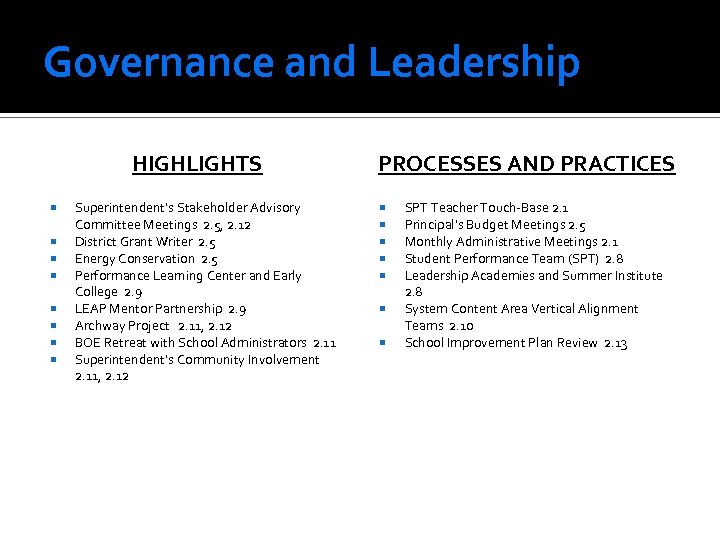
Governance and Leadership HIGHLIGHTS Superintendent’s Stakeholder Advisory Committee Meetings 2. 5, 2. 12 District Grant Writer 2. 5 Energy Conservation 2. 5 Performance Learning Center and Early College 2. 9 LEAP Mentor Partnership 2. 9 Archway Project 2. 11, 2. 12 BOE Retreat with School Administrators 2. 11 Superintendent’s Community Involvement 2. 11, 2. 12 PROCESSES AND PRACTICES SPT Teacher Touch-Base 2. 1 Principal’s Budget Meetings 2. 5 Monthly Administrative Meetings 2. 1 Student Performance Team (SPT) 2. 8 Leadership Academies and Summer Institute 2. 8 System Content Area Vertical Alignment Teams 2. 10 School Improvement Plan Review 2. 13
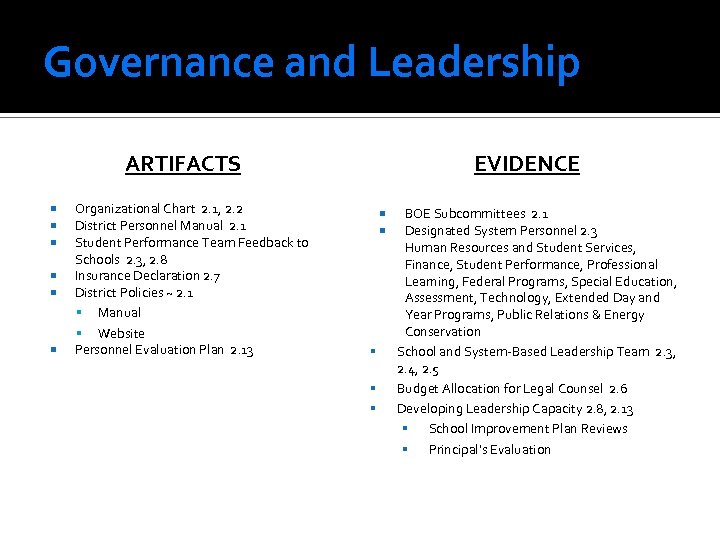
Governance and Leadership ARTIFACTS Organizational Chart 2. 1, 2. 2 District Personnel Manual 2. 1 Student Performance Team Feedback to Schools 2. 3, 2. 8 Insurance Declaration 2. 7 District Policies ~ 2. 1 Manual Website Personnel Evaluation Plan 2. 13 EVIDENCE BOE Subcommittees 2. 1 Designated System Personnel 2. 3 Human Resources and Student Services, Finance, Student Performance, Professional Learning, Federal Programs, Special Education, Assessment, Technology, Extended Day and Year Programs, Public Relations & Energy Conservation School and System-Based Leadership Team 2. 3, 2. 4, 2. 5 Budget Allocation for Legal Counsel 2. 6 Developing Leadership Capacity 2. 8, 2. 13 School Improvement Plan Reviews Principal’s Evaluation
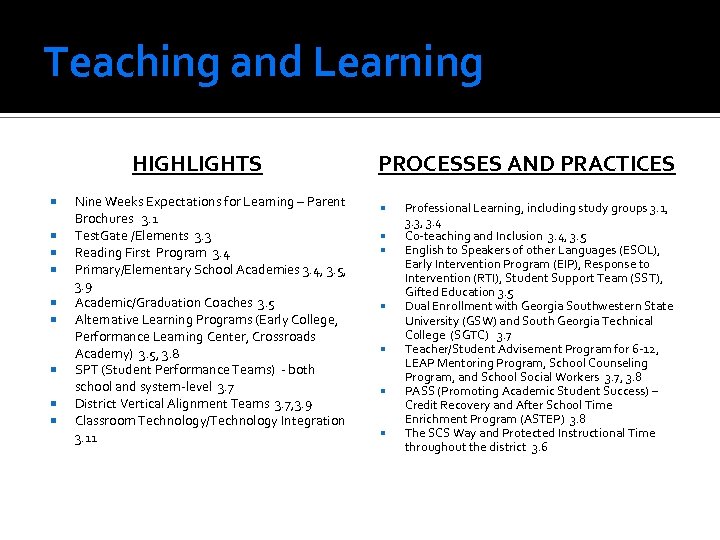
Teaching and Learning HIGHLIGHTS Nine Weeks Expectations for Learning – Parent Brochures 3. 1 Test. Gate /Elements 3. 3 Reading First Program 3. 4 Primary/Elementary School Academies 3. 4, 3. 5, 3. 9 Academic/Graduation Coaches 3. 5 Alternative Learning Programs (Early College, Performance Learning Center, Crossroads Academy) 3. 5, 3. 8 SPT (Student Performance Teams) - both school and system-level 3. 7 District Vertical Alignment Teams 3. 7, 3. 9 Classroom Technology/Technology Integration 3. 11 PROCESSES AND PRACTICES Professional Learning, including study groups 3. 1, 3. 3, 3. 4 Co-teaching and Inclusion 3. 4, 3. 5 English to Speakers of other Languages (ESOL), Early Intervention Program (EIP), Response to Intervention (RTI), Student Support Team (SST), Gifted Education 3. 5 Dual Enrollment with Georgia Southwestern State University (GSW) and South Georgia Technical College (SGTC) 3. 7 Teacher/Student Advisement Program for 6 -12, LEAP Mentoring Program, School Counseling Program, and School Social Workers 3. 7, 3. 8 PASS (Promoting Academic Student Success) – Credit Recovery and After School Time Enrichment Program (ASTEP) 3. 8 The SCS Way and Protected Instructional Time throughout the district 3. 6
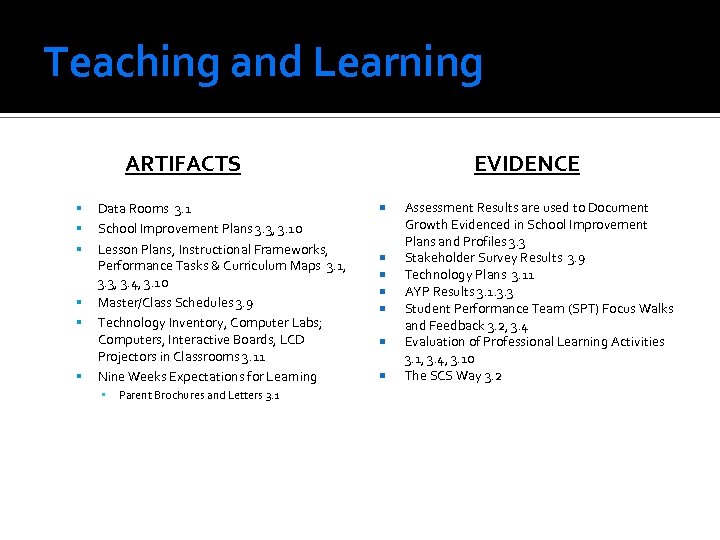
Teaching and Learning ARTIFACTS Data Rooms 3. 1 School Improvement Plans 3. 3, 3. 10 Lesson Plans, Instructional Frameworks, Performance Tasks & Curriculum Maps 3. 1, 3. 3, 3. 4, 3. 10 Master/Class Schedules 3. 9 Technology Inventory, Computer Labs; Computers, Interactive Boards, LCD Projectors in Classrooms 3. 11 Nine Weeks Expectations for Learning • Parent Brochures and Letters 3. 1 EVIDENCE Assessment Results are used to Document Growth Evidenced in School Improvement Plans and Profiles 3. 3 Stakeholder Survey Results 3. 9 Technology Plans 3. 11 AYP Results 3. 1. 3. 3 Student Performance Team (SPT) Focus Walks and Feedback 3. 2, 3. 4 Evaluation of Professional Learning Activities 3. 1, 3. 4, 3. 10 The SCS Way 3. 2
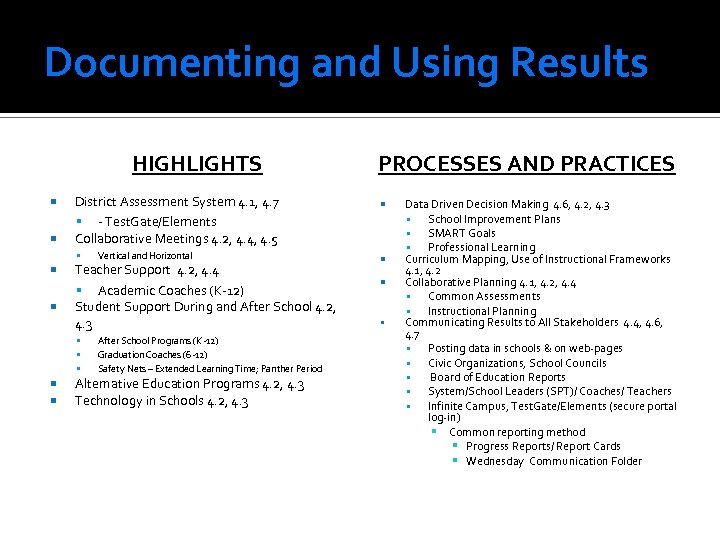
Documenting and Using Results HIGHLIGHTS District Assessment System 4. 1, 4. 7 - Test. Gate/Elements Collaborative Meetings 4. 2, 4. 4, 4. 5 Teacher Support 4. 2, 4. 4 Academic Coaches (K-12) Student Support During and After School 4. 2, 4. 3 Vertical and Horizontal After School Programs (K-12) Graduation Coaches (6 -12) Safety Nets – Extended Learning Time; Panther Period Alternative Education Programs 4. 2, 4. 3 Technology in Schools 4. 2, 4. 3 PROCESSES AND PRACTICES • Data Driven Decision Making 4. 6, 4. 2, 4. 3 School Improvement Plans SMART Goals Professional Learning Curriculum Mapping, Use of Instructional Frameworks 4. 1, 4. 2 Collaborative Planning 4. 1, 4. 2, 4. 4 Common Assessments Instructional Planning Communicating Results to All Stakeholders 4. 4, 4. 6, 4. 7 Posting data in schools & on web-pages Civic Organizations, School Councils Board of Education Reports System/School Leaders (SPT)/ Coaches/ Teachers Infinite Campus, Test. Gate/Elements (secure portal log-in) Common reporting method Progress Reports/ Report Cards Wednesday Communication Folder
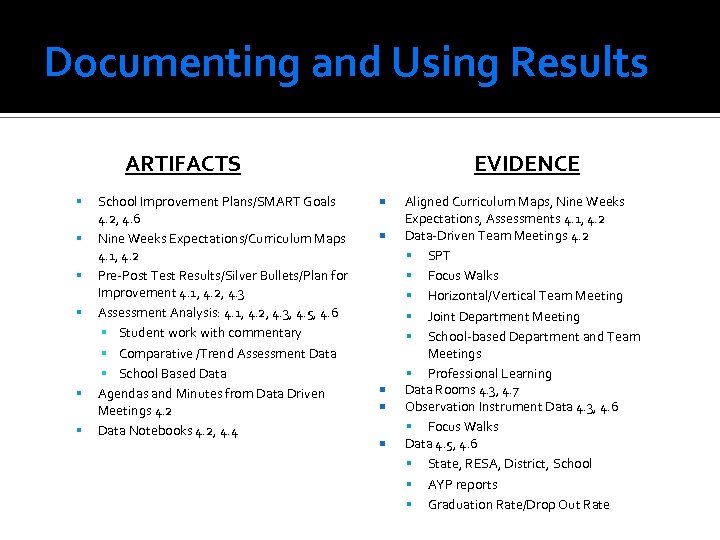
Documenting and Using Results ARTIFACTS School Improvement Plans/SMART Goals 4. 2, 4. 6 Nine Weeks Expectations/Curriculum Maps 4. 1, 4. 2 Pre-Post Test Results/Silver Bullets/Plan for Improvement 4. 1, 4. 2, 4. 3 Assessment Analysis: 4. 1, 4. 2, 4. 3, 4. 5, 4. 6 Student work with commentary Comparative /Trend Assessment Data School Based Data Agendas and Minutes from Data Driven Meetings 4. 2 Data Notebooks 4. 2, 4. 4 EVIDENCE Aligned Curriculum Maps, Nine Weeks Expectations, Assessments 4. 1, 4. 2 Data-Driven Team Meetings 4. 2 SPT Focus Walks Horizontal/Vertical Team Meeting Joint Department Meeting School-based Department and Team Meetings Professional Learning Data Rooms 4. 3, 4. 7 Observation Instrument Data 4. 3, 4. 6 Focus Walks Data 4. 5, 4. 6 State, RESA, District, School AYP reports Graduation Rate/Drop Out Rate
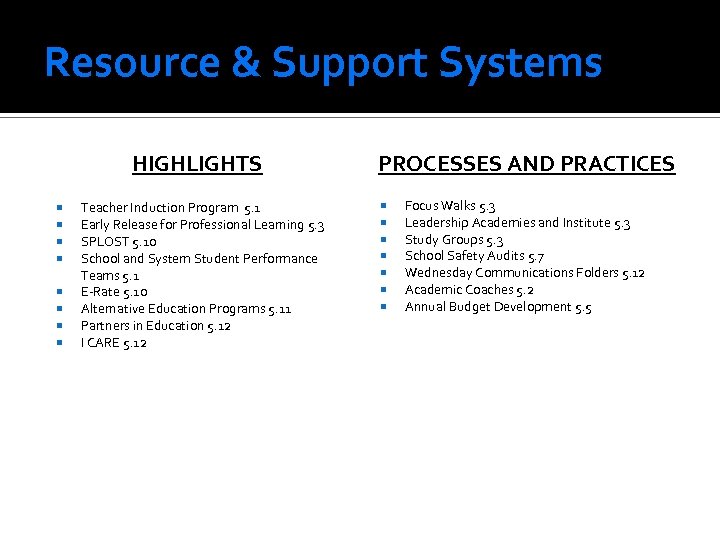
Resource & Support Systems HIGHLIGHTS Teacher Induction Program 5. 1 Early Release for Professional Learning 5. 3 SPLOST 5. 10 School and System Student Performance Teams 5. 1 E-Rate 5. 10 Alternative Education Programs 5. 11 Partners in Education 5. 12 I CARE 5. 12 PROCESSES AND PRACTICES Focus Walks 5. 3 Leadership Academies and Institute 5. 3 Study Groups 5. 3 School Safety Audits 5. 7 Wednesday Communications Folders 5. 12 Academic Coaches 5. 2 Annual Budget Development 5. 5
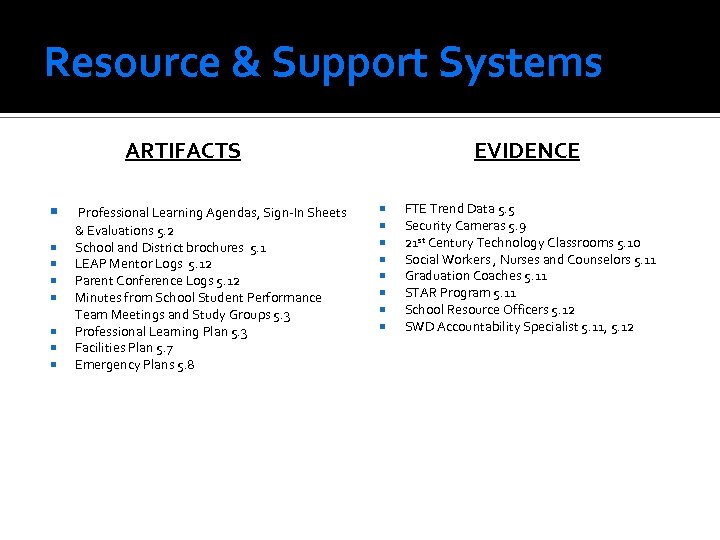
Resource & Support Systems ARTIFACTS Professional Learning Agendas, Sign-In Sheets & Evaluations 5. 2 School and District brochures 5. 1 LEAP Mentor Logs 5. 12 Parent Conference Logs 5. 12 Minutes from School Student Performance Team Meetings and Study Groups 5. 3 Professional Learning Plan 5. 3 Facilities Plan 5. 7 Emergency Plans 5. 8 EVIDENCE FTE Trend Data 5. 5 Security Cameras 5. 9 21 st Century Technology Classrooms 5. 10 Social Workers , Nurses and Counselors 5. 11 Graduation Coaches 5. 11 STAR Program 5. 11 School Resource Officers 5. 12 SWD Accountability Specialist 5. 11, 5. 12
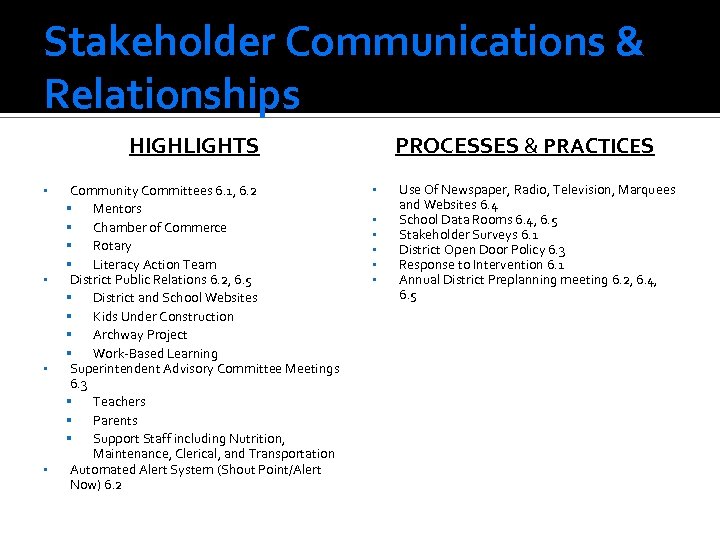
Stakeholder Communications & Relationships HIGHLIGHTS Community Committees 6. 1, 6. 2 Mentors Chamber of Commerce Rotary Literacy Action Team District Public Relations 6. 2, 6. 5 District and School Websites Kids Under Construction Archway Project Work-Based Learning Superintendent Advisory Committee Meetings 6. 3 Teachers Parents Support Staff including Nutrition, Maintenance, Clerical, and Transportation Automated Alert System (Shout Point/Alert Now) 6. 2 PROCESSES & PRACTICES Use Of Newspaper, Radio, Television, Marquees and Websites 6. 4 School Data Rooms 6. 4, 6. 5 Stakeholder Surveys 6. 1 District Open Door Policy 6. 3 Response to Intervention 6. 1 Annual District Preplanning meeting 6. 2, 6. 4, 6. 5
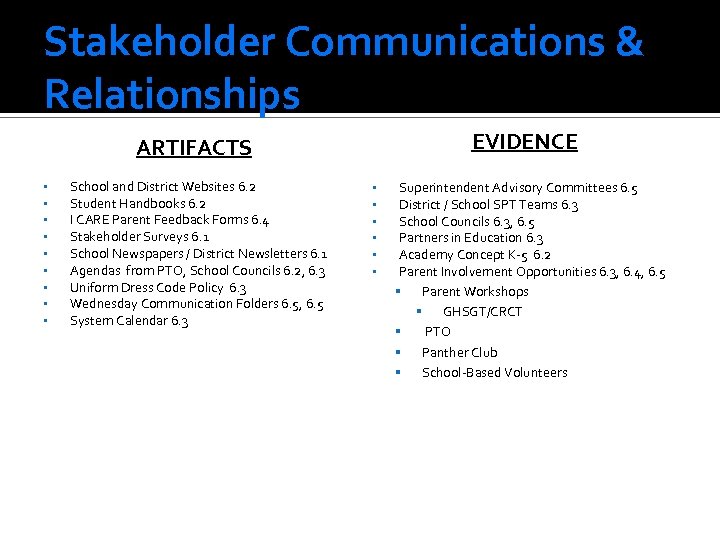
Stakeholder Communications & Relationships EVIDENCE ARTIFACTS School and District Websites 6. 2 Student Handbooks 6. 2 I CARE Parent Feedback Forms 6. 4 Stakeholder Surveys 6. 1 School Newspapers / District Newsletters 6. 1 Agendas from PTO, School Councils 6. 2, 6. 3 Uniform Dress Code Policy 6. 3 Wednesday Communication Folders 6. 5, 6. 5 System Calendar 6. 3 Superintendent Advisory Committees 6. 5 District / School SPT Teams 6. 3 School Councils 6. 3, 6. 5 Partners in Education 6. 3 Academy Concept K-5 6. 2 Parent Involvement Opportunities 6. 3, 6. 4, 6. 5 Parent Workshops GHSGT/CRCT PTO Panther Club School-Based Volunteers
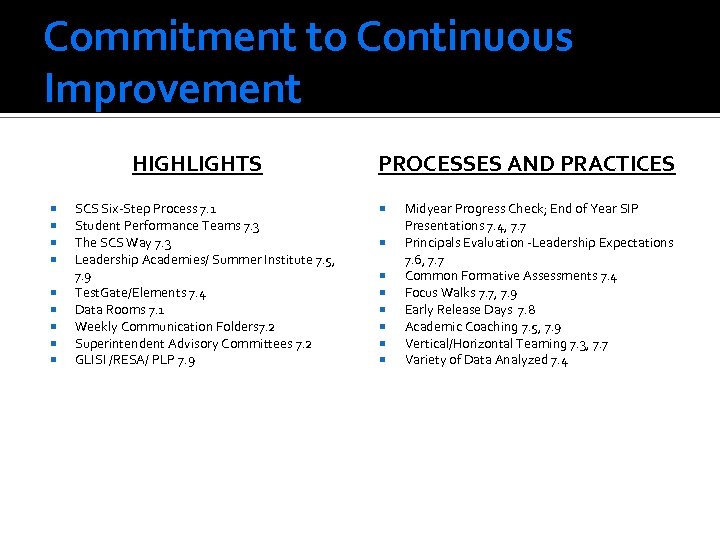
Commitment to Continuous Improvement HIGHLIGHTS SCS Six-Step Process 7. 1 Student Performance Teams 7. 3 The SCS Way 7. 3 Leadership Academies/ Summer Institute 7. 5, 7. 9 Test. Gate/Elements 7. 4 Data Rooms 7. 1 Weekly Communication Folders 7. 2 Superintendent Advisory Committees 7. 2 GLISI /RESA/ PLP 7. 9 PROCESSES AND PRACTICES Midyear Progress Check; End of Year SIP Presentations 7. 4, 7. 7 Principals Evaluation -Leadership Expectations 7. 6, 7. 7 Common Formative Assessments 7. 4 Focus Walks 7. 7, 7. 9 Early Release Days 7. 8 Academic Coaching 7. 5, 7. 9 Vertical/Horizontal Teaming 7. 3, 7. 7 Variety of Data Analyzed 7. 4
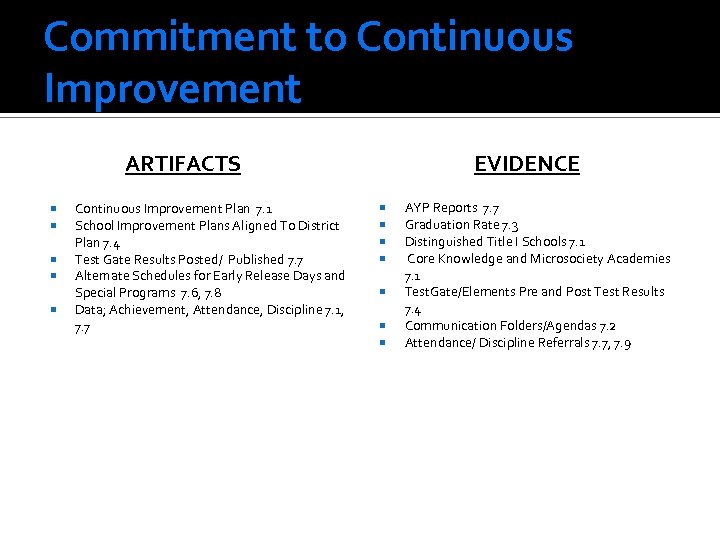
Commitment to Continuous Improvement ARTIFACTS Continuous Improvement Plan 7. 1 School Improvement Plans Aligned To District Plan 7. 4 Test Gate Results Posted/ Published 7. 7 Alternate Schedules for Early Release Days and Special Programs 7. 6, 7. 8 Data; Achievement, Attendance, Discipline 7. 1, 7. 7 EVIDENCE AYP Reports 7. 7 Graduation Rate 7. 3 Distinguished Title I Schools 7. 1 Core Knowledge and Microsociety Academies 7. 1 Test. Gate/Elements Pre and Post Test Results 7. 4 Communication Folders/Agendas 7. 2 Attendance/ Discipline Referrals 7. 7, 7. 9
 Скачать презентацию Sumter County Schools Standards Assessment Report October 6
5eea130e17a7239c31bde470765801dc.ppt