


 Скачать презентацию SUMMIT IMPLEMENTATION REVIEW GROUP SIRG First Regular Meeting
40051cbc9179949343eee36b728c2ac8.ppt
- Количество слайдов: 16
 SUMMIT IMPLEMENTATION REVIEW GROUP (SIRG) First Regular Meeting of 2009 January 12 -16, 2009 (Working Group Sessions) January 14 -16, 2009 (Plenary Sessions) Padilha Vidal Room– 1889 F Street NW, DC 20006 Washington, D. C. PRESENTATION ON ENVIRONMENTAL SUSTAINABILITY CARIBBEAN COMMUNITY CLIMATE CHANGE CENTRE (CCCCC) OEA/Ser. E GRIC/O. 1/doc. 8/09 14 January 2009 Original: English
 Vth SUMMIT OF THE AMERICAS SRIG MEETING CLIMATE CHANGE ISSUES WASHINGTON DC FEB. 14 TH 2009 CARIBBEAN COMMUNITY CLIMATE CHANGE CENTRE 2
 The Global Climate Projections n Unequivocal evidence that the earth’s temperature is rising and attributable to anthropogenic activities – Green House Gases n Projected trends through 2100 q rise in global temperatures of between 2 – 4. 5 o. C q Sea level rise of between 11 -77 cm q Changed weather patterns q More intense extremes –drought , floods q More intense hurricanes 3
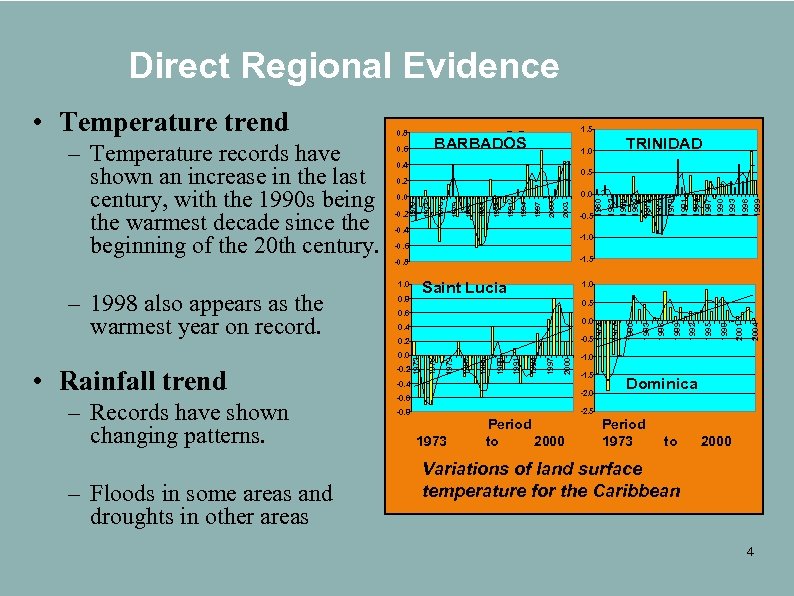 Direct Regional Evidence 0. 6 0. 4 0. 5 0. 2 – Records have shown changing patterns. – Floods in some areas and droughts in other areas 1999 1996 1993 1990 1987 1984 1981 1975 1986 1978 1972 1969 1966 1983 -0. 4 -0. 5 1963 2000 1997 1994 1991 1988 1985 1979 1982 1976 -0. 2 1960 0. 0 -1. 0 -0. 6 -1. 5 -0. 8 Saint Lucia SAINT LUCIA 2000 1997 1994 1991 1988 1985 1982 1979 2004 2001 1998 1995 -1. 0 -0. 2 1976 -0. 5 1973 0. 2 1992 0. 0 0. 4 1989 0. 5 0. 6 1980 0. 8 1. 0 1977 1. 0 0. 0 • Rainfall trend TRINIDAD 1. 0 1974 – 1998 also appears as the warmest year on record. 1. 5 BARBADOS 1973 – Temperature records have shown an increase in the last century, with the 1990 s being the warmest decade since the beginning of the 20 th century. 0. 8 1970 • Temperature trend -0. 4 -1. 5 -2. 0 -0. 6 Dominica DOMINICA -2. 5 -0. 8 1973 Period to 2000 Period 1973 to 2000 Variations of land surface temperature for the Caribbean 4
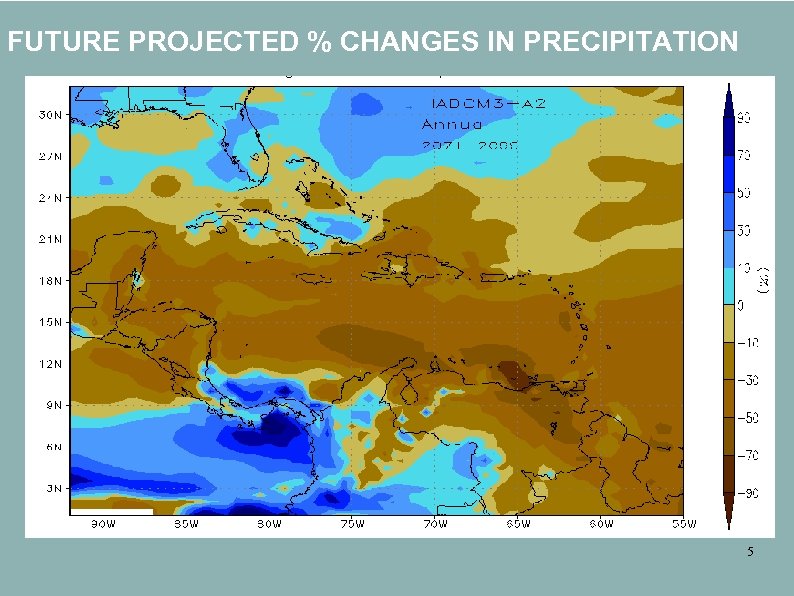 FUTURE PROJECTED % CHANGES IN PRECIPITATION 5
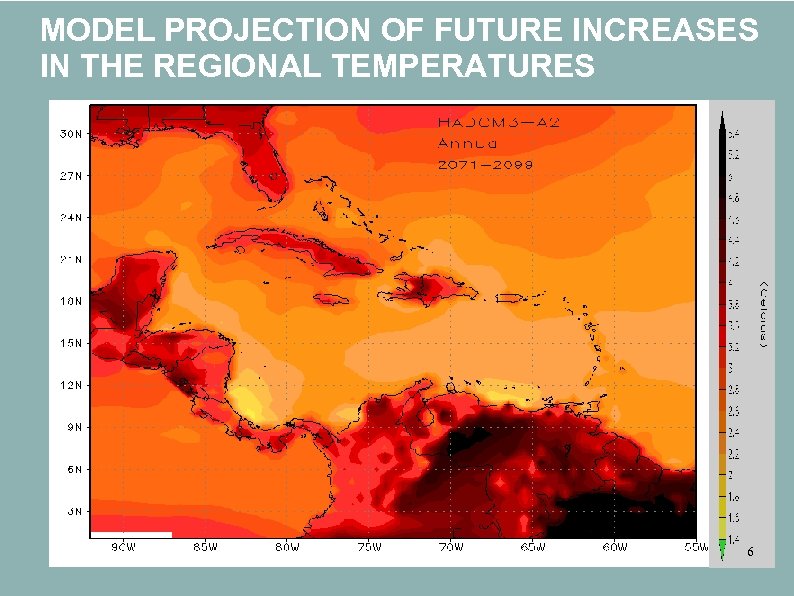 MODEL PROJECTION OF FUTURE INCREASES IN THE REGIONAL TEMPERATURES 6
 Consequences Of Climate Change. ● ● ● ● ● Change in rainfall regimes Increased evaporation with higher temperature Increased evapo-transpiration (soil moisture) >> SLR – salt water intrusion (estuarine, aquifers) Decreased precipitation Increase in extreme events – droughts, floods Increased intensity of heavy rain events – rapid run off / flash floods, >> soil erosion, >> run off of contaminants >> intensity of hurricanes Adverse effects on coastal water 7
 IMPACTS ● Impact studies on vulnerable elements – some indications : ● Less precipitation - less available water; ● Changing weather patterns – agriculture adversely affected. ● Increased frequency of extreme events ● Sea level rise – coastal inundation, storm surge exaggeration ( tourism, aquifers, agriculture, infrastructure, human settlement) ● Increased intensity of hurricanes ( human settlements, tourism, infrastructure, livelihoods. ● Increased temperature ( agriculture, health, coral reefs) 8
 IMPACTS Dire consequences for ● Economic activities Tourism Agriculture Financial sector ● Property and infrastructure ● Human welfare ● Livelihoods ● Regional natural resource base ● Attainment of MDGs in prescribed time frame. ● Indeed for realization of sustainable development goals. 9
 2008 Atlantic hurricane season ● ● Tropical Storm Arthur caused the season to start two days early. – 9 deaths , $78 M US damage in Belize. Third most costly season on record, behind only the 2004 and 2005 seasons, with up to $45 billion in damage (2008 USD). the only year on record in which a major hurricane existed in every month from July through November in the North Atlantic. [1 particularly devastating for Haiti, where over 800 people were killed by four consecutive tropical cyclones (Fay, Gustav, Hanna, and Ike) 10 ] in August and September.
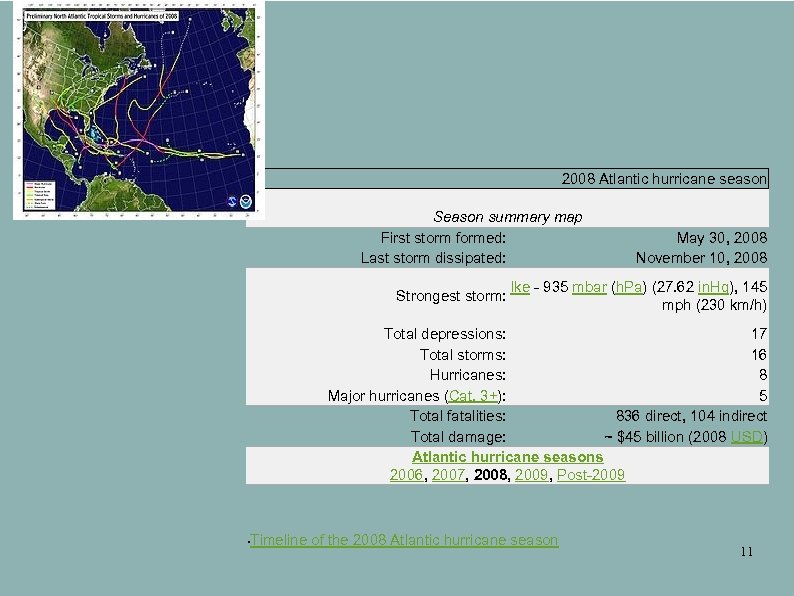 2008 Atlantic hurricane season Season summary map First storm formed: Last storm dissipated: Strongest storm: May 30, 2008 November 10, 2008 Ike - 935 mbar (h. Pa) (27. 62 in. Hg), 145 mph (230 km/h) Total depressions: 17 Total storms: 16 Hurricanes: 8 Major hurricanes (Cat. 3+): 5 Total fatalities: 836 direct, 104 indirect Total damage: ~ $45 billion (2008 USD) Atlantic hurricane seasons 2006, 2007, 2008, 2009, Post-2009 Timeline of the 2008 Atlantic hurricane season • 11
 REGIONAL ISSUES ● Support efforts for ADAPTATION ● Monitoring and observation systems ● ● ● Capacity building –Implementation of the Bali Action Plan Transfer of Environmentally Sound Technologies New resources to support ADAPTATION 12
 SUCCESSOR AGREEMENT TO Kyoto Protocol ● ● Region already finding difficulty to cope with present day climate. Proposed stabilization of global GHG emissions at 450 ppm requires 20% cut by 2020 & 50% by 2050 resulting in 2ºC avg. rise in global temp. Region should strive to get agreement on 350 ppm stabilization level which would require a 30% cut by 2020 and an 80% cut by 2050( in keeping with a EU proposal) This will result in a 1. 5ºC avg. rise in global temp. 13
 ENERGY – CARIBBEAN CONTEXT ● ● ● All CARICOM countries except T&T net energy importers. Strong dependence on fossil fuel – potential to reverse developmental gains achieved over the last 2 -3 decades. Regional scenario of limited resources & >> cost of energy putting a severe drain on limited financial resources 160 Mb in 2004 costing US $6. 5 B ● 116 Mb in 1985 costing US $ 530 m At 2008 prices US $15 b – in some cases requiring countries to devote 50% of foreign exchange earnings to purchase fuel wrt to CC mitigation region contributes << 1% to global GHG budget however opportunity to place the regional energy sector on a more sustainable footing 14
 ENERGY –CARIBBEAN CONTEXT ● Take advantage of innovative financing mechanisms (CDM) & provision of favorable terms for Tech. Transfer to decrease the Carbon Footprint in the region’s energy sector through investment in: ● Energy Efficiency ● Renewable Energy ● Solar , Wind , Geothermal, Hydro , OTEC , Tidal. Biomass including bio-fuels. Establishment of a hemispheric emissions trading regime akin to the existing regime in the EU to create market incentives for mitigation. 15
 THE CARIBBEAN COMMUNITY CLIMATE CHANGE CENTRE 2 nd Floor, Lawrence Nicholas Bldg. P. O. Box 563 Bliss Parade, Belmopan City, Belize Tel: +501 -822 -1094/1104 Fax: +501 -822 -1365 Website: www. caribbeanclimate. bz The best way to predict the future. . . is to create it. . . THANK YOU 16