


 Скачать презентацию Summer Reporter Yi-Cheng Lin Data 2008 09 02 1
2742309390e5c3f94497bdac807b4a4a.ppt
- Количество слайдов: 30
 Summer Reporter : Yi-Cheng Lin Data: 2008/09/02 1
![Outline • What is SCTP [rfc 2960] • Reference paper : Performance of SCTP](https://present5.com/presentation/2742309390e5c3f94497bdac807b4a4a/image-2.jpg "Outline • What is SCTP [rfc 2960] • Reference paper : Performance of SCTP") Outline • What is SCTP [rfc 2960] • Reference paper : Performance of SCTP for IPTV Applications • Ongoing work 2
Outline • What is SCTP [rfc 2960] • Reference paper : Performance of SCTP for IPTV Applications • Ongoing work 2
 What is SCTP • • • Introduction Packets States Data Multihoming Streams 3
 What is SCTP : Introduction • SCTP is a reliable transport protocol operating on top of a potentially unreliable connectionless packet service such as IP. • It offers acknowledged error-free non-duplicated transfer of datagrams (messages). Detection of data corruption, loss of data and duplication of data is achieved by using checksums and sequence numbers. 4
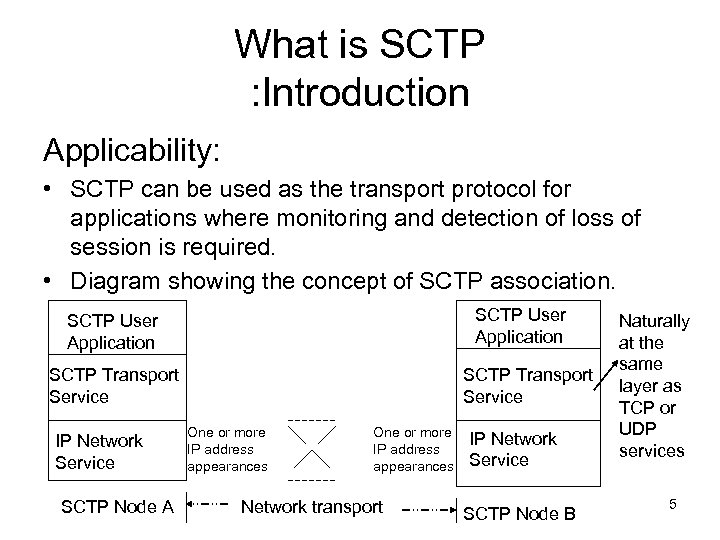 What is SCTP : Introduction Applicability: • SCTP can be used as the transport protocol for applications where monitoring and detection of loss of session is required. • Diagram showing the concept of SCTP association. SCTP User Application SCTP Transport Service IP Network Service SCTP Node A SCTP Transport Service One or more IP address appearances Network transport IP Network Service SCTP Node B Naturally at the same layer as TCP or UDP services 5
 What is SCTP : Introduction • The SCTP decisive difference to TCP is : – Multihoming – the concept of several streams within a connection (association ) – TCP a stream is referred to as a sequence of bytes, an SCTP stream represents a sequence of messages (and these may be very short or long) 6
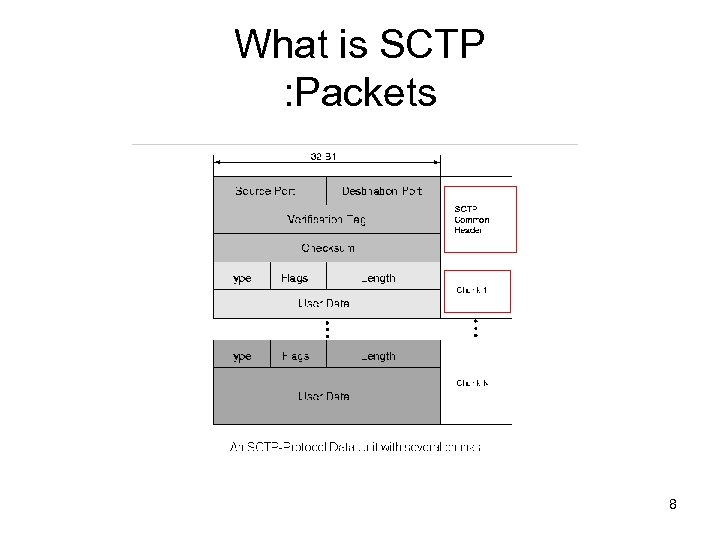
 What is SCTP : Packets • SCTP Packets – SCTP packet forms the payload of an IP packet – composed of a common header and chunks. • Multiple chunks may be multiplexed into one packet up to the Path-MTU size • A chunk may contain either control information or user data. 7
 What is SCTP : Packets 8
 What is SCTP : Packets The common header • The common header consists of 12 bytes. – Source Port – Destination Port – Checksum: • SCTP packet is protected by a 32 bit checksum , robust than the 16 bit checksum of TCP and UDP – verification tag : • 32 bit value , association specific, and exchanged between the endpoints at association startup. So there are two tag values used in one association. 9
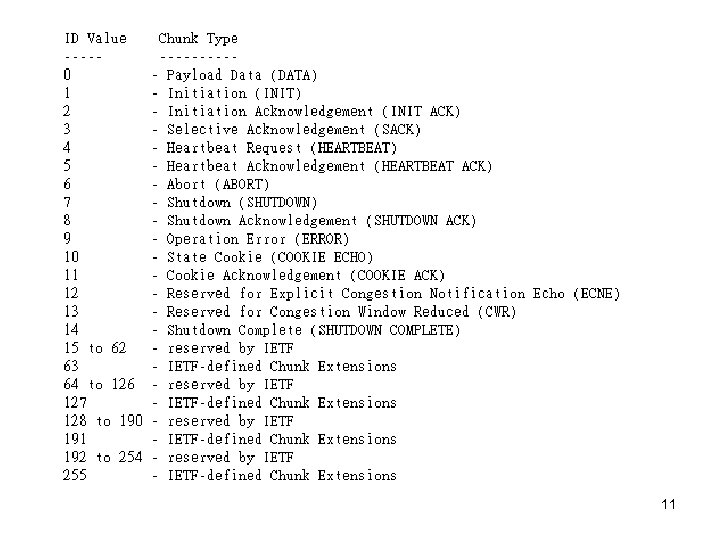
 What is SCTP : Packets Chunk • Chunk type field – used to distinguish data chunks and different types of control chunks • Flags • A chunk length field – because chunks have a variable length. • The value field – contains the actual payload of the chunk. 10
 11
11
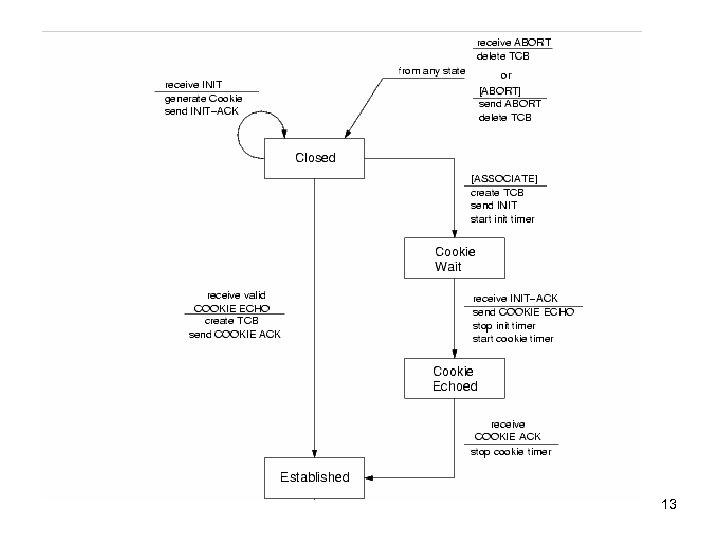
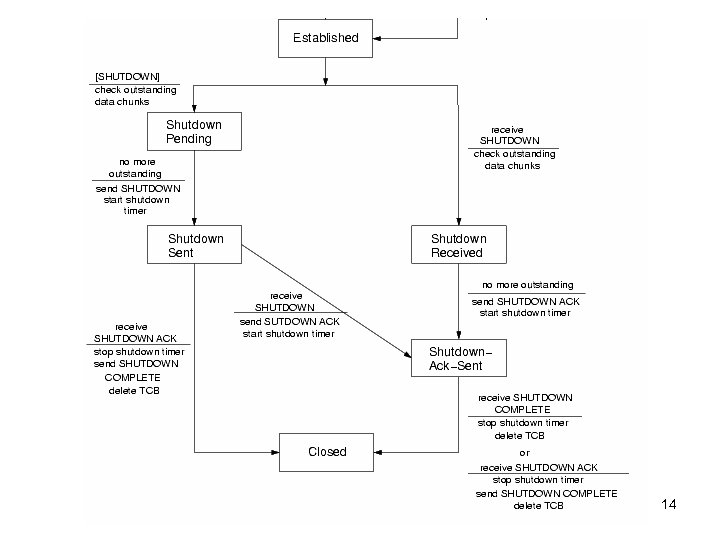
 What is SCTP : States • This section describes the states that an instance of the SCTP protocol enters while an association is established, and when it is taken down again. • The initialization of an association is completed on both sides after the exchange of four messages. 12
 13
13
 14
14
 What is SCTP : Data • SCTP Data Transmission – General concepts • SCTP distinguishes different streams of messages within one SCTP association. • This enables a delivery scheme where only the sequence of messages needs to be maintained per stream (partial in-sequence delivery) which reduces unnecessary head-of-line blocking between independent streams of messages. 15
 What is SCTP : Data • SCTP Data Transmission – Flow control • SCTP uses an end-to-end window based flow and congestion control mechanism similar to the one that is well known from TCP. • The receiver of data may control the rate at which the sender is sending by specifying an octet-based window size (the so-called Receiver Window), and returning this value along with all SACK chunks. • The sender itself keeps a variable known as Congestion Window (short: CWND) that controls the maximum number of outstanding bytes 16
 What is SCTP : Multihoming – An essential property of SCTP is its support of multi-homed nodes. • i. e. nodes which can be reached under several IP addresses. • Advantage: travels on physically different paths if different destination IP address are used, associations become tolerant against physical network failures. 17
 What is SCTP : Streams • SCTP distinguishes different streams of messages within one SCTP association. • SCTP provides a mechanism for bypassing the sequenced delivery service. • Flow control and congestion control in SCTP have been designed in a way which assures that SCTP traffic behaves in the network in the same way as TCP traffic does. • Transport Sequence Number (TSN): Detection of loss and duplication of data chunks. • Selective Acknowledgement (SACK) : retransmitted 18
 Reference paper : Performance of SCTP for IPTV Applications Sang Tae Kim, Seok Joo Koh, Yong Jin Kim Advanced Communication Technology, The 9 th International Conference on (ICACT. 2007) 19
 Reference paper : Performance of SCTP for IPTV Applications Outline • Introduction • Features of SCTP for IPTV Applications • Design of IPTV over SCTP • Performance Analysis • Conclusions 20
 Introduction • There have been some studies on the performance of the SCTP until now. – – – – (1) congestion control, (2) multihoming, (3) multistreaming, (4) out-of-order service, (5) partial reliability extension, (6) application in the wireless/mobile environment, (7) SCTP over satellite networks [4]. • we note some works on the multi-streaming and partial-reliable extension for IPTV applications. 21
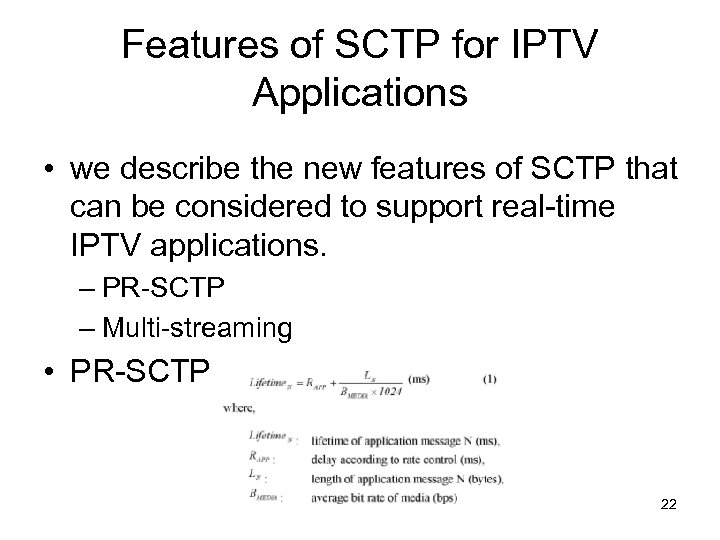 Features of SCTP for IPTV Applications • we describe the new features of SCTP that can be considered to support real-time IPTV applications. – PR-SCTP – Multi-streaming • PR-SCTP 22
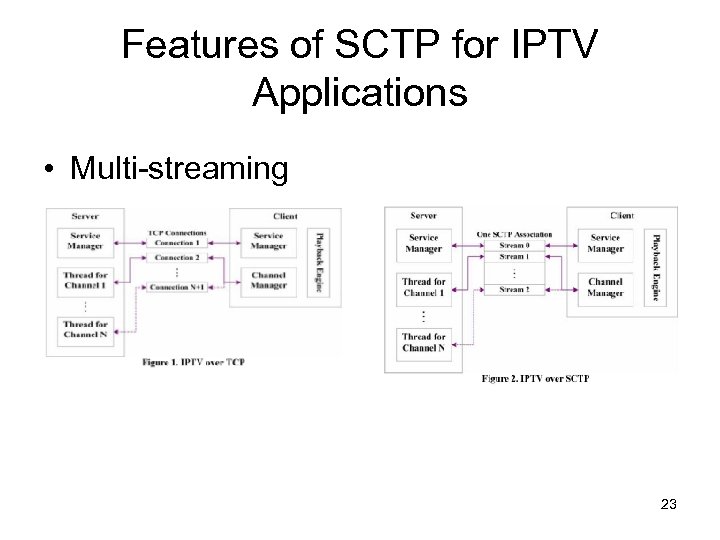 Features of SCTP for IPTV Applications • Multi-streaming 23
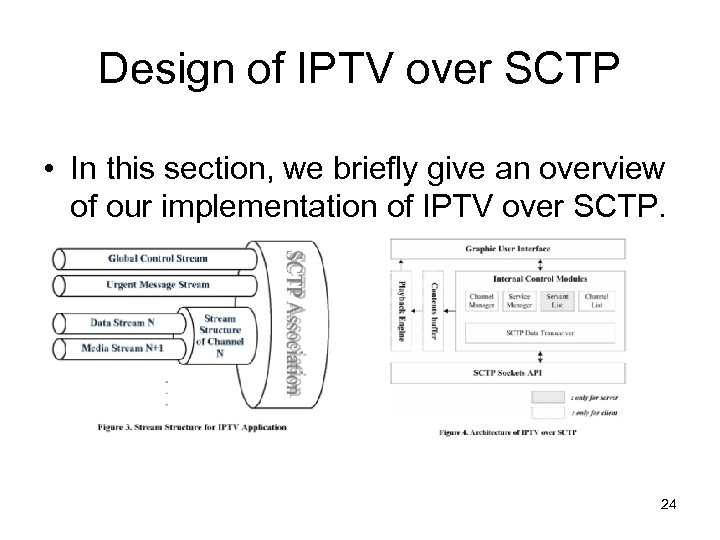 Design of IPTV over SCTP • In this section, we briefly give an overview of our implementation of IPTV over SCTP. 24
 Performance Analysis • Experimental Environment – The bit-rate of multimedia data is a constant value (i. e. , CBR traffic). – The data rate is usually grater than the bit-rate R. – The message size of each SCTP DATA chunk is a constant value of 1024 bytes. 25
![Performance Analysis • Linux kernel 2. 6. 16 and lksctp-tools 1. 0. 6 [9],](https://present5.com/presentation/2742309390e5c3f94497bdac807b4a4a/image-26.jpg "Performance Analysis • Linux kernel 2. 6. 16 and lksctp-tools 1. 0. 6 [9],") Performance Analysis • Linux kernel 2. 6. 16 and lksctp-tools 1. 0. 6 [9], sctplib 1. 0. 5 and socketapi 1. 9. 0 [10]. well-known GNU C/C++ compiler 4. 1. 2 and GNU make 3. 8. 1. • NISTNET 3. Oa [14] is used to emulate network environment. • Wireshark network protocol analyzer [15], similar to the well-known Ethereal, is used to capture the traffic in the transmission. 26
Performance Analysis • Linux kernel 2. 6. 16 and lksctp-tools 1. 0. 6 [9], sctplib 1. 0. 5 and socketapi 1. 9. 0 [10]. well-known GNU C/C++ compiler 4. 1. 2 and GNU make 3. 8. 1. • NISTNET 3. Oa [14] is used to emulate network environment. • Wireshark network protocol analyzer [15], similar to the well-known Ethereal, is used to capture the traffic in the transmission. 26
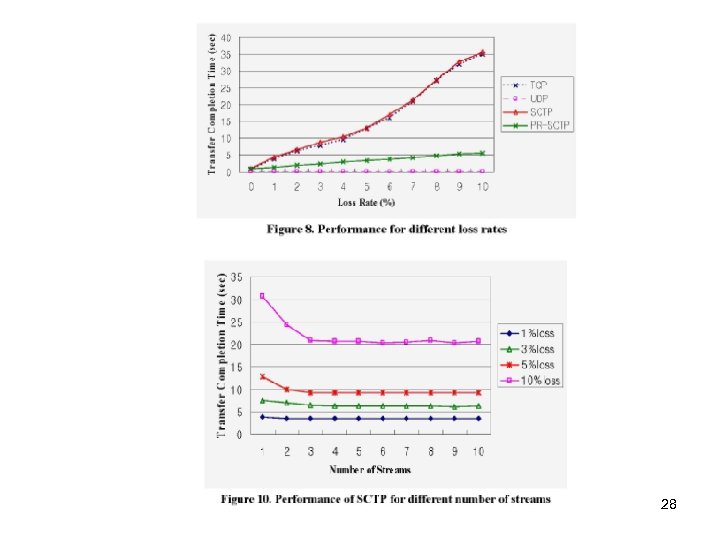
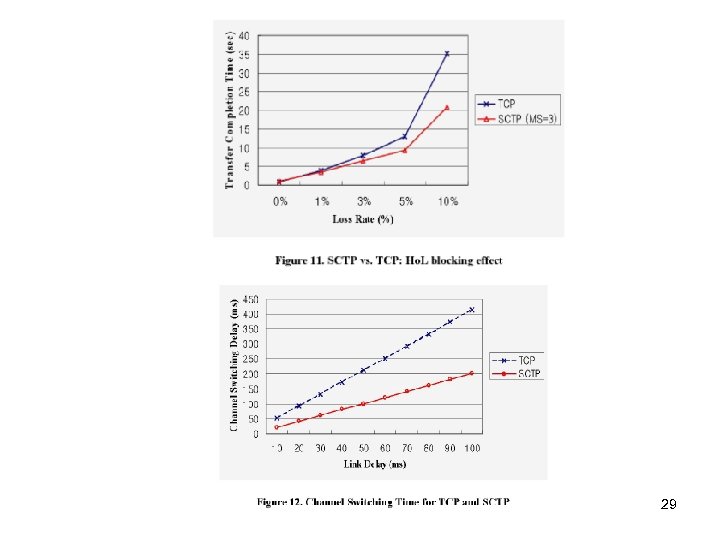
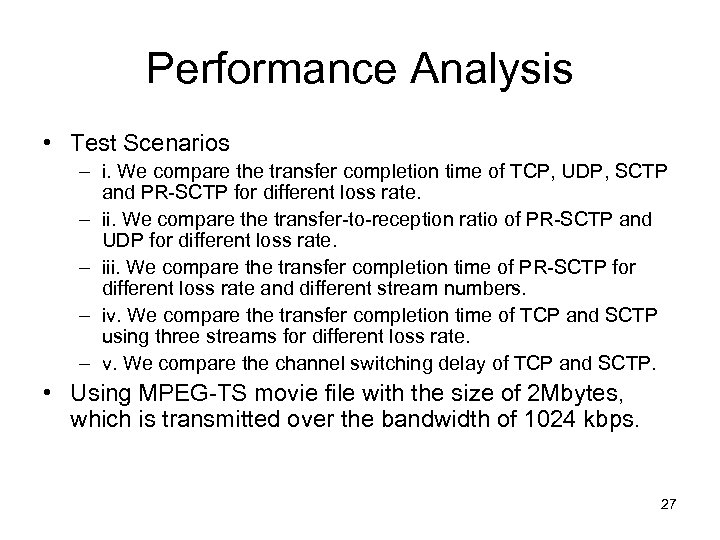 Performance Analysis • Test Scenarios – i. We compare the transfer completion time of TCP, UDP, SCTP and PR-SCTP for different loss rate. – ii. We compare the transfer-to-reception ratio of PR-SCTP and UDP for different loss rate. – iii. We compare the transfer completion time of PR-SCTP for different loss rate and different stream numbers. – iv. We compare the transfer completion time of TCP and SCTP using three streams for different loss rate. – v. We compare the channel switching delay of TCP and SCTP. • Using MPEG-TS movie file with the size of 2 Mbytes, which is transmitted over the bandwidth of 1024 kbps. 27
 28
28
 29
29
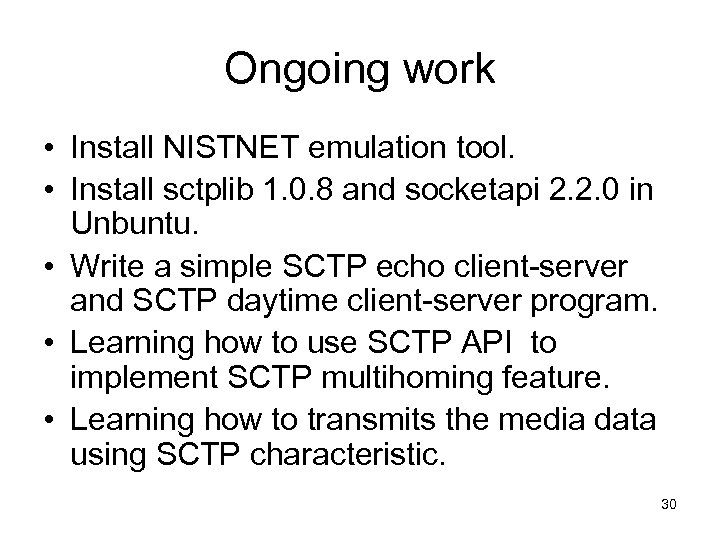 Ongoing work • Install NISTNET emulation tool. • Install sctplib 1. 0. 8 and socketapi 2. 2. 0 in Unbuntu. • Write a simple SCTP echo client-server and SCTP daytime client-server program. • Learning how to use SCTP API to implement SCTP multihoming feature. • Learning how to transmits the media data using SCTP characteristic. 30