


 Скачать презентацию Summary The physical and chemical surface properties of
31af219837d2f06faf0daa085d3469da.ppt
- Количество слайдов: 1
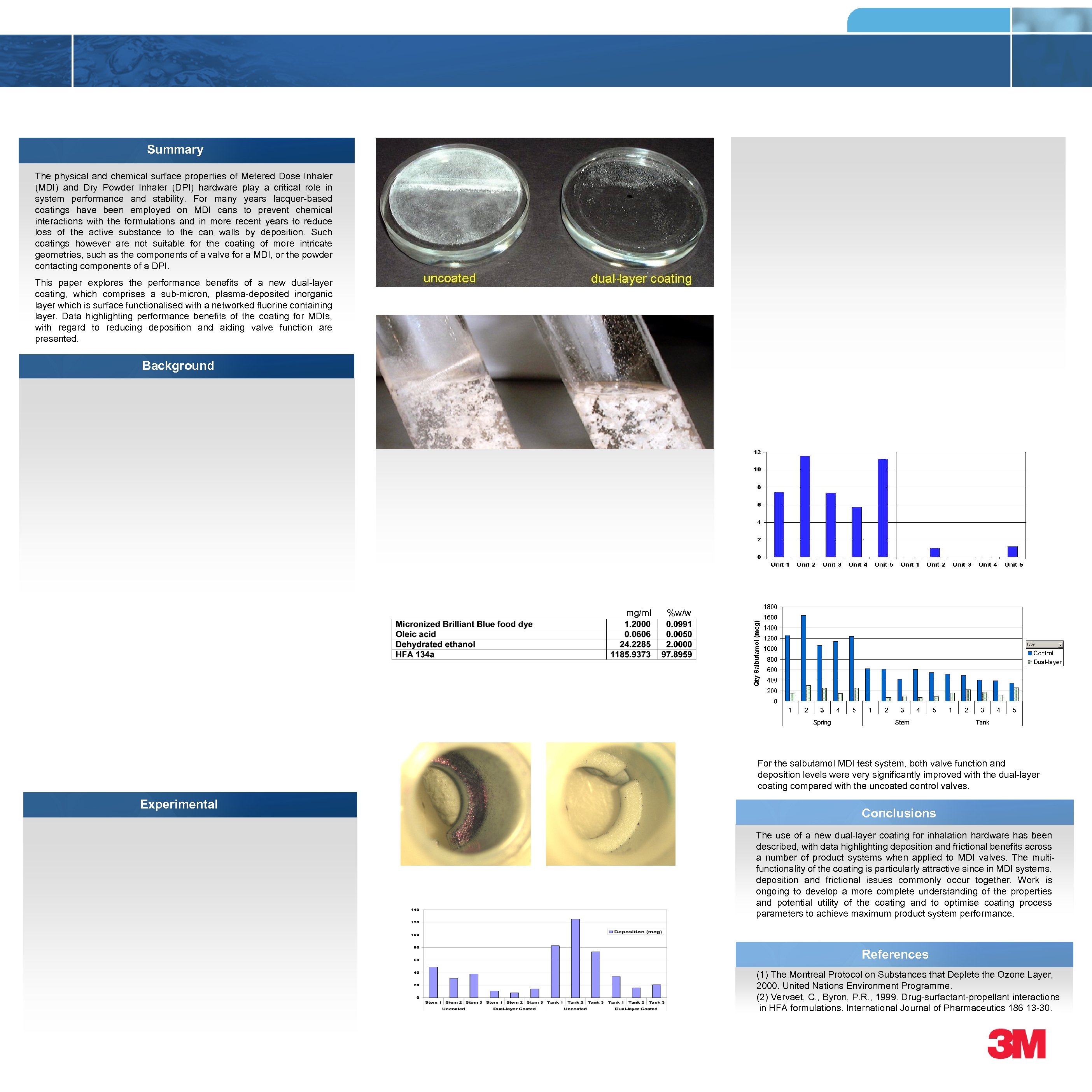 Summary The physical and chemical surface properties of Metered Dose Inhaler (MDI) and Dry Powder Inhaler (DPI) hardware play a critical role in system performance and stability. For many years lacquer-based coatings have been employed on MDI cans to prevent chemical interactions with the formulations and in more recent years to reduce loss of the active substance to the can walls by deposition. Such coatings however are not suitable for the coating of more intricate geometries, such as the components of a valve for a MDI, or the powder contacting components of a DPI. This paper explores the performance benefits of a new dual-layer coating, which comprises a sub-micron, plasma-deposited inorganic layer which is surface functionalised with a networked fluorine containing layer. Data highlighting performance benefits of the coating for MDIs, with regard to reducing deposition and aiding valve function are presented. Background mg/ml %w/w For the salbutamol MDI test system, both valve function and deposition levels were very significantly improved with the dual-layer coating compared with the uncoated control valves. Experimental Conclusions The use of a new dual-layer coating for inhalation hardware has been described, with data highlighting deposition and frictional benefits across a number of product systems when applied to MDI valves. The multifunctionality of the coating is particularly attractive since in MDI systems, deposition and frictional issues commonly occur together. Work is ongoing to develop a more complete understanding of the properties and potential utility of the coating and to optimise coating process parameters to achieve maximum product system performance. References (1) The Montreal Protocol on Substances that Deplete the Ozone Layer, 2000. United Nations Environment Programme. (2) Vervaet, C. , Byron, P. R. , 1999. Drug-surfactant-propellant interactions in HFA formulations. International Journal of Pharmaceutics 186 13 -30.