


 Скачать презентацию summary Phys 1830 Lecture 29 Recall column new
6d5594e30234e13aa64a89b35cf6b690.ppt
- Количество слайдов: 38
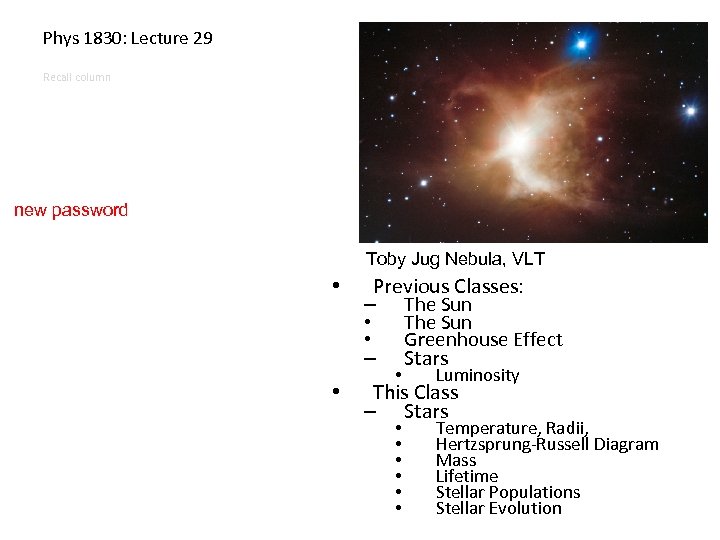 summary Phys 1830: Lecture 29 Recall column new password Toby Jug Nebula, VLT • • Previous Classes: – The Sun • Greenhouse Effect – Stars • Luminosity • • • Temperature, Radii, Hertzsprung-Russell Diagram Mass Lifetime Stellar Populations Stellar Evolution This Class – Stars
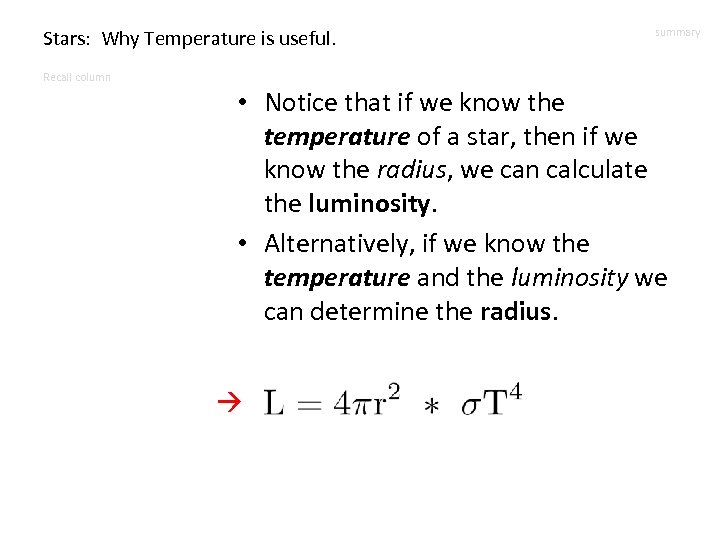 Stars: Why Temperature is useful. summary Recall column • Notice that if we know the temperature of a star, then if we know the radius, we can calculate the luminosity. • Alternatively, if we know the temperature and the luminosity we can determine the radius.
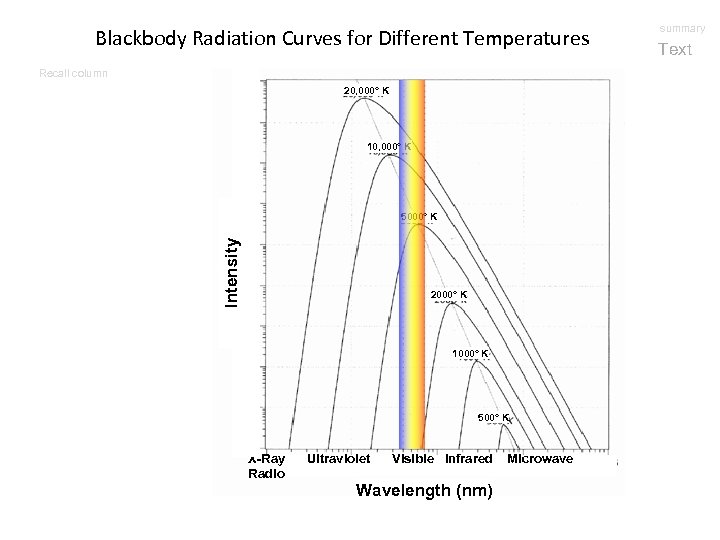 Blackbody Radiation Curves for Different Temperatures Recall column 20, 000° K 10, 000° K Intensity 5000° K 2000° K 1000° K 500° K X-Ray Radio Ultraviolet Visible Infrared Wavelength (nm) Microwave summary Text
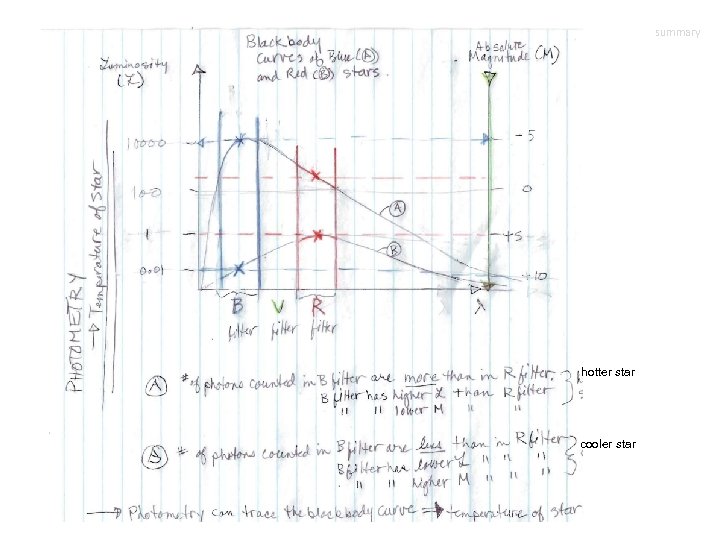
 How do we determine the temperature? summary Recall column • One way is to do photometry on images of stars in different filters. • This gives points on the black body curve. • “Connecting the dots” of intensity can trace the black body curve. • the peak of the black body curve tells us the temperature of the star. • this procedure does not take much observing time.
 summary Recall column hotter star cooler star
 Stellar Temperatures Stellar spectra are much more informative than the blackbody curves. However they take more observing time. There are seven general categories of stellar spectra, corresponding to different temperatures. From highest to lowest temperature, those categories are: OBAFGKM This classification is called Spectral Type or Spectral Class.
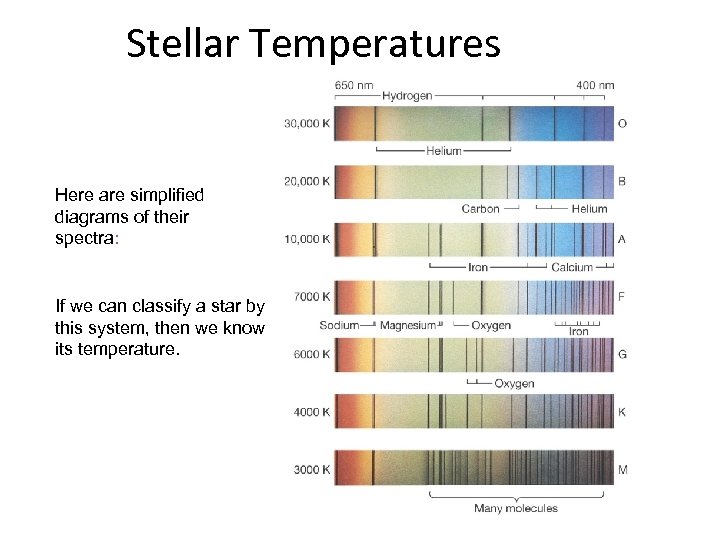 Stellar Temperatures Here are simplified diagrams of their spectra: If we can classify a star by this system, then we know its temperature.
 Stars: Plot Luminosity versus Spectral Class summary Recall column Plots: 1. Plot astronomer’s height versus astronomer’s weight. 2. Plot astronomer’s height versus astronomer’s IQ. 3. Plot Luminosity versus Temperature (Spectral Type) a) As if there were no relationship. b) As if there is a 1 -to-1 correlation.
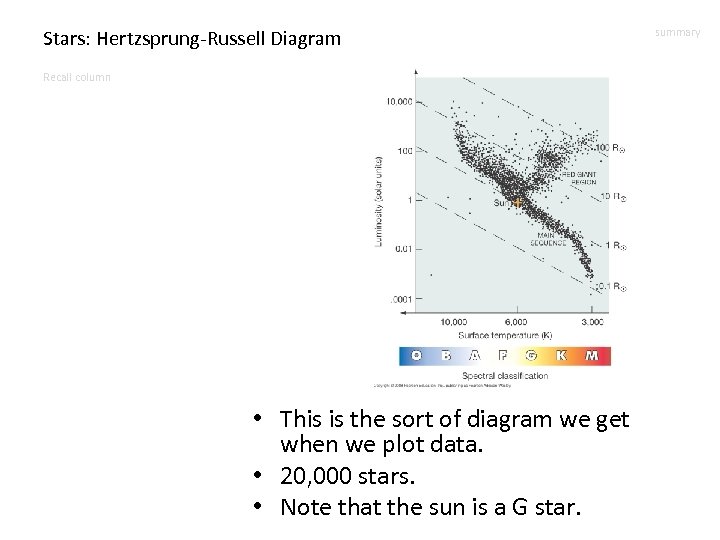 Stars: Hertzsprung-Russell Diagram Recall column • This is the sort of diagram we get when we plot data. • 20, 000 stars. • Note that the sun is a G star. summary
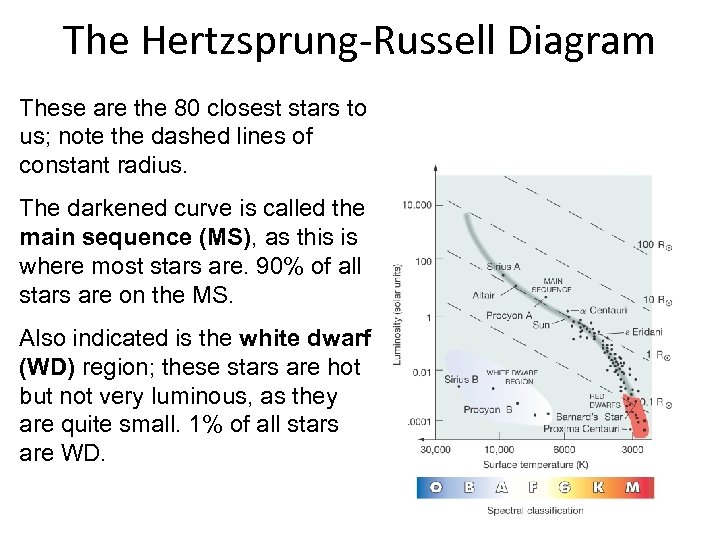 The Hertzsprung-Russell Diagram These are the 80 closest stars to us; note the dashed lines of constant radius. The darkened curve is called the main sequence (MS), as this is where most stars are. 90% of all stars are on the MS. Also indicated is the white dwarf (WD) region; these stars are hot but not very luminous, as they are quite small. 1% of all stars are WD.
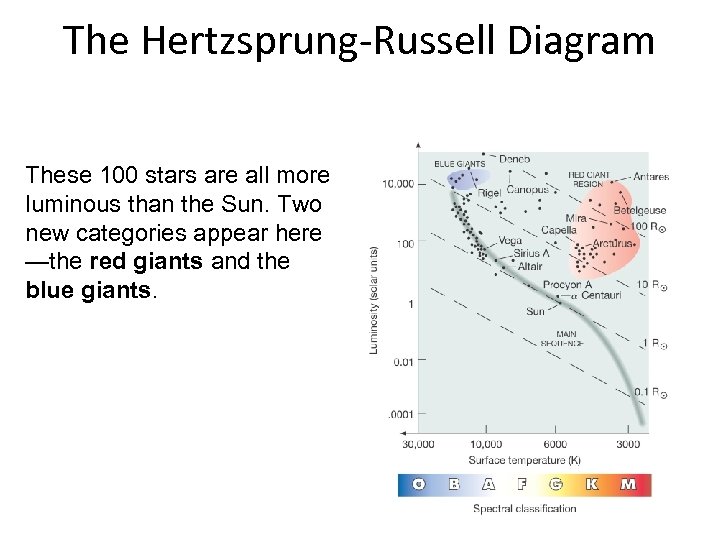 The Hertzsprung-Russell Diagram These 100 stars are all more luminous than the Sun. Two new categories appear here —the red giants and the blue giants.
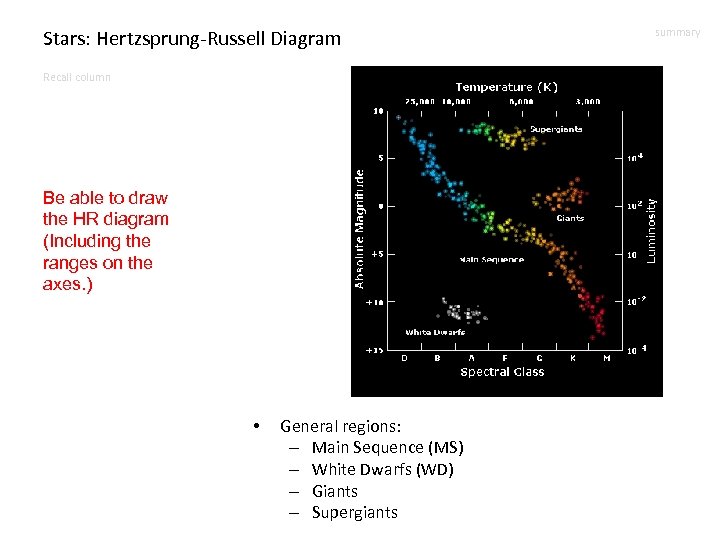 Stars: Hertzsprung-Russell Diagram Recall column Be able to draw the HR diagram (Including the ranges on the axes. ) • General regions: – Main Sequence (MS) – White Dwarfs (WD) – Giants – Supergiants summary
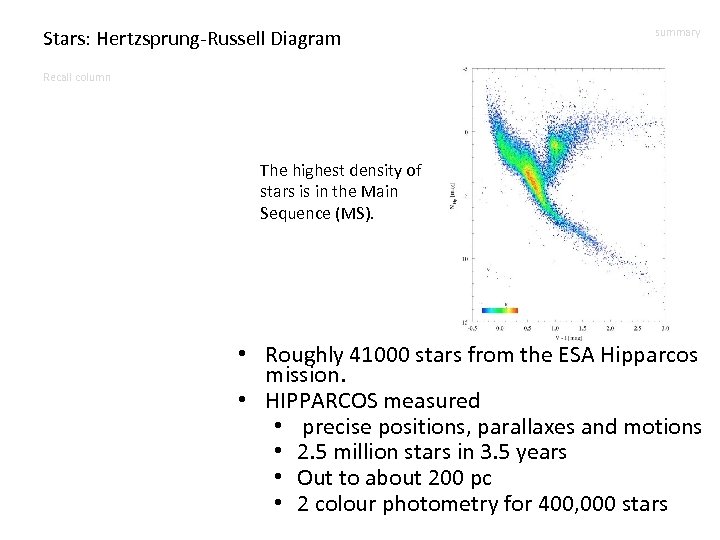 Stars: Hertzsprung-Russell Diagram summary Recall column The highest density of stars is in the Main Sequence (MS). • Roughly 41000 stars from the ESA Hipparcos mission. • HIPPARCOS measured • precise positions, parallaxes and motions • 2. 5 million stars in 3. 5 years • Out to about 200 pc • 2 colour photometry for 400, 000 stars
 Stars: Hertzsprung-Russell Diagram summary Recall column • If we know only the temperature, can we use the H-R diagram to know the luminosity of a star? a) Yes. b) No.
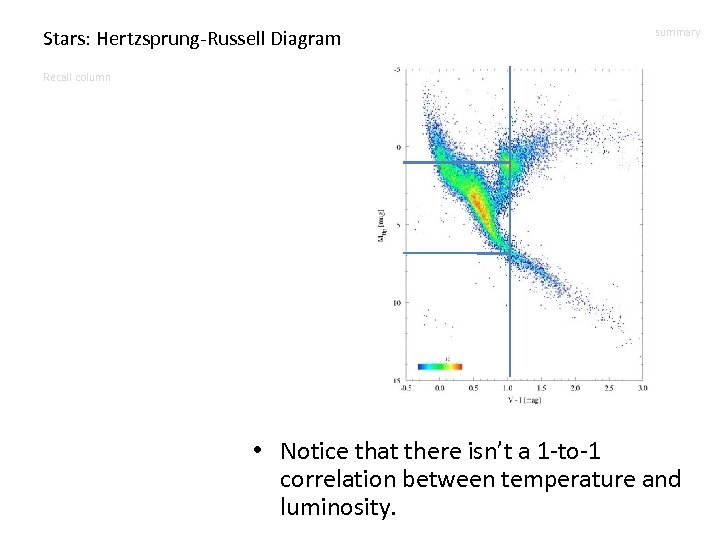 Stars: Hertzsprung-Russell Diagram summary Recall column • Notice that there isn’t a 1 -to-1 correlation between temperature and luminosity.
 Stars: Hertzsprung-Russell Diagram summary Recall column • If we know only the temperature, can we use the H-R diagram to know a unique luminosity for a star? a) Yes. b) No.
 Stars: Hertzsprung-Russell Diagram summary Recall column This is an important diagnostic tool that allows us to find radii, distances, and other characteristics of stars. We can even trace a star’s evolution from birth to death on the diagram. • Draw the HR Diagram and include and label the following: – 4 axes and their ranges – General regions where stars reside – The location of the sun
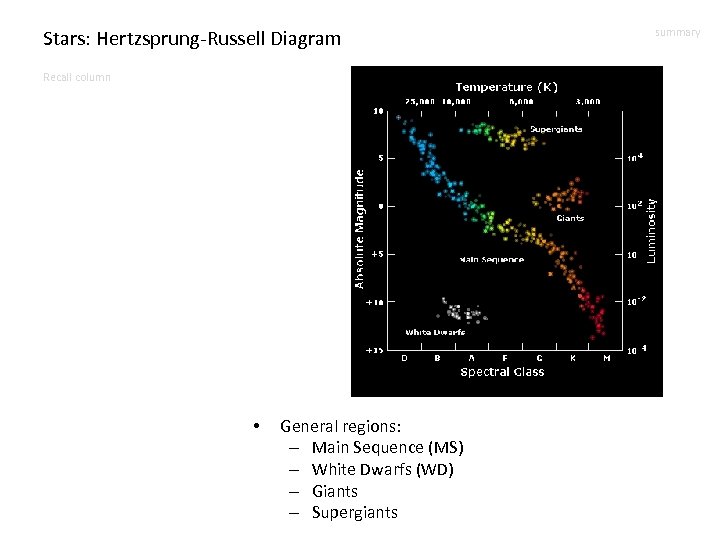 Stars: Hertzsprung-Russell Diagram Recall column • General regions: – Main Sequence (MS) – White Dwarfs (WD) – Giants – Supergiants summary
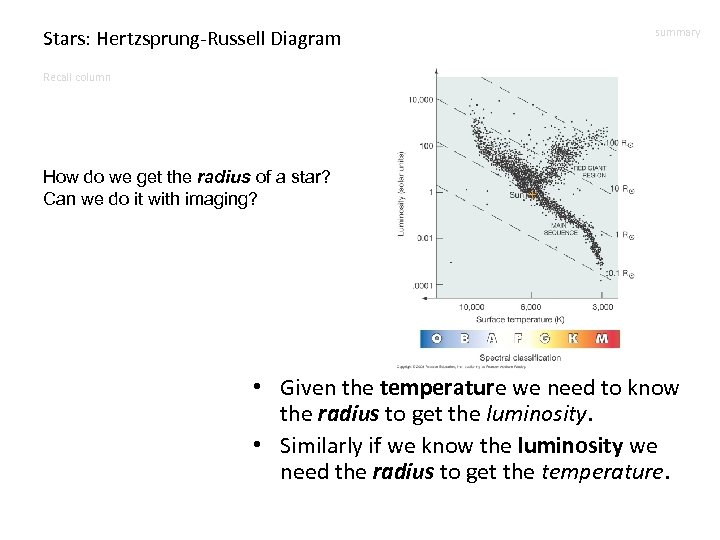 Stars: Hertzsprung-Russell Diagram summary Recall column How do we get the radius of a star? Can we do it with imaging? • Given the temperature we need to know the radius to get the luminosity. • Similarly if we know the luminosity we need the radius to get the temperature.
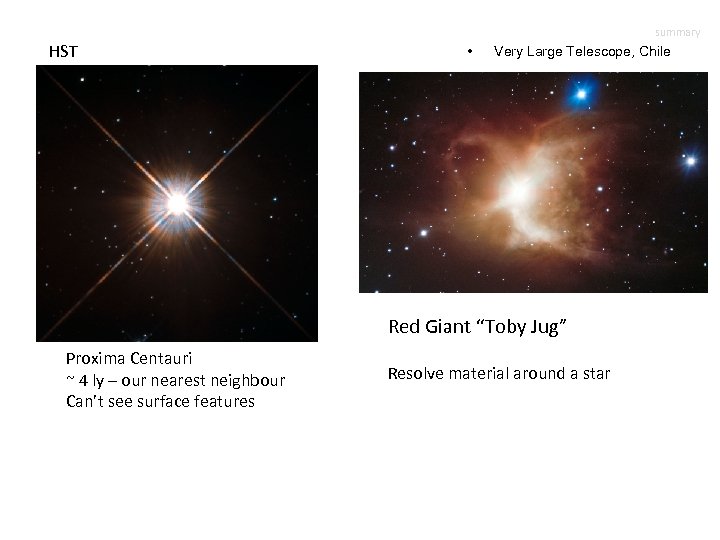 HST summary • Very Large Telescope, Chile Recall column Red Giant “Toby Jug” Proxima Centauri ~ 4 ly – our nearest neighbour Can’t see surface features Resolve material around a star
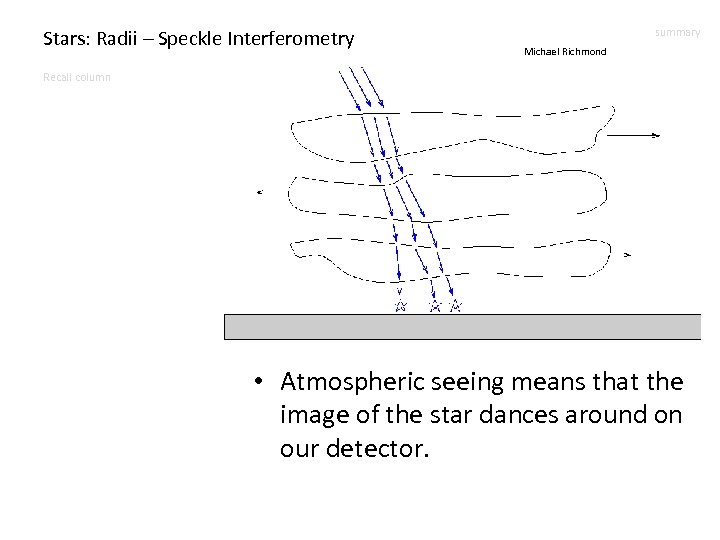 Stars: Radii – Speckle Interferometry summary Michael Richmond Recall column • Atmospheric seeing means that the image of the star dances around on our detector.
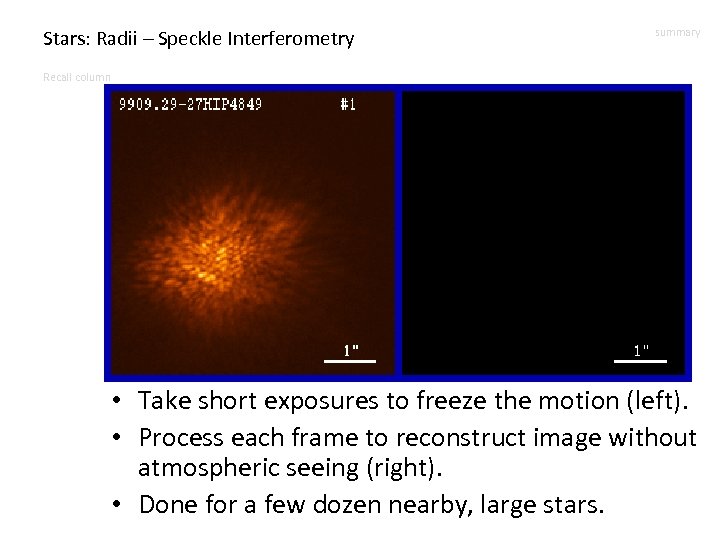 Stars: Radii – Speckle Interferometry summary Recall column • Take short exposures to freeze the motion (left). • Process each frame to reconstruct image without atmospheric seeing (right). • Done for a few dozen nearby, large stars.
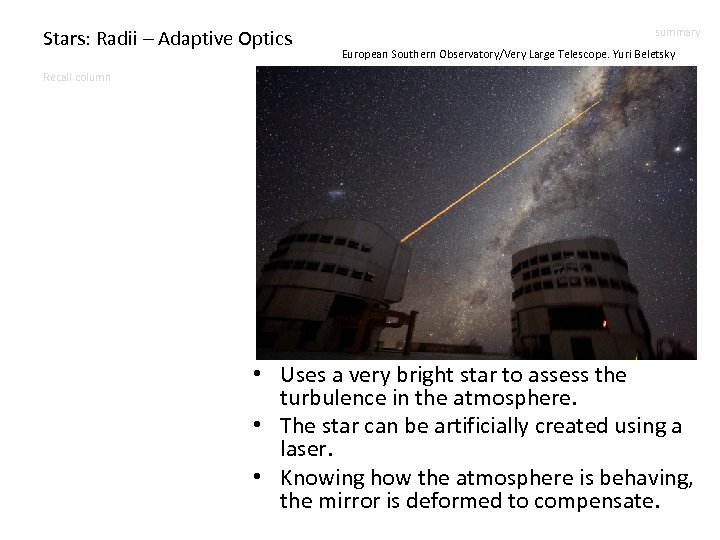 Stars: Radii – Adaptive Optics summary European Southern Observatory/Very Large Telescope. Yuri Beletsky Recall column • Uses a very bright star to assess the turbulence in the atmosphere. • The star can be artificially created using a laser. • Knowing how the atmosphere is behaving, the mirror is deformed to compensate.
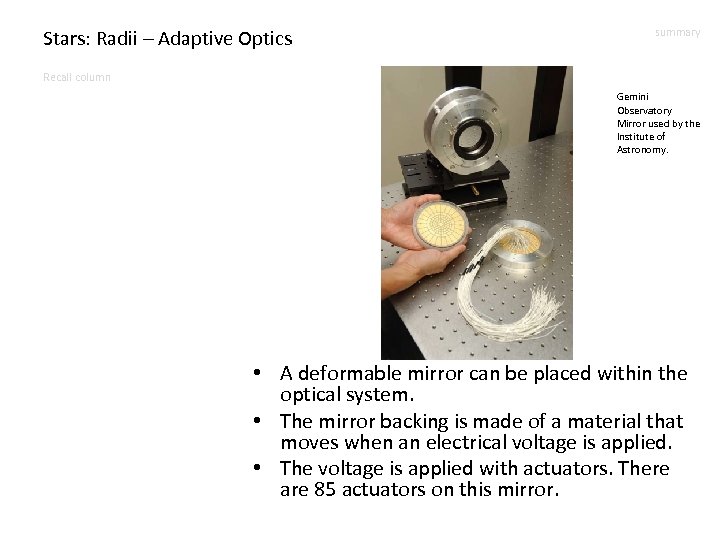 Stars: Radii – Adaptive Optics summary Recall column Gemini Observatory Mirror used by the Institute of Astronomy. • A deformable mirror can be placed within the optical system. • The mirror backing is made of a material that moves when an electrical voltage is applied. • The voltage is applied with actuators. There are 85 actuators on this mirror.
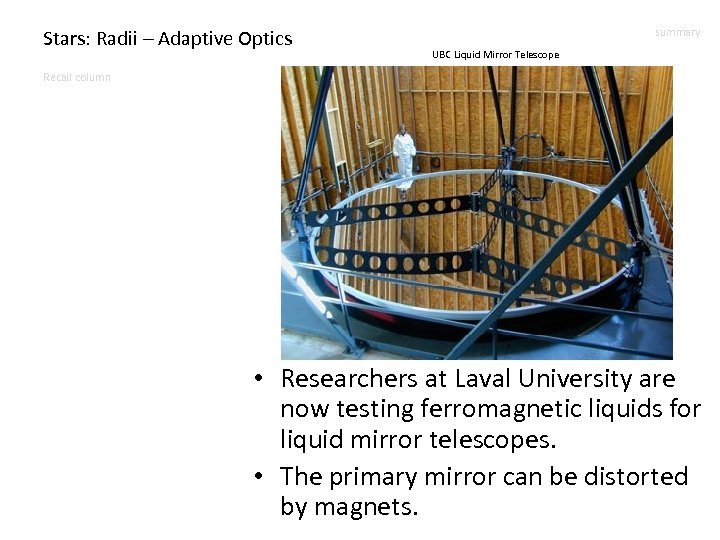 Stars: Radii – Adaptive Optics summary UBC Liquid Mirror Telescope Recall column • Researchers at Laval University are now testing ferromagnetic liquids for liquid mirror telescopes. • The primary mirror can be distorted by magnets.
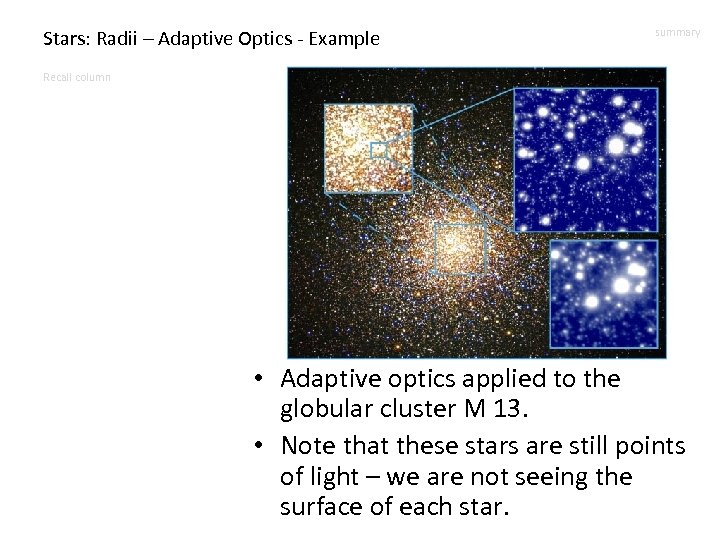 Stars: Radii – Adaptive Optics - Example summary Recall column • Adaptive optics applied to the globular cluster M 13. • Note that these stars are still points of light – we are not seeing the surface of each star.
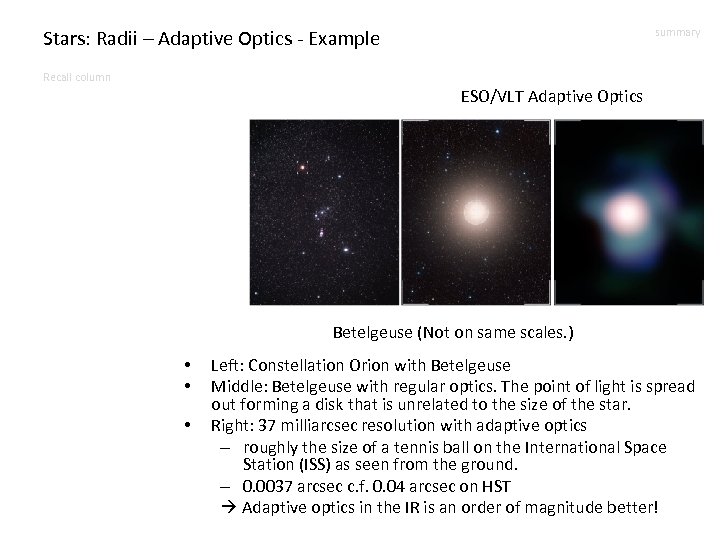 Stars: Radii – Adaptive Optics - Example summary Recall column ESO/VLT Adaptive Optics Betelgeuse (Not on same scales. ) • • • Left: Constellation Orion with Betelgeuse Middle: Betelgeuse with regular optics. The point of light is spread out forming a disk that is unrelated to the size of the star. Right: 37 milliarcsec resolution with adaptive optics – roughly the size of a tennis ball on the International Space Station (ISS) as seen from the ground. – 0. 0037 arcsec c. f. 0. 04 arcsec on HST Adaptive optics in the IR is an order of magnitude better!
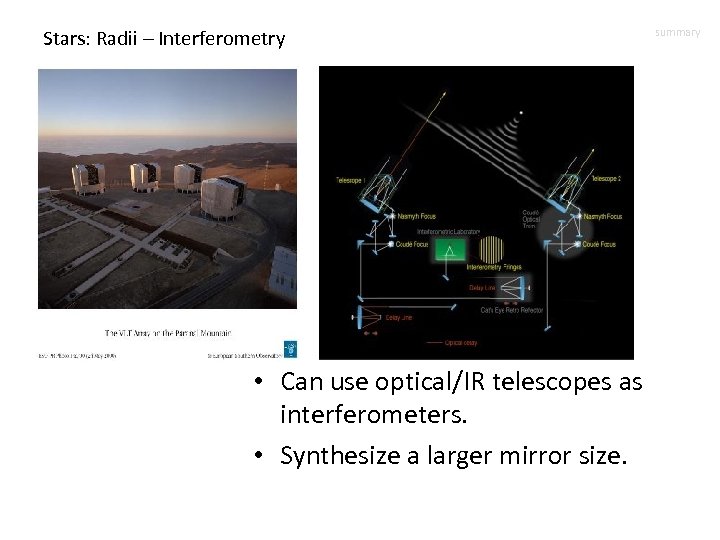 Stars: Radii – Interferometry Recall column • Can use optical/IR telescopes as interferometers. • Synthesize a larger mirror size. summary
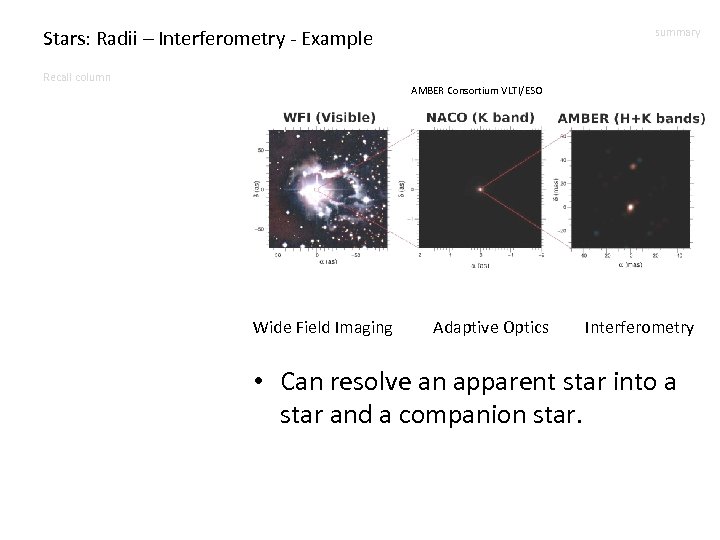 Stars: Radii – Interferometry - Example Recall column summary AMBER Consortium VLTI/ESO Wide Field Imaging Adaptive Optics Interferometry • Can resolve an apparent star into a star and a companion star.
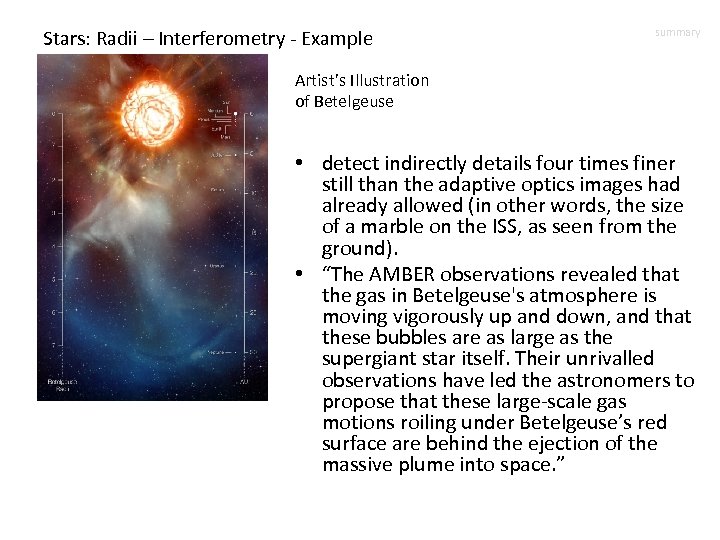 Stars: Radii – Interferometry - Example Recall column summary Artist’s Illustration of Betelgeuse • detect indirectly details four times finer still than the adaptive optics images had already allowed (in other words, the size of a marble on the ISS, as seen from the ground). • “The AMBER observations revealed that the gas in Betelgeuse's atmosphere is moving vigorously up and down, and that these bubbles are as large as the supergiant star itself. Their unrivalled observations have led the astronomers to propose that these large-scale gas motions roiling under Betelgeuse’s red surface are behind the ejection of the massive plume into space. ”
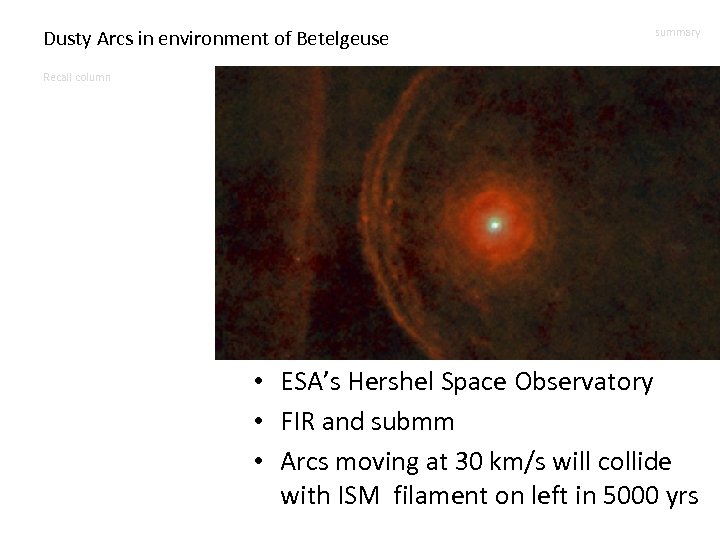 Dusty Arcs in environment of Betelgeuse summary Recall column • ESA’s Hershel Space Observatory • FIR and submm • Arcs moving at 30 km/s will collide with ISM filament on left in 5000 yrs
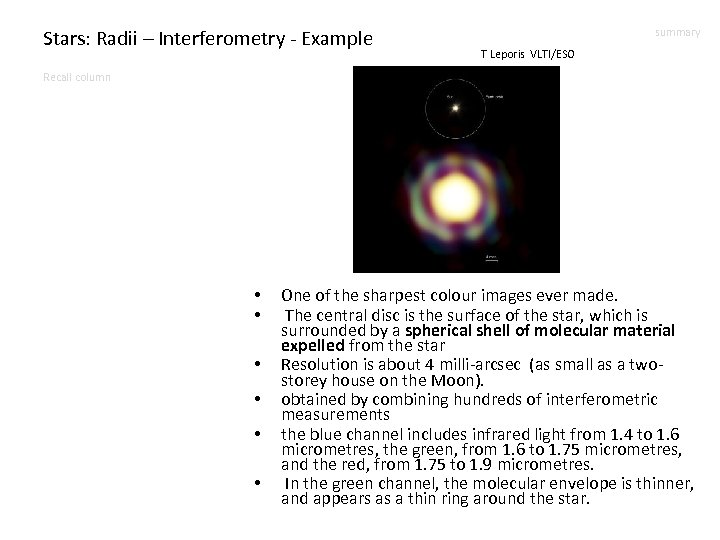 Stars: Radii – Interferometry - Example summary T Leporis VLTI/ESO Recall column • • • One of the sharpest colour images ever made. The central disc is the surface of the star, which is surrounded by a spherical shell of molecular material expelled from the star Resolution is about 4 milli-arcsec (as small as a twostorey house on the Moon). obtained by combining hundreds of interferometric measurements the blue channel includes infrared light from 1. 4 to 1. 6 micrometres, the green, from 1. 6 to 1. 75 micrometres, and the red, from 1. 75 to 1. 9 micrometres. In the green channel, the molecular envelope is thinner, and appears as a thin ring around the star.
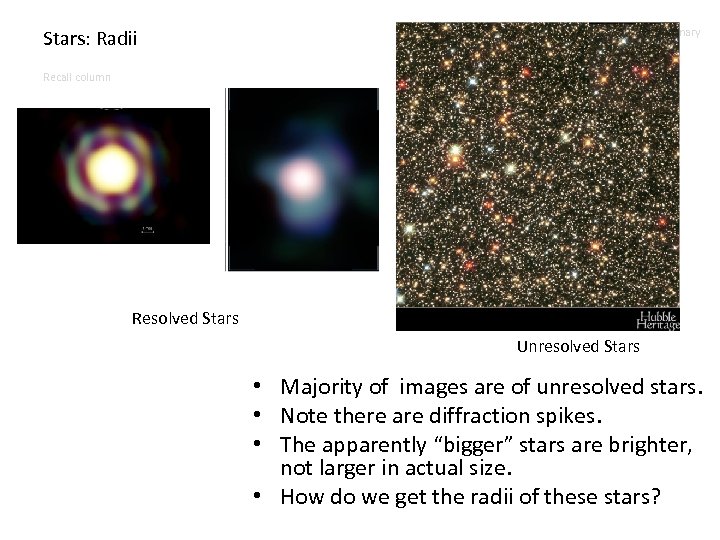 Stars: Radii summary Recall column Resolved Stars Unresolved Stars • Majority of images are of unresolved stars. • Note there are diffraction spikes. • The apparently “bigger” stars are brighter, not larger in actual size. • How do we get the radii of these stars?
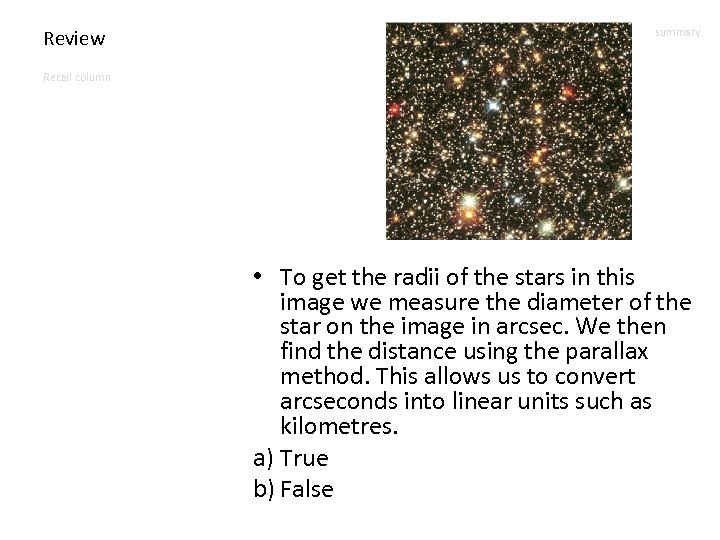 Review summary Recall column • To get the radii of the stars in this image we measure the diameter of the star on the image in arcsec. We then find the distance using the parallax method. This allows us to convert arcseconds into linear units such as kilometres. a) True b) False
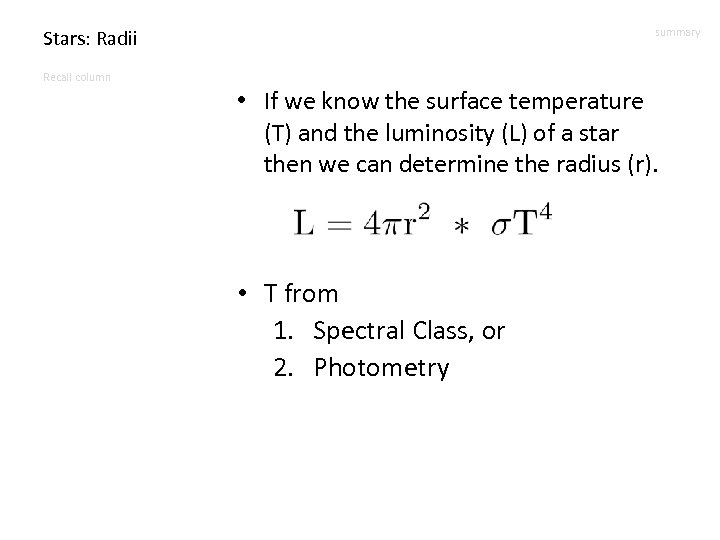 Stars: Radii summary Recall column • If we know the surface temperature (T) and the luminosity (L) of a star then we can determine the radius (r). • T from 1. Spectral Class, or 2. Photometry
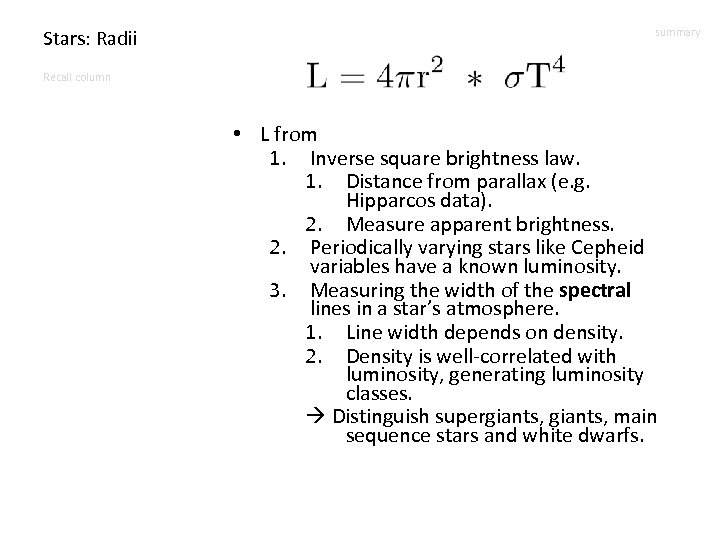 Stars: Radii summary Recall column • L from 1. Inverse square brightness law. 1. Distance from parallax (e. g. Hipparcos data). 2. Measure apparent brightness. 2. Periodically varying stars like Cepheid variables have a known luminosity. 3. Measuring the width of the spectral lines in a star’s atmosphere. 1. Line width depends on density. 2. Density is well-correlated with luminosity, generating luminosity classes. Distinguish supergiants, main sequence stars and white dwarfs.
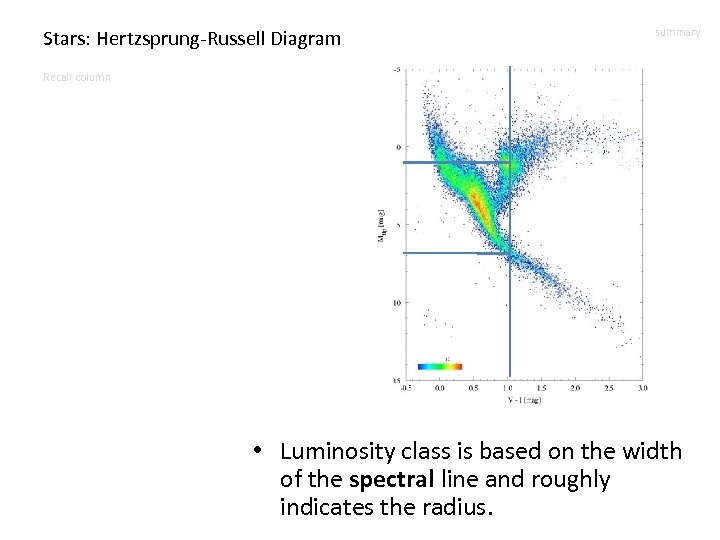 Stars: Hertzsprung-Russell Diagram summary Recall column • Luminosity class is based on the width of the spectral line and roughly indicates the radius.
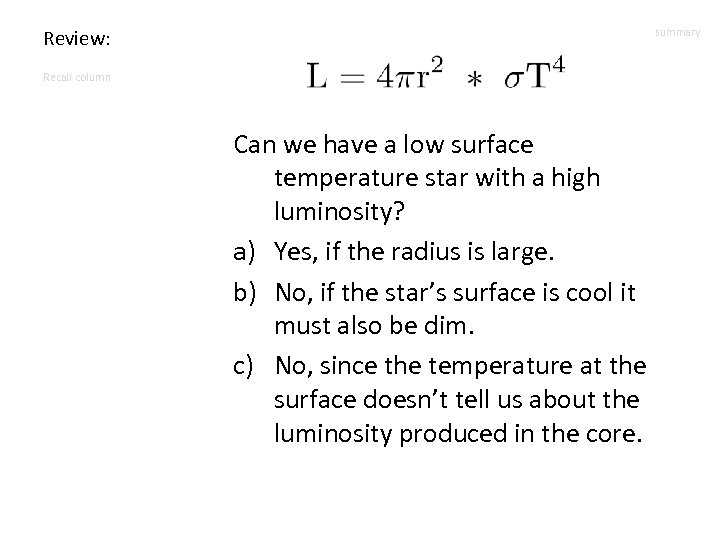 Review: summary Recall column Can we have a low surface temperature star with a high luminosity? a) Yes, if the radius is large. b) No, if the star’s surface is cool it must also be dim. c) No, since the temperature at the surface doesn’t tell us about the luminosity produced in the core.