


 Скачать презентацию Summary of the FY 03 Run the Shutdown
4e63477c8eba423cd5983bdc5b90dc25.ppt
- Количество слайдов: 12
 Summary of the FY 03 Run, the Shutdown work, and plans for the FY 04 Run W. B. Christie, BNL STAR Collaboration meeting Outline Michigan State University August 13, 2003. • Summary of Data acquired in the FY 03 Physics run • Summary of the Shutdown work and schedule • Summary of the STAR Operations FY 03 Critique mtg • Looking ahead to the FY 04 Physics Run STAR
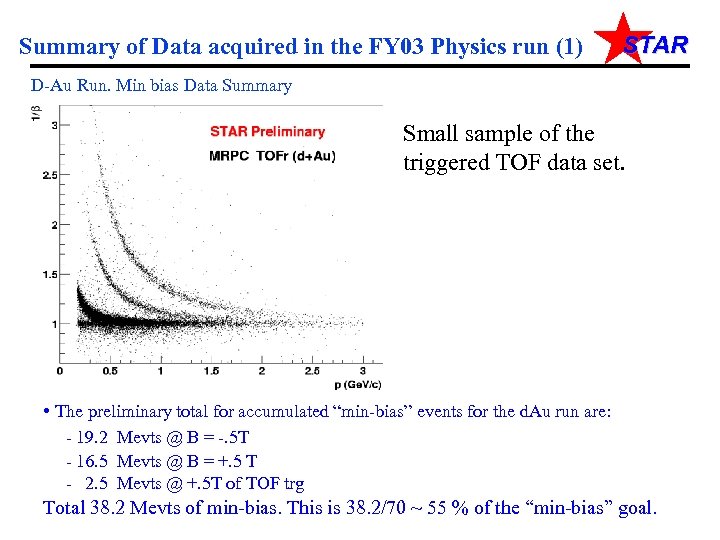 Summary of Data acquired in the FY 03 Physics run (1) STAR D-Au Run. Min bias Data Summary Small sample of the triggered TOF data set. • The preliminary total for accumulated “min-bias” events for the d. Au run are: - 19. 2 Mevts @ B = -. 5 T - 16. 5 Mevts @ B = +. 5 T - 2. 5 Mevts @ +. 5 T of TOF trg Total 38. 2 Mevts of min-bias. This is 38. 2/70 ~ 55 % of the “min-bias” goal.
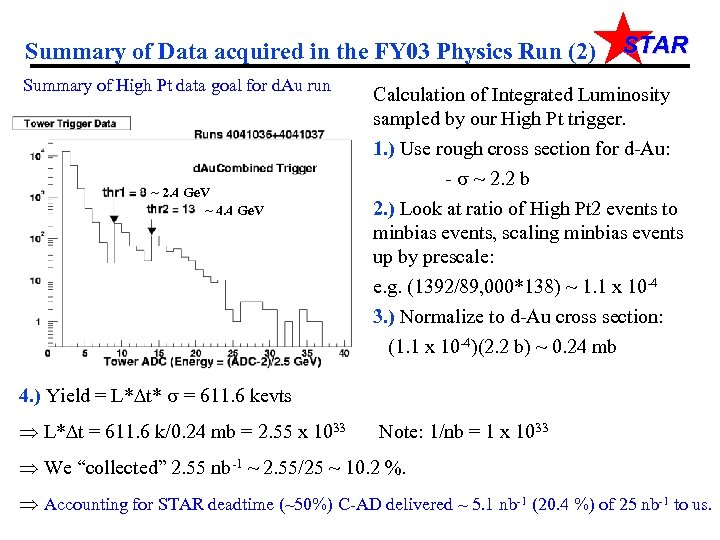 Summary of Data acquired in the FY 03 Physics Run (2) Summary of High Pt data goal for d. Au run ~ 2. 4 Ge. V ~ 4. 4 Ge. V STAR Calculation of Integrated Luminosity sampled by our High Pt trigger. 1. ) Use rough cross section for d-Au: - ~ 2. 2 b 2. ) Look at ratio of High Pt 2 events to minbias events, scaling minbias events up by prescale: e. g. (1392/89, 000*138) ~ 1. 1 x 10 -4 3. ) Normalize to d-Au cross section: (1. 1 x 10 -4)(2. 2 b) ~ 0. 24 mb 4. ) Yield = L* t* = 611. 6 kevts L* t = 611. 6 k/0. 24 mb = 2. 55 x 1033 Note: 1/nb = 1 x 1033 We “collected” 2. 55 nb-1 ~ 2. 55/25 ~ 10. 2 %. Accounting for STAR deadtime (~50%) C-AD delivered ~ 5. 1 nb-1 (20. 4 %) of 25 nb-1 to us.
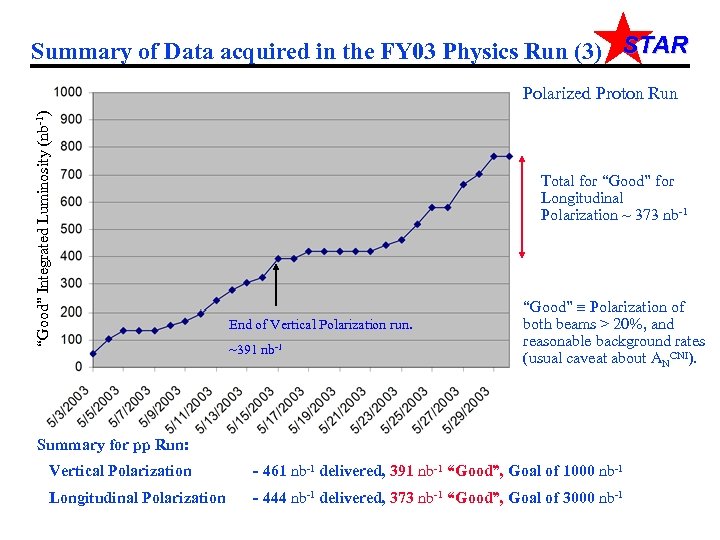 Summary of Data acquired in the FY 03 Physics Run (3) STAR “Good” Integrated Luminosity (nb-1) Polarized Proton Run Total for “Good” for Longitudinal Polarization ~ 373 nb-1 End of Vertical Polarization run. ~391 nb-1 “Good” Polarization of both beams > 20%, and reasonable background rates (usual caveat about ANCNI). Summary for pp Run: Vertical Polarization - 461 nb-1 delivered, 391 nb-1 “Good”, Goal of 1000 nb-1 Longitudinal Polarization - 444 nb-1 delivered, 373 nb-1 “Good”, Goal of 3000 nb-1
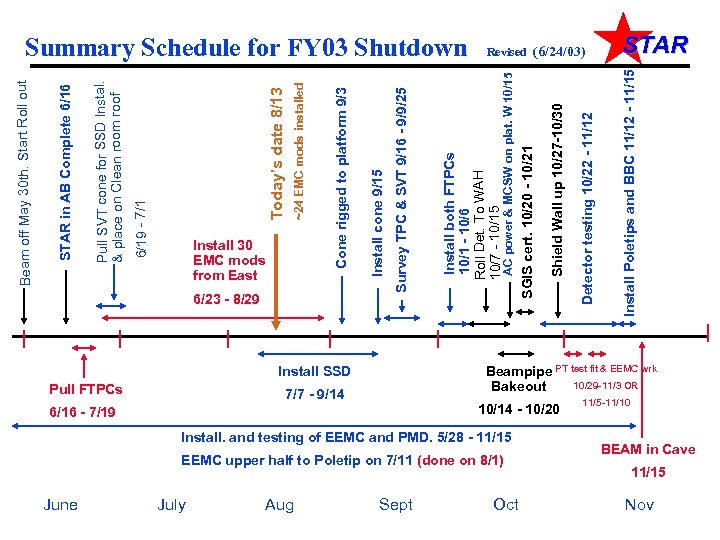 June Pull FTPCs July Install 30 EMC mods from East Aug Install SSD 7/7 - 9/14 6/16 - 7/19 Sept Install. and testing of EEMC and PMD. 5/28 - 11/15 EEMC upper half to Poletip on 7/11 (done on 8/1) Oct 10/14 - 10/20 Revised (6/24/03) Install Poletips and BBC 11/12 - 11/15 Detector testing 10/22 - 11/12 Shield Wall up 10/27 -10/30 SGIS cert. 10/20 - 10/21 AC power & MCSW on plat. W 10/15 Install both FTPCs 10/1 - 10/6 Roll Det. To WAH 10/7 - 10/15 Survey TPC & SVT 9/16 - 9/9/25 6/23 - 8/29 Install cone 9/15 Cone rigged to platform 9/3 ~24 EMC mods installed Today’s date 8/13 6/19 - 7/1 Pull SVT cone for SSD Instal. & place on Clean room roof STAR in AB Complete 6/16 Beam off May 30 th. Start Roll out Summary Schedule for FY 03 Shutdown STAR Beampipe PT test fit & EEMC wrk 10/29 -11/3 OR Bakeout 11/5 -11/10 BEAM in Cave 11/15 Nov
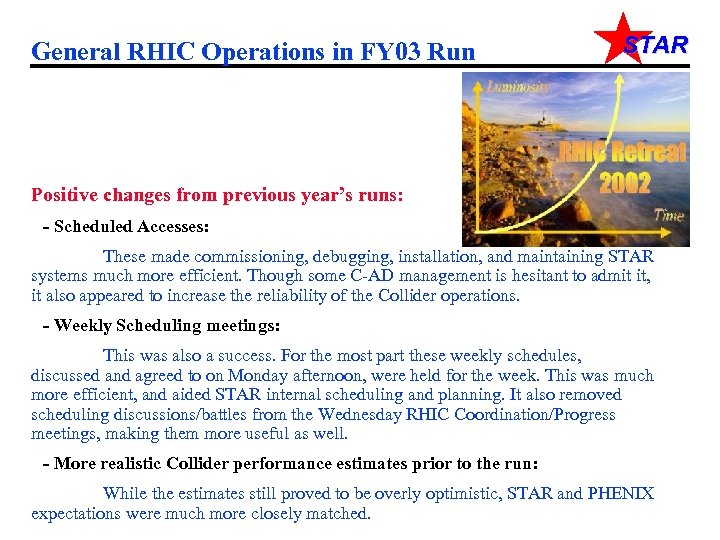 General RHIC Operations in FY 03 Run STAR Positive changes from previous year’s runs: - Scheduled Accesses: These made commissioning, debugging, installation, and maintaining STAR systems much more efficient. Though some C-AD management is hesitant to admit it, it also appeared to increase the reliability of the Collider operations. - Weekly Scheduling meetings: This was also a success. For the most part these weekly schedules, discussed and agreed to on Monday afternoon, were held for the week. This was much more efficient, and aided STAR internal scheduling and planning. It also removed scheduling discussions/battles from the Wednesday RHIC Coordination/Progress meetings, making them more useful as well. - More realistic Collider performance estimates prior to the run: While the estimates still proved to be overly optimistic, STAR and PHENIX expectations were much more closely matched.
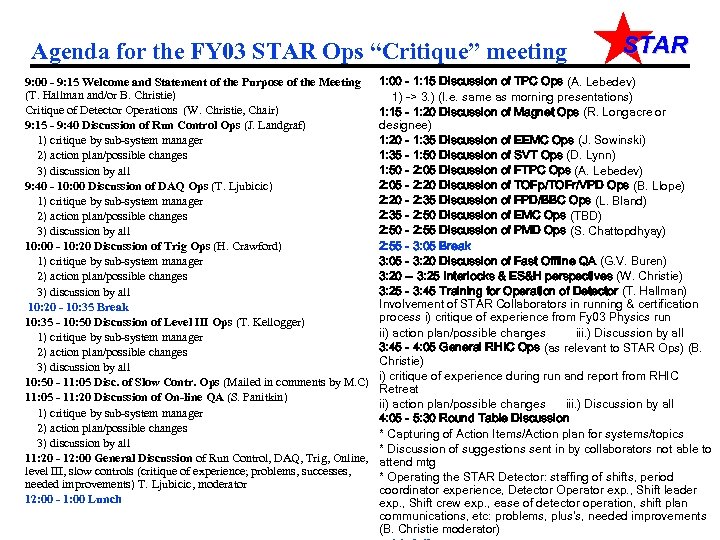 Agenda for the FY 03 STAR Ops “Critique” meeting 9: 00 - 9: 15 Welcome and Statement of the Purpose of the Meeting (T. Hallman and/or B. Christie) Critique of Detector Operations (W. Christie, Chair) 9: 15 - 9: 40 Discussion of Run Control Ops (J. Landgraf) 1) critique by sub-system manager 2) action plan/possible changes 3) discussion by all 9: 40 - 10: 00 Discussion of DAQ Ops (T. Ljubicic) 1) critique by sub-system manager 2) action plan/possible changes 3) discussion by all 10: 00 - 10: 20 Discussion of Trig Ops (H. Crawford) 1) critique by sub-system manager 2) action plan/possible changes 3) discussion by all 10: 20 - 10: 35 Break 10: 35 - 10: 50 Discussion of Level III Ops (T. Kellogger) 1) critique by sub-system manager 2) action plan/possible changes 3) discussion by all 10: 50 - 11: 05 Disc. of Slow Contr. Ops (Mailed in comments by M. C) 11: 05 - 11: 20 Discussion of On-line QA (S. Panitkin) 1) critique by sub-system manager 2) action plan/possible changes 3) discussion by all 11: 20 - 12: 00 General Discussion of Run Control, DAQ, Trig, Online, level III, slow controls (critique of experience; problems, successes, needed improvements) T. Ljubicic, moderator 12: 00 - 1: 00 Lunch STAR 1: 00 - 1: 15 Discussion of TPC Ops (A. Lebedev) 1) -> 3. ) (I. e. same as morning presentations) 1: 15 - 1: 20 Discussion of Magnet Ops (R. Longacre or designee) 1: 20 - 1: 35 Discussion of EEMC Ops (J. Sowinski) 1: 35 - 1: 50 Discussion of SVT Ops (D. Lynn) 1: 50 - 2: 05 Discussion of FTPC Ops (A. Lebedev) 2: 05 - 2: 20 Discussion of TOFp/TOFr/VPD Ops (B. Llope) 2: 20 - 2: 35 Discussion of FPD/BBC Ops (L. Bland) 2: 35 - 2: 50 Discussion of EMC Ops (TBD) 2: 50 - 2: 55 Discussion of PMD Ops (S. Chattopdhyay) 2: 55 - 3: 05 Break 3: 05 - 3: 20 Discussion of Fast Offline QA (G. V. Buren) 3: 20 -- 3: 25 Interlocks & ES&H perspectives (W. Christie) 3: 25 - 3: 45 Training for Operation of Detector (T. Hallman) Involvement of STAR Collaborators in running & certification process i) critique of experience from Fy 03 Physics run ii) action plan/possible changes iii. ) Discussion by all 3: 45 - 4: 05 General RHIC Ops (as relevant to STAR Ops) (B. Christie) i) critique of experience during run and report from RHIC Retreat ii) action plan/possible changes iii. ) Discussion by all 4: 05 - 5: 30 Round Table Discussion * Capturing of Action Items/Action plan for systems/topics * Discussion of suggestions sent in by collaborators not able to attend mtg * Operating the STAR Detector: staffing of shifts, period coordinator experience, Detector Operator exp. , Shift leader exp. , Shift crew exp. , ease of detector operation, shift plan communications, etc: problems, plus's, needed improvements (B. Christie moderator)
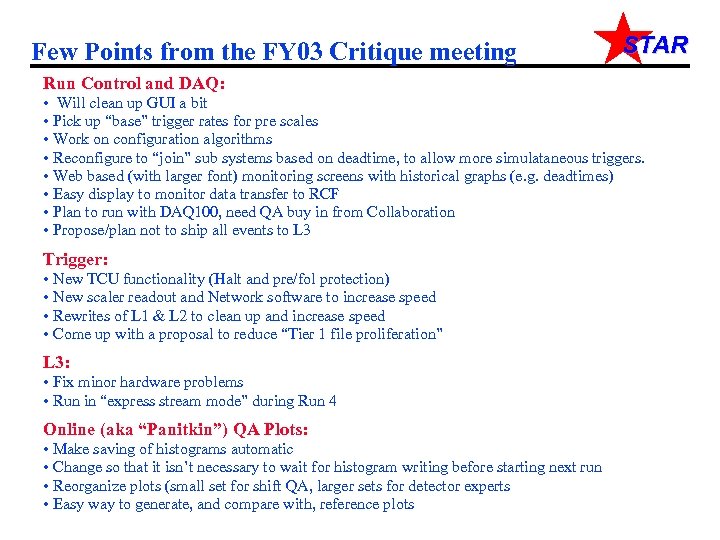 Few Points from the FY 03 Critique meeting STAR Run Control and DAQ: • Will clean up GUI a bit • Pick up “base” trigger rates for pre scales • Work on configuration algorithms • Reconfigure to “join” sub systems based on deadtime, to allow more simulataneous triggers. • Web based (with larger font) monitoring screens with historical graphs (e. g. deadtimes) • Easy display to monitor data transfer to RCF • Plan to run with DAQ 100, need QA buy in from Collaboration • Propose/plan not to ship all events to L 3 Trigger: • New TCU functionality (Halt and pre/fol protection) • New scaler readout and Network software to increase speed • Rewrites of L 1 & L 2 to clean up and increase speed • Come up with a proposal to reduce “Tier 1 file proliferation” L 3: • Fix minor hardware problems • Run in “express stream mode” during Run 4 Online (aka “Panitkin”) QA Plots: • Make saving of histograms automatic • Change so that it isn’t necessary to wait for histogram writing before starting next run • Reorganize plots (small set for shift QA, larger sets for detector experts • Easy way to generate, and compare with, reference plots
 Few Points from the FY 03 Critique meeting (2) STAR Subsystems: • EEMC expects to transition to shift operation sometime during Run 4 • SVT would like top see implementation of “Access checklist” • TOFp tray may be relocated • BBC brings up possible need to deal with ADC saturation during Heavy Ion running Two ideas - split signals to ADCs and attenuate one, or lower gains • FPD plans to complete West side installation • BEMC will replace EPROMS to solve main pedestal problem with Jet trigger • BEMC still working on diagnosis and cure for problem of failing crate power supplies • PMD needs good Heavy Ion pre-trigger, will be fully installed and instrumented for Run 4 Shift Crews and Shift Sign-up • Overlap days need to be taken seriously • Efficiency of shift crew to get detector up and taking must be worked on and quantified • Training shifts should be scheduled later in the run (when probability of beam is higher) • Suggestion to change composition of Shift crews (1 SL, 2 DO, 1 C, +Ts) • Tune shift sign-up to ensure at least one DO has recent experience Complete minutes available via the STAR Operations Web page.
 Looking Ahead to the FY 04 Run STAR C-AD Plans for next year’s run: - “Physics Development mode”: What C-AD is proposing is that after the five week “Set-up” and “Ramp-up” phase for a given beam configuration that Luminosity development continue during the “Physics Running” 8: 00 am to 4: 00 pm Monday through Friday. Concerns: Current Schedule calls for the “Physics Running” to start about December 22 nd. Concern is that to effectively use the holiday period (I. e. time until about January 2 nd) that we must have STAR commissioned, and at least a final min-bias trigger set-up before this time. QM 04 in mid January will pull a number of people out of town. We’ll need a careful plan for commissioning of the higher level and “rare” triggers to effectively make use of beam time in January. With “Physics Development mode” (PDM) running, for STAR to get its 45 hours per week of “spinning tapes”, the uptime for the collider and STAR will have to be much larger than we seen in the past. 45 hrs/wk/(168 hrs/wk - 12 (beam Exp. ) - 8 (access) - 40 (PDM) =108 hrs/wk) ~42% !
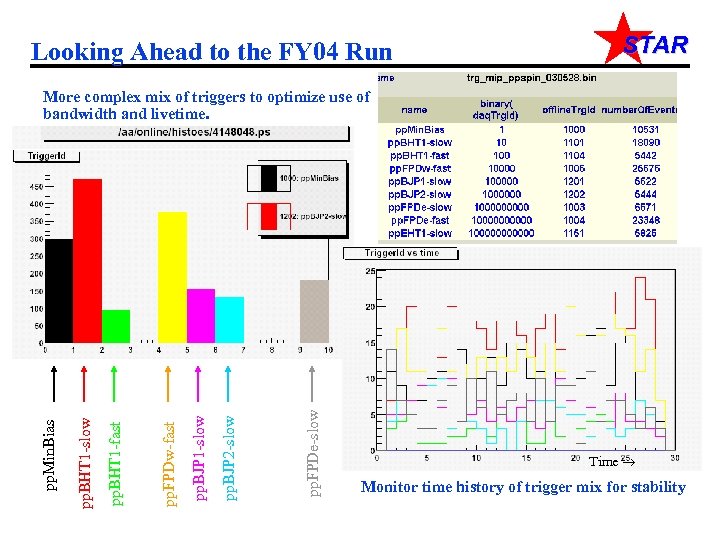 Looking Ahead to the FY 04 Run STAR pp. FPDe-slow pp. BJP 2 -slow pp. BJP 1 -slow pp. FPDw-fast pp. BHT 1 -slow pp. Min. Bias More complex mix of triggers to optimize use of bandwidth and livetime. Time Monitor time history of trigger mix for stability
 Summary STAR • We fairly well followed the FY 03 BUR plan for the last run, and accomplished most of the goals that had been set. • We’ve evolved the operating capabilities of the STAR system (triggers, rates, running modes, new sub systems, etc. ) dramatically every year, and are planning to continue this evolution (rates, DAQ 100, parallel Event builders, L 2 triggers and aborts, etc. ) in the FY 04 run. • We are going to have to perform efficiently and effectively to achieve the accumulation of the large data sets (~ 100 Mevts etc. ) that people are starting to contemplate and request. • Improve Shift Crew efficiency • Reduce fraction of accumulated events which are labeled as “bad” and tossed. • Improve detector performance (e. g. deadtime) monitoring, diagnosis, and recovery. • Continually work on overall robustness of detector operation • Schedule for the FY 04 run presents some schedule issues that we’ll have to plan for. • It’s time to reflect on our past successes, look forward to our future challenges, and enjoy the reception on the roof of BPS.