


 Скачать презентацию Summary of the D_R D projects in 2006 Junji
6a91d83078022fe06abd5b1b26576da1.ppt
- Количество слайдов: 42
 Summary of the D_R&D projects in 2006 Junji Haba KEK
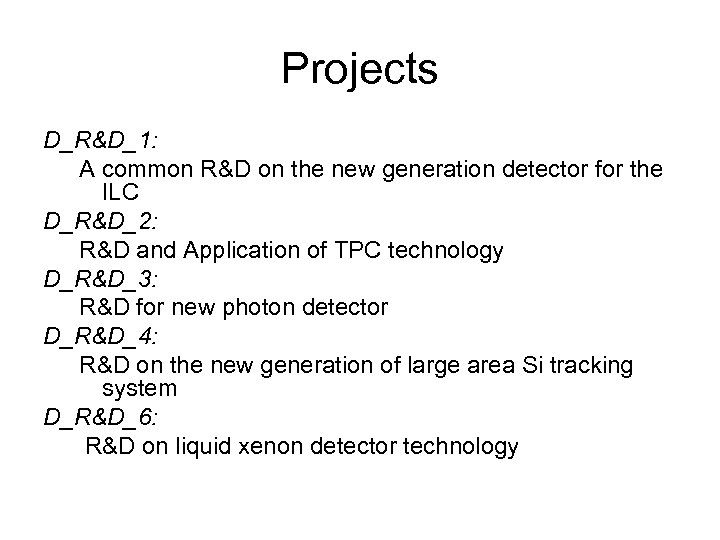 Projects D_R&D_1: A common R&D on the new generation detector for the ILC D_R&D_2: R&D and Application of TPC technology D_R&D_3: R&D for new photon detector D_R&D_4: R&D on the new generation of large area Si tracking system D_R&D_6: R&D on liquid xenon detector technology
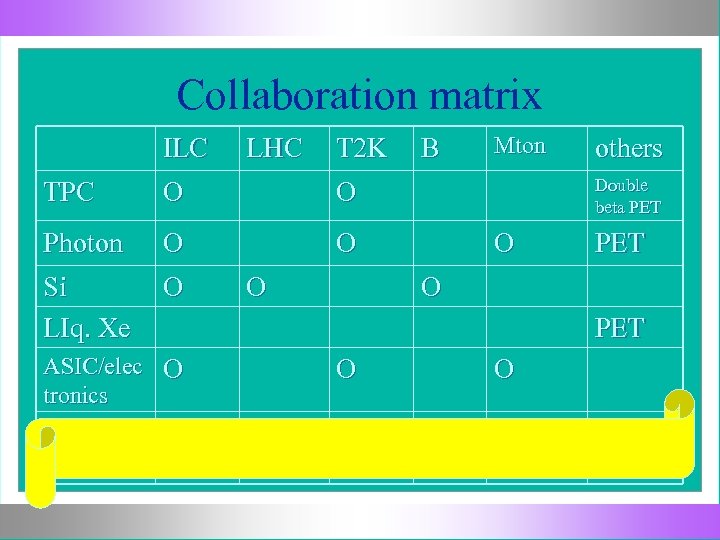
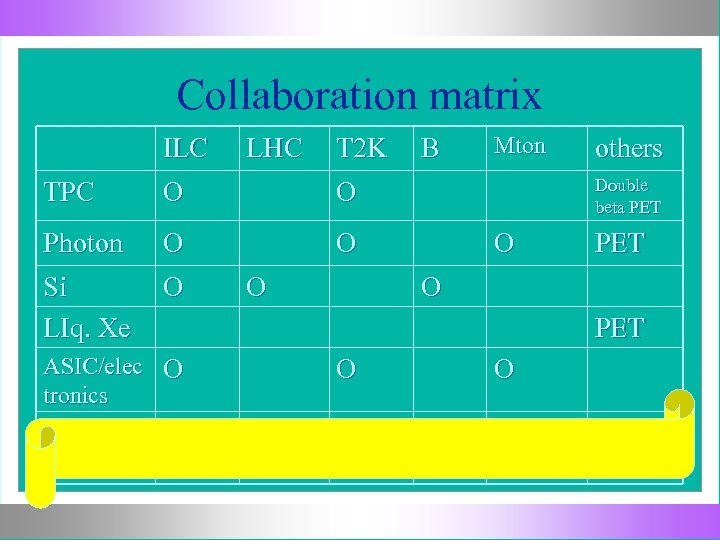 Collaboration matrix ILC LHC T 2 K TPC O O O PET ASIC/elec O tronics HPK others Double beta PET O Si LIq. Xe Mton O Photon B O O O O Double Chooz PET
 TPC
TPC
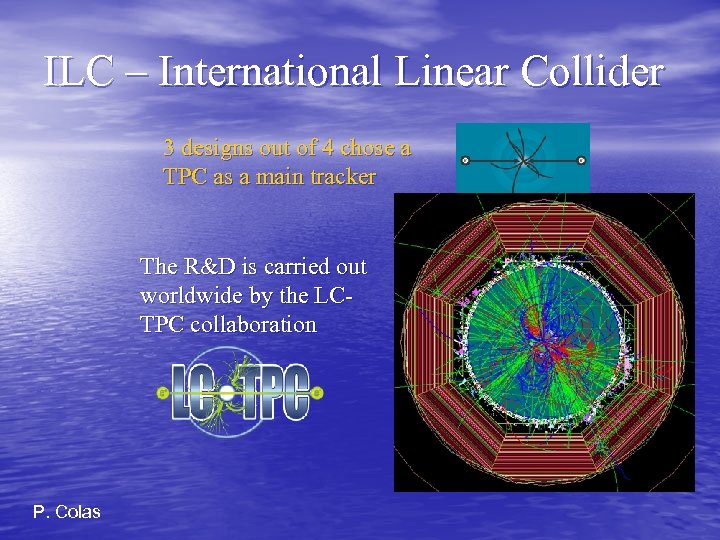 ILC – International Linear Collider 3 designs out of 4 chose a TPC as a main tracker The R&D is carried out worldwide by the LCTPC collaboration P. Colas
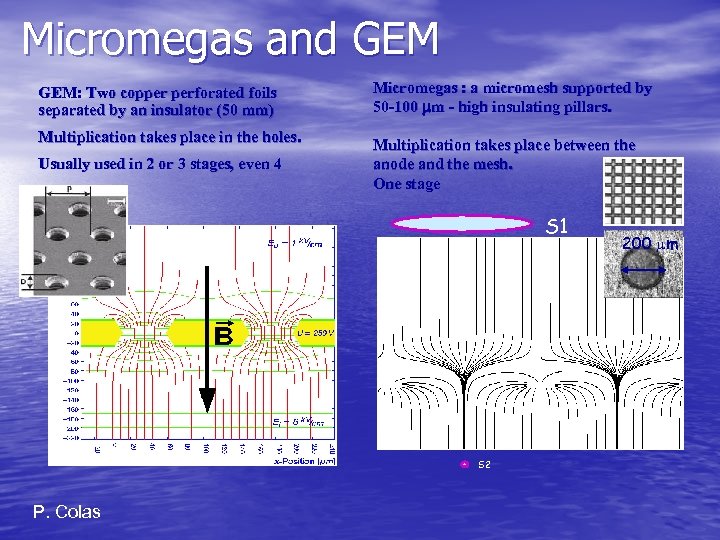 Micromegas and GEM: Two copper perforated foils separated by an insulator (50 mm) Multiplication takes place in the holes. Usually used in 2 or 3 stages, even 4 Micromegas : a micromesh supported by 50 -100 mm - high insulating pillars. Multiplication takes place between the anode and the mesh. One stage S 1 S 2 P. Colas 200 mm
 France-Japan meeting(s) in Paris in September 2006, followed by a 3 -day endplate meeting with a large Japanese attendance (K. Fujii, Y. Kato, H. Kuroiwa, T. Matsuda, A. Sugiyama) http: //www-dapnia. cea. fr/Spp/Meetings/End. Plate/ For the first time, a french attendance at the japanese MPGD meeting in Saga, in January 2007 (D. Attié, P. Colas) Participation of K. Fujii in a TPC analysis “Jamboree” in Aix-la-Chapelle, March 2007 P. Colas
 The CF 4 “saga” • We tried to take data with Ar CF 4 • The detector was very unstable, very different from what we had in • • • Saclay, with afterpulses. We suspected Japanese CF 4 to be different from European CF 4 After a complicated exchange of bottles and careful gas analyses, the two gases were shown to be the same The difference was traced to the presence of impurities in the gas system in Saclay, quenching UVs An admixture of 2% isobutane was found to be enough to stop the UVs and stabilise the operation. This gas Ar CF 4 isobutane (fast, low diffusion) is likely to be used by T 2 K and is favored for the ILC. It is being tested in KEK. P. Colas
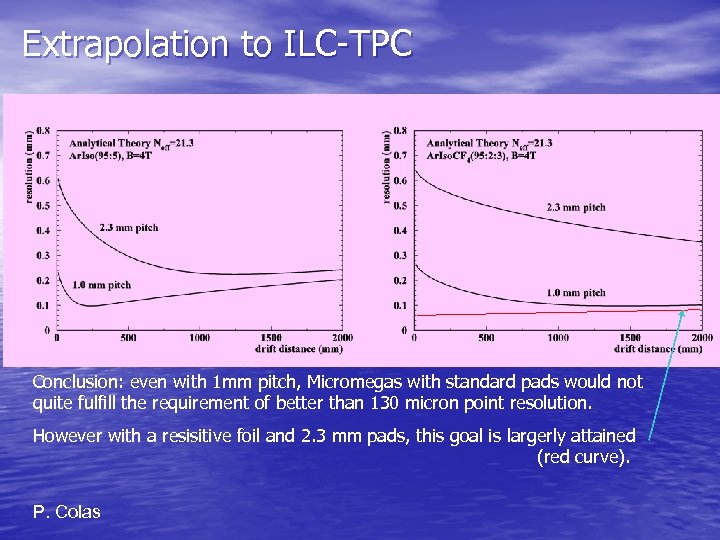 Extrapolation to ILC-TPC Conclusion: even with 1 mm pitch, Micromegas with standard pads would not quite fulfill the requirement of better than 130 micron point resolution. However with a resisitive foil and 2. 3 mm pads, this goal is largerly attained (red curve). P. Colas
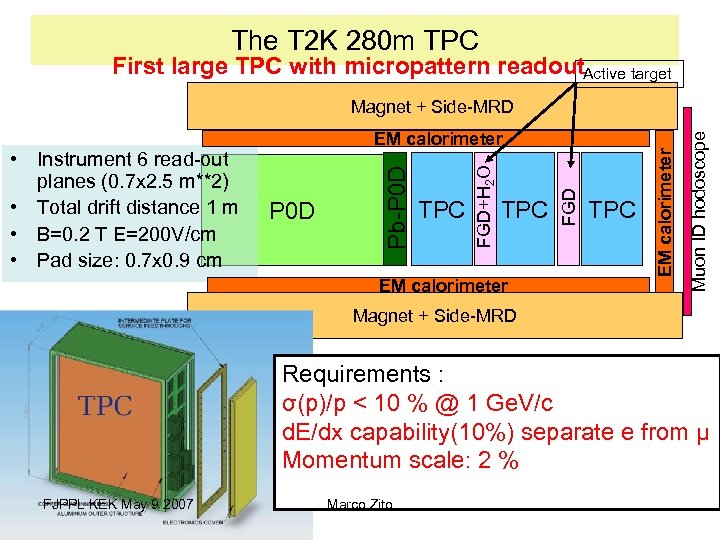 The T 2 K 280 m TPC First large TPC with micropattern readout. Active target EM calorimeter TPC Muon ID hodoscope TPC FGD+H 2 O P 0 D Pb-P 0 D • Instrument 6 read-out planes (0. 7 x 2. 5 m**2) • Total drift distance 1 m • B=0. 2 T E=200 V/cm • Pad size: 0. 7 x 0. 9 cm EM calorimeter Magnet + Side-MRD Requirements : σ(p)/p < 10 % @ 1 Ge. V/c d. E/dx capability(10%) separate e from μ Momentum scale: 2 % FJPPL KEK May 9 2007 Marco Zito
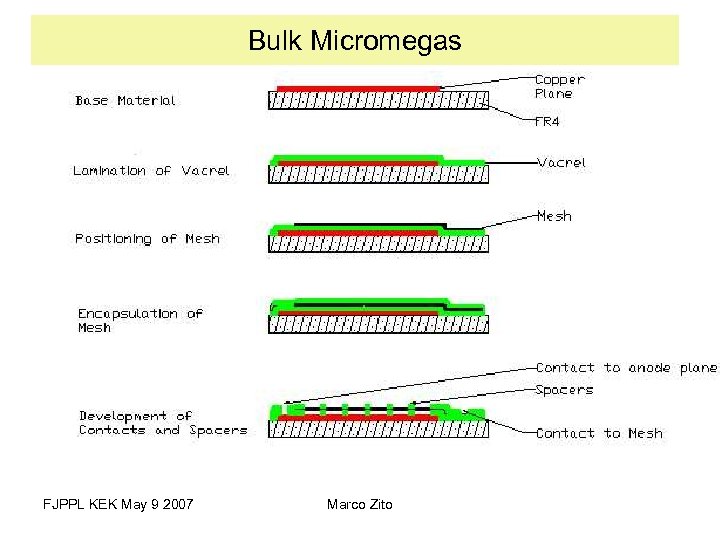 Bulk Micromegas FJPPL KEK May 9 2007 Marco Zito
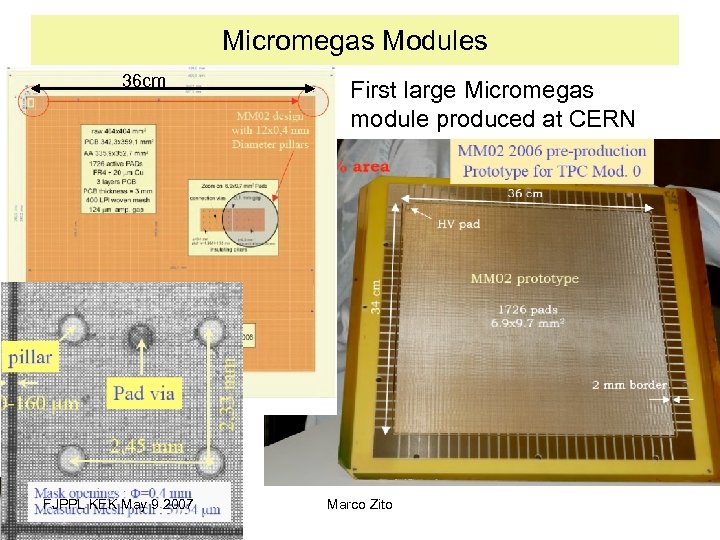 Micromegas Modules 36 cm FJPPL KEK May 9 2007 First large Micromegas module produced at CERN Marco Zito
 Photon sensor FJPPL KEK May 9 2007 Marco Zito
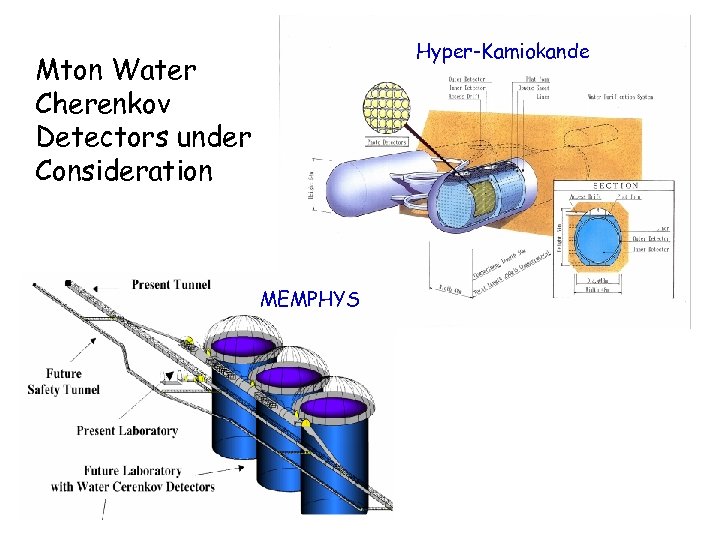 Hyper-Kamiokande Mton Water Cherenkov Detectors under Consideration MEMPHYS TRE
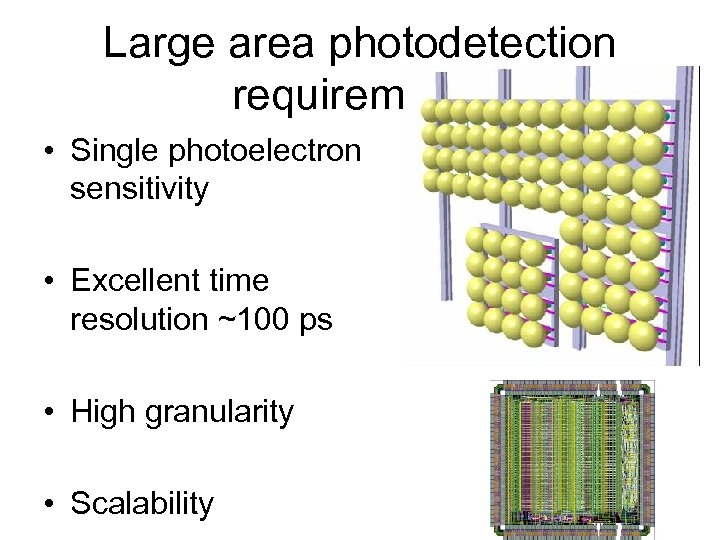 Large area photodetection requirements • Single photoelectron sensitivity • Excellent time resolution ~100 ps • High granularity • Scalability
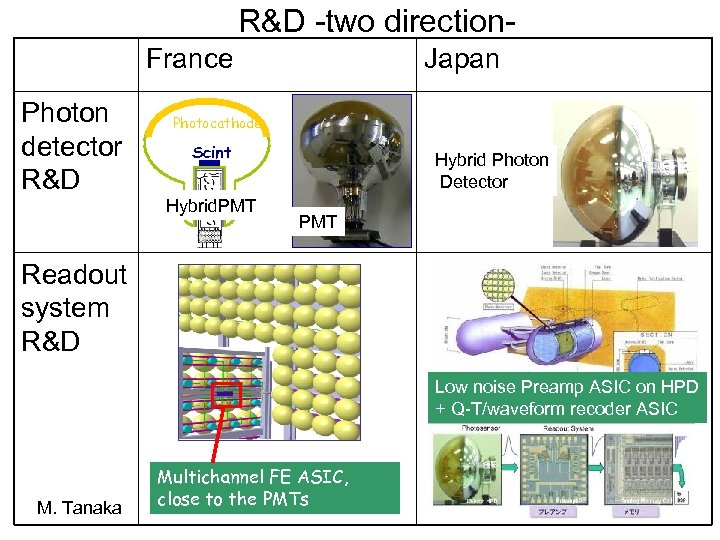 R&D -two direction. France Photon detector R&D Japan Photocathode Scint PMT Hybrid Photon Detector PMT Readout system R&D Low noise Preamp ASIC on HPD + Q-T/waveform recoder ASIC M. Tanaka Multichannel FE ASIC, close to the PMTs
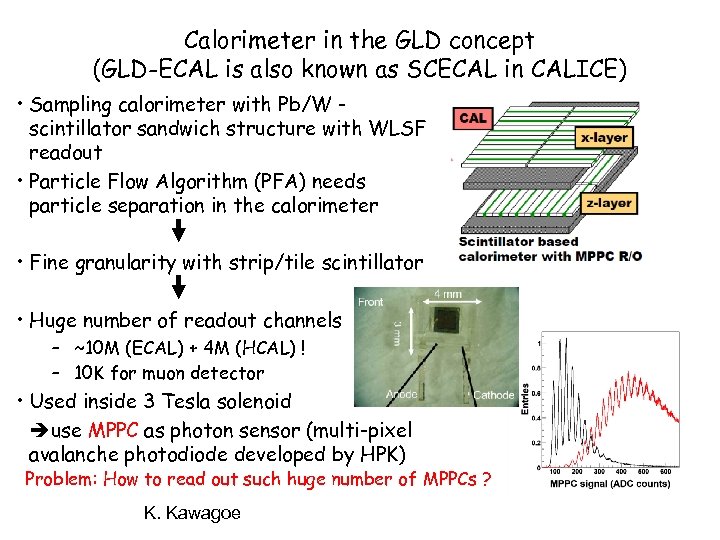 Calorimeter in the GLD concept (GLD-ECAL is also known as SCECAL in CALICE) • Sampling calorimeter with Pb/W scintillator sandwich structure with WLSF readout • Particle Flow Algorithm (PFA) needs particle separation in the calorimeter • Fine granularity with strip/tile scintillator • Huge number of readout channels – ~10 M (ECAL) + 4 M (HCAL) ! – 10 K for muon detector • Used inside 3 Tesla solenoid use MPPC as photon sensor (multi-pixel avalanche photodiode developed by HPK) Problem: How to read out such huge number of MPPCs ? K. Kawagoe
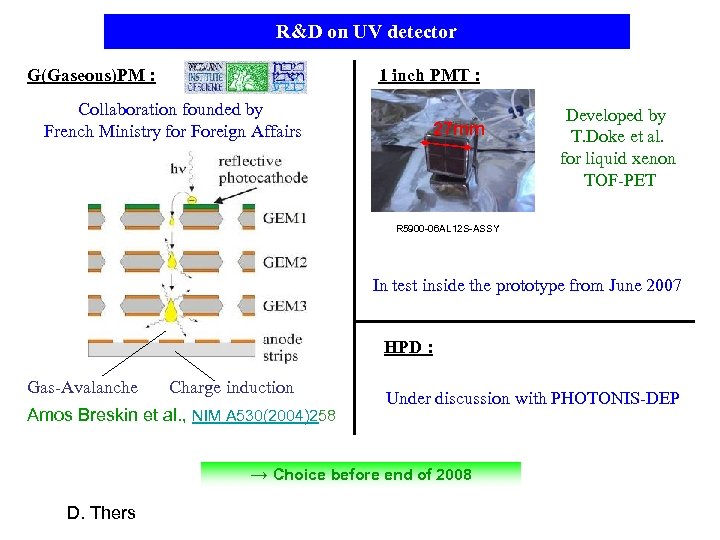 R&D on UV detector G(Gaseous)PM : 1 inch PMT : Collaboration founded by French Ministry for Foreign Affairs 27 mm Developed by T. Doke et al. for liquid xenon TOF-PET R 5900 -06 AL 12 S-ASSY In test inside the prototype from June 2007 HPD : Gas-Avalanche Charge induction Amos Breskin et al. , NIM A 530(2004)258 Under discussion with PHOTONIS-DEP → Choice before end of 2008 D. Thers
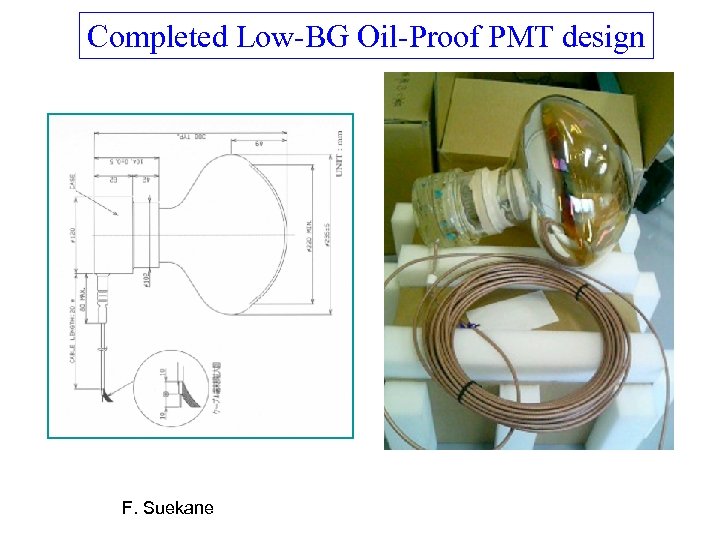 Completed Low-BG Oil-Proof PMT design F. Suekane
 Silicon tracker Actual “collboration” just started.
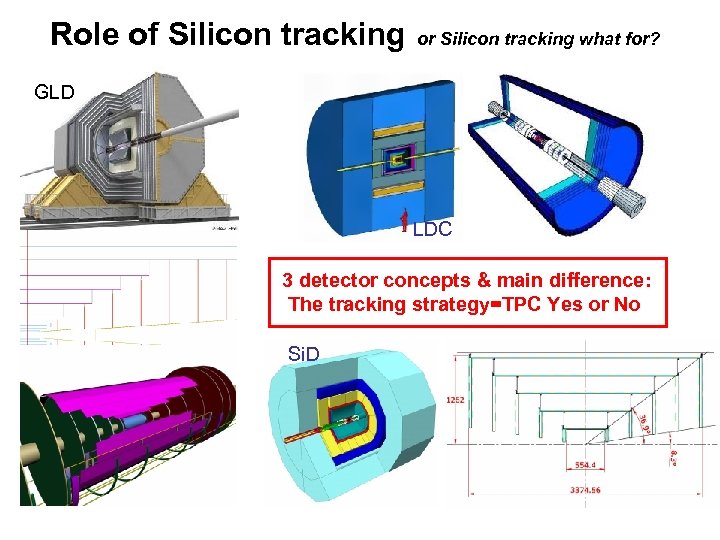 Role of Silicon tracking or Silicon tracking what for? GLD LDC 3 detector concepts & main difference: The tracking strategy=TPC Yes or No Si. D
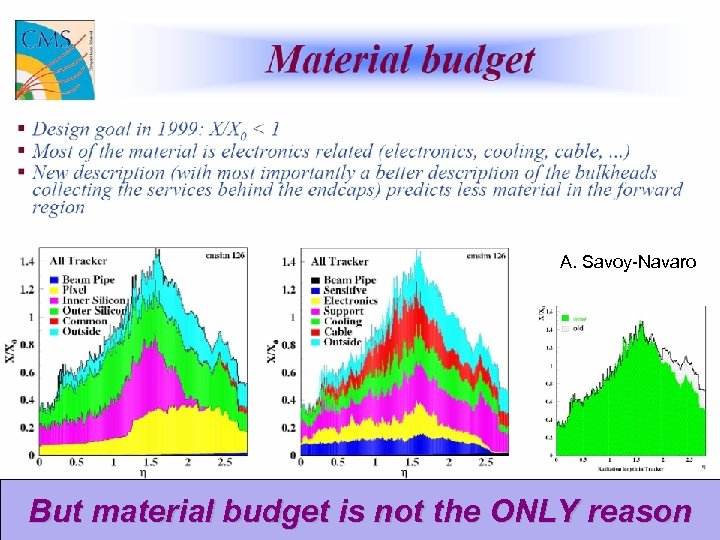 A. Savoy-Navaro But material budget is not the ONLY reason
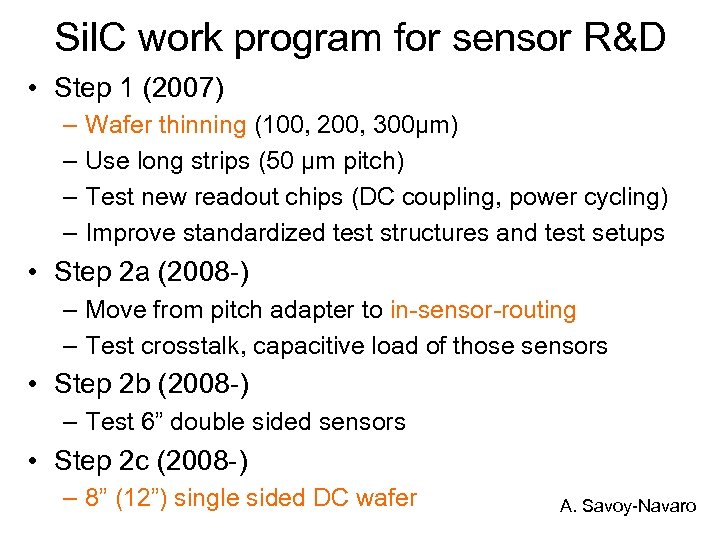 Sil. C work program for sensor R&D • Step 1 (2007) – – Wafer thinning (100, 200, 300µm) Use long strips (50 µm pitch) Test new readout chips (DC coupling, power cycling) Improve standardized test structures and test setups • Step 2 a (2008 -) – Move from pitch adapter to in-sensor-routing – Test crosstalk, capacitive load of those sensors • Step 2 b (2008 -) – Test 6” double sided sensors • Step 2 c (2008 -) – 8” (12”) single sided DC wafer A. Savoy-Navaro
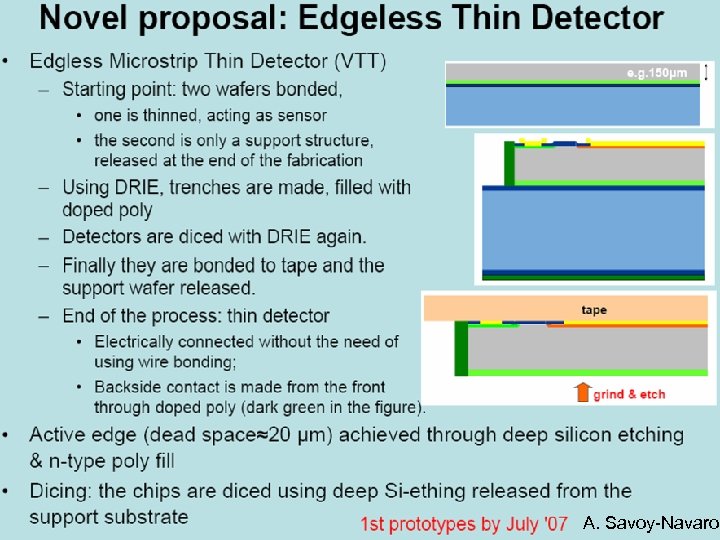 A. Savoy-Navaro
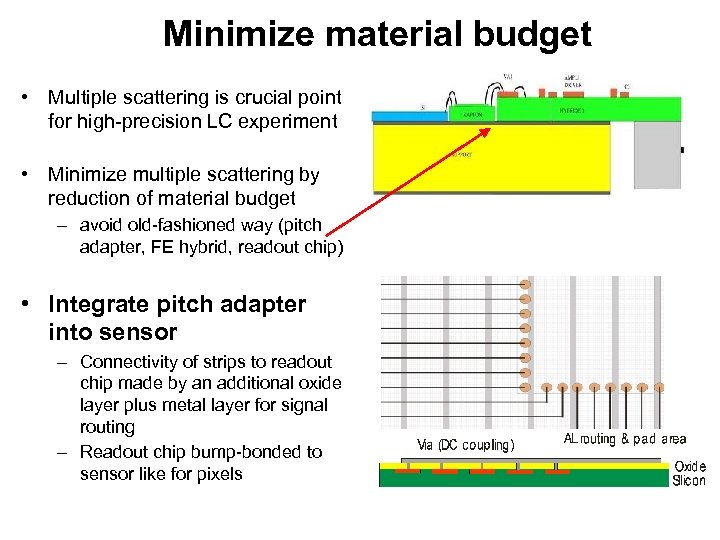 Minimize material budget • Multiple scattering is crucial point for high-precision LC experiment • Minimize multiple scattering by reduction of material budget – avoid old-fashioned way (pitch adapter, FE hybrid, readout chip) • Integrate pitch adapter into sensor – Connectivity of strips to readout chip made by an additional oxide layer plus metal layer for signal routing – Readout chip bump-bonded to sensor like for pixels
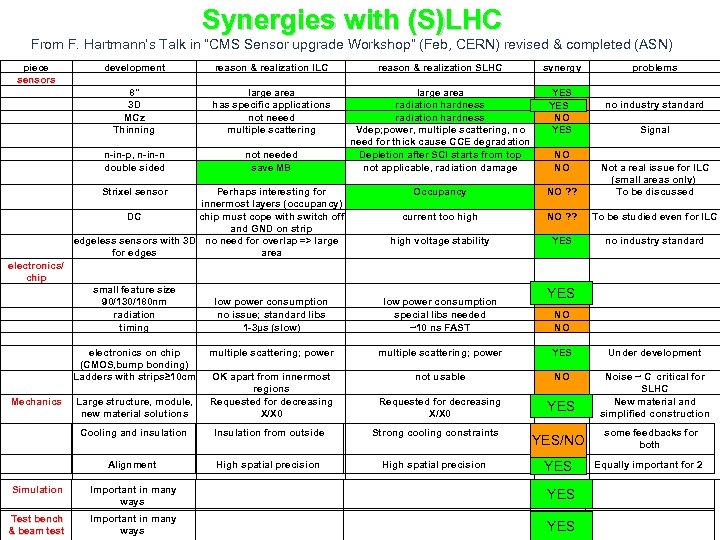 Synergies with (S)LHC From F. Hartmann’s Talk in “CMS Sensor upgrade Workshop” (Feb, CERN) revised & completed (ASN) piece sensors reason & realization SLHC large area radiation hardness Vdep; power, multiple scattering, no need for thick cause CCE degradation Depletion after SCI starts from top not applicable, radiation damage synergy YES NO YES problems no industry standard Signal NO NO Occupancy NO ? ? current too high NO ? ? high voltage stability YES Not a real issue for ILC (small areas only) To be discussed To be studied even for ILC no industry standard low power consumption no issue; standard libs 1 -3µs (slow) multiple scattering; power low power consumption special libs needed ~10 ns FAST multiple scattering; power Large structure, module, new material solutions OK apart from innermost regions Requested for decreasing X/X 0 Cooling and insulation Insulation from outside Strong cooling constraints Alignment High spatial precision Simulation Important in many ways development 8" 3 D MCz Thinning reason & realization ILC large area has specific applications not neeed multiple scattering n-in-p, n-in-n double sided not needed save MB Strixel sensor electronics/ chip Mechanics Test bench & beam test Perhaps interesting for innermost layers (occupancy) DC chip must cope with switch off and GND on strip edgeless sensors with 3 D no need for overlap => large for edges area small feature size 90/130/180 nm radiation timing electronics on chip (CMOS, bump bonding) Ladders with strips≥ 10 cm YES NO NO YES Under development not usable NO Requested for decreasing X/X 0 YES Noise ~ C critical for SLHC New material and simplified construction YES/NO some feedbacks for both High spatial precision YES Equally important for 2 YES
 Liq. Xe detector
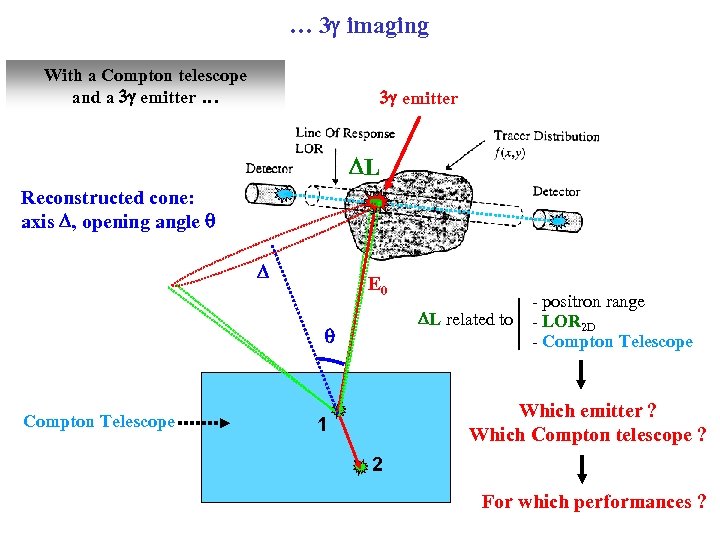 … 3 imaging With a Compton telescope and a 3 emitter … 3 emitter L Reconstructed cone: axis , opening angle E 0 L related to Compton Telescope - positron range - LOR 2 D - Compton Telescope Which emitter ? Which Compton telescope ? 1 2 For which performances ?
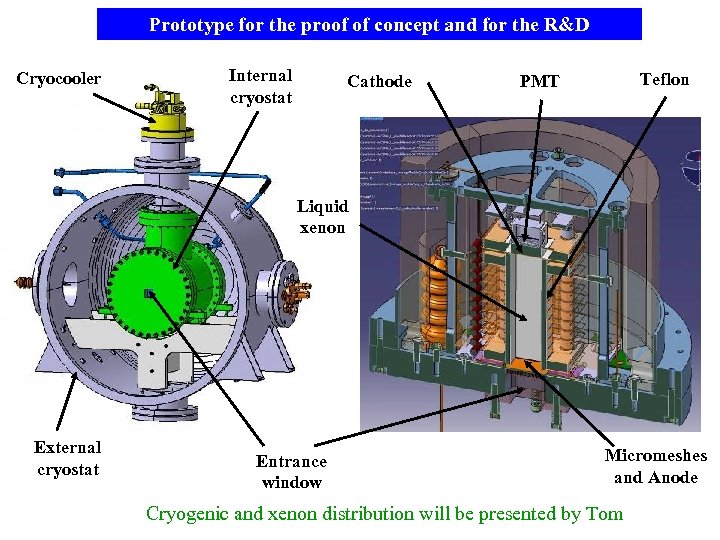 Prototype for the proof of concept and for the R&D Cryocooler Internal cryostat Cathode Teflon PMT Liquid xenon External cryostat Entrance window Micromeshes and Anode Cryogenic and xenon distribution will be presented by Tom
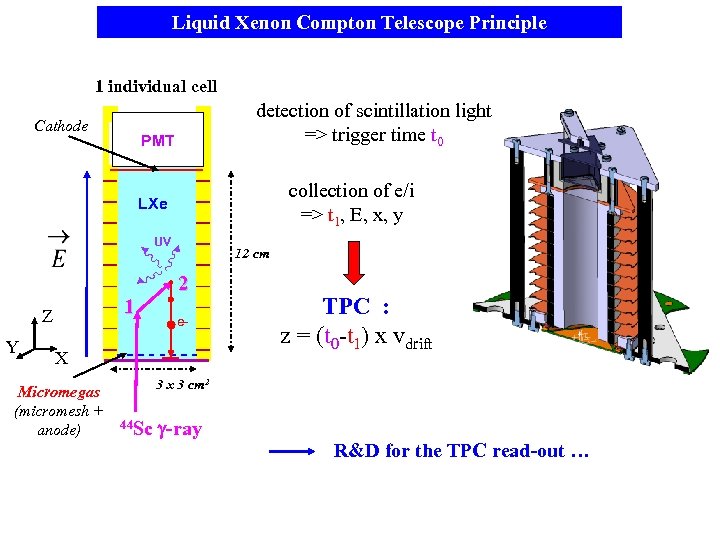 Liquid Xenon Compton Telescope Principle 1 individual cell Cathode detection of scintillation light => trigger time t 0 PMT collection of e/i => t 1, E, x, y LXe UV 12 cm 2 1 Z Y TPC : z = (t 0 -t 1) x vdrift e- X 3 x 3 cm Micromegas (micromesh + 44 Sc -ray anode) 2 R&D for the TPC read-out …
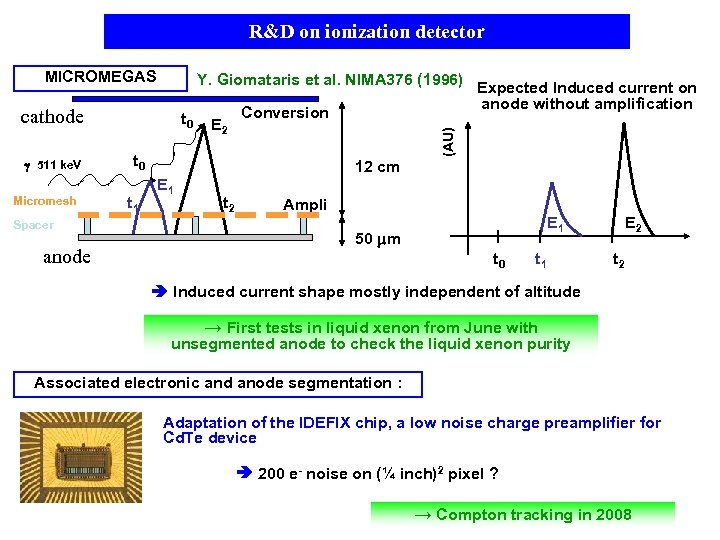 R&D on ionization detector MICROMEGAS Y. Giomataris et al. NIMA 376 (1996) 511 ke. V Micromesh Spacer anode t 0 E 2 Conversion (AU) cathode t 0 t 1 Expected Induced current on anode without amplification 12 cm E 1 t 2 Ampli E 1 50 mm t 0 t 1 E 2 t 2 Induced current shape mostly independent of altitude → First tests in liquid xenon from June with unsegmented anode to check the liquid xenon purity Associated electronic and anode segmentation : Adaptation of the IDEFIX chip, a low noise charge preamplifier for Cd. Te device 200 e- noise on (¼ inch)2 pixel ? → Compton tracking in 2008
 ASIC and electronics • • Design rule finer and finer Development cost higher and higher Necessary expertise more and more Collaborative action more and more effective and important
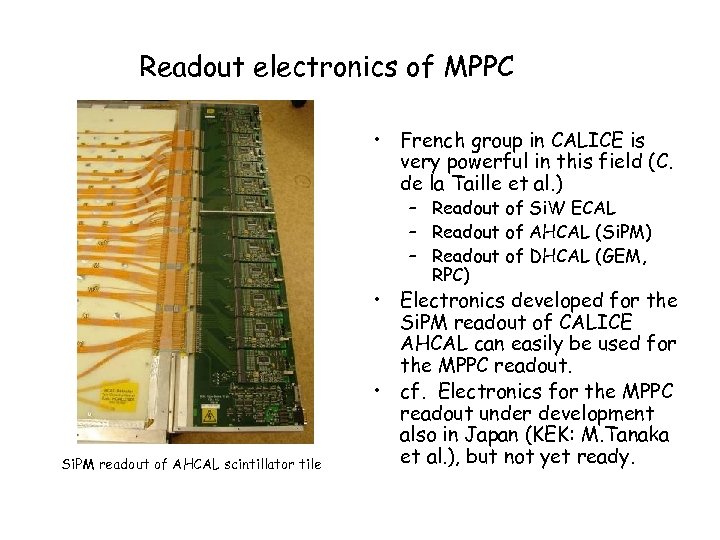 Readout electronics of MPPC • French group in CALICE is very powerful in this field (C. de la Taille et al. ) – Readout of Si. W ECAL – Readout of AHCAL (Si. PM) – Readout of DHCAL (GEM, RPC) Si. PM readout of AHCAL scintillator tile • Electronics developed for the Si. PM readout of CALICE AHCAL can easily be used for the MPPC readout. • cf. Electronics for the MPPC readout under development also in Japan (KEK: M. Tanaka et al. ), but not yet ready.
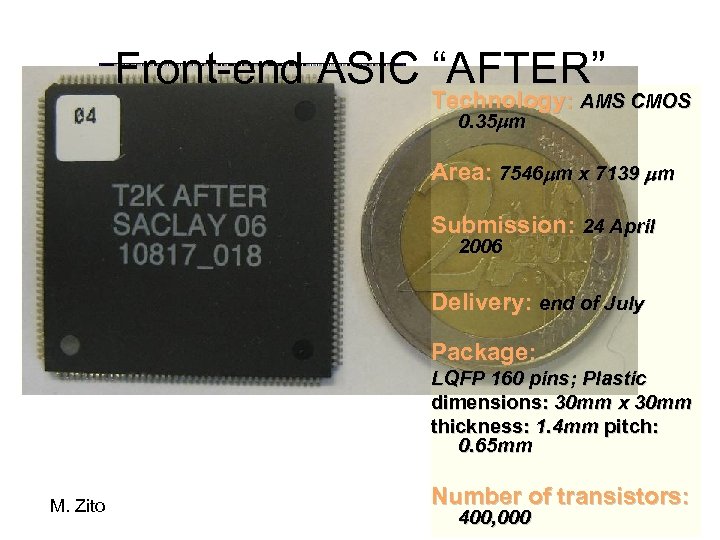 Front-end ASIC “AFTER” Technology: AMS CMOS 0. 35 mm SCA: 76 x 511 Cells Area: 7546 mm x 7139 mm Submission: 24 April 2006 Delivery: end of July Package: LQFP 160 pins; Plastic dimensions: 30 mm x 30 mm thickness: 1. 4 mm pitch: 0. 65 mm M. Zito Number of transistors: 400, 000
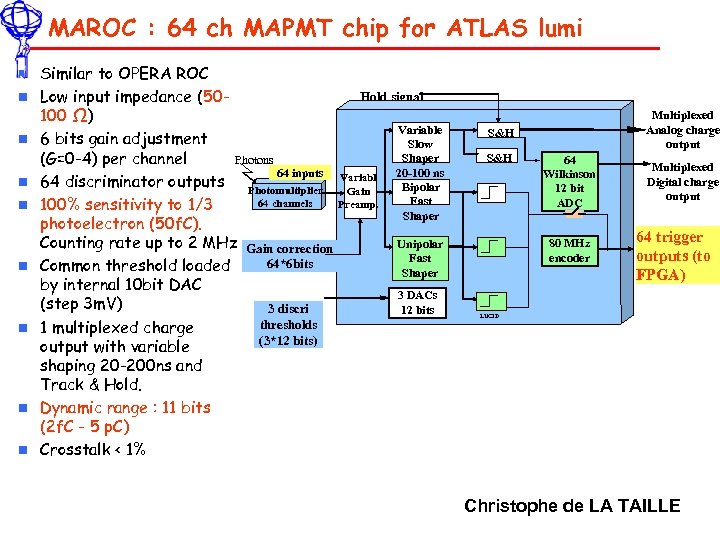 MAROC : 64 ch MAPMT chip for ATLAS lumi n n n n n Similar to OPERA ROC Hold signal Low input impedance (50100 Ω) Variable 6 bits gain adjustment Slow Shaper (G=0 -4) per channel Photons 20 -100 ns 64 inputs 64 discriminator outputs Photomultiplier Variabl Bipolar Gain Fast 64 channels Preamp. 100% sensitivity to 1/3 Shaper photoelectron (50 f. C). Unipolar Counting rate up to 2 MHz Gain correction Fast 64*6 bits Common threshold loaded Shaper by internal 10 bit DAC 3 DACs (step 3 m. V) 3 discri 12 bits thresholds 1 multiplexed charge (3*12 bits) output with variable shaping 20 -200 ns and Track & Hold. Dynamic range : 11 bits (2 f. C - 5 p. C) Crosstalk < 1% Multiplexed Analog charge output S&H 64 Wilkinson 12 bit ADC 80 MHz encoder Multiplexed Digital charge output 64 trigger outputs (to FPGA) LUCID Christophe de LA TAILLE
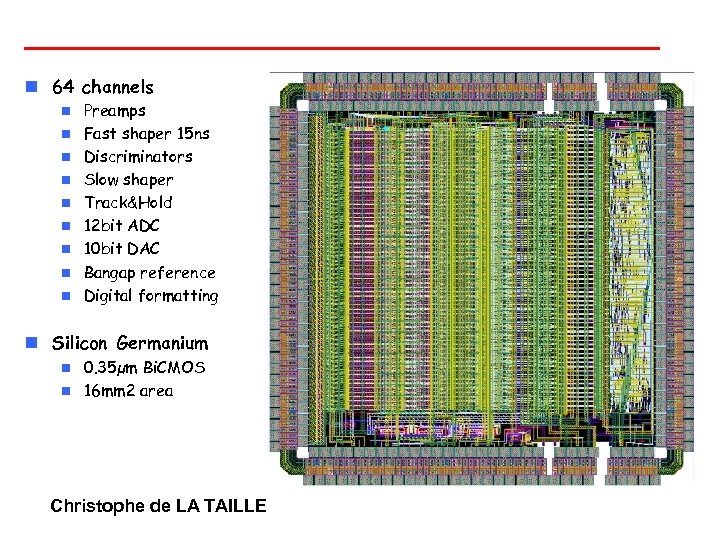 n 64 channels n n n n n Preamps Fast shaper 15 ns Discriminators Slow shaper Track&Hold 12 bit ADC 10 bit DAC Bangap reference Digital formatting n Silicon Germanium 0. 35µm Bi. CMOS n 16 mm 2 area n Christophe de LA TAILLE
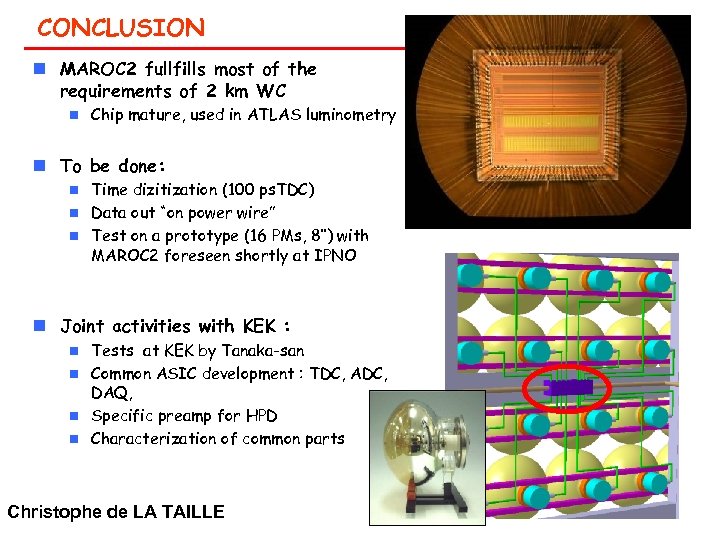 CONCLUSION n MAROC 2 fullfills most of the requirements of 2 km WC n Chip mature, used in ATLAS luminometry n To be done: Time dizitization (100 ps. TDC) n Data out “on power wire” n Test on a prototype (16 PMs, 8’’) with MAROC 2 foreseen shortly at IPNO n n Joint activities with KEK : Tests at KEK by Tanaka-san n Common ASIC development : TDC, ADC, DAQ, n Specific preamp for HPD n Characterization of common parts n Christophe de LA TAILLE
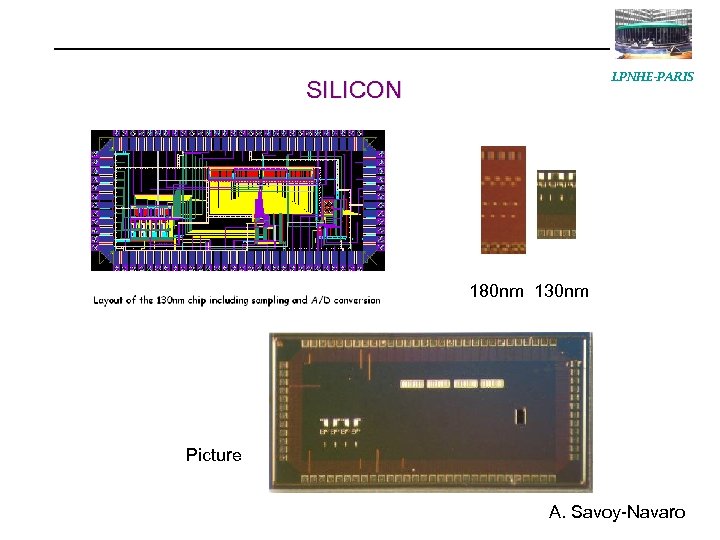 LPNHE-PARIS SILICON 180 nm 130 nm Picture A. Savoy-Navaro
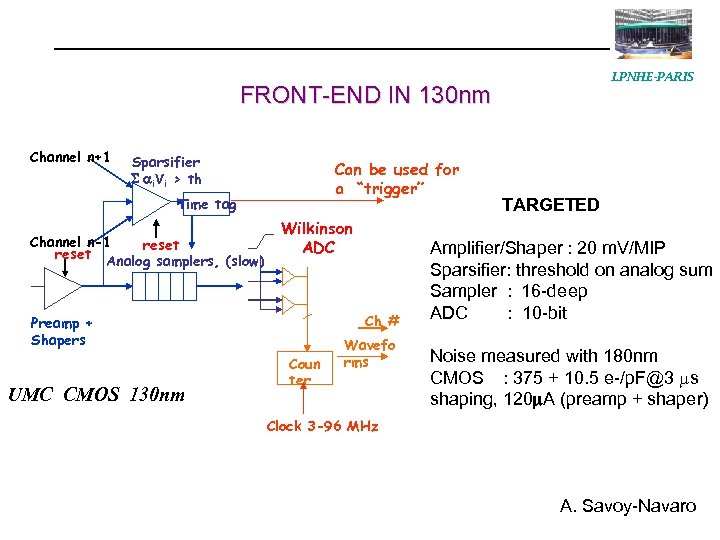 LPNHE-PARIS FRONT-END IN 130 nm Channel n+1 Sparsifier S ai. Vi > th Can be used for a “trigger” Time tag Channel n-1 reset Analog samplers, (slow) Wilkinson ADC Ch # Preamp + Shapers UMC CMOS 130 nm Coun ter Wavefo rms TARGETED Amplifier/Shaper : 20 m. V/MIP Sparsifier: threshold on analog sum Sampler : 16 -deep ADC : 10 -bit Noise measured with 180 nm CMOS : 375 + 10. 5 e-/p. F@3 ms shaping, 120 m. A (preamp + shaper) Clock 3 -96 MHz A. Savoy-Navaro
 Collaboration matrix ILC LHC T 2 K TPC O O O PET ASIC/elec O tronics HPK others Double beta PET O Si LIq. Xe Mton O Photon B O O O O Double Chooz PET
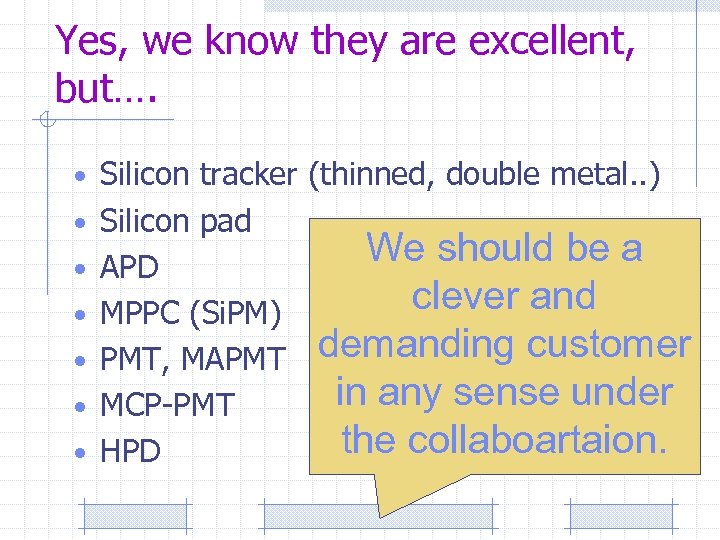 Yes, we know they are excellent, but…. • Silicon tracker (thinned, double metal. . ) • Silicon pad • APD • MPPC (Si. PM) • PMT, MAPMT • MCP-PMT • HPD We should be a clever and demanding customer in any sense under the collaboartaion.
 To summarize • Good start of collaborations in many fields of detector R&D of FJPPL. • Several outcomes have already been achieved. • Horizontal collaboration among the projects might be more important in any field.