


 Скачать презентацию Summary of Papers 1 P Sauer and M
5e096d9ff669a5d83d375cb005124427.ppt
- Количество слайдов: 87
 Summary of Papers 1. P. Sauer and M. Pai, “Power System Steady State Stability and the Load Flow Jacobian, ” IEEE Transactions on Power Systems, Vol. 5, No. 4, Nov. 1990 2. V. Ajjarapu and C. Christy, “The Continuation Power Flow: A Tool for Steady State Voltage Stability Analysis, ” IEEE Transactions on Power Systems, Vol. 7, No. 1, Feb. , 1992. 3. S. Greene, I. Dobson, and F. Alvarado, “Sensitivity of the Loading Margin to Voltage Collapse with Respect to Arbitrary Parameters, ” IEEE Transactions on Power Systems, Vol. 12, No. 1, Feb. 1997, pp. 232 240. 4. S. Greene, I. Dobson, and F. Alvarado, “Contingency Ranking for Voltage Collapse via Sensitivities from a Single Nose Curve, ” IEEE Transactions on Power Systems, Vol. 14, No. 1, Feb. 1999, pp. 262 272. 1
 Voltage Security Voltage security is the ability of the system to maintain adequate and controllable voltage levels at all system load buses. The main concern is that voltage levels outside of a specified range can affect the operation of the customer’s loads. Voltage security may be divided into two main problems: 1. Low voltage: voltage level is outside of pre defined range. 2. Voltage instability: an uncontrolled voltage decline. You should know that • low voltage does not necessarily imply voltage instability • no low voltage does not necessarily imply voltage stability • voltage instability does necessarily imply low voltage 2
 Resources There have been several individuals that have significantly progressed the field of voltage security. These include: • Ajjarapu from ISU • Van Cutsem: See the book by Van Cutsem and Vournas. • Alvarado, Dobson, Canizares, & Greene There a couple other texts that provide good treatments of the subject: • Carson Taylor: “Power System Voltage Stability” • Prabha Kundur: “Power System Stability & Control” 3
 Our treatment of voltage security will proceed as follows: • Voltage instability in a simple system • Voltage instability in a large system • Brief treatment of bifurcation analysis • Continuation power flow (path following) methods • Sensitivity methods 4
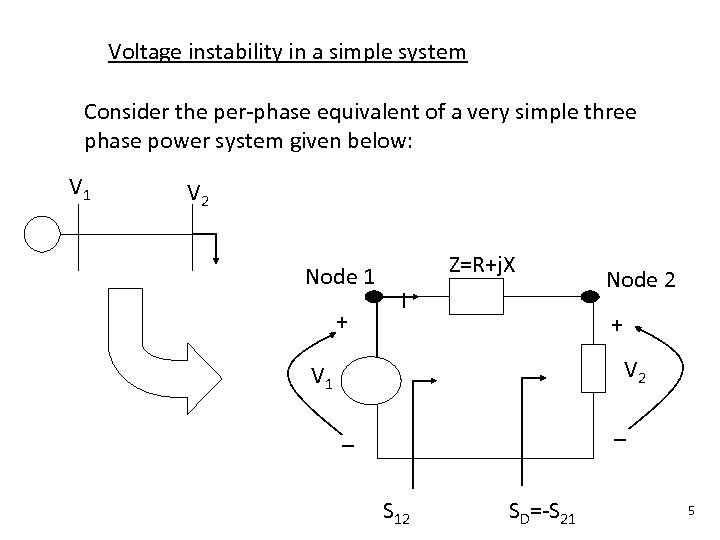 Voltage instability in a simple system Consider the per phase equivalent of a very simple three phase power system given below: V 1 V 2 Node 1 + Z=R+j. X I Node 2 + V 2 V 1 _ _ S 12 SD= S 21 5
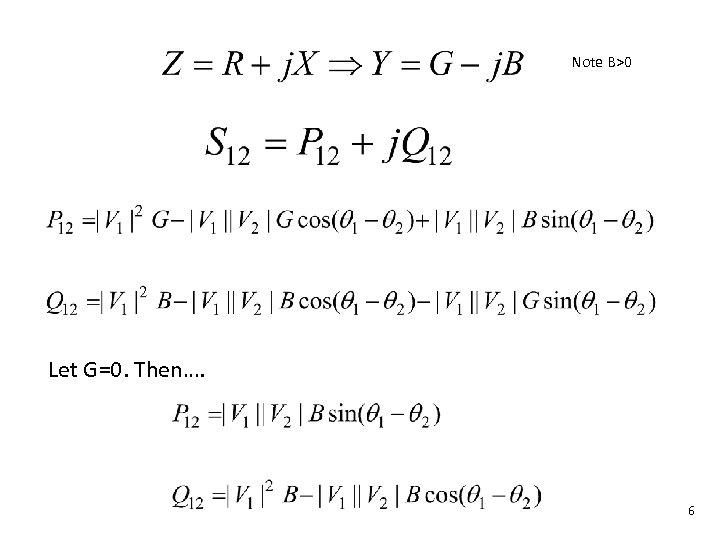 Note B>0 Let G=0. Then…. 6
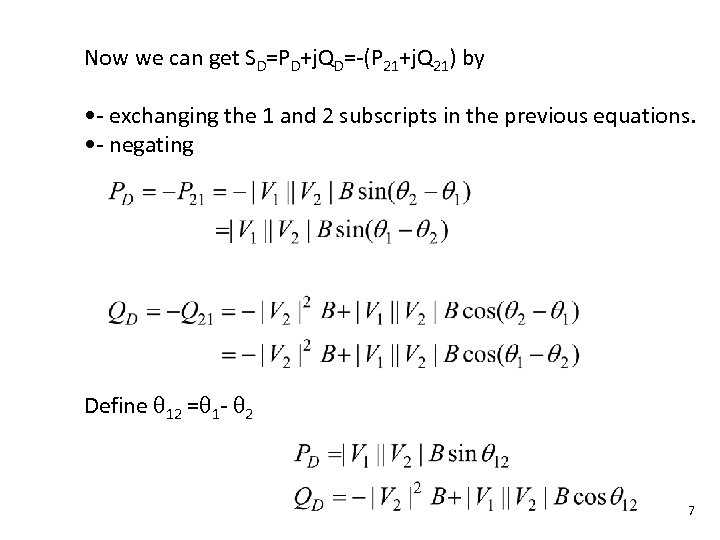 Now we can get SD=PD+j. QD= (P 21+j. Q 21) by • exchanging the 1 and 2 subscripts in the previous equations. • negating Define 12 = 1 2 7
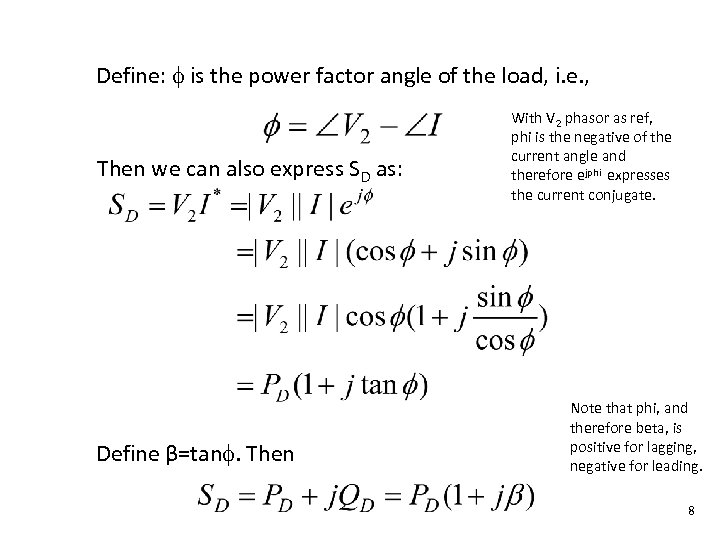 Define: is the power factor angle of the load, i. e. , Then we can also express SD as: Define β=tan. Then With V 2 phasor as ref, phi is the negative of the current angle and therefore ejphi expresses the current conjugate. Note that phi, and therefore beta, is positive for lagging, negative for leading. 8
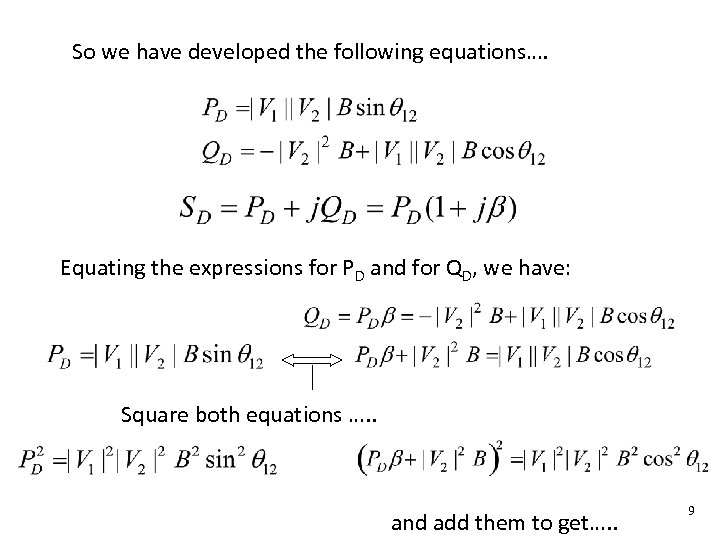 So we have developed the following equations…. Equating the expressions for PD and for QD, we have: Square both equations …. . and add them to get…. . 9
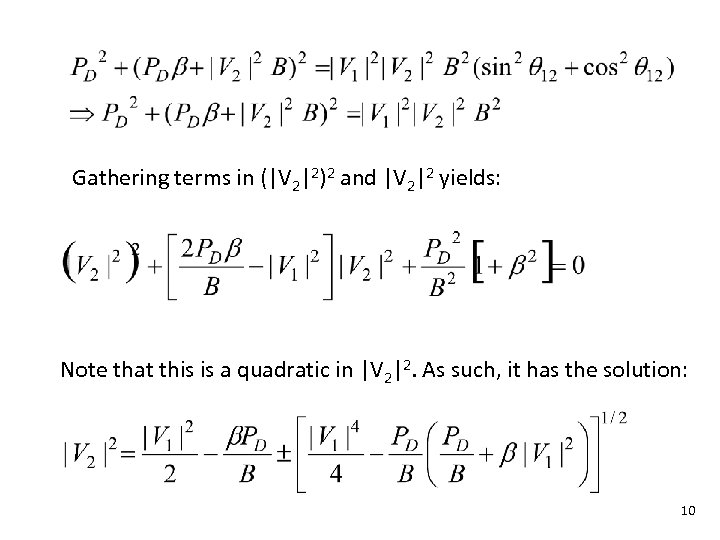 Gathering terms in (|V 2|2)2 and |V 2|2 yields: Note that this is a quadratic in |V 2|2. As such, it has the solution: 10
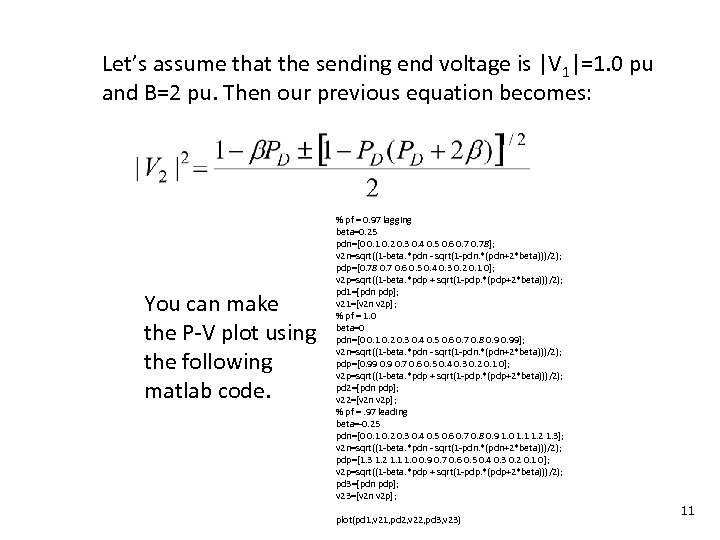 Let’s assume that the sending end voltage is |V 1|=1. 0 pu and B=2 pu. Then our previous equation becomes: You can make the P V plot using the following matlab code. % pf = 0. 97 lagging beta=0. 25 pdn=[0 0. 1 0. 2 0. 3 0. 4 0. 5 0. 6 0. 78]; v 2 n=sqrt((1 beta. *pdn sqrt(1 pdn. *(pdn+2*beta)))/2); pdp=[0. 78 0. 7 0. 6 0. 5 0. 4 0. 3 0. 2 0. 1 0]; v 2 p=sqrt((1 beta. *pdp + sqrt(1 pdp. *(pdp+2*beta)))/2); pd 1=[pdn pdp]; v 21=[v 2 n v 2 p]; % pf = 1. 0 beta=0 pdn=[0 0. 1 0. 2 0. 3 0. 4 0. 5 0. 6 0. 7 0. 8 0. 99]; v 2 n=sqrt((1 beta. *pdn sqrt(1 pdn. *(pdn+2*beta)))/2); pdp=[0. 99 0. 7 0. 6 0. 5 0. 4 0. 3 0. 2 0. 1 0]; v 2 p=sqrt((1 beta. *pdp + sqrt(1 pdp. *(pdp+2*beta)))/2); pd 2=[pdn pdp]; v 22=[v 2 n v 2 p]; % pf =. 97 leading beta= 0. 25 pdn=[0 0. 1 0. 2 0. 3 0. 4 0. 5 0. 6 0. 7 0. 8 0. 9 1. 0 1. 1 1. 2 1. 3]; v 2 n=sqrt((1 beta. *pdn sqrt(1 pdn. *(pdn+2*beta)))/2); pdp=[1. 3 1. 2 1. 1 1. 0 0. 9 0. 7 0. 6 0. 5 0. 4 0. 3 0. 2 0. 1 0]; v 2 p=sqrt((1 beta. *pdp + sqrt(1 pdp. *(pdp+2*beta)))/2); pd 3=[pdn pdp]; v 23=[v 2 n v 2 p]; plot(pd 1, v 21, pd 2, v 22, pd 3, v 23) 11
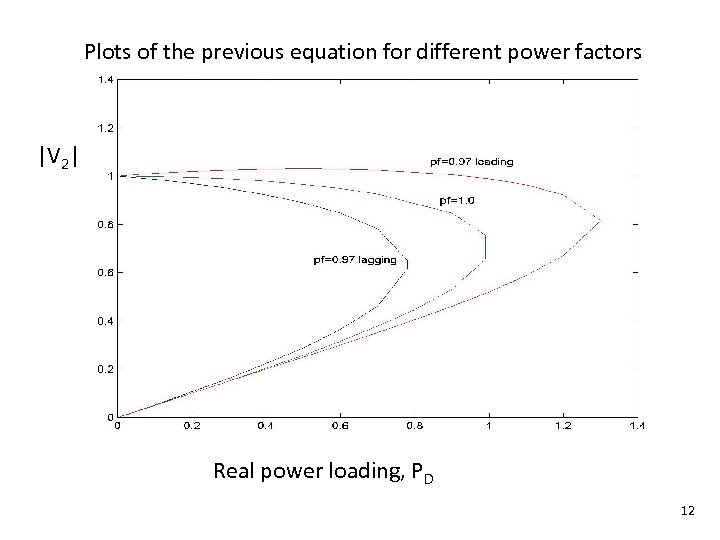 Plots of the previous equation for different power factors |V 2| Real power loading, PD 12
 Some comments regarding the PV curves: 1. Each curve has a maximum load. This value is typically called the maximum system load or the system loadability. 2. If the load is increased beyond the loadability, the voltages will decline uncontrollably. 3. For a value of load below the loadability, there are two voltage solutions. The upper one corresponds to one that can be reached in practice. The lower one is correct mathematically, but I do not know of a way to reach these points in practice. 4. In the lagging or unity power factor condition, it is clear that the voltage decreases as the load power increases until the loadability. In this case, the voltage instability phenomena is detectable, i. e. , operator will be aware that voltages are declining before the loadability is exceeded. 5. In the leading case, one observes that the voltage is flat, or perhaps even increasing a little, until just before the loadability. Thus, in the leading condition, voltage instability is not very detectable. The leading condition occurs during high transfer conditions when the load is light or when the load is highly compensated. 13
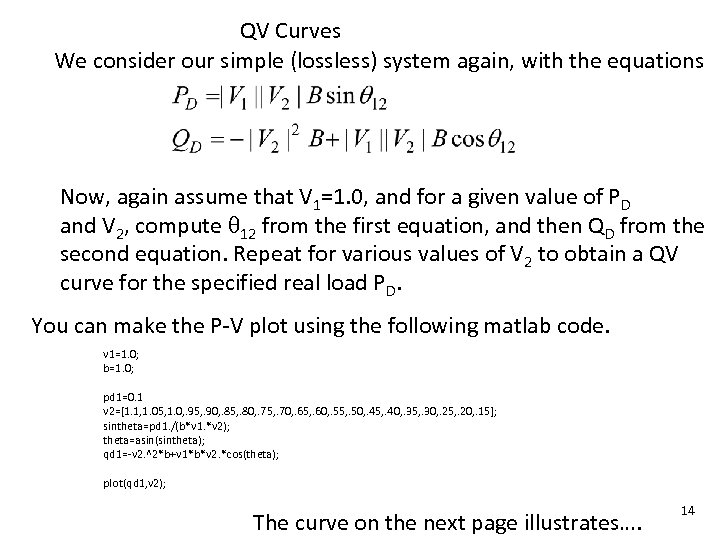 QV Curves We consider our simple (lossless) system again, with the equations Now, again assume that V 1=1. 0, and for a given value of PD and V 2, compute 12 from the first equation, and then QD from the second equation. Repeat for various values of V 2 to obtain a QV curve for the specified real load PD. You can make the P V plot using the following matlab code. v 1=1. 0; b=1. 0; pd 1=0. 1 v 2=[1. 1, 1. 05, 1. 0, . 95, . 90, . 85, . 80, . 75, . 70, . 65, . 60, . 55, . 50, . 45, . 40, . 35, . 30, . 25, . 20, . 15]; sintheta=pd 1. /(b*v 1. *v 2); theta=asin(sintheta); qd 1= v 2. ^2*b+v 1*b*v 2. *cos(theta); plot(qd 1, v 2); The curve on the next page illustrates…. 14
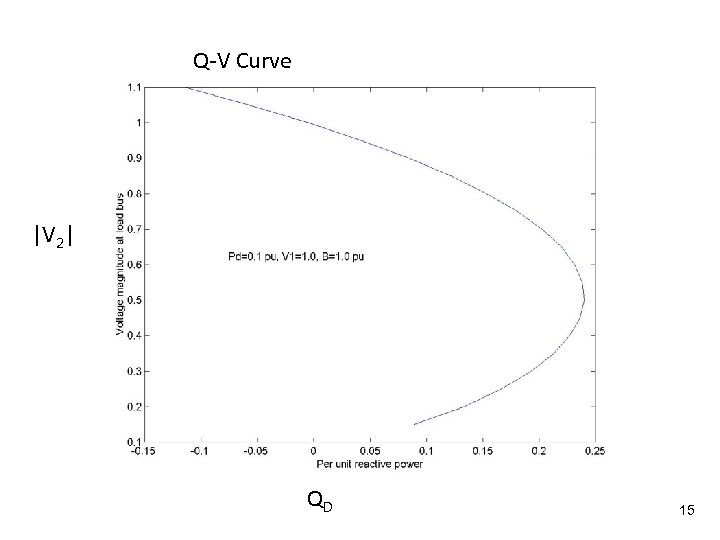 Q V Curve |V 2| QD 15
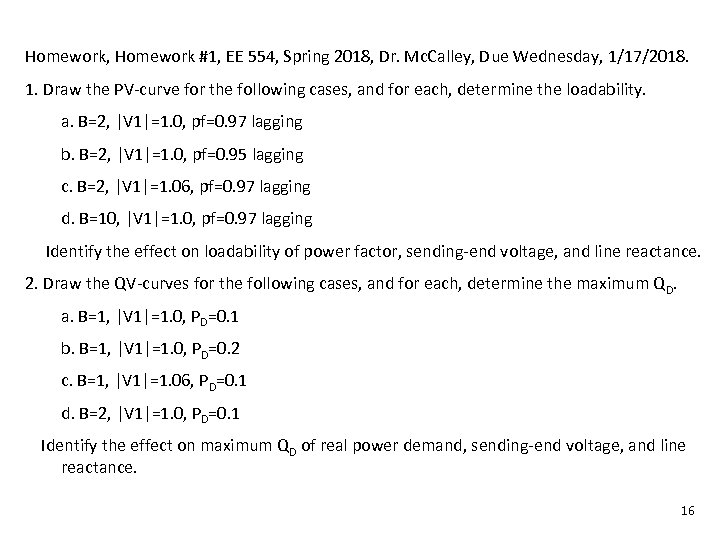 Homework, Homework #1, EE 554, Spring 2018, Dr. Mc. Calley, Due Wednesday, 1/17/2018. 1. Draw the PV curve for the following cases, and for each, determine the loadability. a. B=2, |V 1|=1. 0, pf=0. 97 lagging b. B=2, |V 1|=1. 0, pf=0. 95 lagging c. B=2, |V 1|=1. 06, pf=0. 97 lagging d. B=10, |V 1|=1. 0, pf=0. 97 lagging Identify the effect on loadability of power factor, sending end voltage, and line reactance. 2. Draw the QV curves for the following cases, and for each, determine the maximum Q D. a. B=1, |V 1|=1. 0, PD=0. 1 b. B=1, |V 1|=1. 0, PD=0. 2 c. B=1, |V 1|=1. 06, PD=0. 1 d. B=2, |V 1|=1. 0, PD=0. 1 Identify the effect on maximum QD of real power demand, sending end voltage, and line reactance. 16
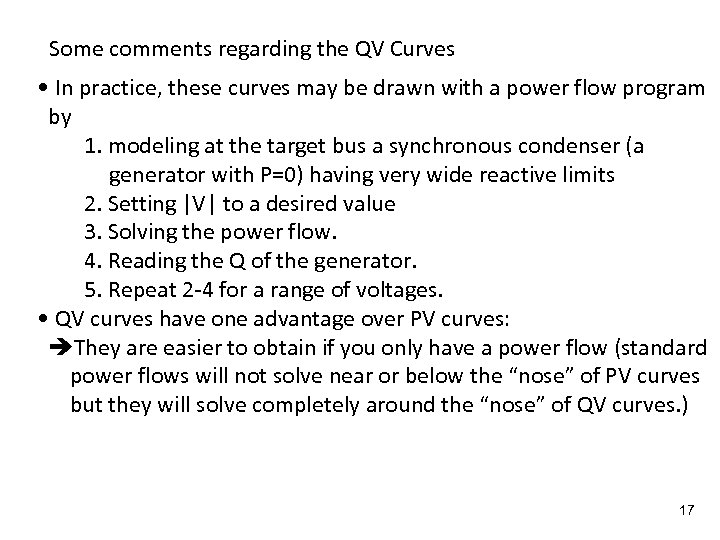 Some comments regarding the QV Curves • In practice, these curves may be drawn with a power flow program by 1. modeling at the target bus a synchronous condenser (a generator with P=0) having very wide reactive limits 2. Setting |V| to a desired value 3. Solving the power flow. 4. Reading the Q of the generator. 5. Repeat 2 4 for a range of voltages. • QV curves have one advantage over PV curves: They are easier to obtain if you only have a power flow (standard power flows will not solve near or below the “nose” of PV curves but they will solve completely around the “nose” of QV curves. ) 17
 Voltage instability in a large system: Influential factors: • Load modeling • Reactive power limits on generators • Loss of a circuit • Availability of switchable shunt devices Two important ideas on which understanding of the above influences rest: 1. Voltage instability occurs when the reactive power supply cannot meet the reactive power demand of the network. • • Transmission line loading is too high Reactive sources (generators) are too far from load centers Generator terminal voltages are too low. Insufficient load reactive compensation 2. Reactive power cannot be moved very far in a network (“vars do not travel”), since I 2 X is large. Implication: The SYSTEM can have a var surplus but experience voltage instability if a local area has a var deficiency. 18
 Load modeling In analyzing voltage instability, it is necessary to consider the network under various voltage profiles. Voltage stability depends on the level of current drawn by the loads. The level of current drawn by the loads can depend on the voltage seen by the loads. Therefore, voltage instability analysis requires a model of how the load responds to load variations. Thus, load modeling is very influential in voltage instability analysis. 19
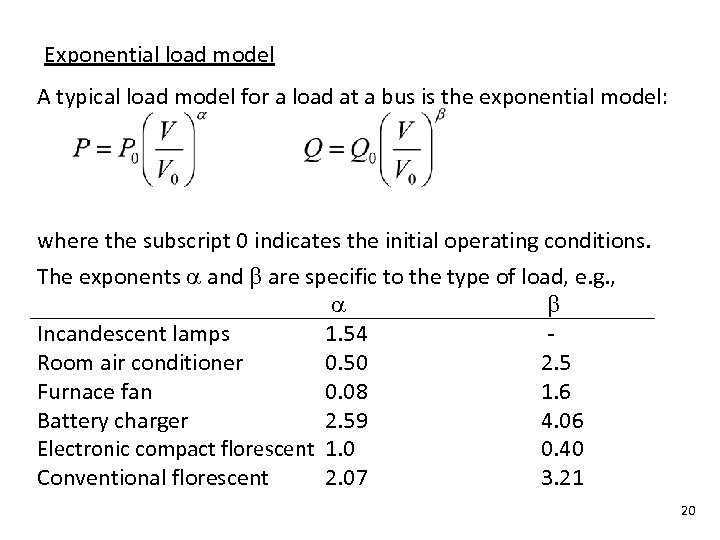 Exponential load model A typical load model for a load at a bus is the exponential model: where the subscript 0 indicates the initial operating conditions. The exponents and are specific to the type of load, e. g. , Incandescent lamps 1. 54 Room air conditioner 0. 50 2. 5 Furnace fan 0. 08 1. 6 Battery charger 2. 59 4. 06 Electronic compact florescent 1. 0 0. 40 Conventional florescent 2. 07 3. 21 20
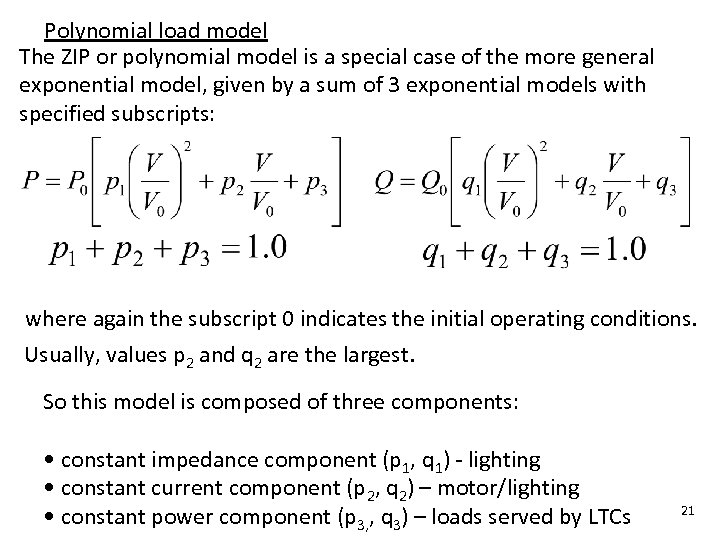 Polynomial load model The ZIP or polynomial model is a special case of the more general exponential model, given by a sum of 3 exponential models with specified subscripts: where again the subscript 0 indicates the initial operating conditions. Usually, values p 2 and q 2 are the largest. So this model is composed of three components: • constant impedance component (p 1, q 1) lighting • constant current component (p 2, q 2) – motor/lighting • constant power component (p 3, , q 3) – loads served by LTCs 21
 Effect of Load modeling Understanding the effect of each component on voltage instability depends on understanding two ideas: 1. Voltage instability is alleviated when the demand reduces. This is because I reduces and I 2 X reactive losses in the circuits reduce. 2. Since voltage instability causes voltage decline, alleviation of voltage instability results if demand reduces with voltage decline. This gives the key to understanding the effect of load modeling. • constant impedance load (p 1) is GOOD since demand reduces with square of voltage. • constant current load (p 2) is OK since demand reduces with voltage. • Constant power load (p 3) is BAD since demand does not change as voltage declines. 22
 Some considerations in load modeling The effects of voltage variation on loads, and thus of loads on voltage instability, cannot be fully captured using exponential or polynomial load models because of the following three aspects. • Thermostatic load recovery • Induction motor stalling/tripping • Load tap changers 23
 Thermostatic load recovery Heating load is the most common type of thermostatic load, and it is one for which we are all quite familiar. Although much heating is done with natural gas as the primary fuel, some heating is done electrically, and even gas heating systems always contain some electric components as well, e. g. , the fans. Othermostatic loads include space heaters/coolers, water heaters, and refrigerators. When voltage drops, thermostatic loads initially decrease in power consumption. But after voltages remain low for a few minutes, the load regulation devices (thermostats) will start the loads or will maintain them for longer periods so that more of them are on at the same time. This is referred to as thermostatic load recovery, and it tends to exacerbate voltage problems at the high voltage level. 24
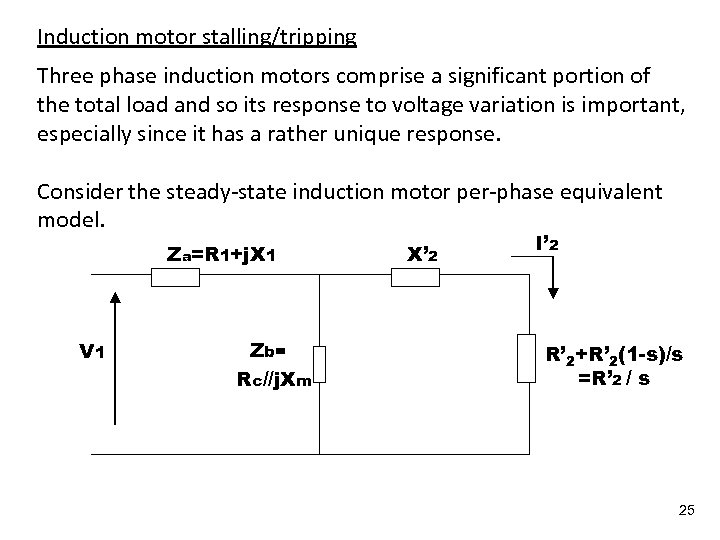 Induction motor stalling/tripping Three phase induction motors comprise a significant portion of the total load and so its response to voltage variation is important, especially since it has a rather unique response. Consider the steady state induction motor per phase equivalent model. Za=R 1+j. X 1 V 1 Zb= Rc//j. Xm X’ 2 I’ 2 R’ 2+R’ 2(1 -s)/s =R’ 2 / s 25
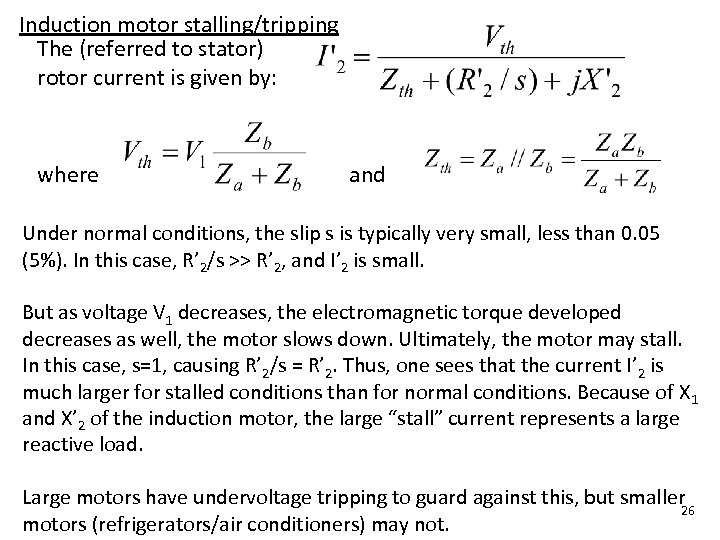 Induction motor stalling/tripping The (referred to stator) rotor current is given by: where and Under normal conditions, the slip s is typically very small, less than 0. 05 (5%). In this case, R’ 2/s >> R’ 2, and I’ 2 is small. But as voltage V 1 decreases, the electromagnetic torque developed decreases as well, the motor slows down. Ultimately, the motor may stall. In this case, s=1, causing R’ 2/s = R’ 2. Thus, one sees that the current I’ 2 is much larger for stalled conditions than for normal conditions. Because of X 1 and X’ 2 of the induction motor, the large “stall” current represents a large reactive load. Large motors have undervoltage tripping to guard against this, but smaller 26 motors (refrigerators/air conditioners) may not.
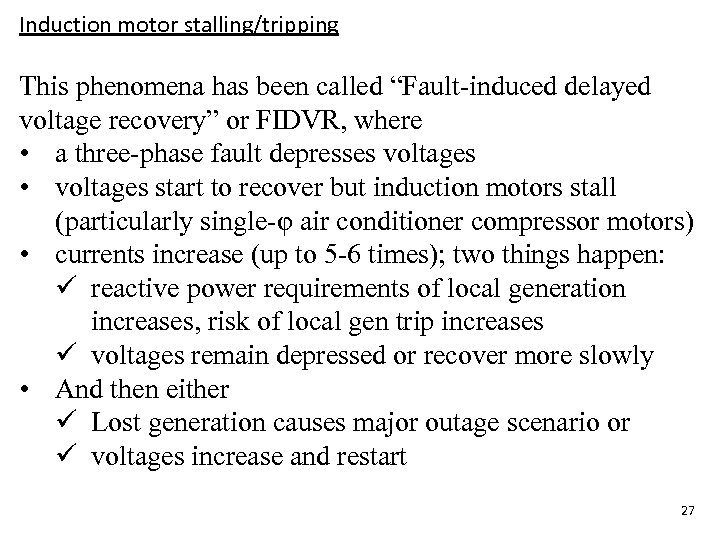 Induction motor stalling/tripping This phenomena has been called “Fault-induced delayed voltage recovery” or FIDVR, where • a three-phase fault depresses voltages • voltages start to recover but induction motors stall (particularly single-φ air conditioner compressor motors) • currents increase (up to 5 -6 times); two things happen: ü reactive power requirements of local generation increases, risk of local gen trip increases ü voltages remain depressed or recover more slowly • And then either ü Lost generation causes major outage scenario or ü voltages increase and restart 27
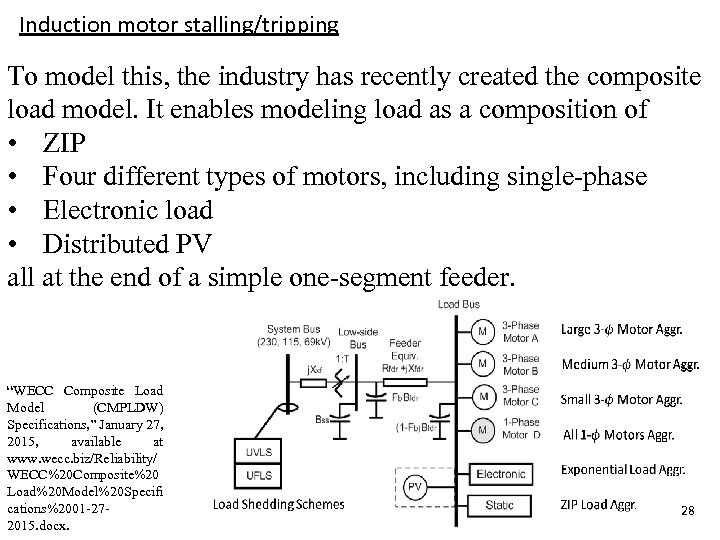 Induction motor stalling/tripping To model this, the industry has recently created the composite load model. It enables modeling load as a composition of • ZIP • Four different types of motors, including single-phase • Electronic load • Distributed PV all at the end of a simple one-segment feeder. “WECC Composite Load Model (CMPLDW) Specifications, ” January 27, 2015, available at www. wecc. biz/Reliability/ WECC%20 Composite%20 Load%20 Model%20 Specifi cations%2001 -272015. docx. 28
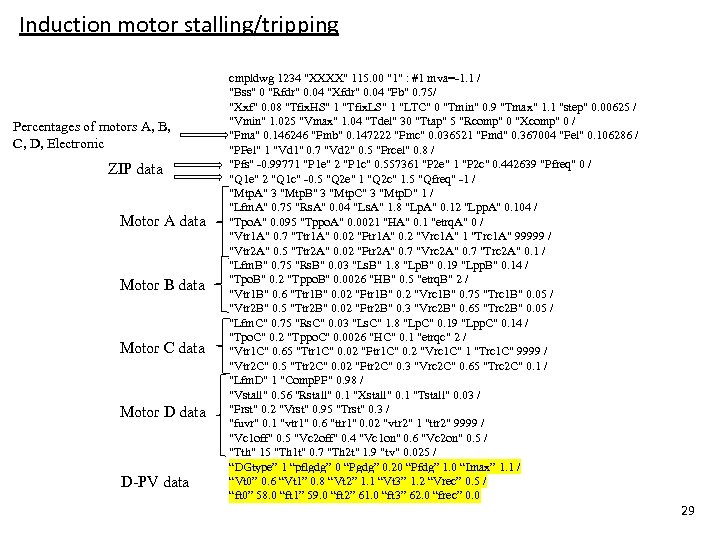 Induction motor stalling/tripping Percentages of motors A, B, C, D, Electronic ZIP data Motor A data Motor B data Motor C data Motor D data D-PV data cmpldwg 1234 "XXXX" 115. 00 "1" : #1 mva=-1. 1 / "Bss" 0 "Rfdr" 0. 04 "Xfdr" 0. 04 "Fb" 0. 75/ "Xxf" 0. 08 "Tfix. HS" 1 "Tfix. LS" 1 "LTC" 0 "Tmin" 0. 9 "Tmax" 1. 1 "step" 0. 00625 / "Vmin" 1. 025 "Vmax" 1. 04 "Tdel" 30 "Ttap" 5 "Rcomp" 0 "Xcomp" 0 / "Fma" 0. 146246 "Fmb" 0. 147222 "Fmc" 0. 036521 "Fmd" 0. 367004 "Fel" 0. 106286 / "PFel" 1 "Vd 1" 0. 7 "Vd 2" 0. 5 "Frcel" 0. 8 / "Pfs" -0. 99771 "P 1 e" 2 "P 1 c" 0. 557361 "P 2 e" 1 "P 2 c" 0. 442639 "Pfreq" 0 / "Q 1 e" 2 "Q 1 c" -0. 5 "Q 2 e" 1 "Q 2 c" 1. 5 "Qfreq" -1 / "Mtp. A" 3 "Mtp. B" 3 "Mtp. C" 3 "Mtp. D" 1 / "Lfm. A" 0. 75 "Rs. A" 0. 04 "Ls. A" 1. 8 "Lp. A" 0. 12 "Lpp. A" 0. 104 / "Tpo. A" 0. 095 "Tppo. A" 0. 0021 "HA" 0. 1 "etrq. A" 0 / "Vtr 1 A" 0. 7 "Ttr 1 A" 0. 02 "Ftr 1 A" 0. 2 "Vrc 1 A" 1 "Trc 1 A" 99999 / "Vtr 2 A" 0. 5 "Ttr 2 A" 0. 02 "Ftr 2 A" 0. 7 "Vrc 2 A" 0. 7 "Trc 2 A" 0. 1 / "Lfm. B" 0. 75 "Rs. B" 0. 03 "Ls. B" 1. 8 "Lp. B" 0. 19 "Lpp. B" 0. 14 / "Tpo. B" 0. 2 "Tppo. B" 0. 0026 "HB" 0. 5 "etrq. B" 2 / "Vtr 1 B" 0. 6 "Ttr 1 B" 0. 02 "Ftr 1 B" 0. 2 "Vrc 1 B" 0. 75 "Trc 1 B" 0. 05 / "Vtr 2 B" 0. 5 "Ttr 2 B" 0. 02 "Ftr 2 B" 0. 3 "Vrc 2 B" 0. 65 "Trc 2 B" 0. 05 / "Lfm. C" 0. 75 "Rs. C" 0. 03 "Ls. C" 1. 8 "Lp. C" 0. 19 "Lpp. C" 0. 14 / "Tpo. C" 0. 2 "Tppo. C" 0. 0026 "HC" 0. 1 "etrqc" 2 / "Vtr 1 C" 0. 65 "Ttr 1 C" 0. 02 "Ftr 1 C" 0. 2 "Vrc 1 C" 1 "Trc 1 C" 9999 / "Vtr 2 C" 0. 5 "Ttr 2 C" 0. 02 "Ftr 2 C" 0. 3 "Vrc 2 C" 0. 65 "Trc 2 C" 0. 1 / "Lfm. D" 1 "Comp. PF" 0. 98 / "Vstall" 0. 56 "Rstall" 0. 1 "Xstall" 0. 1 "Tstall" 0. 03 / "Frst" 0. 2 "Vrst" 0. 95 "Trst" 0. 3 / "fuvr" 0. 1 "vtr 1" 0. 6 "ttr 1" 0. 02 "vtr 2" 1 "ttr 2" 9999 / "Vc 1 off" 0. 5 "Vc 2 off" 0. 4 "Vc 1 on" 0. 6 "Vc 2 on" 0. 5 / "Tth" 15 "Th 1 t" 0. 7 "Th 2 t" 1. 9 "tv" 0. 025 / “DGtype” 1 “pflgdg” 0 “Pgdg” 0. 20 “Pfdg” 1. 0 “Imax” 1. 1 / “Vt 0” 0. 6 “Vt 1” 0. 8 “Vt 2” 1. 1 “Vt 3” 1. 2 “Vrec” 0. 5 / “ft 0” 58. 0 “ft 1” 59. 0 “ft 2” 61. 0 “ft 3” 62. 0 “frec” 0. 0 29
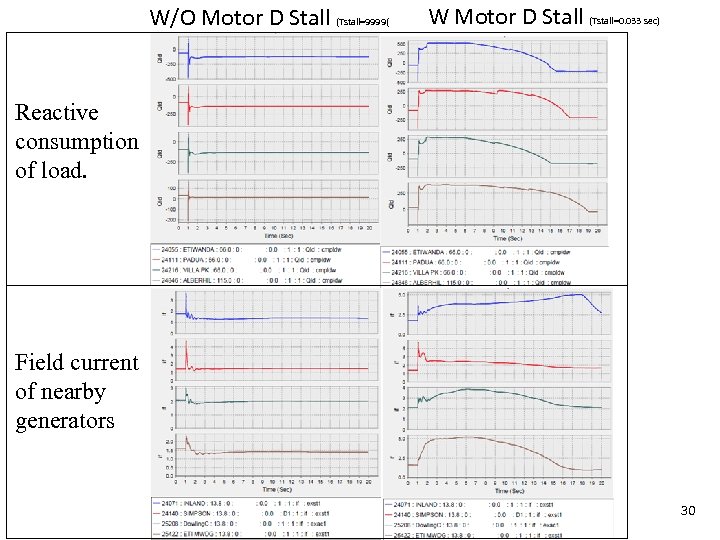 W/O Motor D Stall (Tstall=9999( W Motor D Stall (Tstall=0. 033 sec) Reactive consumption of load. Field current of nearby generators 30
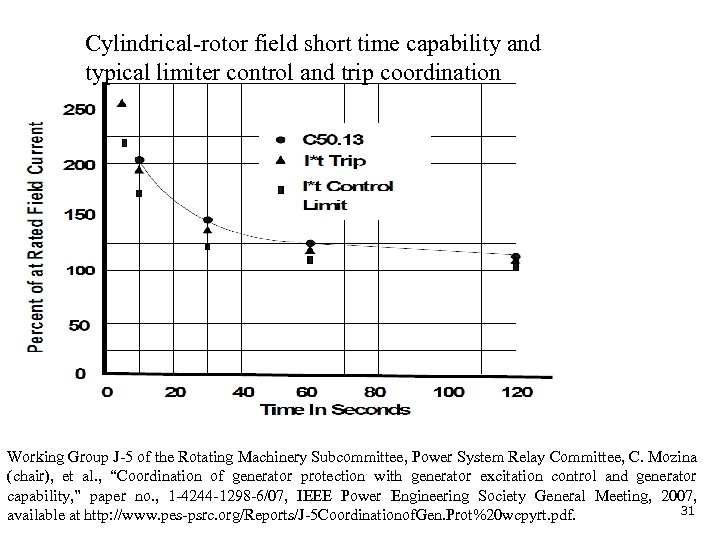 Cylindrical-rotor field short time capability and typical limiter control and trip coordination Working Group J-5 of the Rotating Machinery Subcommittee, Power System Relay Committee, C. Mozina (chair), et al. , “Coordination of generator protection with generator excitation control and generator capability, ” paper no. , 1 -4244 -1298 -6/07, IEEE Power Engineering Society General Meeting, 2007, 31 available at http: //www. pes-psrc. org/Reports/J-5 Coordinationof. Gen. Prot%20 wcpyrt. pdf.
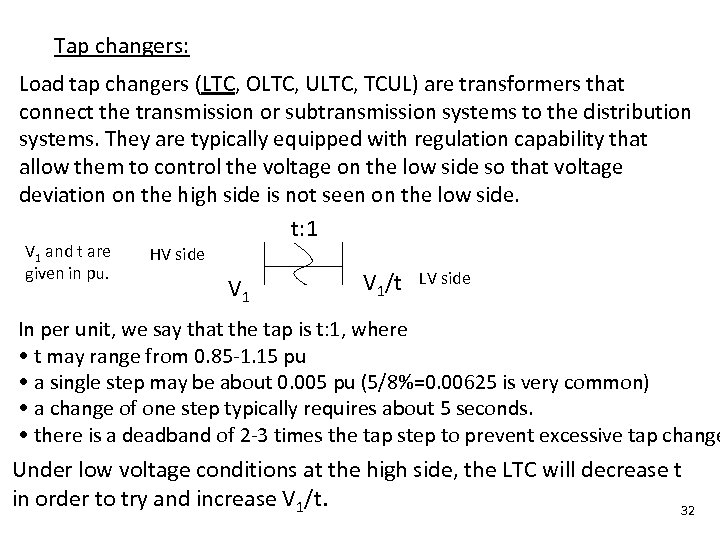 Tap changers: Load tap changers (LTC, OLTC, ULTC, TCUL) are transformers that connect the transmission or subtransmission systems to the distribution systems. They are typically equipped with regulation capability that allow them to control the voltage on the low side so that voltage deviation on the high side is not seen on the low side. V 1 and t are given in pu. t: 1 HV side V 1/t LV side In per unit, we say that the tap is t: 1, where • t may range from 0. 85 1. 15 pu • a single step may be about 0. 005 pu (5/8%=0. 00625 is very common) • a change of one step typically requires about 5 seconds. • there is a deadband of 2 3 times the tap step to prevent excessive tap change Under low voltage conditions at the high side, the LTC will decrease t in order to try and increase V 1/t. 32
 Tap changers: Thus, as long as the LTC is regulating (not at a limit), a voltage decline on the high side does not result in voltage decline at the load, in the steady state, so that even if the load is constant Z, it appears to the high side as if it is constant power. So a simple load model for voltage instability analysis, for systems using LTC, is constant power! There are 2 qualifications to using such a simple model (constant power): 1. “Fast” voltage dips are seen at the low side (since LTC action typically requires minutes), and if the dip is low enough, induction motors may trip, resulting in an immediate decrease in load power. 2. Once the LTC hits limit (minimum t), then the low side voltage begins to decline, and it becomes necessary to model the load voltage sensitivity. 33
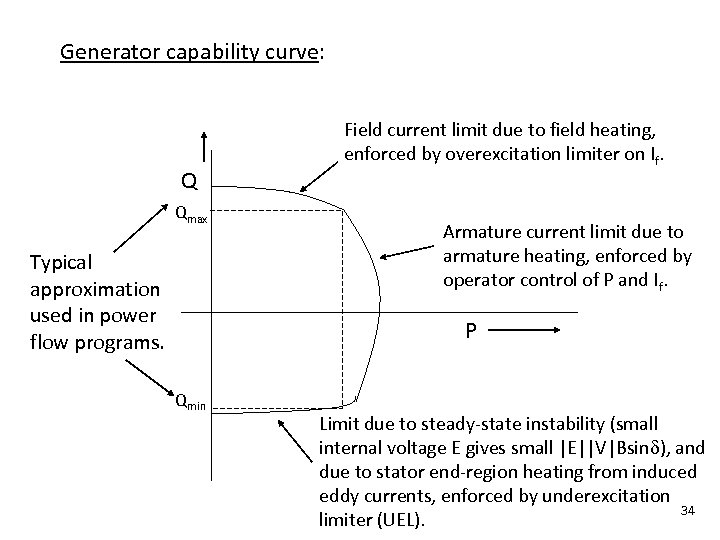 Generator capability curve: Q Qmax Typical approximation used in power flow programs. Field current limit due to field heating, enforced by overexcitation limiter on If. Armature current limit due to armature heating, enforced by operator control of P and If. P Qmin Limit due to steady state instability (small internal voltage E gives small |E||V|Bsin ), and due to stator end region heating from induced eddy currents, enforced by underexcitation 34 limiter (UEL).
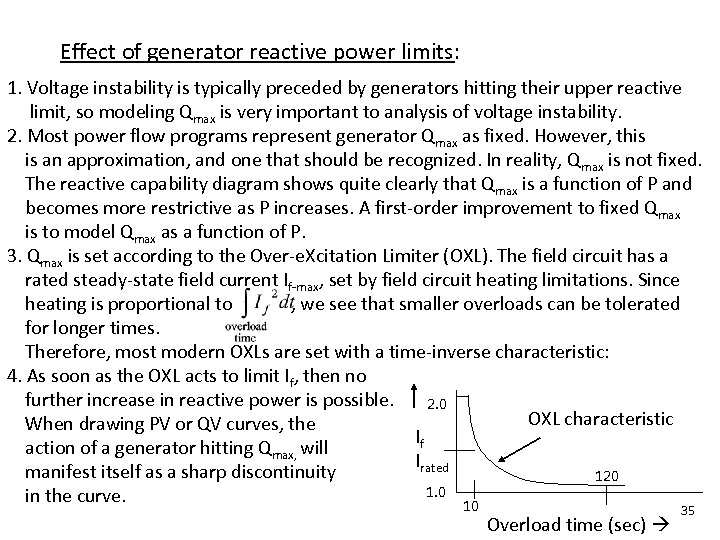 Effect of generator reactive power limits: 1. Voltage instability is typically preceded by generators hitting their upper reactive limit, so modeling Qmax is very important to analysis of voltage instability. 2. Most power flow programs represent generator Qmax as fixed. However, this is an approximation, and one that should be recognized. In reality, Qmax is not fixed. The reactive capability diagram shows quite clearly that Qmax is a function of P and becomes more restrictive as P increases. A first order improvement to fixed Q max is to model Qmax as a function of P. 3. Qmax is set according to the Over e. Xcitation Limiter (OXL). The field circuit has a rated steady state field current If max, set by field circuit heating limitations. Since heating is proportional to , we see that smaller overloads can be tolerated for longer times. Therefore, most modern OXLs are set with a time inverse characteristic: 4. As soon as the OXL acts to limit If, then no further increase in reactive power is possible. 2. 0 OXL characteristic When drawing PV or QV curves, the If action of a generator hitting Qmax, will Irated manifest itself as a sharp discontinuity 120 1. 0 in the curve. 10 35 Overload time (sec)
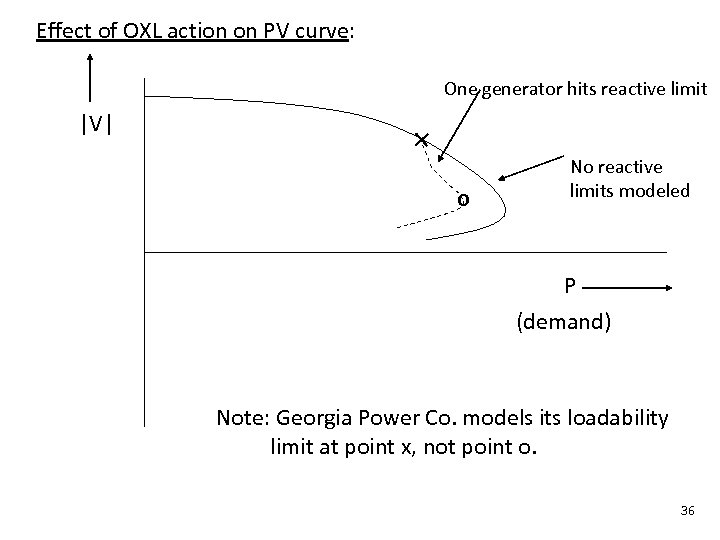 Effect of OXL action on PV curve: One generator hits reactive limit |V| o No reactive limits modeled P (demand) Note: Georgia Power Co. models its loadability limit at point x, not point o. 36
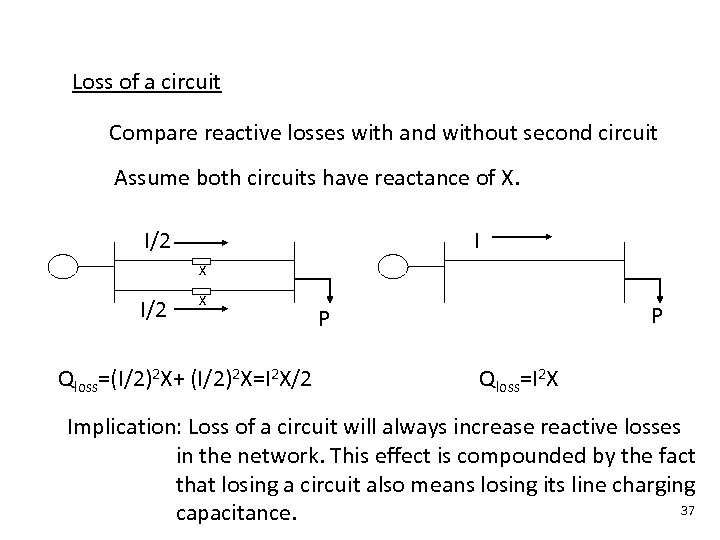 Loss of a circuit Compare reactive losses with and without second circuit Assume both circuits have reactance of X. I/2 I X I/2 X Qloss=(I/2)2 X+ (I/2)2 X=I 2 X/2 P P Qloss=I 2 X Implication: Loss of a circuit will always increase reactive losses in the network. This effect is compounded by the fact that losing a circuit also means losing its line charging 37 capacitance.
 Kundur, on pp. 979 990, has an excellent example which illustrates many of the aforementioned effects. The illustration was done using a long term time domain simulation program (Eurostag). 38
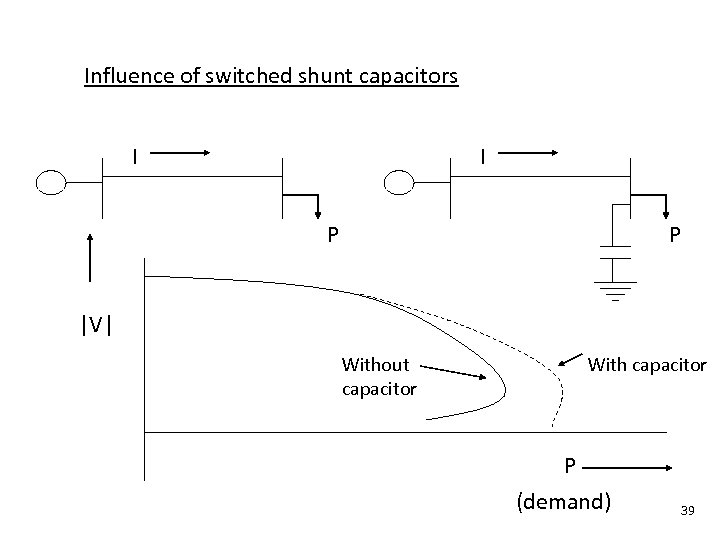 Influence of switched shunt capacitors I I P P |V| Without capacitor With capacitor P (demand) 39
 But, shunt compensation has some drawbacks: • It produces reactive power in proportion to the square of the voltage, therefore when voltages drop, so does the reactive power supplied by the capacitor. • It has a maximum compensation level beyond which stable operation is not possible (See pg. 972 of Kundur, and next slide). (A synchronous condenser and an SVC do not have these 2 drawbacks) • It results in a flatter PV curve and therefore makes voltage instability less detectable. Therefore, as the load grows in areas lacking generation, more and more shunt compensation is used to keep voltages in normal operating ranges. By so doing, normal operating points progressively approach loadability. 40
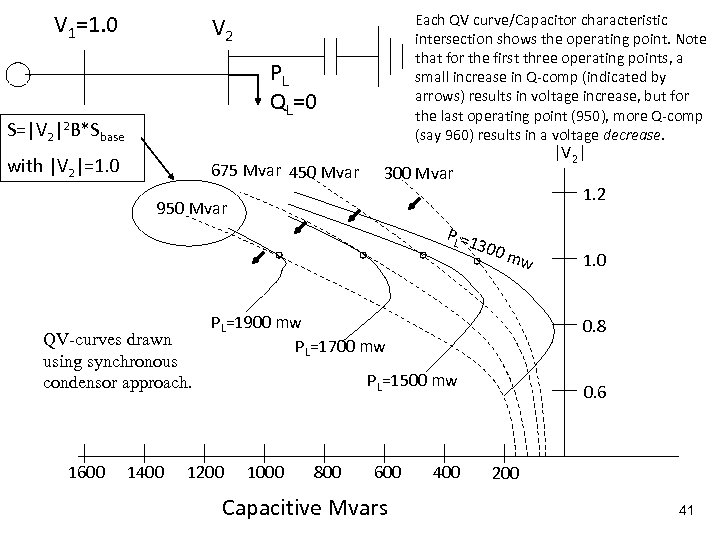 V 1=1. 0 Each QV curve/Capacitor characteristic intersection shows the operating point. Note that for the first three operating points, a small increase in Q comp (indicated by arrows) results in voltage increase, but for the last operating point (950), more Q comp (say 960) results in a voltage decrease. V 2 PL QL=0 S=|V 2|2 B*Sbase with |V 2|=1. 0 675 Mvar 450 Mvar |V 2| 300 Mvar 1. 2 950 Mvar PL =1 300 QV-curves drawn using synchronous condensor approach. 1600 1400 mw PL=1900 mw PL=1700 mw 0. 8 PL=1500 mw 1200 1000 800 600 Capacitive Mvars 1. 0 400 0. 6 200 41
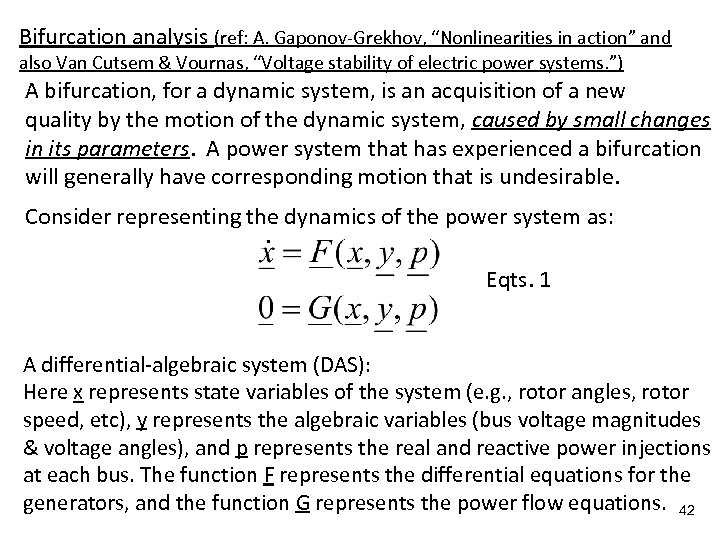 Bifurcation analysis (ref: A. Gaponov Grekhov, “Nonlinearities in action” and also Van Cutsem & Vournas, “Voltage stability of electric power systems. ”) A bifurcation, for a dynamic system, is an acquisition of a new quality by the motion of the dynamic system, caused by small changes in its parameters. A power system that has experienced a bifurcation will generally have corresponding motion that is undesirable. Consider representing the dynamics of the power system as: Eqts. 1 A differential algebraic system (DAS): Here x represents state variables of the system (e. g. , rotor angles, rotor speed, etc), y represents the algebraic variables (bus voltage magnitudes & voltage angles), and p represents the real and reactive power injections at each bus. The function F represents the differential equations for the generators, and the function G represents the power flow equations. 42
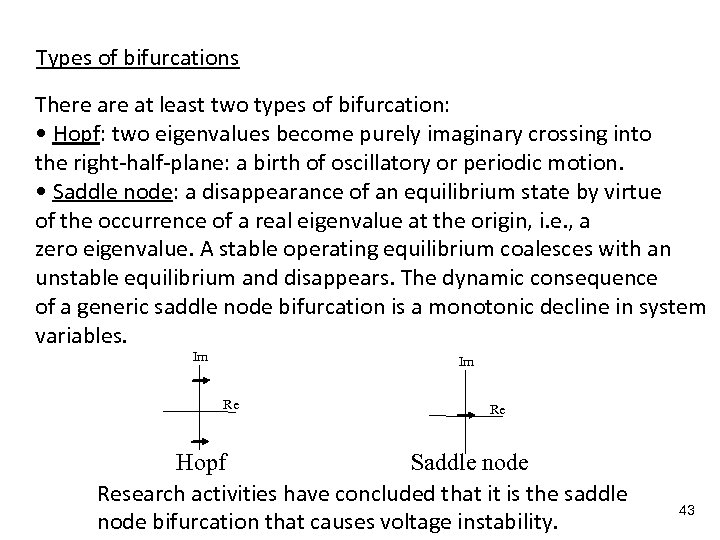 Types of bifurcations There at least two types of bifurcation: • Hopf: two eigenvalues become purely imaginary crossing into the right half plane: a birth of oscillatory or periodic motion. • Saddle node: a disappearance of an equilibrium state by virtue of the occurrence of a real eigenvalue at the origin, i. e. , a zero eigenvalue. A stable operating equilibrium coalesces with an unstable equilibrium and disappears. The dynamic consequence of a generic saddle node bifurcation is a monotonic decline in system variables. Im Im Re Re Saddle node Hopf Research activities have concluded that it is the saddle node bifurcation that causes voltage instability. 43
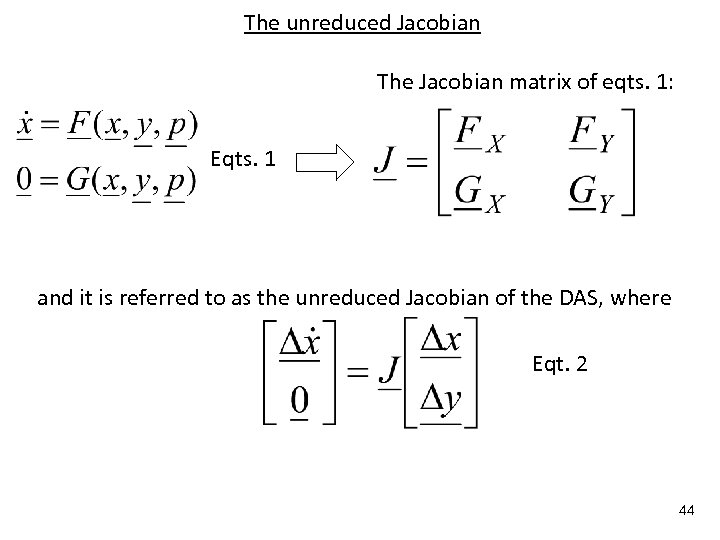 The unreduced Jacobian The Jacobian matrix of eqts. 1: Eqts. 1 and it is referred to as the unreduced Jacobian of the DAS, where Eqt. 2 44
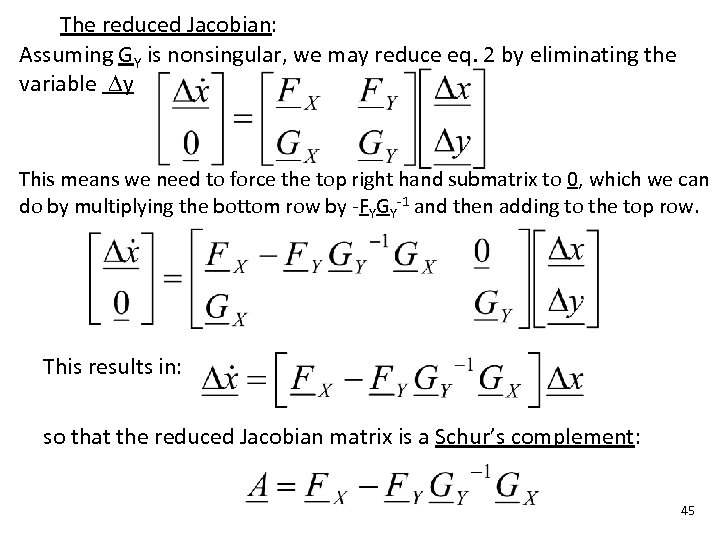 The reduced Jacobian: Assuming GY is nonsingular, we may reduce eq. 2 by eliminating the variable y This means we need to force the top right hand submatrix to 0, which we can do by multiplying the bottom row by FYGY 1 and then adding to the top row. This results in: so that the reduced Jacobian matrix is a Schur’s complement: 45
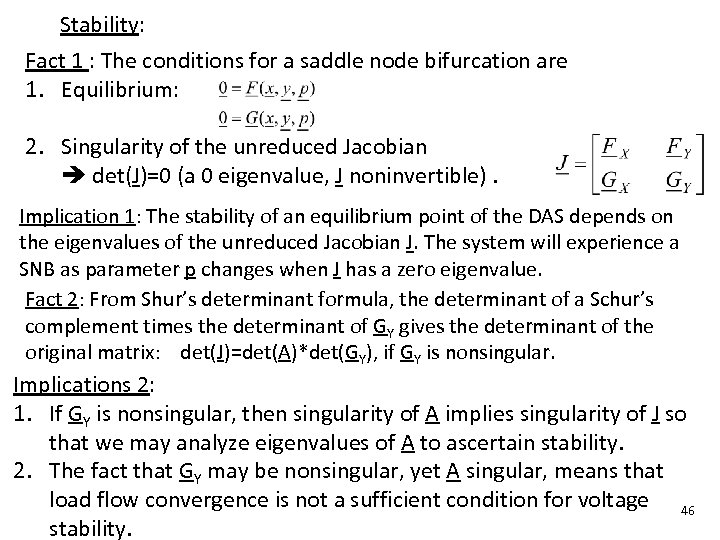 Stability: Fact 1 : The conditions for a saddle node bifurcation are 1. Equilibrium: 2. Singularity of the unreduced Jacobian det(J)=0 (a 0 eigenvalue, J noninvertible). Implication 1: The stability of an equilibrium point of the DAS depends on the eigenvalues of the unreduced Jacobian J. The system will experience a SNB as parameter p changes when J has a zero eigenvalue. Fact 2: From Shur’s determinant formula, the determinant of a Schur’s complement times the determinant of GY gives the determinant of the original matrix: det(J)=det(A)*det(GY), if GY is nonsingular. Implications 2: 1. If GY is nonsingular, then singularity of A implies singularity of J so that we may analyze eigenvalues of A to ascertain stability. 2. The fact that GY may be nonsingular, yet A singular, means that load flow convergence is not a sufficient condition for voltage 46 stability.
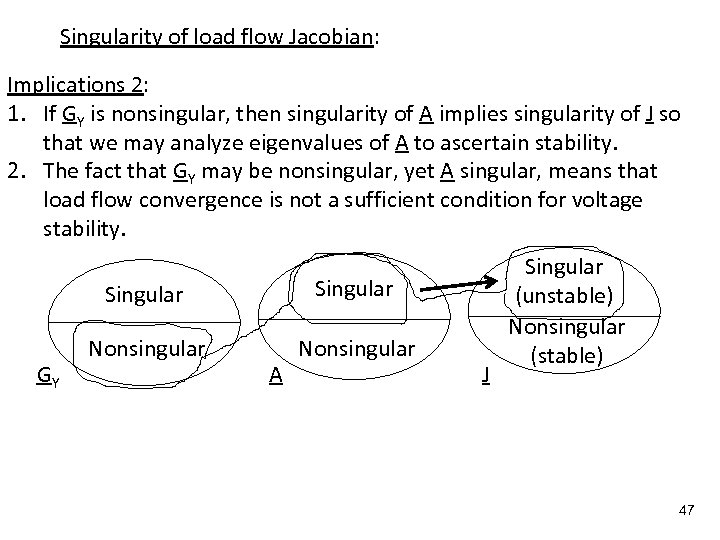 Singularity of load flow Jacobian: Implications 2: 1. If GY is nonsingular, then singularity of A implies singularity of J so that we may analyze eigenvalues of A to ascertain stability. 2. The fact that GY may be nonsingular, yet A singular, means that load flow convergence is not a sufficient condition for voltage stability. Singular GY Singular Nonsingular A J Singular (unstable) Nonsingular (stable) 47
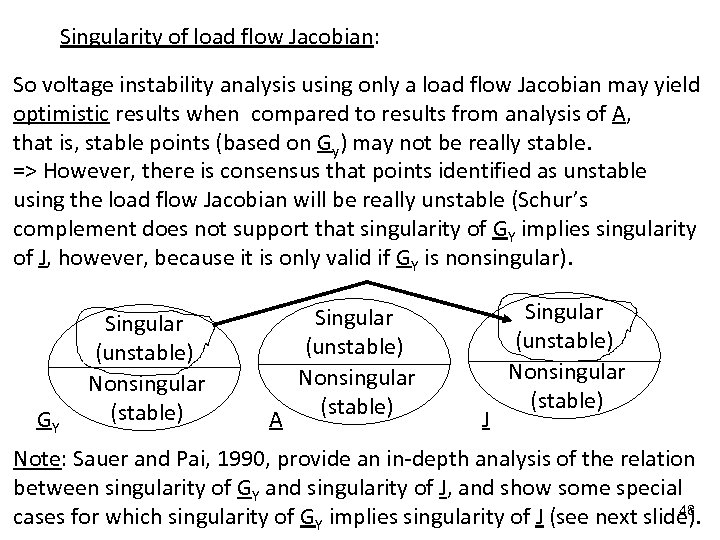 Singularity of load flow Jacobian: So voltage instability analysis using only a load flow Jacobian may yield optimistic results when compared to results from analysis of A, that is, stable points (based on Gy) may not be really stable. => However, there is consensus that points identified as unstable using the load flow Jacobian will be really unstable (Schur’s complement does not support that singularity of GY implies singularity of J, however, because it is only valid if GY is nonsingular). GY Singular (unstable) Nonsingular (stable) A Singular (unstable) Nonsingular (stable) J Singular (unstable) Nonsingular (stable) Note: Sauer and Pai, 1990, provide an in depth analysis of the relation between singularity of GY and singularity of J, and show some special 48 cases for which singularity of GY implies singularity of J (see next slide).
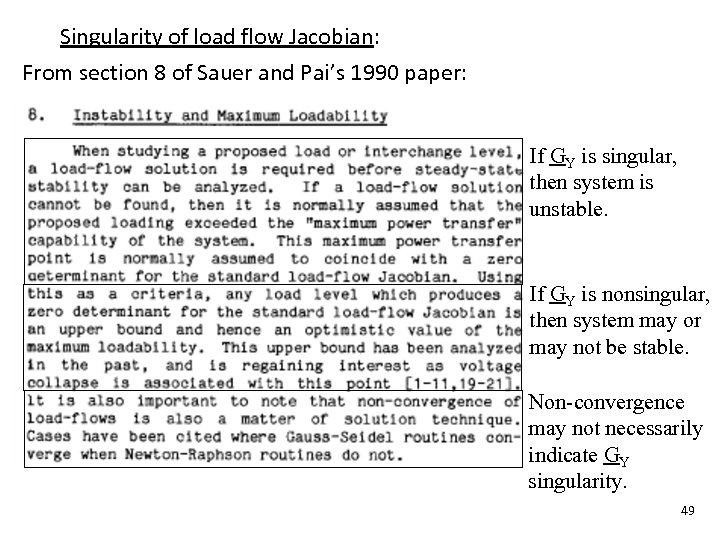 Singularity of load flow Jacobian: From section 8 of Sauer and Pai’s 1990 paper: If GY is singular, then system is unstable. If GY is nonsingular, then system may or may not be stable. Non-convergence may not necessarily indicate GY singularity. 49
 Singularity of load flow Jacobian: So, we assume that load flow Jacobian analysis provides an upper bound on stability. Fact: The bifurcation (zero eigenvalue of GY) of the load flow Jacobian corresponds to the “turn around point” (i. e. , the “nose” point) of a P V or Q V curve drawn using a power flow program. This can be proven using an optimization approach. See pp. 218 220 of the text by Van Cutsem and Vournas. We have previously denoted the power flow equations as G(x, y, p)=0, but now we denote them as G(y, p)=0, without the dependence on the state variables x (which relate to the machine modeling and include, minimally, and of each machine). 50
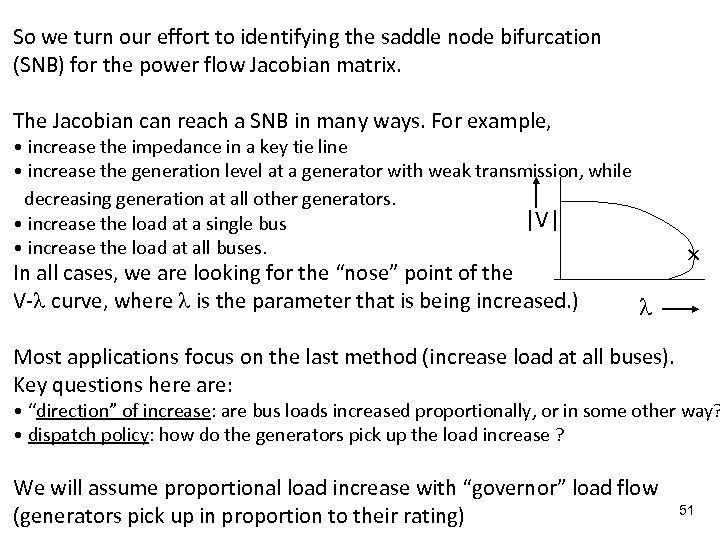 So we turn our effort to identifying the saddle node bifurcation (SNB) for the power flow Jacobian matrix. The Jacobian can reach a SNB in many ways. For example, • increase the impedance in a key tie line • increase the generation level at a generator with weak transmission, while decreasing generation at all other generators. |V| • increase the load at a single bus • increase the load at all buses. In all cases, we are looking for the “nose” point of the V curve, where is the parameter that is being increased. ) Most applications focus on the last method (increase load at all buses). Key questions here are: • “direction” of increase: are bus loads increased proportionally, or in some other way? • dispatch policy: how do the generators pick up the load increase ? We will assume proportional load increase with “governor” load flow (generators pick up in proportion to their rating) 51
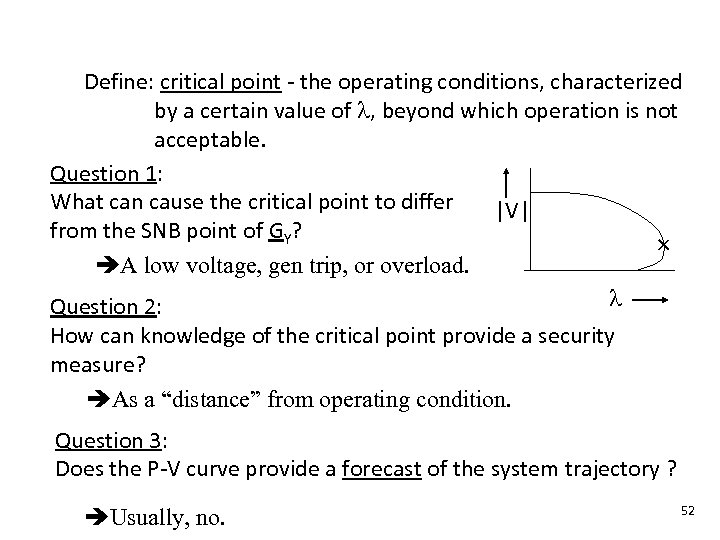 Define: critical point the operating conditions, characterized by a certain value of , beyond which operation is not acceptable. Question 1: What can cause the critical point to differ |V| from the SNB point of GY? A low voltage, gen trip, or overload. Question 2: How can knowledge of the critical point provide a security measure? As a “distance” from operating condition. Question 3: Does the P V curve provide a forecast of the system trajectory ? Usually, no. 52
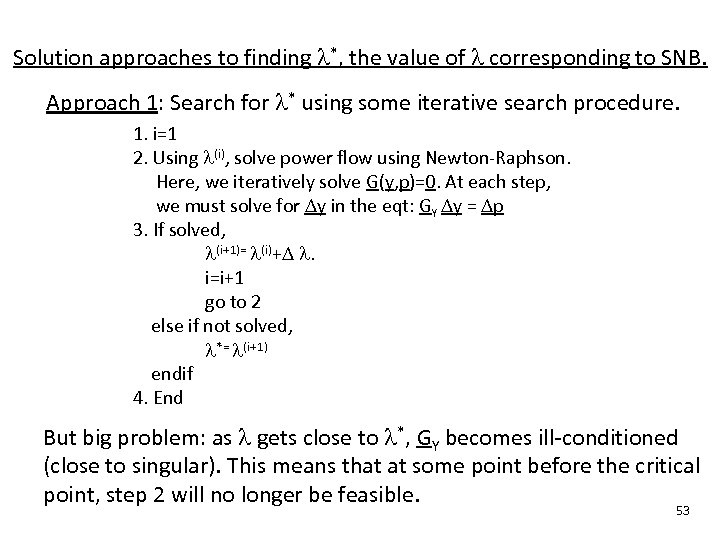 Solution approaches to finding *, the value of corresponding to SNB. Approach 1: Search for * using some iterative search procedure. 1. i=1 2. Using (i), solve power flow using Newton Raphson. Here, we iteratively solve G(y, p)=0. At each step, we must solve for y in the eqt: GY y = p 3. If solved, (i+1)= (i)+ . i=i+1 go to 2 else if not solved, *= (i+1) endif 4. End But big problem: as gets close to *, GY becomes ill conditioned (close to singular). This means that at some point before the critical point, step 2 will no longer be feasible. 53
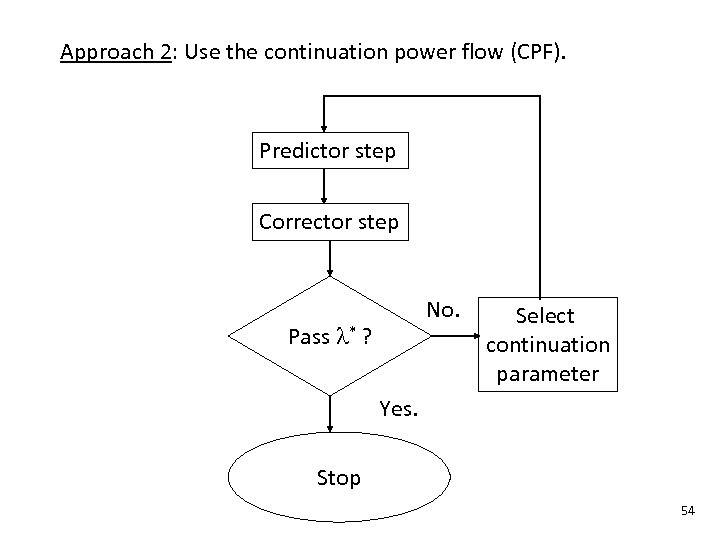 Approach 2: Use the continuation power flow (CPF). Predictor step Corrector step No. Pass * ? Select continuation parameter Yes. Stop 54
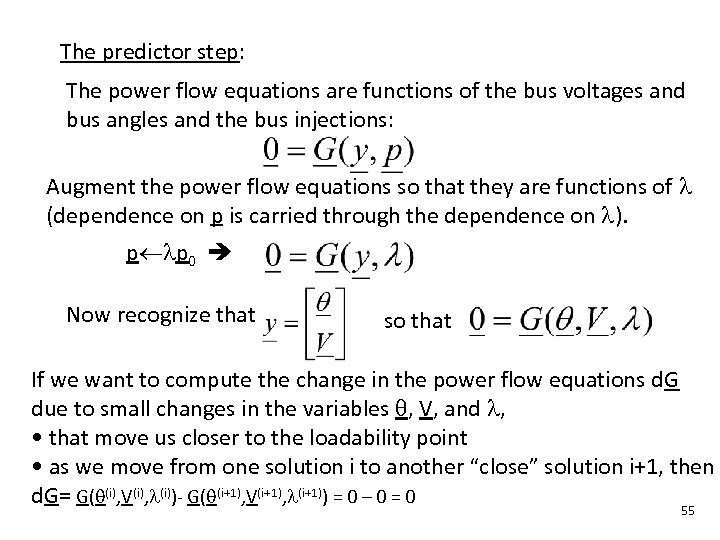 The predictor step: The power flow equations are functions of the bus voltages and bus angles and the bus injections: Augment the power flow equations so that they are functions of (dependence on p is carried through the dependence on ). p p 0 Now recognize that so that If we want to compute the change in the power flow equations d. G due to small changes in the variables , V, and , • that move us closer to the loadability point • as we move from one solution i to another “close” solution i+1, then d. G= G( (i), V(i), (i)) G( (i+1), V(i+1), (i+1)) = 0 – 0 = 0 55
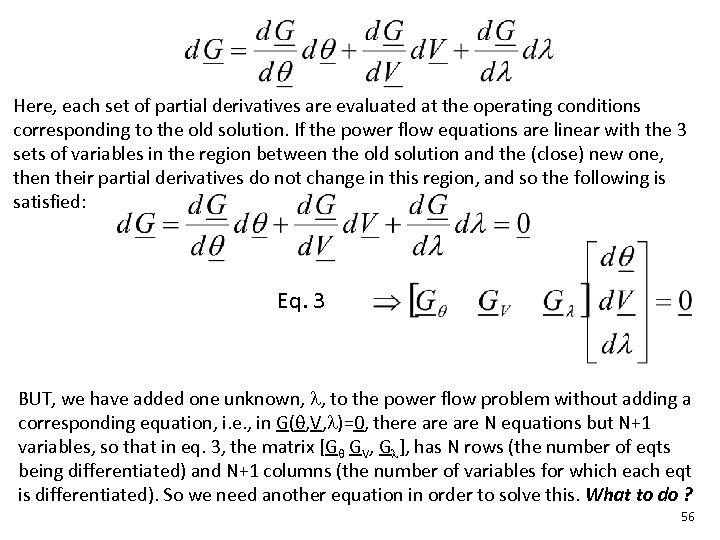 Here, each set of partial derivatives are evaluated at the operating conditions corresponding to the old solution. If the power flow equations are linear with the 3 sets of variables in the region between the old solution and the (close) new one, then their partial derivatives do not change in this region, and so the following is satisfied: Eq. 3 BUT, we have added one unknown, , to the power flow problem without adding a corresponding equation, i. e. , in G( , V, )=0, there are N equations but N+1 variables, so that in eq. 3, the matrix [G GV, G ], has N rows (the number of eqts being differentiated) and N+1 columns (the number of variables for which each eqt is differentiated). So we need another equation in order to solve this. What to do ? 56
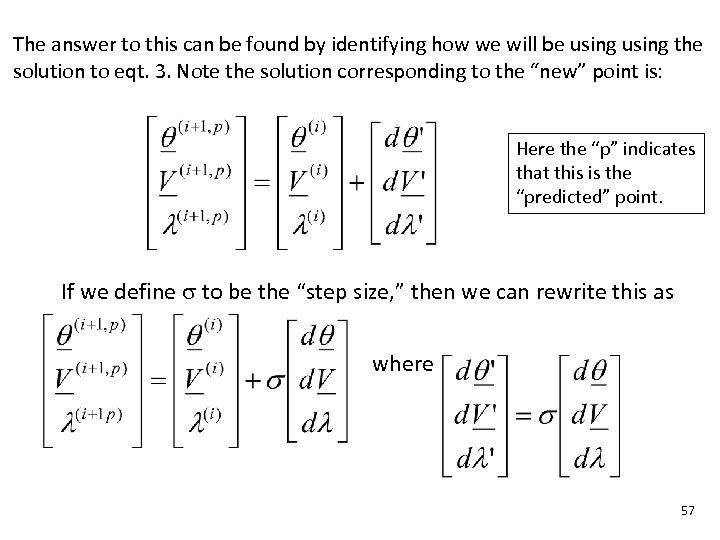 The answer to this can be found by identifying how we will be using the solution to eqt. 3. Note the solution corresponding to the “new” point is: Here the “p” indicates that this is the “predicted” point. If we define to be the “step size, ” then we can rewrite this as where 57
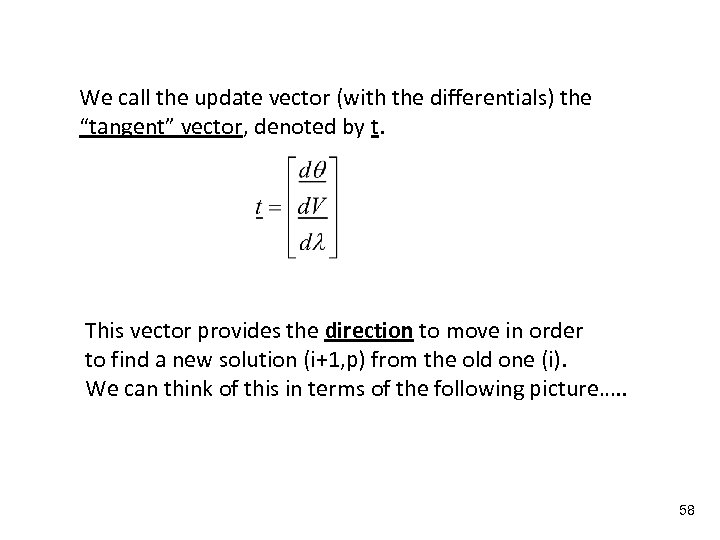 We call the update vector (with the differentials) the “tangent” vector, denoted by t. This vector provides the direction to move in order to find a new solution (i+1, p) from the old one (i). We can think of this in terms of the following picture…. . 58
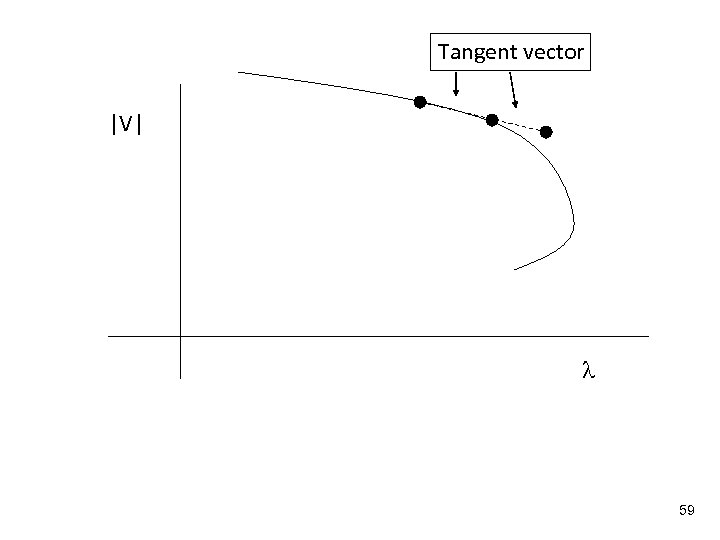 Tangent vector |V| 59
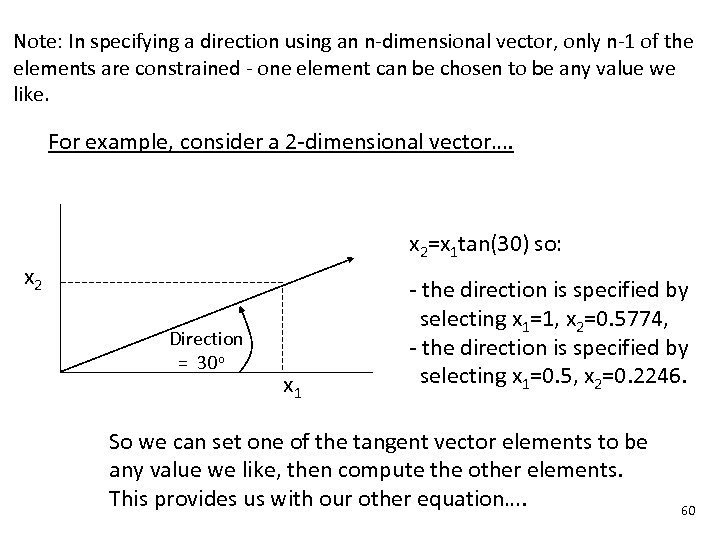 Note: In specifying a direction using an n dimensional vector, only n 1 of the elements are constrained one element can be chosen to be any value we like. For example, consider a 2 dimensional vector…. x 2=x 1 tan(30) so: x 2 Direction = 30 o x 1 the direction is specified by selecting x 1=1, x 2=0. 5774, the direction is specified by selecting x 1=0. 5, x 2=0. 2246. So we can set one of the tangent vector elements to be any value we like, then compute the other elements. This provides us with our other equation…. 60
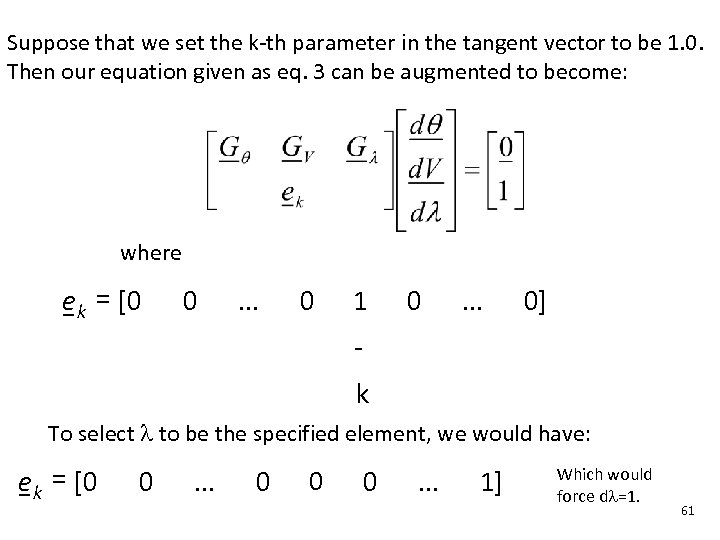 Suppose that we set the k th parameter in the tangent vector to be 1. 0. Then our equation given as eq. 3 can be augmented to become: where ek = [ 0 0 . . . 0 1 0 . . . 0] k To select to be the specified element, we would have: ek = [ 0 0 . . . 0 0 0 . . . 1] Which would force d =1. 61
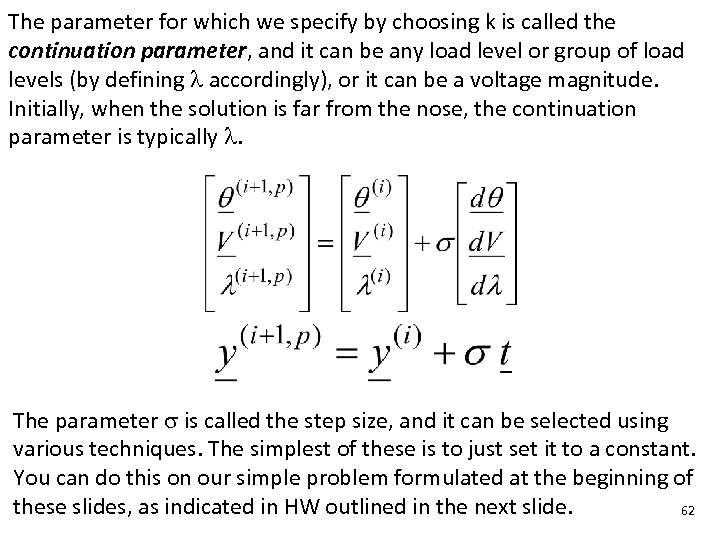 The parameter for which we specify by choosing k is called the continuation parameter, and it can be any load level or group of load levels (by defining accordingly), or it can be a voltage magnitude. Initially, when the solution is far from the nose, the continuation parameter is typically . The parameter is called the step size, and it can be selected using various techniques. The simplest of these is to just set it to a constant. You can do this on our simple problem formulated at the beginning of these slides, as indicated in HW outlined in the next slide. 62
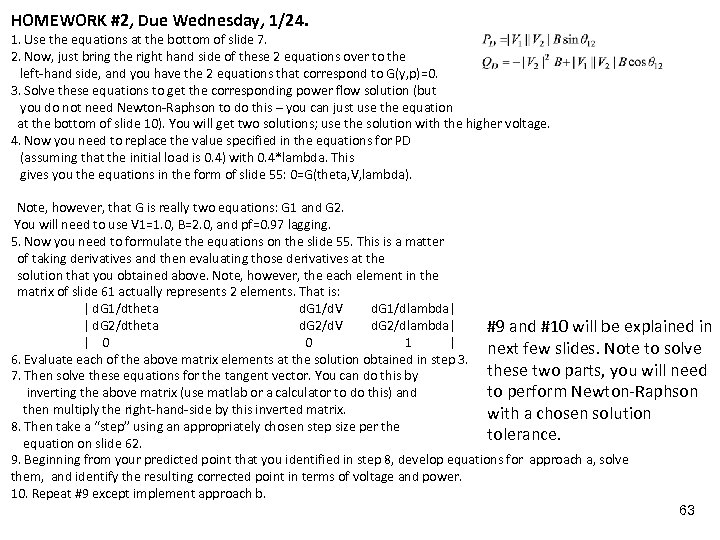 HOMEWORK #2, Due Wednesday, 1/24. 1. Use the equations at the bottom of slide 7. 2. Now, just bring the right hand side of these 2 equations over to the left hand side, and you have the 2 equations that correspond to G(y, p)=0. 3. Solve these equations to get the corresponding power flow solution (but you do not need Newton Raphson to do this – you can just use the equation at the bottom of slide 10). You will get two solutions; use the solution with the higher voltage. 4. Now you need to replace the value specified in the equations for PD (assuming that the initial load is 0. 4) with 0. 4*lambda. This gives you the equations in the form of slide 55: 0=G(theta, V, lambda). Note, however, that G is really two equations: G 1 and G 2. You will need to use V 1=1. 0, B=2. 0, and pf=0. 97 lagging. 5. Now you need to formulate the equations on the slide 55. This is a matter of taking derivatives and then evaluating those derivatives at the solution that you obtained above. Note, however, the each element in the matrix of slide 61 actually represents 2 elements. That is: | d. G 1/dtheta d. G 1/d. V d. G 1/dlambda| | d. G 2/dtheta d. G 2/d. V d. G 2/dlambda| #9 and #10 will be explained in | 0 0 1 | next few slides. Note to solve 6. Evaluate each of the above matrix elements at the solution obtained in step 3. these two parts, you will need 7. Then solve these equations for the tangent vector. You can do this by inverting the above matrix (use matlab or a calculator to do this) and to perform Newton Raphson then multiply the right hand side by this inverted matrix. with a chosen solution 8. Then take a “step” using an appropriately chosen step size per the tolerance. equation on slide 62. 9. Beginning from your predicted point that you identified in step 8, develop equations for approach a, solve them, and identify the resulting corrected point in terms of voltage and power. 10. Repeat #9 except implement approach b. 63
 Issues addressed in remainder of these slides: • Corrector step, slides 65 -67. • • Approach a, Perpendicular intersection method Approach b, Parameterization method Detection of critical point, Slide 68. Selection of continuation parameter, Slides 69 -71 Alleviating the ill-conditioning problem, Slides 72 -73. Known codes for continuation methods, Slide 74 Calculation of sensitivities for voltage instability, Slides 75 -87. 64
 Corrector step Note, however, that the predicted point will satisfy the power flow equations only if the power flow equations are linear, which they are not. That is, the partial derivatives are not constant in the region between old and new points. So our point needs correction. This leads to the corrector step. There are two different approaches for performing the corrector step. Approach a: Perpendicular intersection method. Approach b: Parameterization method 65
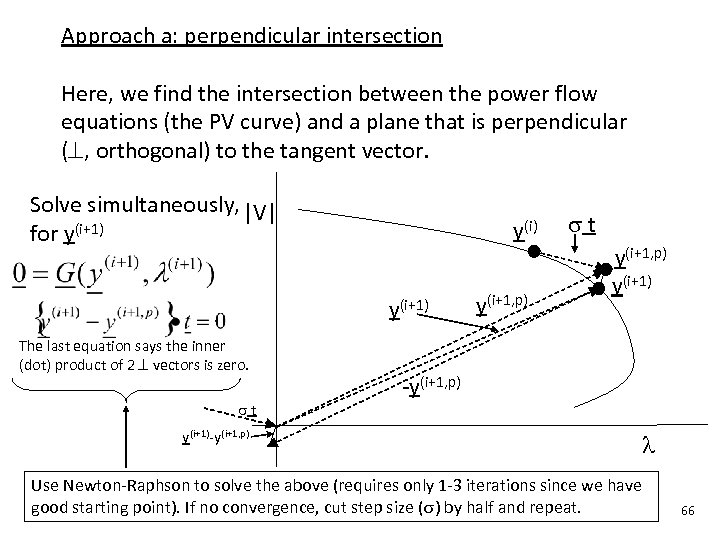 Approach a: perpendicular intersection Here, we find the intersection between the power flow equations (the PV curve) and a plane that is perpendicular ( , orthogonal) to the tangent vector. Solve simultaneously, |V| for y(i+1) The last equation says the inner (dot) product of 2 vectors is zero. t y(i+1) y(i+1, p) t y(i+1, p) y(i+1) y(i+1, p) Use Newton Raphson to solve the above (requires only 1 3 iterations since we have good starting point). If no convergence, cut step size ( ) by half and repeat. 66
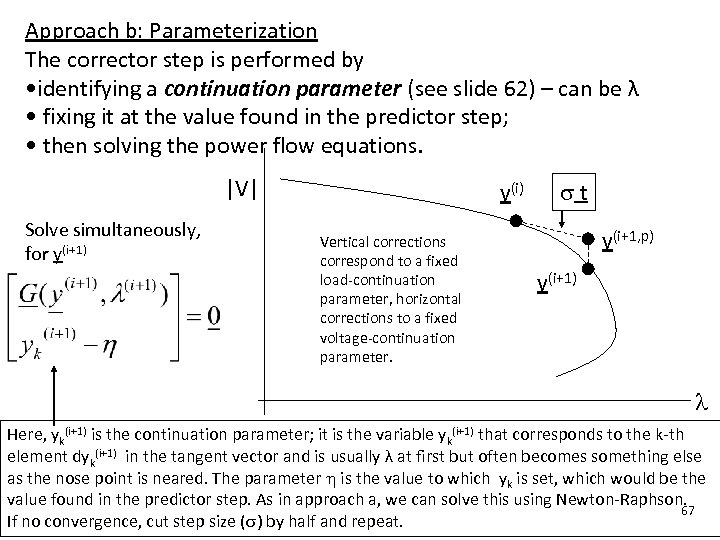 Approach b: Parameterization The corrector step is performed by • identifying a continuation parameter (see slide 62) – can be λ • fixing it at the value found in the predictor step; • then solving the power flow equations. |V| Solve simultaneously, for y(i+1) y(i) Vertical corrections correspond to a fixed load continuation parameter, horizontal corrections to a fixed voltage continuation parameter. t y(i+1, p) y(i+1) Here, yk(i+1) is the continuation parameter; it is the variable yk(i+1) that corresponds to the k th element dyk(i+1) in the tangent vector and is usually λ at first but often becomes something else as the nose point is neared. The parameter is the value to which yk is set, which would be the value found in the predictor step. As in approach a, we can solve this using Newton Raphson. 67 If no convergence, cut step size ( ) by half and repeat.
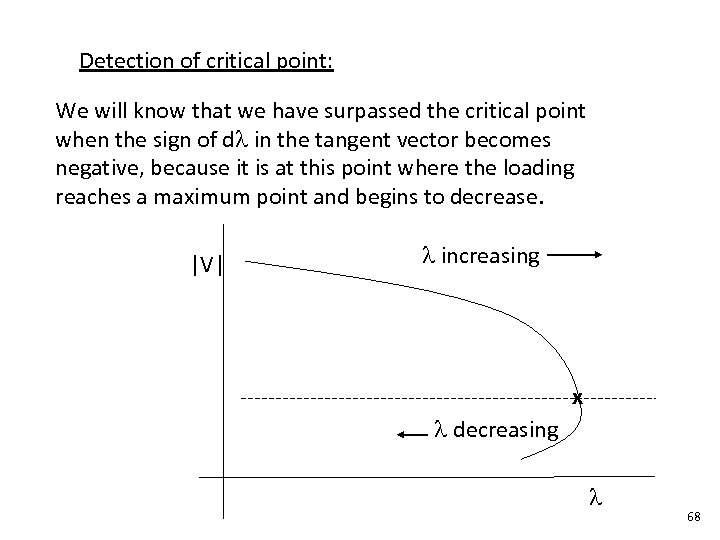 Detection of critical point: We will know that we have surpassed the critical point when the sign of d in the tangent vector becomes negative, because it is at this point where the loading reaches a maximum point and begins to decrease. |V| increasing x decreasing 68
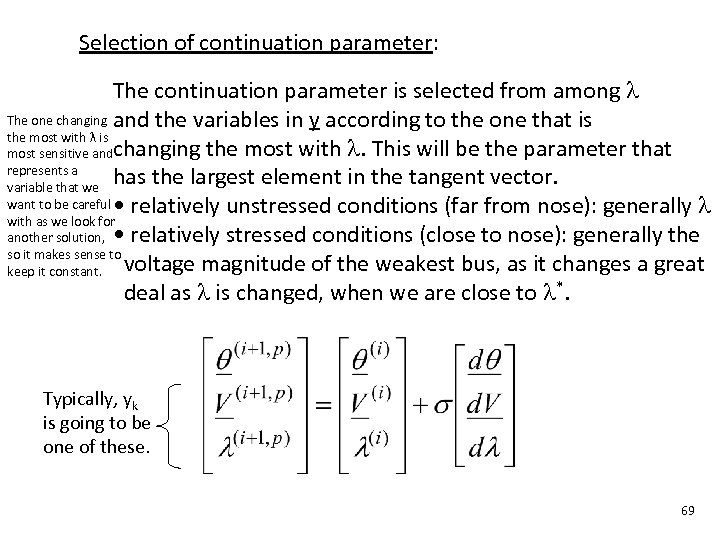 Selection of continuation parameter: The continuation parameter is selected from among The one changing and the variables in y according to the one that is the most with λ is most sensitive andchanging the most with . This will be the parameter that represents a has the largest element in the tangent vector. variable that we want to be careful • relatively unstressed conditions (far from nose): generally with as we look for another solution, • relatively stressed conditions (close to nose): generally the so it makes sense to voltage magnitude of the weakest bus, as it changes a great keep it constant. deal as is changed, when we are close to *. Typically, yk is going to be one of these. 69
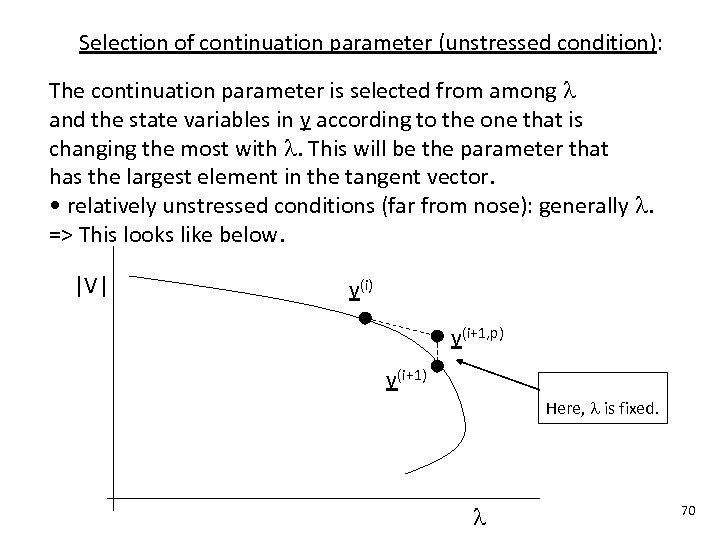 Selection of continuation parameter (unstressed condition): The continuation parameter is selected from among and the state variables in y according to the one that is changing the most with . This will be the parameter that has the largest element in the tangent vector. • relatively unstressed conditions (far from nose): generally . => This looks like below. |V| y(i) y(i+1, p) y(i+1) Here, is fixed. 70
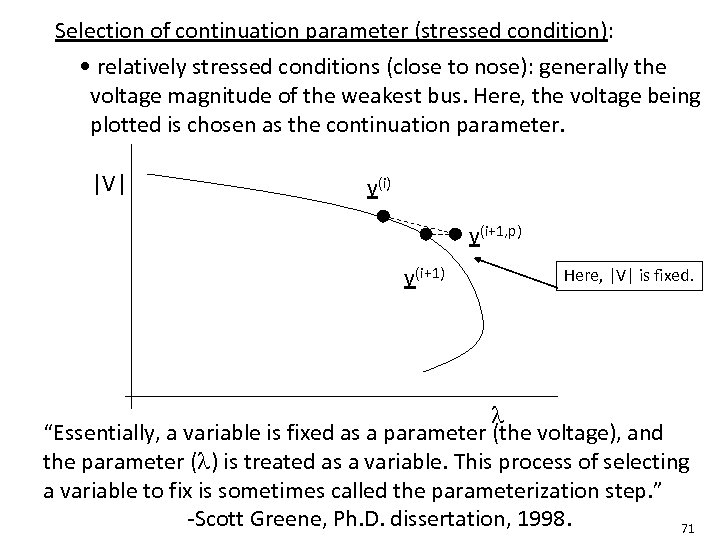 Selection of continuation parameter (stressed condition): • relatively stressed conditions (close to nose): generally the voltage magnitude of the weakest bus. Here, the voltage being plotted is chosen as the continuation parameter. |V| y(i) y(i+1, p) y(i+1) Here, |V| is fixed. “Essentially, a variable is fixed as a parameter (the voltage), and the parameter ( ) is treated as a variable. This process of selecting a variable to fix is sometimes called the parameterization step. ” Scott Greene, Ph. D. dissertation, 1998. 71
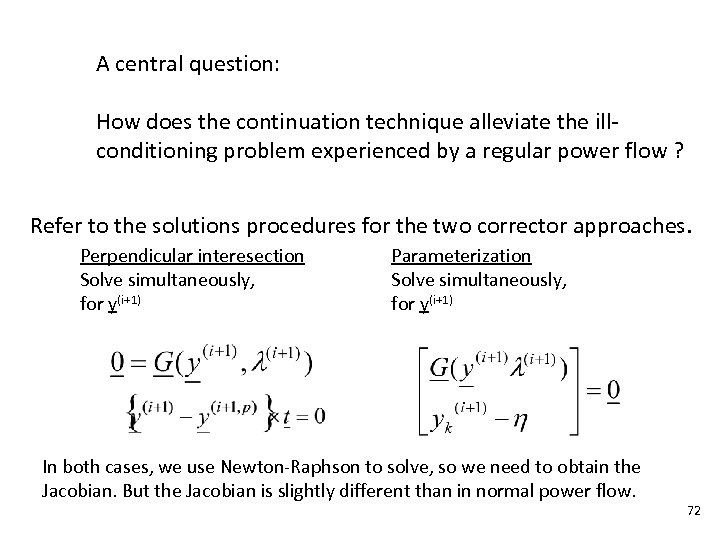 A central question: How does the continuation technique alleviate the ill conditioning problem experienced by a regular power flow ? Refer to the solutions procedures for the two corrector approaches. Perpendicular interesection Solve simultaneously, for y(i+1) Parameterization Solve simultaneously, for y(i+1) In both cases, we use Newton Raphson to solve, so we need to obtain the Jacobian. But the Jacobian is slightly different than in normal power flow. 72
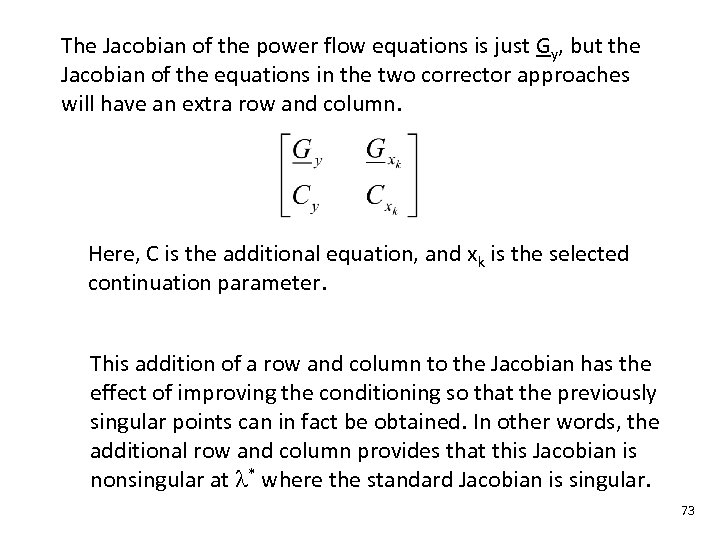 The Jacobian of the power flow equations is just Gy, but the Jacobian of the equations in the two corrector approaches will have an extra row and column. Here, C is the additional equation, and xk is the selected continuation parameter. This addition of a row and column to the Jacobian has the effect of improving the conditioning so that the previously singular points can in fact be obtained. In other words, the additional row and column provides that this Jacobian is nonsingular at * where the standard Jacobian is singular. 73
 Known codes for continuation methods: 1. Claudio Canizarres at University of Waterloo: C code UWPFLOW is a research tool that has been designed to calculate local bifurcations related to system limits or singularities in the system Jacobian. The program also generates a series of output files that allow further analyses, such as tangent vectors, left and right eigenvectors at a singular bifurcation point, Jacobians, power flow solutions at different loading levels, voltage stability indices, etc 2. Federico Milano’s webpages: PSAT, http: //faraday 1. ucd. ie/psat. html Main features of PSAT are: Power Flow; Continuation Power Flow; Optimal Power Flow; Small Signal Stability Analysis; Time Domain Simulation; Complete Graphical User Interface; User Defined Models; FACTS Models; Wind Turbine Models; Conversion of Data Files from several Formats; Export results to EPS, plain text, MS Excel and La. Te. X files; Interfaces to GAMS and UWPFLOW Programs; Command Line Usage; and GNU Octave Compatibility. 3. I have Matlab code that does it – from Scott Greene. 4. Venkataramana Ajjarapu (ISU): Various codes 5. Powertech has a commercial tool in their DSATools suite, called VSAT, http: //www. dsatools. com/vsat/ VSAT is a highly automated analysis tool designed for a comprehensive voltage security assessment using powerflowbased steady-state methods. VSAT includes flexible specification of voltage security criteria and computational features required to assess the voltage performance of power systems. Like TSAT and SSAT, VSAT can be used to calculate . security limits under specified criteria, contingencies, and transfer conditions 74
 Calculation of sensitivities for voltage instability analysis What is a sensitivity ? It is the derivative of an equation with respect to a variable. It shows how parameter 1 changes with parameter 2. It is: exact when parameter 2 depends linearly on parameter 1. It is approximate when parameter 2 depends nonlinearly on parameter 1, but it is quite accurate if it is only used close to where it is calculated. 75
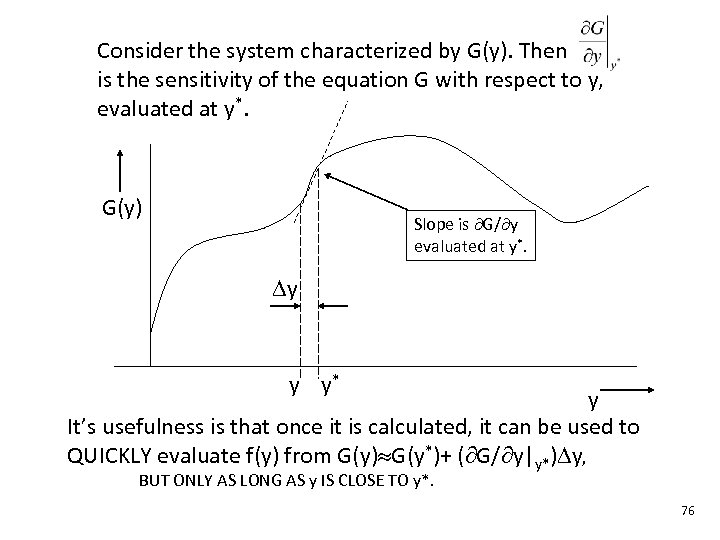 Consider the system characterized by G(y). Then is the sensitivity of the equation G with respect to y, evaluated at y*. G(y) Slope is G/ y evaluated at y*. y y y* y It’s usefulness is that once it is calculated, it can be used to QUICKLY evaluate f(y) from G(y) G(y*)+ ( G/ y|y*) y, BUT ONLY AS LONG AS y IS CLOSE TO y*. 76
 Consider parameter p: we desire to obtain the sensitivity of G(y, p) to p. Typical parameters p would be a bus load, a bus power factor, or a generation level. Very important to distinguish between • voltage sensitivities • voltage instability sensitivities What is the difference between them in terms of • what they mean ? • how to compute them ? 77
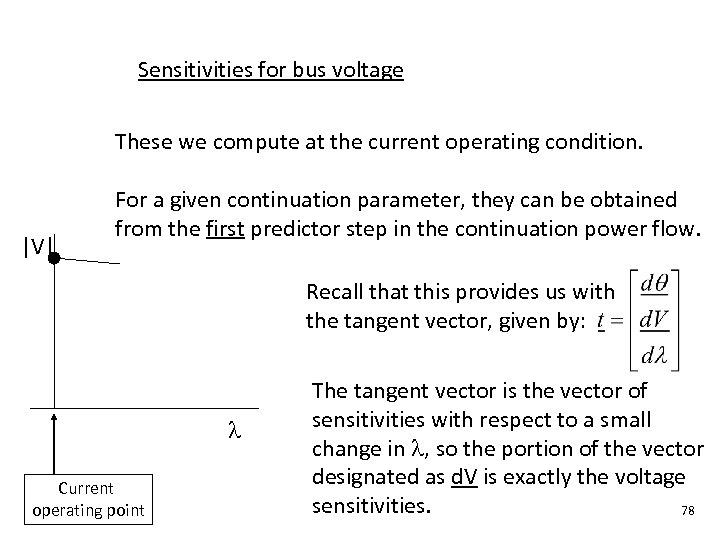 Sensitivities for bus voltage These we compute at the current operating condition. |V| For a given continuation parameter, they can be obtained from the first predictor step in the continuation power flow. Recall that this provides us with the tangent vector, given by: Current operating point The tangent vector is the vector of sensitivities with respect to a small change in , so the portion of the vector designated as d. V is exactly the voltage sensitivities. 78
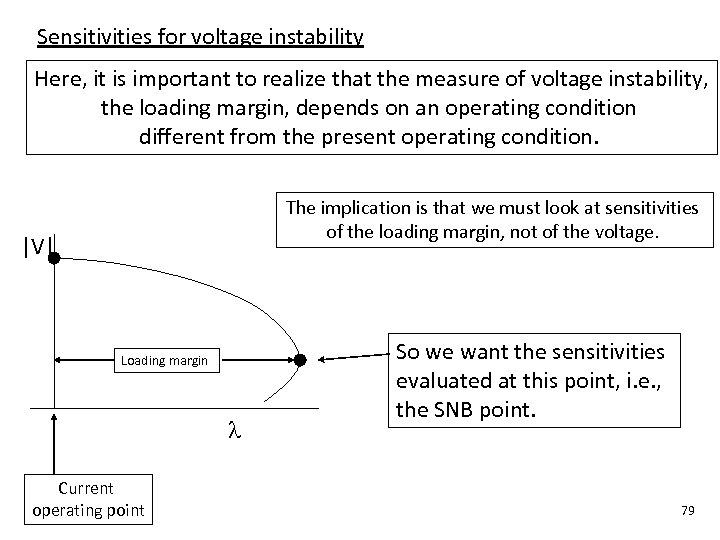 Sensitivities for voltage instability Here, it is important to realize that the measure of voltage instability, the loading margin, depends on an operating condition different from the present operating condition. The implication is that we must look at sensitivities of the loading margin, not of the voltage. |V| Loading margin Current operating point So we want the sensitivities evaluated at this point, i. e. , the SNB point. 79
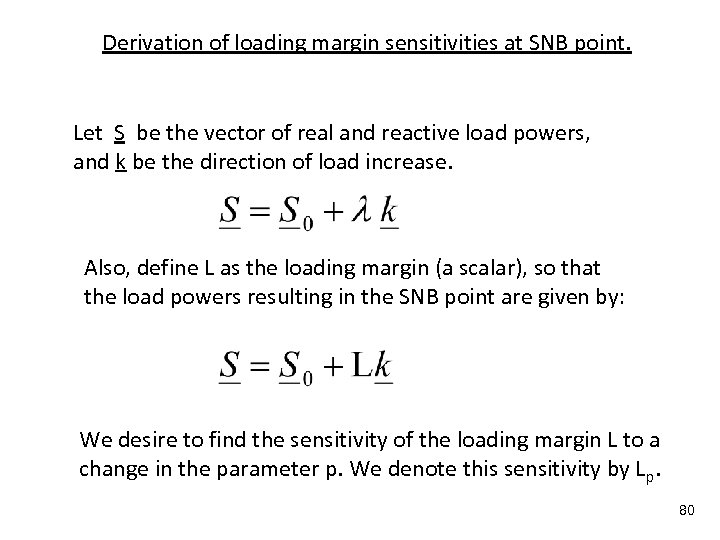 Derivation of loading margin sensitivities at SNB point. Let S be the vector of real and reactive load powers, and k be the direction of load increase. Also, define L as the loading margin (a scalar), so that the load powers resulting in the SNB point are given by: We desire to find the sensitivity of the loading margin L to a change in the parameter p. We denote this sensitivity by Lp. 80
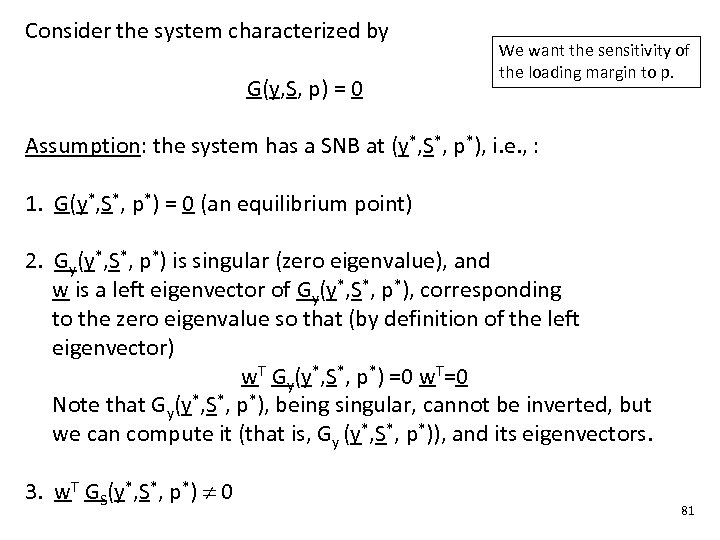 Consider the system characterized by G(y, S, p) = 0 We want the sensitivity of the loading margin to p. Assumption: the system has a SNB at (y*, S*, p*), i. e. , : 1. G(y*, S*, p*) = 0 (an equilibrium point) 2. Gy(y*, S*, p*) is singular (zero eigenvalue), and w is a left eigenvector of Gy(y*, S*, p*), corresponding to the zero eigenvalue so that (by definition of the left eigenvector) w. T Gy(y*, S*, p*) =0 w. T=0 Note that Gy(y*, S*, p*), being singular, cannot be inverted, but we can compute it (that is, Gy (y*, S*, p*)), and its eigenvectors. 3. w. T GS(y*, S*, p*) 0 81
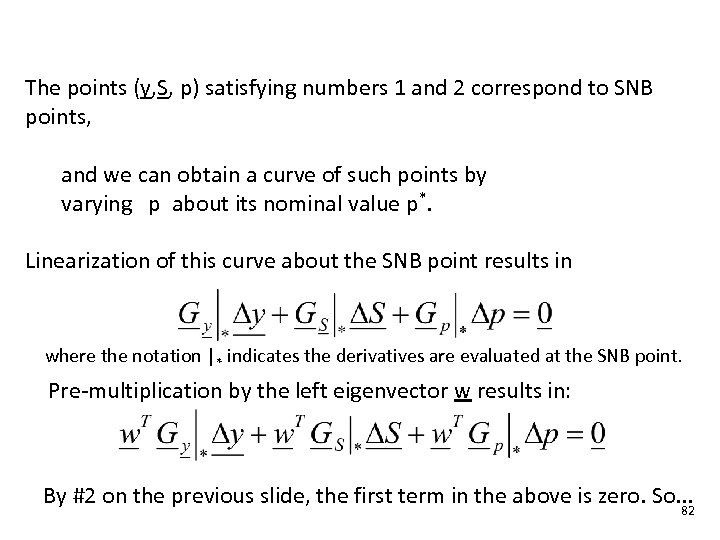 The points (y, S, p) satisfying numbers 1 and 2 correspond to SNB points, and we can obtain a curve of such points by varying p about its nominal value p*. Linearization of this curve about the SNB point results in where the notation |* indicates the derivatives are evaluated at the SNB point. Pre multiplication by the left eigenvector w results in: By #2 on the previous slide, the first term in the above is zero. So. . . 82
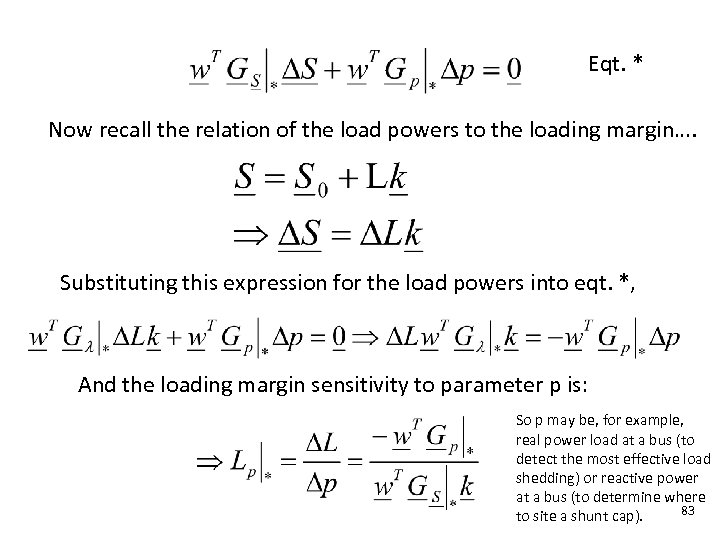 Eqt. * Now recall the relation of the load powers to the loading margin…. Substituting this expression for the load powers into eqt. *, And the loading margin sensitivity to parameter p is: So p may be, for example, real power load at a bus (to detect the most effective load shedding) or reactive power at a bus (to determine where 83 to site a shunt cap).
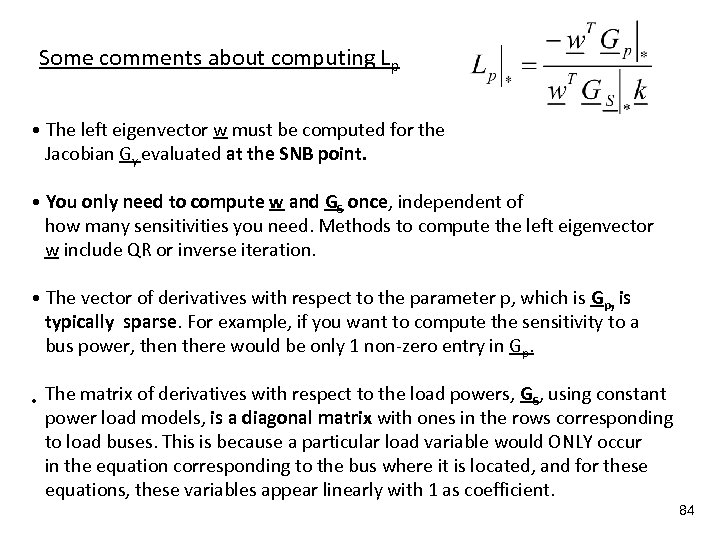 Some comments about computing Lp • The left eigenvector w must be computed for the Jacobian Gy evaluated at the SNB point. • You only need to compute w and GS once, independent of how many sensitivities you need. Methods to compute the left eigenvector w include QR or inverse iteration. • The vector of derivatives with respect to the parameter p, which is Gp, is typically sparse. For example, if you want to compute the sensitivity to a bus power, then there would be only 1 non zero entry in Gp. • The matrix of derivatives with respect to the load powers, GS, using constant power load models, is a diagonal matrix with ones in the rows corresponding to load buses. This is because a particular load variable would ONLY occur in the equation corresponding to the bus where it is located, and for these equations, these variables appear linearly with 1 as coefficient. 84
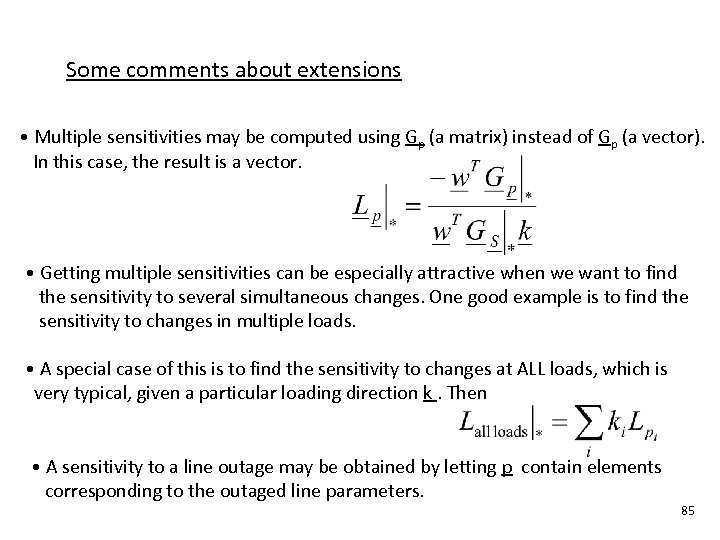 Some comments about extensions • Multiple sensitivities may be computed using Gp (a matrix) instead of Gp (a vector). In this case, the result is a vector. • Getting multiple sensitivities can be especially attractive when we want to find the sensitivity to several simultaneous changes. One good example is to find the sensitivity to changes in multiple loads. • A special case of this is to find the sensitivity to changes at ALL loads, which is very typical, given a particular loading direction k. Then • A sensitivity to a line outage may be obtained by letting p contain elements corresponding to the outaged line parameters. 85
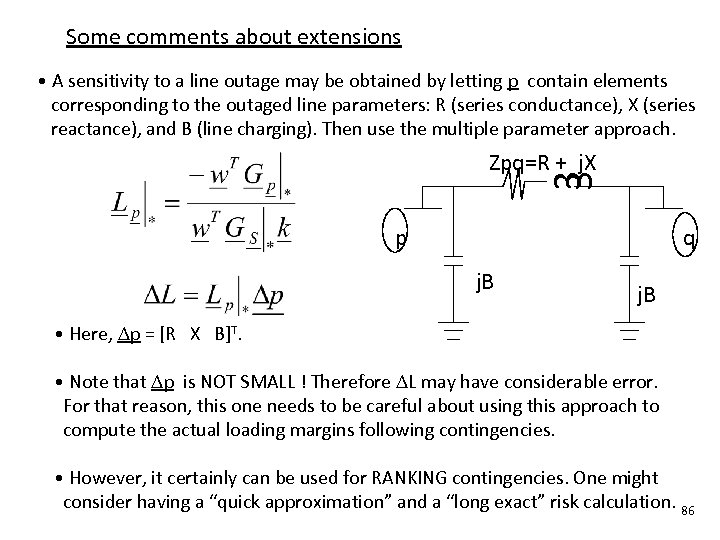 Some comments about extensions • A sensitivity to a line outage may be obtained by letting p contain elements corresponding to the outaged line parameters: R (series conductance), X (series reactance), and B (line charging). Then use the multiple parameter approach. 3 3 Zpq=R + j. X p q j. B • Here, p = [R X B]T. • Note that p is NOT SMALL ! Therefore L may have considerable error. For that reason, this one needs to be careful about using this approach to compute the actual loading margins following contingencies. • However, it certainly can be used for RANKING contingencies. One might consider having a “quick approximation” and a “long exact” risk calculation. 86
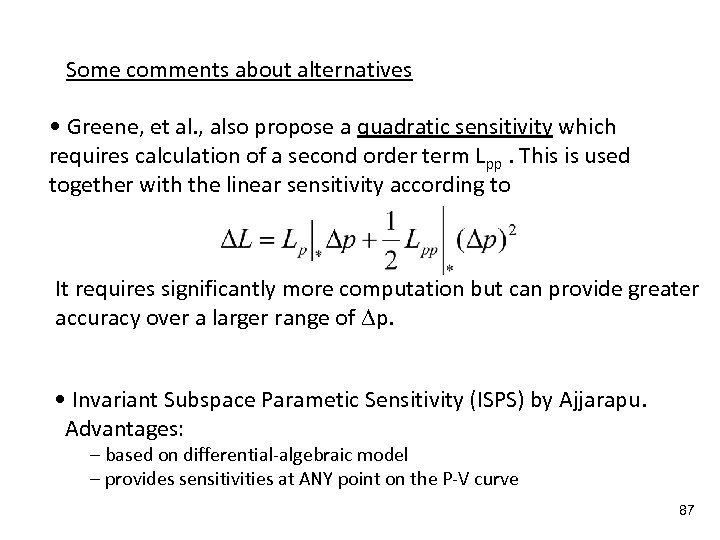 Some comments about alternatives • Greene, et al. , also propose a quadratic sensitivity which requires calculation of a second order term Lpp. This is used together with the linear sensitivity according to It requires significantly more computation but can provide greater accuracy over a larger range of p. • Invariant Subspace Parametic Sensitivity (ISPS) by Ajjarapu. Advantages: – based on differential algebraic model – provides sensitivities at ANY point on the P V curve 87