


 Скачать презентацию Summary and Wrap-up Facts Issues and Future Raisa
61b08fa6a69ed23ccb5e5ea08002739f.ppt
- Количество слайдов: 41
 Summary and Wrap-up: Facts, Issues and Future Raisa Deber, Ph. D University of Toronto November 21, 2005
 What we heard We need evidence!
 Policy dilemmas n n Conference clarified that there is still much we need to know Many issues up for debate
 Need to separate facts from values n n What is Mary’s health status? – Fact What services will help Mary remain in the community? –Fact (once we get the data!) What are the implications of various ways of organizing and delivering those services? – Fact (once we get the data!) How much would those services cost? – Fact (but varies with how they are organized)
 Need to separate facts from values Who should pay for those services? – Value n How much should the people who provide the services be paid? – Value (with labour economics ‘fact’ constraints) n
 Is health insurance immoral? n “It can also be stated that the system’s underlying egalitarianism is immoral in that it rewards that segment of the population that shows no concern for the medically deleterious consequences of its lifestyle. ” Source: Jean-Luc Migué, The Fraser Institute (“Funding and Production of Health Services: Outlook and Potential Solutions. ” Discussion Paper No. 10, Commission on the Future of Health Care in Canada, 2002)
 Is profit immoral? “. . making profits off the suffering of others is deplorable. It is is ethically and morally wrong to allow wealthy people to buy their way to the front of the line. Putting profits ahead of patients is wrong. ” Source: Canada Health Coalition, For-Profit MRI/CT Clinics Reality Check. Downloaded Aug 28, 2002 from http: //www. healthcoalition. ca/realitycheck 4. htm
 One clue we are talking about ideas n n Can these statements be proven to be true or false? What evidence (if any) might cause the individuals making them to change their minds?
 Ideas are not right or wrong n n n You may agree or disagree with them They are an integral part of policy making But they should not be confused with facts
 Some issues are contentious n n n No agreement about what we want to do If policy is about ‘who gets what’, then it may involve redistribution of resources It will be about ‘winners’ and ‘losers’ n E. g. , competition vs. cooperation
 Many policies have implications for women n n As recipients of care As providers of care n n n Health professionals (e. g. , nursing) Health workers (e. g. , PSWs) Volunteers Family care givers Various policies will have different winners and losers
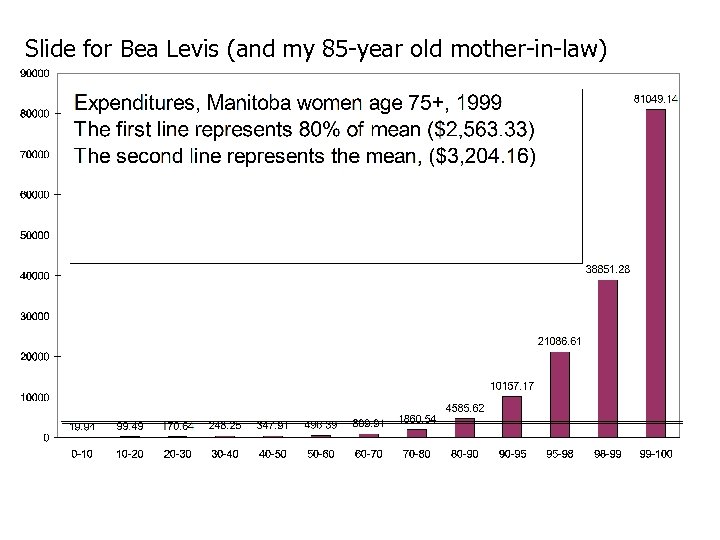 Slide for Bea Levis (and my 85 -year old mother-in-law)
 But some issues are not contentious at all n n n Research may be needed about how to accomplish particular goals But little disagreement about the goals I. e. , Elinor Caplan’s point about BETTER care for more people, rather than just more care
 Example, falls n n n General consensus that falls are not a good thing For individuals Or for the health care system Evidence about how best to prevent them is thus: Valuable Not particularly controversial (unless you market throw rugs)
 Policy issue: institutional constraints n n n Canada Health Act requires coverage based on: n Where care delivered (in hospital) n Or by whom (physicians) Governments can insure beyond this But they are not required to Community support services do not fall under CHA Should this be changed?
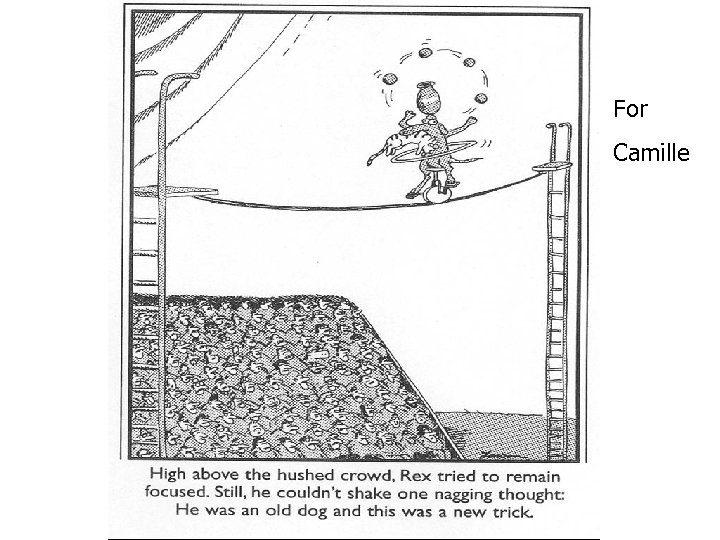 For Camille
 The issue of effectiveness Are various services/interventions: • effective? • cost-effective? Which services? For whom? Can we target groups most likely to be helped?
 Evidence n n n We need the evidence! This should not be that contentious Although, as Pat Armstrong noted, what counts as evidence may well be!
 But not always clear cut n n Sliding scale of ability to benefit implies ‘boundary’ issues Services may be cost-effective if they replace more expensive services But also ‘add ons’ (even if often useful ones) if they are used by people who would otherwise not have been served How do we tell the difference?
 Who should pay for what? n n n What is the responsibility of society? What is the responsibility of voluntary organizations (including faith-based groups)? What is the responsibility of individuals and their families? How should workers be treated (and how much should they be paid)? Not a question of evidence, but of values
 “What’s in, What’s out”: Stakeholders’ views about the boundaries of Medicare n Research team: n n n n Raisa Deber Earl Berger A. Paul Williams Brenda Gamble Acknowledgments: M-THAC for funding Ann Pendleton for survey mailing and data entry Cathy Bezic for coordination and survey mailing
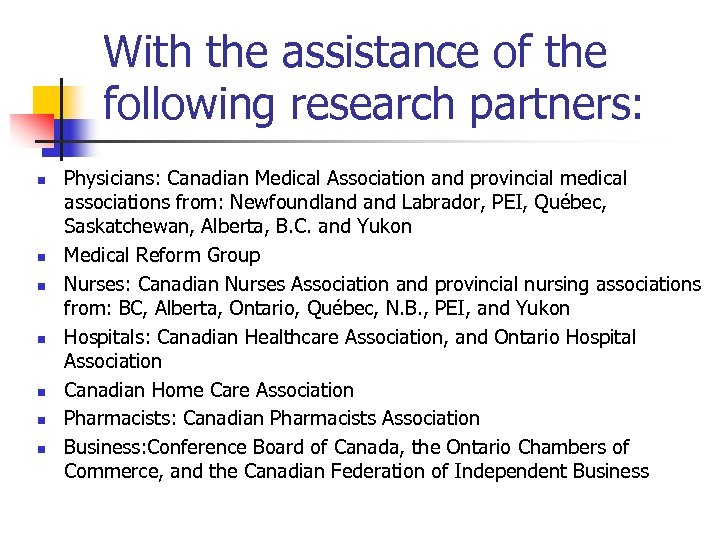 With the assistance of the following research partners: n n n n Physicians: Canadian Medical Association and provincial medical associations from: Newfoundland Labrador, PEI, Québec, Saskatchewan, Alberta, B. C. and Yukon Medical Reform Group Nurses: Canadian Nurses Association and provincial nursing associations from: BC, Alberta, Ontario, Québec, N. B. , PEI, and Yukon Hospitals: Canadian Healthcare Association, and Ontario Hospital Association Canadian Home Care Association Pharmacists: Canadian Pharmacists Association Business: Conference Board of Canada, the Ontario Chambers of Commerce, and the Canadian Federation of Independent Business
 For full results of Boundaries of Medicare Project n n Results posted at: From Medicare To Home And Community (M-THAC) Research Unit www. m-thac. org
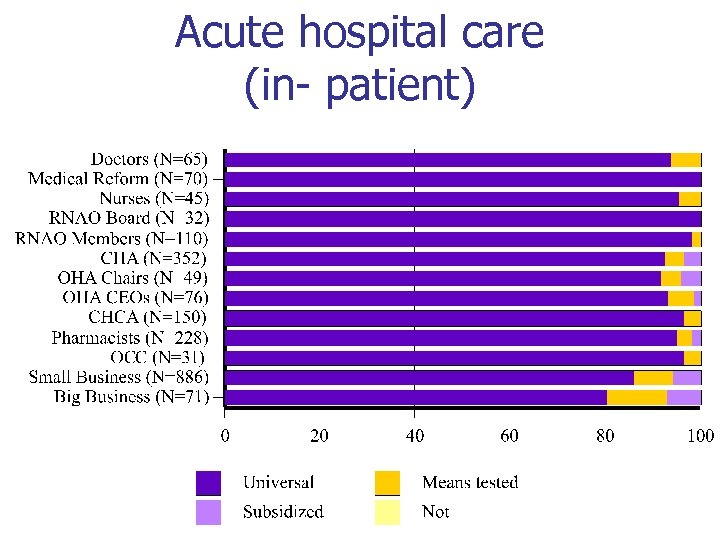
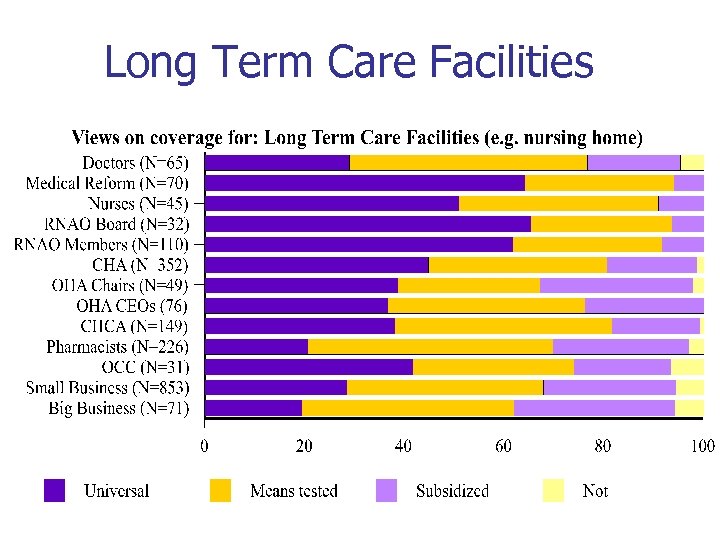
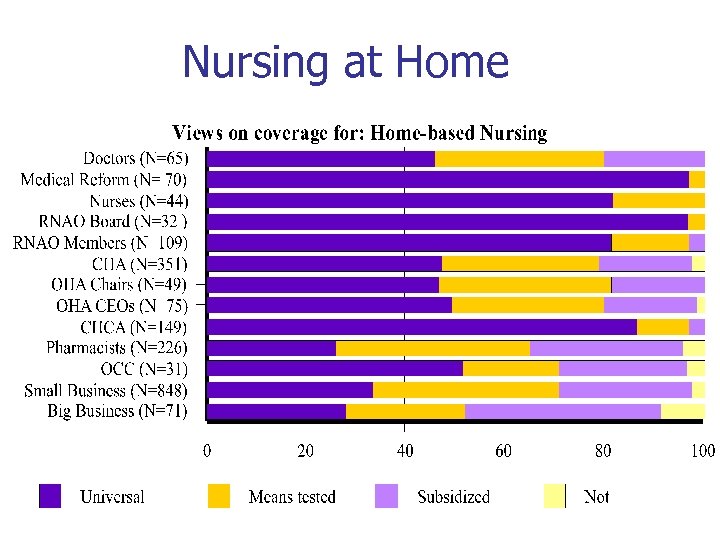
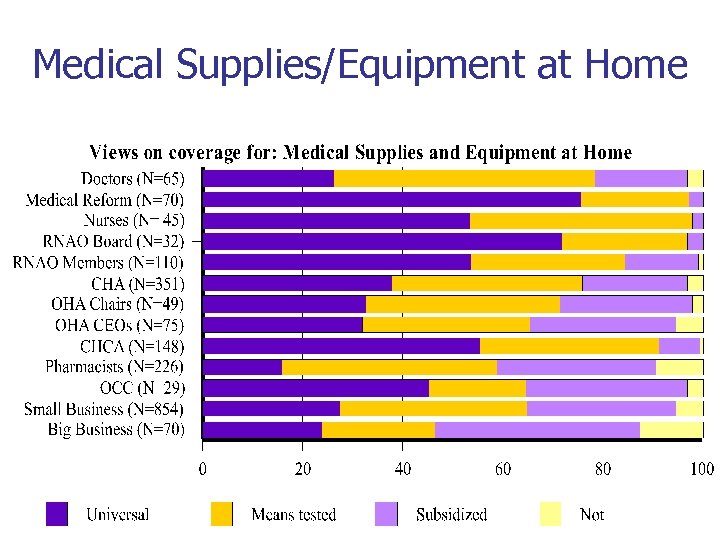
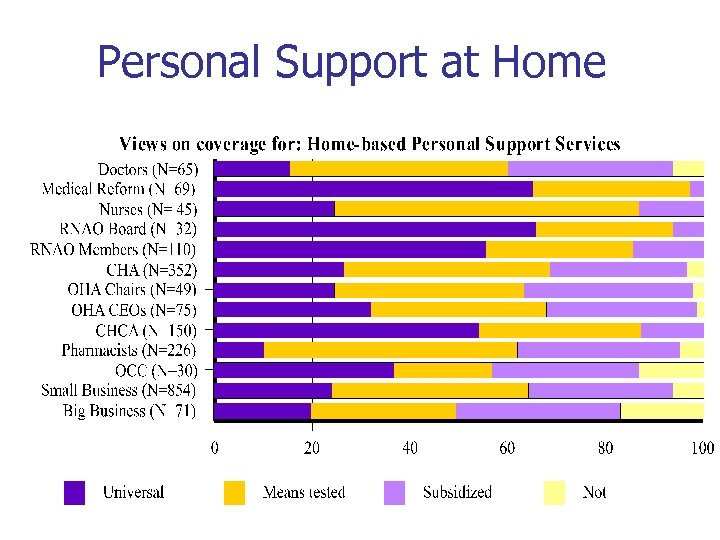
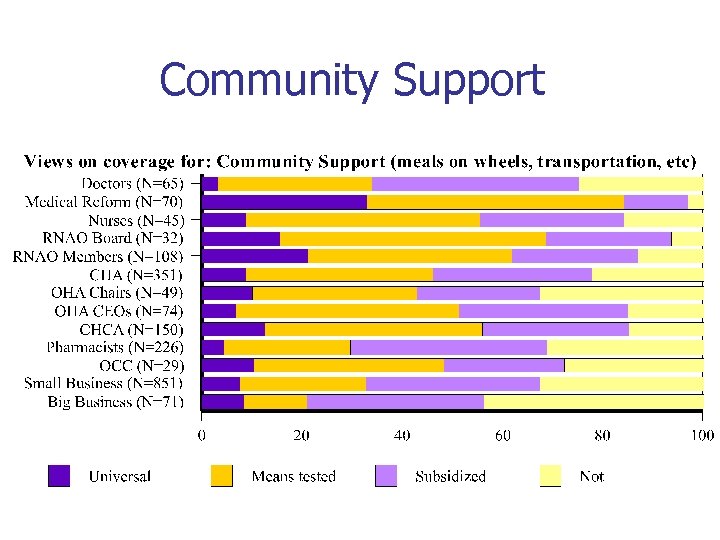
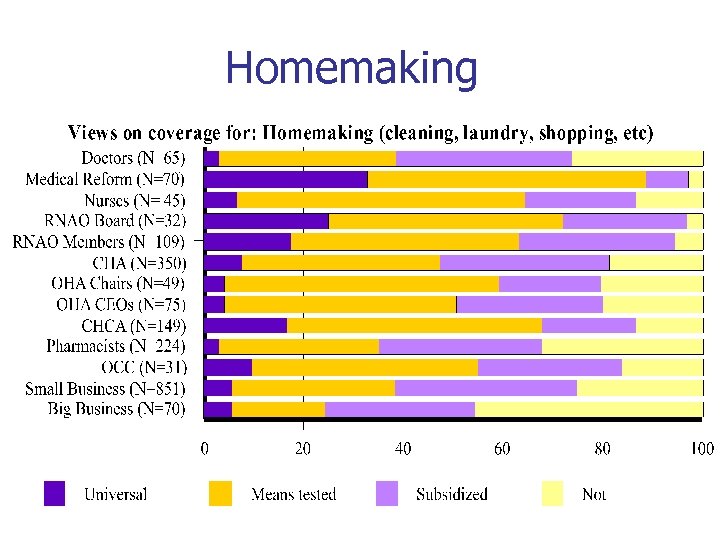
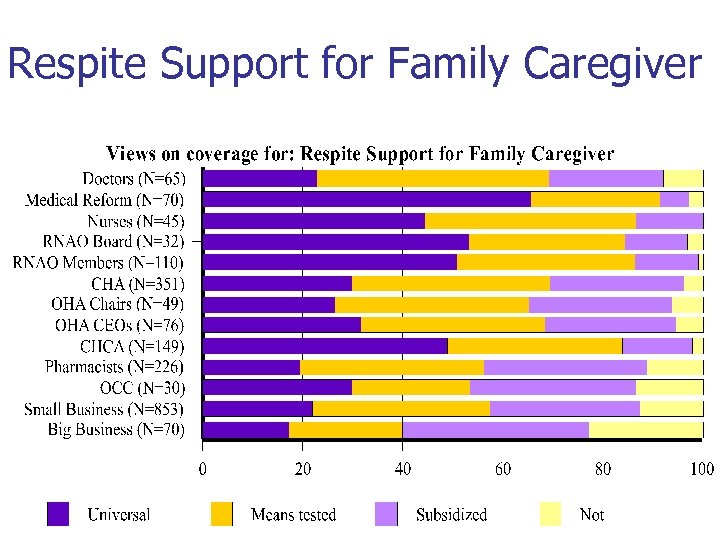
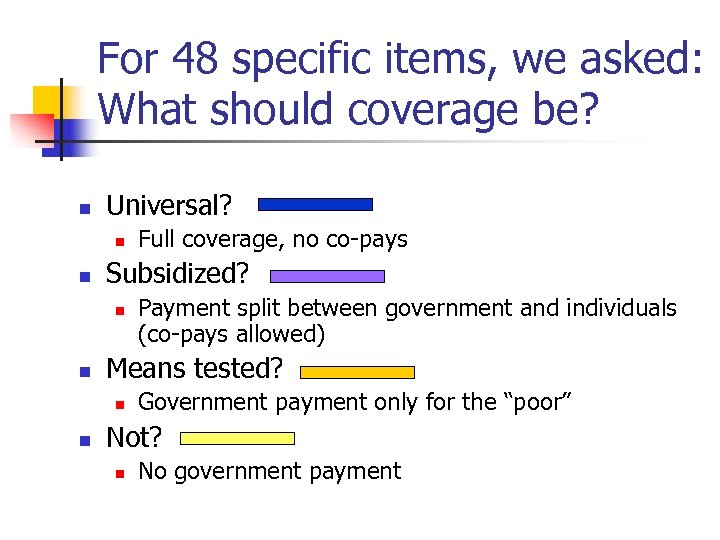 For 48 specific items, we asked: What should coverage be? n Universal? n n Subsidized? n n Payment split between government and individuals (co-pays allowed) Means tested? n n Full coverage, no co-pays Government payment only for the “poor” Not? n No government payment
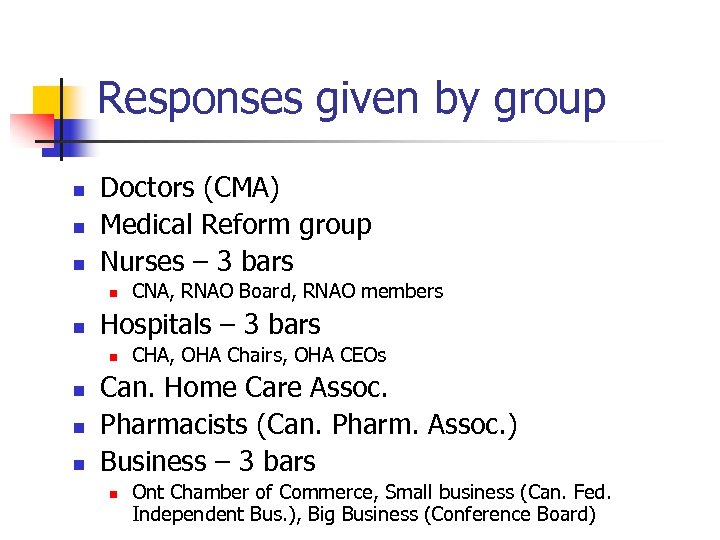 Responses given by group n n n Doctors (CMA) Medical Reform group Nurses – 3 bars n n Hospitals – 3 bars n n CNA, RNAO Board, RNAO members CHA, OHA Chairs, OHA CEOs Can. Home Care Assoc. Pharmacists (Can. Pharm. Assoc. ) Business – 3 bars n Ont Chamber of Commerce, Small business (Can. Fed. Independent Bus. ), Big Business (Conference Board)
 Acute hospital care (in- patient)
 Long Term Care Facilities
 Nursing at Home
 Medical Supplies/Equipment at Home
 Personal Support at Home
 Community Support
 Homemaking
 Respite Support for Family Caregiver
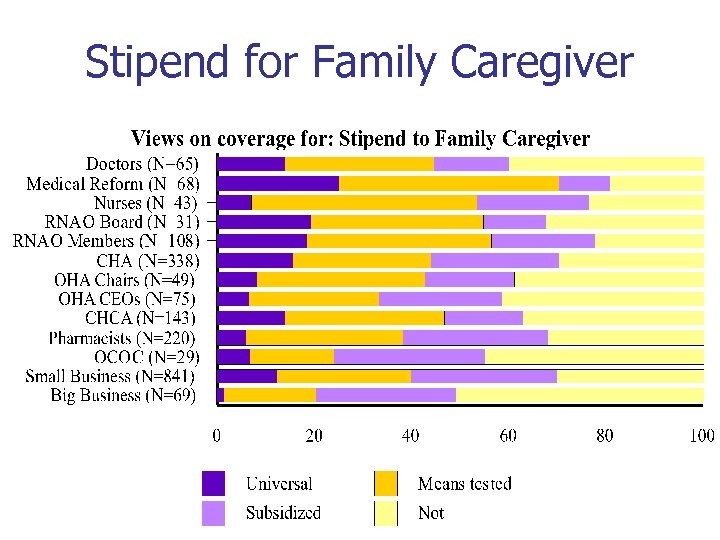 Stipend for Family Caregiver
 Bottom line? n n n Consensus that hospital-based services should continue to be fully insured Consensus that long-term care in institutions should involve user fees Hypothesis: Tendency to see home care as more similar to LTC facilities than to hospitals
 Result? n n n Little support for full universal coverage for home-based professional care Even less support for full universal coverage for community support services Almost no support for paying for “women’s work”
 But… n n Nucleus of support for believing that they can be part of the system, with costs subsidized Evidence thus likely to be very important in clarifying which services are valuable, and for whom
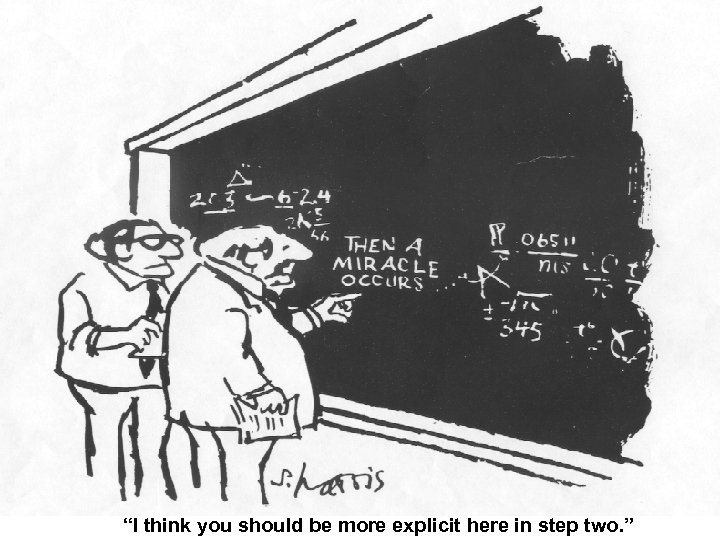 “I think you should be more explicit here in step two. ”
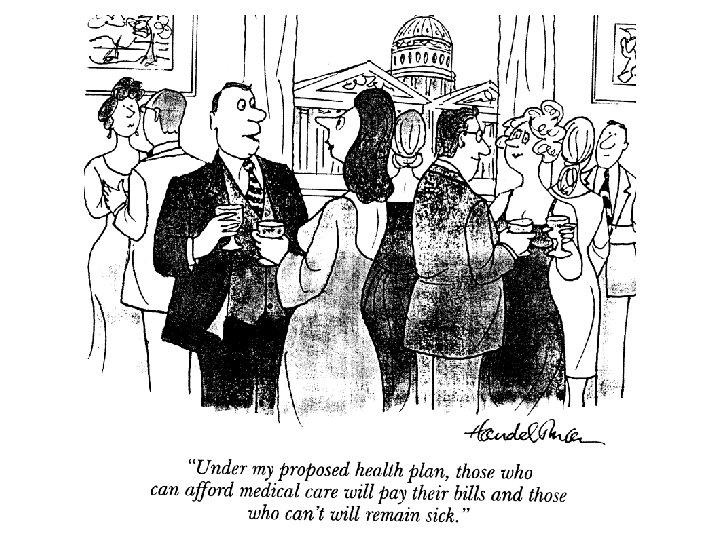
 Policy analysis or policy advocacy n Policy analysis n n balanced, objective analysis assesses multiple positions and interests may recommend a policy option n. Policy advocacy n n starts from a particular position may use tools of policy analysis to justify
 Role of CRNCC? n n n Go beyond “yea boo” Try to: n Analyze what the issues are n Distinguish between “facts” and “values” n Clarify implications of ideas, institutions, and interests Recognizing that the data can be used for more effective advocacy should you wish to do so