


 Скачать презентацию Suleyman Demirel University 2011 EXPLORATION 1 Chapter 4
exploration 1, chapter 4.pptx
- Количество слайдов: 66
 Suleyman Demirel University, 2011 EXPLORATION 1 Chapter 4 OSI Transport Layer By Zhamanov Azamat
 Suleyman Demirel University, 2011 Upon completion of this chapter, you will be able to: • Explain the need for the Transport layer. • Identify the role of the Transport layer as it provides the end-to-end transfer of data between applications. • Describe the role of two TCP/IP Transport layer protocols: TCP and UDP. • Explain the key functions of the Transport layer, including reliability, port addressing, and segmentation. • Explain how TCP and UDP each handle key functions. • Identify when it is appropriate to use TCP or UDP and provide examples of applications that use each protocol.
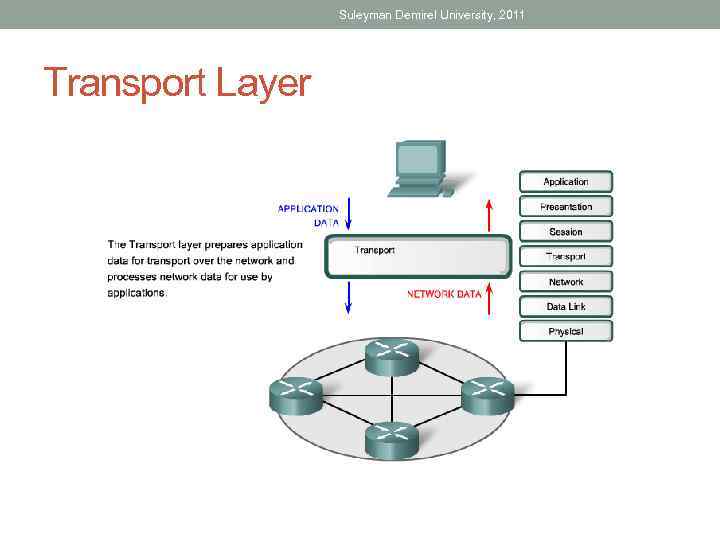 Suleyman Demirel University, 2011 Transport Layer
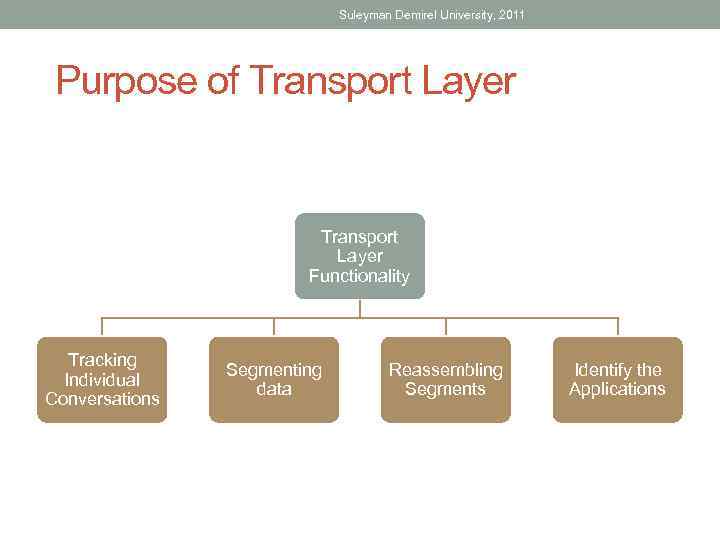 Suleyman Demirel University, 2011 Purpose of Transport Layer Functionality Tracking Individual Conversations Segmenting data Reassembling Segments Identify the Applications
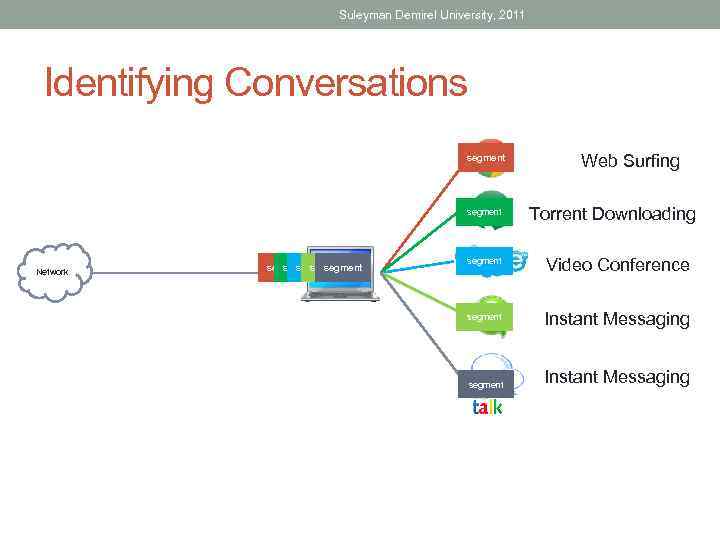
 Suleyman Demirel University, 2011 Tracking Individual Conversations • Any host may have multiple applications that are communicating across the network. Each of these applications will be communicating with one or more applications on remote hosts. It is the responsibility of the Transport layer to maintain the multiple communication streams between these applications.
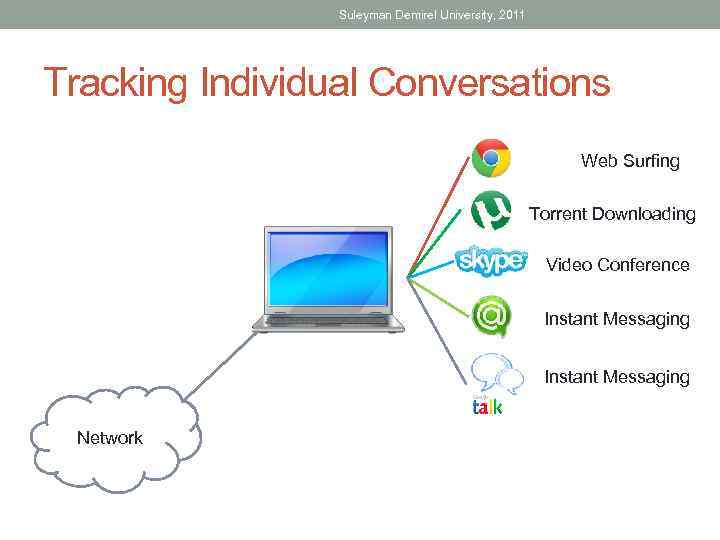 Suleyman Demirel University, 2011 Tracking Individual Conversations Web Surfing Torrent Downloading Video Conference Instant Messaging Network
 Suleyman Demirel University, 2011 Segmenting Data • The Transport layer protocols describe services that segment data from the Application layer. • This includes the encapsulation required on each piece of data. • Each piece of application data requires headers to be added at the Transport layer to indicate to which communication it is associated.
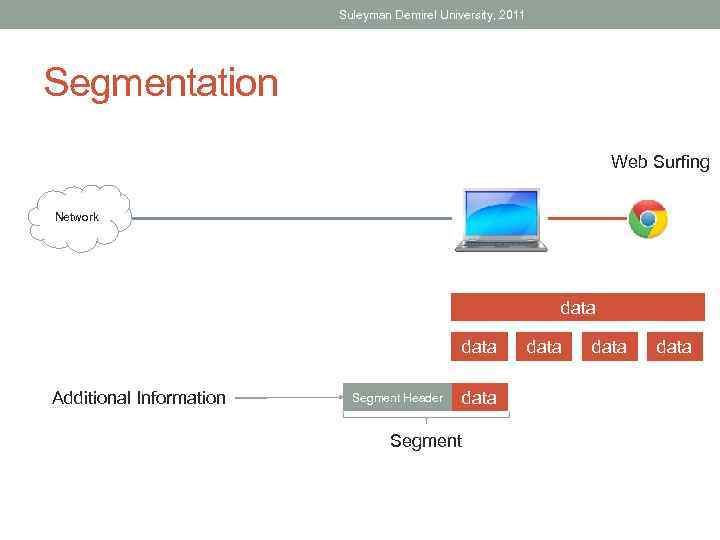 Suleyman Demirel University, 2011 Segmentation Web Surfing Network data Additional Information Segment Header Segment data
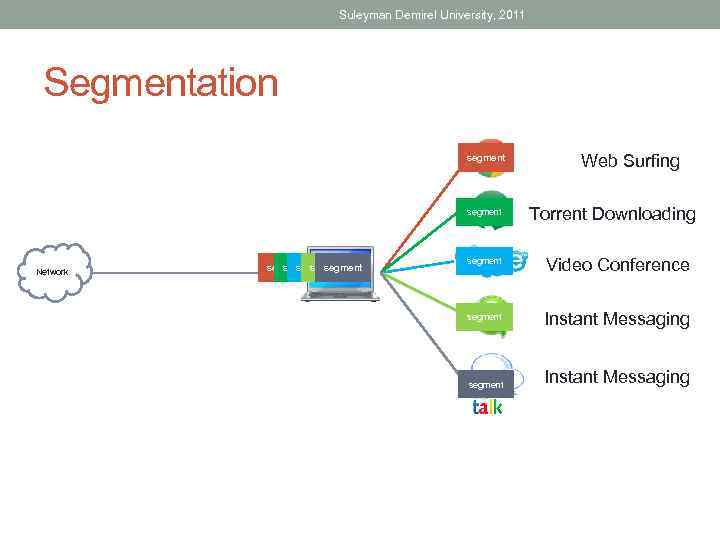 Suleyman Demirel University, 2011 Segmentation segment Network segment segment Web Surfing Torrent Downloading segment Video Conference segment Instant Messaging
 Suleyman Demirel University, 2011 Reassembling Segments • At the receiving host, each piece of data may be directed to the appropriate application. • Additionally, these individual pieces of data must also be reconstructed into a complete data stream that is useful to the Application layer. • The protocols at the Transport layer describe the how the Transport layer header information is used to reassemble the data pieces into streams to be passed to the Application layer.
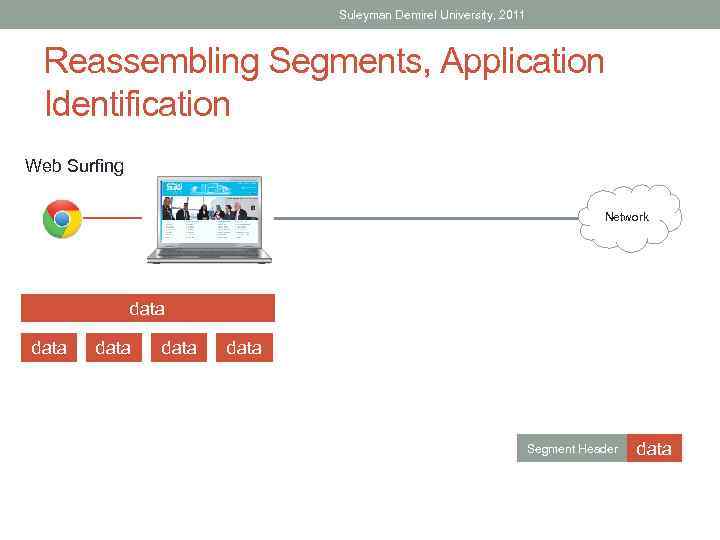 Suleyman Demirel University, 2011 Reassembling Segments, Application Identification Web Surfing Network data data Segment Header data
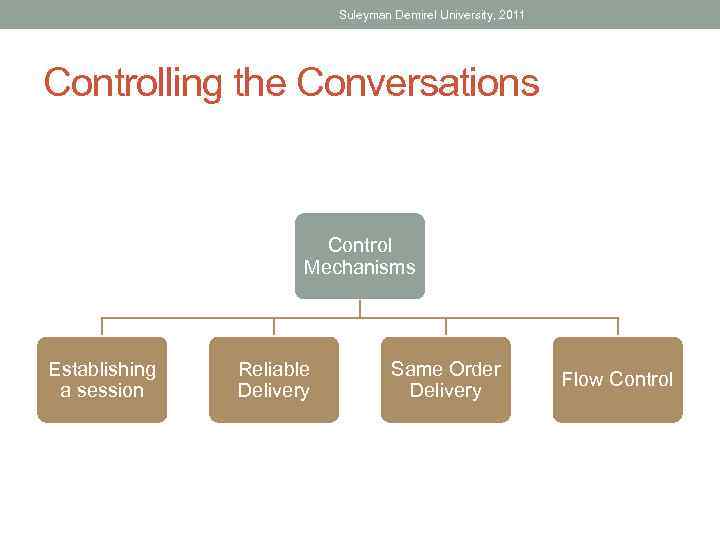 Suleyman Demirel University, 2011 Controlling the Conversations Control Mechanisms Establishing a session Reliable Delivery Same Order Delivery Flow Control
 Suleyman Demirel University, 2011 Establishing a Session • The Transport layer can provide this connection orientation by creating a sessions between the applications. These connections prepare the applications to communicate with each other before any data is transmitted. Within these sessions, the data for a communication between the two applications can be closely managed.
 Suleyman Demirel University, 2011 Reliable Delivery • For many reasons, it is possible for a piece of data to become corrupted, or lost completely, as it is transmitted over the network. The Transport layer can ensure that all pieces reach their destination by having the source device to retransmit any data that is lost.
 Suleyman Demirel University, 2011 Same Order Delivery • Because networks may provide multiple routes that can have different transmission times, data can arrive in the wrong order. By numbering and sequencing the segments, the Transport layer can ensure that these segments are reassembled into the proper order.
 Suleyman Demirel University, 2011 Flow Control Mechanism • Network hosts have limited resources, such as memory or bandwidth. When Transport layer is aware that these resources are overtaxed, some protocols can request that the sending application reduce the rate of data flow. This is done at the Transport layer by regulating the amount of data the source transmits as a group. Flow control can prevent the loss of segments on the network and avoid the need for retransmission.
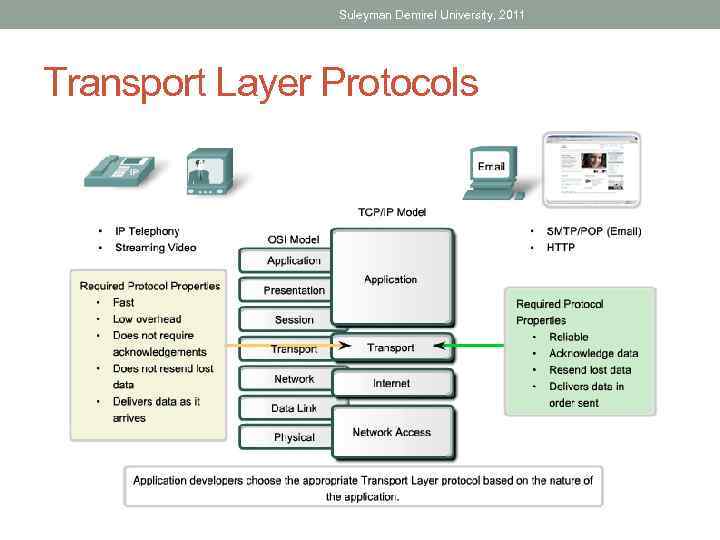
 Suleyman Demirel University, 2011 Transport Layer Protocols • Computers uses different types of Transport layers protocols by some reasons. • What is the reason for it?
 Suleyman Demirel University, 2011 Question • What kind of Computer Network Communications do you know?
 Suleyman Demirel University, 2011 Different kinds of Computer Networks • Web Browsing • File sharing • IP Telephony • Video Streaming (conference or online lesson) • Working with mail
 Suleyman Demirel University, 2011 Question • For which of them we need reliability in delivery?
 Suleyman Demirel University, 2011 Question • For which of them we need Speed in delivery?
 Suleyman Demirel University, 2011 Transport Layer Protocols
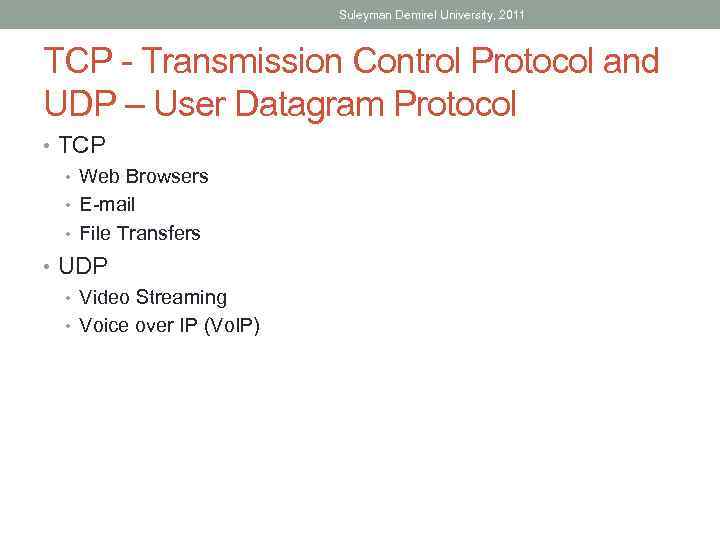 Suleyman Demirel University, 2011 TCP - Transmission Control Protocol and UDP – User Datagram Protocol • TCP • Web Browsers • E-mail • File Transfers • UDP • Video Streaming • Voice over IP (Vo. IP)
 Suleyman Demirel University, 2011 Identifying Conversations segment Network segment segment Web Surfing Torrent Downloading segment Video Conference segment Instant Messaging
 Suleyman Demirel University, 2011 Question • We can see visual different colors of segments, by using colors we separate segments. • How computers make separation between segments?
 Suleyman Demirel University, 2011 Answer • Computers use Port Addresses
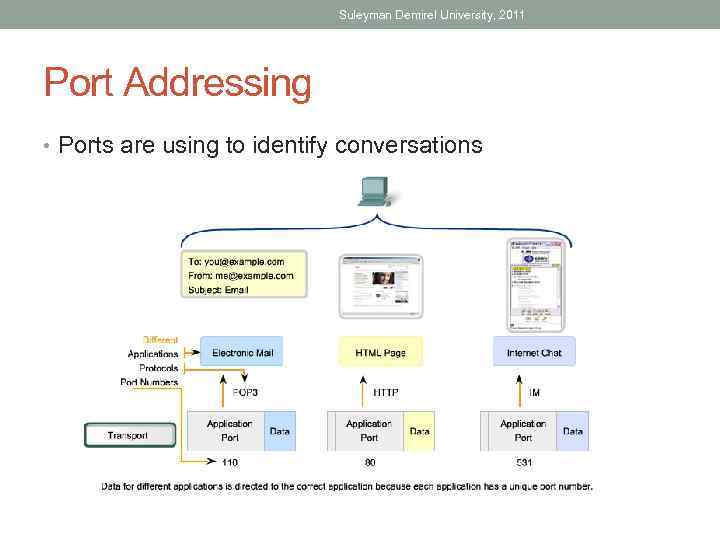 Suleyman Demirel University, 2011 Port Addressing • Ports are using to identify conversations
 Suleyman Demirel University, 2011 Port Addresses • Well Known Ports (Numbers 0 to 1023) • Registered Ports (Numbers 1024 to 49151) • Dynamic or Private Ports (Numbers 49152 to 65535) • NETSTAT is an important network utility that can be used to verify current connections
 Suleyman Demirel University, 2011 Well Known Ports • Are served for services and applications. • They are commonly used for applications such as HTTP (web server) POP 3/SMTP (e-mail server) and Telnet.
 Suleyman Demirel University, 2011 Registered Ports • Are assigned to user processes or applications. • These processes are primarily individual applications that a user has chosen to install rather than common applications that would receive a Well Known Port. • When not used for a server resource, these ports may also be used dynamically selected by a client as its source port.
 Suleyman Demirel University, 2011 Dynamic or Private Ports • Also known as Ephemeral Ports, these are usually assigned dynamically to client applications when initiating a connection. • It is not very common for a client to connect to a service using a Dynamic or Private Port (although some peer-topeer file sharing programs do).
 Suleyman Demirel University, 2011 Question • How to view states of connection in your computer?
 Suleyman Demirel University, 2011 Answer • Use Netstat
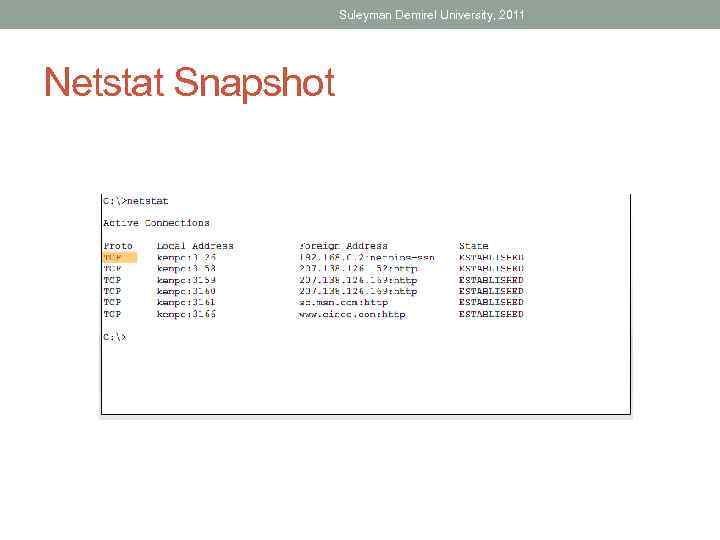 Suleyman Demirel University, 2011 Netstat Snapshot
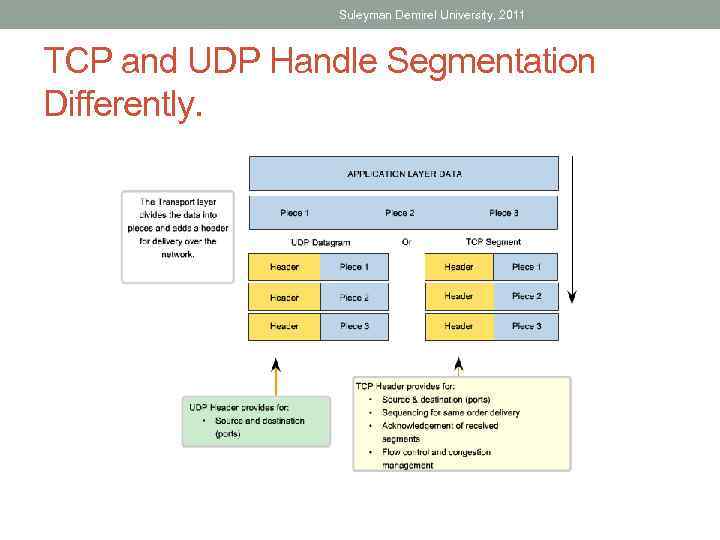 Suleyman Demirel University, 2011 TCP and UDP Handle Segmentation Differently.
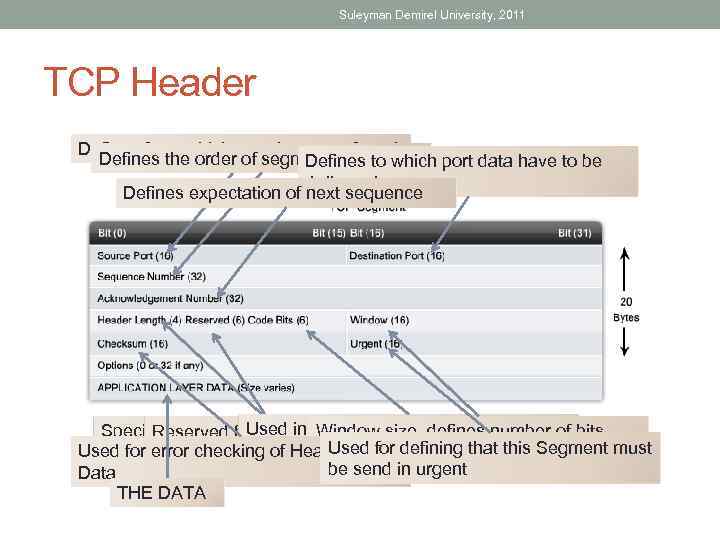 Suleyman Demirel University, 2011 TCP Header Defines from which port data transferred Defines the order of segment Defines to which port data have to be delivered Defines expectation of next sequence Used in session size, defines number Window Specify Header Length in bytes management and in of bits Reserved for something Used for treatment of and defining acknowledgment Used for error checking of Headersegments andthat this Segment must before sending be send in urgent Data THE DATA
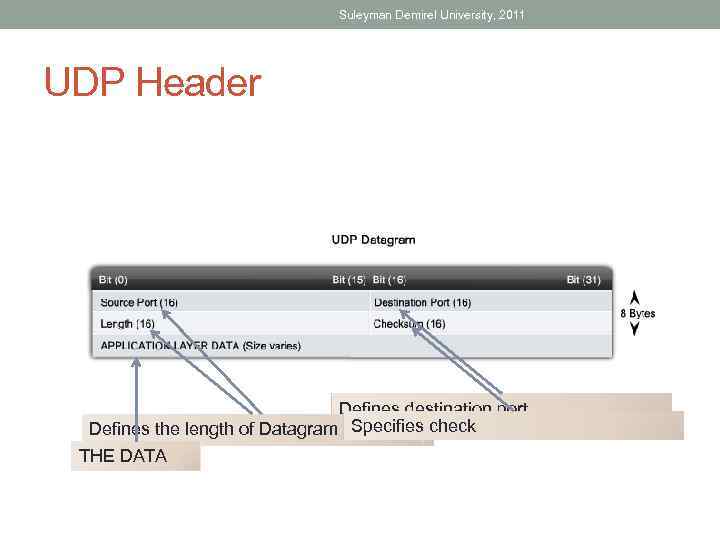 Suleyman Demirel University, 2011 UDP Header Defines destination port Defines the length of Datagram Specifies check Defines source port THE DATA
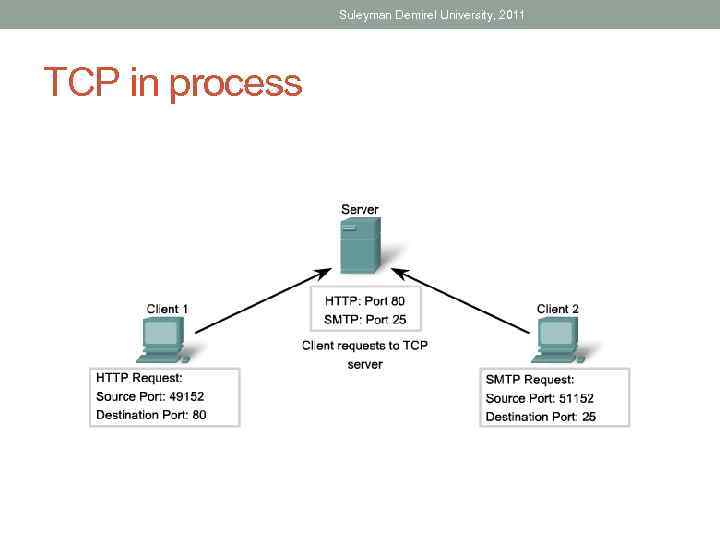 Suleyman Demirel University, 2011 TCP in process
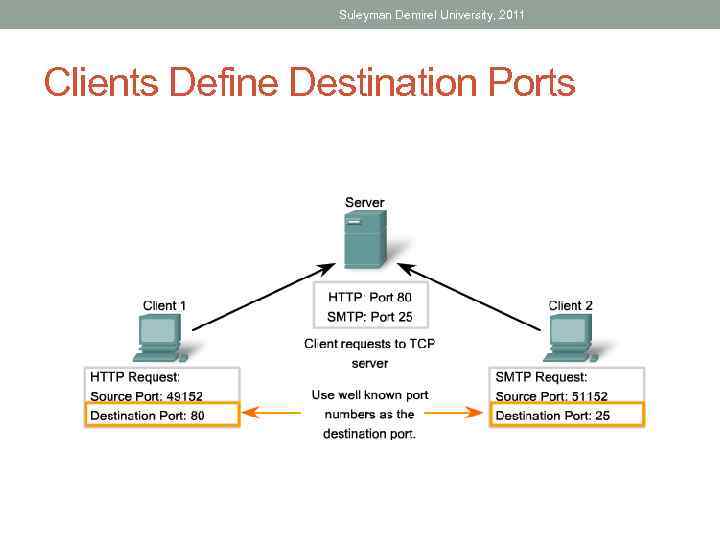 Suleyman Demirel University, 2011 Clients Define Destination Ports
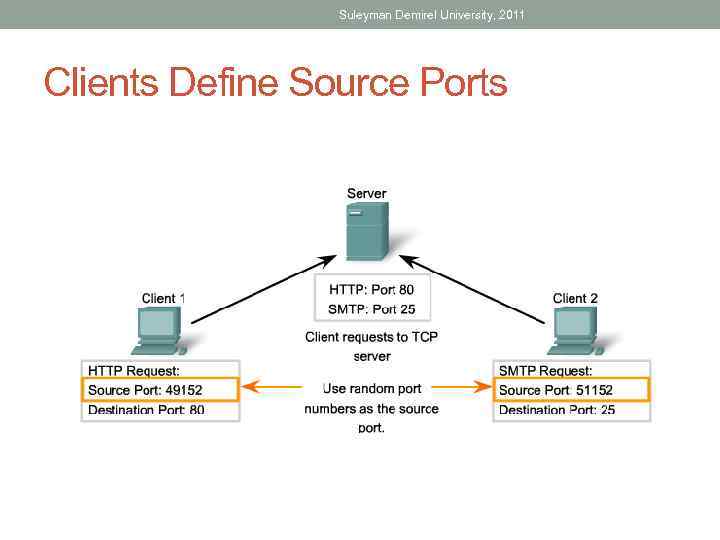 Suleyman Demirel University, 2011 Clients Define Source Ports
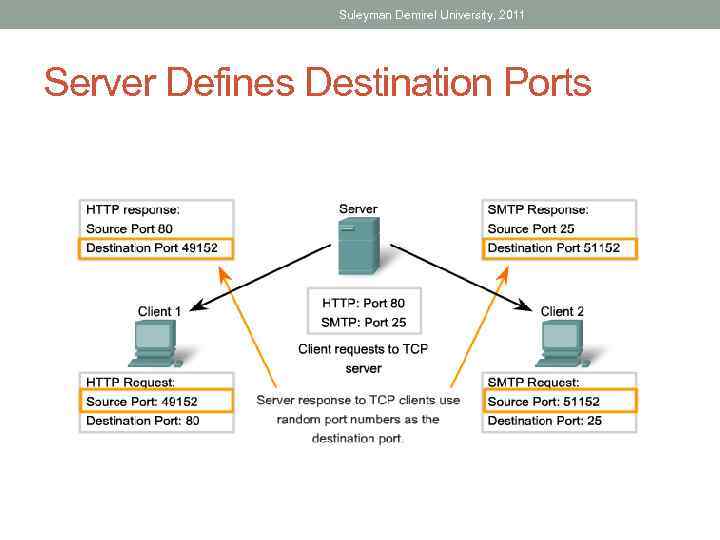 Suleyman Demirel University, 2011 Server Defines Destination Ports
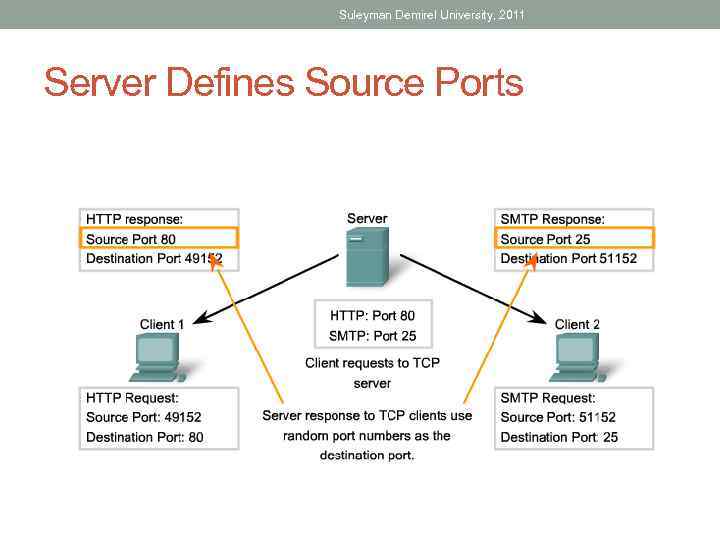 Suleyman Demirel University, 2011 Server Defines Source Ports
 Suleyman Demirel University, 2011 TCP CONNECTION ESTABLISHMENT AND TERMINATION
 Suleyman Demirel University, 2011 Question • Establishment?
 Suleyman Demirel University, 2011 Answer
 Suleyman Demirel University, 2011 Question • How me make handshake?
 Suleyman Demirel University, 2011 Answer
 Suleyman Demirel University, 2011 Question • How many way do we have in handshake process?
 Suleyman Demirel University, 2011 Answer
 Suleyman Demirel University, 2011 TCP Have to do Establishment before it Starts Transmission • This process is called 3 way handshake
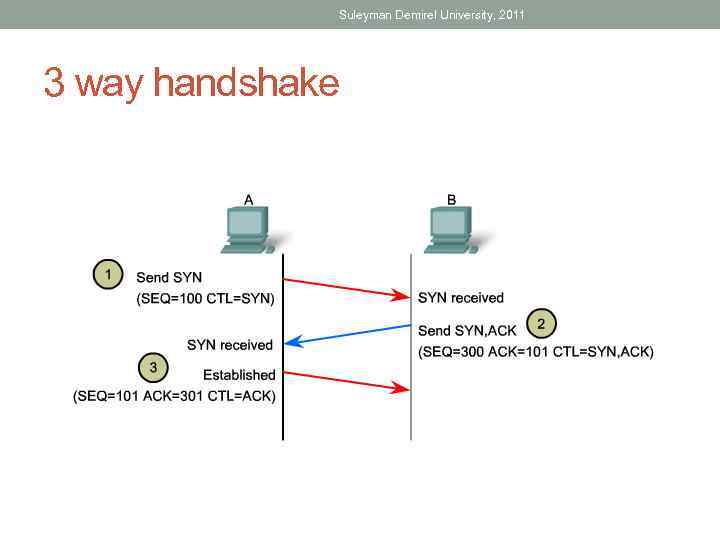 Suleyman Demirel University, 2011 3 way handshake
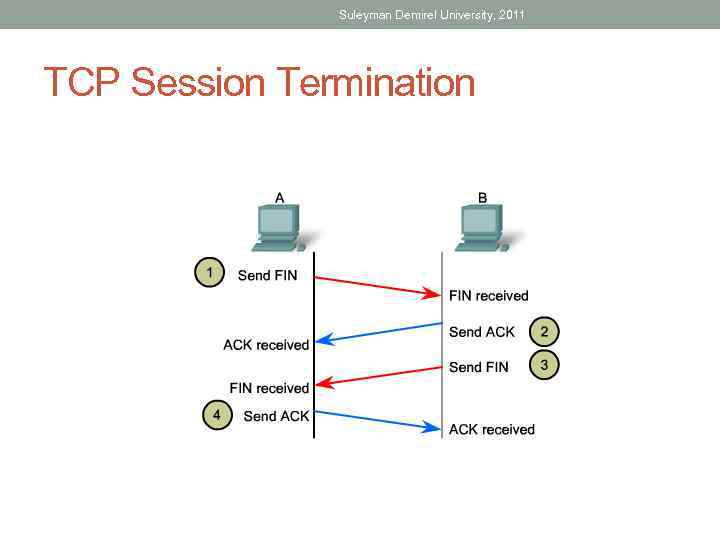 Suleyman Demirel University, 2011 TCP Session Termination
 Suleyman Demirel University, 2011 Question • How people say goodbye?
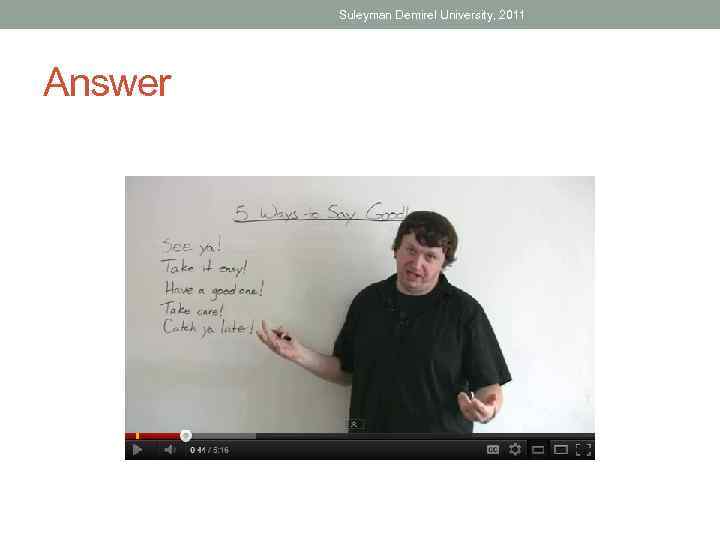 Suleyman Demirel University, 2011 Answer
 Suleyman Demirel University, 2011 REORDERING SEGMENTS AFTER RECEIVING
 Suleyman Demirel University, 2011 Question • Why it is needed?
 Suleyman Demirel University, 2011 Answer • Segments can be delivered in wrong order
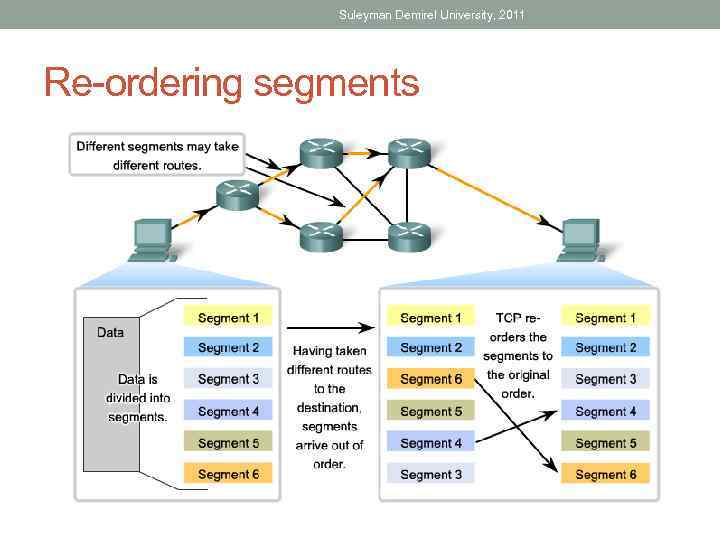 Suleyman Demirel University, 2011 Re-ordering segments
 Suleyman Demirel University, 2011 Acknowledgement • is?
 Suleyman Demirel University, 2011 Computer Acknowledgment • Computers often sends acknowledgement to each other, to confirm that they have received data.
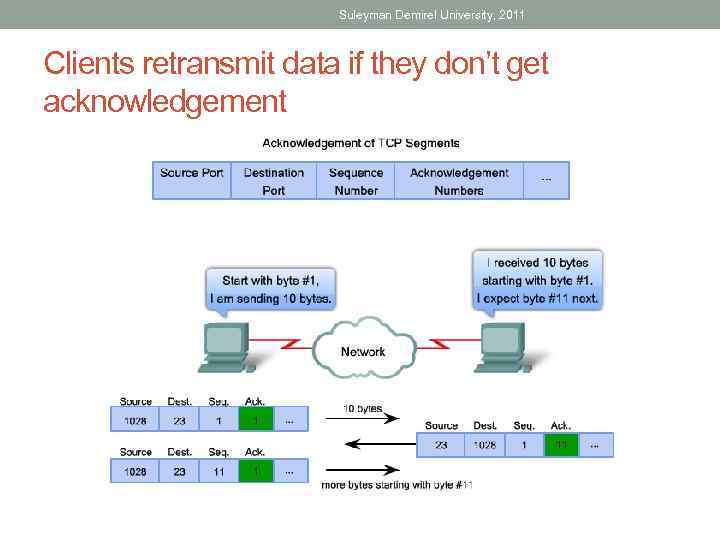 Suleyman Demirel University, 2011 Clients retransmit data if they don’t get acknowledgement
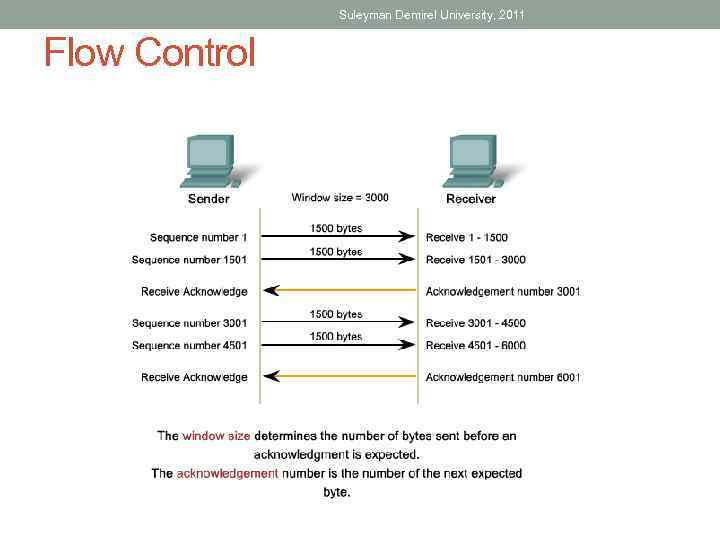 Suleyman Demirel University, 2011 Flow Control
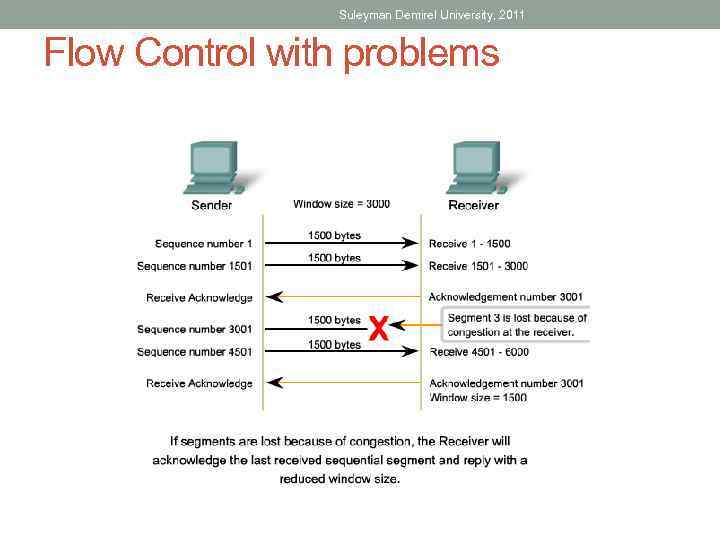 Suleyman Demirel University, 2011 Flow Control with problems
 Suleyman Demirel University, 2011 UDP – USER DATAGRAM PROTOCOL
 Suleyman Demirel University, 2011 UDP • UDP protocol is the protocol of OSI model’s 4 th layer (transport layer), is not reliable but very fast!!!
 Suleyman Demirel University, 2011 QUESTIONS