


 Скачать презентацию Suffolk Community Health Care Services GP s Presentation 24
bfd39078d30bf7d4172e78d1e4e2cd08.ppt
- Количество слайдов: 20
 Suffolk Community Health. Care Services GP’s Presentation 24 th June 2015
 Introduction We are a collaboration between: • Ipswich Hospital NHS Trust • West Suffolk NHS Foundation Trust and • Norfolk Community Health and Care Trust We are committed to working together to provide integrated, high quality safe and sustainable health care services to the communities of Suffolk with a focus on prevention and early intervention. We want to provide the right care, in the right place, at the right time for our patients and the communities we serve.
 A Consortium that is committed to providing the Right Care in the Right Place at the Right Time • Suffolk based health care for a Suffolk population • Established relationships with system partners and stakeholders • Demonstrable commitment to acute, primary and community service integration • Focussing our resources on the patient rather than our traditional organisational boundaries • Committed to wider change - NHS Five year Forward view • Three highly rated and experienced NHS providers
 Question 1 How can you ensure community resource is protected and not brought into the hospital?
 Working together to deliver Community Services efficiently • The Consortium will implement a Partnership approach to service planning, redesign and delivery • Work with GP’s and practice staff to increase community provision and develop pathways • Work with other partners to deliver integration benefits • Keep current community staff engaged to shape changes • Monitor patient feedback and engage patients in service design and delivery
 Working together to deliver Community Services efficiently • Acute Trust strategies are about increasing community provision where appropriate • Open book approach to current service costs and any changes to ensure transparency • Welcome GP and commissioner representation on Stakeholder Board • Maintain current transformation to increase patient facing time • Mobile working • Patient records • Review key pathways to identify and implement integration benefits at pace • Equality Impact Assessments for all service change • We will evaluate changes to ensure that expected benefits are delivered
 Question 2 Can queries be raised answered?
 Engaging you in change, responding to your questions, Short answer is yes, what works best for you? • Communications Plan, tailored to meet the needs of different stakeholder groups • FAQ’s • Bulletins • Q&A Portal • Satisfaction surveys • Presentations to GP Federation or other events What we really want is : • Early engagement to shape thinking • Honest discussions about GP requirements/expectations, and agreement on what is achievable – referral routes, mechanism of referral, patient communications e. g. discharge summaries • Meaningful KPI’s to measure quality and benefit
 Engaging you in change, responding to your questions, Transition/Mobilisation • Acute Trust’s recognise the pressures in community and primary care • Change inevitable, as current models are not sustainable • Stakeholder Board to invite GP and other stakeholder engagement to shape changes • Communications Plan, tailored to meet the needs of different stakeholder groups • Briefings/bulletins to share key messages, milestones, proposals Transformation • Identify key pathways and use clinical networks to inform change • Key measures to assess benefits of change • Establish relationships to facilitate timely responses to your questions.
 Question 3 Will there be a reduction in service and capacity?
 Working together to deliver Community Services efficiently • There is no intention to reduce services or capacity • Integration provides an opportunity to respond as a system • Flexibility of staff deployment to address peaks in demand • Staff rotations to enhance learning and development opportunities and create shared understanding of pathways • Maintain the current roll out of Systm. One to realise benefits
 Working together to deliver Community Services efficiently • Acute Trust strategies are about increasing community provision where appropriate • Open book approach to current service costs and any changes to ensure transparency • Welcome GP and commissioner representation on Stakeholder Board • Maintain current transformation to increase patient facing time • Mobile working • Patient records • Review key pathways to identify and implement integration benefits at pace • Equality Impact Assessments for all service change • We will evaluate changes to ensure that expected benefits are delivered
 Question 4 Which aspects of the services will be provided by whom?
 Service configuration • Principles are that patients are seen first time, every time in the most appropriate setting by staff with the appropriate skills • Align specialist community services with acute counterparts • Create ease of access to specialist advice • Select a CES/Wheelchair provider with shared vision and values • Mindful of Health and Social Care review • Five Year Forward View and Hospitals without walls • Sustainability and Future Proofing • Integration
 Service configuration • We have broad principles and preferences, but precise configuration will be confirmed during mobilisation to enable : • Thorough understanding of current configuration • Thorough understanding of interdependencies • Risks to quality an governance • Commissioner aspirations • Stakeholder engagement • Staff ideas on redesign • Health and Care Review • ‘As is’ versus ‘To be’ • Priorities • Maximum benefit • Timelines
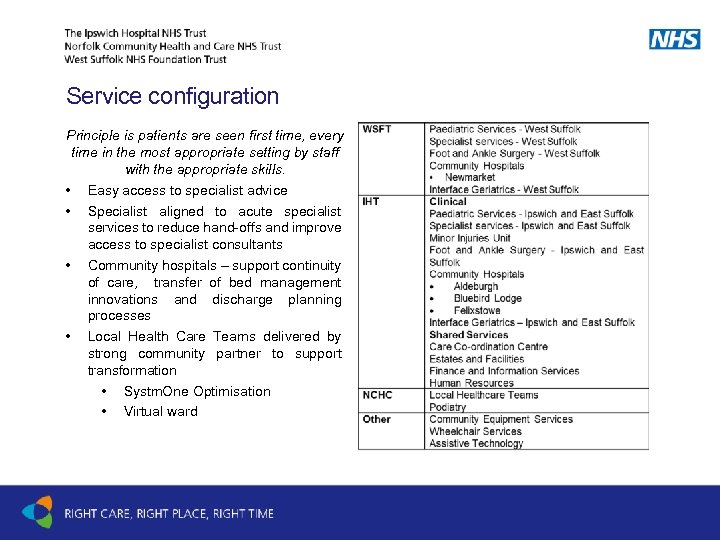 Service configuration Principle is patients are seen first time, every time in the most appropriate setting by staff with the appropriate skills. • Easy access to specialist advice • Specialist aligned to acute specialist services to reduce hand-offs and improve access to specialist consultants • Community hospitals – support continuity of care, transfer of bed management innovations and discharge planning processes • Local Health Care Teams delivered by strong community partner to support transformation • Systm. One Optimisation • Virtual ward
 Priorities in Summary We are preparing a detailed plan and checklist for an effective , timely and safe mobilisation to ensure - • Seamless / safe transfer of services from existing provider - no difference in service provided from day one • Effectively manage staff change and anxiety • Addressing the infrastructure unknowns • Embedding governance and processes - datix, SIRI, risk etc • Engagement and communication with external stakeholders
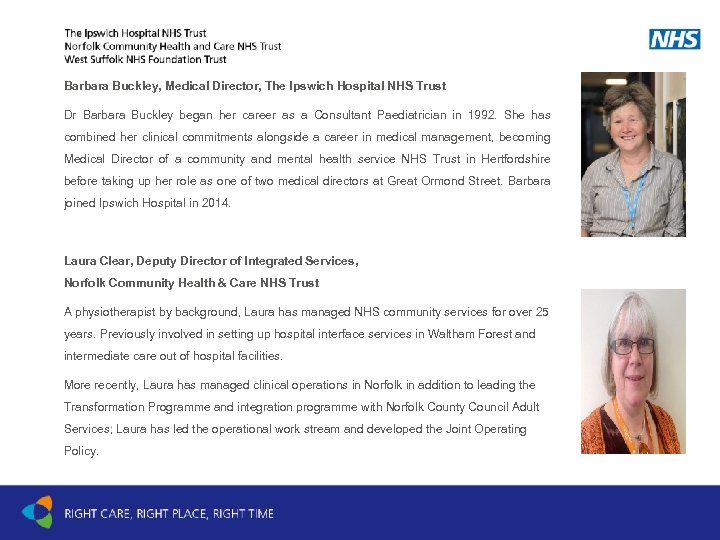 Barbara Buckley, Medical Director, The Ipswich Hospital NHS Trust Dr Barbara Buckley began her career as a Consultant Paediatrician in 1992. She has combined her clinical commitments alongside a career in medical management, becoming Medical Director of a community and mental health service NHS Trust in Hertfordshire before taking up her role as one of two medical directors at Great Ormond Street. Barbara joined Ipswich Hospital in 2014. Laura Clear, Deputy Director of Integrated Services, Norfolk Community Health & Care NHS Trust A physiotherapist by background, Laura has managed NHS community services for over 25 years. Previously involved in setting up hospital interface services in Waltham Forest and intermediate care out of hospital facilities. More recently, Laura has managed clinical operations in Norfolk in addition to leading the Transformation Programme and integration programme with Norfolk County Council Adult Services; Laura has led the operational work stream and developed the Joint Operating Policy.
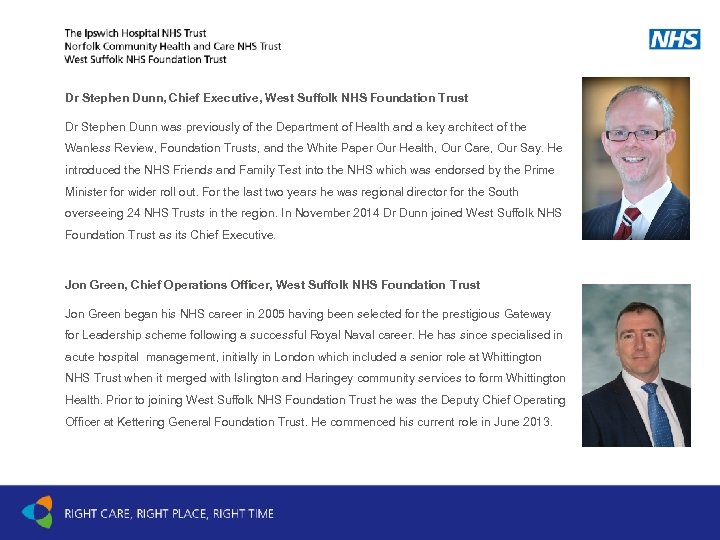 Dr Stephen Dunn, Chief Executive, West Suffolk NHS Foundation Trust Dr Stephen Dunn was previously of the Department of Health and a key architect of the Wanless Review, Foundation Trusts, and the White Paper Our Health, Our Care, Our Say. He introduced the NHS Friends and Family Test into the NHS which was endorsed by the Prime Minister for wider roll out. For the last two years he was regional director for the South overseeing 24 NHS Trusts in the region. In November 2014 Dr Dunn joined West Suffolk NHS Foundation Trust as its Chief Executive. Jon Green, Chief Operations Officer, West Suffolk NHS Foundation Trust Jon Green began his NHS career in 2005 having been selected for the prestigious Gateway for Leadership scheme following a successful Royal Naval career. He has since specialised in acute hospital management, initially in London which included a senior role at Whittington NHS Trust when it merged with Islington and Haringey community services to form Whittington Health. Prior to joining West Suffolk NHS Foundation Trust he was the Deputy Chief Operating Officer at Kettering General Foundation Trust. He commenced his current role in June 2013.
 Thank you