


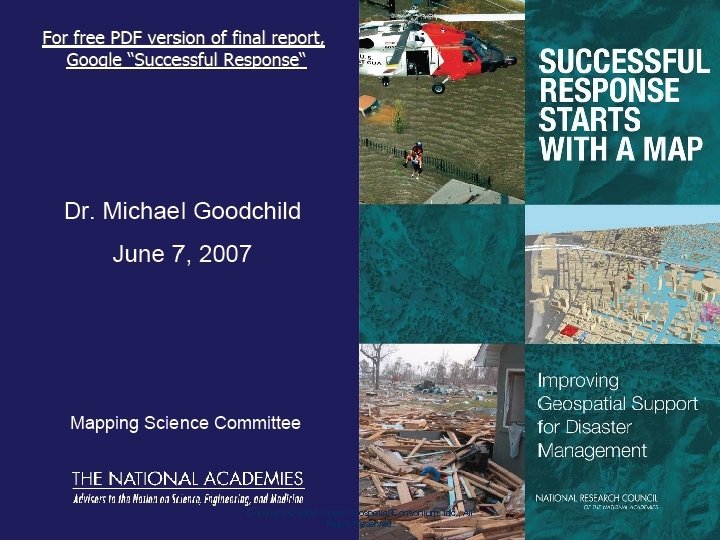
 Скачать презентацию Successful Response Starts with a Map The US
1ed8e967a62e8bfe0fdc5bc29ee03d42.ppt
- Количество слайдов: 24
 Successful Response Starts with a Map: The US National Academy Study and OGC Projects that illustrate how technology can be used to meet a number of the Study Recommendations GSDI 10 Trinidad Tobago Carl Reed, Ph. D CTO, Open Geospatial Consortium February 29, 2008 Copyright © 2008, Open Geospatial Consortium, Inc. , All Rights Reserved.
 Agenda • "Wise men talk because they have something to say; fools, because they have to say something. " -Plato Copyright © 2008, Open Geospatial Consortium, Inc. , All Rights Reserved. Helping the World to Communicate Geographically
 The Problem Statement • Every year, natural and technological hazards in the United States cost an estimated $1 billion per week in the form of lives lost and public and private properties destroyed. • Yet, EM planners and responders cannot get the information they need when the need it in the format they need it in! • OR: Grand Challenge #1—Provide hazard and disaster information where and when it is needed. – National Science and Technology Council, Committee on Environment and Natural Resources, 2005. Copyright © 2008, Open Geospatial Consortium, Inc. , All Rights Reserved. Helping the World to Communicate Geographically
 Study Background • Requested by: NASA, NOAA, NGA, USGS • Goal: Evaluate the current use of geospatial data and tools in emergency management and make recommendations to improve that use • Process: Committee of 13 with backgrounds in federal, state, and local emergency management. • Product: A report with a vision and recommendations for more effective use of geospatial data for EM and enhanced cooperation between different EM geospatial users. Copyright © 2008, Open Geospatial Consortium, Inc. , All Rights Reserved. Helping the World to Communicate Geographically
 Recommendations 1. Agency strategic planning documents must explicitly state the role of geospatial data and tools for EM 2. Strengthen the current system of US NSDI governance to insure strong national leadership 3. Must establish policies and guidelines that address the sharing of geospatial data in support of all phases of EM Copyright © 2008, Open Geospatial Consortium, Inc. , All Rights Reserved. Helping the World to Communicate Geographically
 Recommendations 4. DHS should lead development of a nationally coordinated set of security requirements for data to be shared for emergency preparedness and response. 5. Contracts and other procurement mechanisms in place to permit emergency managers to acquire geospatial data and share data assets rapidly during disasters. 6. Address communication problems that currently inhibit communication between first responders and coordinating centers Copyright © 2008, Open Geospatial Consortium, Inc. , All Rights Reserved. Helping the World to Communicate Geographically
 Recommendations 7. National Response Plan needs to include backup and archiving of geospatial data, tools, and procedures developed as part of disaster response and recovery. 8. Agencies with responsibility for funding research on emergency management should support the adaptation, development, and improvement of geospatial tools for EM 9. Academic EM curricula should increase the emphasis given to geospatial data and tools and Geospatial professionals who may be involved in emergency response should receive increased training in EM business processes and practices Copyright © 2008, Open Geospatial Consortium, Inc. , All Rights Reserved. Helping the World to Communicate Geographically
 Recommendations 10. FEMA: expand team of permanent geospatial professionals and develop strategies for more rapid deployment. 11. Establish and maintain a secure list of appropriately qualified geospatial professionals who can support emergency response during disasters. 12. DHS should expand focus a component of its grant programs to promote geospatial preparedness Copyright © 2008, Open Geospatial Consortium, Inc. , All Rights Reserved. Helping the World to Communicate Geographically
 Examples of Emergency Management related reference architectures and approaches Copyright © 2008, Open Geospatial Consortium, Inc. , All Rights Reserved.
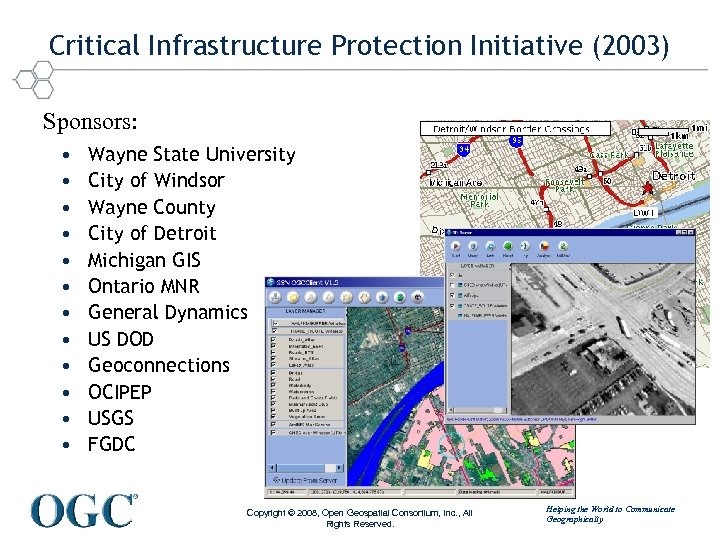 Critical Infrastructure Protection Initiative (2003) Sponsors: • • • Wayne State University City of Windsor Wayne County City of Detroit Michigan GIS Ontario MNR General Dynamics US DOD Geoconnections OCIPEP USGS FGDC Copyright © 2008, Open Geospatial Consortium, Inc. , All Rights Reserved. Helping the World to Communicate Geographically
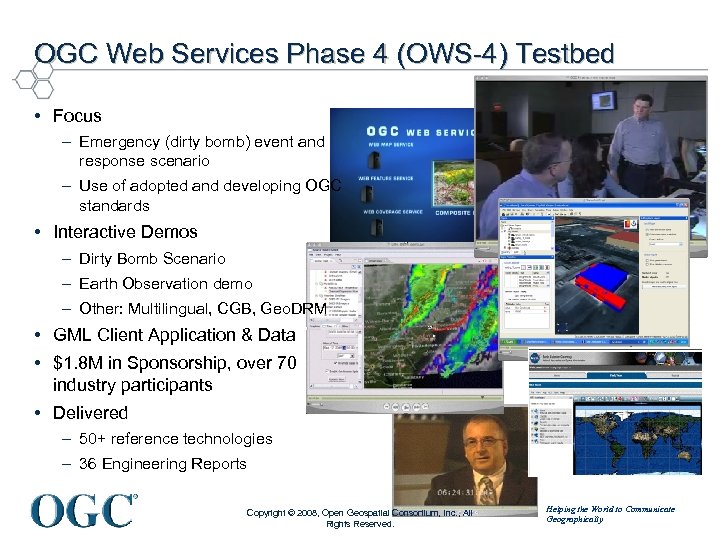 OGC Web Services Phase 4 (OWS-4) Testbed • Focus – Emergency (dirty bomb) event and response scenario – Use of adopted and developing OGC standards • Interactive Demos – Dirty Bomb Scenario – Earth Observation demo – Other: Multilingual, CGB, Geo. DRM • GML Client Application & Data • $1. 8 M in Sponsorship, over 70 industry participants • Delivered – 50+ reference technologies – 36 Engineering Reports Copyright © 2008, Open Geospatial Consortium, Inc. , All Rights Reserved. Helping the World to Communicate Geographically
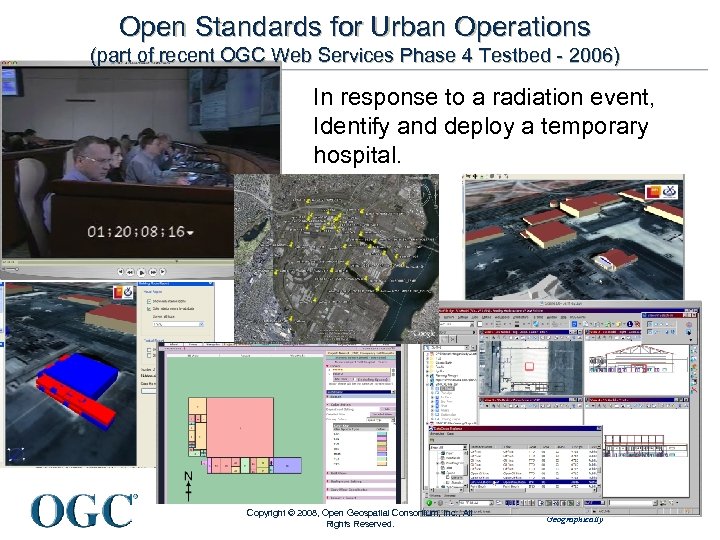 Open Standards for Urban Operations (part of recent OGC Web Services Phase 4 Testbed - 2006) In response to a radiation event, Identify and deploy a temporary hospital. Copyright © 2008, Open Geospatial Consortium, Inc. , All Rights Reserved. Helping the World to Communicate Geographically
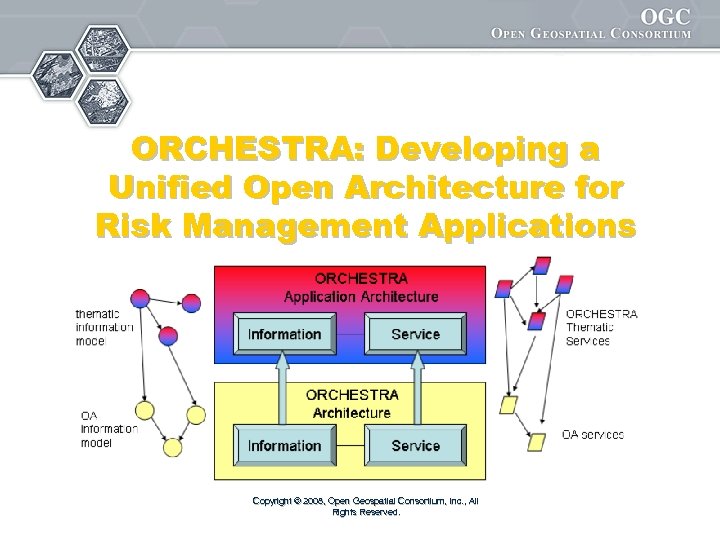 ORCHESTRA: Developing a Unified Open Architecture for Risk Management Applications http: //www. eu-orchestra. org/. © ORCHESTRA Consortium Copyright © 2008, Open Geospatial Consortium, Inc. , All Rights Reserved.
 What is ORCHESTRA? • A Reference Model for interoperable service architectures (platform-independent, policyindependent, etc. ) • An open web-services architecture and based on standards for risk management • Open specifications, distributed for free • Reference Model for ORCHESTRA – An OGC Best Practice – http: //portal. opengeospatial. org/files/? artifact_id=23286 Copyright © 2008, Open Geospatial Consortium, Inc. , All Rights Reserved. Helping the World to Communicate Geographically
 GEOSS Vision • Build on and add value to existing Earth-observation systems by coordinating their efforts, addressing critical gaps, supporting their interoperability, sharing information, reaching a common understanding of user requirements, and improving delivery of information to users. Copyright © 2008, Open Geospatial Consortium, Inc. , All Rights Reserved. Helping the World to Communicate Geographically
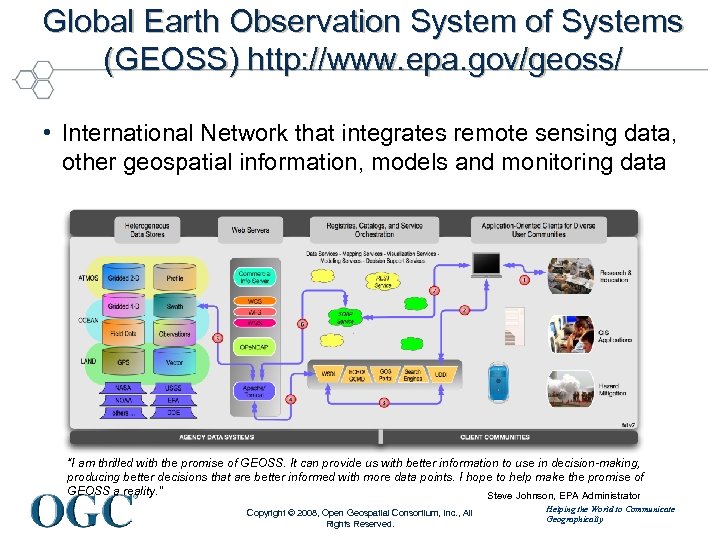 Global Earth Observation System of Systems (GEOSS) http: //www. epa. gov/geoss/ • International Network that integrates remote sensing data, other geospatial information, models and monitoring data “I am thrilled with the promise of GEOSS. It can provide us with better information to use in decision-making, producing better decisions that are better informed with more data points. I hope to help make the promise of GEOSS a reality. ” Steve Johnson, EPA Administrator Copyright © 2008, Open Geospatial Consortium, Inc. , All Rights Reserved. Helping the World to Communicate Geographically
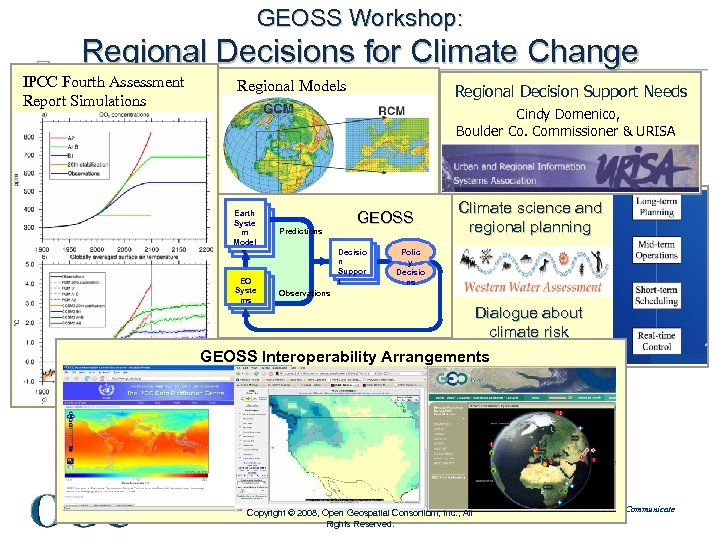 GEOSS Workshop: Regional Decisions for Climate Change IPCC Fourth Assessment Report Simulations Regional Models Regional Decision Support Needs Cindy Domenico, Boulder Co. Commissioner & URISA Earth Syste m Model s Predictions EO Syste ms Climate science and regional planning Observations GEOSS Decisio n Suppor t Polic y Decisio ns Dialogue about climate risk 20 -50 GEOSS Interoperability Arrangements year horizons Copyright © 2008, Open Geospatial Consortium, Inc. , All Rights Reserved. Helping the World to Communicate Geographically
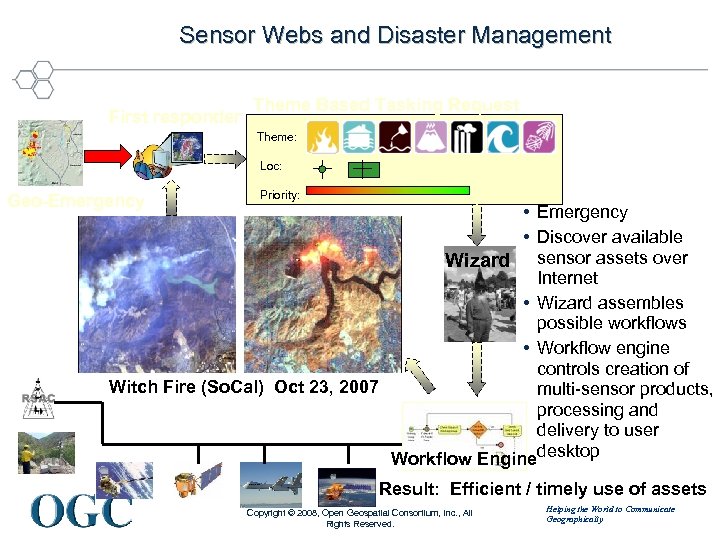 Sensor Webs and Disaster Management First responder Theme Based Tasking Request Theme: Loc: Geo-Emergency Priority: • Emergency • Discover available Wizard sensor assets over Internet • Wizard assembles possible workflows • Workflow engine controls creation of Witch Fire (So. Cal) Oct 23, 2007 multi-sensor products, processing and delivery to user Workflow Enginedesktop Result: Efficient / timely use of assets Copyright © 2008, Open Geospatial Consortium, Inc. , All Rights Reserved. Helping the World to Communicate Geographically
 Global Monitoring for Environment and Security • GMES represents a concerted effort to bring data and information providers together with users, so they can better understand each other and make environmental and security-related information available to the people who need it through enhanced or new services. Copyright © 2008, Open Geospatial Consortium, Inc. , All Rights Reserved. Helping the World to Communicate Geographically
 Copyright © 2008, Open Geospatial Consortium, Inc. , All Rights Reserved. Helping the World to Communicate Geographically
 Policy is key! Copyright © 2008, Open Geospatial Consortium, Inc. , All Rights Reserved.
 Example OGC-based Policy Positions • UK Ordnance Survey: GML Master. Map product • Canada Geospatial Data Infrastructure (CGDI) • US CIA and DHS: Part of their Geospatial Enterprise Architectures. • Australian SDI recommends use of OGC standards, • European Union INSPIRE. • Open Location Services built into consumer offerings from major location services vendors Copyright © 2008, Open Geospatial Consortium, Inc. , All Rights Reserved. Helping the World to Communicate Geographically
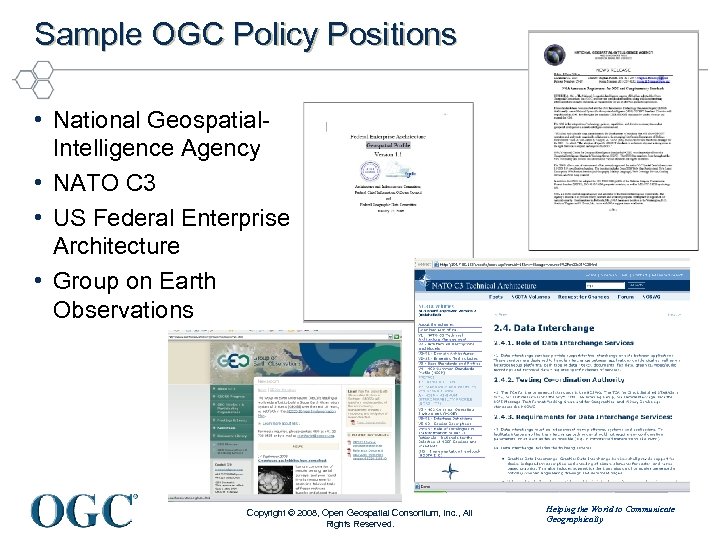 Sample OGC Policy Positions • National Geospatial. Intelligence Agency • NATO C 3 • US Federal Enterprise Architecture • Group on Earth Observations Copyright © 2008, Open Geospatial Consortium, Inc. , All Rights Reserved. Helping the World to Communicate Geographically
 Questions & Comments Carl Reed creed@opengeospatial. org Open Geospatial Consortium, Inc www. opengeospatial. org Copyright © 2008, Open Geospatial Consortium, Inc. , All Rights Reserved. Helping the World to Communicate Geographically