 Скачать презентацию Successful places with homes and jobs A NATIONAL
7b3b7e97da590334736d5996bac21191.ppt
- Количество слайдов: 34



Successful places with homes and jobs A NATIONAL AGENCY WORKING LOCALLY HOUSING LIN NORTH EAST 11 November 2015 Bill Carr
Agenda § National perspective: The importance of VOP to Government § Local context and demand: Challenges and opportunities § What do we mean by supported housing? § Case studies § A few points to note
National Perspective
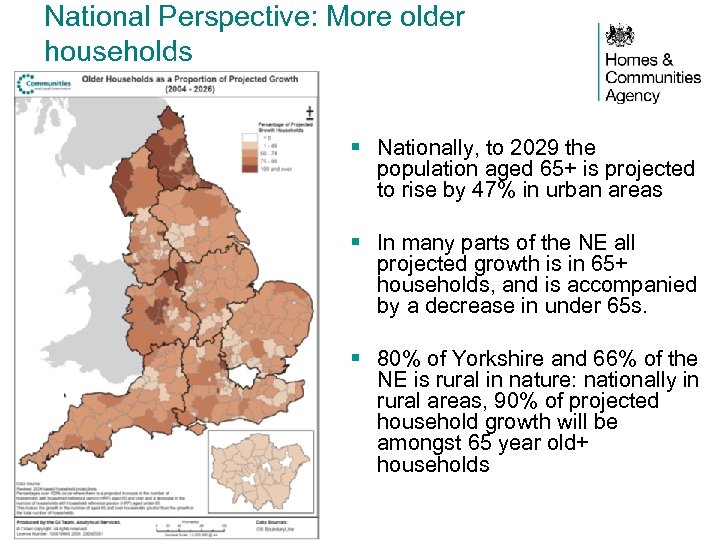
National Perspective: More older households § Nationally, to 2029 the population aged 65+ is projected to rise by 47% in urban areas § In many parts of the NE all projected growth is in 65+ households, and is accompanied by a decrease in under 65 s. § 80% of Yorkshire and 66% of the NE is rural in nature: nationally in rural areas, 90% of projected household growth will be amongst 65 year old+ households
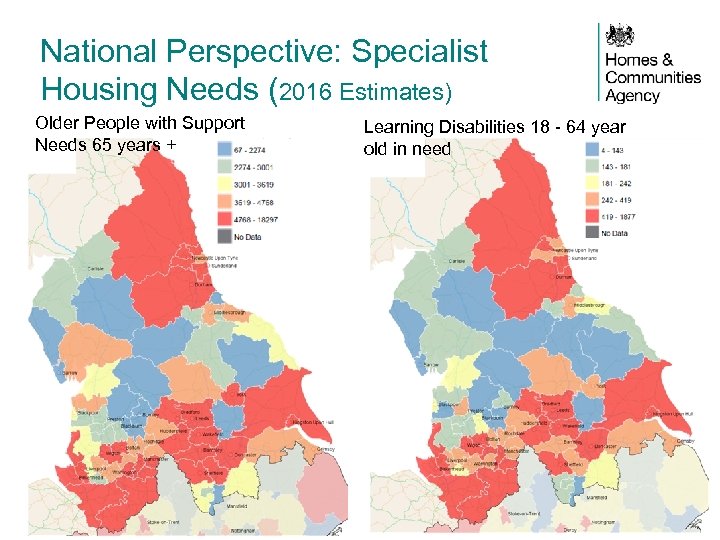
National Perspective: Specialist Housing Needs (2016 Estimates) Older People with Support Needs 65 years + Learning Disabilities 18 - 64 year old in need
The importance of VOP to Government § Increasing housing for VOP matters for public spending and the housing market § Frontier Economics, HCA (2010) – estimated a total net benefit of £ 640 m per year § Building Research Establishment (2015) has calculated that the annual cost of poor housing to the NHS is at least £ 1. 4 bn § Housing is therefore integral to the health and care agenda and needs to be part of the solution § Not just rented, options need to include home ownership
What do we know about OP? § Tend not to move – social renters most likely § Size criteria in the social rented sector only applies to tenants of working age § Home ownership is growing in 65+ age group § Outright ownership is still most common in 55+ § Number of retired home owners with mortgage is increasing § Retirement may last 25+ years meaning a range of housing options and no ‘one size fits all’ age 55+
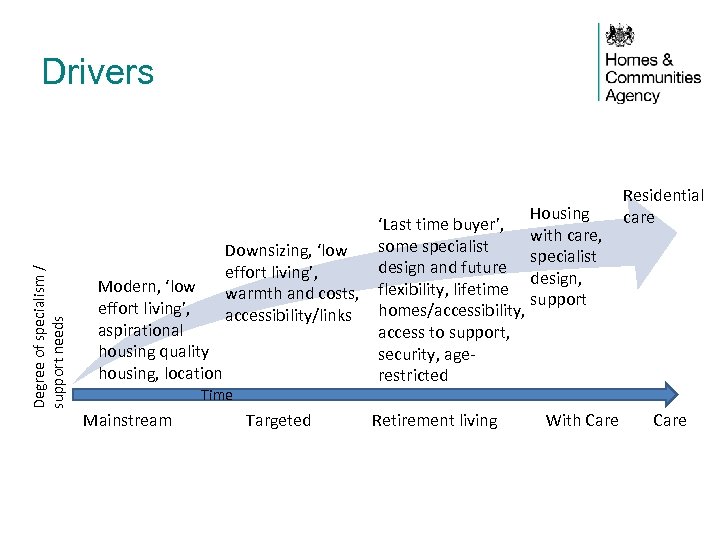
Degree of specialism / support needs Drivers Modern, ‘low effort living’, aspirational housing quality housing, location Downsizing, ‘low effort living’, warmth and costs, accessibility/links Time Mainstream Targeted Housing ‘Last time buyer’, with care, some specialist design and future design, flexibility, lifetime support homes/accessibility, access to support, security, agerestricted Retirement living With Care Residential care Care
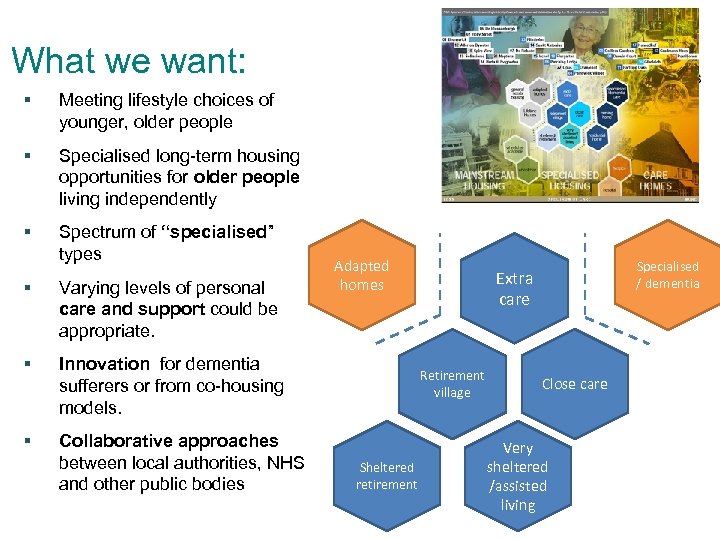
What we want: § Meeting lifestyle choices of younger, older people § Specialised long-term housing opportunities for older people living independently § Spectrum of “specialised” types § Varying levels of personal care and support could be appropriate. § Innovation for dementia sufferers or from co-housing models. § Collaborative approaches between local authorities, NHS and other public bodies Adapted homes Retirement village Sheltered retirement Specialised / dementia Extra care Close care Very sheltered /assisted living
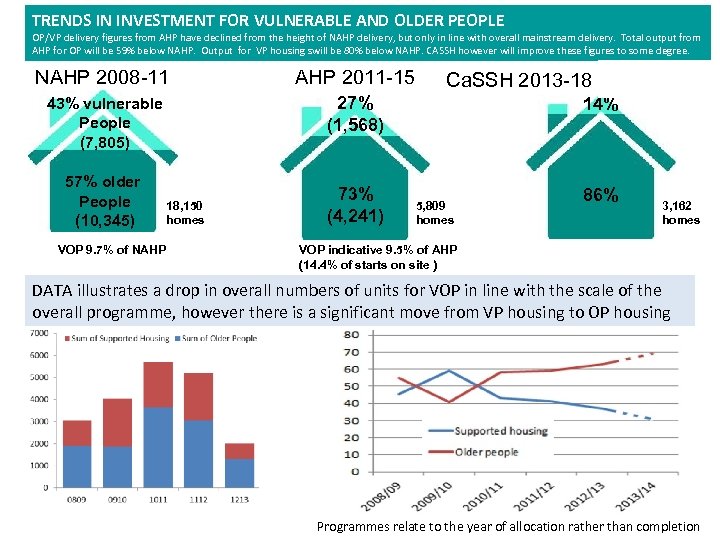
TRENDS IN INVESTMENT FOR VULNERABLE AND OLDER PEOPLE OP/VP delivery figures from AHP have declined from the height of NAHP delivery, but only in line with overall mainstream delivery. Total output from AHP for OP will be 59% below NAHP. Output for VP housing swill be 80% below NAHP. CASSH however will improve these figures to some degree. NAHP 2008 -11 AHP 2011 -15 43% vulnerable People (7, 805) 27% (1, 568) 57% older People (10, 345) VOP 9. 7% of NAHP 18, 150 homes 73% (4, 241) Ca. SSH 2013 -18 14% 5, 809 homes 86% 3, 162 homes VOP indicative 9. 5% of AHP (14. 4% of starts on site ) DATA illustrates a drop in overall numbers of units for VOP in line with the scale of the overall programme, however there is a significant move from VP housing to OP housing Programmes relate to the year of allocation rather than completion
Local Context and Demand
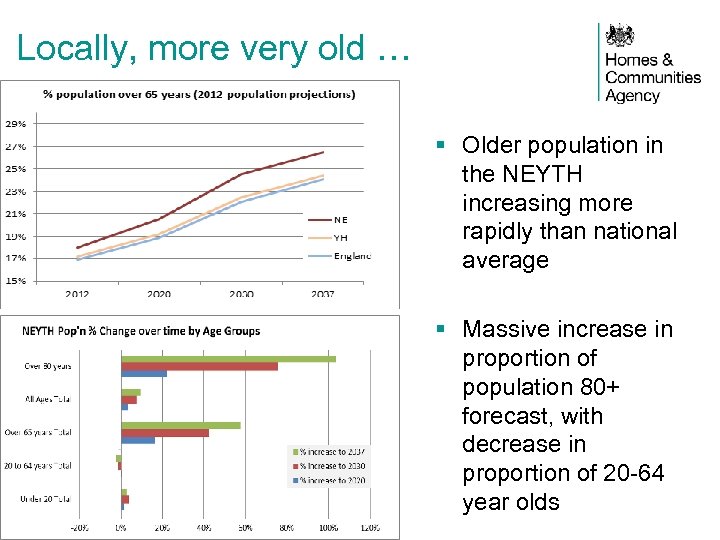
Locally, more very old … § Older population in the NEYTH increasing more rapidly than national average § Massive increase in proportion of population 80+ forecast, with decrease in proportion of 20 -64 year olds
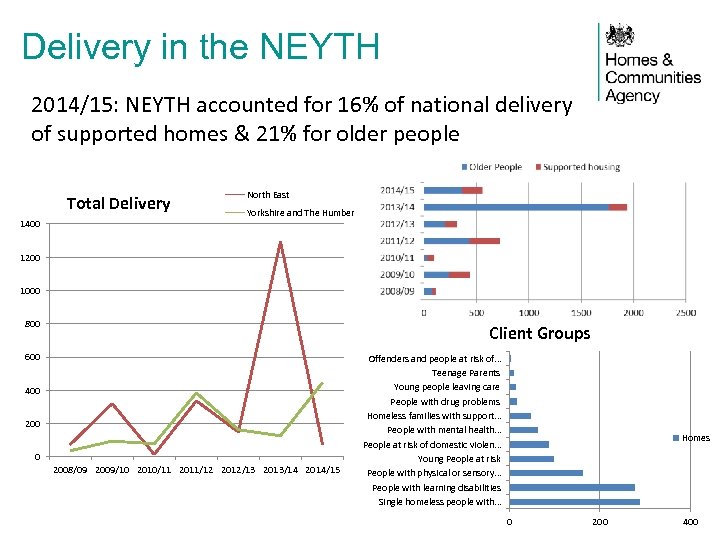
Delivery in the NEYTH 2014/15: NEYTH accounted for 16% of national delivery of supported homes & 21% for older people Total Delivery 1400 North East Yorkshire and The Humber 1200 1000 800 Client Groups 600 400 2008/09 2009/10 2010/11 2011/12 2012/13 2013/14 2014/15 Offenders and people at risk of. . . Teenage Parents Young people leaving care People with drug problems Homeless families with support. . . People with mental health. . . People at risk of domestic violen. . . Young People at risk People with physical or sensory. . . People with learning disabilities Single homeless people with. . . Homes 0 200 400
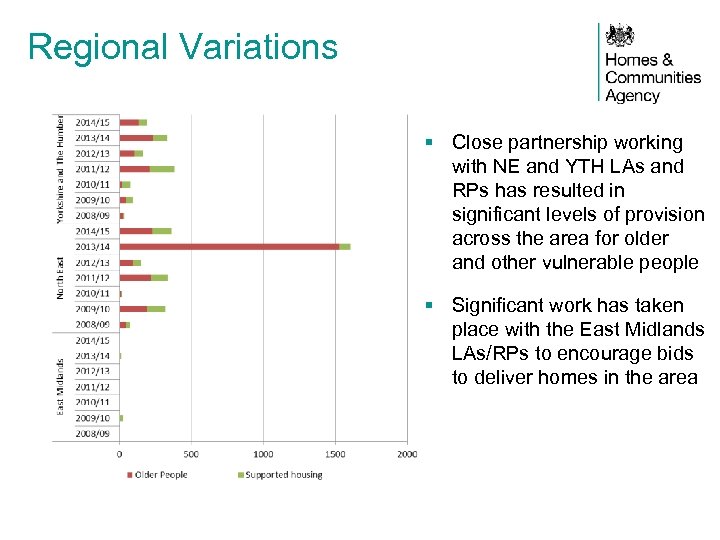
Regional Variations § Close partnership working with NE and YTH LAs and RPs has resulted in significant levels of provision across the area for older and other vulnerable people § Significant work has taken place with the East Midlands LAs/RPs to encourage bids to deliver homes in the area
What do we mean by Supported Housing?
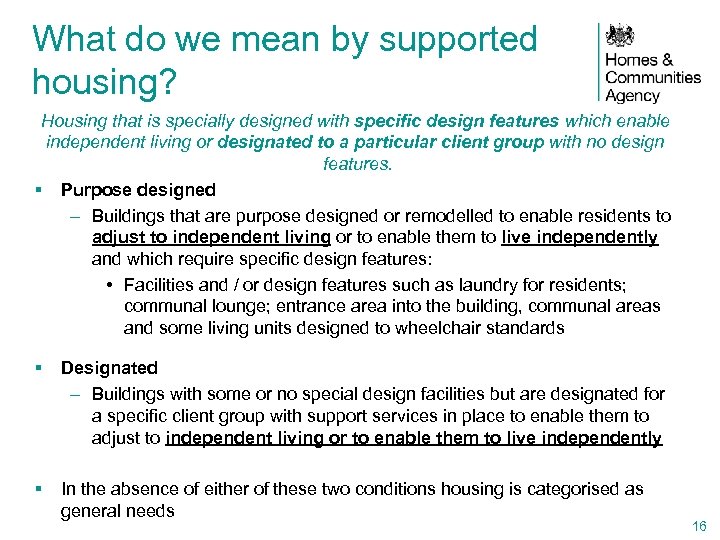
What do we mean by supported housing? Housing that is specially designed with specific design features which enable independent living or designated to a particular client group with no design features. § Purpose designed – Buildings that are purpose designed or remodelled to enable residents to adjust to independent living or to enable them to live independently and which require specific design features: • Facilities and / or design features such as laundry for residents; communal lounge; entrance area into the building, communal areas and some living units designed to wheelchair standards § Designated – Buildings with some or no special design facilities but are designated for a specific client group with support services in place to enable them to adjust to independent living or to enable them to live independently § In the absence of either of these two conditions housing is categorised as general needs 16
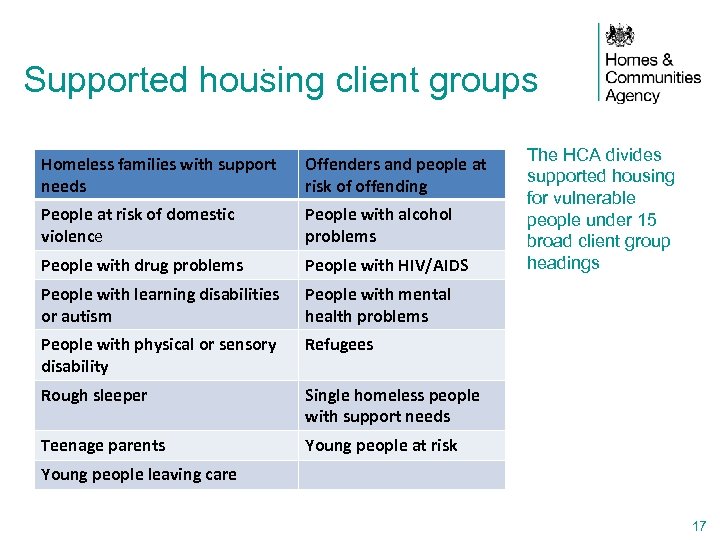
. Supported housing client groups Homeless families with support needs Offenders and people at risk of offending People at risk of domestic violence People with alcohol problems People with drug problems People with HIV/AIDS People with learning disabilities or autism People with mental health problems People with physical or sensory disability Refugees Rough sleeper Single homeless people with support needs Teenage parents The HCA divides supported housing for vulnerable people under 15 broad client group headings Young people at risk Young people leaving care 17
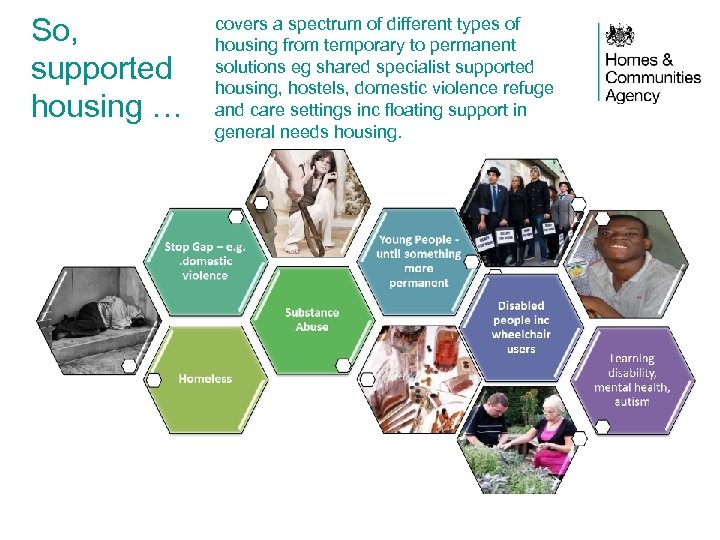
So, supported housing … covers a spectrum of different types of housing from temporary to permanent solutions eg shared specialist supported housing, hostels, domestic violence refuge and care settings inc floating support in general needs housing.
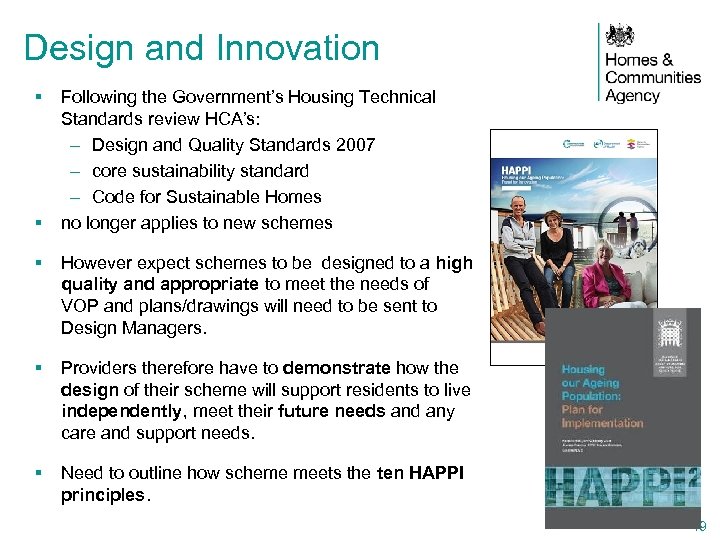
Design and Innovation § § Following the Government’s Housing Technical Standards review HCA’s: – Design and Quality Standards 2007 – core sustainability standard – Code for Sustainable Homes no longer applies to new schemes § However expect schemes to be designed to a high quality and appropriate to meet the needs of VOP and plans/drawings will need to be sent to Design Managers. § Providers therefore have to demonstrate how the design of their scheme will support residents to live independently, meet their future needs and any care and support needs. § Need to outline how scheme meets the ten HAPPI principles. 19
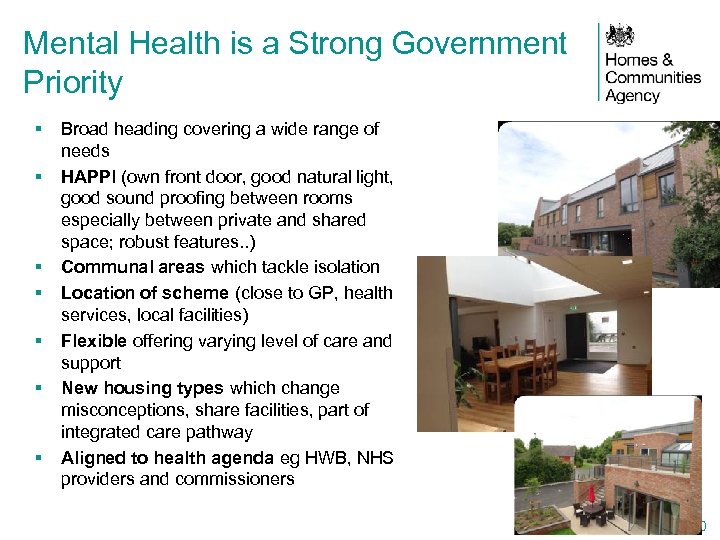
Mental Health is a Strong Government Priority § § § § Broad heading covering a wide range of needs HAPPI (own front door, good natural light, good sound proofing between rooms especially between private and shared space; robust features. . ) Communal areas which tackle isolation Location of scheme (close to GP, health services, local facilities) Flexible offering varying level of care and support New housing types which change misconceptions, share facilities, part of integrated care pathway Aligned to health agenda eg HWB, NHS providers and commissioners 20
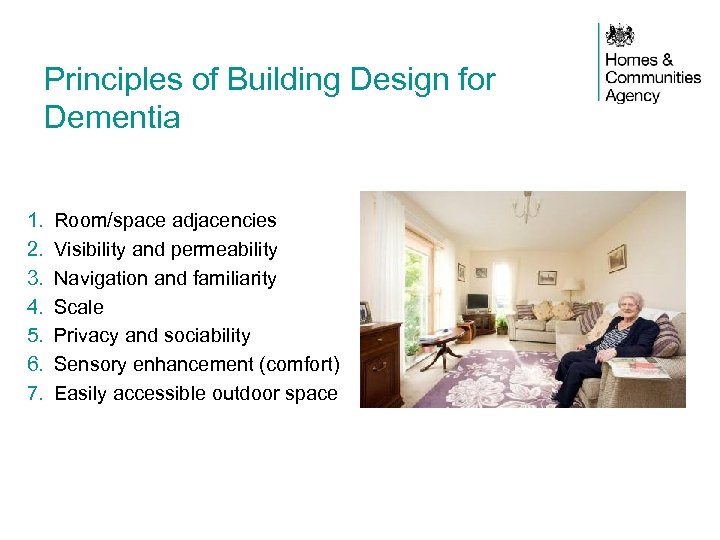
Principles of Building Design for Dementia 1. 2. 3. 4. 5. 6. 7. Room/space adjacencies Visibility and permeability Navigation and familiarity Scale Privacy and sociability Sensory enhancement (comfort) Easily accessible outdoor space
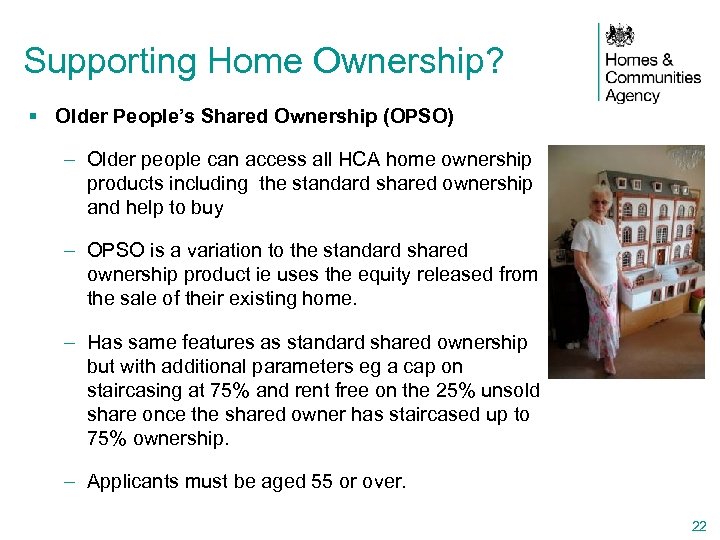
Supporting Home Ownership? § Older People’s Shared Ownership (OPSO) – Older people can access all HCA home ownership products including the standard shared ownership and help to buy – OPSO is a variation to the standard shared ownership product ie uses the equity released from the sale of their existing home. – Has same features as standard shared ownership but with additional parameters eg a cap on staircasing at 75% and rent free on the 25% unsold share once the shared owner has staircased up to 75% ownership. – Applicants must be aged 55 or over. 22
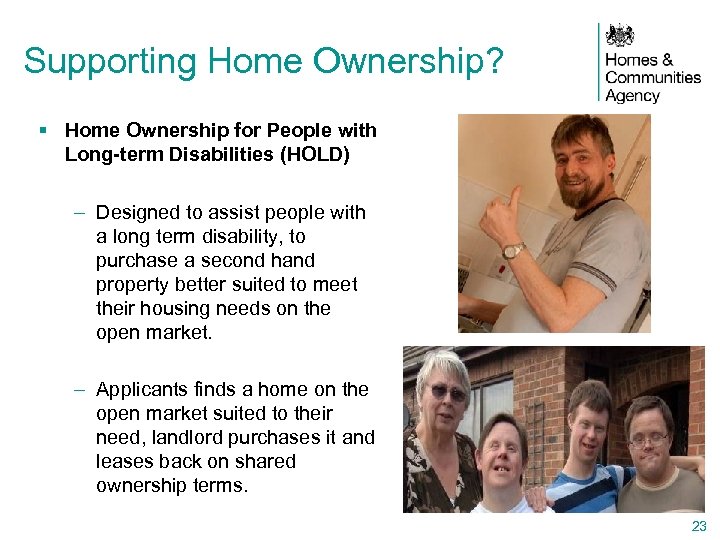
Supporting Home Ownership? § Home Ownership for People with Long-term Disabilities (HOLD) – Designed to assist people with a long term disability, to purchase a second hand property better suited to meet their housing needs on the open market. – Applicants finds a home on the open market suited to their need, landlord purchases it and leases back on shared ownership terms. 23
Grant and Section 106 units Delivery as part of S 106 § Expectation that S 106 schemes will be delivered at nil grant § HCA funding on S 106 schemes only by exception § Evidence that funding will result in provision of additional affordable housing which would not otherwise be delivered § Detailed scrutiny: – Test of economics of individual schemes through the HCA Development Appraisal Tool – Reference to the local planning authority’s viability assessment 24
Land Open bidding for most HCA sites. Requirement to deliver best value but this does not preclude innovation § We are open to ideas as to the use of land by public bodies in a mutually beneficial way that optimises land receipts as far as possible and delivers specialist accommodation for the benefit of local communities. • This may include deferred land receipt and joint ventures with housing associations and NHS providers and commissioners where the delivery of new specialised accommodation will help reduce the burden on stretched health and care budgets. 25
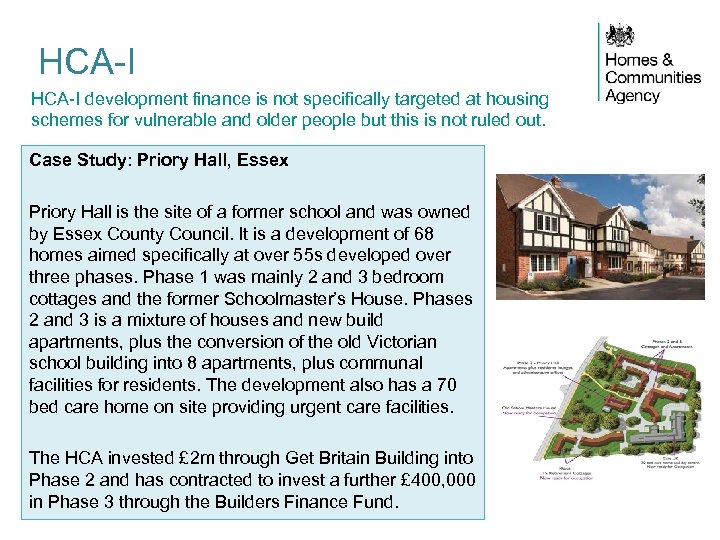
HCA-I development finance is not specifically targeted at housing schemes for vulnerable and older people but this is not ruled out. Case Study: Priory Hall, Essex Priory Hall is the site of a former school and was owned by Essex County Council. It is a development of 68 homes aimed specifically at over 55 s developed over three phases. Phase 1 was mainly 2 and 3 bedroom cottages and the former Schoolmaster’s House. Phases 2 and 3 is a mixture of houses and new build apartments, plus the conversion of the old Victorian school building into 8 apartments, plus communal facilities for residents. The development also has a 70 bed care home on site providing urgent care facilities. The HCA invested £ 2 m through Get Britain Building into Phase 2 and has contracted to invest a further £ 400, 000 in Phase 3 through the Builders Finance Fund.
Case studies
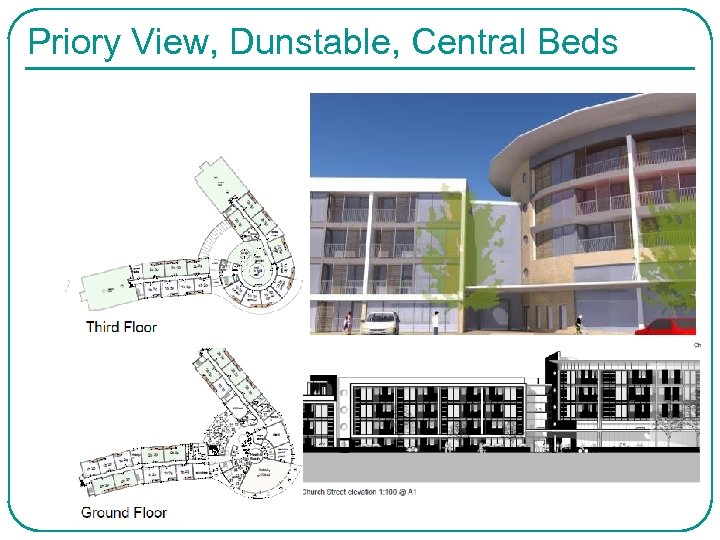
Priory View, Dunstable, Central Beds
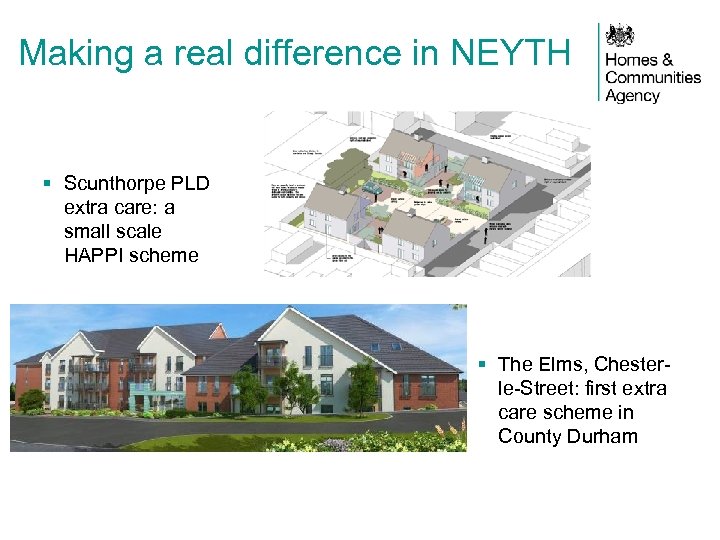
Making a real difference in NEYTH § Scunthorpe PLD extra care: a small scale HAPPI scheme § The Elms, Chesterle-Street: first extra care scheme in County Durham
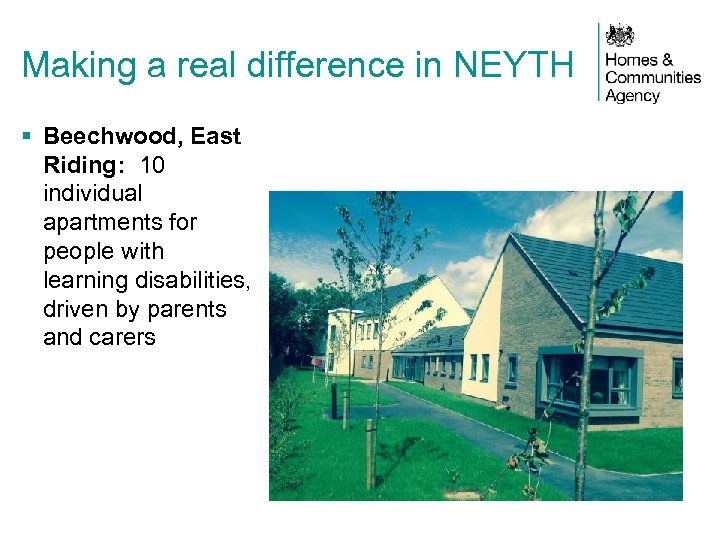
Making a real difference in NEYTH § Beechwood, East Riding: 10 individual apartments for people with learning disabilities, driven by parents and carers
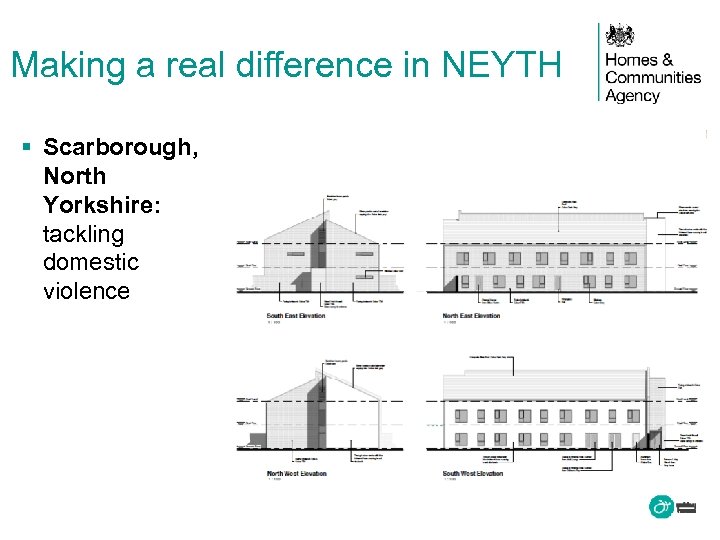
Making a real difference in NEYTH § Scarborough, North Yorkshire: tackling domestic violence
A few points to note
A few points to note § § Better Care Fund Further scope for development finance Use of public land to deliver specialist and OP housing Specialist OP housing within large scale development proposals (ATLAS) § The HCA are working with health partners to explore joint working opportunities § Three local examples: • University of Northumbria & North Tyneside MBC • • South Tyneside General Hospital & South Tyneside Homes University of Northumbria & Stockton BC 33
A Short Anecdote Mental Health and Housing Local Initiative Newcastle 1997 …………….
Скачать презентацию Successful places with homes and jobs A NATIONAL
7b3b7e97da590334736d5996bac21191.ppt