


 Скачать презентацию Successful Intervention Plans from Start to Finish Amanda
ff3e6a7cdeebeb48f1ffcdb8c1341476.ppt
- Количество слайдов: 24
 Successful Intervention Plans from Start to Finish Amanda Geidel, Director of Special Education Assistant Professor of Education Concordia University, Nebraska Amanda. geidel@cune. edu
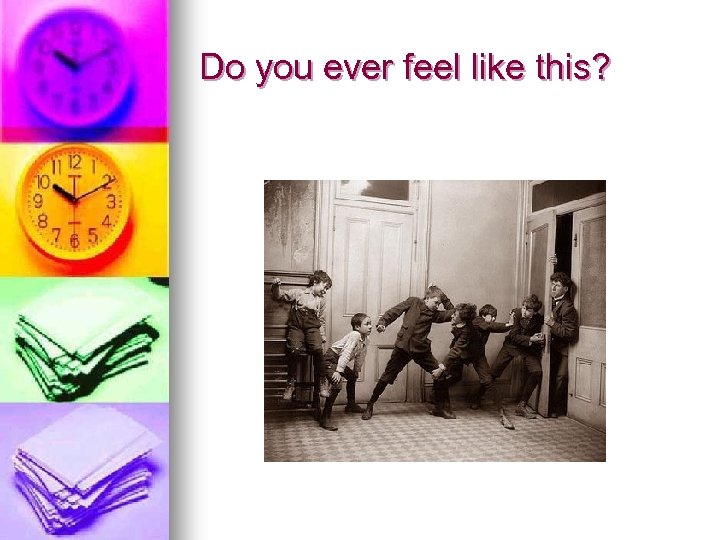 Do you ever feel like this?
 Do you ever want to give up?
 Success in inclusive education… n “…is about changing the general education teachers’ beliefs so that they hold the least dangerous assumption about students’ capabilities and have high expectations for student achievement. ” l Jorgensen, Schuh & Nisbet 2006
 Seven Steps in the Special Education Process: Pre-referral n Referral n Evaluation n Identification n IEP writing n IEP implementation n Yearly evaluation and re-writing of IEP n
 Identification Process: n 1 – Student has difficulty in class n 2 – Pre-referral services begin, either Rt. I or SAT n 3 – No improvement? Referral for Special Education?
 Whether RTI or SAT… Pre-referral Planning Includes: n 1) Identifying the problem(s) n 2) Gathering baseline data n 3) Writing a goal(s) n 4) Planning Intervention(s) n 5) Data collection and follow-up plans.
 So, what’s the problem? n Be sure to focus on ONE problem per intervention goal n Describe each problem with detail and clarity n What is the difference between what is expected and what is occurring?
 How do I collect baseline data? Look at previous report cards n Visit with others who know the child n Take observation notes or find someone to help do that n Look at your own documented scores on student work n Take some simple data n
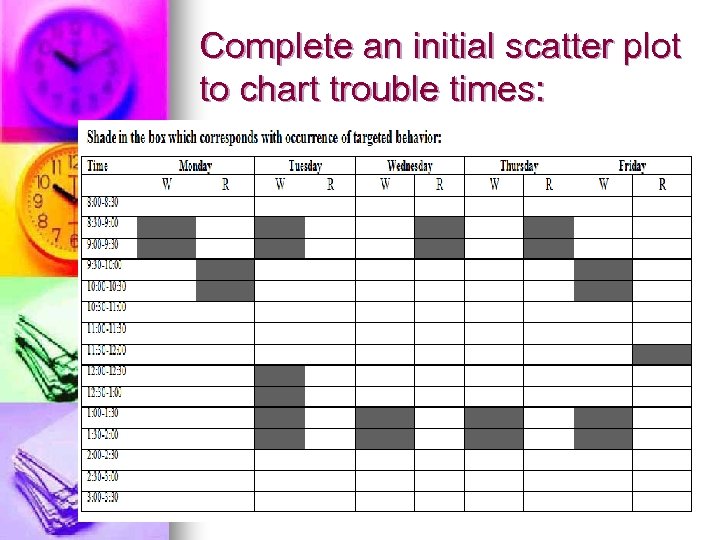 Complete an initial scatter plot to chart trouble times:
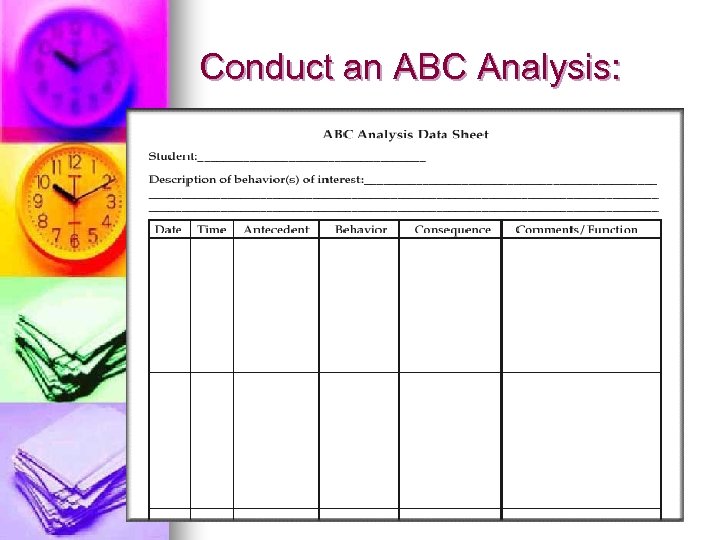 Conduct an ABC Analysis:
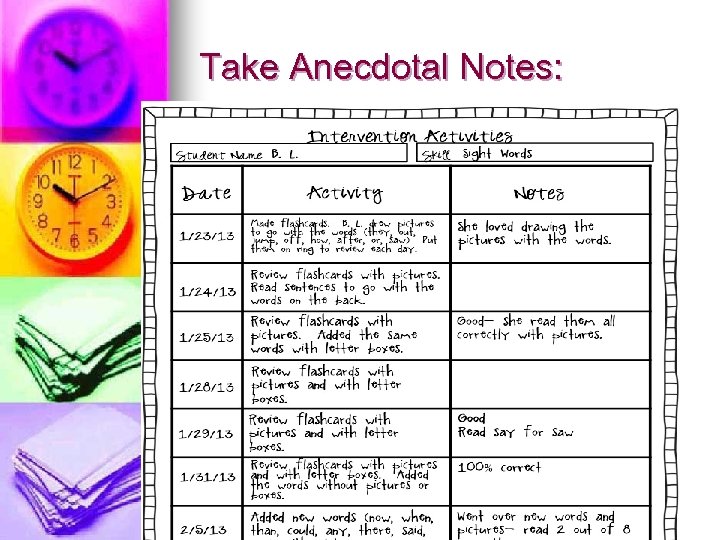 Take Anecdotal Notes:
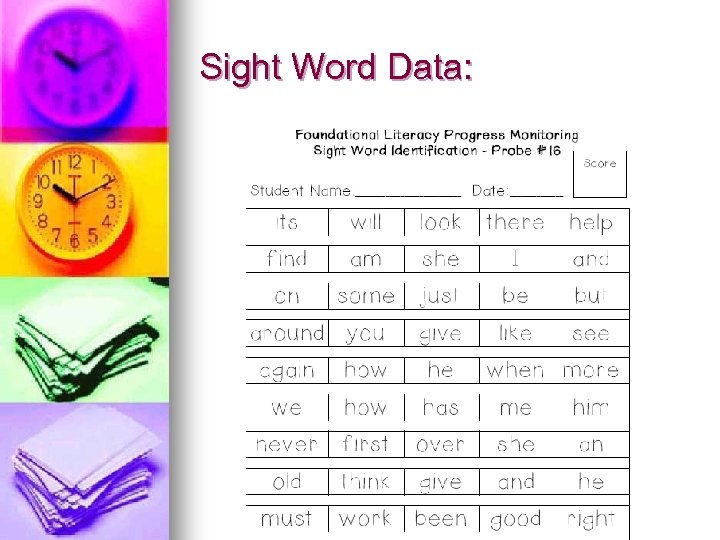 Sight Word Data:
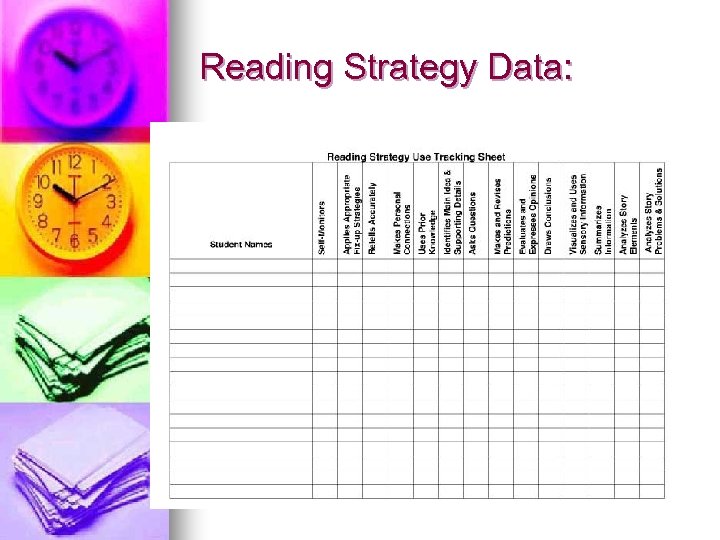 Reading Strategy Data:
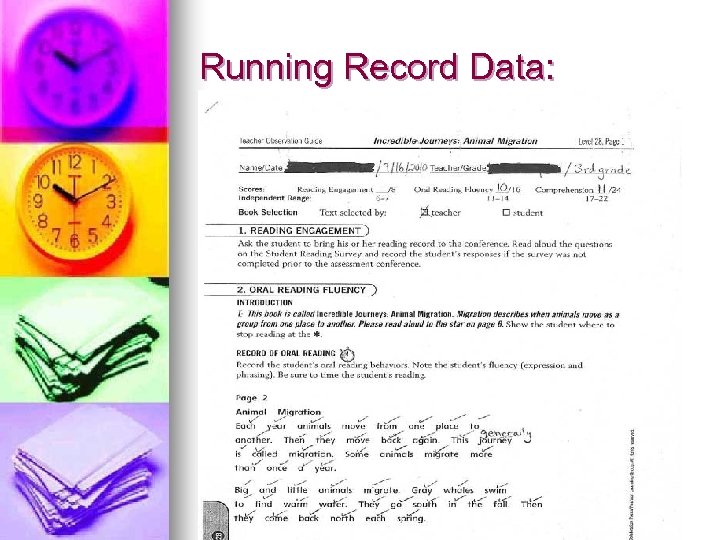 Running Record Data:
 Identify Reading Levels: n Independent – 0 -5 errors 95 -100% accuracy n Instructional – 6 -10 errors 90 -94% accuracy n Frustration – 11 or more errors 89% or below
 What goes into the goal? n Timeframe: how long will the intervention last/take? n Student’s expected behavior n Conditions (extra needed details) n Criteria
 Examples: By Dec. 22, Sara will volunteer to read a problem out loud, while in math class, on 9/10 opportunities. n By the end of 2 nd quarter, Jay will score at the instructional level, on 3 rd grade material, on 8/10 opportunities. n
 How can I intervene? Use available resources and tools for guidance n Seek input from colleagues and other professionals n Look at what needs to change in the environment or setting that will allow student success. n How will you motivate the student during the intervention? n
 More modifying and intervening… What academic modifications or adaptations are needed? n Are there behavioral issues that need to be addressed? n How is/can the family be involved? n What social situations might impede progress? n
 A “must buy” for any teacher!
 Make the Needed Adaptations for Student Success: n http: //www. grandviewlibrary. org/ Curriculum. Adaptations/Nine. Typ es. pdf n Adaptation grid. doc
 Collecting data and making USE of it… Create simple data charts that you can record student scores/behaviors on quickly. n Ask others to monitor the same skills/behaviors when necessary. n Review the results daily/weekly n IF no progress is being made, revisit your intervention plans and revise where needed! n
 Resources: n Jorgensen, C. M. , Schuh, M. C. , & Nisbet, J. (2006). The inclusion facilitator’s guide. Baltimore, MD: Brookes. n Mc. Carney, S. B. (2006), Pre-Referral intervention manual (3 rd ed. ). Columbia, MO: Hawthorne. n Salend, S. J. (2008) Creating inclusive classrooms: Effective and reflective practices for all students. Upper Saddle River, New Jersey: Pearson Education.