


 Скачать презентацию Successes and Failures in E-Commerce in the United
e2435fa511b95ca9f191fd7ffba6dfff.ppt
- Количество слайдов: 56
 Successes and Failures in E-Commerce in the United States: Lessons to be Learned • Kenneth H. Slade • Hale and Dorr LLP • PRAC Conference • Singapore April 26, 1999 E-Commerce in the United States
 Preface • I am not a securities analyst or investment advisor • I am commenting on the current state of e-commerce as I see it, from my perspective as an attorney working with clients in the area. These comments do not reflect the opinions of Hale and Dorr LLP. • As this presentation is a summary and has been prepared in order to highlight only a few selected issues or factors, and as those issues and factors are subject to change, it should be not be relied upon without independent investigation of the issues or factors referred to herein or other factors which you may consider relevant April 26, 1999 E-Commerce in the United States 2
 Overview • Definition of E-Commerce • Current Status of E-Commerce in the United States • Some Successes • Some Failures • Future Developments • Seven Lessons to be Learned April 26, 1999 E-Commerce in the United States 3
 Definition of E-Commerce • Electronic Commerce refers to the conduct of business transactions (whether with consumers or between businesses) using the Internet or other computer networks. • Examples: – Retail transactions – Business-to-business transactions – Electronic cash (beyond scope of this talk) April 26, 1999 E-Commerce in the United States 4
 Growth of E-Commerce in the United States • Growth of Internet Population • User Demographics • Retail Products Purchased by U. S. Internet Users • Internet Use by U. S. Businesses April 26, 1999 E-Commerce in the United States 5
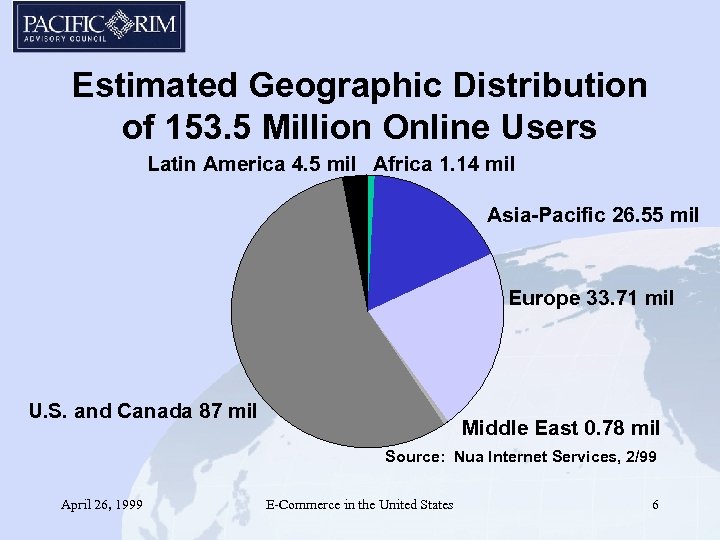 Estimated Geographic Distribution of 153. 5 Million Online Users Latin America 4. 5 mil Africa 1. 14 mil Asia-Pacific 26. 55 mil Europe 33. 71 mil U. S. and Canada 87 mil Middle East 0. 78 mil Source: Nua Internet Services, 2/99 April 26, 1999 E-Commerce in the United States 6
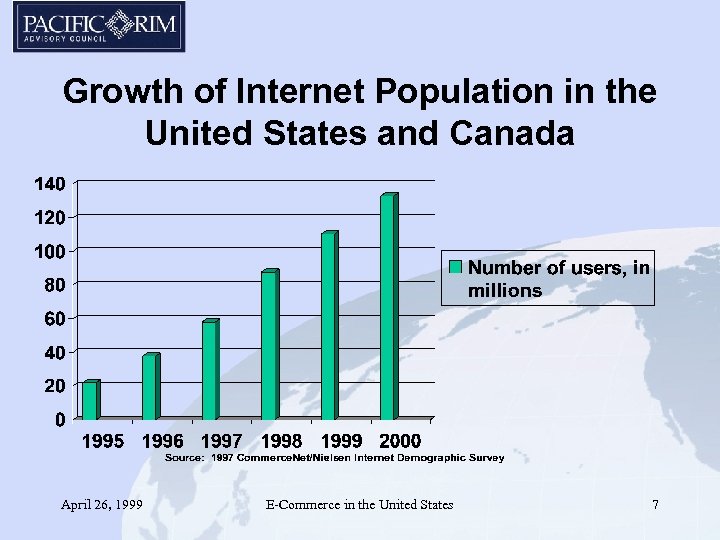 Growth of Internet Population in the United States and Canada April 26, 1999 E-Commerce in the United States 7
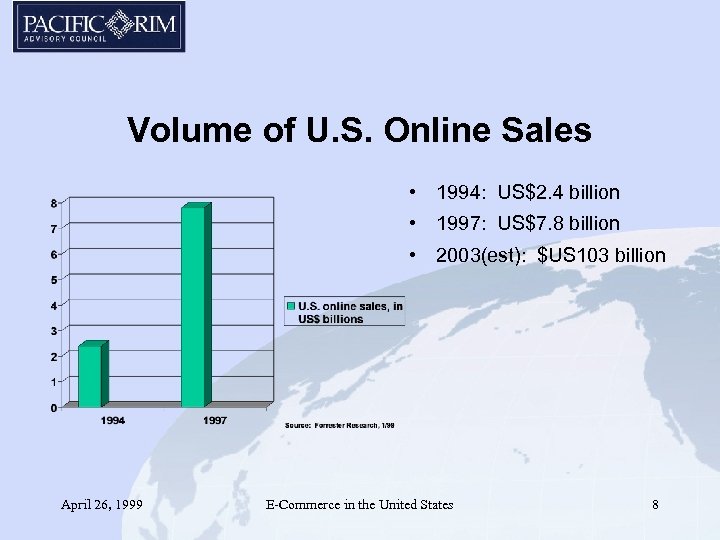 Volume of U. S. Online Sales • 1994: US$2. 4 billion • 1997: US$7. 8 billion • 2003(est): $US 103 billion April 26, 1999 E-Commerce in the United States 8
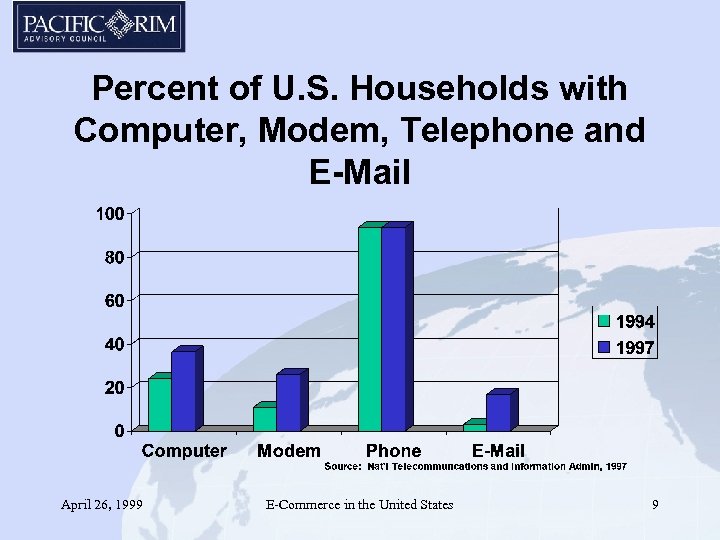 Percent of U. S. Households with Computer, Modem, Telephone and E-Mail April 26, 1999 E-Commerce in the United States 9
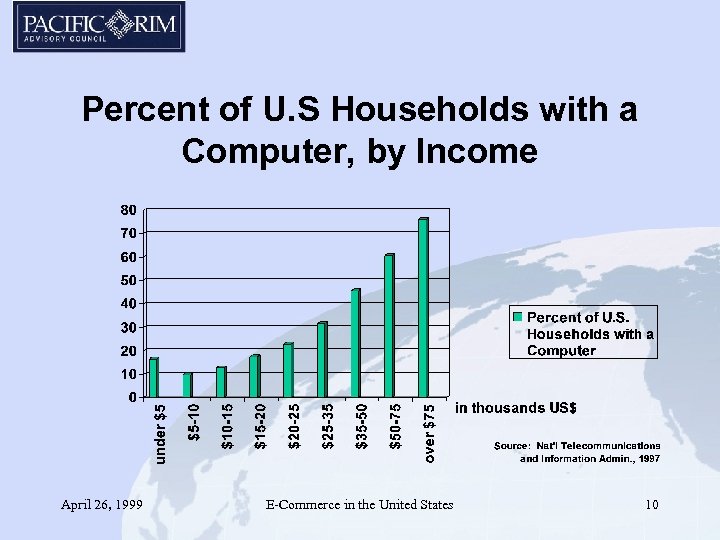 Percent of U. S Households with a Computer, by Income April 26, 1999 E-Commerce in the United States 10
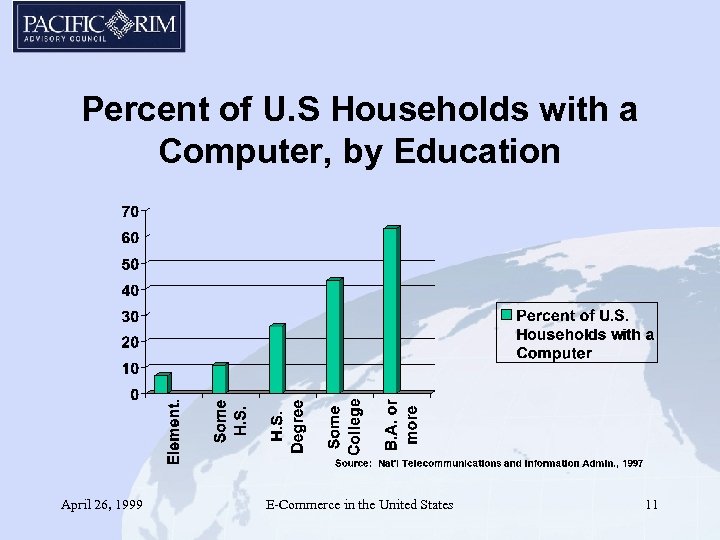 Percent of U. S Households with a Computer, by Education April 26, 1999 E-Commerce in the United States 11
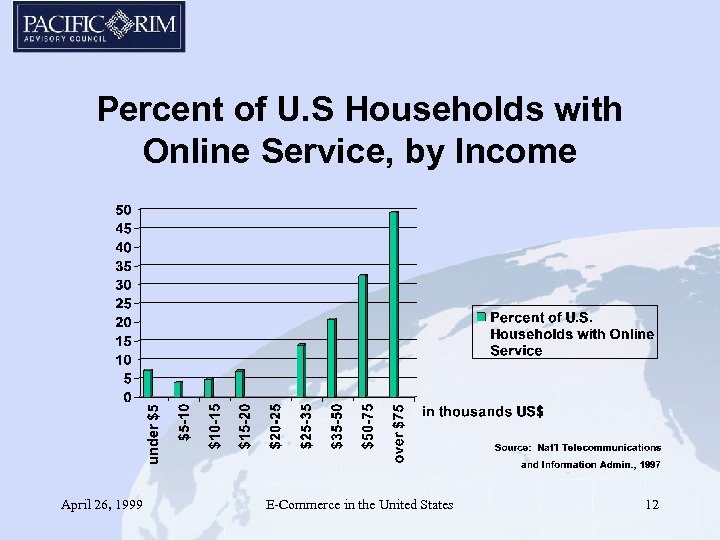 Percent of U. S Households with Online Service, by Income April 26, 1999 E-Commerce in the United States 12
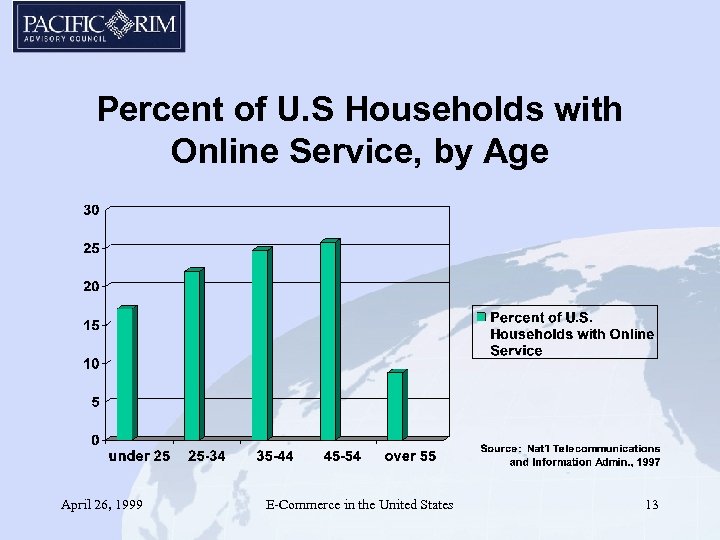 Percent of U. S Households with Online Service, by Age April 26, 1999 E-Commerce in the United States 13
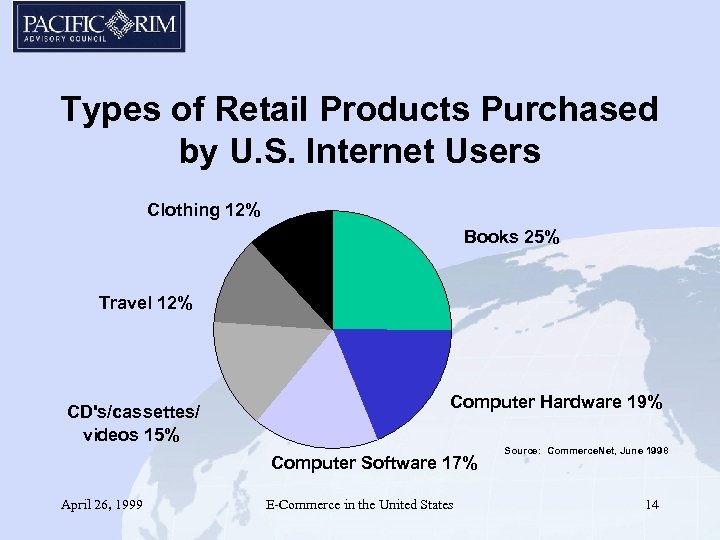 Types of Retail Products Purchased by U. S. Internet Users Clothing 12% Books 25% Travel 12% CD's/cassettes/ videos 15% Computer Hardware 19% Computer Software 17% April 26, 1999 E-Commerce in the United States Source: Commerce. Net, June 1998 14
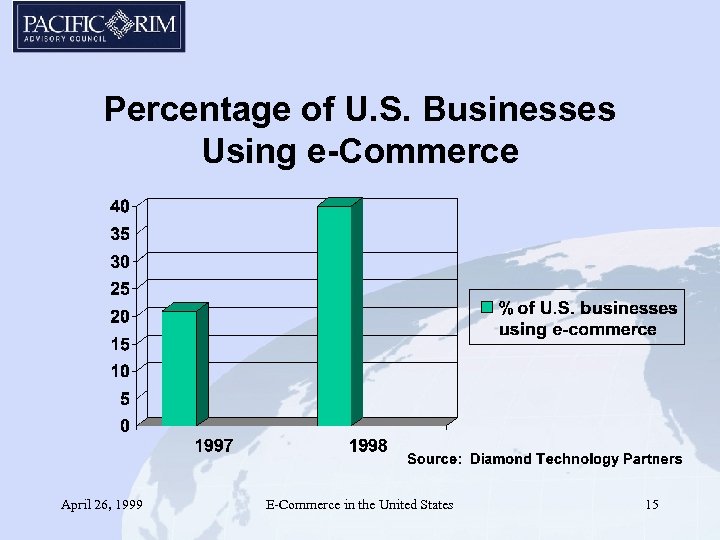 Percentage of U. S. Businesses Using e-Commerce April 26, 1999 E-Commerce in the United States 15
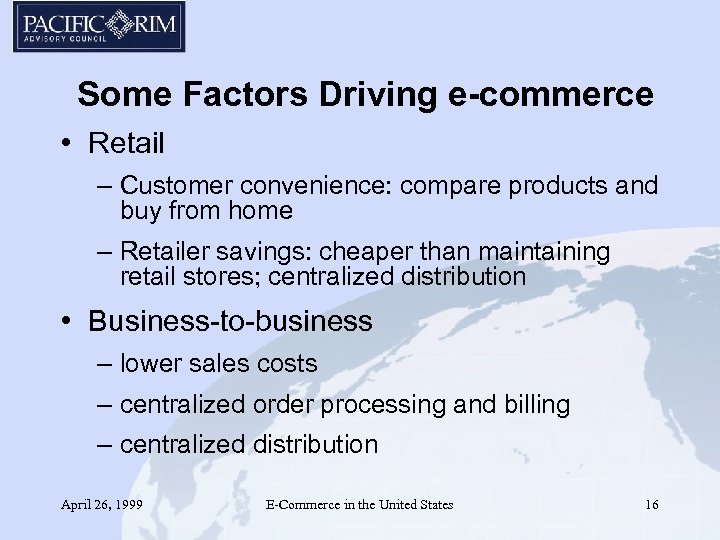 Some Factors Driving e-commerce • Retail – Customer convenience: compare products and buy from home – Retailer savings: cheaper than maintaining retail stores; centralized distribution • Business-to-business – lower sales costs – centralized order processing and billing – centralized distribution April 26, 1999 E-Commerce in the United States 16
 Some Successes • RETAIL – amazon. com – e. Bay – E*Trade • BUSINESS-TO-BUSINESS – Cisco April 26, 1999 E-Commerce in the United States 17
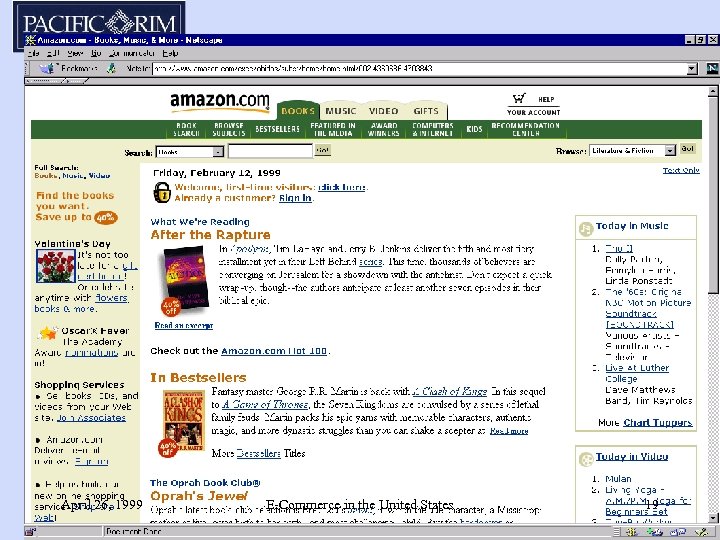
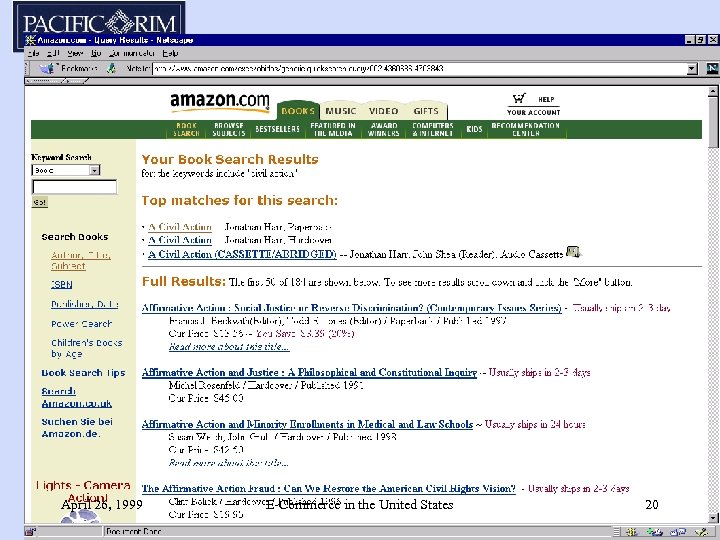
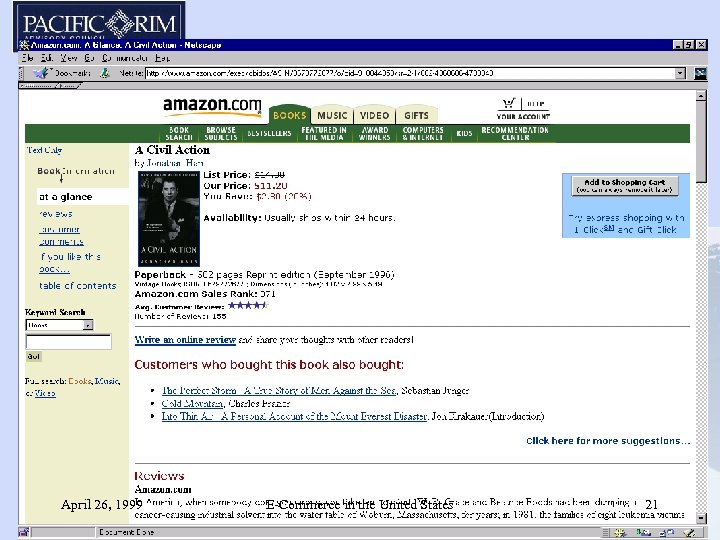
 amazon. com • On-line revenues increased 51% from US$1, 429 million for FY 97 to US$2, 161 million for FY 98 (ending 6 -30 -98) • Advertising and electronic commerce fees increased 159% from US$98 million for FY 1997 to US$254 for FY 98 • amazon. com is an online book, CD and video retailer and soon. . . prescription drugs • offers more than 4. 7 million books, music CD, video, DVD and computer games. April 26, 1999 E-Commerce in the United States 18
 April 26, 1999 E-Commerce in the United States 19
 April 26, 1999 E-Commerce in the United States 20
 April 26, 1999 E-Commerce in the United States 21
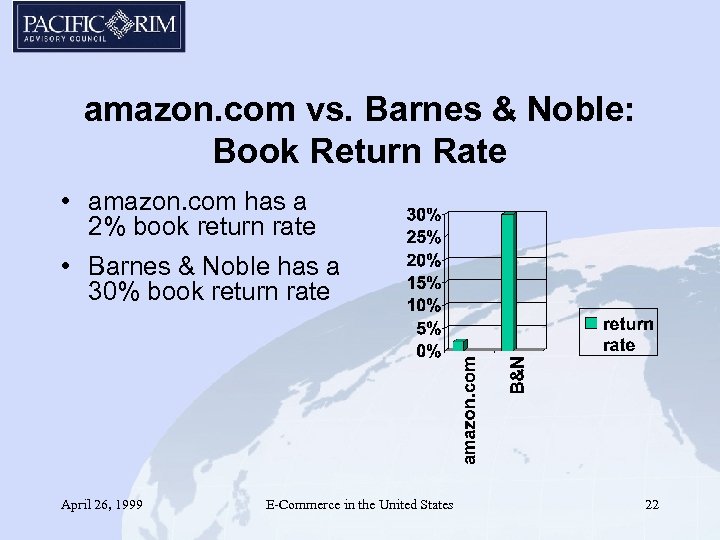 amazon. com vs. Barnes & Noble: Book Return Rate • amazon. com has a 2% book return rate • Barnes & Noble has a 30% book return rate April 26, 1999 E-Commerce in the United States 22
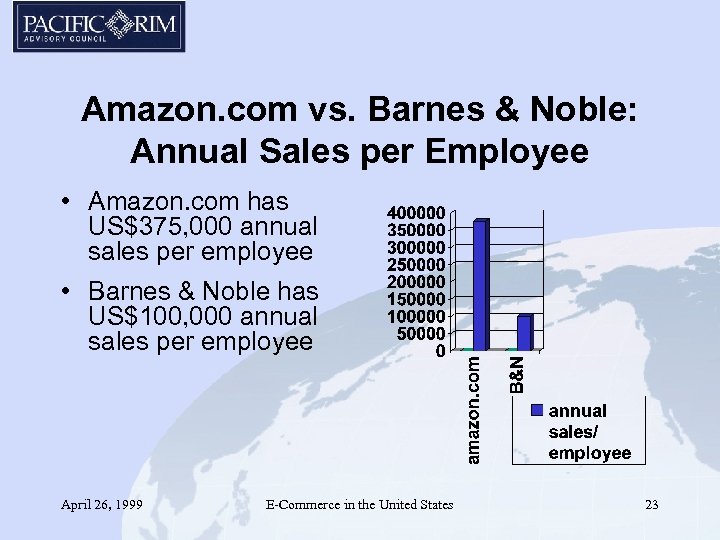 Amazon. com vs. Barnes & Noble: Annual Sales per Employee • Amazon. com has US$375, 000 annual sales per employee • Barnes & Noble has US$100, 000 annual sales per employee April 26, 1999 E-Commerce in the United States 23
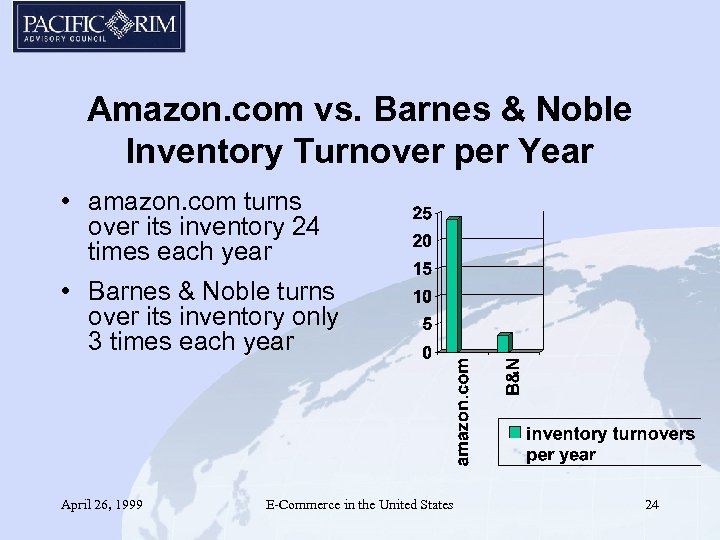 Amazon. com vs. Barnes & Noble Inventory Turnover per Year • amazon. com turns over its inventory 24 times each year • Barnes & Noble turns over its inventory only 3 times each year April 26, 1999 E-Commerce in the United States 24
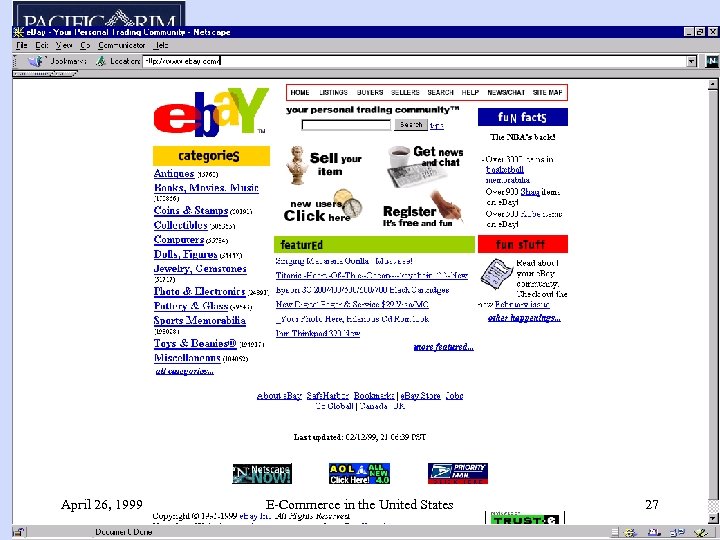
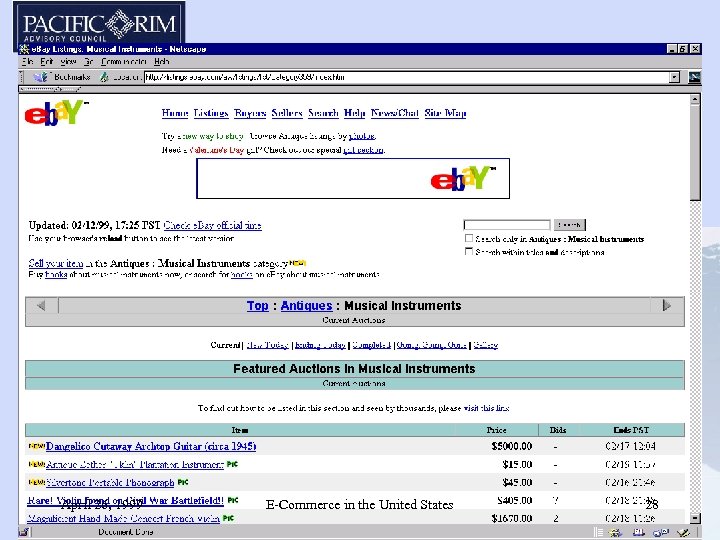
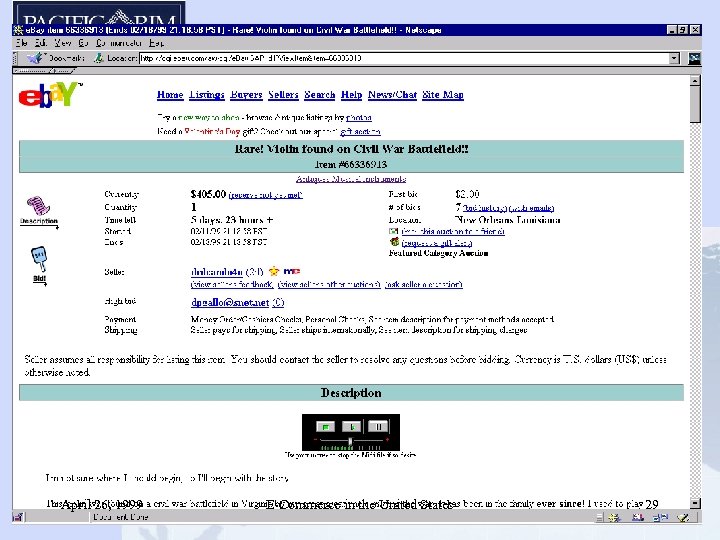
 e. Bay • Operates an online person-to-person exchange in an auction format to trade personal items such as antiques, coins, collectibles, computers, dolls, jewelry and other items. • Hosts live, on-line bidding for high-exposure items – January 1999 -- hosted auction with Guernseys to sell Mark Mc. Gwire home run balls April 26, 1999 E-Commerce in the United States 25
 e. Bay • 2. 1 million registered users • over 800, 000 online auctions per day, over 140 million hits per week (Source: Wired) • 72% increase in registered users from September 1998 to December 1998 • stock rose from initial offering price of US$18 in September 23, 1998 to US$231 as of February 16, 1999 • market capitalization was US$9. 5 billion as of February 16, 1999 April 26, 1999 E-Commerce in the United States 26
 April 26, 1999 E-Commerce in the United States 27
 April 26, 1999 E-Commerce in the United States 28
 April 26, 1999 E-Commerce in the United States 29
 e. Bay’s competition • Yahoo! Auctions, working with Butterfield & Butterfield – movie memorabilia and O. J. Simpson possessions – free to users (vs. e. Bay’s charge of 25¢ to US$2. 00, plus percentage of sales price to sellers) • Sotheby’s • Others: Millionaire. com, 2 The. Market. com, Onsale, Auction Universe, First Auction April 26, 1999 E-Commerce in the United States 30
 e. Bay’s response • Improving user’s experience – offer additional services: payments, shipping and customs clearance • Investing in infrastructure – add icon from Equifax to verify the identity of users – insure products worth US$25 to US$200 through Lloyd’s of London – offer access to escrow services • expanding internationally – launched country-specific auctions in the United Kingdom and Canada April 26, 1999 E-Commerce in the United States 31
 e. Bay’s response (continued) • Boosting “fun factor” – publishing on-line newsltr; adding 18 chat rooms • addressing concerns about fraud – tougher rules for deadbeats; clarify policies on auctioning illegal items; closer coordination with law enforcement – NYC Dept. of Consumer Affairs investigation for fraud (multiple sales of one-of-a-kind items) • Spend more on promotion -- through AOL and Netscape’s Netcenter portal (offer most popular Internet resources through a single site) April 26, 1999 E-Commerce in the United States 32
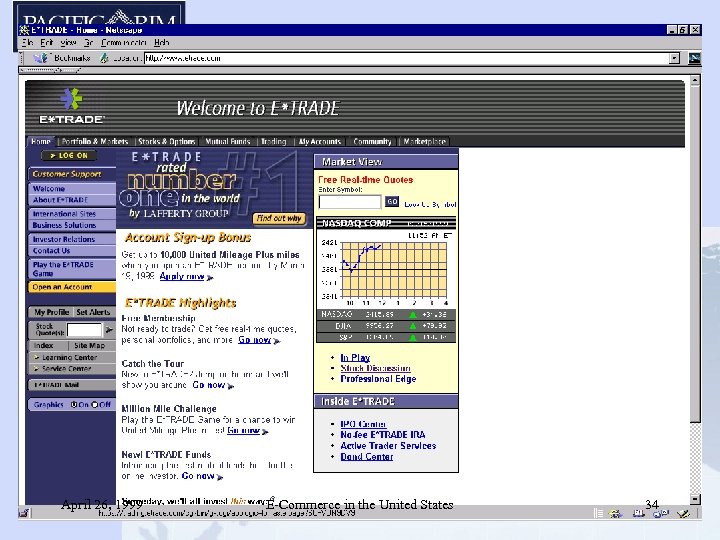
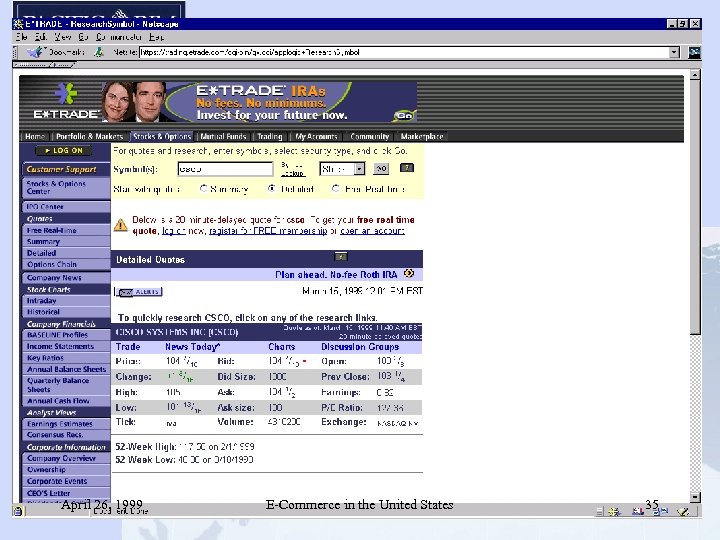
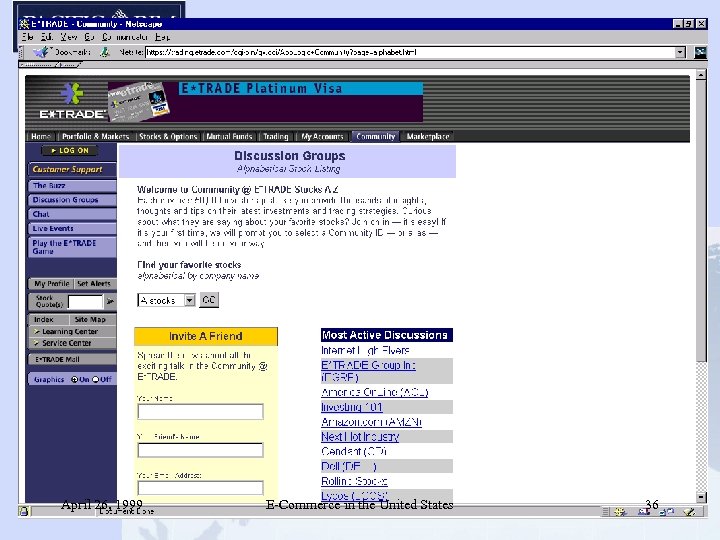
 E*Trade • Provides on-line investing services: automated stock, bond and mutual fund order placement at low commission rates; portfolio tracking; real-time market commentary and analysis 7 x 24 • Revenues for FY 1998 (ending 9/30/98) were US$245. 3 million, up 57% • market capitalization increased from US$2. 7 billion as of 12/31/98 to US$5. 43 billion as of 3/3/99 April 26, 1999 E-Commerce in the United States 33
 April 26, 1999 E-Commerce in the United States 34
 April 26, 1999 E-Commerce in the United States 35
 April 26, 1999 E-Commerce in the United States 36
 E*Trade’s Alliances • America Online -- part of AOL’s Personal Financial Channel • Banc. Boston Robertson Stephens -- users have access to proprietary research and recommendations available only to large investors and institutions • CNNfn -- significant branded presence • Scudder Kemper Investments-- offers more than 30 no-load Scudder Funds online • E*Trade is the exclusive retail broker for a number of high profile Internet IPO’s, including Priceline. com April 26, 1999 E-Commerce in the United States 37
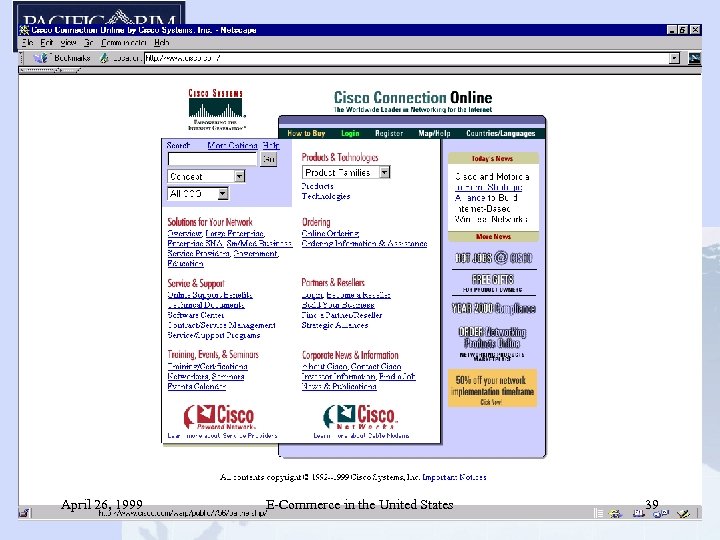
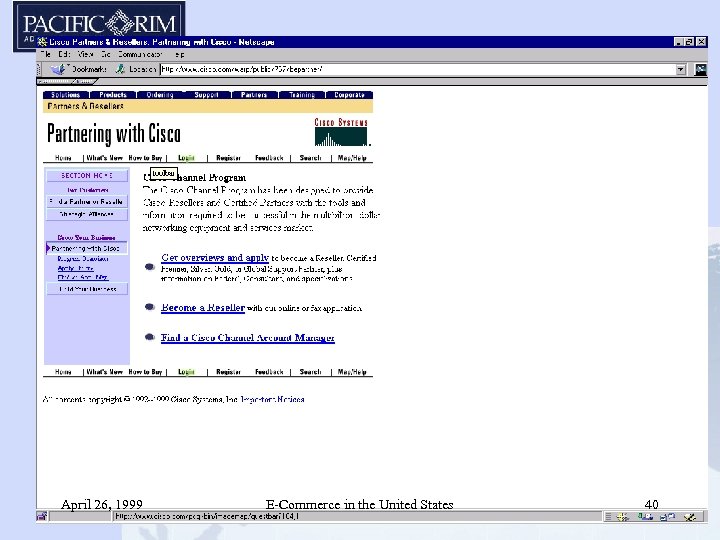
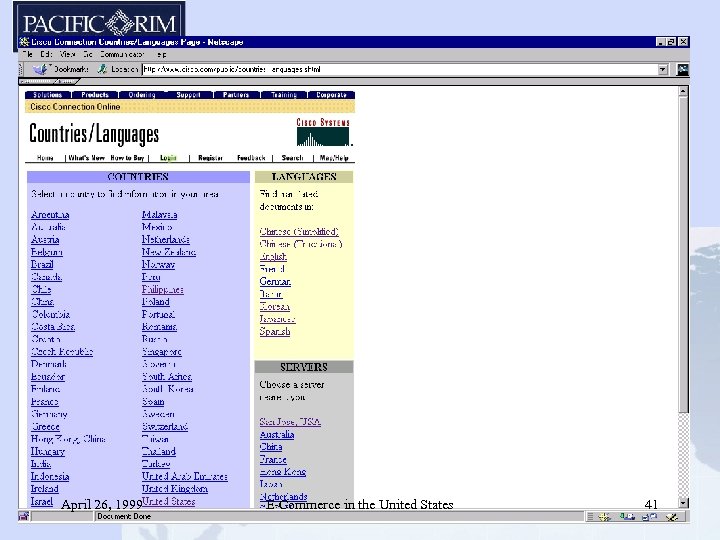
 BUSINESS-TO-BUSINESS: Cisco • 1998 revenues of US$8. 5 billion; market capitalization of US$165 billion (3/99) • Sells Internet routers and network switches; software that resides on customer’s Intranet and provide ordering tracking and other functions • By providing Internet based technical support, the company is resolving 200, 000 calls per day without human intervention April 26, 1999 E-Commerce in the United States 38
 April 26, 1999 E-Commerce in the United States 39
 April 26, 1999 E-Commerce in the United States 40
 April 26, 1999 E-Commerce in the United States 41
 Some Failures • IBM’s World Avenue Mall • MCI’s 1 -800 Music Now April 26, 1999 E-Commerce in the United States 42
 IBM’s World Avenue Mall • on-line mall offering a variety of consumer products • July 1997: shut down after a year of subpar revenue • according to CNNfn, merchants criticized IBM for lack of promotions relating to World Avenue • IBM will not be a “traffic-generator” – conceded that on-line mall requires major retailer or consumer packaged-goods company to generate necessary traffic April 26, 1999 E-Commerce in the United States 43
 MCI’s 1 -800 Music Now • MCI Communications abandoned in December 1996 its 1 -800 Music Now service, just one year after launching the venture to sell CD’s over both phone lines and its on-line shopping mall • MCI spent US$10 million developing and promoting the service on TV, radio and print media. • According to the Washington Post, 1 -800 Music Now failed due to three major obstacles: • wrong product at wrong time-- 1995 -96 music sales overall had a slow year; other retailers offered deep discounts • did not offer an easy-to-use site for consumers; easier to buy from traditional record store • prices were relatively high (vs. retail stores) April 26, 1999 E-Commerce in the United States 44
 Future Developments • Technological breakthroughs will make ecommerce easier and more accessible to larger audiences • Problems ahead -- bumps in the road April 26, 1999 E-Commerce in the United States 45
 Technological Breakthroughs • increased use of digital certificates • development of higher capacity media for video and audio recordings • use of new technologies to provide singleuse or limited-use copies • increasing consumer demand for faster Internet access (service through cable TV box) – as of 1/99, 67% of US households subscribe to cable; 96. 56% of U. S. homes passed by cable April 26, 1999 E-Commerce in the United States 46
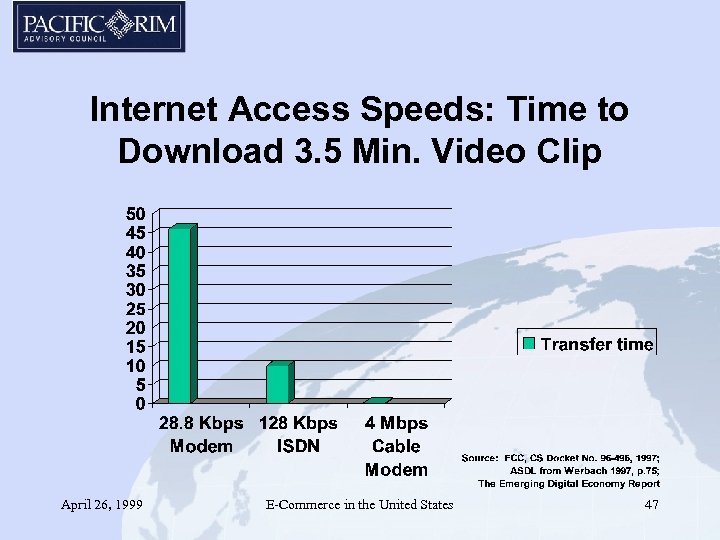 Internet Access Speeds: Time to Download 3. 5 Min. Video Clip April 26, 1999 E-Commerce in the United States 47
 Bumps in the Road • Possible governmental charges for Internet access • Government efforts to collect sales and use taxes • Internet patents: threat to fluid structures of WWW – Microsoft’s patent covering aspects of cascading style sheets – conflict between innovation and collaboration • Resistance from traditional “brick-and-mortar” retailers – Compaq announced on 2/23/99 that it had revoked the ability of Internet-only retailers to sell its computers for a 90 -day evaluation period – response to growing sale by both on-line retailers and traditional retailers opening cyber outlets, although ban does not affect the latter • Efforts to increase security meeting resistance – computers with specific serial numbers (Pentium® III processor) April 26, 1999 E-Commerce in the United States 48
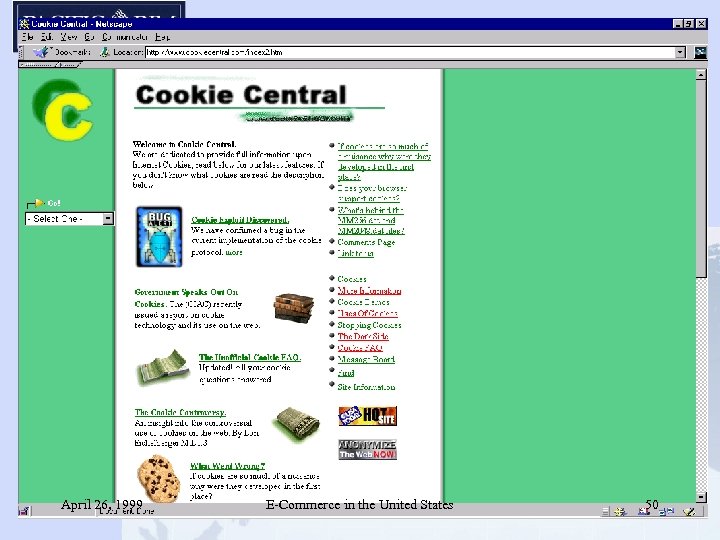
 Perhaps Biggest Bump in Road: Privacy • European Union’s Data Privacy Directive • receiving increasing attention from U. S. Federal Trade Commission – as of 3/98, of 1, 400 websites reviewed by FTC, only 14% informed visitors of their information-collection practices – only 28 of those sites posted “comprehensive” privacy statements • cookies or Cookie Monster? – remembers account information – remembers where user left off in site – potential of tracking usage of site and developing user profile in order to direct other information April 26, 1999 E-Commerce in the United States 49
 April 26, 1999 E-Commerce in the United States 50
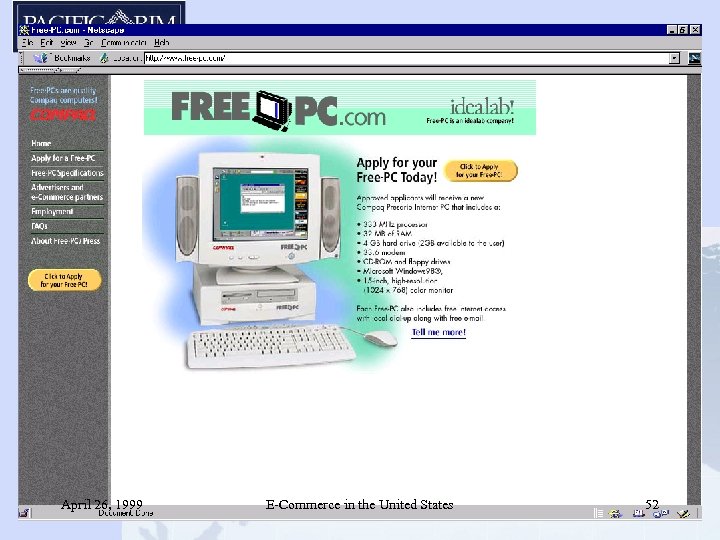
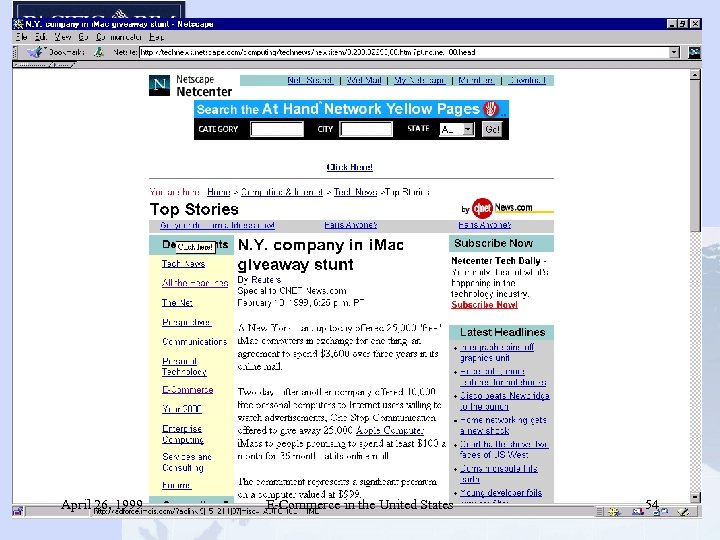
 Bump or Launching Ramp? • Consumers seem not to be concerned by loss of privacy • Free-PC gives away 10, 000 free computers, in exchange for permission to target advertising messages directly to customer’s desktop – marketing companies pay US$1, 000 per user for such information – cost of state-of-the-art Compaq Presario has dropped to US$800 – received 1, 200, 000 visits on web site on morning of announcement April 26, 1999 E-Commerce in the United States 51
 April 26, 1999 E-Commerce in the United States 52
 Free-PC • messages sent based on detailed information provided by customer – age, income, family status, personal tastes and interests • Advertisements will appear in frame surrounding working area -- and cannot be removed – agreement with Cybergold, which represents Disney, ESPN, credit-card issuer MBNA and AOL April 26, 1999 E-Commerce in the United States 53
 April 26, 1999 E-Commerce in the United States 54
 Seven Lessons to be Learned • #1 - Copying is the highest form of flattery … so expect to be flattered • #2 - Ease of access: establish a close, hopefully unique, relationship with a portal to increase traffic through your website • #3 - Ease of use: make the site easy, fast and perhaps even fun • successes: amazon. com, e. Bay, E*Trade, Cisco • failures: 1 -800 Music Now April 26, 1999 E-Commerce in the United States 55
 Seven Lessons to be Learned • #4 - Convenience is not enough; offer competitive prices as well • #5 - Multi-industry on-line malls will probably be controlled by a few major companies with patience and deep pockets • IBM was not patient and was not willing to dig deep enough into its pockets • #6 - Follow Cisco’s lead: do business for the Internet and through the Internet • #7 - Future = next month April 26, 1999 E-Commerce in the United States 56