


 Скачать презентацию Success Stories from IT Consolidations Corinne Irwin Karen
6c4b90d805c1a3d4e64a9bdbd13df5cb.ppt
- Количество слайдов: 33
 Success Stories from IT Consolidations Corinne Irwin Karen Petraska John Sprague
 Consolidation Success Stories § I 3 P continues NASA trend to provide consolidated enterprise IT services § Consolidations often perceived negatively: loss of local control, end-user focus § ICAM, NCAD, and NOMAD are three examples of Consolidation success stories § These consolidations provided enhanced: » Collaboration » Mobility » Scalability » Security » Simplicity of Architecture » Data and System integration » And yes, cost management Presentation Title — 2— March 5, 2010
 NASA’s Identity, Credential and Access Management Consolidation
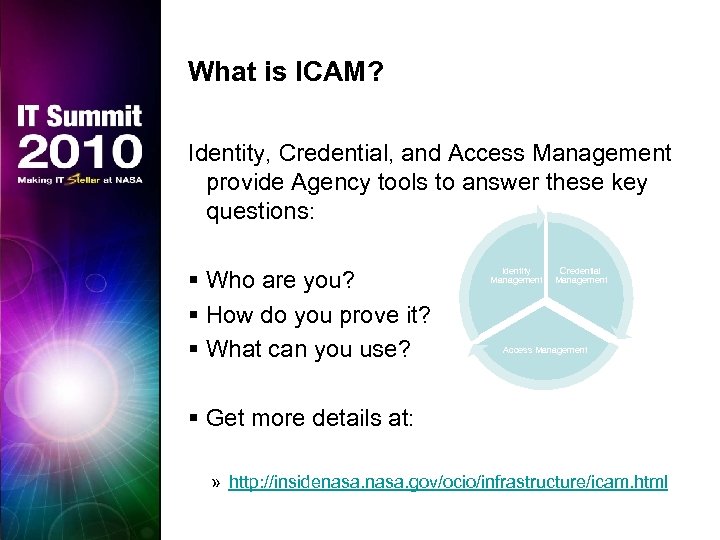 What is ICAM? Identity, Credential, and Access Management provide Agency tools to answer these key questions: § Who are you? § How do you prove it? § What can you use? Identity Management Credential Management Access Management § Get more details at: » http: //insidenasa. gov/ocio/infrastructure/icam. html
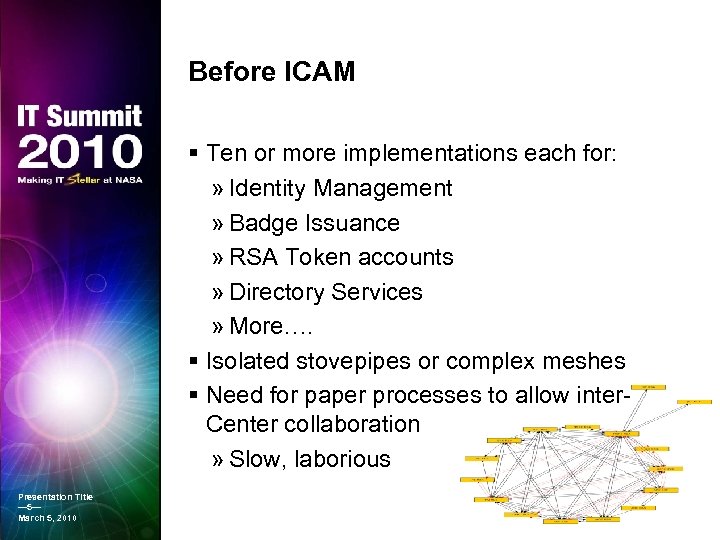 Before ICAM § Ten or more implementations each for: » Identity Management » Badge Issuance » RSA Token accounts » Directory Services » More…. § Isolated stovepipes or complex meshes § Need for paper processes to allow inter. Center collaboration » Slow, laborious Presentation Title — 5— March 5, 2010
 The Consolidation Presentation Title — 6— March 5, 2010 § Identity: A single, authoritative identity store for everyone that does business with NASA » Decommissioned Center x. 500 s and local identity systems § Credential: A few Agency credentials to access most facilities and systems » We have already retired hundreds of application-unique passwords § Physical Access: An Agency-wide system for all physical access to buildings and rooms § Logical Access: » NASA Account Management System (NAMS) allows access to over 1, 000 applications » A single Active Directory forest/domain » The Access Launchpad for access to web applications » Consolidated RSA infrastructure for two-factor access where smartcards cannot be used
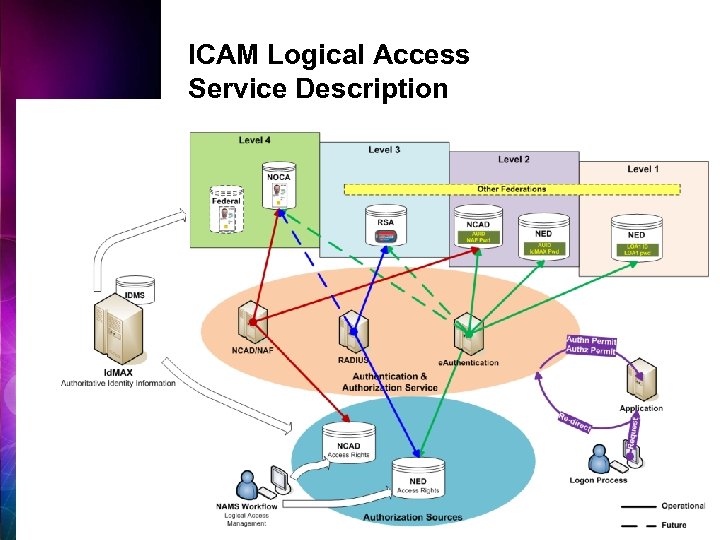 ICAM Logical Access Service Description 7
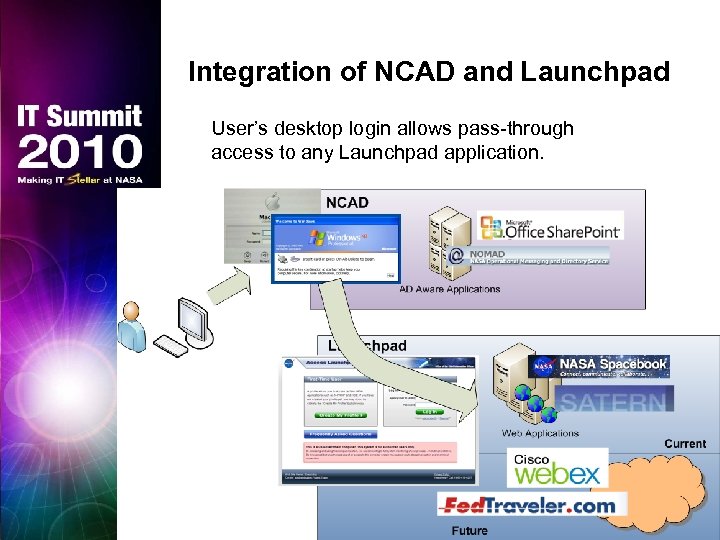 Integration of NCAD and Launchpad User’s desktop login allows pass-through access to any Launchpad application.
 Collaboration § Smartcard login to the desktop, then get to over 500 applications without re-logging in § Access to Agency applications without a separate process to validate the user’s identity Mobility § Any NASA worker can visit any NASA Center, and get: » Pre-authorized access to any building/room » Wireless access to the NASA network Presentation Title — 9— March 5, 2010
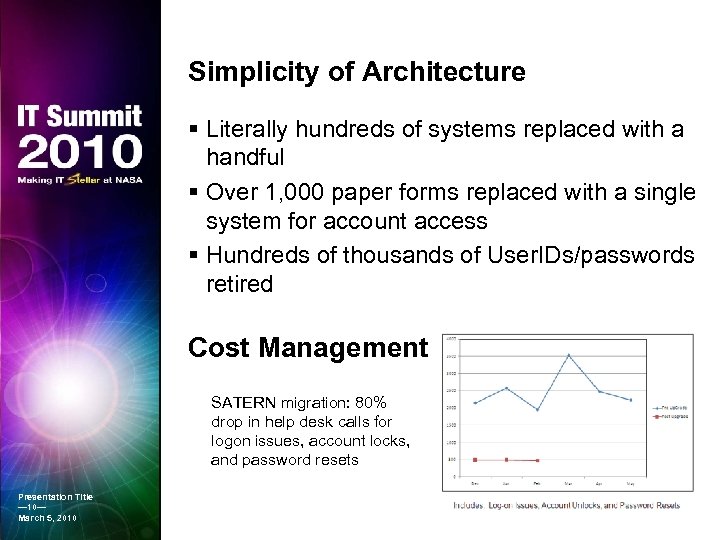 Simplicity of Architecture § Literally hundreds of systems replaced with a handful § Over 1, 000 paper forms replaced with a single system for account access § Hundreds of thousands of User. IDs/passwords retired Cost Management SATERN migration: 80% drop in help desk calls for logon issues, account locks, and password resets Presentation Title — 10— March 5, 2010
 Security § We can ensure on a person-by-person basis that those who need IT security training have taken it § We know what each person has access to § When someone leaves NASA, we can immediately: » Disable AD and Launchpad accounts » Revoke PKI Certificates and Tokens » Close Accounts managed in NAMS Presentation Title — 11— March 5, 2010
 Data & System Integration § SATERN Integration » Ensures IT security training is complete » Can set other training courses as pre-requisites for any access granted through NAMS § Provide “Basic Level of Entitlement” access to IT systems based on Identity attributes § Various Directories all “match: ” » Id. MAX » NCAD » NOMAD GAL Presentation Title — 12— March 5, 2010 » NASA Enterprise Directory
 Considerations § NASA’s ICAM allows Trust throughout the Federal government and beyond » First, NASA must trust NASA » Configuration settings needed on desktops, networks, to enable NASA Trust » Any change that is managed locally is difficult to manage well § Centrally managed infrastructure services provide a standard baseline against which we can assess the impact of changes, be they new federal mandates or implementation of new functional requirements. § At the same time, a single change impacts the entire Enterprise » Is everyone ready? » Has it been thoroughly tested? » Any unintended consequences? Presentation Title — 13— March 5, 2010
 NASA’s Active Directory Consolidation
 NASA Consolidation of Active Directory § Active Directory is a Microsoft tool that » Serves as a directory of people in the environment » Provides an authentication mechanism to AD-aware applications » Provides a coordinated management environment of groups, objects, and policies for an organization § In most organizations, when you log in to your Windows or Mac computer, you are authenticating to Active Directory Presentation Title — 15— March 5, 2010
 Historical Perspective § NASA historically did not manage Active Directory as an integrated environment for the Agency » Many small organizations had their own AD instances. There were likely more than a hundred domains Agency-wide, including child domains and individual instances of AD, and an unknown number of workgroups » In many cases, user accounts from different organizations were issued for specific internal purposes; collaboration using a common credential was not possible » Organizations established external “trust relationships” that were managed with no common set of criteria and could compromise connected NASA resources Presentation Title — 16— March 5, 2010
 The Consolidation Presentation Title — 17— March 5, 2010 § Began in 2006, completed in Summer 2010 § Migrated 57, 000 desktops; 66, 000 users; 3, 700 servers § Reduced to a single forest, single domain § Eliminated all 35 two way trusts » Allowing eleven one way trusts (they trust us, we do NOT trust them) to continue to exist temporarily § Replaced hundreds of domain controllers with 65 for the entire Agency § Reduced an unknown number of AD domain administrators (>100) to eight
 Overall Improvements § Designed to enable mobility » In most cases, residents from one NASA center can go to another NASA center, put their laptop on the network and it works! » Working toward getting access to home resources like file shares and printers § Enables users from various centers to collaborate across centers § Enables push of consistent policies across the Agency § Enables seamless access to authenticated wireless and applications across the Agency Presentation Title — 18— March 5, 2010
 Security Implications § A single, simplified, centrally managed infrastructure that we have full control over and full understanding of what it is » Deployed a continuous security monitoring tool across all of AD. Events of all kinds reported and investigated instantly. » Deployed a third party management system that tightly and granularly controls configuration changes and who can make them Presentation Title — 19— March 5, 2010 § By eliminating and prohibiting trusts with entities containing non-ICAM vetted user accounts, we have a clear view of who we plan to allow into our systems § We can enforce consistent security and management policies on all objects
 Considerations § A change of this magnitude with such a large number of migrations is a huge coordination and project management challenge » In addition to requirements, design and operational readiness reviews, we did a migration readiness checklist , migration readiness review and migration completion review at each center § Simple, understandable outreach materials for end users are essential § Do not underestimate the level of effort needed to get buy-in and cooperation from all those organizations who are losing control of their domains. Presentation Title — 20— March 5, 2010
 NASA’s Email Consolidation
 NOMAD NASA Operational Messaging And Directory Service A consolidated Microsoft Exchange-based groupware infrastructure for all NASA civil servants and contractors http: //nomad. nasa. gov Presentation Title — 22— March 5, 2010
 NOMAD Origins § In 2004, Administrator O’Keefe directed the NASA CIO to transform how NASA provided IT services to the Agency workforce » At the heart of the memo was the direction to provide an integrated messaging and calendaring solution allowing NASA to communicate as a single entity. § First center (HQ) fully migrated in March 2005 § By 2008 and 4 CIOs later, all 10 major NASA centers are migrated onto NOMAD Presentation Title — 23— March 5, 2010
 Goals Presentation Title — 24— March 5, 2010 § Provide a uniform messaging and calendaring environment § Integrate both civil servants and contractors § Offer access from anywhere § Increase security § Use open standards for interoperability § Support NASA’s heterogeneous environment § Minimize downtime and single points of failure § Leverage existing resources § Reduce costs § Allow the Agency to focus on bigger issues
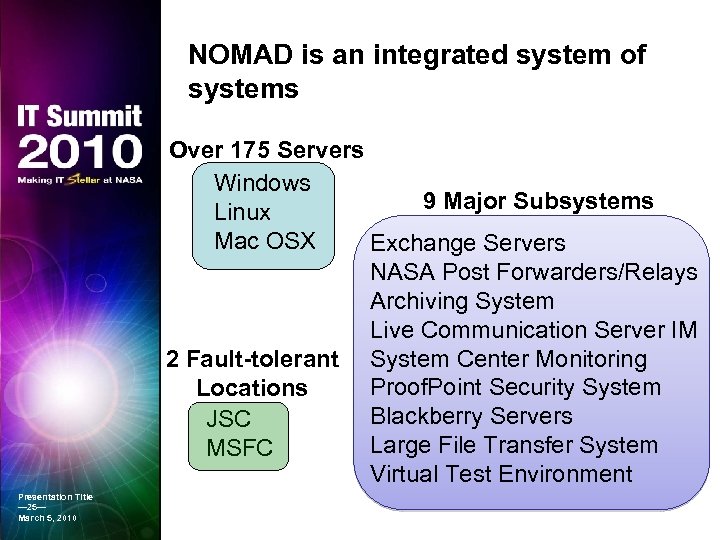 NOMAD is an integrated system of systems Over 175 Servers Windows 9 Major Subsystems Linux Mac OSX Exchange Servers NASA Post Forwarders/Relays Archiving System Live Communication Server IM 2 Fault-tolerant System Center Monitoring Proof. Point Security System Locations Blackberry Servers JSC Large File Transfer System MSFC Virtual Test Environment Presentation Title — 25— March 5, 2010
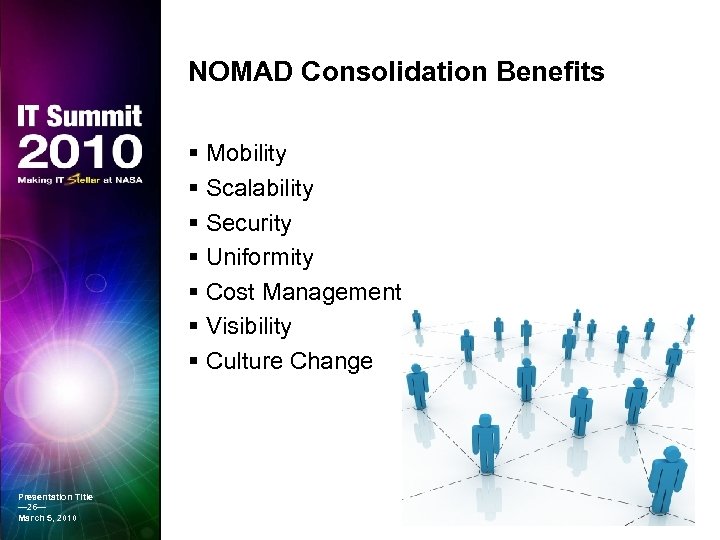 NOMAD Consolidation Benefits § Mobility § Scalability § Security § Uniformity § Cost Management § Visibility § Culture Change Presentation Title — 26— March 5, 2010
 Mobility Presentation Title — 27— March 5, 2010 § Issue » NASA is a globally distributed and very mobile population » NASA’s centers have a variety of firewall policies and configurations § Solution » To guarantee access from any center or facility, NOMAD was designed to be an “external” service • Similar to many of today’s cloud offerings » Most O/Ss and devices are enabled through a suite of secure access protocols
 Scalability § NOMAD’s first user quantity was about 4, 000 § Today, NOMAD supports around 60, 000 users § The fundamental design of the system has not changed between those two capacities, just the number of servers § NOMAD was architected to continue to scale to meet NASA’s needs » The dual-site fault-tolerant architecture allows us to load servers and storage systems with only a 50% load Presentation Title — 28— March 5, 2010
 Security Presentation Title — 29— March 5, 2010 § By drastically decreasing the number of email servers across the Agency, consolidating to NOMAD reduced the attack surface » Entire Exchange backend infrastructure can only be accessed via client access servers § Multiple layers of security are applied against viruses, malware and vulnerabilities » A variety of anti-virus engines and databases are actively scanning at all times » Multiple firewalls and security zones isolate access as appropriate § Agency security policies can be enforced
 Uniformity Presentation Title — 30— March 5, 2010 § Users all have an @NASA. GOV address » A NASA identity is a NASA identity regardless of the center they currently reside at § Every NOMAD provisioned desktop, laptop and smartphone can access NOMAD services regardless of where they are » An Internet Café network looks exactly the same as a NASA center network § Since NASA must comply with federal standards and regulations, a consolidated messaging system furnishes a consistent application of governance
 Cost Management § Did NOMAD reduce the cost of messaging across the Agency? Who knows? ? § What we do know is… § Hundreds of servers retired § Numerous folks are no longer managing email servers and can focus on more important activities § Software licenses united § Hardware consistently refreshed § NASA now has an understanding of the cost to provide email Presentation Title — 31— March 5, 2010 “You cannot manage what you cannot measure”
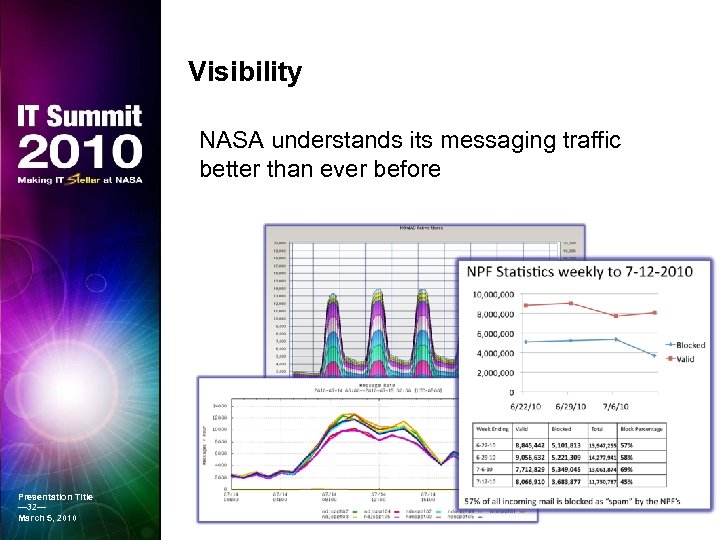 Visibility NASA understands its messaging traffic better than ever before Presentation Title — 32— March 5, 2010
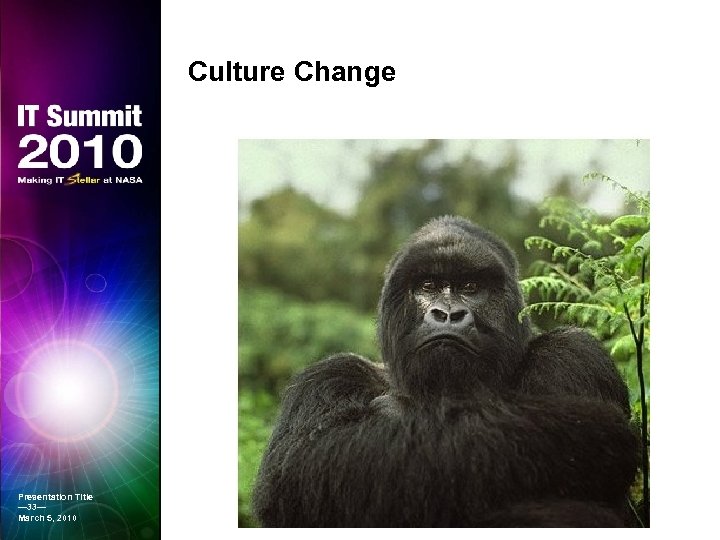 Culture Change Presentation Title — 33— March 5, 2010