 Скачать презентацию Subjective feeling provoked by real or imagined objects
8cae9173c64f7587a5a35a466962df6e.ppt
- Количество слайдов: 174



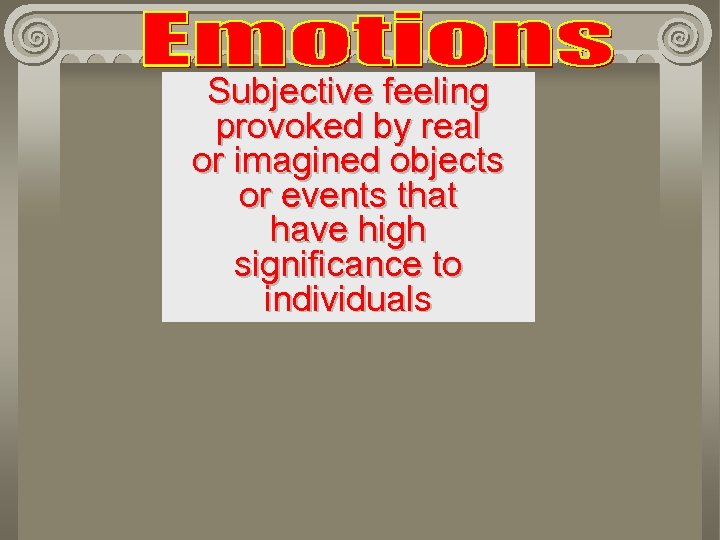
Subjective feeling provoked by real or imagined objects or events that have high significance to individuals
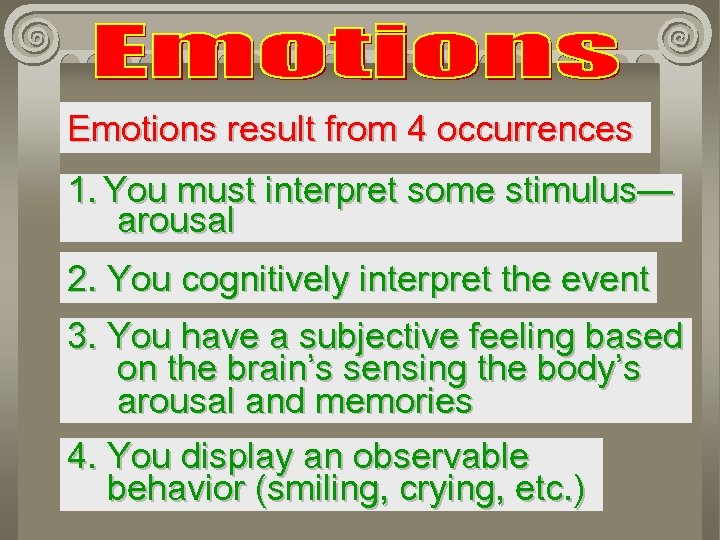
Emotions result from 4 occurrences 1. You must interpret some stimulus— arousal 2. You cognitively interpret the event 3. You have a subjective feeling based on the brain’s sensing the body’s arousal and memories 4. You display an observable behavior (smiling, crying, etc. )
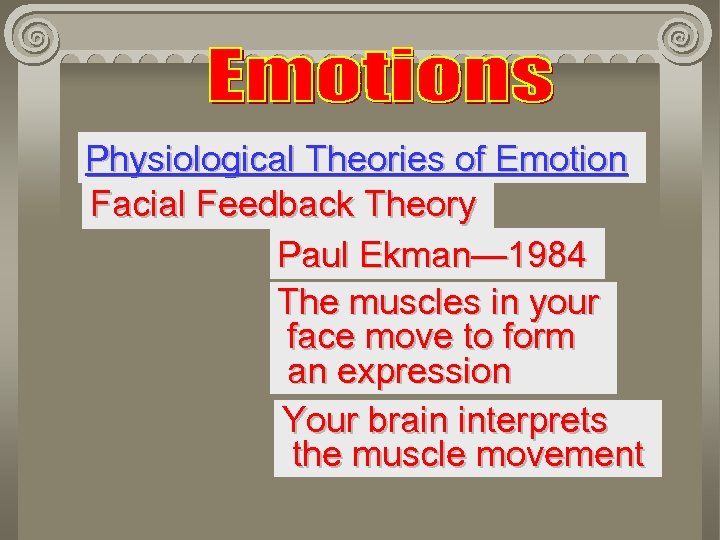
Physiological Theories of Emotion Facial Feedback Theory Paul Ekman— 1984 The muscles in your face move to form an expression Your brain interprets the muscle movement
Physiological Theories of Emotion Facial Feedback Theory Next, you feel an emotion Then, you demonstrate observable behavior
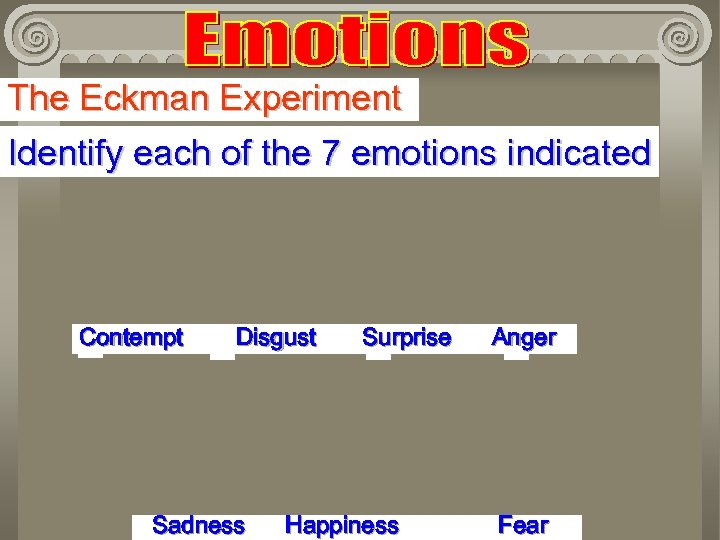
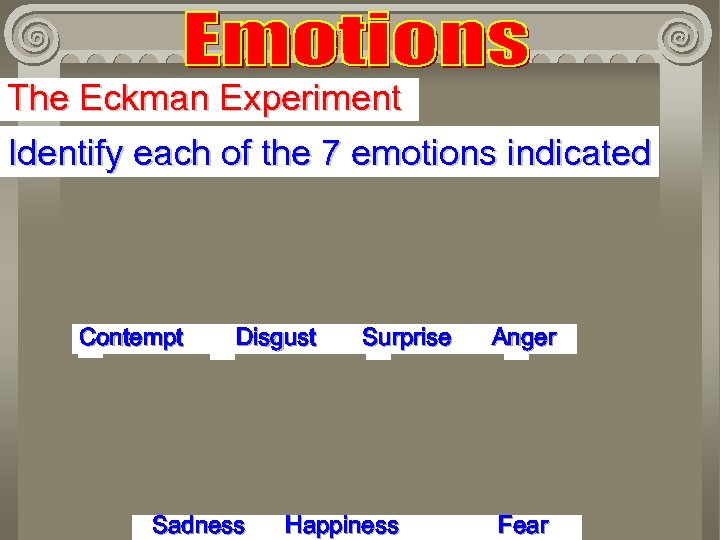
The Eckman Experiment Identify each of the 7 emotions indicated Contempt 1 2 Disgust 5 Sadness Surprise 3 6 Happiness 7 Anger 4 Fear
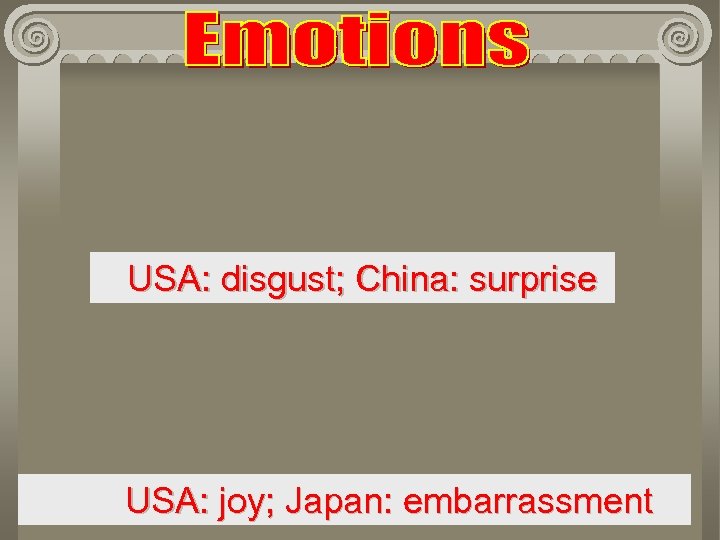
USA: disgust; China: surprise USA: joy; Japan: embarrassment
The Eckman Experiment Identify each of the 7 emotions indicated Contempt 1 2 Disgust 5 Sadness Surprise 3 6 Happiness 7 Anger 4 Fear
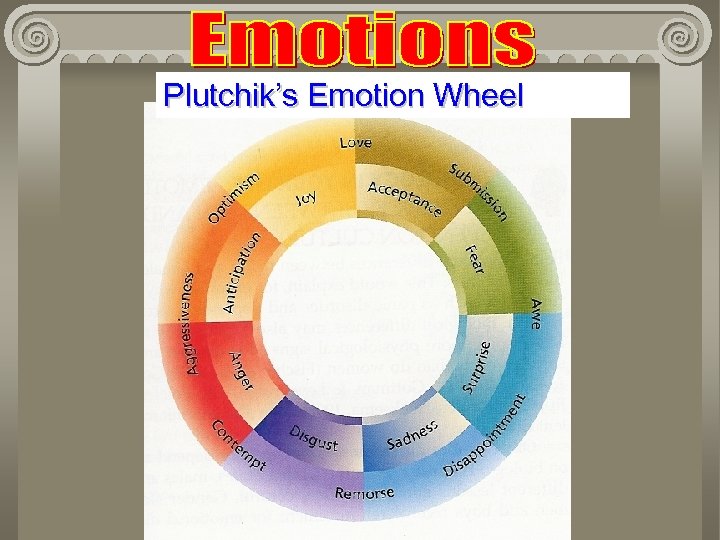
Plutchik’s Emotion Wheel
Do most people choose partners/friends who have sensation-seeking tendencies similar to their own?
More anger More psych. Signs of emotional arousal during interpersonal conflicts More violent acts More panic disorder More depression
Two emotional processing systems in brain 1. Fast response: Mainly unconscious Quick screen incoming stimuli Respond quickly to cues of potentially important events Linked to implicit memory system
Two emotional processing systems in brain 2. Conscious processing linked to explicit memory Growing fear as you anticipate giving a speech Generates emotions more slowly than the unconscious pathways Delivers more complete information to consciousness Relies heavily on cerebral cortex
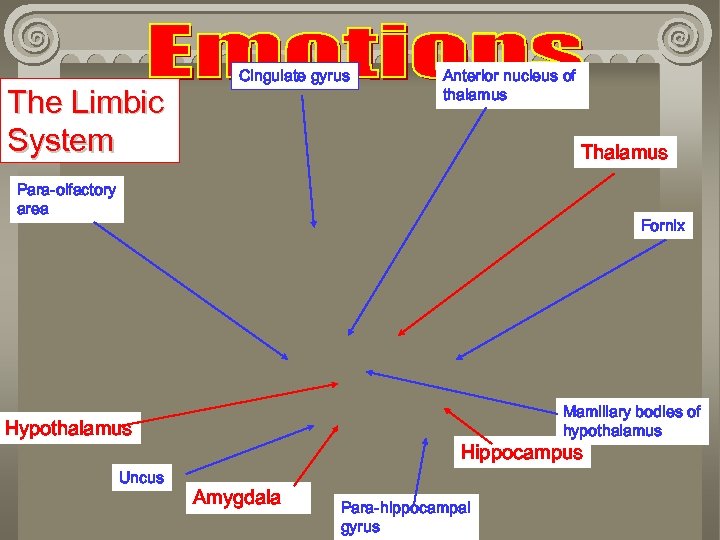
The Limbic System Cingulate gyrus Anterior nucleus of thalamus Thalamus Para-olfactory area Fornix Mamillary bodies of hypothalamus Hypothalamus Uncus Hippocampus Amygdala Para-hippocampal gyrus
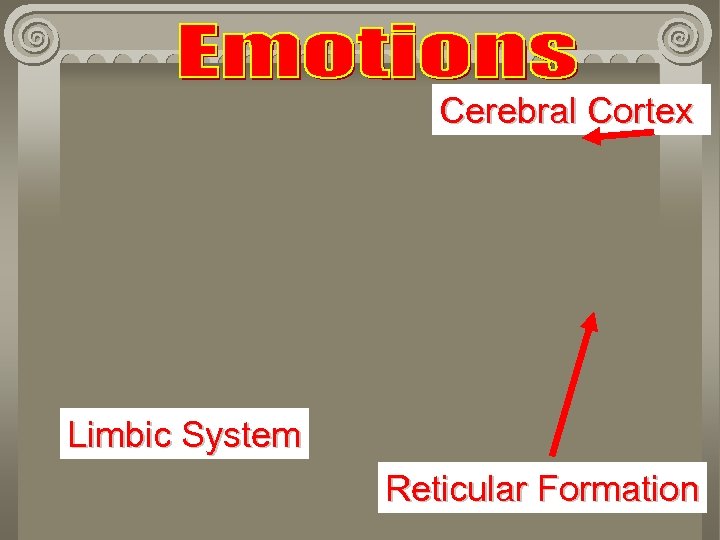
Cerebral Cortex Limbic System Reticular Formation
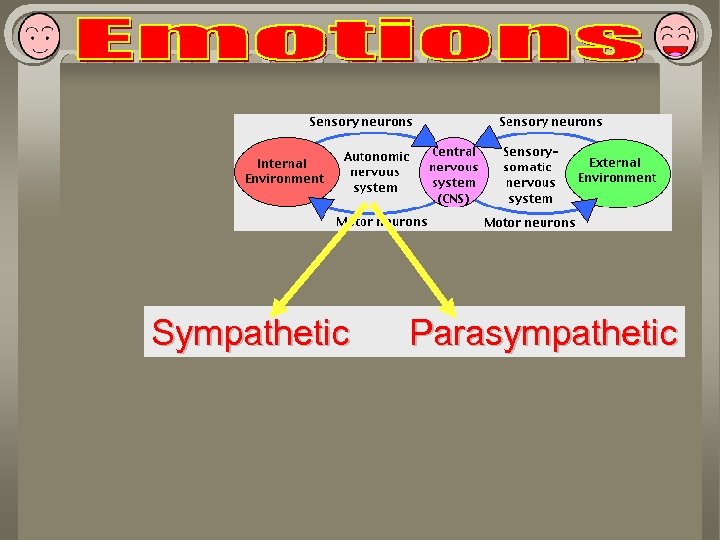
Sympathetic Parasympathetic
Physiological Theories of Emotion James-Lange Theory William James— 1890 Carl Lange— 1922 You experience physiological changes
Physiological Theories of Emotion James-Lange Theory Next, your brain interprets the physiological changes Then, you feel a specific emotion Then, you demonstrate observable behavior
Physiological Theories of Emotion The Cannon-Bard Theory Walter B. Cannon— 1929 Philip Bard— 1934
Physiological Theories of Emotion The Cannon-Bard Theory Your experience activates the hypothalamus, which produces messages to the cerebral cortex and your body organs. The reacting organs activate sensory signals, then sensory signals combine with cortical message, yielding emotion
Physiological Theories of Emotion Schachter-Singer Experiment— 1962 Stanley Schachter Jerome Singer
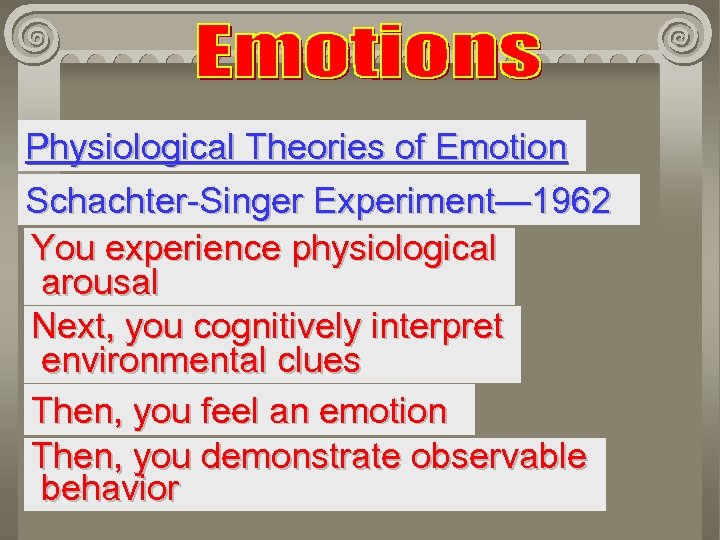
Physiological Theories of Emotion Schachter-Singer Experiment— 1962 You experience physiological arousal Next, you cognitively interpret environmental clues Then, you feel an emotion Then, you demonstrate observable behavior
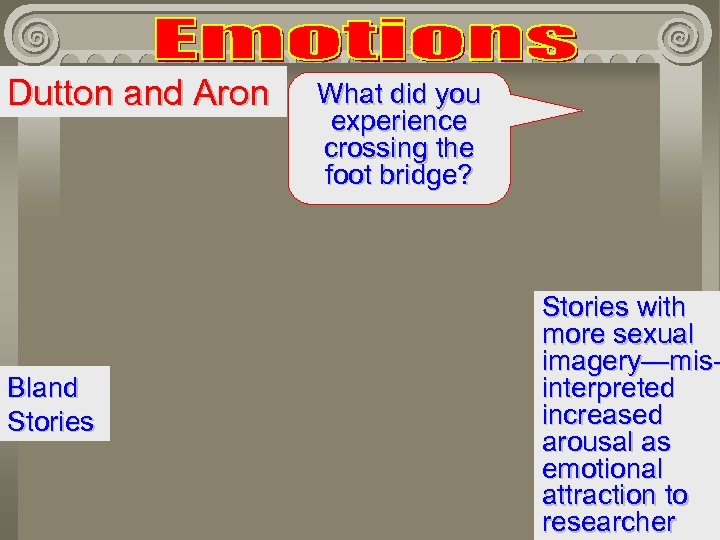
Dutton and Aron Bland Stories What did you experience crossing the foot bridge? Stories with more sexual imagery—misinterpreted increased arousal as emotional attraction to researcher
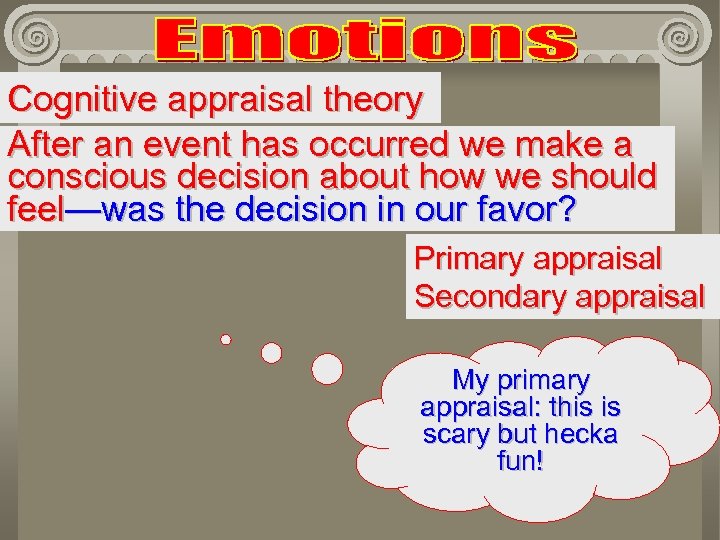
Cognitive appraisal theory After an event has occurred we make a conscious decision about how we should feel—was the decision in our favor? Primary appraisal Secondary appraisal My primary appraisal: this is scary but hecka fun!
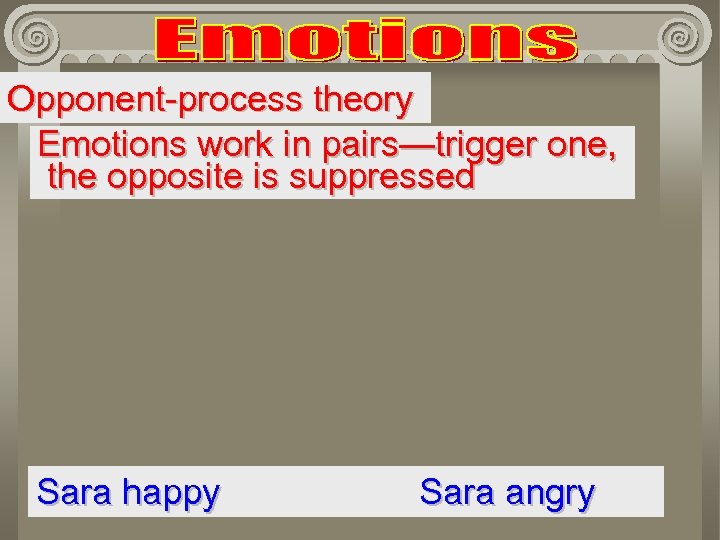
Opponent-process theory Emotions work in pairs—trigger one, the opposite is suppressed Sara happy Sara angry
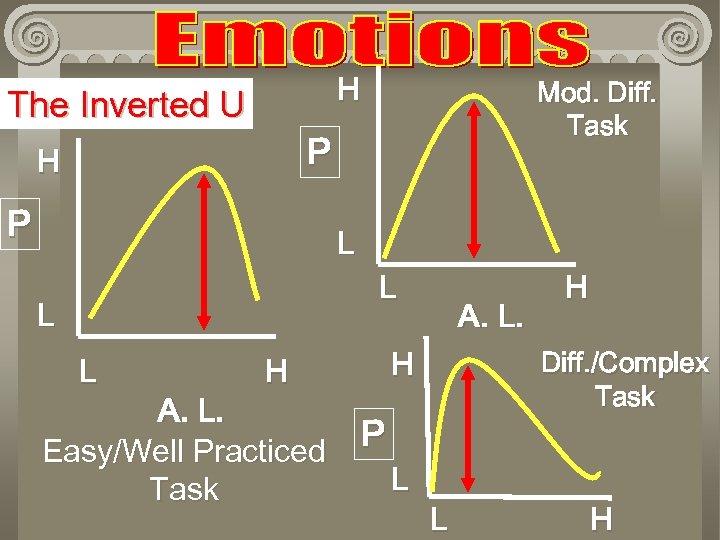
H The Inverted U Mod. Diff. Task P H P L L H H A. L. Easy/Well Practiced Task A. L. P L H Diff. /Complex Task L H
Biologically, why do some people seek thrills? Dopamine pathways in some brains are disposed to high levels of stimulation
High emotional intelligence Tuned in to own emotions Tuned into emotions of others Manage negative feelings Curtail inappropriate expression of impulses Goleman’s Marshmallow Test
Deception Cues Some lies involve false information Heightened attention Longer speech pauses Constrained gestures
Deception Cues When lies involve hiding one’s true feelings, liar may become more physically & behaviorally aroused (shifts in posture, speech errors, shrugging. )
Deception Cues The face is easier to control than the body
Maverick (1994)
Which of Miss Becky’s smiles is sincere?
Are Polygraph Tests Reliable?
No clinically recognized category for abnormal levels of anger Relaxation training, cognitive therapy and skill development
Motivation: Connects observable behavior to internal states Accounts for variability in behavior Explains perseverance despite adversity Relates biology to behavior
There are 2 types of motivation: Biological Social
Body has built-in regulating systems that work like thermostats to maintain internal processes. Body temperature Blood sugar levels Production of hormones Can you give some examples?
The tendency of all organisms to correct imbalances and deviations from their normal state is called: homeostasis
Homeostatic drives are controlled primarily by physiological processes over which an individual has no conscious control.
Non-homeostatic drives are greatly influenced by social and psychological factors—motives, which are mainly learned Love/sex Fear Anger
Intrinsic vs. extrinsic motivation Intrinsic: doing something where the reward is internal— knowledge gained/fun. Extrinsic: doing something for a reward external to you.
Sigmund Freud and unconscious motivation The unconscious mind harbors complex motives arising from traumatic experiences and sexual conflicts
Instinct or fixed-action patterns Unlearned behavior patterns that occur throughout a species and are triggered by identifiable stimuli
Clark Hull, experimental psychologist, 1943, traced motivation back to basic psychological needs. When an organism is denied something it needs or wants (food, water, etc. ). . .
. . . it becomes tense or agitated. To relieve, or reduce, the tension or agitation, the person will engage in more or less random activity. Thus biological needs drive an organism to act.
If a behavior (that a person is driven to do) reduces the drive, the organism will begin to acquire a habit. Therefore, when the person feels the drive again, she or he will try the reduction response again.
Hull: all human motives are extensions of biological needs Desire to acquire property Striving for excellence Seeking affection Seeking amusement All are based on homeostatic motives
Other psychologist researchers disputed Hull. . . They said Hull had overlooked some important factors in human and animal behavior. Example: Hull—babies become attached to mothers because their mothers relieve such drives as hunger or thirst.
Experiments by Harry Harlow (et al ) disproved the drive reduction theory about babies & mothers Monkey love experiments
Harlow: drive reduction theorists overlooked the fact that some experiences are inherently pleasurable.
Pleasurable things may not reduce biological drives. . . but they do serve as incentives or goals for behavior Another item overlooked in the drive reduction theory: Humans derive pleasure from stimulation or arousal Drives for stimulation as plausible as drives to reduce stimulation.
People usually do not partake in competitive sports or hobbies to reduce drives.
James Olds (1960) discovered a pleasure center in the hypothalamus In a Skinner Box, to gain brief stimulation from an implanted electrode, rats would press a bar to exhaustion rather than partake in available food, water, sex, or rest.
Other psychologists also proved that humans learn through observation with no identifiable reward. Harlow, Olds and others, therefore, disproved Hull’s drive reduction theory.
With drive reduction theory disproved, we are left with a list of unlearned, innate drives that include hunger and thirst, but also curiosity, contact with soft things, and many other things.
Leon Festinger Mental adjustments that occur in people who voluntarily undergo unpleasant experiences When people voluntarily act in ways that produce discomfort or otherwise clash with their attitudes and values, they develop a highly motivating mental state called cognitive dissonance
People are motivated to avoid the uncomfortable state of dissonance If people find themselves experiencing cognitive dissonance, they attempt to reduce it in ways that are predictable Either change behavior or change cognitions (Marines: the latter— rationalization or developing a stronger organizational loyalty)
Cognitive dissonance theory: when people’s cognitions and actions are in conflict (a state of dissonance) they often reduce the conflict by changing their thinking to fit their behavior. People don’t like to see themselves as foolish or inconsistent. So to explain their own behavior to themselves, people are motivated to change their attitudes. Otherwise, it would threaten their self-esteem
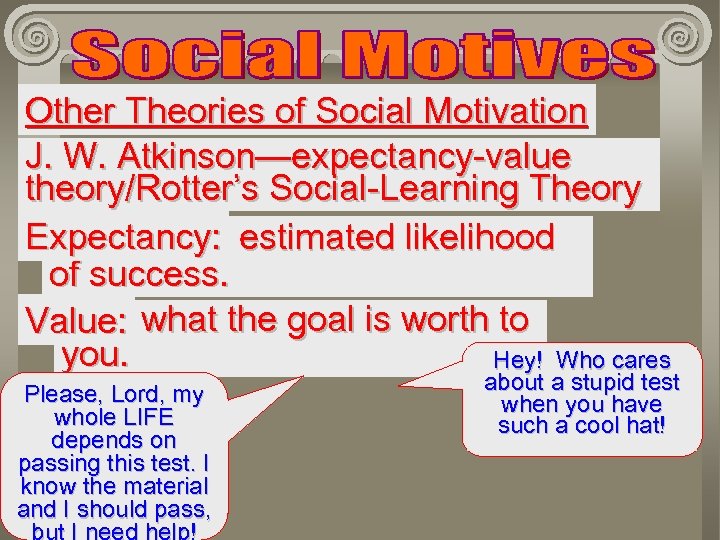
Other Theories of Social Motivation J. W. Atkinson—expectancy-value theory/Rotter’s Social-Learning Theory Expectancy: estimated likelihood of success. Value: what the goal is worth to you. Hey! Who cares Please, Lord, my whole LIFE depends on passing this test. I know the material and I should pass, about a stupid test when you have such a cool hat!
Motivation mainly from the unconscious mind (the id) 2 basic desires: eros—desire for sex thanatos—destruction Only one who takes a developmental approach to motivation—motives change from childhood to adulthood
Abraham Maslow Pioneer of humanistic psychology ALL humans need To feel competent To win approval & recognition Sense of achievement
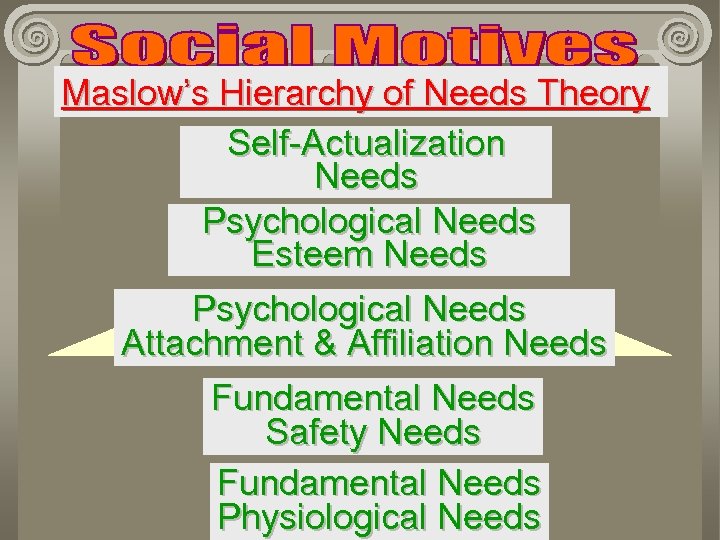
Maslow’s Hierarchy of Needs Theory Self-Actualization Needs Psychological Needs Esteem Needs Psychological Needs Attachment & Affiliation Needs Fundamental Needs Safety Needs Fundamental Needs Physiological Needs
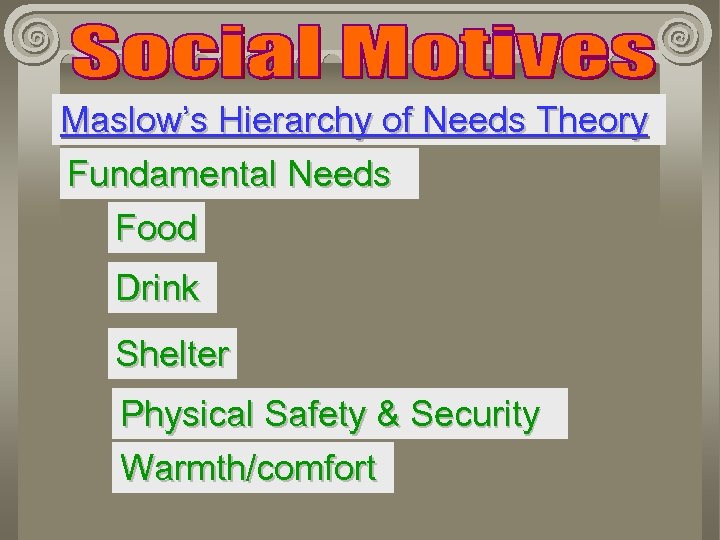
Maslow’s Hierarchy of Needs Theory Fundamental Needs Food Drink Shelter Physical Safety & Security Warmth/comfort
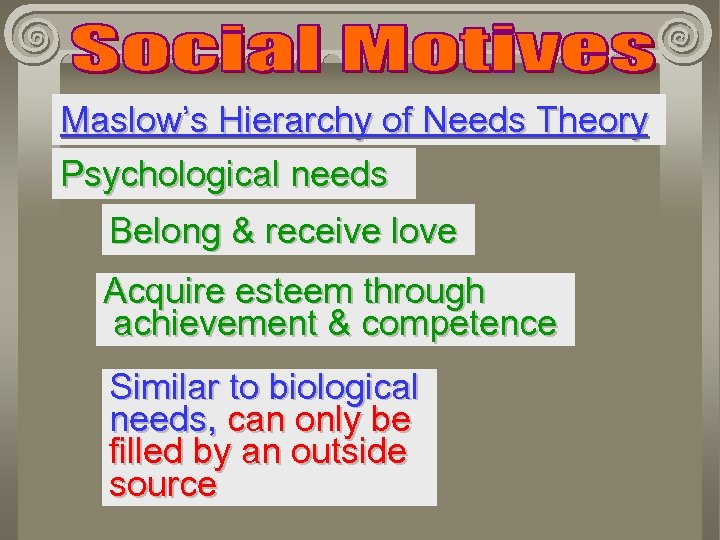
Maslow’s Hierarchy of Needs Theory Psychological needs Belong & receive love Acquire esteem through achievement & competence Similar to biological needs, can only be filled by an outside source
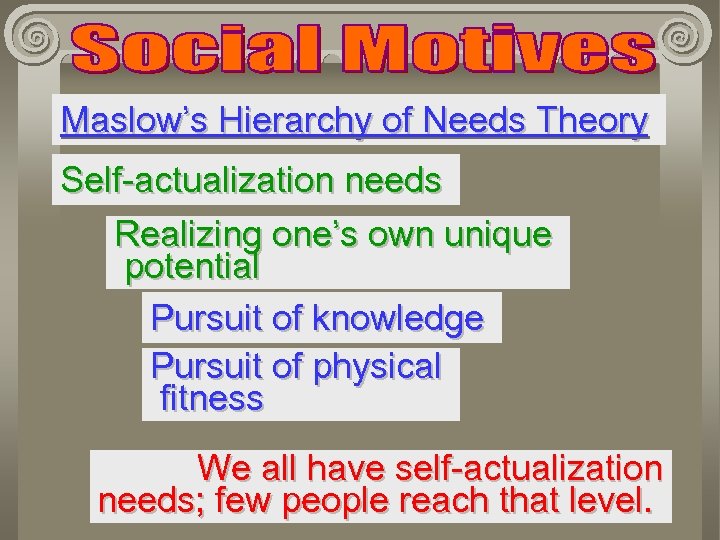
Maslow’s Hierarchy of Needs Theory Self-actualization needs Realizing one’s own unique potential Pursuit of knowledge Pursuit of physical fitness We all have self-actualization needs; few people reach that level.
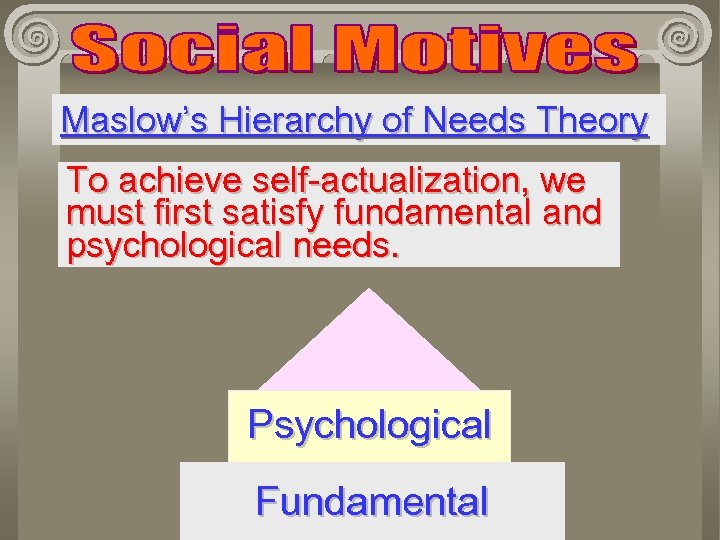
Maslow’s Hierarchy of Needs Theory To achieve self-actualization, we must first satisfy fundamental and psychological needs. Psychological Fundamental
Maslow’s Hierarchy of Needs Theory Therefore, some needs take precedence over others Achieving one level of satisfaction releases new needs & motivations.
Maslow’s Hierarchy of Needs Theory Therefore, some needs take precedence over others Achieving one level of satisfaction releases new needs & motivations.
Maslow’s Hierarchy of Needs Theory Research by others does not support the conclusion that one need must be satisfied before another can be. Example: Christopher Columbus Maslow may have identified basic needs; but no guarantee they will be satisfied in order
Other Theories of Social Motivation Competency theory: if a task is too easy, we don’t learn how competent we are. So, to prove or disprove our competency, we choose moderately difficult tasks where both successes and failures may be instructive.
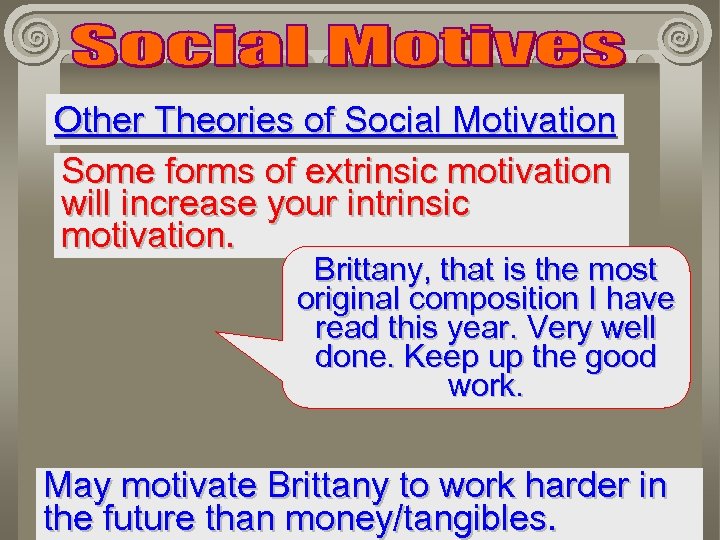
Other Theories of Social Motivation Some forms of extrinsic motivation will increase your intrinsic motivation. Brittany, that is the most original composition I have read this year. Very well done. Keep up the good work. May motivate Brittany to work harder in the future than money/tangibles.
Let’s test one of these theories. Divide yourselves into 5 groups. In each group, select one person to act as the group psychologist/ researcher. Everyone except for the researcher, take out two clean pieces of paper and a writing implement.
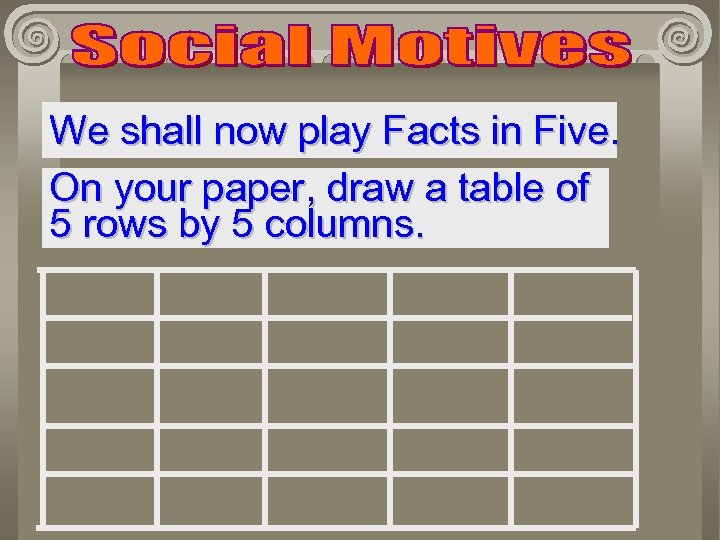
We shall now play Facts in Five. On your paper, draw a table of 5 rows by 5 columns.
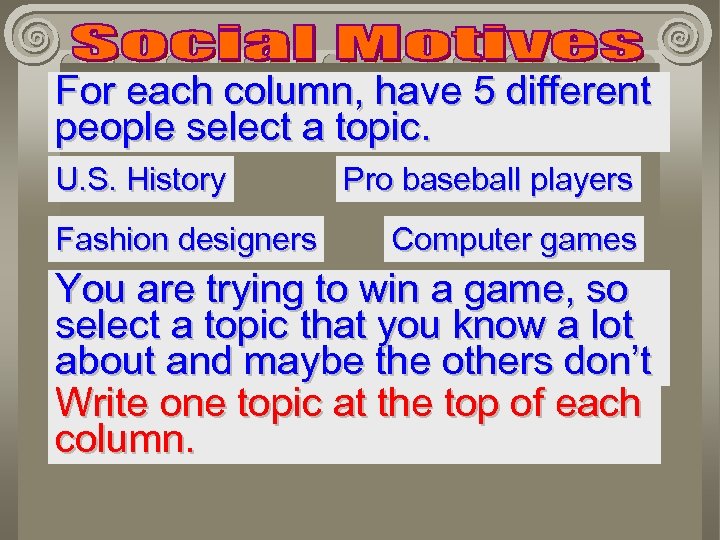
For each column, have 5 different people select a topic. U. S. History Fashion designers Pro baseball players Computer games You are trying to win a game, so select a topic that you know a lot about and maybe the others don’t Write one topic at the top of each column.
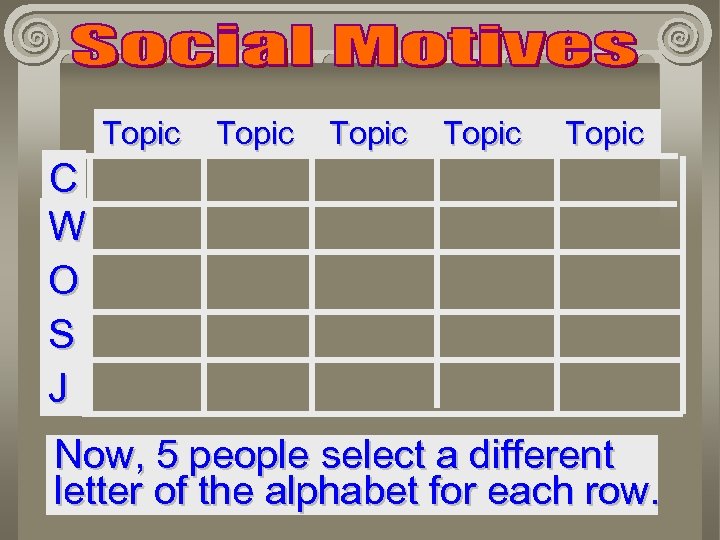
C W O S J Topic Topic Now, 5 people select a different letter of the alphabet for each row.
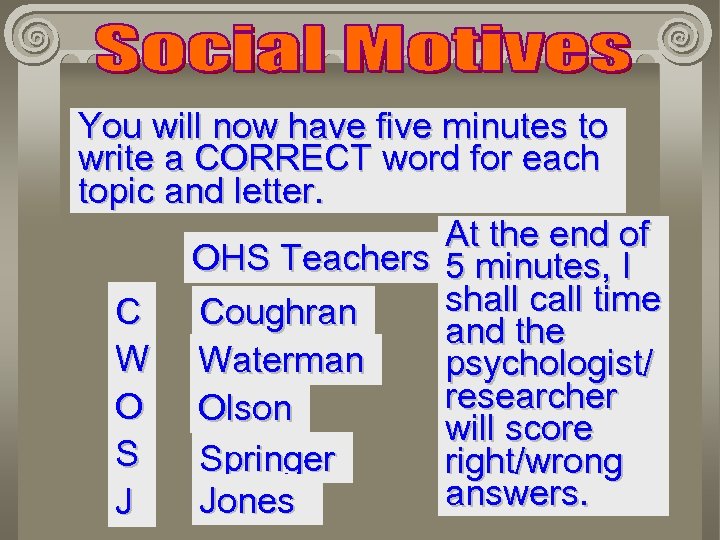
You will now have five minutes to write a CORRECT word for each topic and letter. At the end of OHS Teachers 5 minutes, I shall call time C Coughran and the W Waterman psychologist/ researcher O Olson will score S Springer right/wrong answers. Jones J
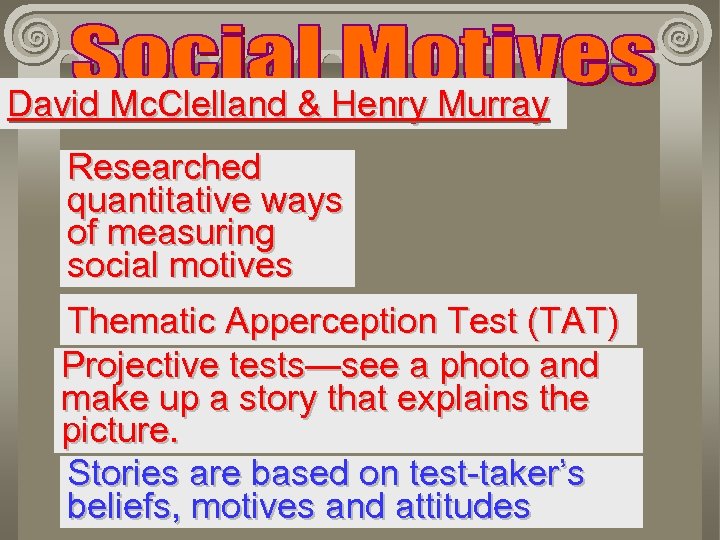
David Mc. Clelland & Henry Murray Researched quantitative ways of measuring social motives Thematic Apperception Test (TAT) Projective tests—see a photo and make up a story that explains the picture. Stories are based on test-taker’s beliefs, motives and attitudes
David Mc. Clelland Then Mc. Clelland his team would evaluate the stories based on a scoring system—the n Ach measurement Ok, now YOU are going to take a TAT.
For each picture, write a story that includes: 1) What events have led up to the event depicted? 2) What is occurring at the moment? 3) What are the characters’ feelings and thoughts? 4) What will be the eventual outcome?
Scoring the Thematic Apperception Test (TAT) Mc. Clelland testing motivation for personal achievement If writer was concerned with standards of excellence and a high level of performance, with unique accomplishments, or with the pursuit of a long-term career or goal, he or she scored high on the TAT.
Matina Horner tested to determine another dimension of achievement motivation (1970 and 1972). Let’s start our discussion of Horner by taking her test.
Girls, write a story that begins with this sentence: “After the first semester grades are recorded, Anne finds herself number 1 in her class. ” Guys, write a story that begins with this sentence: “After the first semester grades are recorded, John finds himself number 1 in his class. ”
Matina Horner In 1970, Horner found that 90% of males wrote success stories. . . however, more than 65% of the females predicted doom for Anne. Difference: Medical school class Horner’s testing identified that in some people, there is a motive to avoid success.
Matina Horner (In the 1970 s), females in our society raised with idea that being successful in all but a few careers is odd and not feminine. Thus if successful in medicine, law, and other traditionally male professions, a woman must be a failure as a woman.
Matina Horner discovered: bright women exhibited stronger fear of success than did women who were average or slightly above average. Bright women: expecting success made them more likely to avoid it, despite the obvious advantages of a rewarding career Horner: success involves deep conflicts for women.
Matina Horner Challenging Horner: How do you define success? Cherry & Deaux, 1978—if asked to write about traditionally female-dominated occupations, males would exhibit fear of success. Paludi, 1984—gave Horner’s test; 45% males expressed fear of success; 49% females did same
What part of the brain controls homeostatic drives? The hypothalamus Let’s study this concept by looking at hunger
Your lateral hypothalamus (LH) tells your body that you must eat. Your ventromedial hypothalamus (VMH) tells your body when it has had enough food.
The LH, or “go, ” signal is more active in cold temperatures. The VMH, or “stop, ” signal is more active in warm temperatures
The glucostatic theory: the hypothalamus monitors the amount of glucose, or ready sugar, available in the blood. As the blood glucose entering the blood drops, the LH fires to stimulate eating. Same time, pancreas releases insulin to convert incoming calories to energy
Glucostatic theory Energy obtained can be consumed by active cells or stored as fat for later use. Glycogen energy After eating—as blood glucose drops—pancreas secretes glycogen, which helps convert stored energy into useful energy.
Another factor affecting eating is the set-point—the weight around which your day-to-day weight tends to fluctuate. Daily calorie intake and & expenditure of energy vary; but over the long run, the body maintains a very stable weight.
Evidence suggests that the ventromedial hypothalamus (VMH) plays a role in the level at which your set-point is maintained. Rats whose VMH has been destroyed tend to eat until their weight increases 4 -5 times from the normal, but they do not eat until they explode.
Bottom line: the hypothalamus “interprets” at least three kinds of information: The amount of glucose entering body cells Your set-point Your body temperature
As you grew up, what messages did you get about eating? How have those experiences affected your present food choices and behaviors regarding food?
What food choices do you tend to make when you are angry, sad or frustrated?
Hey Mustangs AP psychos! I’m Morgan Spurlock and I made a movie about the American culture and eating. I called it Super Size Me and I focused on obesity in the United States and how the Mc. Donald’s Corporation contributes to that obesity.
Anorexia Nervosa and Bulimia Karen Tracy Gold Mary Kate Carpenter Olsen Katherine Mc. Phee
Anorexia Nervosa and Bulimia
Now, we are going to discuss “The Hunger Anorexia Artists” by Emily Sohn. Sigh. and. . wish I Nervosa 1/10 Ias Bulimia were hot as Thanks to Simone, skinny is now OUT. She is such a trendsetter. Today’s HOT women are, uh, robust, yeah ROBUST, like Simone.
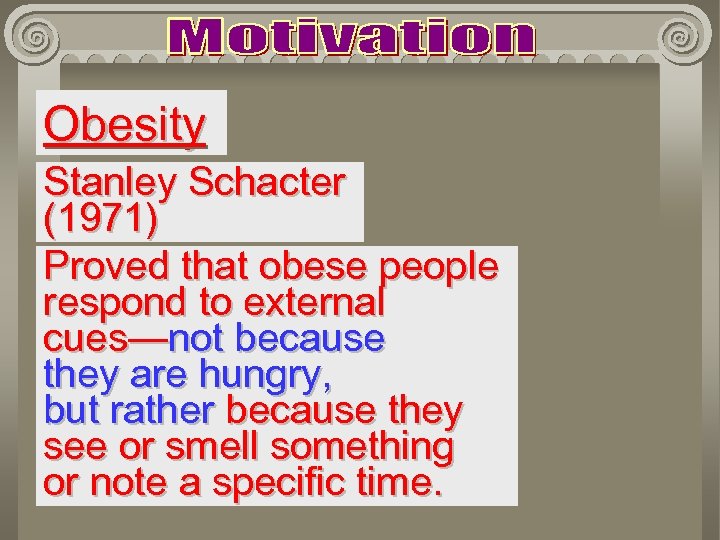
Obesity Stanley Schacter (1971) Proved that obese people respond to external cues—not because they are hungry, but rather because they see or smell something or note a specific time.
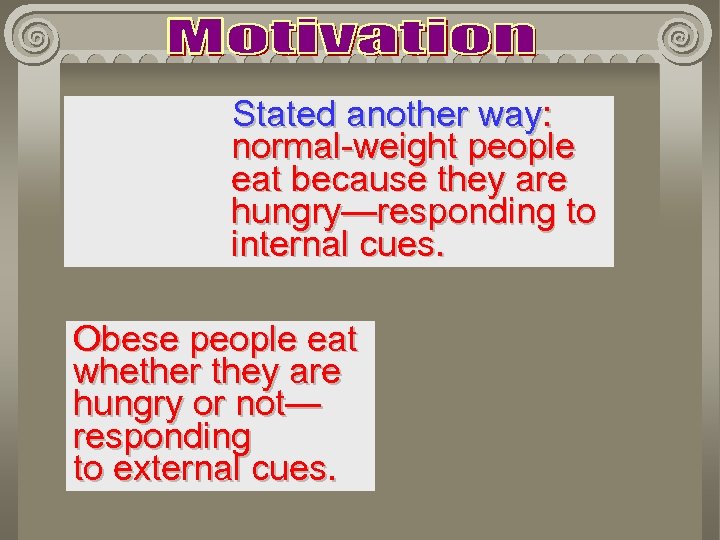
Stated another way: normal-weight people eat because they are hungry—responding to internal cues. Obese people eat whether they are hungry or not— responding to external cues.
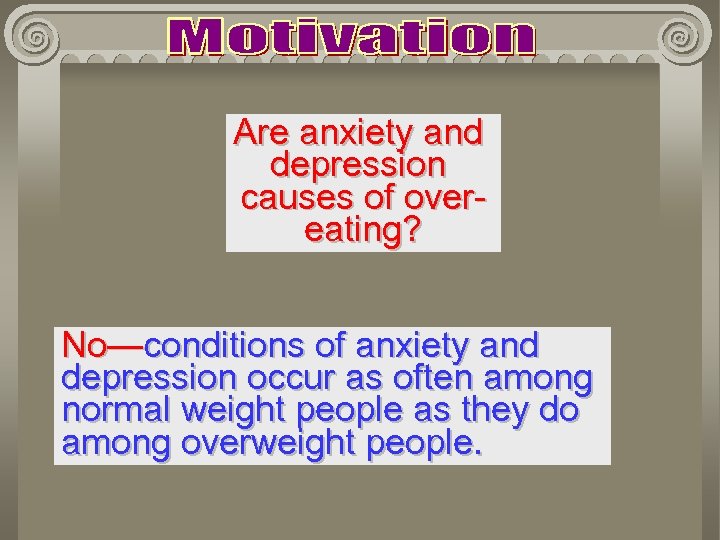
Are anxiety and depression causes of overeating? No—conditions of anxiety and depression occur as often among normal weight people as they do among overweight people.
Will exercise always lead to weight loss? No, not always. Only if a person does not also increase his or her food intake as he or she increases the amount of exercise. Cause of weight gain: too little exercise in proportion to food intake.
Sexual motivation
Kinsey, 1953 Masters & Johnson, 1970
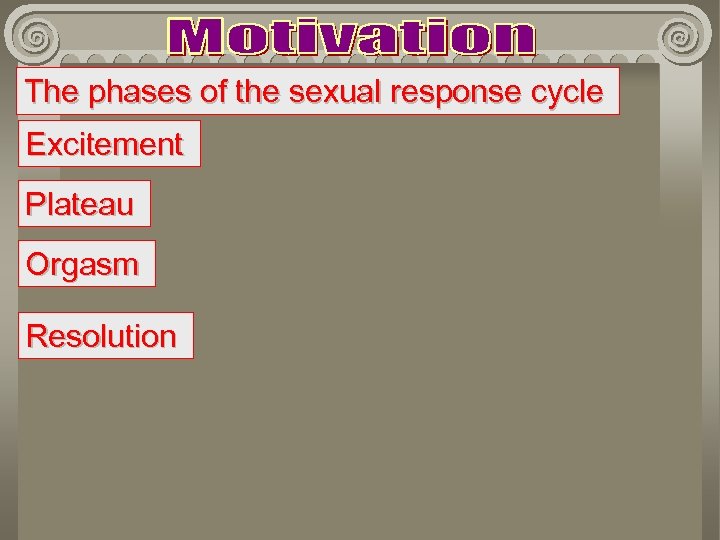
The phases of the sexual response cycle Excitement Plateau Orgasm Resolution
Mate selection Men Women
Conflict situations: we often have to evaluate situations and then make difficult decisions between two or more options; major sources of stress Four broad categories Approach-approach: choose between two attractive alternatives
Conflict situations: four broad categories Avoidance-avoidance conflict: an individual confronts two unattractive alternatives This is so hard. I need a debate partner and the only people who want to work with me are 2 slackers. Whom should I select? or
Conflict situations: four broad categories Approach-avoidance conflict: hard. I don’t This is so want to hurt Aimee’s A person wants to do something, but feelings, but she really has fears or doubts or needs to use deodorant. is repulsed by But if I tell her, she may it at the same time get upset.
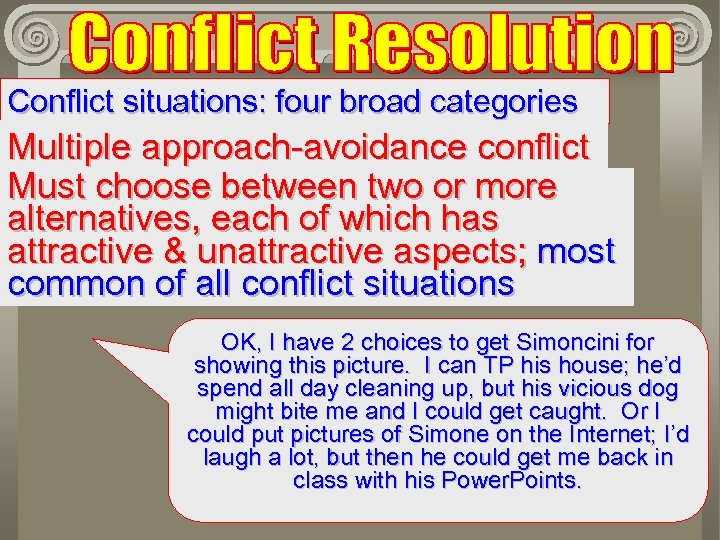
Conflict situations: four broad categories Multiple approach-avoidance conflict Must choose between two or more alternatives, each of which has attractive & unattractive aspects; most common of all conflict situations OK, I have 2 choices to get Simoncini for showing this picture. I can TP his house; he’d spend all day cleaning up, but his vicious dog might bite me and I could get caught. Or I could put pictures of Simone on the Internet; I’d laugh a lot, but then he could get me back in class with his Power. Points.
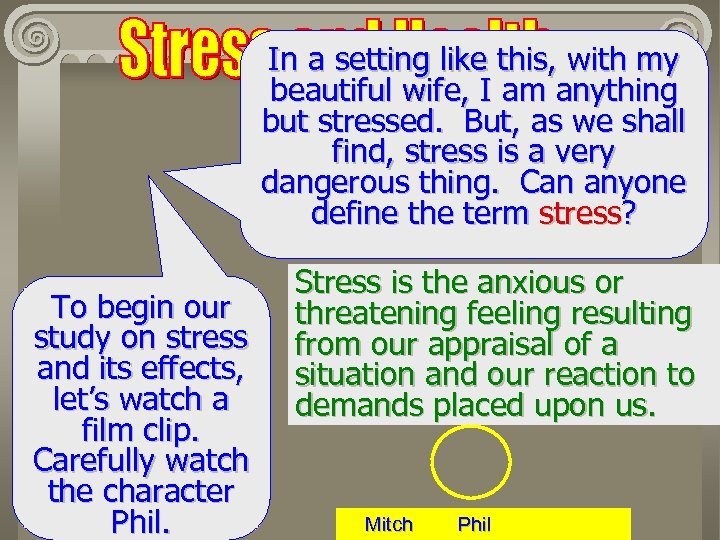
In a setting like this, with my beautiful wife, I am anything but stressed. But, as we shall find, stress is a very dangerous thing. Can anyone define the term stress? To begin our study on stress and its effects, let’s watch a film clip. Carefully watch the character Phil. Stress is the anxious or threatening feeling resulting from our appraisal of a situation and our reaction to demands placed upon us. Mitch Phil
Can you attribute Phil’s violent reaction to stress? If so, what were some of the causes of his stress?
Working alone, write down five common causes of stress in your life. I hate term papers. Are you graduating? Did you get into college? Can you pay for college? Formal date
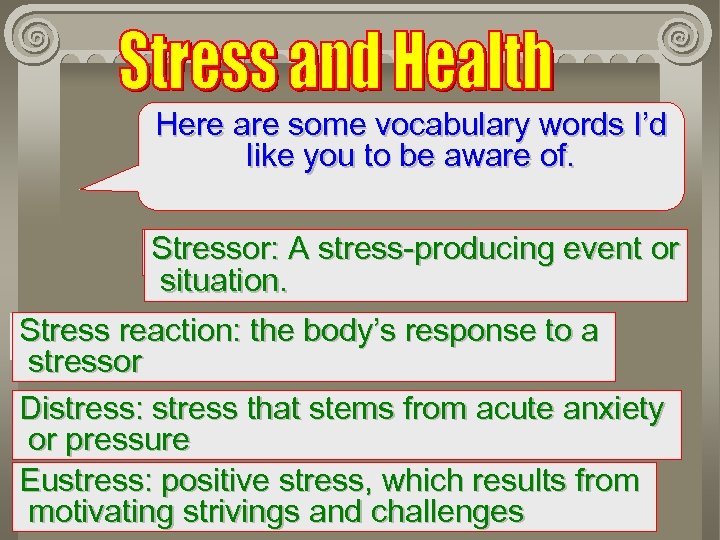
Here are some vocabulary words I’d like you to be aware of. Stressor: Stressor A stress-producing event or situation. Stress reaction: the body’s response to a stressor Distress: stress that stems from acute anxiety Distress: or pressure Eustress: positive stress, which results from Eustress: motivating strivings and challenges
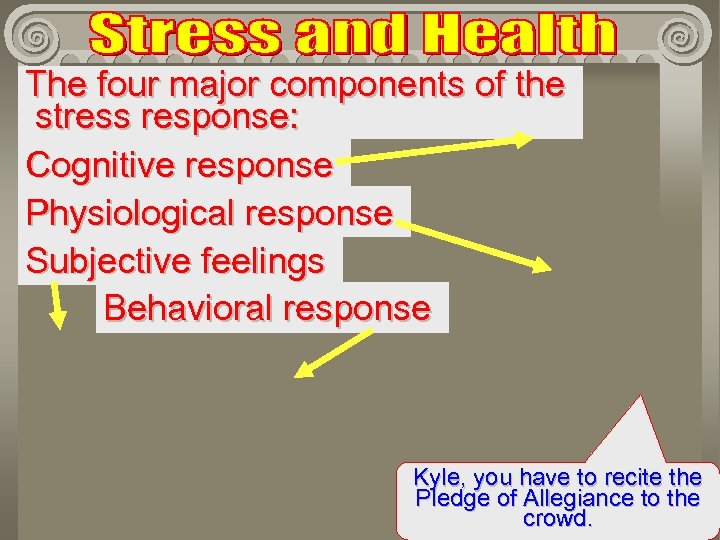
The four major components of the stress response: Cognitive response Physiological response Subjective feelings Behavioral response Kyle, you have to recite the Pledge of Allegiance to the crowd.

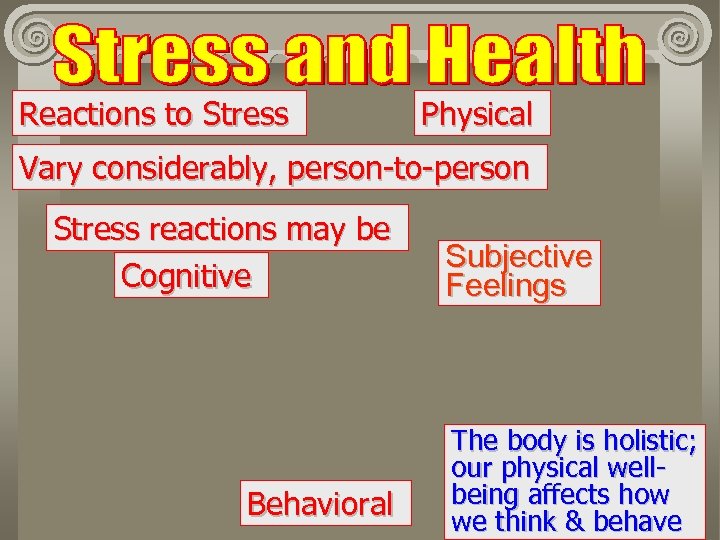
Reactions to Stress Physical Vary considerably, person-to-person Stress reactions may be Cognitive Behavioral Subjective Feelings The body is holistic; our physical wellbeing affects how we think & behave
Two of the foremost life-change researchers are Thomas H. Holmes and Richard H. Rahe. In 1967 they developed a scale to measure the effects of 43 common stressful events on human health. Let’s read about their study on p. 418 of the yellow book and then you can take their survey. Richard Rahe
We are now going to take the Holmes. Rahe Social Readjustment Rating Scale survey Your mission is to now develop a Social Readjustment Rating Scale with 25 life events that are stressful for teens. Work in groups of 2 -3. Develop 25 life events. Next, place the events in order from most stressful to least stressful. Then, assign a numerical value for each event. Now, let’s see how your scale compares with one developed about teens by professionals
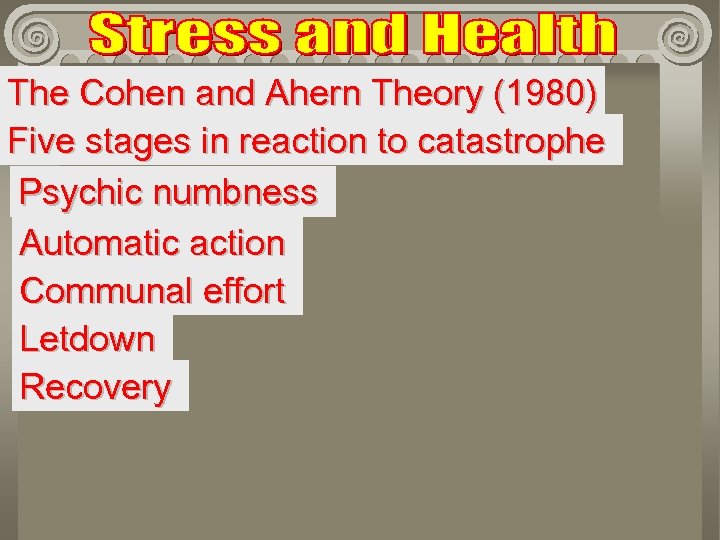
The Cohen and Ahern Theory (1980) Five stages in reaction to catastrophe Psychic numbness Automatic action Communal effort Letdown Recovery
Post-Traumatic Stress Disorder (PTSD)
Everyone has some sorts of stress in their daily lives. Some things are as routine and simple as too much noise, crowding or hassles. Unfortunately, even minor, day-today stressors can have adverse affects on health. To illustrate, let’s watch a film clip. Let’s see if George Banks in Father of the Bride displayed those four components Stress Vulnerability
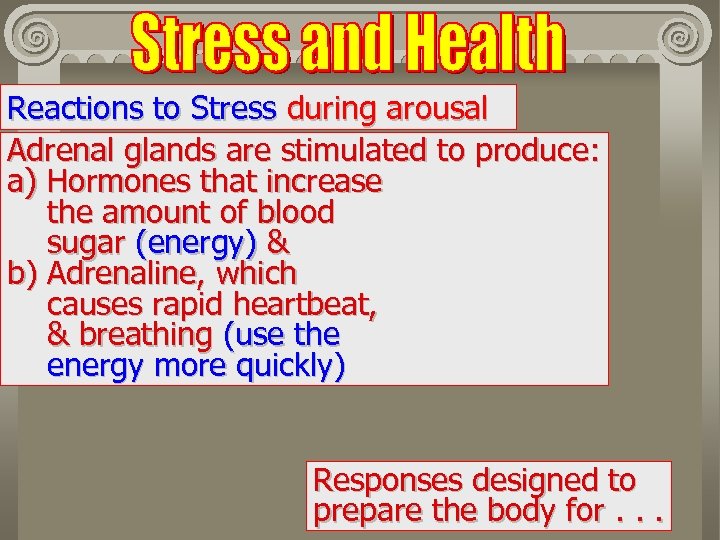
Reactions to Stress during arousal Adrenal glands are stimulated to produce: a) Hormones that increase the amount of blood sugar (energy) & b) Adrenaline, which causes rapid heartbeat, & breathing (use the energy more quickly) Responses designed to prepare the body for. . .
Reactions to Stress. . . self –defense, often called the Fight or Response Flight Needed for survival
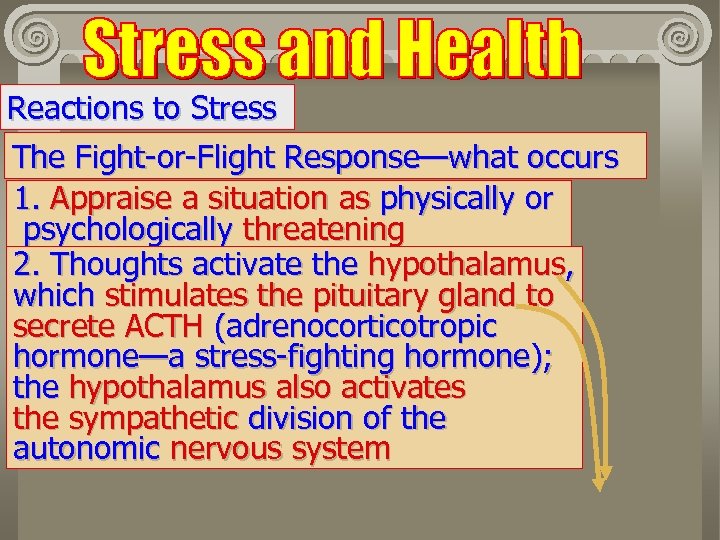
Reactions to Stress The Fight-or-Flight Response—what occurs 1. Appraise a situation as physically or psychologically threatening 2. Thoughts activate the hypothalamus, which stimulates the pituitary gland to secrete ACTH (adrenocorticotropic hormone—a stress-fighting hormone); the hypothalamus also activates the sympathetic division of the autonomic nervous system
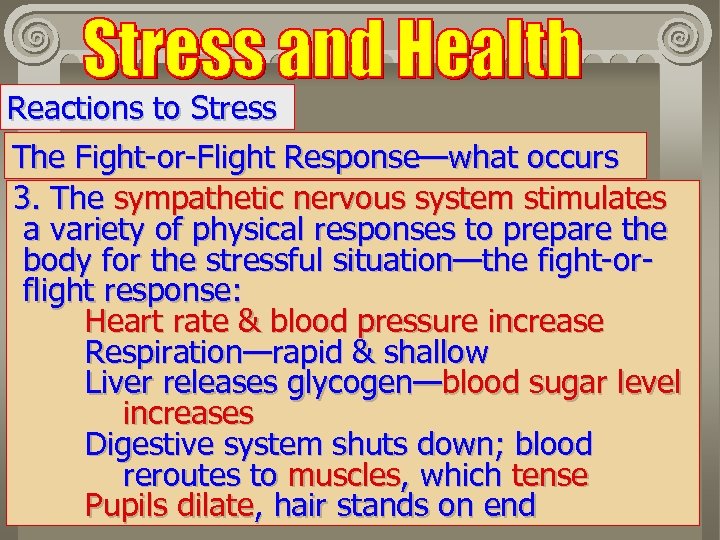
Reactions to Stress The Fight-or-Flight Response—what occurs 3. The sympathetic nervous system stimulates a variety of physical responses to prepare the body for the stressful situation—the fight-orflight response: Heart rate & blood pressure increase Respiration—rapid & shallow Liver releases glycogen—blood sugar level increases Digestive system shuts down; blood reroutes to muscles, which tense Pupils dilate, hair stands on end
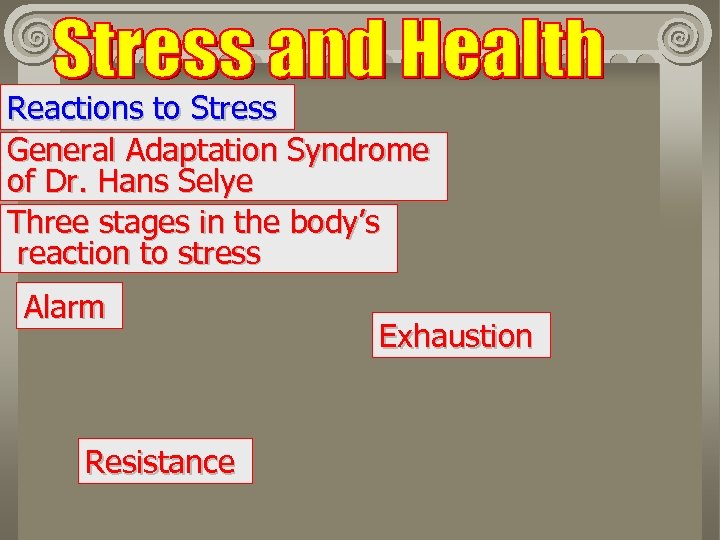
Reactions to Stress General Adaptation Syndrome of Dr. Hans Selye Three stages in the body’s reaction to stress Alarm Resistance Exhaustion
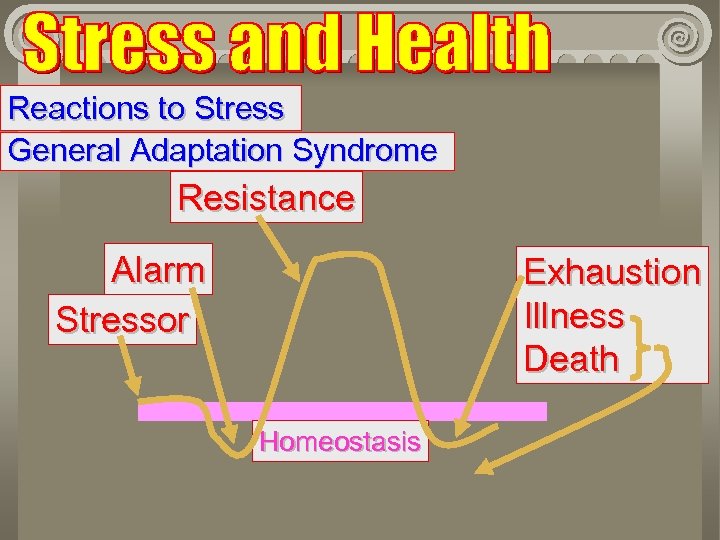
Reactions to Stress General Adaptation Syndrome Resistance Alarm Stressor Exhaustion Illness Death Homeostasis
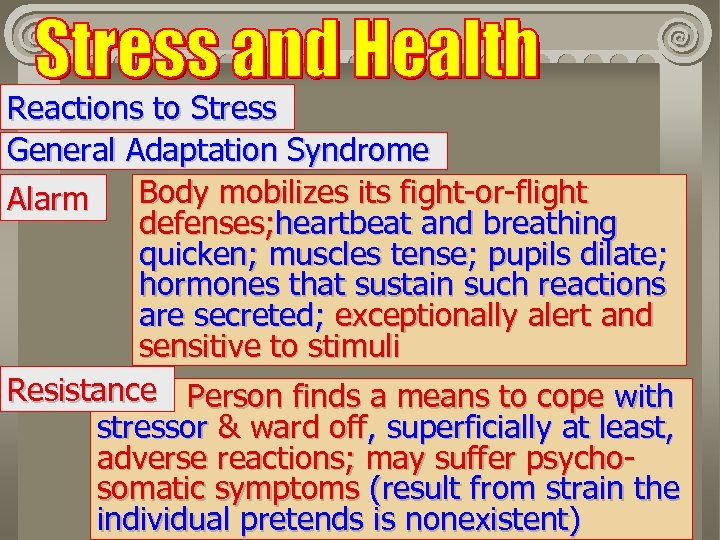
Reactions to Stress General Adaptation Syndrome Body mobilizes its fight-or-flight Alarm defenses; heartbeat and breathing quicken; muscles tense; pupils dilate; hormones that sustain such reactions are secreted; exceptionally alert and sensitive to stimuli Resistance Person finds a means to cope with stressor & ward off, superficially at least, adverse reactions; may suffer psychosomatic symptoms (result from strain the individual pretends is nonexistent)
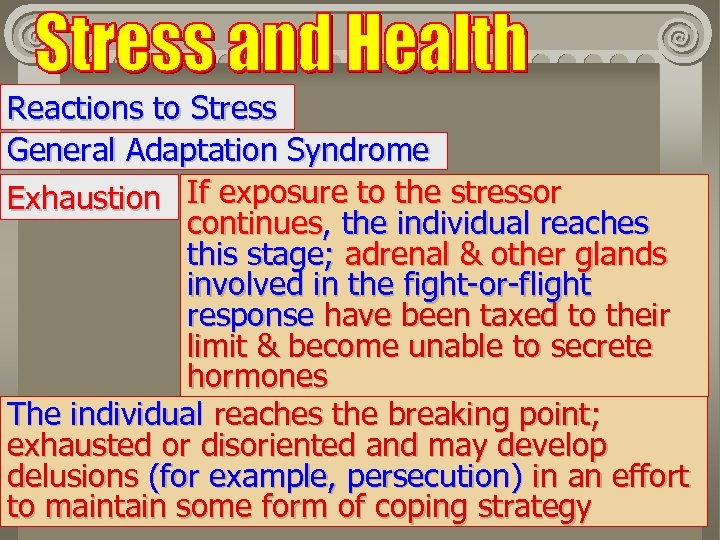
Reactions to Stress General Adaptation Syndrome Exhaustion If exposure to the stressor continues, the individual reaches this stage; adrenal & other glands involved in the fight-or-flight response have been taxed to their limit & become unable to secrete hormones The individual reaches the breaking point; exhausted or disoriented and may develop delusions (for example, persecution) in an effort to maintain some form of coping strategy
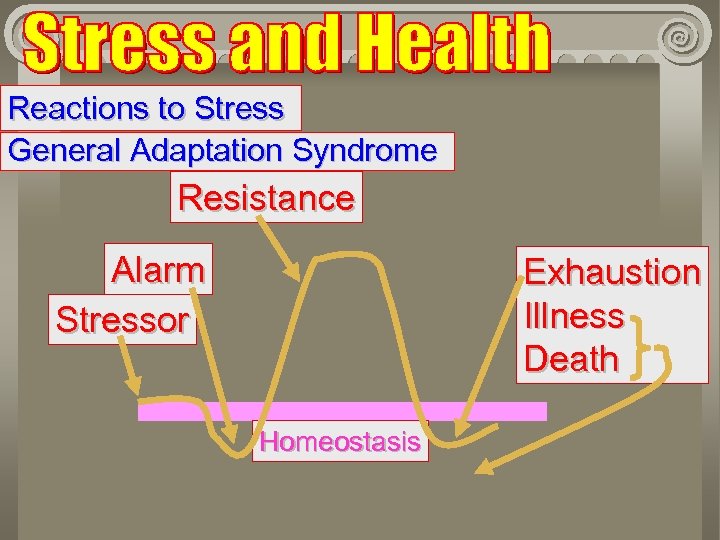
Reactions to Stress General Adaptation Syndrome Resistance Alarm Stressor Exhaustion Illness Death Homeostasis
John Gray, Ph. D. Copyright 1992, Harper. Collins Publishers, New York, NY “The classic guide to understanding the opposite (gender). ” And remember, everyone, Dr. Gray’s work is a theory; but one based on years of research.
Martians value power, competency, efficiency, and achievement. They like to do things to improve themselves and develop their power and skills. A man’s sense of self is defined through his ability to achieve results. This may be caused by very high levels of cortisol excretion—cortisol is important in the fight-or-flight response.
Now we’ll travel to Venus; and we’ll find that Venusians have different values from Martians. Venusians value love, beauty, communication, and relationships. They spend a lot of time supporting, helping and nurturing one another.
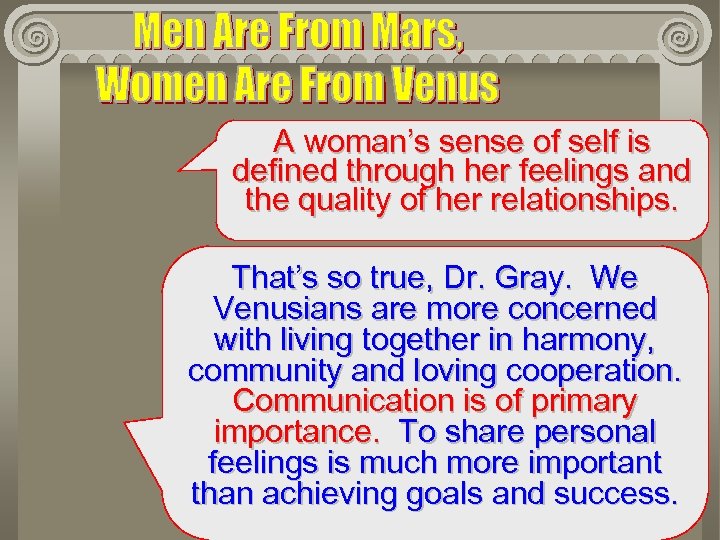
A woman’s sense of self is defined through her feelings and the quality of her relationships. That’s so true, Dr. Gray. We Venusians are more concerned with living together in harmony, community and loving cooperation. Communication is of primary importance. To share personal feelings is much more important than achieving goals and success.
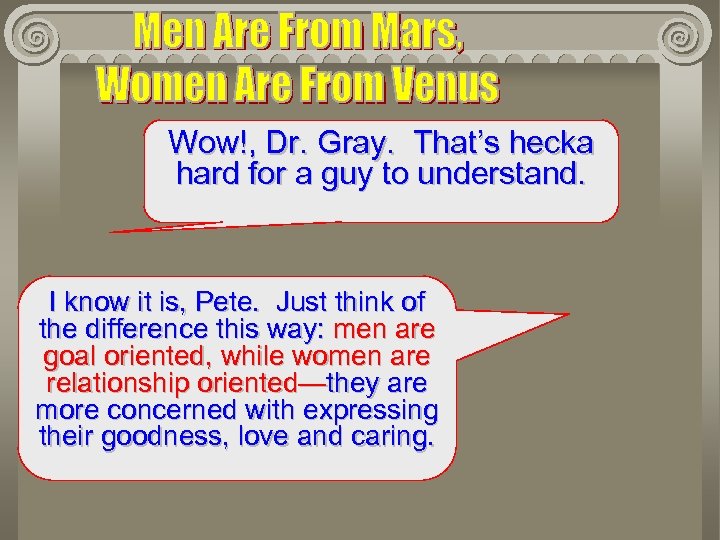
Wow!, Dr. Gray. That’s hecka hard for a guy to understand. I know it is, Pete. Just think of the difference this way: men are goal oriented, while women are relationship oriented—they are more concerned with expressing their goodness, love and caring.
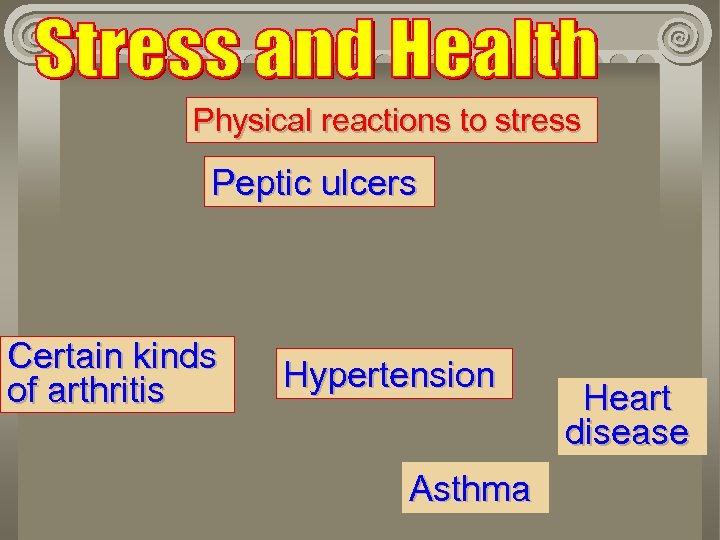
Physical reactions to stress Peptic ulcers Certain kinds of arthritis Hypertension Asthma Heart disease
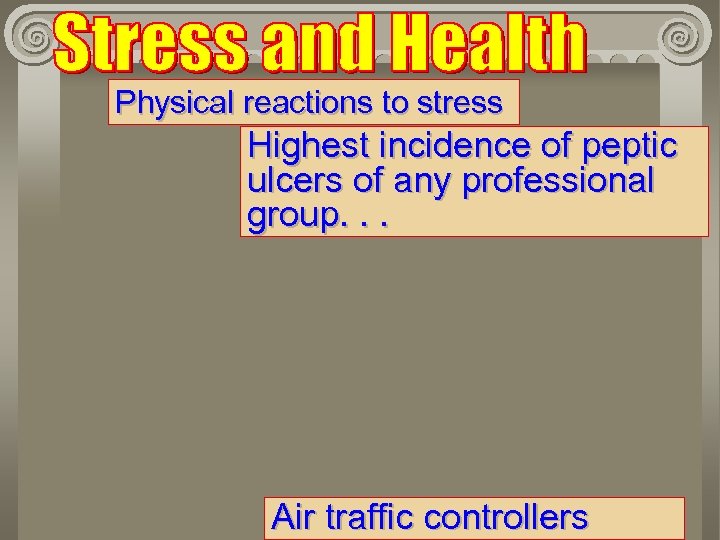
Physical reactions to stress Highest incidence of peptic ulcers of any professional group. . . Air traffic controllers
Physical reactions to stress When you experience stressful situations for a long period of time, it decreases your immune system’s ability to cope; during the exhaustion stage of Selye’s General Adaptation Syndrome, the immune system is suppressed and you can become seriously ill
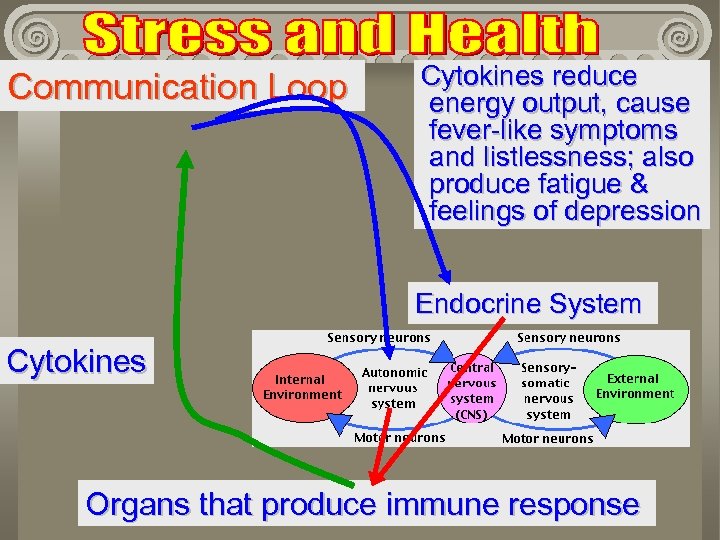
Communication Loop Cytokines reduce energy output, cause fever-like symptoms and listlessness; also produce fatigue & feelings of depression Endocrine System Cytokines Organs that produce immune response
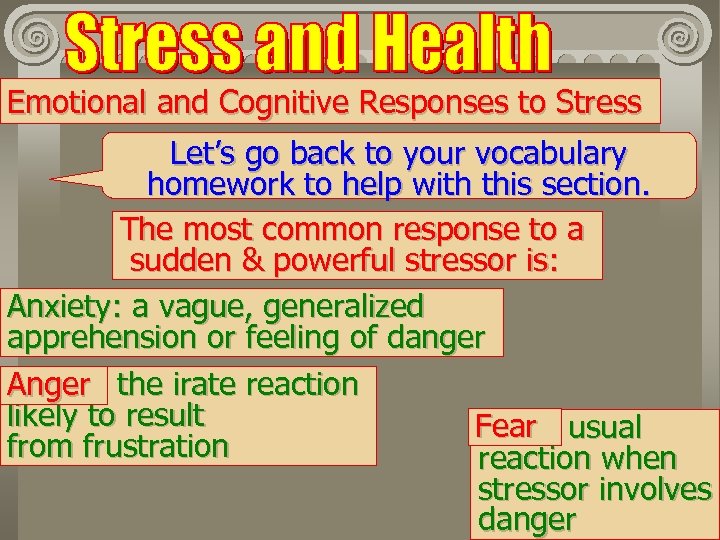
Emotional and Cognitive Responses to Stress Let’s go back to your vocabulary homework to help with this section. The most common response to a sudden & powerful stressor is: Anxiety: a vague, generalized apprehension or feeling of danger Anger the irate reaction likely to result Fear usual from frustration reaction when stressor involves danger
Emotional and Cognitive Responses to Stress Common short-term stress: emotional stress reactions Overreacting to minor irritations (George Banks & hot dog buns) Getting no joy from daily pleasures, doubting one’s abilities while feeling tense, short-tempered & more anxious
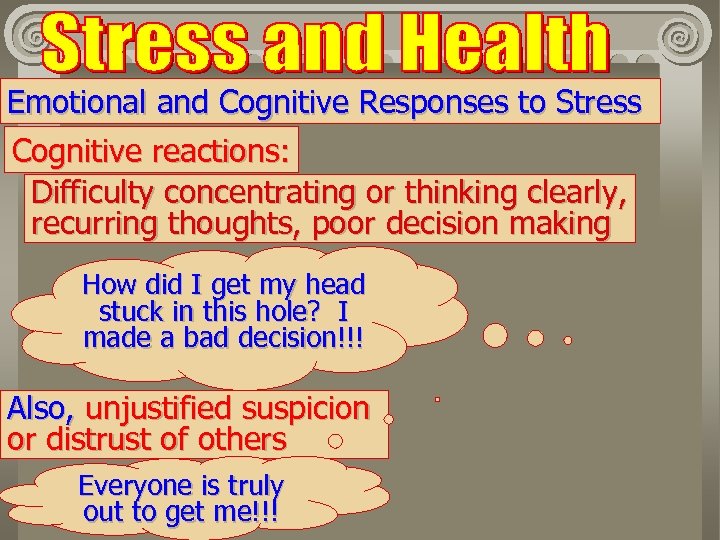
Emotional and Cognitive Responses to Stress Cognitive reactions: Difficulty concentrating or thinking clearly, recurring thoughts, poor decision making How did I get my head stuck in this hole? I made a bad decision!!! Also, unjustified suspicion or distrust of others Everyone is truly out to get me!!!
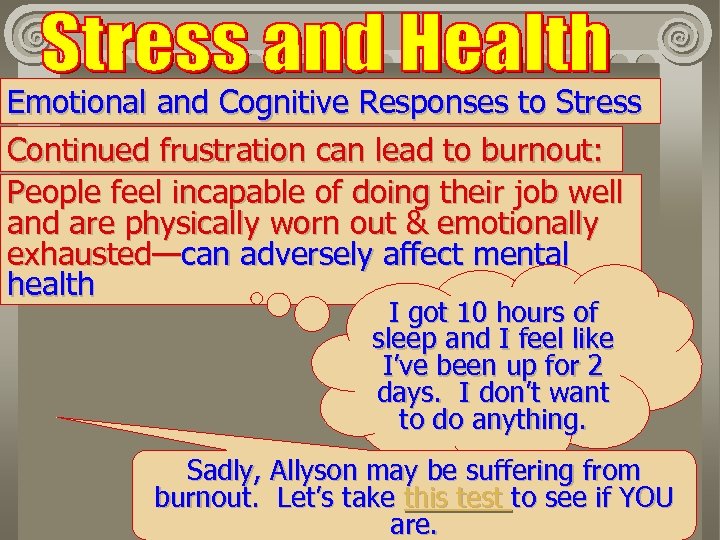
Emotional and Cognitive Responses to Stress Continued frustration can lead to burnout: People feel incapable of doing their job well and are physically worn out & emotionally exhausted—can adversely affect mental health I got 10 hours of sleep and I feel like I’ve been up for 2 days. I don’t want to do anything. Sadly, Allyson may be suffering from burnout. Let’s take this test to see if YOU are.
An individual’s personality make him or her more vulnerable to stress Type A personalities Very likely to have coronary artery disease, followed, often, by heart attacks (sometimes in the 30 s or 40 s in males) Type A: chronic state of stress—almost constant flow of adrenalin into the bloodstream
Type A Personality Adrenalin interacts with cholesterol and other chemical agents to block the coronary arteries
Type A People Always ready for fight or flight Much free-floating hostility— anger with no real object or focus Very irritable Any kind of delay is a cause for great irritation Always seem to be struggling Achievement-oriented
Opposite of a Type A is a Type B Personality Less competitive, more easygoing Let’s take a test to see if you are Type A
Coping with Stress I’m a mellow Type B. John, you are a good—and mellow— womb-mate. Cognitive appraisal is our interpretation of an event or potential event and helps the stress impact of that event. Hey, don’t I look Why am I so mellow—rarely suffering from stress? Well, one thing I do is use strong cognitive appraisal skills.
Coping with Stress So, Rachel, what are they? Hey, Kellsey, note this super relaxed and sanguine look on my face. What I use are defense mechanisms like denial or intellectualization. They really help me calm down. Jessica, I do cognitive appraisal, but I’m a hecka Type A. What can I do to cope with stress?
Coping with Stress Ladies, as Sergeant Edlao used to tell Simoncini, let me ‘splain. Denial is a coping mechanism in which a person decides that the event is not really a stressor. Intellectualization is a coping mechanism in which the person analyzes a situation from an emotionally detached viewpoint. Both are defense mechanisms and they do lower physical reactions to stress, though they may not be totally healthy psychologically.
Coping with Stress Those coping mechanisms are OK, Rachel; but there are better ones, called active coping strategies. Here are some. 1. Stress journal—focus on intense emotional experiences and “autopsy” them to try to understand why they affected you the way they did. Reread and think over what you wrote. 2. Stress-inoculation—rehearse everyday situations you find stressful. Think through (war game) how you would handle the situation.
Coping with Stress 3. Put things in perspective: “What was bothering you one year ago today? ” Is this situation all that bad? Rate situation on scale of 1 to 10—world-wide catastrophe = 10. 4. Sublimation—redirection of negative feelings into positive action. Example: long run or hitting a punching bag.
4. Sublimation—redirection of negative feelings into positive action. Another example
5. Religiosity: “It’s God’s will. ” 6. Humor 7. Altruism
Top 10 Stress Busters 1. Strive for balance 2. Get the facts 3. Talk with someone you trust 4. Exercise 5. Write in a journal 6. Take care of yourself— sleep, limit use of salt, sugar, & caffeine.
Top 10 Stress Busters 7. Set priorities 8. Help others 9. Cultivate hobbies 10. Master a form of relaxation a. Progressive relaxation b. Visualization (guided imagery) c. Meditation
Body-Centered Relaxation Breathing Exercises Progressive Muscle Relaxation
Body-Centered Relaxation Massage Aromatherapy Yoga
Mindfulness Activities Meditation Humor Therapy Music Therapy
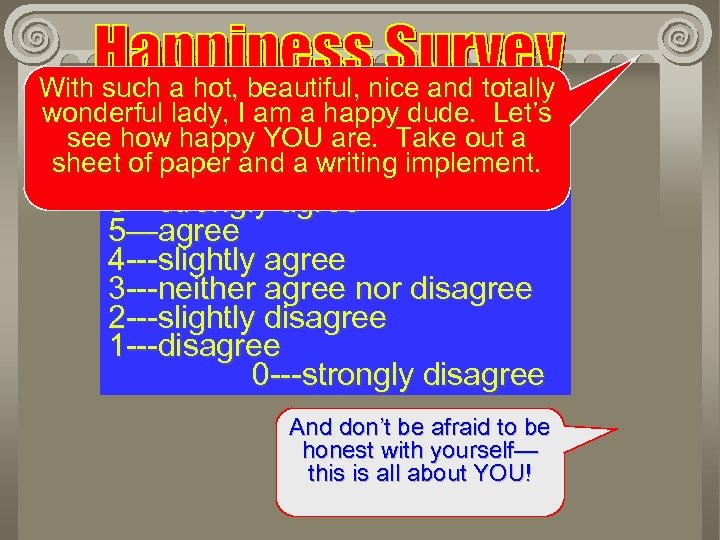
With such a hot, beautiful, nice and totally wonderful each Iof thehappy dude. Let’s For lady, am a 15 statements seethat will appear, are. Take out a how happy YOU select an sheet of paper and the following scale: answer from a writing implement. 6—strongly agree 5—agree 4 ---slightly agree 3 ---neither agree nor disagree 2 ---slightly disagree 1 ---disagree 0 ---strongly disagree And don’t be afraid to be honest with yourself— this is all about YOU!
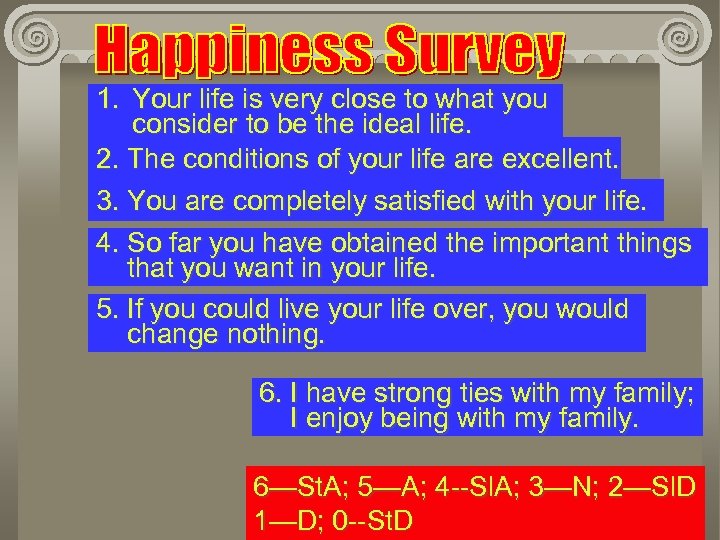
1. Your life is very close to what you consider to be the ideal life. 2. The conditions of your life are excellent. 3. You are completely satisfied with your life. 4. So far you have obtained the important things that you want in your life. 5. If you could live your life over, you would change nothing. 6. I have strong ties with my family; I enjoy being with my family. 6—St. A; 5—A; 4 --Sl. A; 3—N; 2—Sl. D 1—D; 0 --St. D
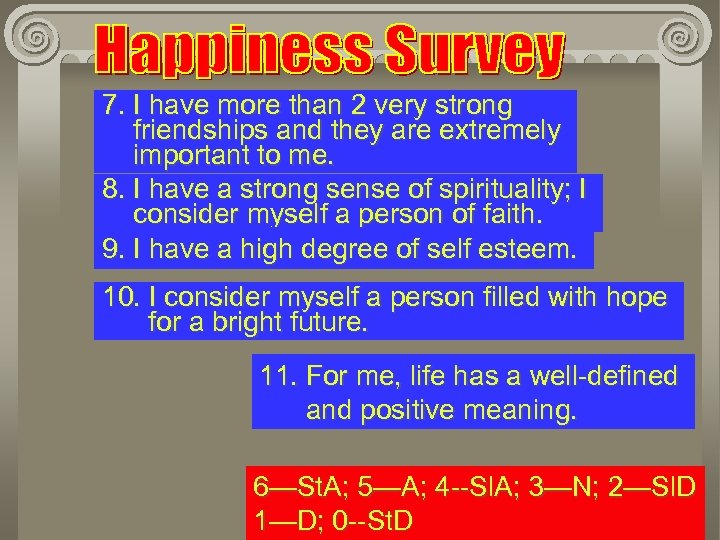
7. I have more than 2 very strong friendships and they are extremely important to me. 8. I have a strong sense of spirituality; I consider myself a person of faith. 9. I have a high degree of self esteem. 10. I consider myself a person filled with hope for a bright future. 11. For me, life has a well-defined and positive meaning. 6—St. A; 5—A; 4 --Sl. A; 3—N; 2—Sl. D 1—D; 0 --St. D
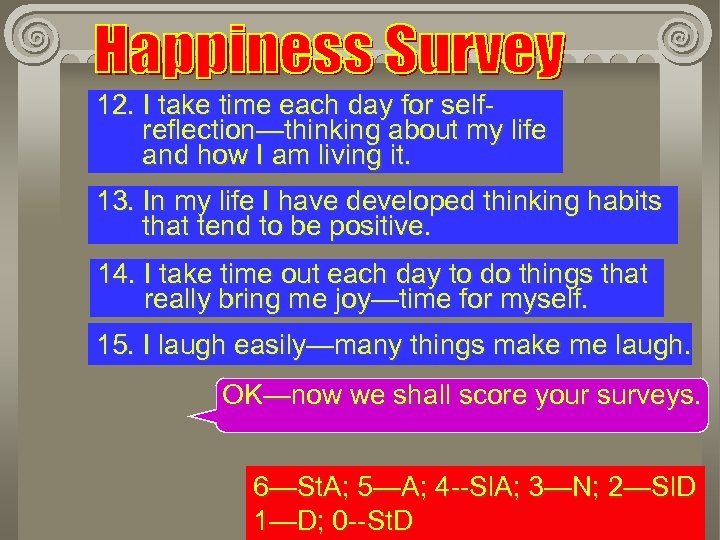
12. I take time each day for selfreflection—thinking about my life and how I am living it. 13. In my life I have developed thinking habits that tend to be positive. 14. I take time out each day to do things that really bring me joy—time for myself. 15. I laugh easily—many things make me laugh. OK—now we shall score your surveys. 6—St. A; 5—A; 4 --Sl. A; 3—N; 2—Sl. D 1—D; 0 --St. D
No horsing around: add up your scores.
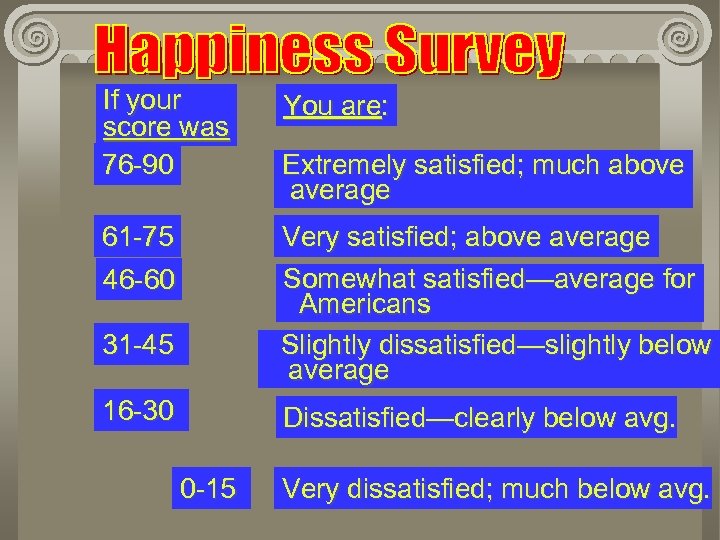
If your score was 76 -90 61 -75 46 -60 You are: Extremely satisfied; much above average Very satisfied; above average Somewhat satisfied—average for Americans Slightly dissatisfied—slightly below average 31 -45 16 -30 Dissatisfied—clearly below avg. 0 -15 Very dissatisfied; much below avg.
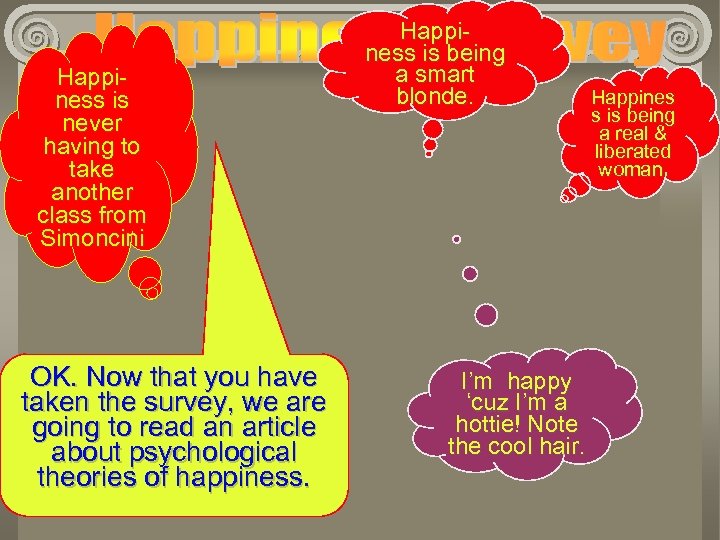
Happiness is never having to take another class from Simoncini OK. Now that you have taken the survey, we are going to read an article about psychological theories of happiness. Happiness is being a smart blonde. I’m happy ‘cuz I’m a hottie! Note the cool hair. Happines s is being a real & liberated woman.
Скачать презентацию Subjective feeling provoked by real or imagined objects
8cae9173c64f7587a5a35a466962df6e.ppt