 Скачать презентацию Subject: Thermoregulation. Plan: ► Concept about isothermies, thermoregulation
10- Питание. Терморегуляция.ppt
- Количество слайдов: 16



Subject: Thermoregulation. Plan: ► Concept about isothermies, thermoregulation types. ► Heat generation – a chemical thermoregulation. ► Thermolysis – a physical thermoregulation. ► Isothermie regulation.
Thermoregulation Isothermie – constancy of body temperature and internal medium of an organism. The isothermie is one of the most important indicators of a homeostasis Constancy of body temperature is provided with the functional system including a series of organs producing heat, and the structures providing a thermolysis, and also the mechanisms regulating their activity.
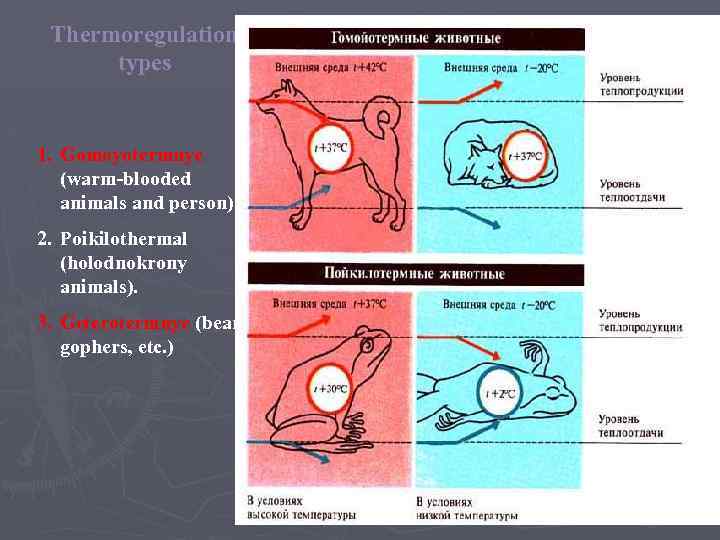
Thermoregulation types 1. Gomoyotermnye (warm-blooded animals and person) 2. Poikilothermal (holodnokrony animals). 3. Geterotermnye (bears, gophers, etc. )
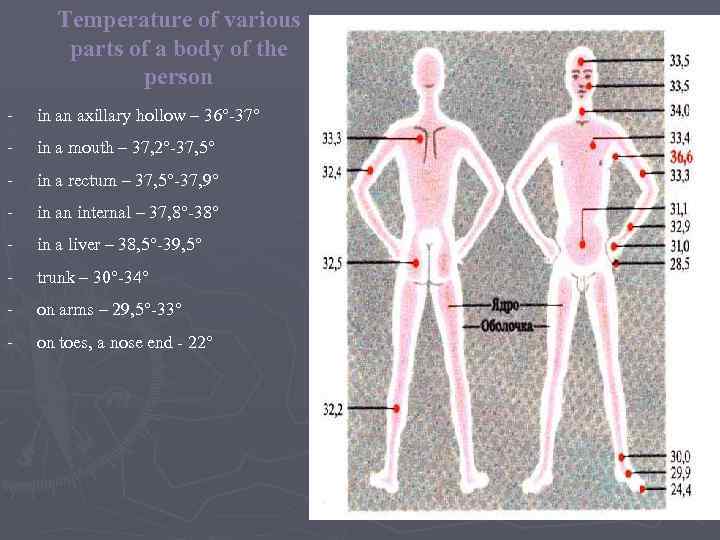
Temperature of various parts of a body of the person - in an axillary hollow – 36°-37° - in a mouth – 37, 2°-37, 5° - in a rectum – 37, 5°-37, 9° - in an internal – 37, 8°-38° - in a liver – 38, 5°-39, 5° - trunk – 30°-34° - on arms – 29, 5°-33° - on toes, a nose end - 22°
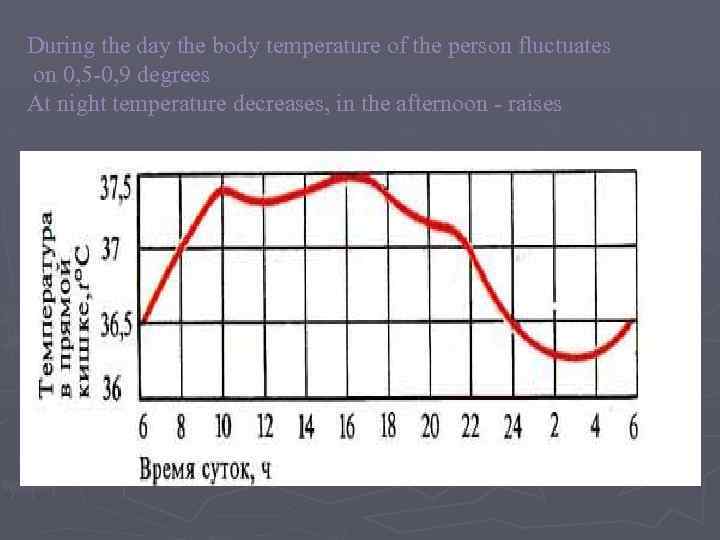
During the day the body temperature of the person fluctuates on 0, 5 -0, 9 degrees At night temperature decreases, in the afternoon - raises
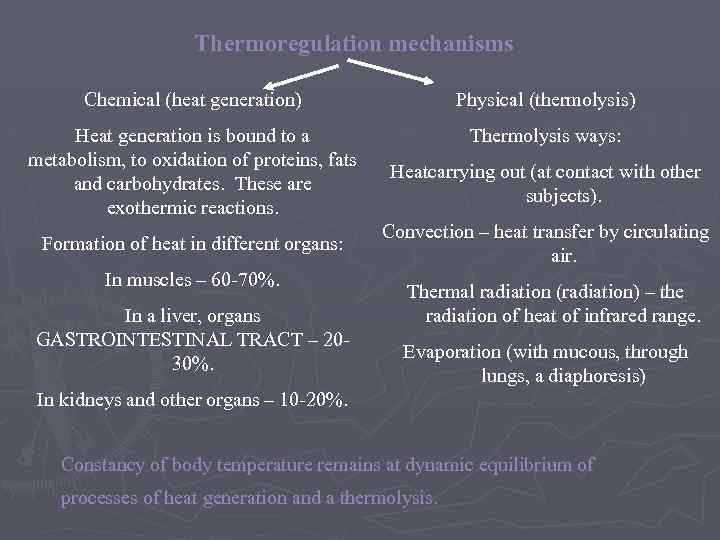
Thermoregulation mechanisms Chemical (heat generation) Physical (thermolysis) Heat generation is bound to a metabolism, to oxidation of proteins, fats and carbohydrates. These are exothermic reactions. Thermolysis ways: Formation of heat in different organs: In muscles – 60 -70%. In a liver, organs GASTROINTESTINAL TRACT – 2030%. Heatcarrying out (at contact with other subjects). Convection – heat transfer by circulating air. Thermal radiation (radiation) – the radiation of heat of infrared range. Evaporation (with mucous, through lungs, a diaphoresis) In kidneys and other organs – 10 -20%. Constancy of body temperature remains at dynamic equilibrium of processes of heat generation and a thermolysis.

Isothermie regulation Thermoreceptors: 1. Peripheric (skin, mucous, organs GASTROINTESTINAL TRACT). - holodovy receptors (flasks to Krauza) - thermal receptors (Ruffini's little body) 2. Central (the hypothalamus, a mesencephalon, a cortex of larger hemispheres) Forward cores of a hypothalamus supervise a physical thermoregulation. Back cores of a hypothalamus supervise a chemical thermoregulation.
The humoral regulation is carried out by Zh. VS hormones (thyroid, a pituitary body, adrenals, sexual glands). Hormones: AKTG, Somatotropinum, thyroxine, adrenaline, Noradrenalinum, sexual hormones.
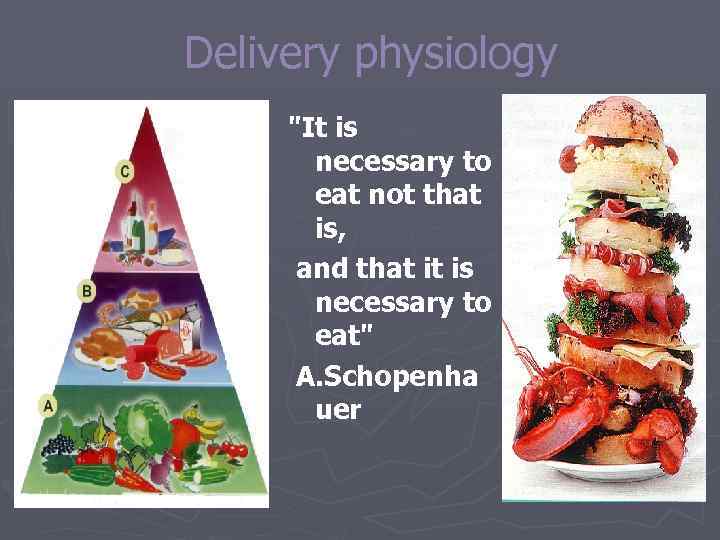
Delivery physiology "It is necessary to eat not that is, and that it is necessary to eat" A. Schopenha uer
►The nutrition consists of many components, proteins, fats, carbohydrates, macro - and trace substances, vitamins, фитонцидов and alimentary fibers. ►The rational delivery is a delivery which satisfies energy, plastic and other needs of an organism and provides necessary level of an exchange.
► Main components of a balanced diet: 1) Balance: - on nutrients (B: Zh: U) - on H 2 O - on mikroro-and to macrocells - on vitamins - 2) Diet (frequency rate of meal – 4 -5 times per day, инервалы, distribution of quantity of nutrition and calories to each reception. ) 3) Power balance (A metabolic cost of an organism at various intensity of a physical activity)
Daily physiological norms of feedstuffs for adult population: ► protein-80 -100 g squirrel ► (not mey 1 g of protein on 1 kg of mass of a body), including % animal protein-55. Children at the age of 1 -12 years have 1, 5 g/kg of mass of a body per day. At pregnancy – 3 -4 g/kg of mass of a body per day). ► Lipidy-80 -100 g. (50 -60% animal fat, 30 -40% vegetable) ► Uglevody-400 -500 g. (from them 75% Amylum, 20%-Saccharum, 3% - pectinaceous вещетва, 2% - a fat) ► Ratio of proteins, fats and carbohydrates: B: Zh: U-1: 1: 4, 6
Alimentary fibers – immediately aren't exposed to digestion, have no power value, but play an important role in digestion. ► Form gel structures of alimentary masses. ► Promote depletion of a stomach, an intestine. ► Regulate the GASTROINTESTINAL TRACT motor function. ► Promote removal from an organism of toxins and serious metals. ► Are very vitamin-rich. ► Prevent development of an atherosclerosis, a diabetes mellitus, etc. Alimentary fibers – contain in the basic in vegetables, bean, fruit and crude grain
Life water source ► Water – is the main component of nutrition. In an organism of the adult makes 65% of mass. ► Daily requirement of 35 -40 ml on 1 kg of weight, or 2 – 2, 5 liters from them: 1, 5 in nutrition and 1 liter water, juice, etc.
► Vitamins – are biological катализаторми, provide economic and correct use of nutrients.
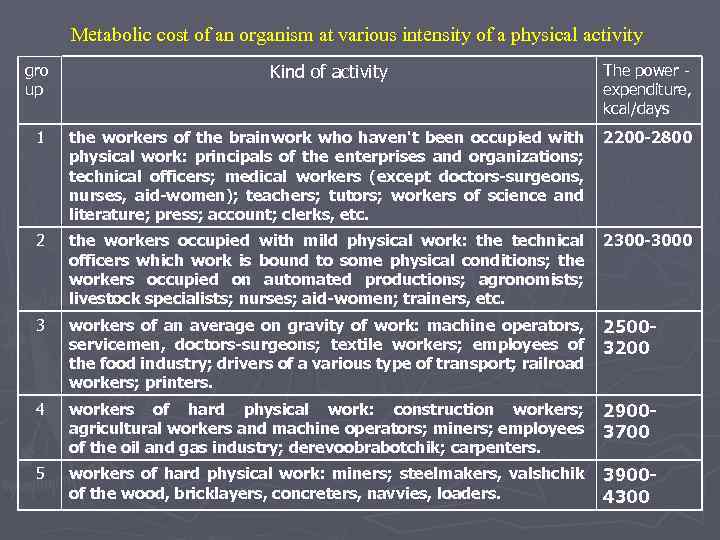
Metabolic cost of an organism at various intensity of a physical activity gro up Kind of activity The power expenditure, kcal/days 1 the workers of the brainwork who haven't been occupied with physical work: principals of the enterprises and organizations; technical officers; medical workers (except doctors-surgeons, nurses, aid-women); teachers; tutors; workers of science and literature; press; account; clerks, etc. 2200 -2800 2 the workers occupied with mild physical work: the technical officers which work is bound to some physical conditions; the workers occupied on automated productions; agronomists; livestock specialists; nurses; aid-women; trainers, etc. 2300 -3000 3 workers of an average on gravity of work: machine operators, servicemen, doctors-surgeons; textile workers; employees of the food industry; drivers of a various type of transport; railroad workers; printers. 25003200 4 workers of hard physical work: construction workers; agricultural workers and machine operators; miners; employees of the oil and gas industry; derevoobrabotchik; carpenters. 29003700 5 workers of hard physical work: miners; steelmakers, valshchik of the wood, bricklayers, concreters, navvies, loaders. 39004300
Скачать презентацию Subject: Thermoregulation. Plan: ► Concept about isothermies, thermoregulation
10- Питание. Терморегуляция.ppt